

LLM citations are the links an AI engine like ChatGPT or Gemini shows as sources in its answer. A citation puts a website in front of the person asking, at the moment they decide what to buy. For a small website, it can be the only way into an answer that big publishers usually own.
To find out which websites get those citations, I ran 150 commercial “best X for Y” searches through ChatGPT and Gemini between June 25 and June 27, 2026. 100 searches came from a beverage niche. The other 50 came from protein powder, like “best protein powder for women” and “best whey isolate protein powder.” ChatGPT ran GPT-4o with web search turned on, and Gemini ran Gemini 2.5 Flash.
That gave me 2,128 citations across 680 websites. For each website, I pulled its Domain Rating (DR) from Ahrefs, plus referring domains and harmonic centrality from Rankavi’s database.
The key findings:
- Websites under DR 20 won 48% of ChatGPT’s citations. Half of its cited pages came from websites with DR 22 or lower.
- 119 of the 231 websites ChatGPT cited had a DR under 20.
- Gemini cited more established websites. Its cited pages had a median DR of 55, and 18% of its citations went to websites under DR 20.
- Gemini cited 7.1 websites per answer, ChatGPT 3.3. Only 60 of 680 websites were cited by both.
- In June, ChatGPT ran one search per answer and used the keyword exactly as written.
How did I run the LLM citation study?
I ran the LLM citation study on 150 “best X for Y” searches across two niches:
- 100 searches in a beverage niche, from broad terms to specific ones.
- 50 protein powder searches, like “best protein powder for weight loss,” “best vegan protein powder,” and “best protein powder for diabetics.”
- Every search went to ChatGPT (GPT-4o, web search on) and Gemini (Gemini 2.5 Flash) through their APIs, logged out and with no chat history.
- ChatGPT’s searches ran on June 26 and 27, 2026. Gemini’s ran on June 25 and 27.
- Subdomains are merged into their main domain, so
ods.od.nih.govcounts asnih.gov. - DR, referring domains, and harmonic centrality leave out Google’s own links and social platforms like YouTube, Reddit, and Facebook. Their near-perfect scores would skew the numbers.
Domain Rating comes from Ahrefs. Referring domains and harmonic centrality come from Rankavi’s link tracker.
How many websites do ChatGPT and Gemini cite in niche searches?
Gemini cited about twice as many websites as ChatGPT in niche searches. One Gemini answer cited 7.1 different websites on average, and one ChatGPT answer cited 3.3.
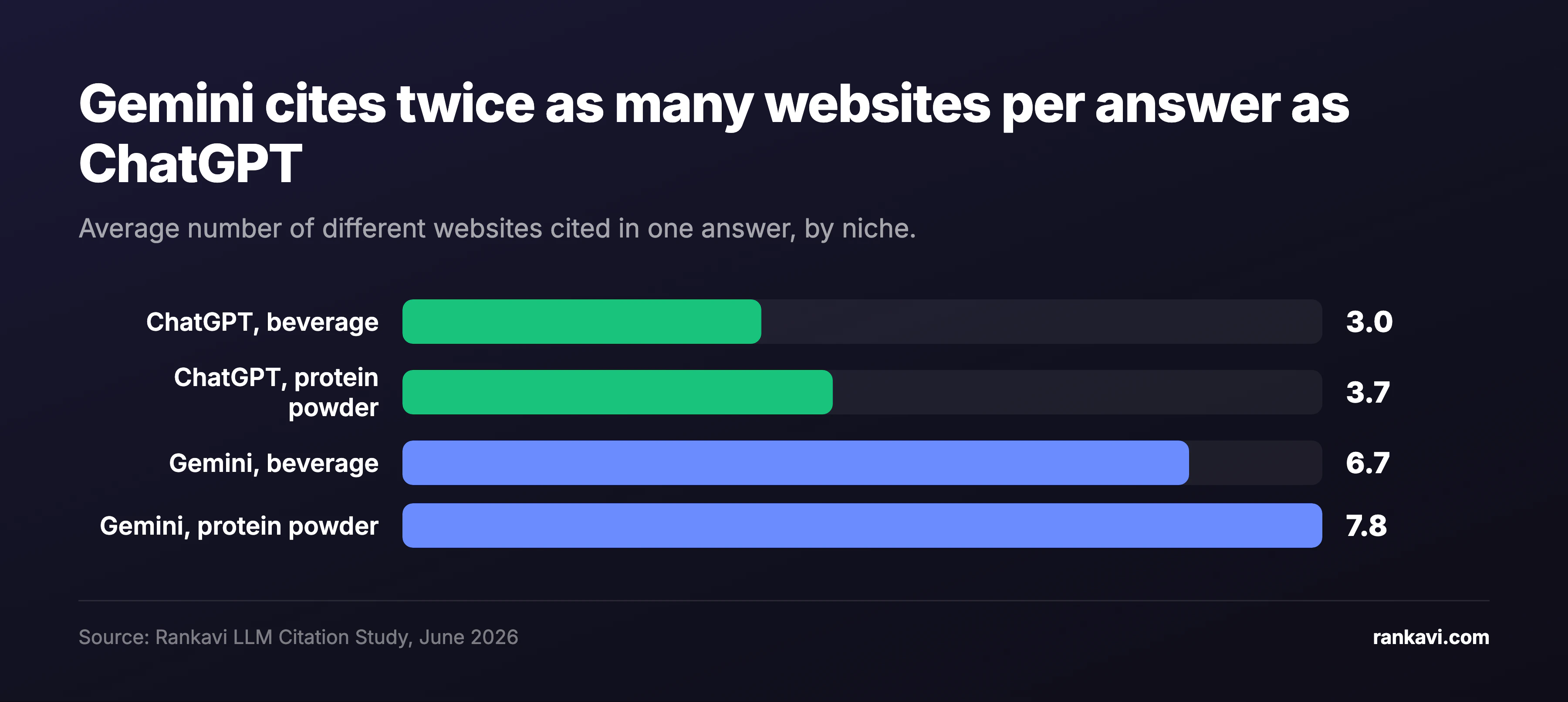
Protein powder answers cited more websites than beverage answers on both engines. ChatGPT cited 3.7 websites per protein powder answer and 3.1 per beverage answer. Gemini cited 7.8 and 6.7.
Across all 150 searches, Gemini cited 509 different websites and ChatGPT 231.
Do ChatGPT and Gemini cite the same websites?
No, ChatGPT and Gemini rarely cite the same websites. Of the 680 websites they cited, only 60 were cited by both engines. ChatGPT cited 171 websites that Gemini never cited, and Gemini cited 449 that ChatGPT never cited.
What Domain Rating do websites need to get cited by ChatGPT and Gemini?
Websites don’t need a high Domain Rating to get cited by ChatGPT in niche searches. Websites under DR 20 won 48% of ChatGPT’s citations. Half of its cited pages came from websites with DR 22 or lower.
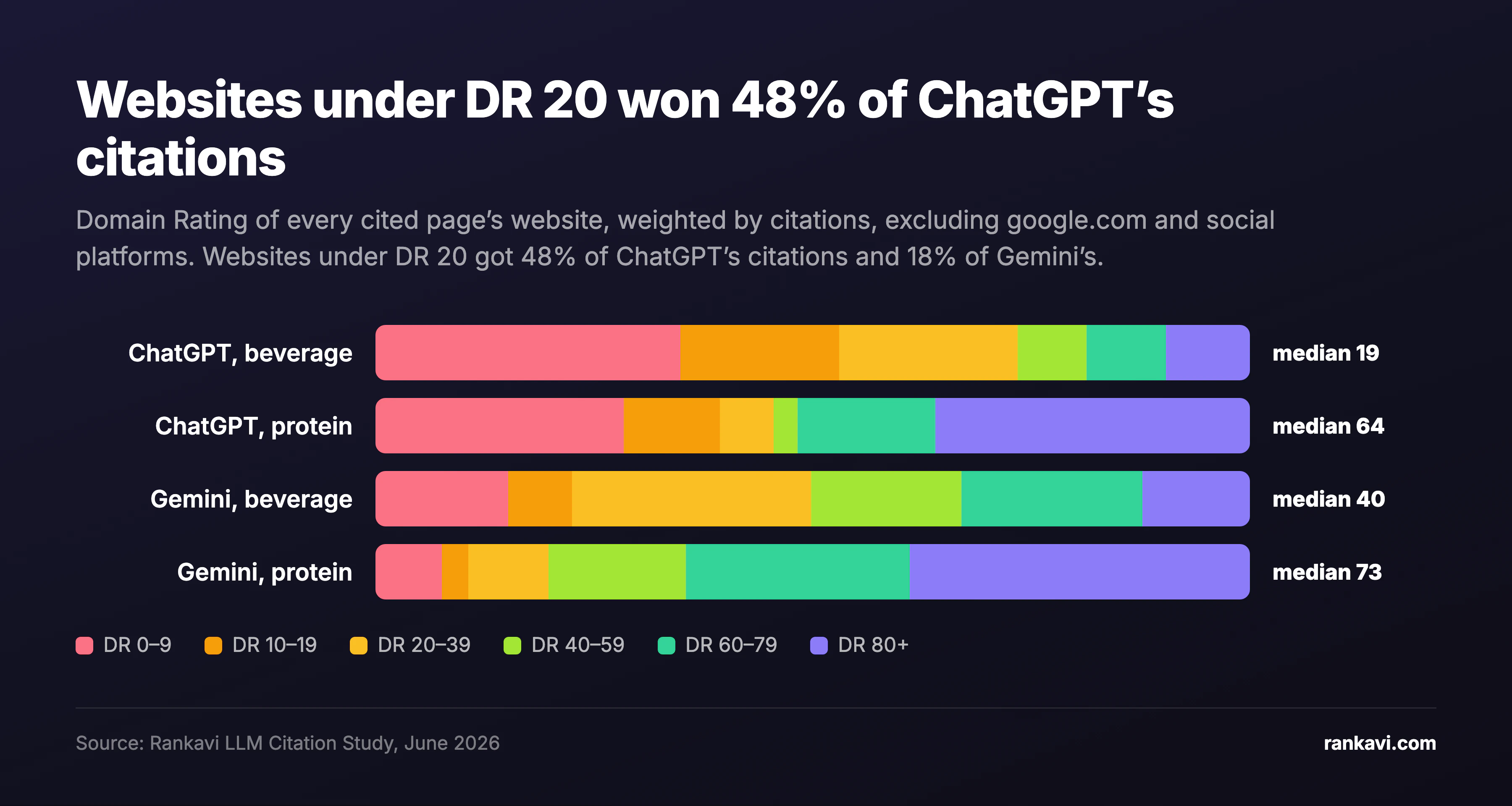
119 of the 231 websites ChatGPT cited had a DR under 20. Even its first citation, the top spot in an answer, came from a website with a median DR of 20.
Gemini cited more established websites. Half of its cited pages came from websites with DR 55 or higher, and 18% of its citations went to websites under DR 20. Still, 143 of the websites it cited were under DR 20, more than ChatGPT cited.
Beverage niche: In the beverage niche, 53% of ChatGPT’s citations went to websites under DR 20. Its cited websites had a median DR of 19. Gemini gave 23% of its beverage citations to websites under DR 20, with a median DR of 40.
Protein powder: In protein powder searches, 39% of ChatGPT’s citations went to websites under DR 20, with a median DR of 64. Gemini gave 11% to websites under DR 20, with a median DR of 73. Big publishers like Healthline and Forbes took more of the protein powder answers.
How many referring domains do cited websites need?
Cited websites don’t need many referring domains either. Half of ChatGPT’s cited pages came from websites with 33 or fewer referring domains. 60% of its citations went to websites with fewer than 100.
Gemini’s cited websites were better linked. Their median was 217 referring domains, and 38% of its citations went to websites with fewer than 100.
Harmonic centrality shows the same split. 64% of ChatGPT’s citations and 56% of Gemini’s went to websites outside the top 1% of the web by centrality. You can measure harmonic centrality for any website with Rankavi’s free checker.
Which websites win protein powder citations?
Health and fitness publishers won the most protein powder citations. ChatGPT cited Healthline in 27 of the 50 protein powder answers, and Forbes and Fit&Well in 15 each. Gemini cited Forbes in 29 answers, Healthline in 28, and Garage Gym Reviews in 17.
Small websites still made the top 10. Four of ChatGPT’s 10 most-cited protein powder websites had a DR under 20, and each appeared in 4 to 8 answers. Gemini’s top 10 included one website under DR 20, cited in 8 answers.
Gemini also cited Men’s Health in 14 protein powder answers and Everyday Health in 10. Both engines cited BarBend. Gemini cited protein brands’ own websites too, like Naked Nutrition in 8 answers.
What fan-out queries did ChatGPT and Gemini run in June?
In June, ChatGPT ran one fan-out query per answer, and it was always the keyword exactly as written. Fan-out queries are the background searches an AI engine runs to gather sources. ChatGPT never used the site: operator, which limits a search to one website.
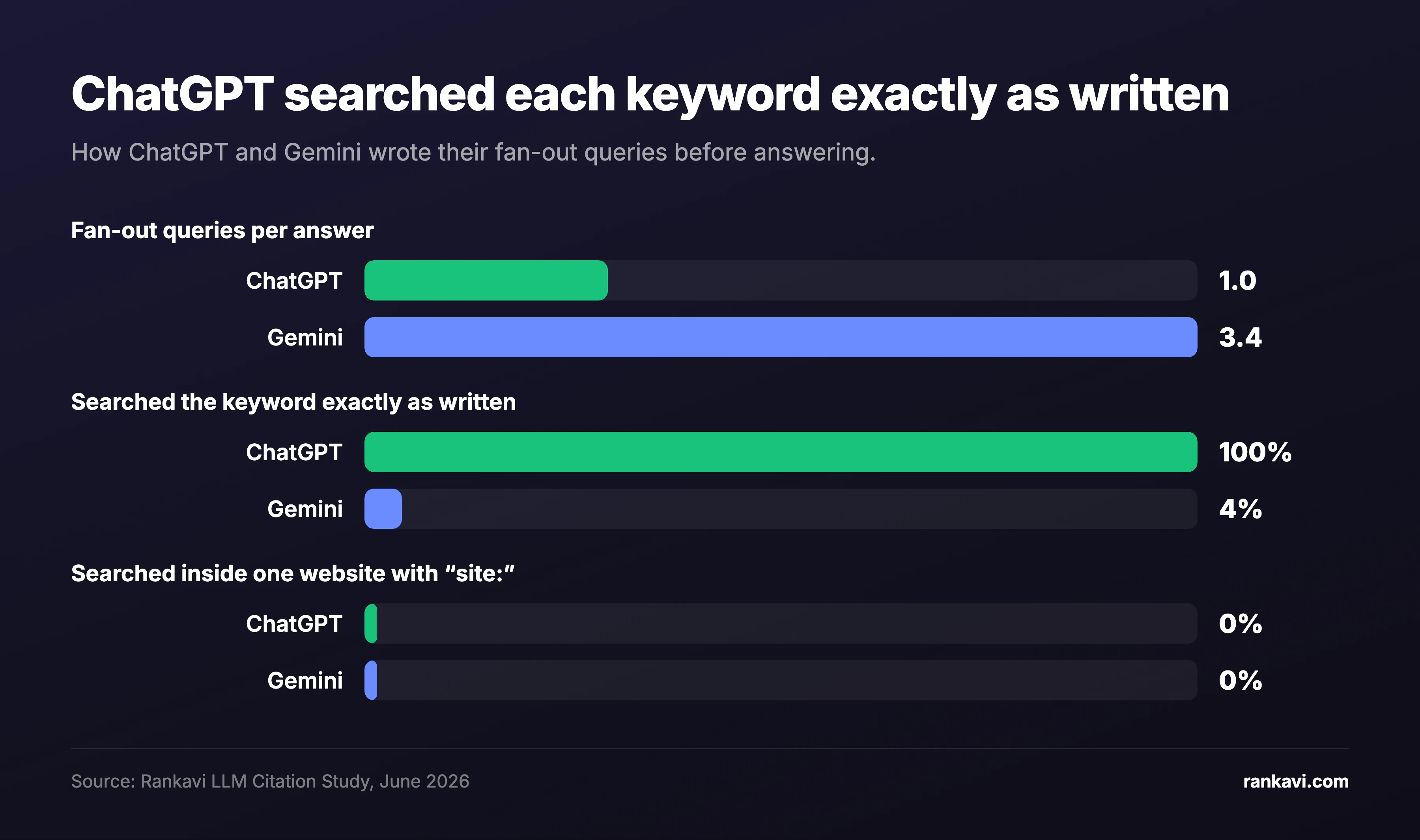
Gemini ran 3.4 fan-out queries per answer and used the exact keyword in only 4% of them. It rewrote each keyword into searches of about 5 words, adding words that point to ratings and reviews.
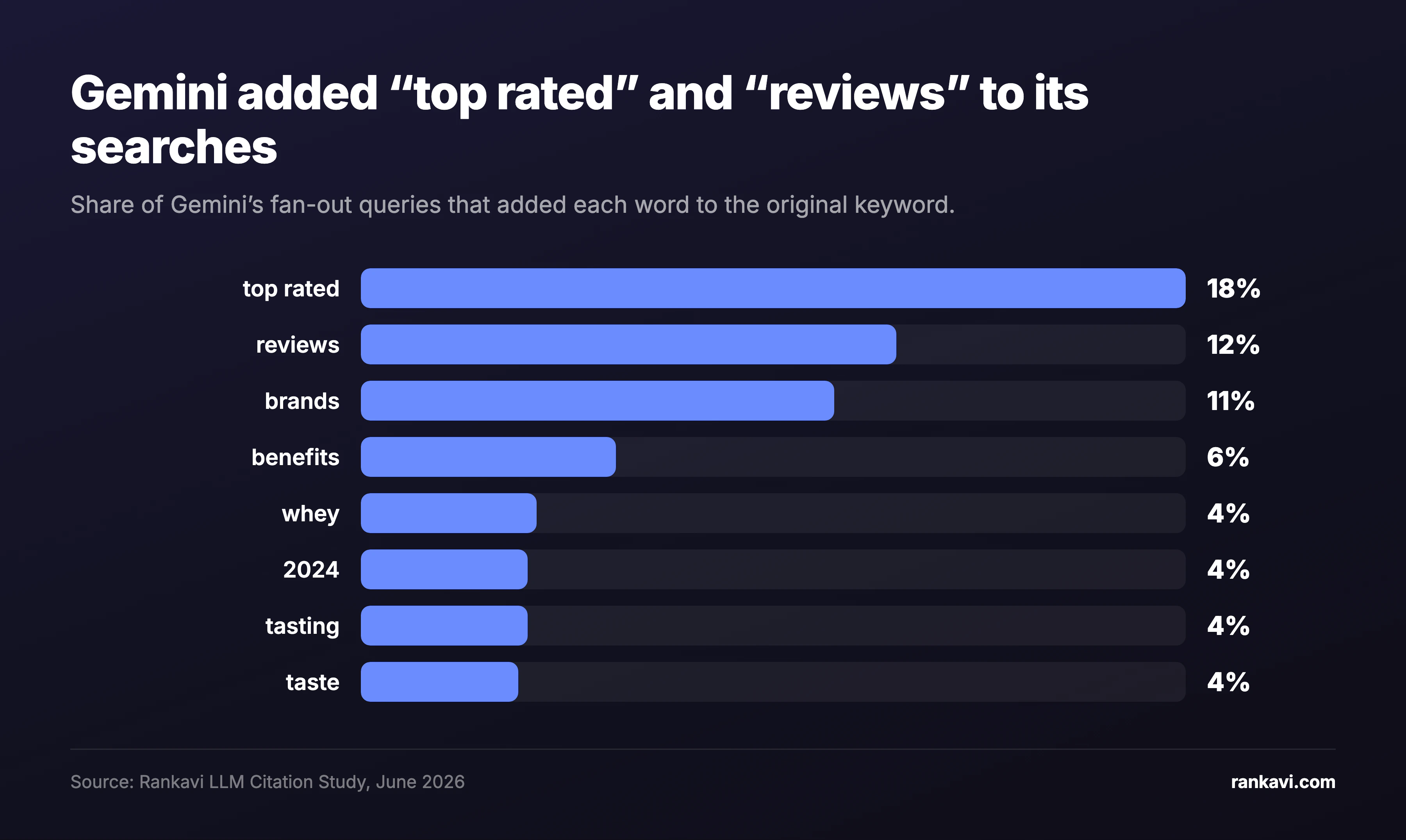
Gemini added “top rated” to 18% of its searches, “reviews” to 12%, and “brands” to 11%. It also added “2024” to 4% of its searches, even though the study ran in 2026. Only 1% of its searches included “2026.”
Why did small websites win so many ChatGPT citations?
Small websites won so many ChatGPT citations most likely because of how ChatGPT searched. It ran one search per answer, using the keyword exactly as written. The results looked like a normal web search, where small niche websites often rank for niche terms.
Gemini searched differently. It rewrote each keyword into 3 to 4 searches with words like “top rated,” “reviews,” and “brands.” Those searches pull in more review publishers and big brand websites, which fits Gemini’s higher median DR of 55.
The niche itself matters too. In the beverage niche, where many small websites cover the same narrow topic, websites under DR 20 won 53% of ChatGPT’s citations. In protein powder, where big health publishers compete for the same searches, that share fell to 39%.
How can small websites get cited by ChatGPT and Gemini?
Small websites can get cited by ChatGPT and Gemini by owning a tight niche and getting listed where both engines search. Based on the data:
- Go deep on one niche. In the beverage niche, websites under DR 20 won 53% of ChatGPT’s citations. Small websites did best where every search stayed inside one topic.
- Target the exact phrasing people search. In June, ChatGPT searched each keyword exactly as written. A page that ranks for “best protein powder for diabetics” had a direct path into that answer.
- Use the words Gemini adds. Gemini added “top rated,” “reviews,” and “brands” to its searches. Pages that cover top-rated picks, reviews, and brand comparisons match those searches.
- Target ChatGPT and Gemini separately. Only 60 of 680 cited websites appeared in both engines. Visibility in one tells you little about the other.
- Get named on the niche websites AI already cites. 119 of ChatGPT’s cited websites had a DR under 20. A mention on a focused niche website can put your brand into answers big publishers never cover.
- Don’t rely on one engine’s habits. ChatGPT and Gemini searched in very different ways, and AI engines change how they search over time. Spread your visibility across niche websites, big publishers, and your own pages.
- Track your visibility more than once. AI engines change how they search, and answers vary between runs. Check your most important searches on each engine regularly, and track how often your brand appears.