

AI search visibility means how often your brand, website, products, or content appear in AI-generated search answers. You gain visibility when AI platforms mention, cite, recommend, or use your information to answer a relevant question. It matters because people now research topics, compare options, and make buying decisions inside AI tools, often before they visit a single website. That exposure builds brand awareness and creates new chances to be discovered.
AI search visibility works when an AI system connects your content with a user’s question and includes your information in its answer. Clear, relevant, and authoritative content that AI systems can discover and interpret gives them a reason to do that. But which websites do AI engines actually cite?
To find out, I ran 200 commercial “best X for Y” searches through ChatGPT, Gemini, Perplexity, and Google on September 30, 2026, and traced every website they cited. I used the models free users get by default: GPT-5.6 Luna in ChatGPT, Gemini 3.6 Flash, and Perplexity’s Sonar. The Google results come from US desktop search, four months after Google’s May 2026 core update and while its September 2026 spam update, which started on September 24, was still rolling out. That gave me 9,259 AI citations across 1,521 websites.
Now, I know the size of this study is not in any shape or form comparable to the large AI visibility studies. Yext analyzed more than 6.8 million citations across 1.6 million responses from Gemini, ChatGPT, and Perplexity. Semrush and Kevin Indig tracked 1,094 categories, 50,000 brands, and 600,000 citations in ChatGPT over six months. Ahrefs studied 75,000 brands to find which factors correlate with visibility in Google’s AI Overviews. My study is far smaller, and it answers a narrower question: which websites do AI engines cite when people search for products to buy?
I looked only at commercial ecommerce keywords. Every keyword follows the short “best X for Y” pattern, like “best running shoes for flat feet.” Keep in mind, though, that real users often type much longer prompts, like “best running shoes for women with wide feet and high arches that run true to size, need almost no break-in, work well on a treadmill, and are on sale under $150 with fast shipping.” A prompt like that would likely trigger more background searches, one per need. It could also pull in detailed reviews, fit guides, and brand product pages instead of “best of” lists. This study covers the short version only. I split the 200 keywords into four types of commercial searches, based on how often people buy the product: consumables like coffee and supplements, semi-durables like running shoes and cookware, durables like mattresses and appliances, and occasional or gift purchases like jewelry. That let me compare how many citations each type of search got, and which websites each type favored.
For every website the AI engines cited, I then pulled its link profile: Domain Rating (DR) from Ahrefs, plus harmonic centrality, PageRank, referring domains, and outgoing links from Rankavi’s database. I compared the cited websites with each other, and with websites that rank in Google’s top 10 but no AI engine cited. The result shows how many sources each engine cites, which websites they trust, what types of pages they pick, and whether backlinks and authority metrics predict an AI citation.
The key findings:
- Perplexity cited 8.8 websites per answer, Gemini 7.4, Google’s AI Overviews 5.9, and ChatGPT only 2.6.
- Only 40 websites were cited by all three chat engines. Most sites that one engine trusts, the others never cite.
- “Best of” listicles made up 89% of Perplexity’s citations and 48% of ChatGPT’s.
- AI engines mostly cite high-authority websites. The median cited page came from a DR 84 website in ChatGPT and DR 87 in Perplexity.
- AI-cited websites were twice as likely to have DR 80+ as websites that ranked on Google but that no AI engine cited.
- 85% of all citations to websites under DR 20 came from Gemini, making it the engine most open to small websites.
- Most AI citations don’t come from Google’s top 10. Only 15% of ChatGPT’s cited websites ranked on page one for the same search.
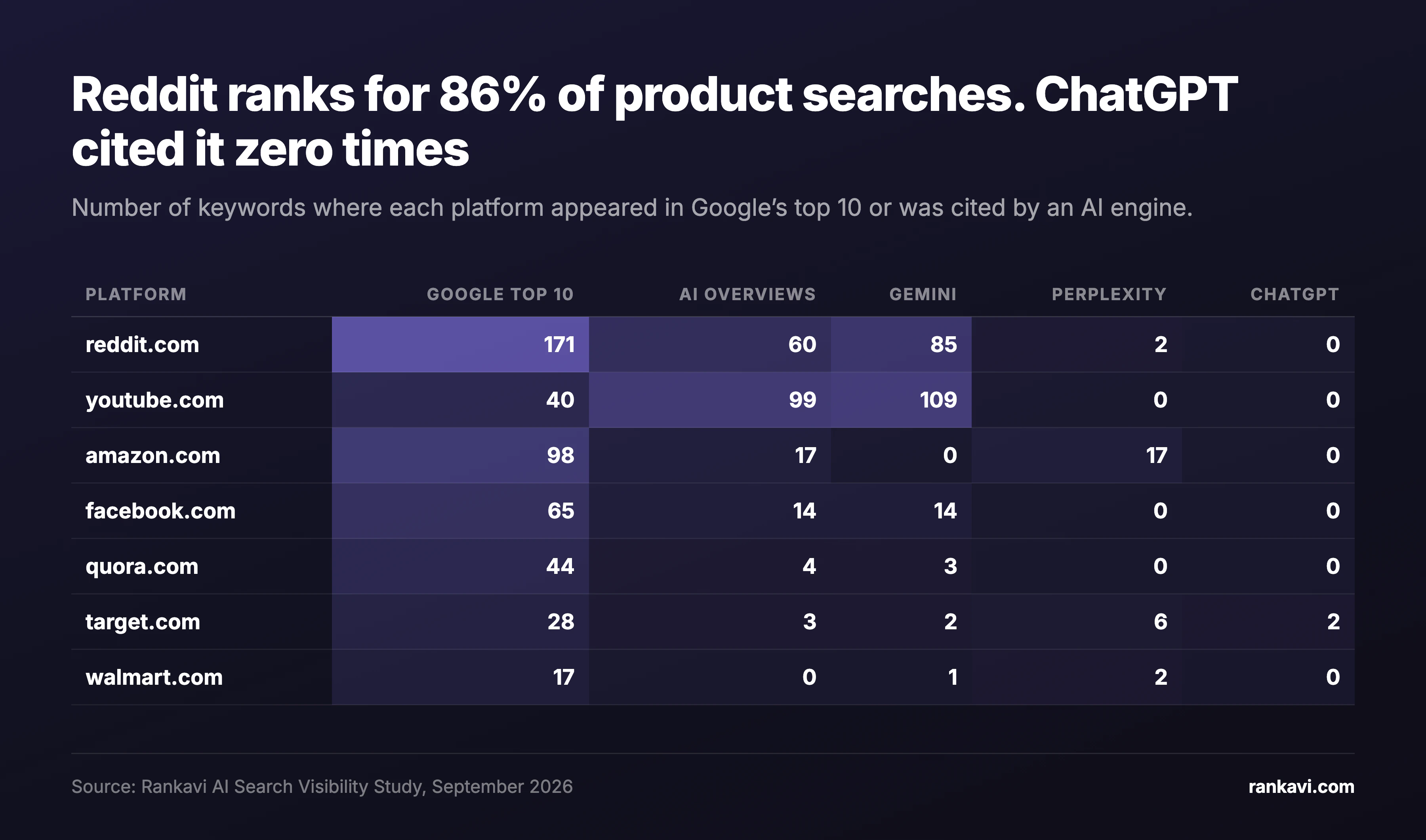
- Reddit ranked in Google’s top 10 for 171 of the 200 searches, but ChatGPT didn’t cite it once.
- Google showed an AI Overview on 171 of the 200 product searches (86%).
- Half of ChatGPT’s searches used the
site:operator to look inside one specific website.
How did I run the AI search visibility study?
I ran the AI search visibility study on 200 “best X for Y” keywords across ChatGPT, Gemini, Perplexity, and Google. I split the 200 keywords into 12 segments, three for each store type:
| Store type | Segments (keywords) | Example keyword |
|---|---|---|
| Consumables | Coffee, tea & drinks (17), supplements & nutrition (17), skincare, personal care & pet (16) | best magnesium for sleep |
| Semi-durables | Running shoes & apparel (17), kitchen cookware & tools (17), outdoor, travel & home textiles (16) | best cast iron skillet for beginners |
| Durables | Mattresses, furniture & bedroom (17), home & kitchen appliances (17), electronics, fitness & mobility (16) | best air purifier for allergies |
| Occasional & gifts | Jewelry & watches (17), gifts & special occasions (17), fragrance, gift sets & home decor (16) | best gifts for new moms |
I sent every keyword to each source once, on September 30, 2026:
| Source | Model or setup |
|---|---|
| ChatGPT | gpt-5.6-luna, the model free ChatGPT users get, with web search on |
| Gemini | gemini-3.6-flash, with Google Search grounding on |
| Perplexity | sonar, Perplexity’s default model |
| US desktop search results, top 10, with the AI Overview | |
| All AI engines | Answers up to 2,048 tokens, one run per keyword, no repeats |
How I counted citations:
- A citation is every linked source in an answer. “Websites per answer” counts each website once per answer.
- Subdomains are merged into their main domain, so
ods.od.nih.govcounts asnih.gov. - Google’s links to its own google.com pages inside AI Overviews are left out of the rankings.
- Page types come from URL and title patterns. For example, “best” in the URL or title marks a listicle, and
/products/marks a product page. - A cited website “ranks on Google” if it appears anywhere in the top 10 for the same keyword.
- The comparison group is the 471 websites that ranked in Google’s top 10 for at least one keyword, but that no AI engine cited.
Domain Rating comes from Ahrefs. Harmonic centrality, PageRank, referring domains, and outgoing links come from Rankavi’s link tracker.
How many sources does each AI engine cite?
The number of sources each AI engine cites varies widely. Perplexity cites the most websites per answer, and ChatGPT cites the fewest. On average, one Perplexity answer cited 8.8 different websites, compared with 7.4 for Gemini, 5.9 for Google’s AI Overviews, and 2.6 for ChatGPT.
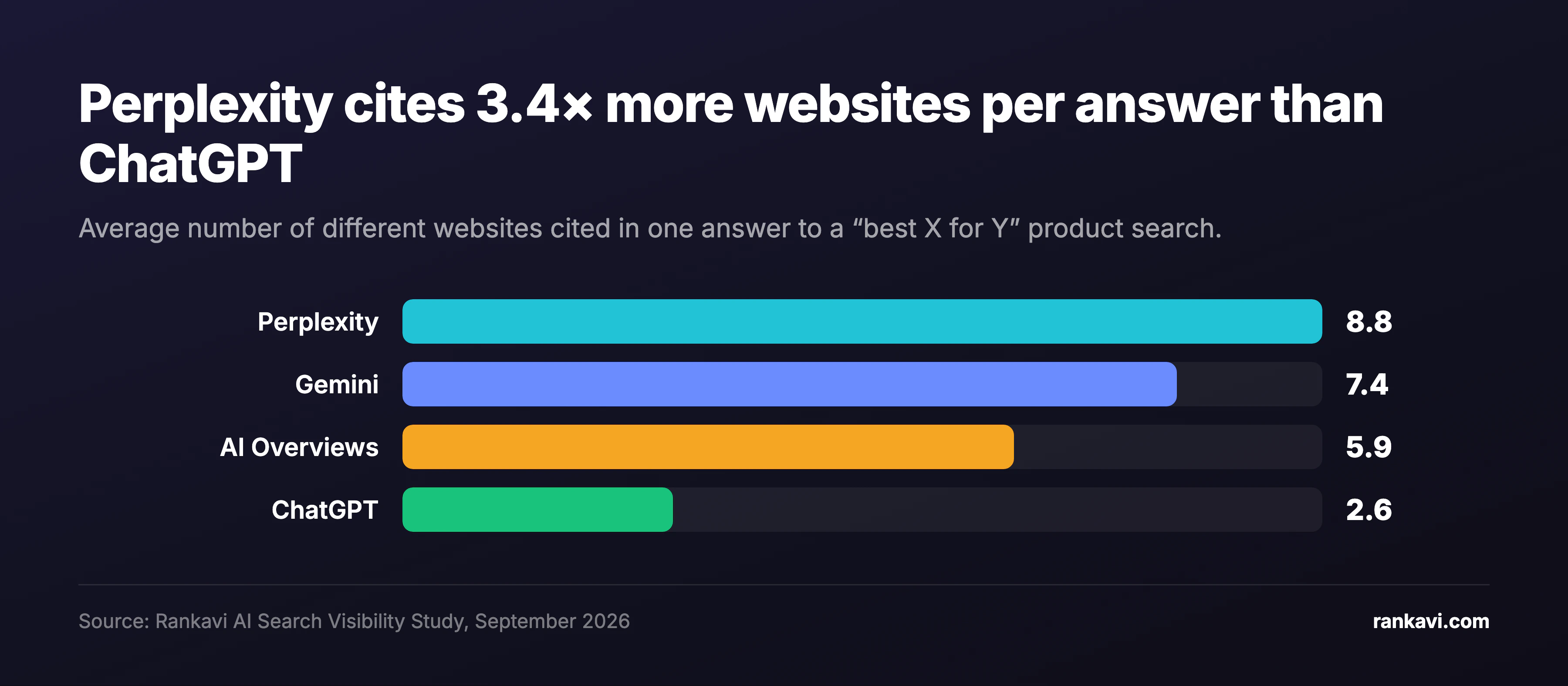
Across all 200 keywords, Gemini cited 756 different websites. Perplexity cited 468, AI Overviews 421, and ChatGPT only 313.
Most of those websites showed up only once. 84% of the websites Gemini cited appeared for just one keyword. So did 81% for AI Overviews, 78% for ChatGPT, and 58% for Perplexity. Each engine has a small group of favorites it cites again and again, and a long tail it cites once.
ChatGPT cited the fewest websites, but not because it found fewer. Before answering, it ran 3 to 4 web searches, and each search returned a list of websites. Its final answer cited only 2 or 3 of them. Most websites it found never got cited.
These counts come from one canonical phrasing, “best X for Y,” not long-tail prompts or questions. The wording of a prompt can change which sources an engine pulls in, and how many. “Find me the best X for Y” asks for a search. “What are the best X for Y according to reviews?” points the engine at review websites. “Find me what people say online about the best X for Y” points it at forums and communities. Each version would likely bring back a different number and type of sources.
Do AI engines recommend brands from the pages they cite?
Yes, AI engines mostly recommend brands from the pages they cite. I listed every brand each engine recommended, then checked the pages it cited in that same answer. A Gemini answer named 6.5 brands on average. ChatGPT and AI Overviews named 3.6, and Perplexity named 1.7.
95% of the brands Perplexity recommended appeared on a third-party page it cited. That share was 73% for Gemini, 69% for AI Overviews, and 63% for ChatGPT.
| Engine | Brands per answer | On a cited third-party page | Only on the brand’s own site | From Google Shopping | On no cited page |
|---|---|---|---|---|---|
| Perplexity | 1.7 | 95% | 0% | n/a | 5% |
| Gemini | 6.5 | 73% | 1% | n/a | 26% |
| AI Overviews | 3.6 | 69% | 2% | 15% | 14% |
| ChatGPT | 3.6 | 63% | 8% | n/a | 29% |
The rest did not come from a cited third-party page. AI Overviews took 15% of its brands from Google Shopping product cards. ChatGPT found 8% only on the brand’s own website. Another 29% of ChatGPT’s brands appeared on none of its cited pages. Those most likely came from the model’s training data.
Store type changed the picture most for ChatGPT. For consumables like supplements and coffee, only 32% of its brands appeared on a cited third-party page. For semi-durables like running shoes and cookware, that share rose to 89%.
Do ChatGPT, Gemini, and Perplexity cite the same websites?
No, ChatGPT, Gemini, and Perplexity rarely cite the same websites. All three chat engines answered the same keywords, yet only 40 websites were cited by all three. That is 40 out of the 1,304 websites they cited in total. Gemini cited 598 websites that neither ChatGPT nor Perplexity cited, and Perplexity cited 295 of its own.
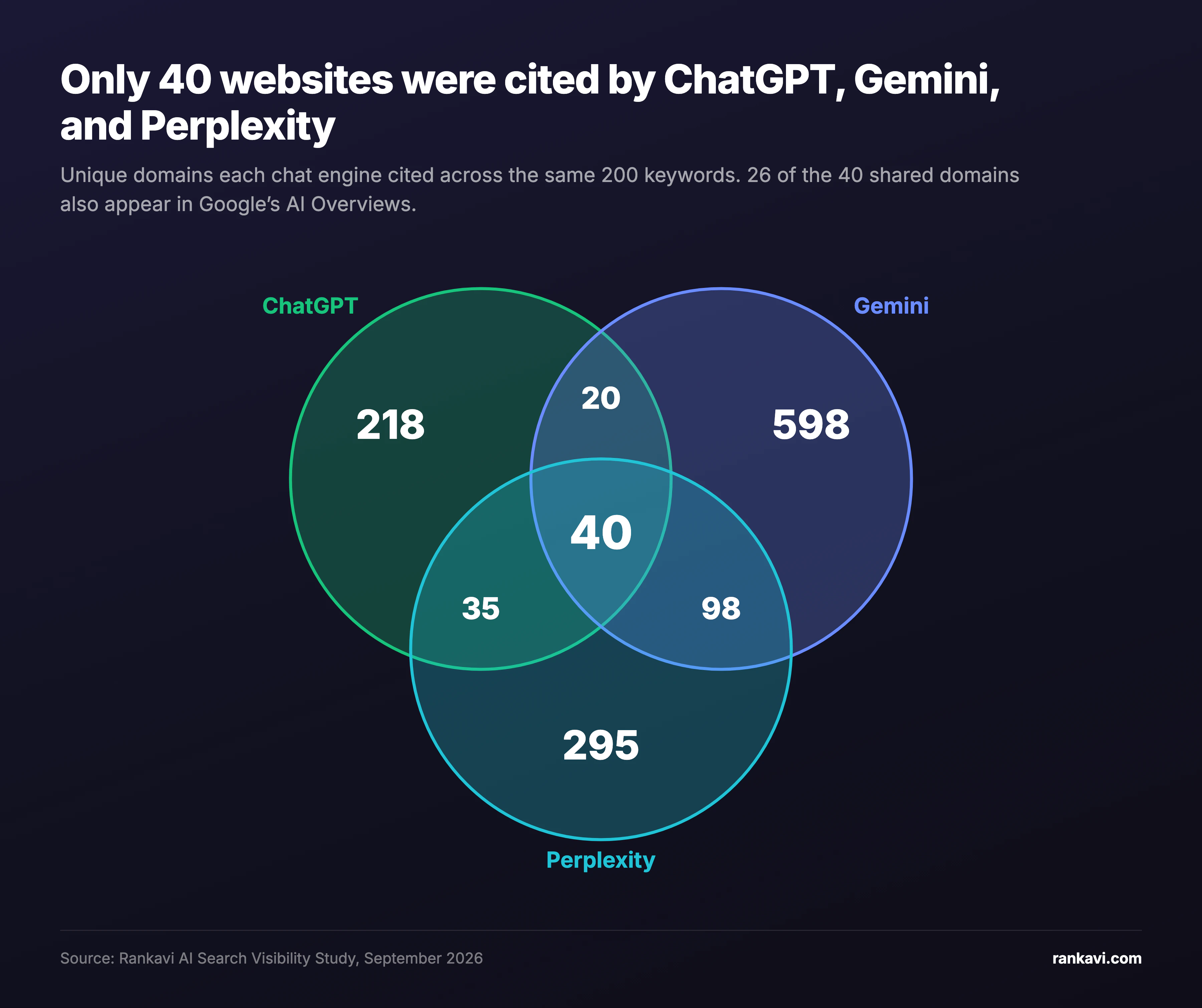
The 40 shared websites are mostly large review and health publishers: Forbes, OutdoorGearLab, RTINGS, Good Housekeeping, Healthline, the Sleep Foundation, NBC News, REI, Tom’s Guide, and the NIH. Being visible in one AI engine doesn’t mean you’re visible in the others.
The engines disagree even on the same search. For the same keyword, ChatGPT and Gemini shared no website at all on 150 of the 200 keywords. ChatGPT and Perplexity shared none on 114, and Gemini and Perplexity on 61. All three chat engines cited at least one common website on only 31 of the 200 keywords.
Which websites get cited most by AI?
The websites that get cited most by AI depend on the engine. ChatGPT leans on health authorities and big review brands, Gemini on YouTube and Reddit, and Perplexity on news and media publishers.
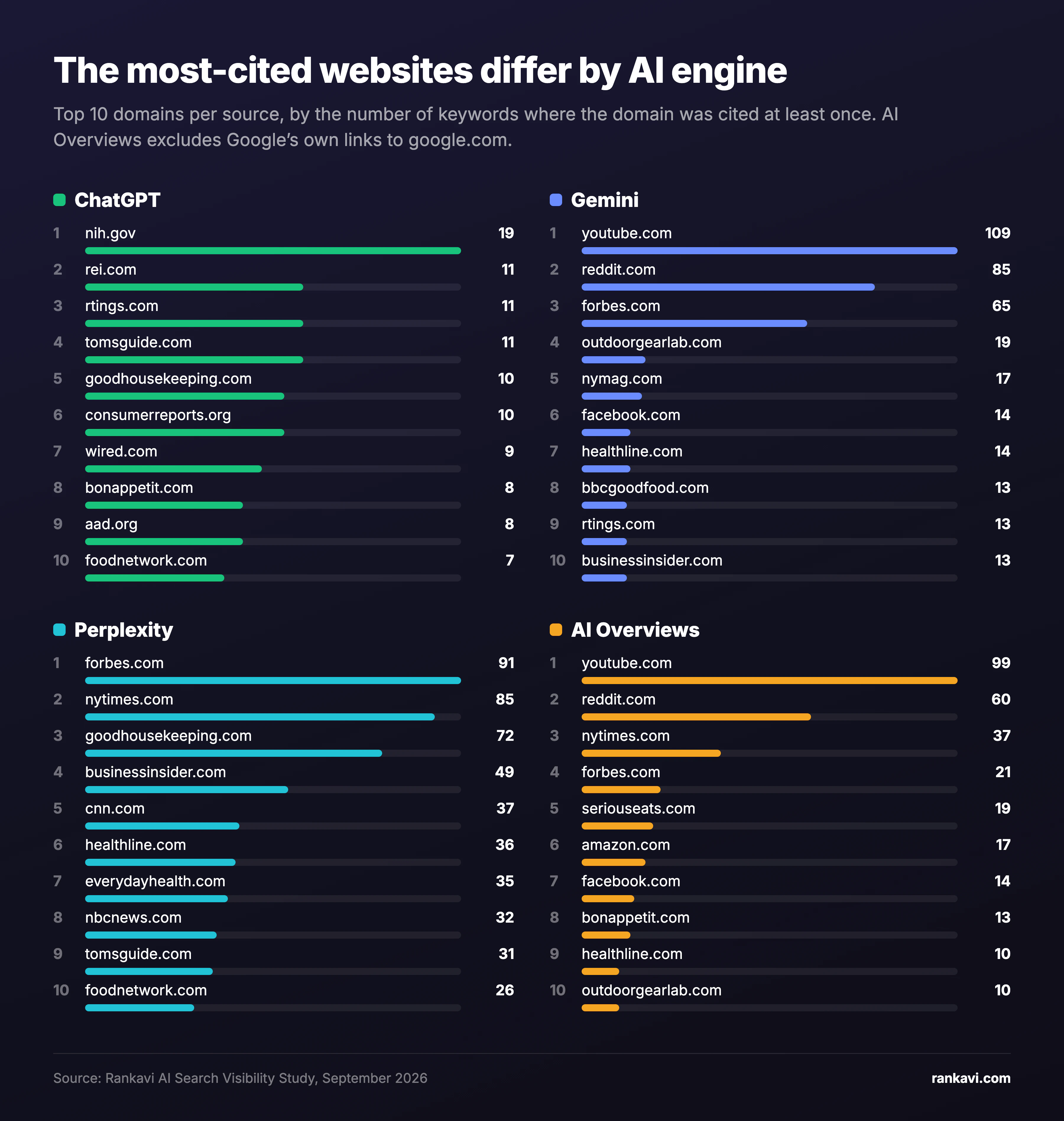
Gemini cited YouTube in 109 of the 200 answers and Reddit in 85. Perplexity cited Forbes in 91 answers and The New York Times in 85.
23% of AI Overviews’ citations linked to Google Shopping product listings, not to the store that sells the product. Those listings come from the product data stores send to Google Merchant Center. Leaving those out, its 10 most-cited websites took 39% of its citations, compared with 27% to 30% for the chat engines.
The most-cited websites also change with the product category:
| Store type | ChatGPT | Gemini | Perplexity | AI Overviews |
|---|---|---|---|---|
| Consumables | nih.gov, aad.org, vcahospitals.com | youtube.com, reddit.com, forbes.com | healthline.com, everydayhealth.com, nbcnews.com | youtube.com, amazon.com, reddit.com |
| Semi-durables | rei.com, runnersworld.com, outdoorgearlab.com | youtube.com, forbes.com, reddit.com | nytimes.com, forbes.com, goodhousekeeping.com | youtube.com, reddit.com, nytimes.com |
| Durables | rtings.com, sleepfoundation.org, consumerreports.org | youtube.com, forbes.com, reddit.com | forbes.com, nytimes.com, goodhousekeeping.com | youtube.com, reddit.com, nytimes.com |
| Occasional & gifts | nordstrom.com, bluenile.com, sephora.com | youtube.com, forbes.com, giftlist.com | forbes.com, nytimes.com, amazon.com | youtube.com, reddit.com, nytimes.com |
For supplements and skincare, ChatGPT cites health authorities like the NIH and the American Academy of Dermatology. For gifts, it cites retailers like Nordstrom and Blue Nile. Within each engine, the four store types shared only 5% to 7% of their cited websites, except Perplexity at 19%.
What types of pages get cited by AI?
“Best of” listicles are the types of pages that get cited by AI most often. They made up 89% of Perplexity’s citations, 48% of ChatGPT’s, and 38% of Google’s AI Overviews citations. This matches Ahrefs’ analysis of ChatGPT sources, which found that “best X” lists made up 43.8% of all cited page types.
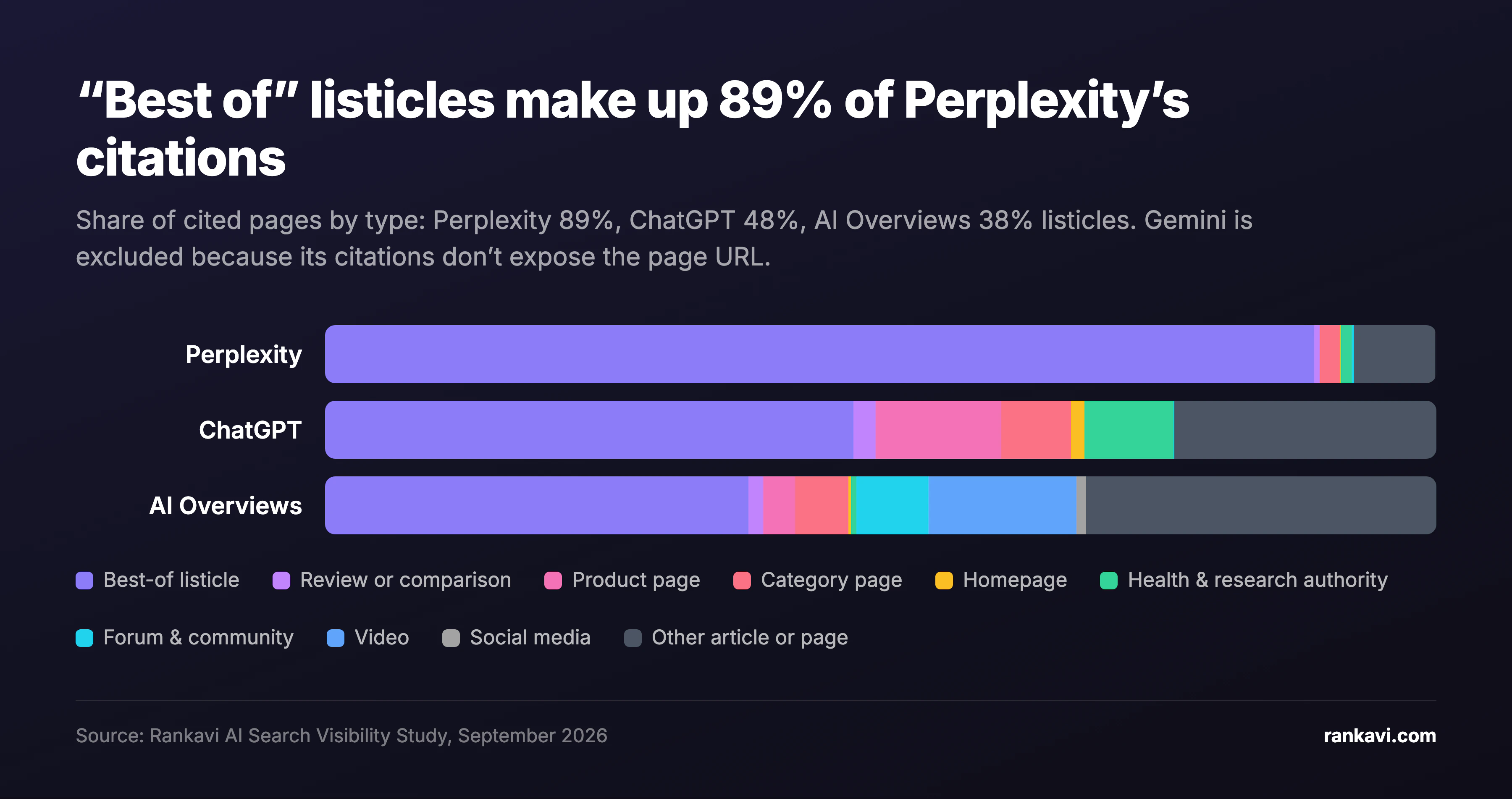
ChatGPT was the only engine that often cited product pages directly (11% of its citations). AI Overviews cited videos (13%) and forum threads (7%) more than any other source.
The page type also depends on the product. ChatGPT cited listicles for 71% of its semi-durable citations, like running shoes and cookware, but only 18% of its consumable citations. For supplements and skincare, it cited health authorities like the NIH instead. For pet food, it cited veterinary groups like AAFCO and WSAVA. Perplexity barely changed: listicles made up 79% to 97% of its citations in every store type.
Whenever a search touched on health or safety, ChatGPT linked to government and medical sources. It cited the NIH for magnesium for sleep, vitamin D, probiotics, and protein powder. It cited the American Academy of Dermatology for sunscreen, retinol, and acne face wash. It cited the NHTSA for newborn car seats, the CPSC for toddler toys, and the USDA for meat cutting boards. In total, 34 of the 200 ChatGPT answers cited a government or health authority. Perplexity did that in 11 answers, and AI Overviews in only 5.
What Domain Rating do you need to get cited by AI?
Most pages that get cited by AI come from websites with a high Domain Rating (DR). I left out Google’s own Shopping links and social platforms like YouTube and Reddit. Their near-perfect DR would skew the numbers. In Perplexity, half of the cited pages came from websites with DR 87 or higher. That midpoint was DR 84 for ChatGPT, DR 76 for AI Overviews, and DR 62 for Gemini. Google’s own top 10 sits in the middle: half of its ranking pages came from websites with DR 75 or higher.
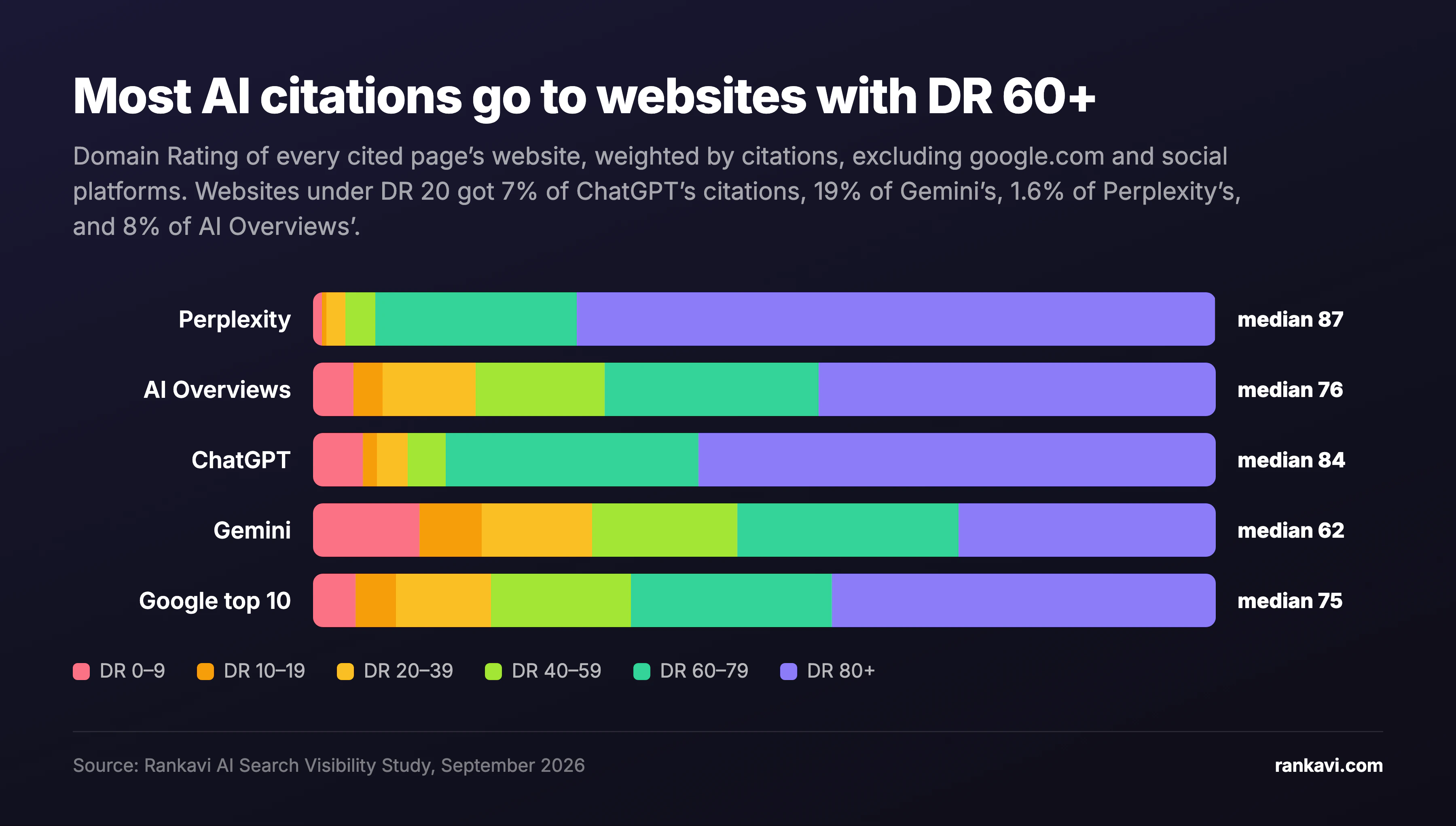
Websites under DR 20 got only 7% of ChatGPT’s citations, 8% of AI Overviews’, and 1.6% of Perplexity’s. Gemini was the exception, at 19%. Compared with websites that ranked in Google’s top 10 but never got cited, AI-cited websites were twice as likely to have DR 80+.
Small websites still get cited, but much less often. ChatGPT cited 45 small websites with a DR under 20. These websites got only 54 citations in total, or just over 1 each. Big websites with a DR of 80 or more got 4 citations each on average. The NIH alone got 34. Gemini showed the same pattern. Small websites got 4.5 citations each, while big websites got 12.5 each.
The first citation in an answer usually goes to a strong website. The median DR of the first cited website was 91 in Perplexity, 86 in AI Overviews, 85 in ChatGPT, and 62 in Gemini.
Low-DR websites got cited in every product category. One in five websites the AI engines cited had a DR under 20: 296 of 1,512. Google’s top 10 for the same searches had only 114 websites under DR 20. Here is how many websites under DR 20 each engine cited, by store type:
| Engine | Consumables | Semi-durables | Durables | Occasional & gifts | Total |
|---|---|---|---|---|---|
| Gemini | 68 | 29 | 33 | 55 | 182 |
| AI Overviews | 25 | 11 | 8 | 7 | 51 |
| ChatGPT | 11 | 13 | 8 | 13 | 45 |
| Perplexity | 18 | 7 | 1 | 3 | 29 |
| Any engine | 117 | 58 | 47 | 77 | 296 |
| Google top 10 | 39 | 22 | 29 | 25 | 114 |
Consumables: Consumables like coffee, supplements, and skincare had the most low-DR websites cited. 117 websites under DR 20 got cited here, 21% of all websites cited in the category. Gemini cited 68 of them, and even Perplexity cited 18. ChatGPT cited 11, and leaned on health authorities like the NIH instead.
Semi-durables: In semi-durables like running shoes, cookware, and outdoor gear, 58 websites under DR 20 got cited. Most were niche review blogs about running, hiking, or cooking. Gemini cited 29 of them, ChatGPT 13, AI Overviews 11, and Perplexity 7.
Durables: Even in durables like mattresses, appliances, and electronics, 47 websites under DR 20 got cited. Gemini cited 33 of them, and ChatGPT and AI Overviews 8 each. Perplexity was the exception, with just one.
Occasional and gifts: In gift searches like jewelry and home decor, 77 websites under DR 20 got cited. Gemini cited 55 of them. ChatGPT cited 13, tied with semi-durables for its highest number. Many were small jewelry stores and gift guide websites.
Gemini cited the most low-DR websites in every store type. Small websites have their best chance in consumables and gifts, where 117 and 77 of them got cited.
Which low-DR websites win AI citations?
The low-DR websites that win AI citations are mostly small sites focused on one niche, like runweekly.com, techfitnesslab.com, and driproast.com. Almost none of them got cited more than twice. The most-cited website under DR 20, balancejournal.co (DR 15), appeared in answers for just 4 of the 200 keywords.
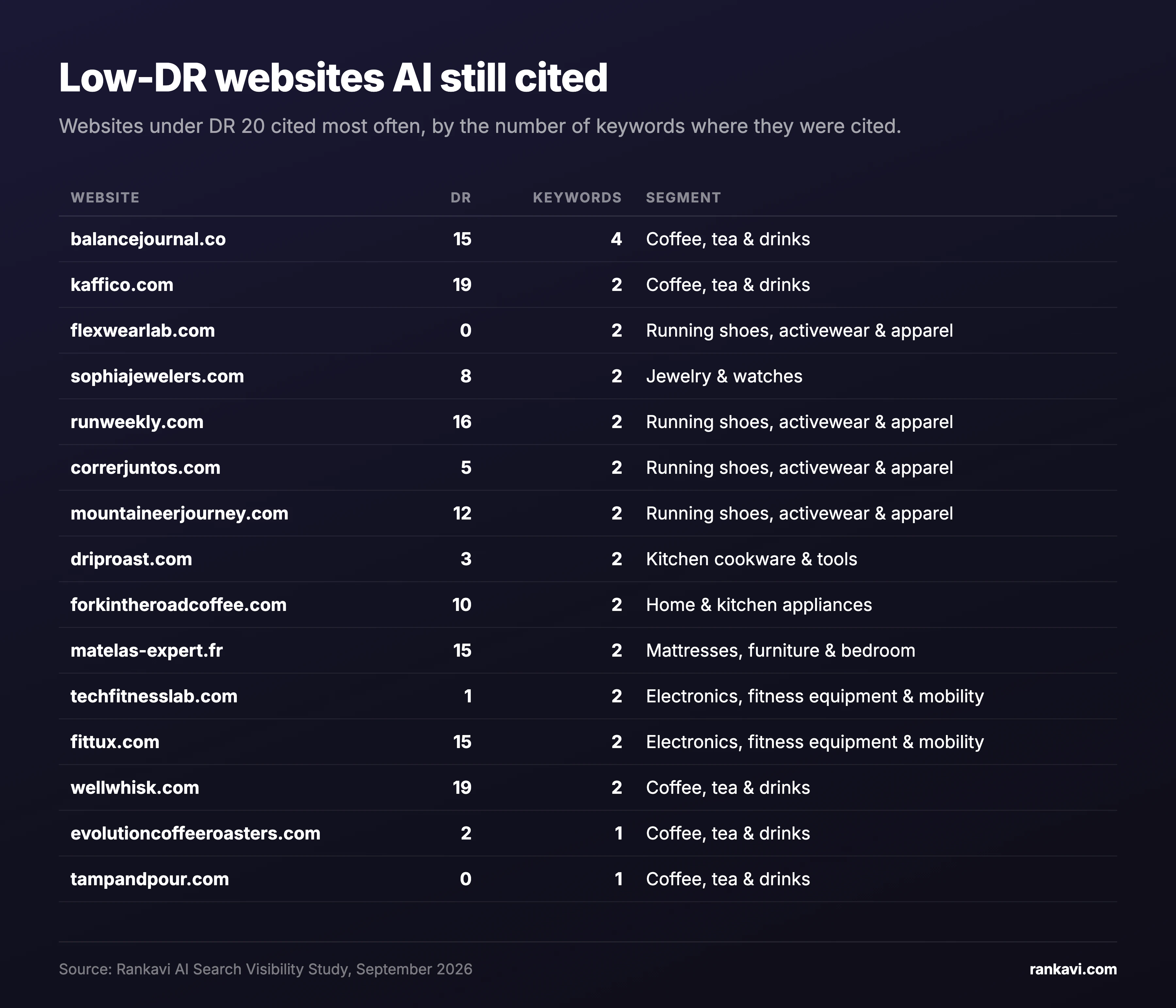
85% of all citations to websites under DR 20 came from Gemini: 819 of 958. If you run a small website, Gemini is the AI engine most likely to cite you. ChatGPT, Perplexity, and AI Overviews mostly stick to large publishers.
23% of Gemini’s consumable citations and 24% of its gift citations went to websites under DR 20, compared with 11% for semi-durables. Small websites have the best chance in Gemini, for products people rebuy or buy as gifts.
What harmonic centrality do you need to get cited by AI?
You don’t need top harmonic centrality to get cited by AI, but most citations still go to central websites. Harmonic centrality measures how close a website sits to every other website in the web’s link graph. I ranked 133 million domains by it, so rank 1 is the most central website on the web. You can measure harmonic centrality for any website with Rankavi’s free checker. As with DR, I left out Google’s own links and social platforms.
In Perplexity, half of the cited pages came from websites ranked in the top 4,337. That midpoint was rank 15,370 for ChatGPT, 389,298 for AI Overviews, and 547,940 for Gemini. Google’s top 10 sat at rank 388,769, almost exactly where AI Overviews did.
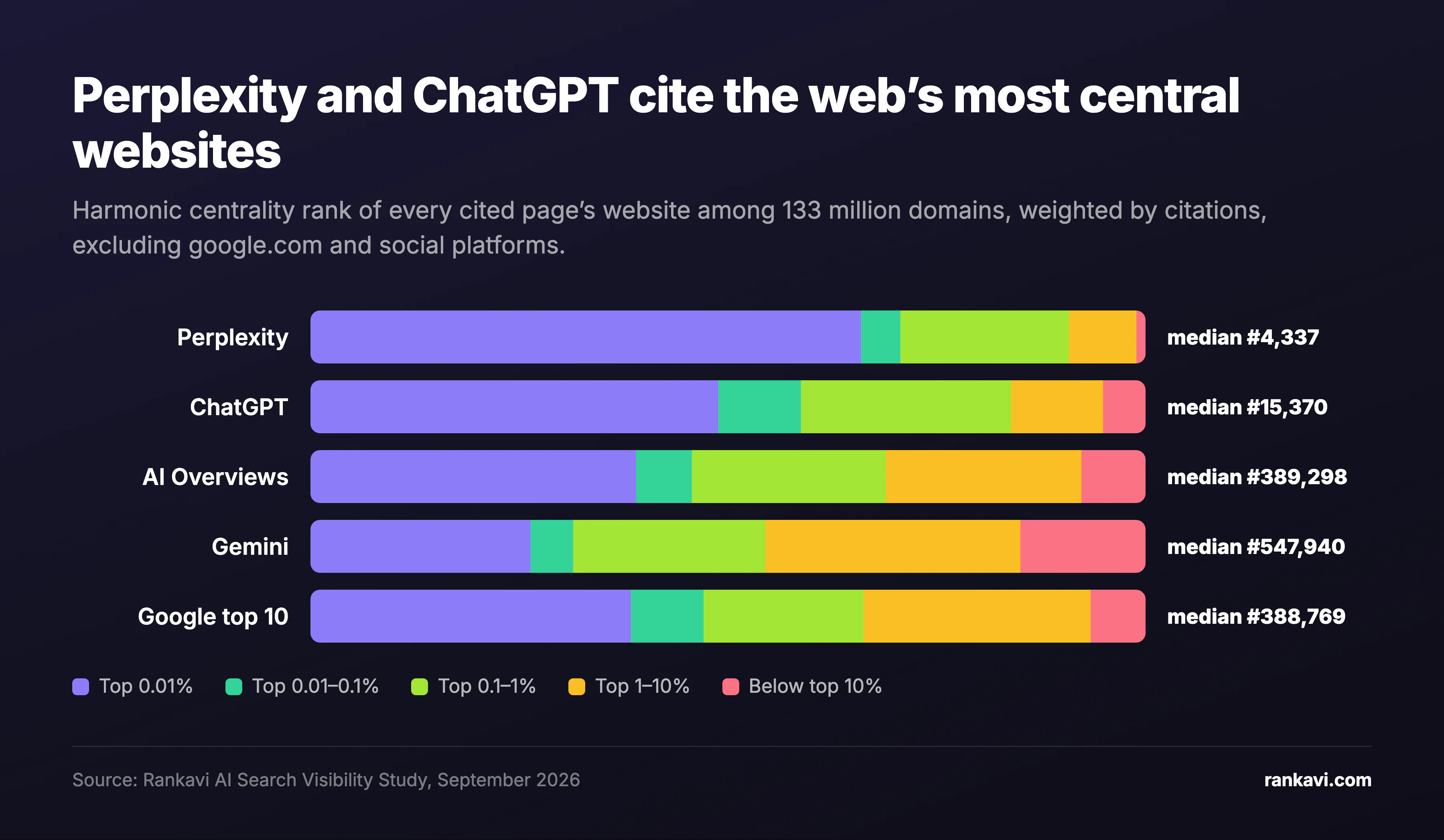
762 of the 1,477 websites the AI engines cited, about half, ranked outside the top 1% of the web. 233 of them ranked outside even the top 10%. Gemini alone cited 458 websites outside the top 1%, more than Google’s top 10 had for the same searches.
Here is how many websites outside the top 1% each engine cited, by store type:
| Engine | Consumables | Semi-durables | Durables | Occasional & gifts | Total |
|---|---|---|---|---|---|
| Gemini | 154 | 87 | 87 | 142 | 458 |
| AI Overviews | 75 | 48 | 40 | 33 | 194 |
| Perplexity | 49 | 19 | 23 | 29 | 111 |
| ChatGPT | 15 | 23 | 22 | 31 | 91 |
| Any engine | 269 | 151 | 145 | 220 | 762 |
| Google top 10 | 116 | 97 | 85 | 105 | 395 |
Consumables: Consumables like coffee, supplements, and skincare had the most less-central websites cited, 269 in total. For Gemini, half of its consumable citations went to websites outside the top 1% of the web.
Semi-durables: In semi-durables like running shoes, cookware, and outdoor gear, 151 websites outside the top 1% got cited. Gemini cited 87 of them and AI Overviews 48.
Durables: Even in durables like mattresses, appliances, and electronics, 145 websites outside the top 1% got cited. AI Overviews cited its most central websites here, with half of its citations from websites in the top 0.08%.
Occasional and gifts: In gift searches like jewelry and home decor, 220 websites outside the top 1% got cited. ChatGPT cited 31 of them, its most of any store type. For Gemini, half of its gift citations went to websites outside the top 1%.
Perplexity and ChatGPT stick to the web’s most central websites, as they do with DR, while Gemini and AI Overviews reach much further out.
How many referring domains do you need to get cited by AI?
You don’t need thousands of referring domains to get cited by AI, but the most-cited websites have them. Referring domains are the number of different websites that link to a site. I counted them with Rankavi’s database, and left out Google’s own links and social platforms.
In Perplexity, half of the cited pages came from websites with 21,288 or more referring domains. That midpoint was 12,083 for ChatGPT, 2,464 for AI Overviews, and 608 for Gemini. Google’s top 10 sat at 2,132, close to AI Overviews.
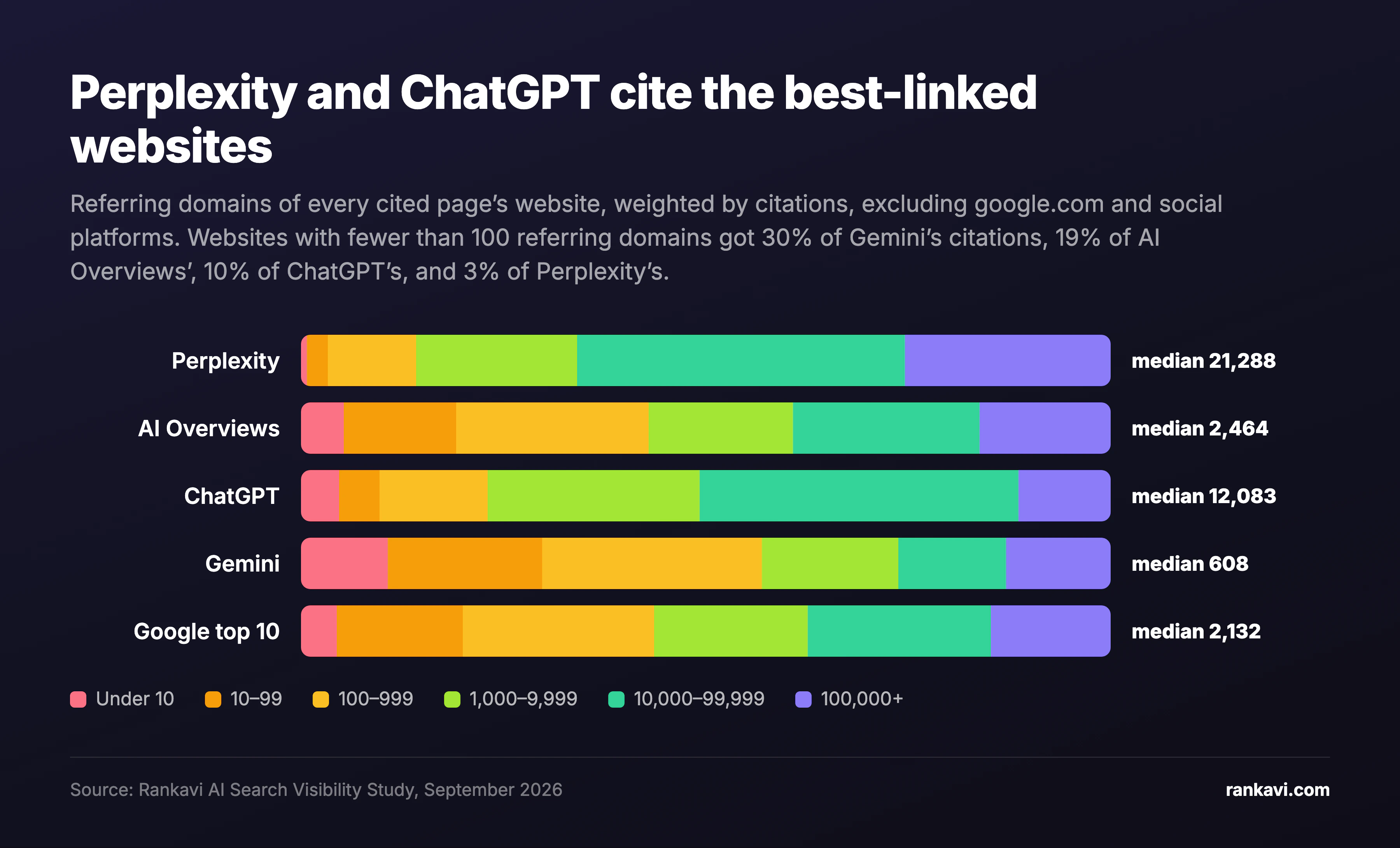
AI engines also cited websites with few links. Of 1,477 cited websites, 508 had fewer than 100 referring domains, and 175 had fewer than 10. Gemini cited 317 websites with fewer than 100 referring domains, more than appeared in Google’s top 10 results for the same searches.
The median AI-cited website had 367 referring domains. Websites that ranked in Google’s top 10 but never got cited had 179, about half as many.
Here is how many websites with fewer than 100 referring domains each engine cited, by store type:
| Engine | Consumables | Semi-durables | Durables | Occasional & gifts | Total |
|---|---|---|---|---|---|
| Gemini | 112 | 52 | 59 | 97 | 317 |
| AI Overviews | 54 | 31 | 18 | 20 | 123 |
| ChatGPT | 9 | 15 | 9 | 21 | 54 |
| Perplexity | 30 | 8 | 9 | 8 | 53 |
| Any engine | 189 | 100 | 87 | 139 | 508 |
| Google top 10 | 78 | 48 | 53 | 62 | 236 |
Consumables: Consumables like coffee, supplements, and skincare had the most cited websites with under 100 referring domains, 189 in total. Gemini’s cited websites had a median of just 390 referring domains here.
Semi-durables: In semi-durables like running shoes, cookware, and outdoor gear, 100 websites with under 100 referring domains got cited. Gemini cited 52 of them and AI Overviews 31.
Durables: Even in durables like mattresses, appliances, and electronics, 87 websites with under 100 referring domains got cited. AI Overviews cited its best-linked websites here, with a median of 4,698 referring domains.
Occasional and gifts: In gift searches like jewelry and home decor, 139 websites with under 100 referring domains got cited. ChatGPT cited 21 of them, its most of any store type. Its median dropped to 2,692 referring domains, and Gemini’s to just 187.
Perplexity and ChatGPT cite the best-linked websites, as they do with DR and harmonic centrality, while Gemini and AI Overviews cite many more websites with only a few links.
Does ranking on Google get you cited by AI?
Ranking on Google mostly does not get you cited by AI. Only 15% of the websites ChatGPT cited ranked in Google’s top 10 for the same search. For Gemini it was 18%, and for Perplexity 10%. Even Google’s own AI Overviews cited websites outside its top 10 results 68% of the time.
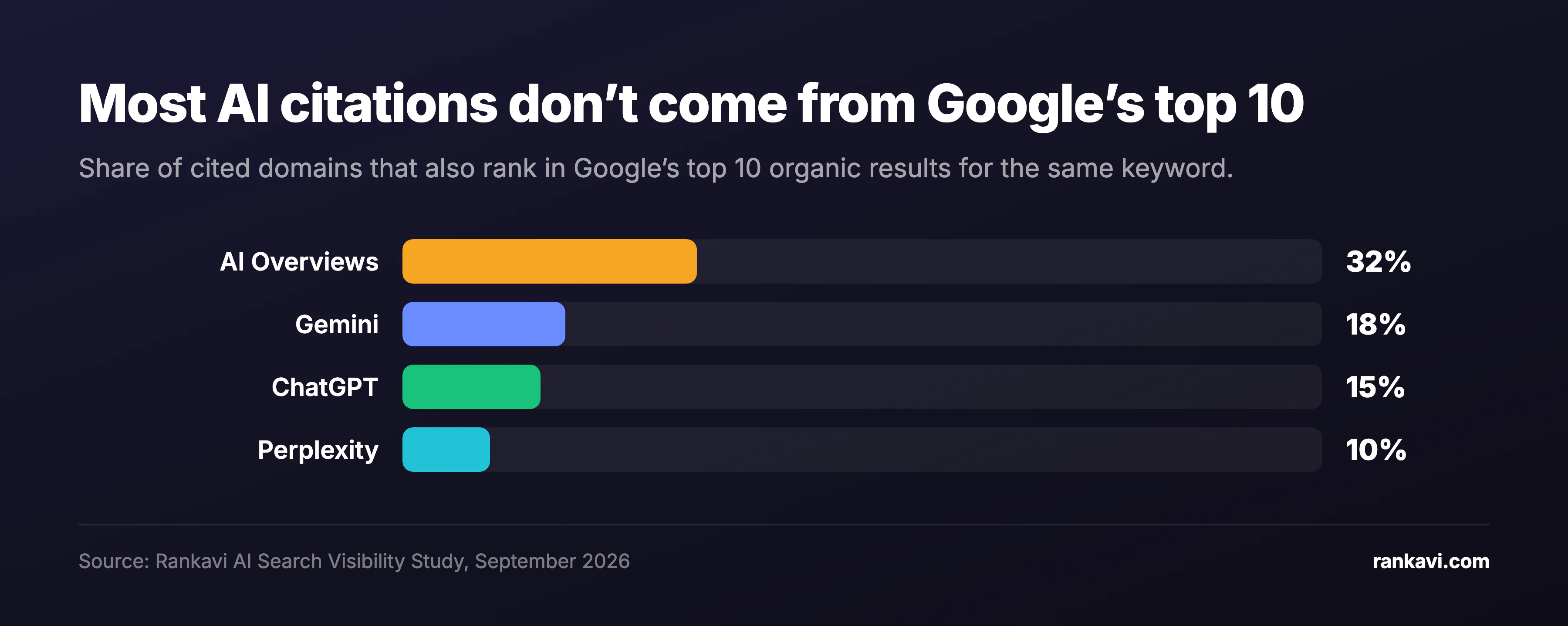
In every store type, only 9% to 10% of Perplexity’s cited websites ranked in Google’s top 10. ChatGPT’s overlap peaked at 20% for semi-durables, and AI Overviews’ at 38% for gifts.
In January 2025, Seer Interactive found that Google rankings do track ChatGPT brand mentions. It ran 10,000 questions from the finance and SaaS industries through OpenAI’s GPT-4o. The questions came from Google’s People Also Ask boxes. Seer then checked which brands each answer named. It also checked whether those brands ranked for the same question on Google and Bing.
Brands on page one of Google showed a strong correlation with ChatGPT mentions, at about 0.65. Bing rankings correlated a little less, at 0.5 to 0.6. Backlinks had a weak or even neutral effect. Seer’s own conclusion was that search rankings “appear to play some role in influencing LLM mentions, but they’re not the whole story.”
How often do AI Overviews appear for “best X for Y” product searches?
AI Overviews appeared on 86% of the “best X for Y” product searches I tested: 171 of 200, on US desktop search. AI Overviews appeared most on consumables and durables (92% each) and least on gift searches (74%).
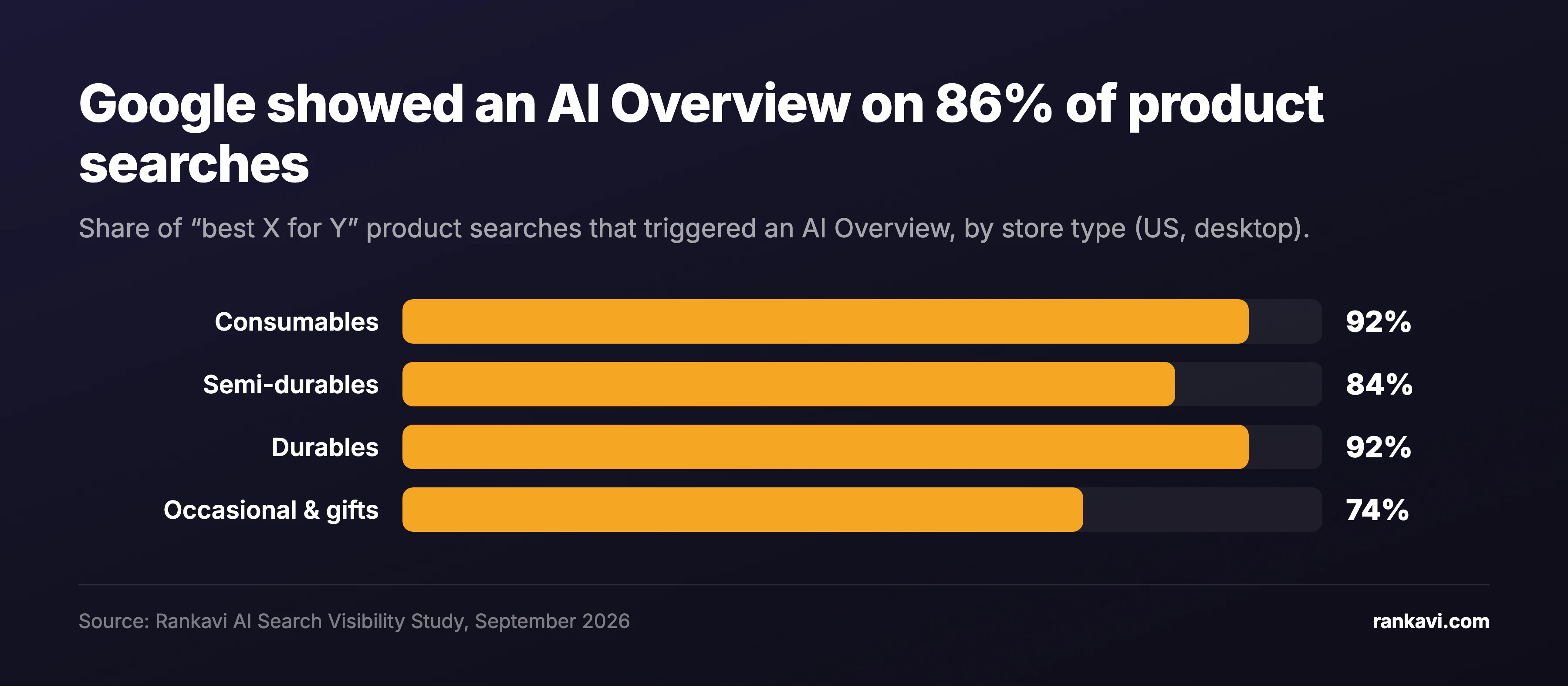
By segment, AI Overviews showed up on all 16 skincare, personal care, and pet searches. They were least common for fragrance, gift sets, and home decor (10 of 16 searches) and for jewelry and watches (12 of 17).
Why does Reddit dominate Google but not ChatGPT?
Reddit dominates Google but not ChatGPT since ChatGPT nearly stopped citing Reddit in August 2026. Reddit ranked in Google’s top 10 for 171 of the 200 searches, more than any other website. ChatGPT didn’t cite it once, and Perplexity cited it only twice. Gemini and AI Overviews, which both run on Google’s index, cited Reddit in 85 and 60 answers.
Search Engine Journal reported the drop on August 19, 2026, using data from Promptwatch. Reddit averaged 3.83% of ChatGPT Search citations from July 18 to August 7, 2026. From August 14 to 17, it averaged 0.52%, an 86% drop. On August 8, ChatGPT began using the site: operator far more often. It appeared in 16.8% of its background searches, up from 0.37%. OpenAI did not comment, and Search Engine Journal noted the cause is not confirmed.
My data, collected on September 30, shows the same pattern six weeks later. None of ChatGPT’s site: searches targeted Reddit. The next section explains how those searches work.
What fan-out queries do ChatGPT and Gemini run before answering?
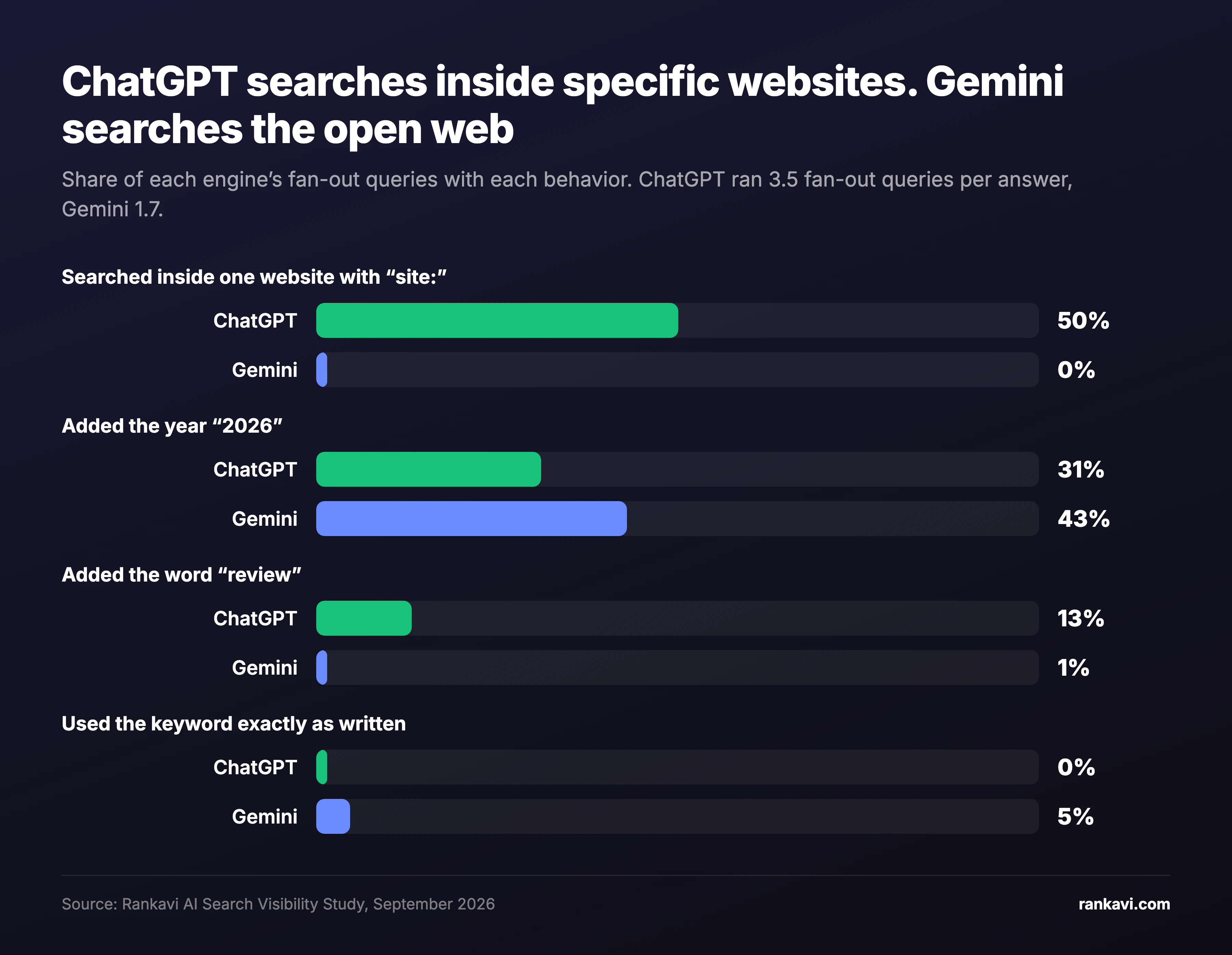
Before answering, ChatGPT and Gemini run fan-out queries for reviews, official specs, and trusted websites by name. Fan-out queries are the background searches an AI engine runs to gather sources. Perplexity and AI Overviews didn’t return theirs in my data, so this section covers ChatGPT and Gemini only. ChatGPT ran 3.5 searches per answer, and half of them used the site: operator to search inside one specific website. Its most common targets were REI, Wirecutter, Serious Eats, and brand stores like Mejuri, Brooks, and Saatva. Gemini ran 1.7 searches per answer and never used site:.
The site: operator limits a search to one website. A search for site:rei.com hiking boots only returns pages from REI. When ChatGPT searches this way, brands named on that website can make it into the answer. Brands that aren’t named there never come back in that search, no matter how well they rank elsewhere.
I think this makes ChatGPT biased toward brands it already knows. It picks the websites before it searches, so the choice comes from its training data. A new brand has no way into a search scoped to a website that doesn’t mention it.
Both engines added the current year to their searches often: 31% of ChatGPT’s searches and 43% of Gemini’s included “2026.” That shows up in what they cite. 40% of ChatGPT’s cited pages and 39% of Perplexity’s had “2026” in the URL or title.
Both engines rewrote the keyword into longer searches of 7 to 8 words, adding words that point to the sources they wanted.
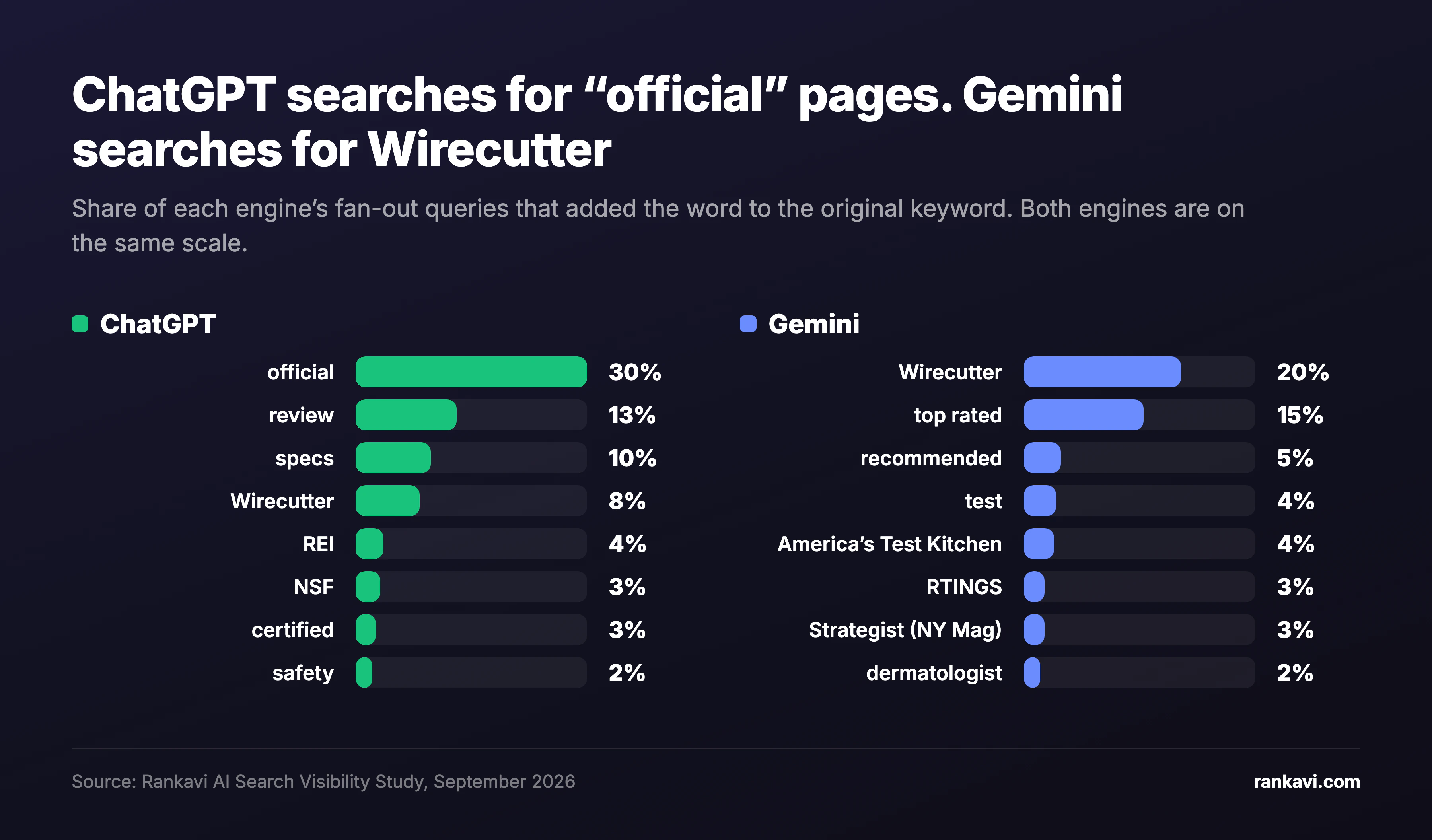
ChatGPT added “official” to 206 of its 692 searches, looking for the brand’s own page. It also added “review” 90 times and “specs” 67 times. Gemini added “top rated” 52 times. Both searched for Wirecutter by name: ChatGPT 57 times and Gemini 68 times. Gemini also searched for America’s Test Kitchen, RTINGS, and New York Magazine’s Strategist by name.
One thing to keep in mind: these searches came from a blank ChatGPT, not a personal one. I sent every query through the ChatGPT API, logged out, without preselecting a free or paid plan, and with no chat history. Free and paid plans run different models, so their searches can differ too. I also didn’t measure how a user’s history changes the searches. TechCrunch reported in April 2025 that ChatGPT can use its memory of past chats to rewrite web searches. For example, ChatGPT may know you buy organic food. Then, when you search “best protein powder for muscle gain,” your search may gain words like “organic,” “plastic-free,” or “eco-friendly,” the same way my searches gained “official” and “review” here. Your answer, and the brands in it, can differ from mine.
How can you improve your AI search visibility?
You can improve your AI search visibility by getting your brand named on the websites AI engines already cite, and by optimizing for each engine separately. Based on the data:
- Get featured in “best of” listicles for every use case. Listicles made up 89% of Perplexity’s citations and 48% of ChatGPT’s. Across the four engines, 63% to 95% of the brands they recommended appeared on a third-party page they cited. Don’t stop at one generic list. Get named in lists for each specific need your product solves. For running shoes, that means lists like “best running shoes for wide feet,” “for high arches,” “for treadmill running,” and “under $150.” Each listing should say who the product is best for and why, in one plain sentence.
- Cover every attribute on your own product pages. ChatGPT added “official” to 30% of its searches and “specs” to 10%, looking for the brand’s own page. Half of its searches used
site:to look inside one website, often a brand store. List every detail a shopper might ask about: fit, sizing, materials, use cases, certifications, price, and shipping. Step 2 of my Shopify case study shows what that looks like for running shoes. - Connect Google Merchant Center for AI Overviews. 23% of AI Overviews’ citations linked to Google Shopping listings. 15% of the brands it recommended came only from those Shopping cards. The listings come from the product data stores send to Merchant Center, so a complete, accurate feed is a free way into AI Overviews.
- Target each AI engine separately. Only 40 websites were cited by all three chat engines, so you need a presence in several places at once. For ChatGPT, that means complete product pages, review labs, and health authorities where they apply. For Perplexity, it means big media listicles. For Gemini and AI Overviews, it means YouTube, Reddit, Facebook, and small niche websites. Gemini and AI Overviews each cited Facebook in 14 answers. Visibility in one engine tells you little about the others.
- Get reviewed by the testers AI searches for by name. ChatGPT added “review” to 13% of its searches and named Wirecutter in 8%. Gemini named Wirecutter in 20% of its searches. It also searched for RTINGS, America’s Test Kitchen, and New York Magazine’s Strategist by name. A review from one of these testers puts your brand on pages AI engines look for directly.
- Don’t skip small, niche websites. One in five websites the AI engines cited had a DR under 20: 296 of 1,512. Gemini alone cited 182 of them. Small websites had the best chance in consumables and gifts. A mention on a focused niche website can reach AI answers that big publishers never cover.
- Back up health claims with official sources. Whenever a search touched on health or safety, ChatGPT linked to government and medical sources. 34 of its 200 answers cited one, like the NIH or the American Academy of Dermatology. If you sell supplements, skincare, or baby products, cite these sources on your pages and list certifications like NSF.
- Build brand recognition the models already know. 29% of the brands ChatGPT recommended appeared on none of its cited pages. Those most likely came from its training data. Press coverage and branded searches can help a brand become one the model already knows.
- Keep working on SEO, but don’t rely on Google rankings alone. Only 10% to 18% of the websites each chat engine cited ranked in Google’s top 10 for the same search. That doesn’t make SEO pointless. Seer Interactive found that brands on page one of Google were more likely to be mentioned by ChatGPT. AI Overviews also cited Google’s top 10 more than any chat engine did, 32% of the time. Higher rankings give AI engines more chances to find you, even if they don’t guarantee a citation.
- Use YouTube and Reddit for Google’s AI. Gemini cited YouTube in 109 of 200 answers and Reddit in 85, and AI Overviews cited them in 99 and 60. ChatGPT cited neither.
- Keep your pages current. About 40% of the pages ChatGPT and Perplexity cited had “2026” in the URL or title, and both engines often added the year to their searches. Update your buying guides and product pages, and keep the year in their titles current.
- Track your visibility more than once. AI answers change between runs and between users, and ChatGPT can rewrite searches using a user’s chat history. Check your most important prompts on each engine several times. Track how often your brand appears, not whether it appeared once.