

Starting a search engine optimization (SEO) business takes a sellable skill, a clear niche and prices that survive slow months. Recurring fees carry the model: a 2023 pricing survey by Ahrefs, which is an SEO software vendor, found 78.2% of SEO providers use monthly retainers.
My name is Michal Sieroslawski, and I’m an entrepreneur who helps SEO businesses show up in Google and AI search. Many clients now start by asking ChatGPT, so its suggestions can bring new customers.
The order proves the skill and fixes the prices before any money goes into paperwork, tools or outreach. The path to a running SEO business follows the nine steps below.
- Choose Your SEO Business Model and Niche
- Build Skills and a Proof Site
- Price Your SEO Services
- Fund the Launch and Keep Cash Flowing
- Register the Business and Write Contracts
- Set Up Tools, Payments and Workflows
- Win the First Clients
- Grow With Freelancers, Hires and Systems
- Turn AI Answers Into Client Leads
1. Choose Your SEO Business Model and Niche
Choosing a model decides how an SEO business earns money, what it sells and how far it can grow. Freelance, productized and agency setups share the same work but carry different economics.
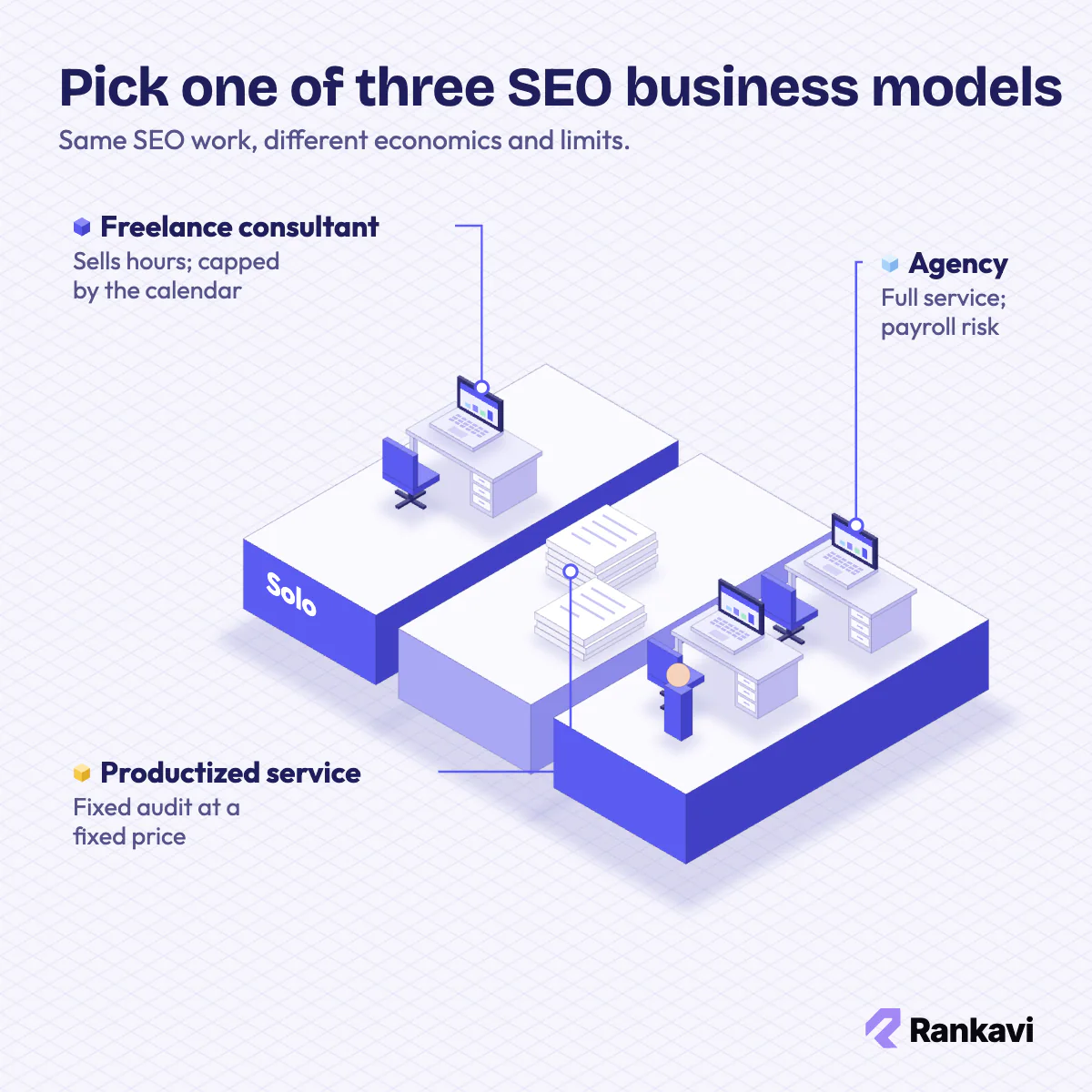
The economics differ because each model sells something different. A freelance SEO consultant sells personal hours. Overheads stay near zero, and the ceiling is the calendar. A productized service sells one fixed deliverable, such as a technical audit, at a fixed price.
A full-service agency sells outcomes across strategy, content and links. That wider scope needs staff, so the agency carries real payroll risk.
The table below compares the three SEO business models side by side:
| Model | What the client buys | Main limit |
|---|---|---|
| Freelance consultant | Expert hours and advice | Hours in the week |
| Productized service | A defined deliverable at a set price | Narrow scope |
| Full-service agency | Ongoing outcomes across disciplines | Fixed costs and hiring |
Beyond these three, two narrower routes exist. White-label SEO means doing the work under another agency’s brand. The work arrives in steady volume. In return, margins are thin and the founder does not own the client. Rank-and-rent means building a local site and ranking it. The founder then rents the leads to a business owner.
A founder does not have to stay in one model forever. Many start as freelancers. Next, they package their best-selling service into a productized offer. Once demand outgrows the calendar, they hire.
Whichever model a founder picks, a vertical niche makes the offer easier to sell. A vertical niche means serving one type of client. “SEO for roofers” or “SEO for dentists in one city” gives prospects a clear reason to call. Plain “SEO” competes with every agency on the planet.
A niche can be cut along five lines:
- Industry: The firm serves one trade, such as roofers or dentists.
- Location: The firm serves clients in one place, such as a single city.
- Platform: The firm serves sites built on one platform, such as Shopify.
- Service specialty: The firm offers one kind of SEO, such as technical SEO.
- Client size: The firm serves businesses of one size.
The strongest niches combine two of these lines, such as technical SEO for Shopify stores.
A sharp niche still has to be a healthy one. Five checks separate a good niche from a crowded one:
- Budget: Clients can afford ongoing SEO.
- Value: One new customer is worth enough to justify the fee.
- Demand: Keyword data shows steady search volume.
- Fit: The founder understands how the industry’s buyers decide.
- Risk: Legal, medical and finance niches draw closer scrutiny, so claims need care.
Market checks then confirm what these tests suggest. Keyword research on the planned services shows whether real demand exists. The firms that already rank reveal their prices and the gaps they leave open.
A few tools make these checks practical. Google Keyword Planner shows search demand, and Google Trends shows its direction. For local niches, a search on Google Maps shows which firms hold the top spots. Agency directories such as Clutch and UpCity show how many firms already serve the niche.
Local niches also limit how many clients a firm can take on. Serving two direct competitors in one city creates a conflict of interest. As a result, a local niche may allow only one client per market.
Once the research is done, a short business plan captures the result. It lists revenue goals, the target client, the core services and the angle that sets the firm apart.
The plan also defines an ideal client profile. This profile covers the client’s industry, size, location and budget. With the profile set, the founder can test whether the income goal is realistic. Dividing the income goal by the revenue per client gives the number of clients needed. That number should then be compared with how many clients one person can serve.
2. Build Skills and a Proof Site
Proof of skill is the product an SEO business sells before it has any clients. Buyers pay for results they can see. So the founder needs a ranked site of their own.
SEO work spans the following six disciplines:
- Keyword research: This finds the terms worth targeting and the intent behind them. Intent means what the searcher actually wants to find.
- On-page SEO: This covers titles, meta descriptions, structure and internal links. A meta description is the short summary shown under a page title in search results.
- Technical SEO: This deals with crawling, indexing, site speed and migrations. Crawling and indexing are how Google finds pages and stores them for search.
- Off-page SEO: This covers outreach, link building and brand mentions on other websites.
- Content: This means writing the pages the research says should exist.
- Analytics: This sets up tracking that turns data into client reports.
A new consultant needs depth in one discipline and competence in the rest. Honesty about the gap matters more than claiming all six.
The fastest way to build those skills is on an owned website. The founder can follow every change through to its result. No client loses patience while waiting. Mistakes on a personal site cost nothing but time.
Because the founder owns the site, its results can be shared freely. That makes it the first case study, which is a written record of a project and its results. A project taken from zero to ranking proves skill without asking any client for permission.
To run that first project, the founder can learn from three free sources:
- Google’s SEO Starter Guide: This guide is free and covers the basics most founders learn first.
- Ahrefs and HubSpot Academy courses: These free courses teach the day-to-day practice of SEO.
- Google Search Central: This is Google’s own documentation of what it allows.
No certification works as an industry licence. So results count for more than credentials, and the proof site supplies those results.
The site can only produce results if people search for its topic. So the topic needs real search demand and moderate competition. Health and finance topics are poor choices. Trust requirements are highest there.
Results also need to be measured from day one. Google Search Console is a free Google service that reports how a site appears in Google Search. Google Analytics 4 tracks the people who visit the site. Both should be connected before the first page goes live. Without a recorded starting point, there is no before-and-after to show.
That starting point is what lets the case study show real change. A case study records the problem, the dated actions and the timeline. It also shows the change in impressions, clicks and average position. Impressions count how often the site appeared in search results. Average position is where it usually ranked. Dated Search Console screenshots serve as evidence.
Purchased links, private blog networks and mass-produced thin pages all break Google’s spam policies. A private blog network is a group of sites built only to link to each other. They can sink the proof site and the credibility it was built to create.
3. Price Your SEO Services
Pricing sets how an SEO business gets paid for slow, ongoing work. SEO results build over months, so a firm needs a way to charge for work that keeps going. Most firms mix hourly advice, monthly retainers, fixed projects and occasional performance deals.
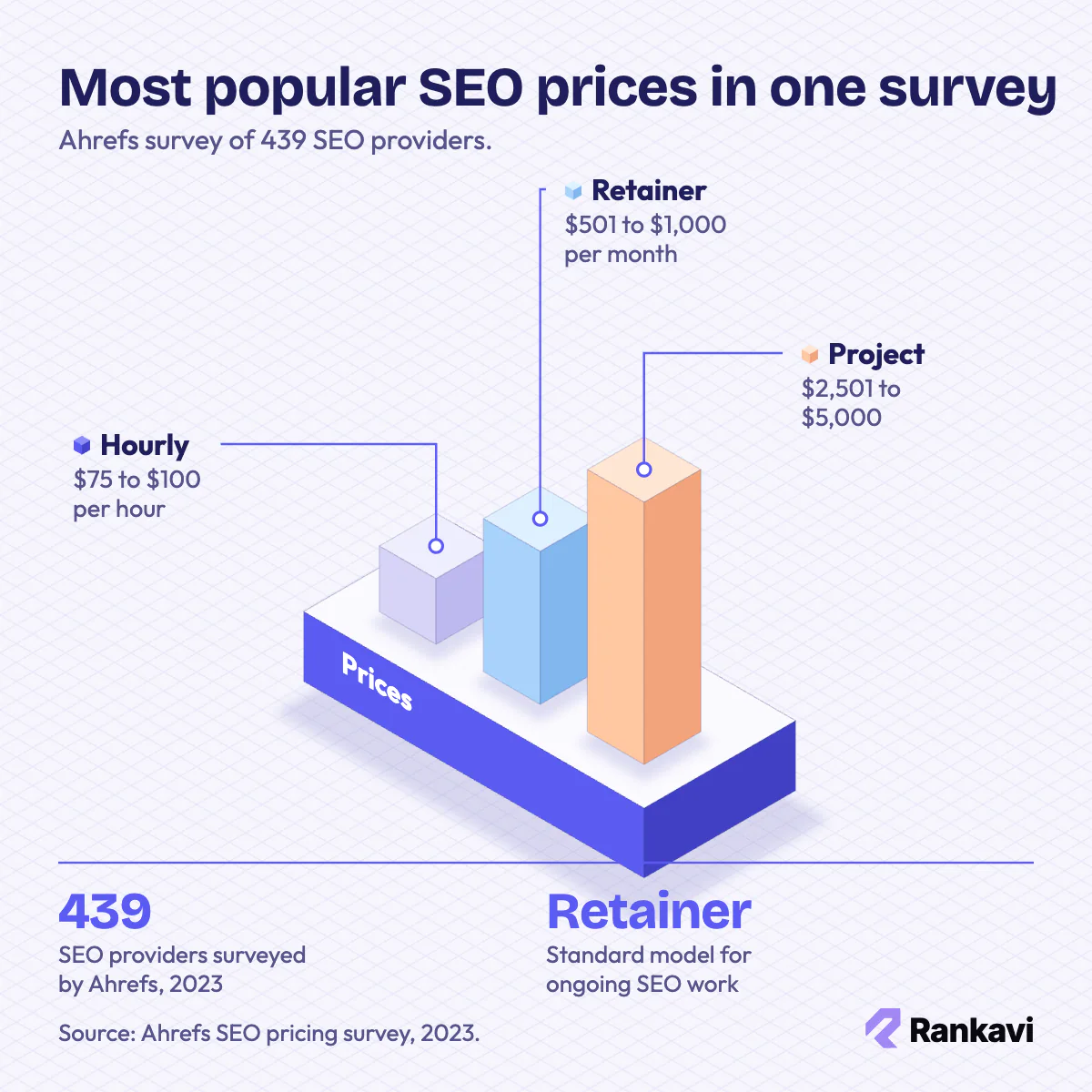
Before picking a model, a new firm needs to know what clients already pay. Ahrefs is an SEO software company whose tools cover keyword research, backlinks and rank tracking. In 2023, it surveyed 439 SEO providers.
In that 2023 survey, the most popular hourly rate was $75 to $100. In 2023, the most popular retainer was $501 to $1,000 per month. The most popular project fee in 2023 was $2,501 to $5,000.
Each of these prices belongs to a different model, and each model fits a different kind of work. The table compares the four common SEO pricing models:
| Model | Best fit | Main risk |
|---|---|---|
| Hourly | Advisory calls and consulting | Income capped by hours |
| Monthly retainer | Ongoing SEO programs | Scope creep |
| Project or productized | Audits, migrations, content builds | Underquoting the work |
| Performance-based | Clients who demand guarantees | Results depend on the client |
The retainer is the standard for ongoing SEO, because the work never really ends. A retainer is a fixed monthly fee for ongoing work. Without a written scope, though, it turns into unlimited access. This is scope creep: the client keeps asking for more without paying more. To prevent it, every month needs a defined list of deliverables.
Fixed projects work differently. They suit first-time buyers. They also often lead to a retainer:
“I love this strategy. This is how I turn a website project into a 9-12 month engagement.”
— A viewer commenting on a YouTube video about selling SEO services
Performance deals tie payment to rankings or traffic. The problem is that those results depend on factors the consultant does not control. One of them is whether the client ships the fixes. For that reason, any performance clause should track something the firm actually governs.
Once a firm picks its models, it needs a price floor. This is the lowest price it can accept. The floor starts with the target monthly income plus tools, taxes and overhead. Dividing that sum by billable hours gives the minimum hourly rate.
Billable hours are the hours a client pays for. Not every working hour can be billed, so this rate is only a minimum. Multiplying the rate by the monthly hours a scope needs gives the lowest workable retainer.
A first-time firm can price below the Ahrefs median. Even so, it should not compete on cheapness. Any discount needs a clear reason and a clear end. A discounted pilot works, and so does a reduced rate in exchange for a published case study.
In both cases, a written date states when the rate rises. A one-time onboarding fee covers the audit and setup work. Most SEO retainers also set a minimum term, since results take months.
Some clients will still call the price too high. Cutting scope protects the rate better than cutting the fee. The following are three ways to lower the commitment without lowering the price:
- Smaller tier: The client buys a smaller package of deliverables at the same rate.
- Shorter term: The client commits to fewer months.
- Phased start: The work begins in stages instead of all at once.
Some clients still demand guarantees. A safer performance structure pairs a reduced base retainer with a bonus. The bonus is tied to leads from a measured baseline. Both sides agree in writing on the source that tracks the leads.
4. Fund the Launch and Keep Cash Flowing
Funding an SEO business covers a small launch budget and the cash needed before retainers add up. The firm needs little equipment, but early months bring little revenue.
The launch budget is small. Starter Story is a website that publishes founder-reported startup data. It put the median SEO agency startup cost at $1,500 in 2026. A fuller setup costs more because it adds registration, a website and branding. Starter Story’s 2026 estimate for that setup ran $5,000 to $15,000.
Startup money at a glance:
| Item | SEO business figure |
|---|---|
| Startup cost | $1,500 median reported by founders; $5,000 to $15,000 for a fuller setup |
| Main costs | SEO software, website and branding, registration, laptop, first marketing |
| Typical margin | 19% after-tax net for studio digital agencies with 0 to 9 staff (proxy for SEO firms) |
| Time to open | Varies: a solo consultant can sell within weeks, while proof sites take months to rank |
Sources: Starter Story (founder-reported startup data), 2026; Promethean Research (digital agency benchmarks), 2025. Time to open is qualitative because no source gives a figure.
Costs stay this low because an SEO firm needs a laptop, software and a website rather than inventory. As a result, outside money is rarely needed. Founders usually pay for the launch in one of three ways:
- Savings or a day job: Most founders self-fund this way. Many keep the day job at first. They leave once client income matches their salary and a loyal client base exists.
- Microloan: In 2026, the U.S. Small Business Administration offers microloans of up to $50,000.
- Business credit card: This is another common route to cover launch costs.
The launch budget is only part of the need. The business also needs working capital, which is the cash that pays the bills while revenue builds. Working capital covers the slow start, since search rankings move over months.
A retainer is a fixed monthly fee a client pays for ongoing work.
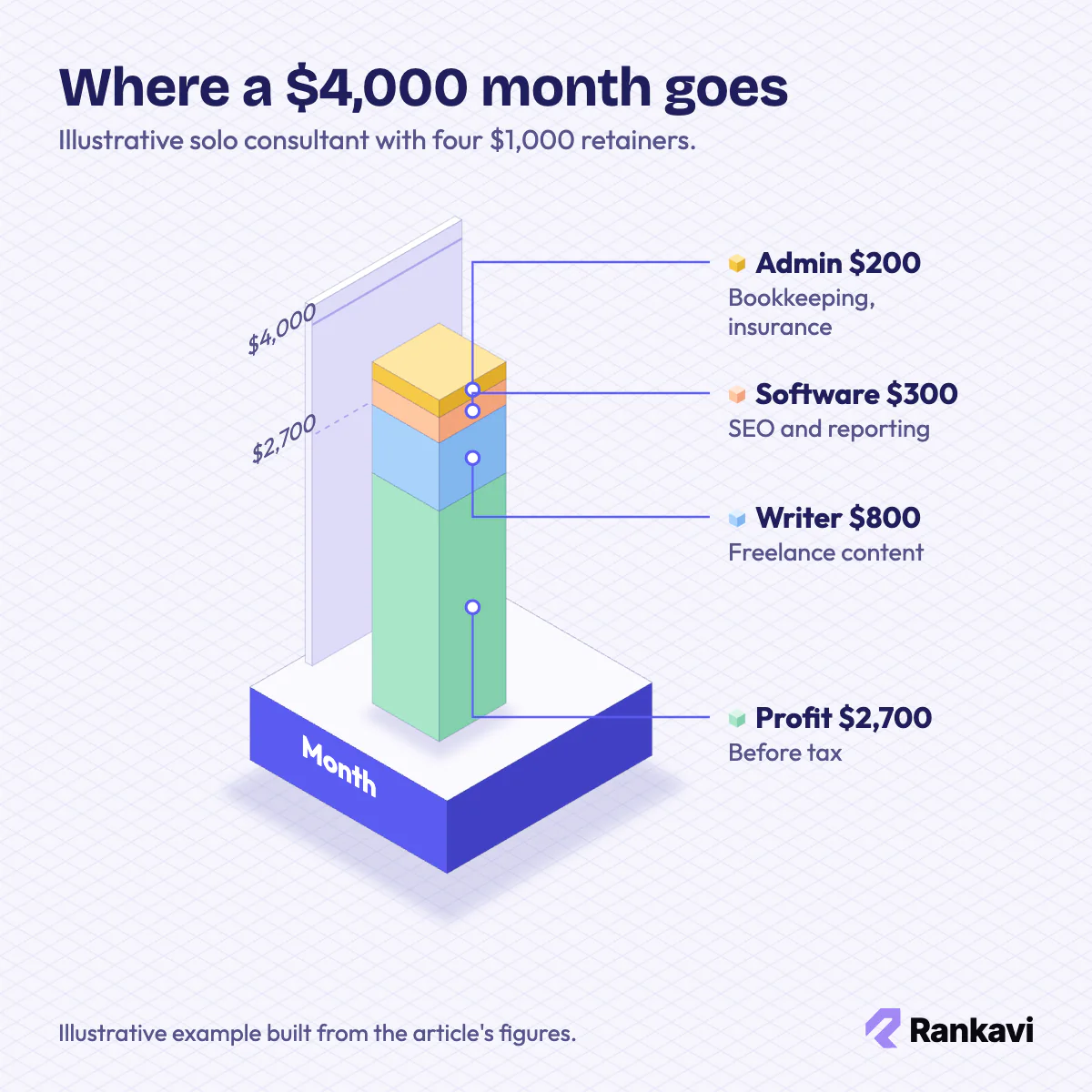
Example: A solo consultant runs four retainers from a lean home setup (illustrative figures).
| Input | Value per month |
|---|---|
| Four retainers at $1,000 | $4,000 |
| SEO software and reporting tools | $300 |
| Freelance writer for client content | $800 |
| Bookkeeping and insurance | $200 |
| Profit before tax | $2,700 |
This example profit is higher than the agency benchmarks. It is counted before tax and before the owner’s pay. It also carries no staff, office or sales costs.
The benchmarks, by contrast, come from agencies that carry salaries and rent. Promethean Research is a firm that publishes financial benchmarks for digital agencies. It reported a 13% average after-tax net margin across digital agencies in 2025. That margin is the share of revenue left as profit after tax. In 2025, studios with 0 to 9 staff kept more, at 19%.
Profit before tax is also not take-home pay. In 2026, the Internal Revenue Service sets the self-employment tax rate at 15.3%. This tax covers Social Security and Medicare.
Estimated tax payments are made quarterly, so the money must be saved ahead of each due date. A separate business account helps set that money aside. Saving is easier when client payments arrive on a regular schedule. Billing retainers in advance through the payment services Stripe or GoCardless keeps cash flow steady.
5. Register the Business and Write Contracts
Registering an SEO business gives it a legal form, a tax identity and contracts that define the work. Paperwork is light because the firm sells a service online.
The first choice is the legal form. It decides how the owner files taxes and whether personal savings are at risk. Many consultants start as a sole proprietorship and later form a limited liability company (LLC). A sole proprietorship needs no state filing. It exists once the first client pays. An LLC is registered with the state, and it keeps business debts and claims apart from personal savings.
The two forms also differ at tax time. A single-member LLC is taxed by default as a disregarded entity. This means the Internal Revenue Service (IRS), the federal tax agency, does not treat the LLC as a separate taxpayer. Profit passes to the owner’s personal return instead. If profit grows, the LLC can later elect S corporation tax treatment.
The LLC’s protection has limits. It does not shield the owner from personal professional errors. Mixing personal and business money can also weaken the protection. For this reason, a separate business bank account matters.
Beyond its legal form, the business needs its own tax number. The IRS issues an employer identification number (EIN) for free. Because the IRS application costs nothing, third-party sites that charge for it are unnecessary. Location can add one more step. A firm formed in one state but working from another may need a registered agent there.
The business name brings its own checks. A name used instead of the legal name needs a doing-business-as (DBA) filing. Registering an LLC does not grant trademark rights to its name. So a search of U.S. Patent and Trademark Office records comes before committing to a name.
Once the business exists, the SEO contract carries most of the legal weight. It sets the scope, timelines, payment terms and termination rules. It also states that rankings are never guaranteed. Google’s own advice on hiring an SEO makes the same point.
Contracts usually split into two documents, and a third protects client data. The documents are as follows:
- Master services agreement: This holds the permanent legal terms.
- Statement of work: This holds the scope, price and timeline of each engagement.
- Non-disclosure agreement: This covers client data.
The contract also spells out what each side must do. It names the client’s duties, such as timely access to analytics tools and the website. A third-party cost clause covers tools and paid links. A one-time review of the template by a small-business attorney is worth the spend.
Professional liability insurance covers claims that advice caused a client loss. Errors and omissions insurance is the core policy for these advice-based claims. The firm also holds client logins, so cyber liability coverage matters too.
Insurance needs vary by state and by client contract. Some client contracts name minimum coverage amounts.
6. Set Up Tools, Payments and Workflows
Operations keep research, client work and billing in one repeatable system. A small SEO firm runs almost entirely on software.
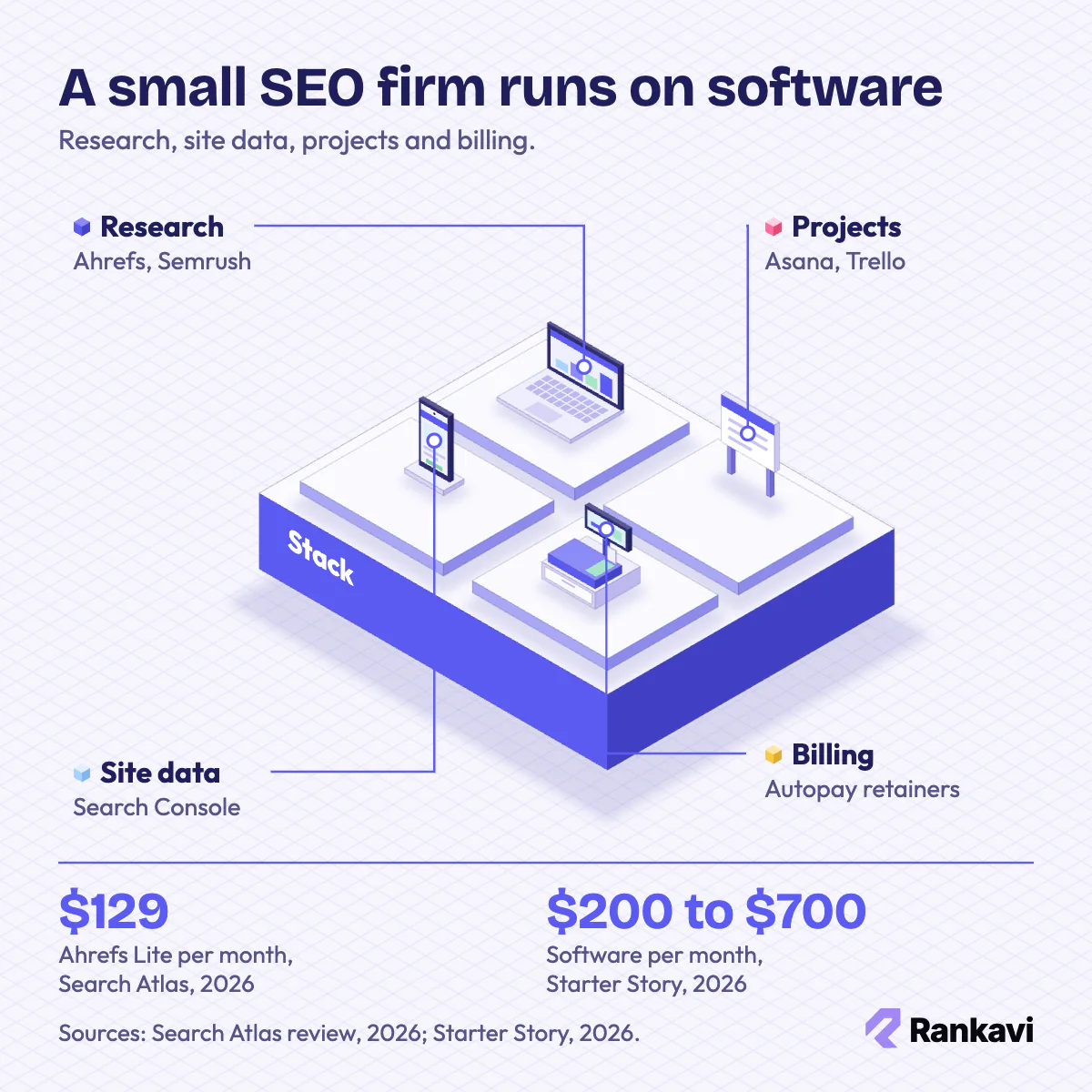
Core tool stack for an SEO business:
| Job | Typical tools |
|---|---|
| Keyword and backlink research | Ahrefs, Semrush |
| Site data | Google Search Console, Google Analytics |
| Project tracking | Asana, Trello, ClickUp |
| Invoicing and payments | QuickBooks, Stripe, PayPal |
Software is a steady monthly bill for this kind of business. Starter Story estimated total software spend at $200 to $700 per month in 2026.
The research suite is the first big choice. It finds keywords and backlinks, which are links to a site from other sites. Semrush is an online visibility and SEO software platform that competes with Ahrefs for agency budgets. The two overlap heavily, so one paid research suite is enough at first. A September 2026 Search Atlas review listed the Ahrefs Lite plan at $129 per month on monthly billing.
Free tools cover most other needs for the first client. Bing Webmaster Tools, Google Analytics 4 and Google Keyword Planner cost nothing. Every client site should connect to Google Search Console from day one.
As client work grows, three more jobs call for their own tools:
- Technical audits: Screaming Frog SEO Spider crawls sites, which means it scans each page for technical problems. PageSpeed Insights checks page speed.
- Client reporting: Looker Studio builds free client reports. AgencyAnalytics and DashThis offer white-label dashboards, which show the agency’s brand instead of the tool maker’s.
- Local work: Local work adds BrightLocal or Whitespark.
Client access needs care. Clients should grant delegated access in Google Search Console and Google Analytics 4 instead of sharing passwords. Delegated access lets the agency see the data under its own login. A password manager such as 1Password or Bitwarden stores any credentials that must be kept.
More clients also means more deadlines to track. One project tool holds every deadline and owner. That way, each task has a set date and a named person.
Billing works best when it repeats the same way each month. Retainers run best on autopay. Numbered invoices list each service, the due date and the payment methods.
Invoices show what a client pays, but not what the work costs in time. Harvest or Toggl tracks hours per client. Those hours show which retainers pay.
7. Win the First Clients
Winning first clients starts with trust rather than with paid ads. Former employers, local business owners and people who have seen the work are the warmest leads.
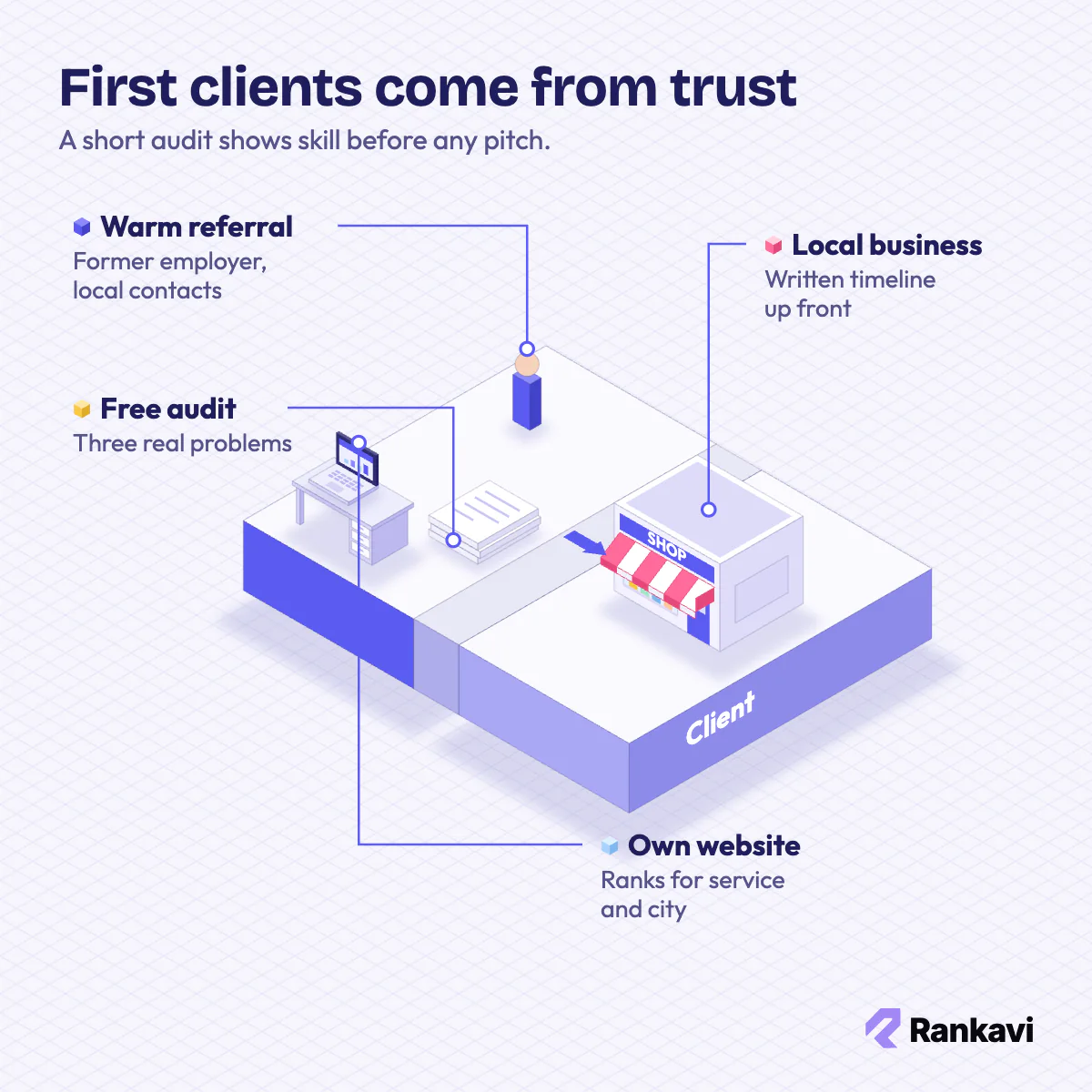
Trust drives the first sale, so warm leads come first. They rank by how much trust already exists, from most to least trusted:
- Former employers and friends who own businesses: These rank highest because they already know and trust the founder.
- Local networks: Groups such as chambers of commerce come next.
- Marketplaces: Directories and freelance sites come last.
Contacting strangers falls outside this circle of trust and brings legal rules. Anti-spam and data protection laws regulate cold email, and these laws differ by country.
Some businesses make easier first clients than others. Local service businesses that win customers through service-plus-city searches make the easiest first clients. Their results are visible.
Once a lead shows interest, the founder needs to prove skill. A short audit beats any sales deck. An audit is a review of a website that finds what holds it back. It names three real problems, what they cost and how to fix them. This shows skill instead of claiming it. The audit also counts as week one of the work.
The audit draws on four checks:
- Google Search Console: This Google tool shows indexing errors, which are pages Google has not added to its search results.
- PageSpeed Insights: This tool measures how fast the site’s pages load.
- Screaming Frog: This tool scans the site for broken links and missing page titles.
- Local listings check: This review finds missing business categories and inconsistent business details.
How the audit is delivered affects whether anyone reads it. A one-page PDF or a short Loom video gets read more often than a long report.
An audit shows skill on a prospect’s site, but the firm also needs proof on its own. The firm’s website should rank for its service and city. Google Business Profile is a free Google listing that shows a business on Maps and in local results.
Both act as live proof of skill. A firm with no clients yet can still build a first case study. A ranked proof site can supply it. So can a permitted pilot, which is a trial project done for a local business with the owner’s approval.
Case studies matter because they change the price conversation. Buyers who understand the work compare value instead of looking for the cheapest quote. Education builds that understanding, and case studies make the point faster than any explanation.
That understanding has to include time, because SEO takes months. The proposal should say so in writing. Clear timelines prevent early cancellations. Clients warned up front stay through the quiet period before results show.
The same honesty applies to promises. Rankings are never guaranteed. Promises that cannot be kept lead to cancellations. For this reason, three kinds of prospects are best declined:
- Prospects who demand a guaranteed first place: They want a promise no one can keep.
- Prospects who cannot fund the months before results: They cannot pay through the quiet period that SEO requires.
- Prospects who refuse site access: They will not let the firm into the website it is meant to improve.
8. Grow With Freelancers, Hires and Systems
Growth turns a one-person practice into a team that delivers without the founder. The shift starts with writing down every repeated task.
Outsourcing makes sense in two situations. The first is when delivery hours cap revenue. The second is when the founder’s time earns more on sales. In both cases, the founder gains by passing work to others.
The same logic decides what to pass on first. The weakest specialism is the first one to outsource. Repeatable work such as content drafts and reporting also goes first. Strategy and client communication stay with the founder.
Once the work is chosen, the agency needs people to do it. The options include the following:
- Freelancers: Freelancers absorb workload spikes. Upwork is a freelance marketplace where agencies find link-building and content specialists. Fiverr Pro, Contra and Toptal are further sources of specialists beyond Upwork. A paid test task on a low-risk deliverable shows a freelancer’s quality before a long engagement.
- White-label SEO provider: A white-label SEO provider is a partner that delivers work under the agency’s own brand. Clients never see the third party. Many agencies use one before hiring in-house staff. A white-label partner needs vetting through sample deliverables, a trial order and a clear answer on link sources. Providers that use private blog networks put the agency’s clients at risk under Google’s spam policies.
- Employees: Employees build lasting knowledge of clients and follow company processes.
Whoever does the work, the instructions shape the outcome. A precise brief decides the quality of the result.
The legal setup differs between these options. Freelancers and employees are classed differently for tax purposes, so local rules apply. Either way, a non-disclosure agreement and an intellectual property clause should cover the work. A non-disclosure agreement is a contract that keeps shared information private.
More people means more work to check. As volume grows, quality control becomes the bottleneck, the step that slows everything else down. Checklists and review steps belong in place before a client spots an error.
Retention grows from reporting outcomes. Clients want to know whether the work paid off and what comes next. A monthly report that answers both keeps retainers renewing.
9. Turn AI Answers Into Client Leads
AI visibility earns an SEO business a place in the answers business owners read before hiring. Many owners now ask Gemini, Perplexity or ChatGPT to suggest an SEO consultant.
ChatGPT is the AI assistant from OpenAI. These assistants lean on pages that other sites trust when they build an answer. So agency directories, review sites and “best SEO agencies” articles shape which firms get named. A young firm with a few of those mentions stands a better chance of appearing.
A firm can see where it stands by running a fixed set of prompts in each assistant every month. Owners type prompts such as “best SEO consultant for dentists in Austin”. The results show which firms get named and which pages get cited. Answers vary by user and change over time. For that reason, no firm can guarantee a placement.
Free groundwork on trusted pages comes first. Claimed profiles on directories such as Clutch and UpCity help, and so do reviews that name the service and industry. The same niche description should appear on the website and LinkedIn.
Google Analytics 4 shows referral traffic from chatgpt.com, which are visits that arrive through a link on another site. Some leads arrive as direct traffic instead, with no source attached. A source question on the contact form catches those leads.
Rankavi is a software as a service (SaaS) platform that publishes brand mentions in articles on indexed third-party websites. SEO consultancies can buy mentions from $12 each, and most go live in under 24 hours. Its page explains how an SEO consultancy can get named in ChatGPT when owners ask for a specialist.