

Starting an online fitness coaching business means selling expert training as a remote service. The U.S. Bureau of Labor Statistics (BLS), which publishes federal job data, counted 388,400 fitness trainer and instructor jobs in 2025.
I am Michal Sieroslawski, and I help online fitness coaching businesses get recommended in AI search. More clients now ask ChatGPT to recommend an online fitness coaching business, so showing up there matters.
The order moves from credibility to legal protection, then to an offer clients can buy and find. Each of the twelve steps below builds on the last, from online fitness coaching idea to first paying customer.
- Choose Your Fitness Coaching Niche
- Get a Recognized Fitness Certification
- Write a Simple Business Plan
- Register Your Business
- Protect Yourself With Insurance and Waivers
- Design Your Coaching Packages
- Price Your Coaching Services
- Set Up Your Filming and Training Gear
- Pick a Coaching Platform
- Market Your Coaching to First Clients
- Grow Through Retention and Referrals
- Show Up When Clients Ask AI
1. Choose Your Fitness Coaching Niche
Choosing a niche means deciding exactly which client the coaching business serves and which problem it solves. A narrow niche shapes the offer, the pricing and every marketing message that follows.
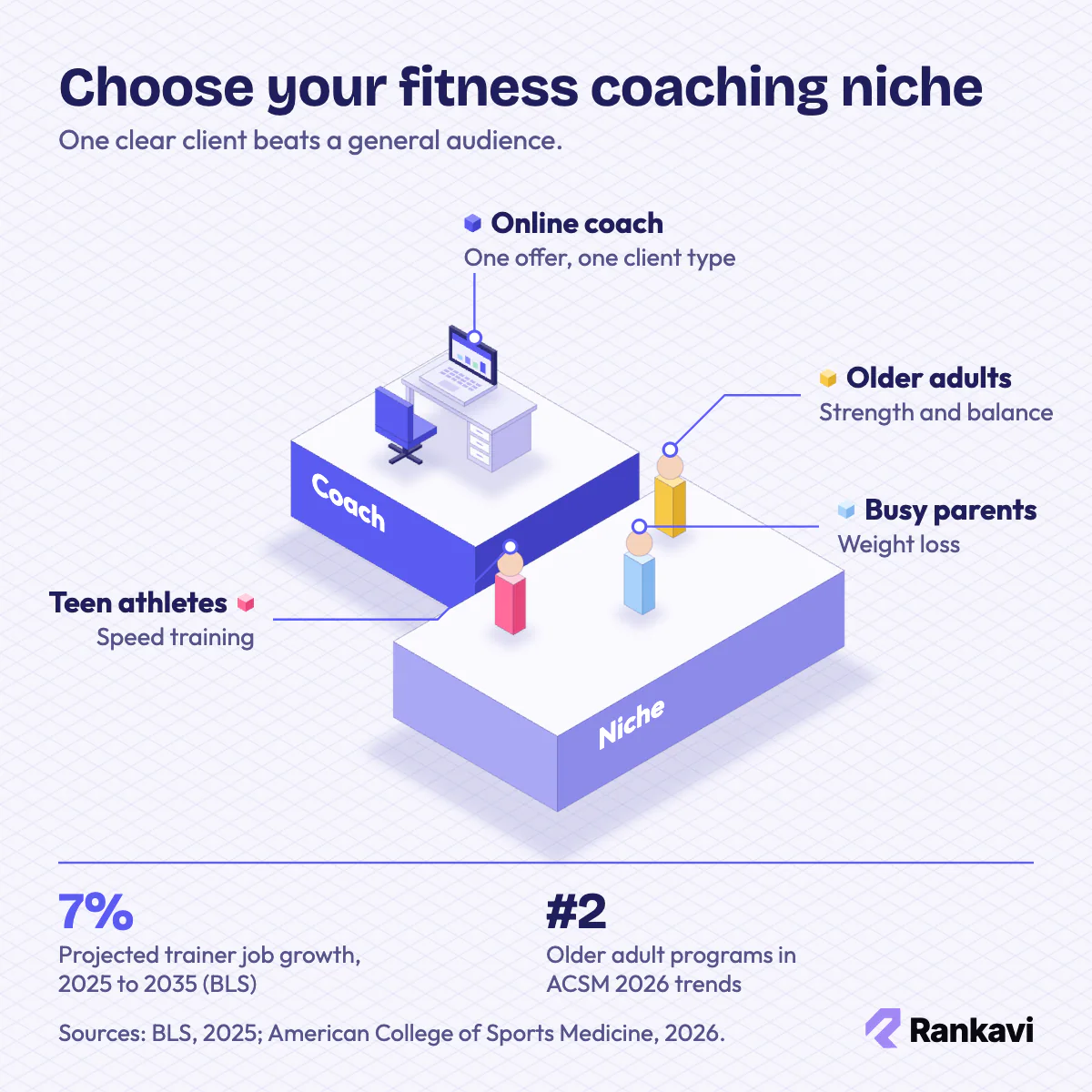
Anyone selling general “weight loss” coaching competes with everyone. Strength for older adults or speed training for teen athletes gives the coach a smaller, easier audience. That audience knows quickly whether the program fits.
Demand supports specialist niches. BLS projected 7 percent job growth for fitness trainers and instructors from 2025 to 2035.
Older clients are one strong bet. The American College of Sports Medicine (ACSM), which publishes a yearly trends survey, ranked fitness programs for older adults second in its 2026 trends.
Each coach also needs a unique selling proposition (USP), the reason clients pick one trainer. It often grows from the coach’s background, such as a past sport, diet or injury.
A niche that is too narrow leaves too few buyers, so a coach tests it first. Enough people must share the problem, want help with it and be able to pay.
A short look at competitors sharpens the niche. New coaches study who already serves the same client, what those coaches offer and where gaps remain. A simple buyer persona then captures the ideal client’s goals, schedule and habits.
“I also prefer to focus on the older clientele as I find they have more money, respond well to my advice…”
— A personal trainer on the T Nation forum
2. Get a Recognized Fitness Certification
Certification requires passing an accredited personal trainer or coaching exam before taking paying clients. Most places do not license online fitness coaches, so the certificate becomes the main proof of competence.

Certification and licensing are different things. A license is a legal permission from the government, while a certification is a credential from a private education body. Some areas still require permits for in-person training, so coaches check local rules before working across regions.
Any good program covers anatomy, exercise technique, client assessment and safe program design. Clients research coaches before hiring, and a respected credential answers their first question about safety.
Coaches look for programs accredited by the National Commission for Certifying Agencies (NCCA), which sets the benchmark for voluntary credentials. A credential without National Commission for Certifying Agencies approval carries less weight with clients and insurers.
Accredited exams cost real money. The National Academy of Sports Medicine (NASM), itself a certification seller, compared the main accredited options. Its 2026 prices ran from $939 for ACSM’s package to $3,450 for NASM’s top package.
Clients can check credentials on the United States Registry of Exercise Professionals (USREPS), which runs a public registry. It listed over 130,000 fitness professionals in 2026.
“…people always need to be on the lookout for self-taught “coaches” with no formal/organized training whose resume is just “See? I got myself into really good shape.””
— A trainer on the T Nation forum
A coach picks the certification that fits the niche. A general personal trainer credential suits broad strength and fitness clients. A niche with special needs, such as older adults, may call for a specialty course on top.
Learning continues after the exam. Certifying bodies require continuing education to renew the credential, and coaches who keep studying stay current with research and trends. Scope of practice matters too: coaches avoid giving medical advice or diagnosing injuries.
3. Write a Simple Business Plan
A business plan sets the direction for the coaching business on paper before money or time is spent. For an online coach, one or two pages will do, because the key assumptions are few: client count, monthly price and how long clients stay.
The plan covers the mission and ideal client, packages and prices, a startup budget and first-year client goals.
Startup money at a glance:
| Item | Online fitness coaching |
|---|---|
| Startup cost | About $1,130 to $3,900 for certification plus a first year of insurance and starter software; filming gear and a website come on top |
| Main costs | Accredited certification ($939 to $3,450), liability insurance (about $189 a year), coaching software ($0 to $23 a month for up to five clients), camera, lighting and website |
| Typical margin | No published margin survey for solo coaches; costs are small fixed fees, so margin rises with client count and falls with coach hours |
| Time to open | About 3 to 4 months, mostly 10 to 15 weeks of exam study, then setup |
Sources: National Academy of Sports Medicine (2025, 2026); Insure Fitness Group (2026); Trainerize (2026).
Since no rent or staff are involved, certification is usually the largest single check. The plan gets revised as the niche sharpens. It also names the biggest risks, such as too few leads or early quitters. For each, the plan states the coach’s response.
4. Register Your Business
Registering the business gives the coaching practice a legal identity that can sign contracts and accept payments. Most new coaches choose between a sole proprietorship and a limited liability company (LLC).
| Structure | Personal liability | Paperwork |
|---|---|---|
| Sole proprietorship | Owner is personally responsible for business debts | Minimal |
| Limited liability company (LLC) | Personal assets get more protection | More filings and fees |
Next comes a free employer identification number (EIN). The Internal Revenue Service (IRS) issues it immediately online, and banks ask for it.
The business name needs a check before registration. Coaches confirm that the name is unique, easy to say aloud and available as a domain and social handle. Many coaches simply use their own name, which builds a personal connection with clients.
Rules differ by state and city. Coaches check local requirements for business licenses and sales tax on digital services before the first payment.
A separate business bank account keeps coaching income apart from personal money. Banks usually ask for the business name, tax number, structure and formation documents. That separation also makes setting aside money for taxes much easier.
5. Protect Yourself With Insurance and Waivers
Insurance and waivers protect the coach if a client gets hurt while following a workout plan. Physical training always carries injury risk, even when the coach never meets the client in person.
Common protection documents:
| Document | What it covers |
|---|---|
| Professional liability insurance | Claims that the coaching advice caused harm |
| General liability insurance | Accidents, injury and property damage claims |
| Coaching agreement | Scope, payment terms, cancellation and liability limits |
| Waiver or informed consent | Client accepts the physical risks of exercise |
Cover is cheap for remote trainers. Insure Fitness Group sold an online trainer policy with $1 million per-occurrence liability limits for $189 a year in 2026. Certifying bodies also offer member discounts, so coaches compare both.
A lawyer reviews the coaching agreement and waiver for the coach’s location. Free online templates are not always enforceable. Every client signs both documents before the first program arrives.
Coverage depends on where the coach and clients live. The policy is checked for every state and country served. A coach stays inside the scope of the certification, because claims outside it can be refused.
Written policies prevent awkward conversations later. Clear rules for cancellation, rescheduling, refunds, payment and client conduct sit inside the agreement.
6. Design Your Coaching Packages
Package design turns the coach’s method into a product that a client can buy. An offer states the outcome, what is included and the timeframe.
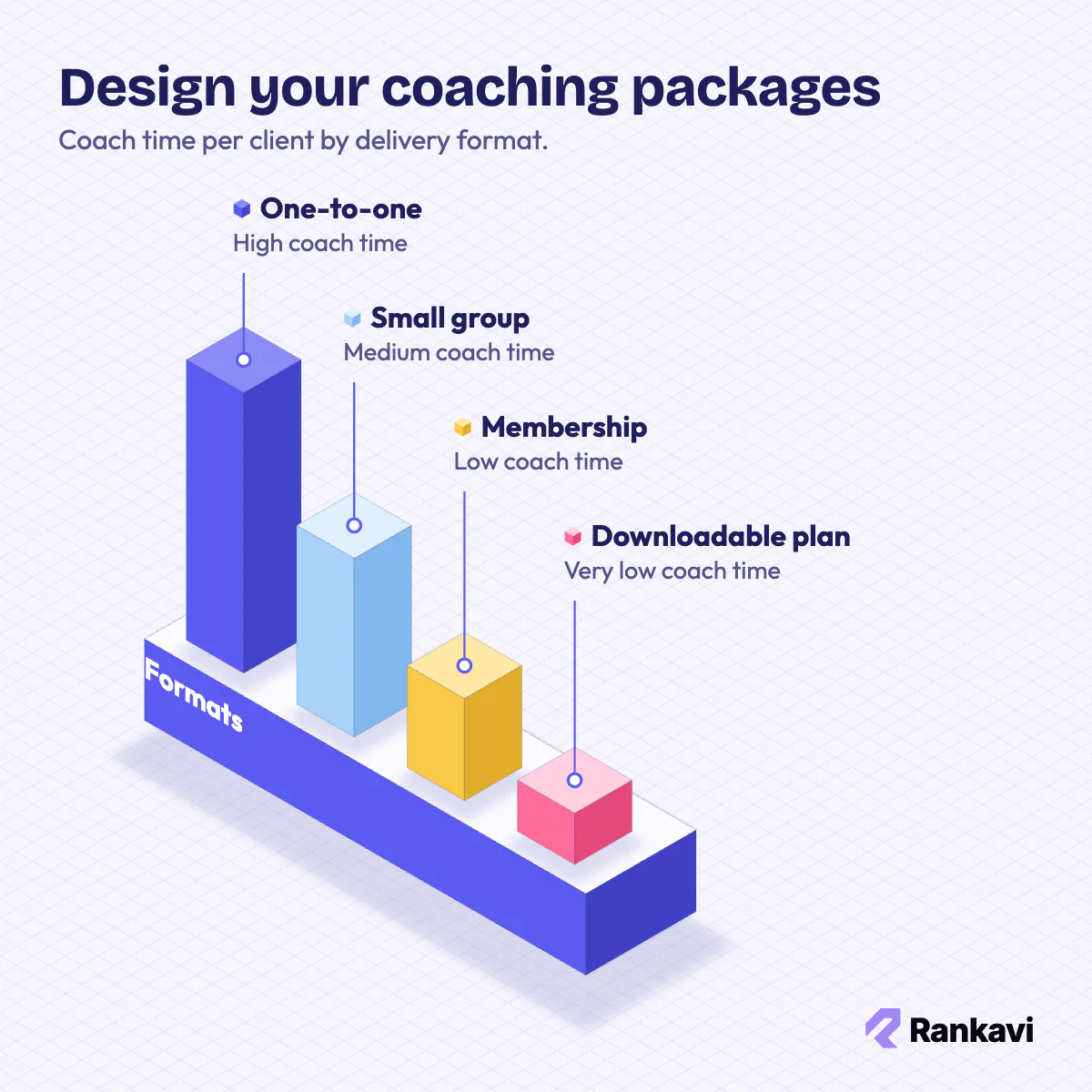
A vague offer like “online coaching” sells poorly. A specific offer names the client, the goal, the check-in rhythm and the support level. Coaches map the method backward from the end result to the first week.
Common delivery formats:
| Format | Typical client | Coach time per client |
|---|---|---|
| One-to-one coaching | Clients wanting full personalization | High |
| Small group coaching | Clients who enjoy shared motivation | Medium |
| Membership or course | Self-directed clients | Low |
| Downloadable plans | Budget-focused clients | Very low |
Each format trades coach time against price. One-to-one coaching earns the most per client but caps how many clients one coach can serve. Group and course formats reach more people at a lower price each.
A solid program includes an assessment, a workout plan, nutrition guidance where qualified, and goal setting. Two or three tiers serve different budgets. The difference between tiers stays obvious so prospects can choose without asking.
7. Price Your Coaching Services
Pricing decides whether the coaching business covers its costs and pays the coach a real income. Online coaches usually charge per package or per month rather than per hour.
Employed trainers set a floor for comparison. BLS reported a median annual wage of $47,160 for fitness trainers and instructors in May 2025, or $22.67 per hour.
Monthly packages beat hourly billing online. A fixed fee for a defined scope is easier for both sides to plan around. Clients pay for results and accountability, not minutes spent writing programs.
Retention is the number to check before setting any price.
Coachway, a coaching software company, tracked 5,666 clients of 201 Nordic coaches in 2026. Its 2026 figures showed 65% of clients still paying at month six. About 6.4% left each month in year one, and the average stay was 4.3 months in that 2026 sample. Every lost client must be replaced before income grows, so break-even depends on churn as much as on price.
A cost-based floor comes next. Coaches add personal and business expenses, include taxes and profit, then divide by the clients they can serve. Competitor rates in the same niche show whether that number fits the market.
Worked example: A coach spends $1,000 on certification and $189 on insurance. Software for five clients costs $23 a month. At $200 a month, five clients bring in $1,000 against about $39 of fixed costs. At 6% monthly churn, one of the five leaves roughly every three months. A four-month client is worth $800, so two clients repay startup. That excludes ads, pay and taxes.
Price also signals quality. A price far below the niche average can make a program look weak. A price far above it needs proof, such as results and reviews.
Some coaches price first clients lower in exchange for testimonials, then raise prices as results and demand grow.
8. Set Up Your Filming and Training Gear
The gear setup determines how professional the coaching looks on video calls and in exercise demonstrations. Packages decide the list. Written programs need little more than a phone, while live group sessions need a camera, light and microphone.
Online coaching needs six basic pieces of gear:
- A reliable laptop and smartphone
- A camera or phone tripod
- Soft lighting for clear video
- A microphone for calls and voiceovers
- A quiet corner or small home studio
- A small set of training equipment for demos
A clear picture and clean sound matter more than expensive equipment. Clients judge a coach by how easy the demonstrations are to see and hear.
Programs should match what clients actually own. Most home trainees lack a bench or rack. Coaches therefore build plans around bands, dumbbells and body weight.
Running from home keeps overheads low. Utilities, rent and cleaning staff, the fixed costs that sink many gyms, never appear on the budget.
9. Pick a Coaching Platform
A coaching platform keeps programs, check-ins, messages and payments in one place. Spreadsheets and scattered messaging apps stop working once the client list grows.
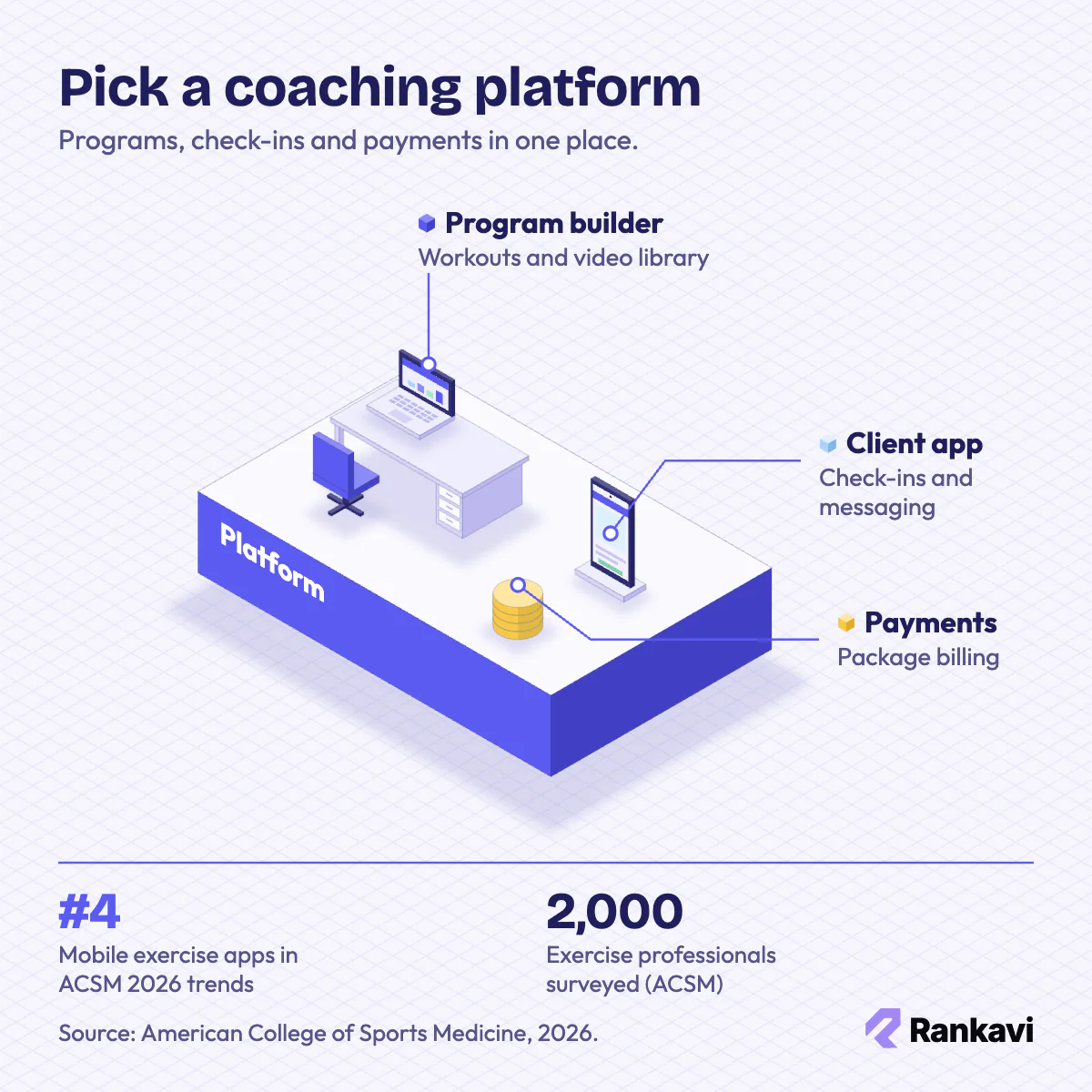
A coaching platform needs six core features:
- Workout program builder
- Exercise video library
- Payments and package billing
- Scheduled client check-ins
- In-app messaging
- Progress tracking and analytics
Trainerize, which offers program delivery and progress tracking, was free for one client in 2026. Its paid plans cost $9 a month for two clients and $23 a month for five in 2026, with prices rising as the client list grows. Superset, a New York City startup, offers a similar coach app.
Clients already expect app-based training: ACSM ranked mobile exercise apps fourth in its 2026 Worldwide Fitness Trends, based on a survey of 2,000 exercise professionals.
Coaches choose between an all-in-one coaching app and a mix of separate tools. An app saves setup time, while separate tools give more control but need more upkeep. A free trial shows whether the client experience feels simple.
A repeatable onboarding workflow saves hours each week. The sequence moves from intake form to signed agreement and payment. The first program and a fixed weekly check-in day follow.
A few numbers deserve attention from the first client. Check-in adherence, renewal rate and lead-to-client conversion show where the business leaks clients before cancellations arrive.
10. Market Your Coaching to First Clients
Marketing puts the coaching offer in front of the clients who need it most. Online coaches rarely meet prospects in person, so the website and social profiles do the selling.
A coaching website explains the services, shows samples of the method and carries a clear call to action. The site loads fast and presents the coach as an authority in the chosen niche.
Social media brings most early leads. Coaches focus on one or two platforms where their clients spend time, such as Instagram, TikTok, YouTube or Facebook groups. Short exercise demos and client wins work well.
Many new coaches train a few people for free first. Friends, family and coworkers who match the target client provide practice, results and testimonials. Those testimonials then appear on the website and social posts.
A coach picks channels by where the niche already spends time. Older adults may respond to Facebook groups and email, while younger athletes favor short video. Posting steadily on one channel beats posting rarely on four.
Free resources attract the right prospects. Lead magnets such as short challenges, workout guides or webinars collect contact details and lead to a coaching application form.
11. Grow Through Retention and Referrals
Growth involves keeping current clients longer and turning their results into referrals. Coachway’s 2026 data showed the steepest losses between months three and six, about 7.5% a month, so renewal planning starts well before a package ends.
Fast replies, adjusted programs and regular feedback requests keep clients through that window. Renewal conversations happen in month two or three, not in the final week.
Word of mouth remains the strongest channel. Satisfied clients refer friends, and referral rewards or affiliate commissions encourage more introductions. Partnerships with coaches in nearby niches widen the reach.
Clients also stay when progress is visible. Regular measurements, photos or lift records show results, and results give clients a reason to renew.
An email list becomes a long-term asset. Paid ads on Facebook speed up growth once the offer converts. Group programs or courses then let one coach serve many more clients.
12. Show Up When Clients Ask AI
AI visibility means a coaching business gets named when prospects ask ChatGPT, Gemini, Perplexity or Google AI Overviews for a coach. Those prompts are often narrow, such as “an online strength coach for women over 50” or “a coach for first-time marathoners”. To answer them, assistants draw on outside pages: coach directories, podcast show notes and “best online fitness coaches” roundups.
This is where a tight niche pays off twice. Mentions that spell out the client and the goal give the assistant a clear match to quote. A generalist blurs into the crowd.
Rankavi is a software as a service (SaaS) platform that publishes brand mentions in articles on indexed third-party websites. Coaches can order articles from $12 each, and most go live in under 24 hours. Coaches focused on ChatGPT answers can read its page on ChatGPT mention placements.