

Starting an online business takes a model that fits the founder’s skills, proof of demand and a legal entity. Online sales made up 17.1% of U.S. retail sales in the second quarter of 2026, a Census Bureau estimate released in August 2026.
My name is Michal Sieroslawski, and I’m an entrepreneur who helps online businesses get found online. Many customers now begin their search for an online business inside an AI chat. Those suggestions often decide who gets contacted first.
The order tests the idea and sets a budget before money goes into it. It makes the business legal before the first sale and builds marketing on a working store. To start an online business, follow the twelve steps below.
- Choose Your Online Business Model
- Validate Demand Before Building
- Write a Simple Business Plan
- Price Your Products and Services
- Budget for Startup Costs
- Register Your Online Business
- Build Your Website or Storefront
- Follow Tax and Privacy Rules
- Set Up Payments and Fulfillment
- Market the Launch
- Grow With Outsourcing and Automation
- Get Named in AI Answers
1. Choose Your Online Business Model
An online business model decides what the business sells, how it delivers the offer and how it earns money. That one choice sets the budget, the wait for first revenue and the margin left after each sale.
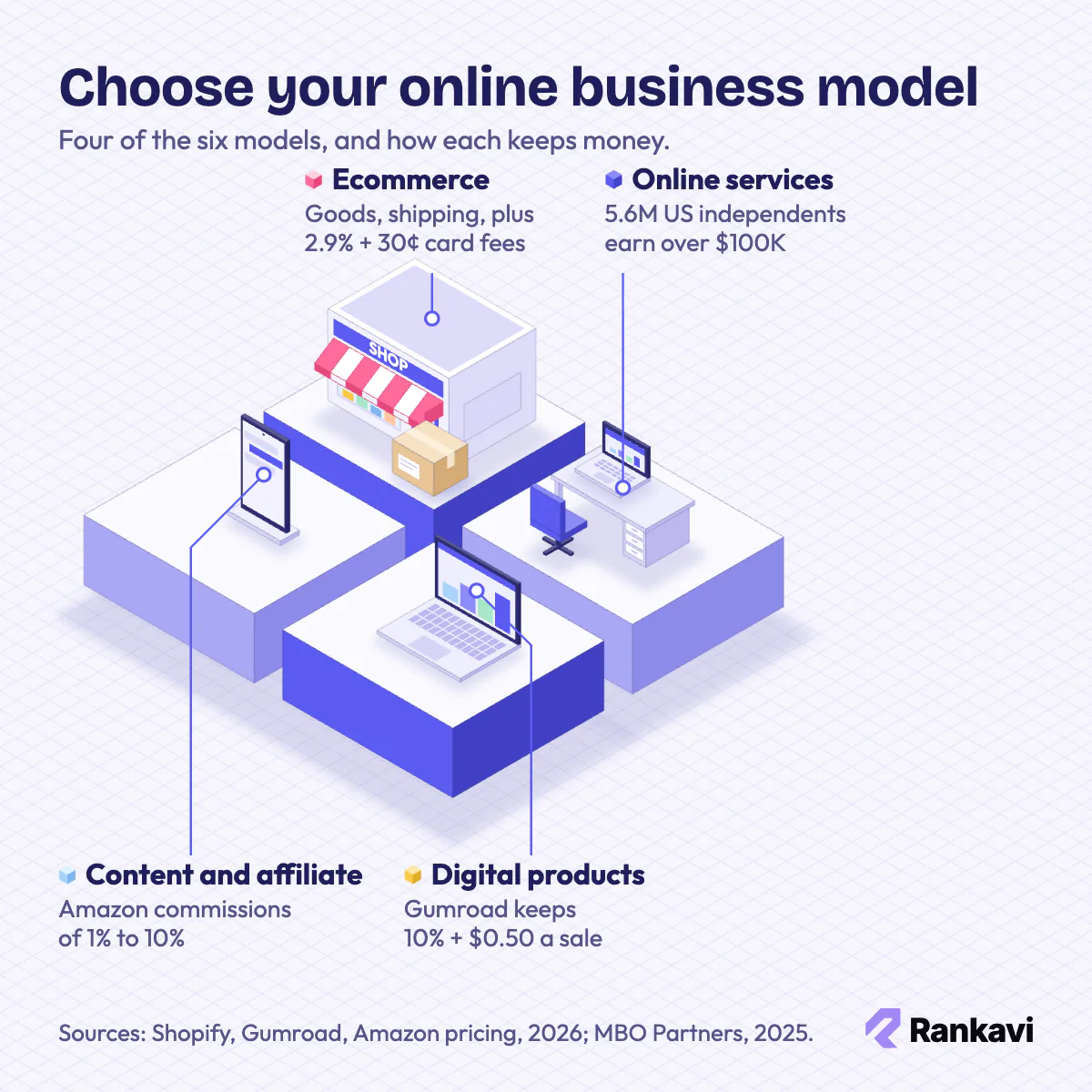
Six online business models cover most of what a beginner picks from:
- Ecommerce: These stores sell physical goods such as candles, pet accessories, skincare or home decor. The U.S. Census Bureau, which publishes federal retail data, put ecommerce sales at $340.2 billion in the second quarter of 2026. Stock ties up cash before any sale. Card fees then trim each order. Shopify runs a hosted store platform. On its U.S. Basic plan, it charges 2.9% plus 30 cents per online card sale in 2026. Product sellers also choose where the store lives. Etsy, Amazon Seller Central and eBay are marketplaces where shoppers already search. In 2026, Etsy charges $0.20 per listing plus a 6.5% transaction fee. Amazon charges $0.99 per item sold on its Individual plan, or $39.99 a month on Professional, in 2026. WooCommerce is a free store plugin for WordPress sites. An owned store on Shopify or WooCommerce trades those ready buyers for control. The owner keeps the customer list and the brand but must attract every visitor. Marketplace sellers rent traffic that fee or policy changes can cut.
- Dropshipping and print-on-demand: These remove the stock purchase. Printful and Printify are print-on-demand services that print shirts, mugs or posters after each order. Dropship suppliers on AliExpress or Spocket ship goods straight to the buyer. The trade-off is thinner margins, slower shipping and less control over quality.
- Freelance and consulting: This work sells skills like web design, bookkeeping, copywriting or video editing. A laptop and a portfolio cover most of the setup, so the first invoice can follow the first signed client. Income stops when billable hours stop. Still, MBO Partners, a workforce-management firm, counted 5.6 million U.S. independents earning over $100,000 in 2025. Upwork and Fiverr are freelance marketplaces where many beginners land their first clients. Both take a fee from every job. Clients found through referrals or outreach pay the full invoice.
- Digital products: These include online courses, spreadsheet templates, ebooks and small software tools. They cost time rather than cash to create. Each extra copy costs almost nothing to deliver. Selling through a storefront adds a cut. On Gumroad, a creator storefront, the fee is 10% plus $0.50 per direct sale, as of 2026.
- Memberships and software: These sell recurring access instead of one-time copies. Patreon and Substack are subscription platforms for paid communities and newsletters, and each keeps 10% of paid income in 2026. A software-as-a-service (SaaS) tool bills users monthly for a hosted app. Recurring revenue is easier to forecast, but every renewal must be earned.
- Content and affiliate sites: These include product review blogs, niche newsletters and YouTube channels. They earn from ads, sponsorships and commissions. Display ads pay by traffic. Google AdSense is Google’s self-serve ad program. Mediavine runs an entry program that asks for 1,000 monthly sessions from tier-1 countries in 2026. Raptive is an ad management firm that lowered its entry bar to 25,000 monthly pageviews in October 2025. Commissions come from affiliate programs instead. In 2026, Amazon Associates pays fixed commissions from 1% on grocery to 10% on luxury beauty. Affiliate networks such as Impact, CJ Affiliate and Awin add brands beyond Amazon. A 2025 Ahrefs study found only 1.74% of newly published pages reached Google’s top 10 within a year.
Set next to each other, the six models split along cost, speed and margin.
Online business models compared:
| Model | Idea examples | Where it sells | Typical startup cost | Time to first revenue | Margin profile |
|---|---|---|---|---|---|
| Ecommerce | Candles, pet gear, skincare | Own store (Shopify, WooCommerce) or marketplace (Etsy, Amazon, eBay) | Highest: stock, samples, shipping supplies | Weeks after stock arrives | Thin: goods, shipping and 2.9% + 30 cents card fees per order, plus marketplace fees |
| Dropshipping and print-on-demand | Custom shirts, mugs, posters | Printful, Printify, AliExpress and Spocket suppliers | Low: samples and ads, no stock | Weeks, once listings and ads run | Thinner than stocked goods: supplier markup, ads and fees per order |
| Freelance and services | Web design, bookkeeping, copywriting | Upwork, Fiverr, direct clients | Lowest: laptop, portfolio, software | Days to weeks, once a client signs | High per hour, capped by billable hours; marketplaces take a fee |
| Digital products | Courses, templates, ebooks | Gumroad, Teachable, Kajabi, Podia | Low cash, high creation time | Months: build first, then launch | High: Gumroad keeps 10% + $0.50 per direct sale |
| Memberships and software | Paid newsletters, communities, SaaS tools | Patreon, Substack, own app | Low for memberships; high build time for software | Months to build a paying base | High and recurring: Patreon and Substack keep 10%; cancellations cut it |
| Content and affiliate | Review blogs, free newsletters, YouTube | Amazon Associates, Impact, CJ Affiliate, Awin; AdSense, Mediavine, Raptive | Low cash, ongoing publishing time | Often a year or more for search traffic | Commissions of 1% to 10% on Amazon, almost no cost of goods |
Sources: Shopify US pricing, 2026; Etsy and Amazon seller fees, 2026; Gumroad, Patreon and Substack pricing, 2026; Amazon Associates fee schedule, 2026; Ahrefs, 2025.
Customer type changes the sale. Business-to-business (B2B) buyers place fewer, larger orders after longer approvals. Consumers buy smaller orders faster.
Scale and exit value differ too. Services grow only with more hours or staff. Products, software and content add buyers without adding hours. Flippa and Empire Flippers are marketplaces where content sites, stores and software businesses change hands. A freelance practice built on one person’s skill is harder to sell.
The best fit matches cash on hand to patience. A founder with savings but little time leans toward a store. One with skills but no savings starts with services. One model should lead at launch. A second can share the same audience once the first pays.
2. Validate Demand Before Building
Demand validation shows whether strangers will pay before the founder spends on stock, code or content. A single paid pilot validates services. Products need a preorder or a small first batch.
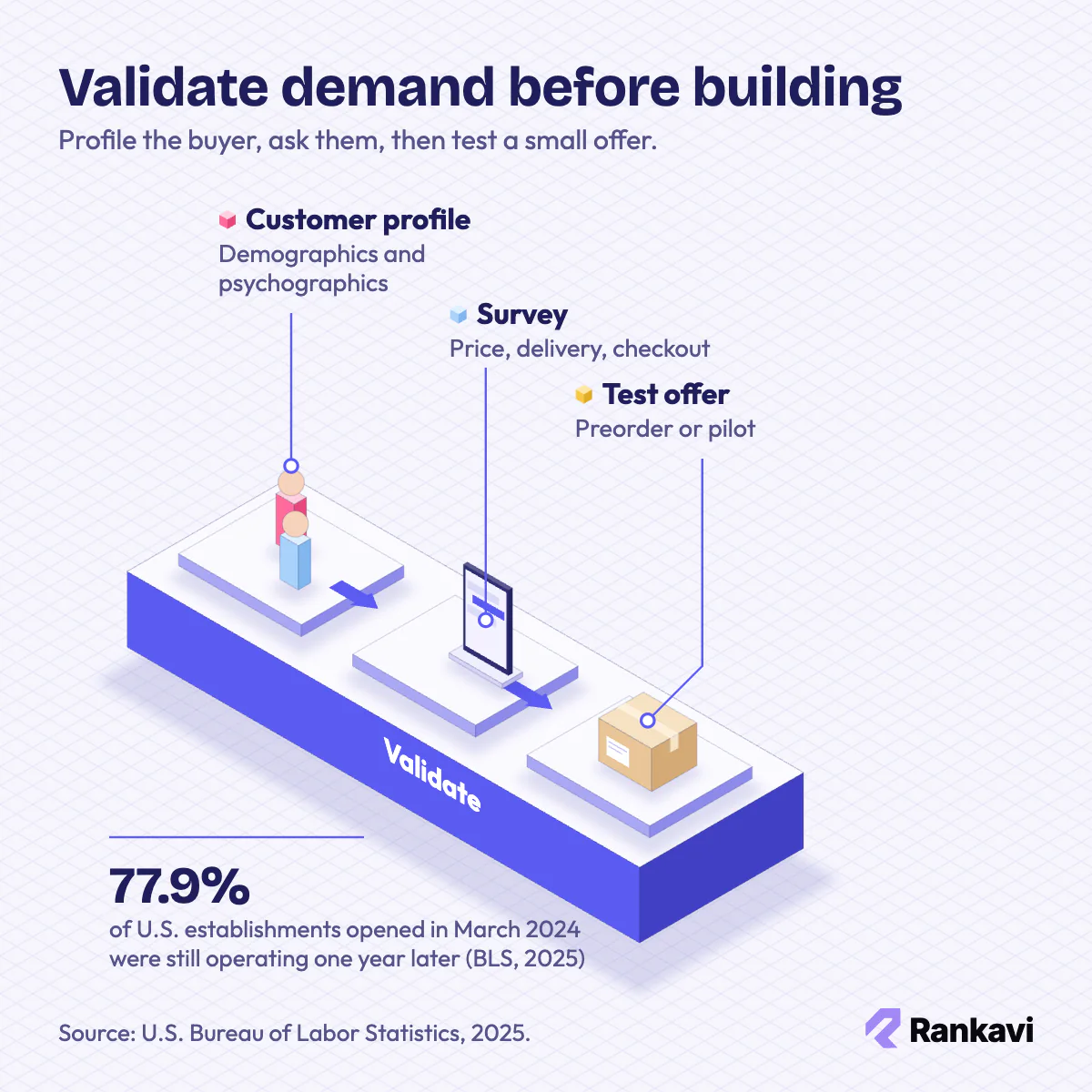
The test starts with a short customer profile: who buys, what problem they search for and what they pay today. Negative reviews on Amazon, Trustpilot and Reddit threads about rival products point to the gaps a new offer can fill.
A profile names the buyer but not how many buyers exist. Search data answers that before any interview. Google Trends is a free Google tool that shows whether interest in a product rises, falls or peaks by season. Google Keyword Planner estimates how many people search for the problem each month.
Search counts show how many people look, not why they look. Interviews cover that, and they work best on past behavior. The Mom Test, a book by Rob Fitzpatrick, teaches founders to ask what people already paid for.
Free tools such as Google Forms collect answers about price, delivery speed and checkout habits in minutes.
Survey answers, though, overstate buying intent. A preorder page, one marketplace listing or a paid pilot package shows whether people actually reach for a card. That live test is a minimum viable product (MVP): the smallest offer that still asks for money. A first paid test can take one of four forms:
- Preorder page: A one-page Carrd site can take preorders or waitlist sign-ups.
- Marketplace listing: One marketplace listing also asks for money.
- Crowdfunded preorder: Kickstarter and Indiegogo host crowdfunded preorders for physical products.
- Paid pilot package: Business clients can sign a letter of intent or pay a deposit.
Each format needs a pass mark, such as a target count of preorders, set before the test starts.
Testing first matters because many new businesses do not last. The U.S. Bureau of Labor Statistics (BLS) publishes federal survival data. Its 2025 table shows 77.9% of establishments opened in March 2024 were still operating one year later. The same 2025 BLS table shows only 34.7% of those opened in March 2015 survived ten years.
3. Write a Simple Business Plan
An online business plan sets one assumption above the rest: how many visitors become paying customers. Everything else, from ad budget to stock orders, follows from that rate. How much detail has to surround that rate depends on who reads the plan.
A solo founder can start with a one-page Lean Canvas. The Lean Canvas is a single-page layout, mapping customers, problem, offer, channels and costs. Lenders expect a longer traditional plan with full financials instead. The U.S. Small Business Administration (SBA), the federal agency for small business, offers free templates for both formats.
A typical business plan covers five sections:
- Executive summary: a short opening that covers the whole plan.
- Market analysis: a strengths, weaknesses, opportunities and threats (SWOT) review of the market.
- Offer and pricing: what the business sells and what it charges.
- Marketing and sales channels: how customers find the business and buy from it.
- Financial projections: average order value, customer acquisition cost, meaning what it costs to win one buyer, and the break-even month.
A plan also sets goals. Short-term goals cover the launch, including a live site and ten first customers. Long-term goals set a revenue target and the month the business should cover its own costs.
Online revenue arrives in five main forms:
- One-time orders: the customer pays once, at the moment of purchase.
- Subscriptions: the customer pays again on a set schedule.
- Client retainers: a client pays a regular fee for ongoing work.
- Commissions: the business earns a share of each sale it brings in.
- Advertising: advertisers pay to reach the site’s audience.
Each form has a different cash cycle, so money reaches the bank at a different speed. A plan names the main model and a fallback.
4. Price Your Products and Services
Pricing decides whether each sale covers its costs and still pays for the ads that brought it. It belongs in the plan, before money goes into a site or stock.
Most launches set that price with one of these methods:
- Cost-plus pricing: This method starts with landed cost and adds a markup on top.
- Keystone pricing: This is cost-plus made simple. The seller doubles the landed cost and sells at that number.
- Competitor-based pricing: Here the seller ignores cost as a starting point and matches the going rate. The market sets the number.
- Value-based pricing: This method charges what the result is worth to the buyer. Cost and competitors both step aside.
Physical products need a floor before any markup makes sense, and that floor is landed cost. Landed cost is the full price of getting one unit ready for a buyer. It covers the goods, packaging, shipping, platform fees and payment fees.
Among these, card fees at Shopify’s 2026 U.S. rate eat into small orders most. Whatever markup sits above that cost must leave enough gross profit to pay for winning the next customer.
Selling on a marketplace raises that floor again. The marketplace takes a referral fee, a cut of each sale, so it gets added to landed cost. Amazon’s referral fees run from 5% to 45% of the sale price in 2026, depending on the category.
For services, the price starts from an income target instead, divided by realistic billable hours. Billable hours are the hours a client actually pays for, which is not a full 40-hour week. Many freelancers move to project or retainer pricing to escape that cap.
A fixed project fee or day rate only holds if the work stays inside its lines. A written scope of work keeps it there by listing what the fee includes. Requests outside that list then become paid change orders.
Digital products flip the problem, because each copy costs almost nothing to make. Cost gives no useful floor, so these products price on value. A check of competitor prices shows the range buyers already accept. Software and memberships often sell good, better and best tiers. Some add a free plan.
Affiliate sites set no prices at all. Earnings follow the commission rate of each product they recommend. Rate alone can mislead, because conversion differs by product. Earnings per click, the average value of one visitor click, compares offers more honestly.
5. Budget for Startup Costs
A startup budget shows how many months the business can run before sales cover the bills. Most online founders self-fund, so the budget doubles as a personal savings plan.
To get that number, the budget has to separate money spent once from money spent every month. A startup budget for an online business holds five kinds of lines:
- One-time costs: These are paid once at the start. They cover the logo, samples and first stock.
- Monthly costs: These repeat for as long as the business runs. They cover platform plans, apps and ads.
- Contingency line: This covers surprises.
- Tax reserve: This holds back money for income and self-employment tax.
- Living costs: These need separate savings.
Most solo launches stay small. The SBA, the federal small business agency, tracks how founders fund them. Its Office of Advocacy, reporting Federal Reserve survey data in 2024, found 58% of firms without employees took on no startup debt.
Only 17% of those solo firms used more than $25,000, the same 2024 report shows. Funded launches run larger: 27% of employer firms started with over $100,000 in debt, per that 2024 data.
Startup money at a glance:
| Item | Online business |
|---|---|
| Startup cost | Lean solo launch: under $25,000, from about $468 a year for a store plan; funded launch with staff: over $100,000 for about a quarter of employer startups |
| Main costs | Platform plan ($39 a month on Shopify Basic), card fees (2.9% + 30 cents per sale), stock and shipping for product stores, ads, optional federal trademark filing |
| Typical margin | Gross, by model: thinnest for ecommerce; high for services and digital products; affiliate commissions of 1% to 10% with almost no cost of goods |
| Time to open | Days to weeks for a service or simple store; often a year or more before search traffic pays a content site |
Sources: SBA Office of Advocacy, 2024; Shopify, Gumroad and Amazon US pricing, 2026; Ahrefs, 2025.
Once the monthly bill is set, the next question is how many visitors it takes to pay it. Store owners check conversion rate first: the share of visitors who buy. Dynamic Yield’s benchmark of more than 400 brands, cited by Shopify in 2026, puts the average at 2.66%. Break-even traffic equals monthly costs divided by gross profit per order, divided by that rate.
Worked example: Picture a solo store selling a $50 product that costs $25 landed. Card fees take $1.75, so each order leaves $23.25. Monthly costs are the $39 platform plan plus $400 in ads, $439 in total. Covering $439 takes 19 orders a month. At a 2.66% conversion rate, that means roughly 715 visitors a month. This sketch is illustrative and leaves out owner pay, taxes and refunds.
Services and digital products skip landed cost and shipping, so they break even with far fewer visitors.
Until the store reaches that traffic, runway cash usually comes from one of three sources:
- Savings: Personal savings usually fund the runway.
- A day job: A paycheck from a day job is the other usual source.
- Small loans: The SBA backs microloans for owners who need a small loan. Kiva, a nonprofit lender, offers 0% interest loans of $1,000 to $15,000 to U.S. small businesses in 2026.
6. Register Your Online Business
Registration turns a side project into a legal entity that can sign contracts and hold a payment account. The structure picked here sets whether business debts can reach the owner’s personal money. Solo online sellers usually weigh a sole proprietorship against a single-member limited liability company (LLC). Three structures come up most often:
- Sole proprietorship: It needs no state filing at all. The owner carries every debt personally, so business claims reach personal money.
- Single-member limited liability company (LLC): It shields personal savings from business claims instead. That protection matters once customer data and refunds enter the picture. Creating one takes a state filing.
- Corporation: It suits founders planning to raise outside money.
In most states, forming an LLC starts with filing articles of organization with the Secretary of State. The filing names a registered agent, who accepts legal papers. A short operating agreement then records ownership. Banks often ask to see one.
Choosing a business name requires a state registry search and a trademark search. A brand differing from the legal name needs a doing business as (DBA) filing. A name destined to become a domain and a brand deserves federal protection. The U.S. Patent and Trademark Office is the federal agency that registers trademarks. It charges a $350 base fee per class as of 2026, a rate set in January 2025.
The Internal Revenue Service (IRS), the federal tax agency, issues an employer identification number online for free. Payment processors usually ask for that number. A separate business bank account then keeps payouts out of personal money, protecting an LLC’s liability shield.
An LLC can later elect S corporation tax treatment on IRS Form 2553. That election changes how profit is taxed, not the legal entity.
7. Build Your Website or Storefront
For an online business, the website is the address, the shop window and the checkout at once. Visitors judge credibility in seconds, so the offer must be clear above the fold.
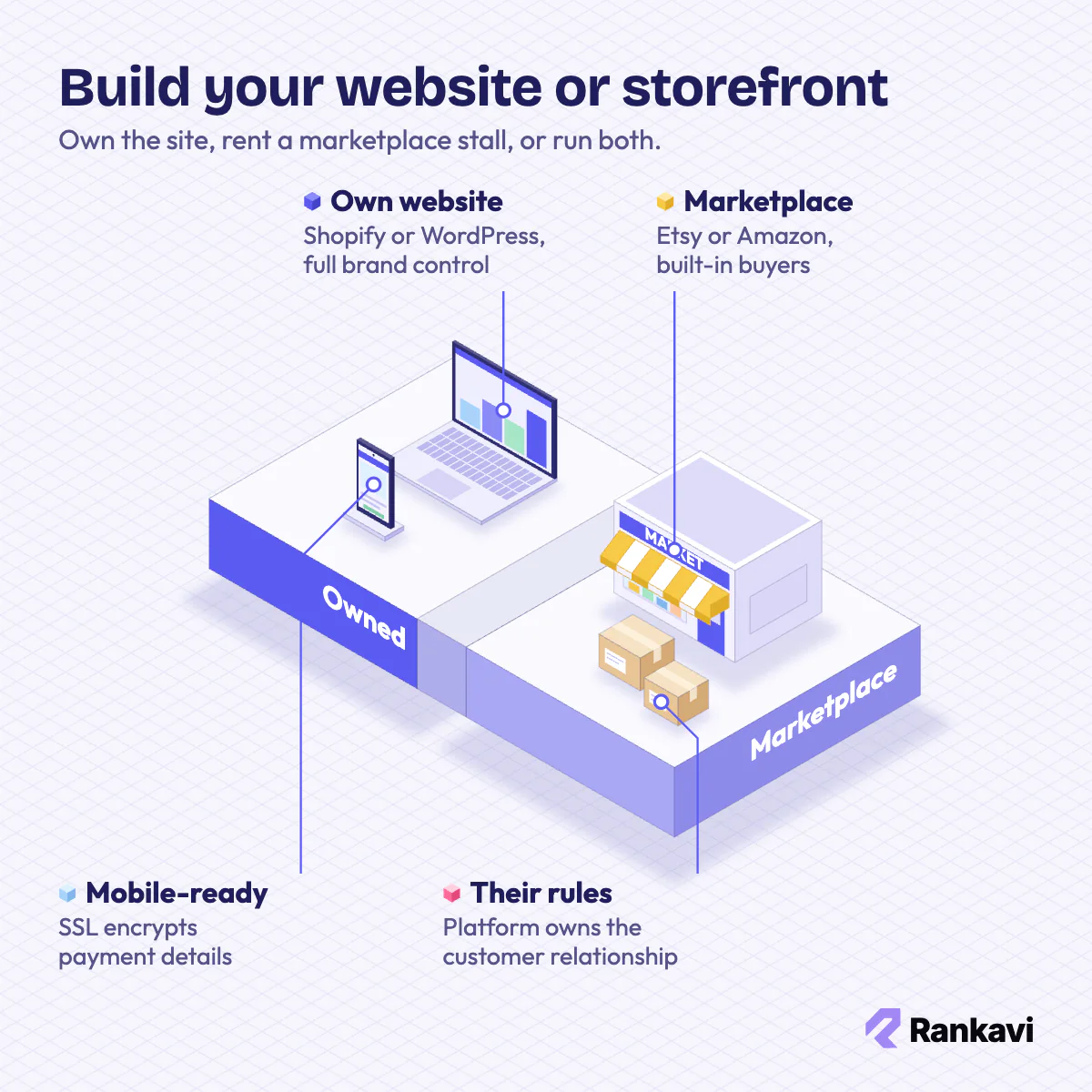
The address starts with a domain name. A domain should match the business name and be easy to spell. Registrars such as GoDaddy and Namecheap sell them. Many builders include one.
Product sellers often pick Shopify, a hosted store builder that runs the site on its own servers. Its Basic plan costs $39 a month in the U.S. as of 2026. Squarespace and Wix are hosted store builders too. They sell design-led templates with drag-and-drop editors, and hosting is included.
Bloggers and service firms often use WordPress. Self-hosted WordPress is free software. It needs paid hosting from a company such as Bluehost or SiteGround. The WooCommerce plugin then adds a cart and checkout.
Etsy is a handmade and vintage marketplace that brings ready buyers. It keeps the customer relationship. Those platforms fall into three types:
| Platform type | Examples | Best fit |
|---|---|---|
| Hosted store builder | Shopify, Squarespace, Wix | Product stores |
| Content management system | WordPress | Content, affiliate and service sites |
| Marketplace | Etsy, Amazon | Sellers who want built-in traffic |
A first store needs a home page, product pages, an about page, contact details, an FAQ and a returns page.
Those pages have to work on a small screen, because many shoppers buy on phones. Contentsquare retail data, cited by Shopify in 2026, shows conversion at 3.7% on desktop and 2% on mobile.
The checkout needs protection as well as a workable layout. A Secure Sockets Layer (SSL) certificate encrypts checkout data. Most builders include one. Let’s Encrypt issues free certificates for self-hosted sites.
Page speed matters too. Google PageSpeed Insights scores pages on Core Web Vitals, Google’s loading and stability measures. Google Search Console shows whether Google has indexed each page.
8. Follow Tax and Privacy Rules
Online compliance covers the licenses, taxes and data rules that apply even without a storefront. A business address and a live site now make these filings possible.
Common compliance items:
| Item | What it covers |
|---|---|
| Business license | Local or state permission to operate |
| Industry license | Regulated fields such as food, health and finance |
| Sales tax registration | Tax collection in states where the business has nexus |
| Resale certificate | Buying stock for resale without paying sales tax on it |
| Federal tax filings | Self-employment tax, quarterly estimates and Form 1099-K |
| Privacy policy | How customer data is collected and used |
| Terms, refund and return policies | Consumer protection disclosures |
| Annual report | State filing that keeps the entity in good standing |
Among these items, sales tax applies wherever the business has nexus. Nexus is a legal tie to a state created by presence or sales volume. Sales volume alone has been enough for nexus since the Supreme Court’s 2018 South Dakota v. Wayfair ruling.
Many store platforms calculate and collect this tax automatically. Etsy collects and remits sales tax on its sellers’ orders under state marketplace facilitator laws.
Beyond sales tax, profit carries a separate federal tax bill. The IRS sets self-employment tax at 15.3% in 2026, due on net earnings of $400 or more. Owners who expect to owe usually pay quarterly estimates. Payment apps and marketplaces also report earnings to the IRS. In 2026, they file Form 1099-K once a seller passes $20,000 across more than 200 transactions.
Alongside tax duties, privacy rules cover the customer data a site collects. A posted privacy policy is the first step, and four laws decide which rules apply to a given site:
- California Online Privacy Protection Act (CalOPPA): This state law covers commercial websites. It requires a policy on any site collecting personal data from California residents.
- California Consumer Privacy Act (CCPA): This is a broader state privacy law. In 2026, California’s attorney general lists over $25 million in gross annual revenue as one trigger.
- General Data Protection Regulation (GDPR): This is the European Union’s data law. It applies when a business sells to people in the union.
- Children’s Online Privacy Protection Act (COPPA): This is a federal law that covers sites aimed at children under 13. It also covers general sites that knowingly collect data from those children.
Beyond privacy, clear terms on returns, shipping costs and warranties answer most buyer questions before checkout. Affiliate and content sites also need visible ad and endorsement disclosures. The Federal Trade Commission (FTC) enforces those disclosures.
The FTC also enforces a federal anti-spam law that covers marketing emails. Each email needs honest sender details, a postal address and a working opt-out link.
9. Set Up Payments and Fulfillment
Payments and fulfillment connect a customer’s click to money in the bank and an order at the door. Services and digital products skip most of the fulfillment side.
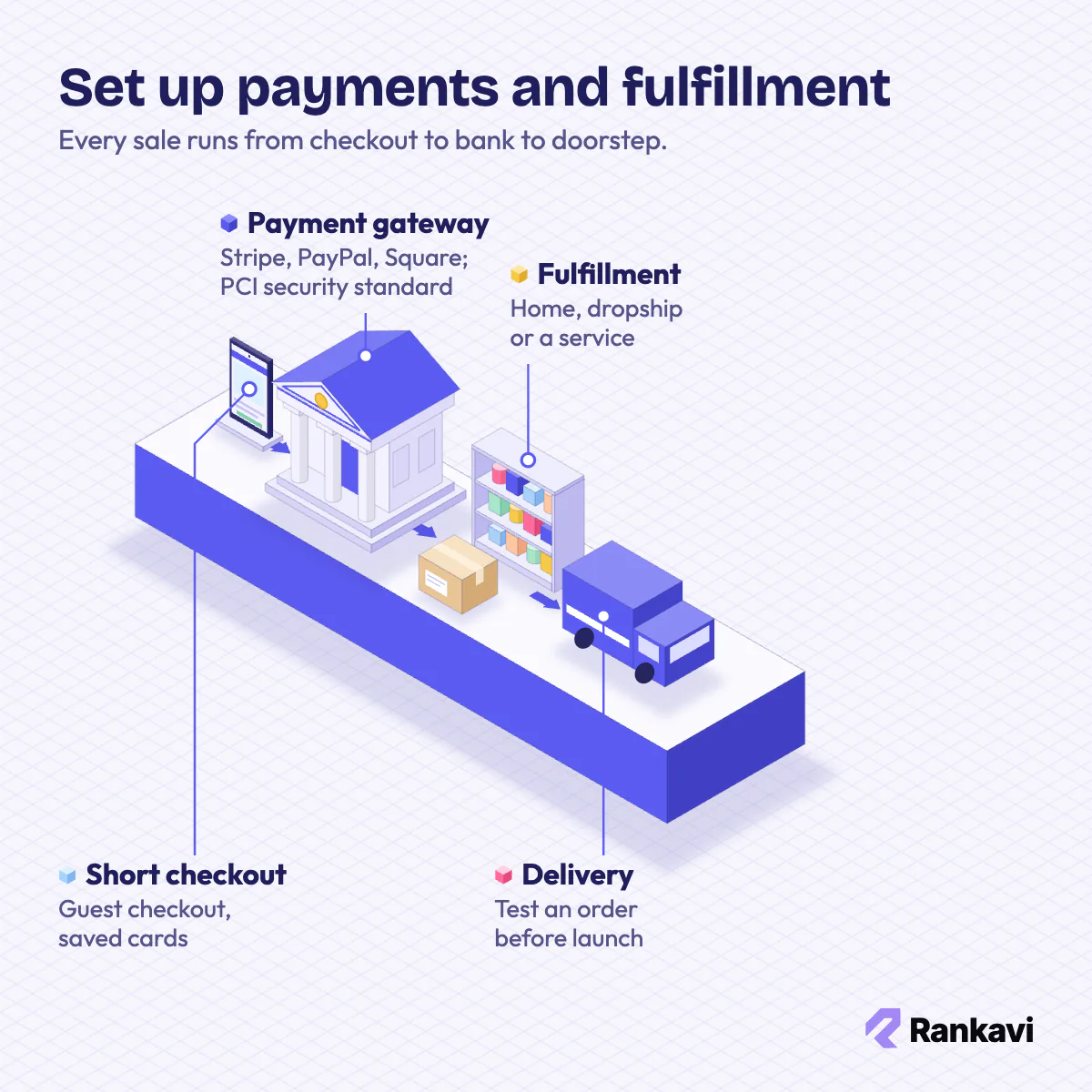
A card number on a checkout page is not money yet. Something has to move the funds from the customer to the bank and then to the business. Stripe, PayPal and Square do that job. Each follows the Payment Card Industry (PCI) Data Security Standard. The PCI Security Standards Council is the industry body that maintains it.
Online stores take money in three main ways:
- Card payments: Shopify Payments handles cards inside Shopify stores.
- Digital wallets: Apple Pay, Google Pay and Shop Pay fill in card and address details in one tap.
- Buy now, pay later: Providers such as Klarna, Afterpay and Affirm split larger orders into installments.
How many steps a buyer faces at checkout decides how many finish. Shorter checkouts keep more buyers. Guest checkout, saved cards and wallet payments reduce abandoned carts. Long forms drive shoppers away.
Money that comes in can also go back out, and in two different ways. A refund is the seller’s choice. A chargeback is a bank reversing a card payment after a dispute. Fraud filters such as Stripe Radar flag risky orders before they ship.
Once the payment clears, the goods still have to reach the buyer. Physical products get there in three main ways:
- Packing at home: The business packs each order itself. Home shippers buy labels through Pirate Ship or ShipStation. Parcels then go to the U.S. Postal Service (USPS) or FedEx.
- Dropshipping: Orders ship without the business ever packing them.
- Fulfillment services: A fulfillment service such as Fulfillment by Amazon (FBA) handles the shipping work. Fulfillment warehouses such as ShipBob store stock and ship each order.
Digital products need none of that packing and carrying. They deliver through a download link or a members area.
Shipped or downloaded, orders still generate questions. Support for order questions, returns and complaints runs on email, chat and help pages.
A test order before launch catches broken steps early.
10. Market the Launch
Launch marketing puts the offer in front of its first customers and reveals which channel pays back fastest. Each model leans on a different first channel.
Online marketing runs through five main channels:
- Search engine optimization (SEO) and content: SEO means shaping pages so search engines rank them for what buyers type. Search traffic is free but slow, which is why content sites need patience. The same 2025 Ahrefs study found 40.82% of pages that reached the top 10 did so within a month. Pages that miss that window rarely catch up quickly.
- Social media: Short video on TikTok and images on Instagram build awareness for product brands. Service founders often win early clients through LinkedIn posts and referrals instead.
- Email marketing: An email list reaches buyers without an algorithm in the way. Klaviyo and Mailchimp send the welcome and launch sequences. A waitlist built before launch gives the first email a ready audience. A short launch offer turns that interest into orders.
- Paid advertising: Paid ads on Google Ads, Meta Ads Manager, TikTok or LinkedIn bring visitors on day one. Retargeting shows ads again to visitors who left without buying.
- Partnerships and collaborations: Partnerships borrow an audience that already trusts someone else. An affiliate program pays creators per sale. Influencer seeding sends free product for an honest post. Guest posts reach a partner’s readers.
Urchin Tracking Module (UTM) tags are short labels added to the end of a link. UTM tags on every link show which channel brought each sale in Google Analytics. Customer acquisition cost is the money spent to win one buyer. Comparing customer acquisition cost per channel against first-order profit picks the channel worth scaling.
A few places exist mainly to greet new products on the day they appear. Product Hunt is a launch site where new software and apps collect votes and comments. Niche Reddit communities and Indie Hackers also accept launch posts that follow their rules.
The first orders do more than bring in money. Reviews and testimonials turn first buyers into proof for the next ones. Asking each early customer for a review once the order arrives builds that proof. The Federal Trade Commission (FTC) reviews rule has been in force since October 2024. It bans fake reviews and rewards tied to a positive or negative rating.
11. Grow With Outsourcing and Automation
Growth involves handing routine work to people and tools so a proven offer can reach more buyers. The first hire usually takes over the task the owner repeats most.
Virtual assistants and freelancers take on that kind of work. They handle customer emails, bookkeeping, design and content production.
Upwork and OnlineJobs.ph are hiring sites that list remote assistants for routine work. A short paid trial task tests a hire before an ongoing contract.
Written instructions keep quality consistent. Standard operating procedures (SOPs) are written step-by-step guides for a single task. Recorded Loom walkthroughs, short videos of the screen, show exactly how to do each task.
Paying helpers also raises the question of worker status. The IRS weighs three things to separate contractors from employees:
- Behavioral control: whether the business controls what the worker does and how.
- Financial control: whether the business controls pay, expenses and tools.
- Type of relationship: written contracts, benefits and whether the work will continue.
Worker status follows control, not the job title.
Email sequences, stock alerts and order confirmations can run without daily effort. Zapier and Make are automation tools that connect apps, so a new order can alert a supplier.
The split between the two comes down to the kind of task. Rule-based tasks suit automation. Judgment calls and customer conversations stay with people. Trello and Asana are task boards that keep work handed to helpers organized.
Google Analytics shows which pages, products and channels bring revenue. Monthly reviews move budget toward what converts.
A proven offer can then add a channel. A store may list on a marketplace. A consultant may package know-how into a course.
12. Get Named in AI Answers
AI visibility means being one of the businesses an assistant names when a buyer asks for a recommendation. Shoppers ask ChatGPT, Gemini, Perplexity and Grok which store to buy from or which freelancer to hire.
Google’s AI Overviews and Microsoft Copilot also answer buying questions right inside search. The practice of earning those mentions is often called generative engine optimization (GEO).
Those answers lean on what third-party sites already say. Reviews, directories, comparison pages, Reddit threads and “best of” roundups shape them. A new online business with no such mentions rarely appears.
As a free first check, ask each assistant the questions buyers ask. Note which businesses get named. A robots.txt file tells crawlers which pages they may read. A site that blocks AI crawlers there also limits what assistants can read.
Rankavi is a software as a service (SaaS) platform that publishes brand mentions in articles on indexed third-party websites. New stores and service brands can buy mentions from $12 per article. Founders who want to show up when buyers ask Grok can also earn Grok brand mentions through the same placements.