

Starting a heating, ventilation and air conditioning (HVAC) business takes a state license, refrigerant certification, insurance and a stocked van. A heating and air conditioning company also needs local demand, a written plan and prices that keep each job profitable.
My name is Michal Sieroslawski, and I help HVAC companies get found by homeowners on Google and in AI chats. Chat-based search is changing how homeowners find HVAC companies. Being visible in those answers is now part of being easy to find.
The steps start with choosing services and writing the plan. Registration, licensing and insurance come next, followed by funding, tools and pricing. The final steps cover software, local marketing, hiring and service agreements. The last step explains how homeowners find contractors through AI assistants. The following list shows how to start an HVAC business in twelve steps.
- Choose Your HVAC Services
- Write an HVAC Business Plan
- Register Your HVAC Company
- Get Licensed and EPA Certified
- Insure Your Business
- Fund Your Startup Costs
- Buy Tools and a Service Vehicle
- Price Your Services
- Set Up Scheduling and Accounting Software
- Market to Local Homeowners
- Grow Your Team and Recurring Revenue
- Earn Recommendations in AI Search
1. Choose Your HVAC Services
Choosing HVAC services decides which jobs the company takes and which customers it serves. The service choice shapes the tools, licenses and prices that every later step depends on.
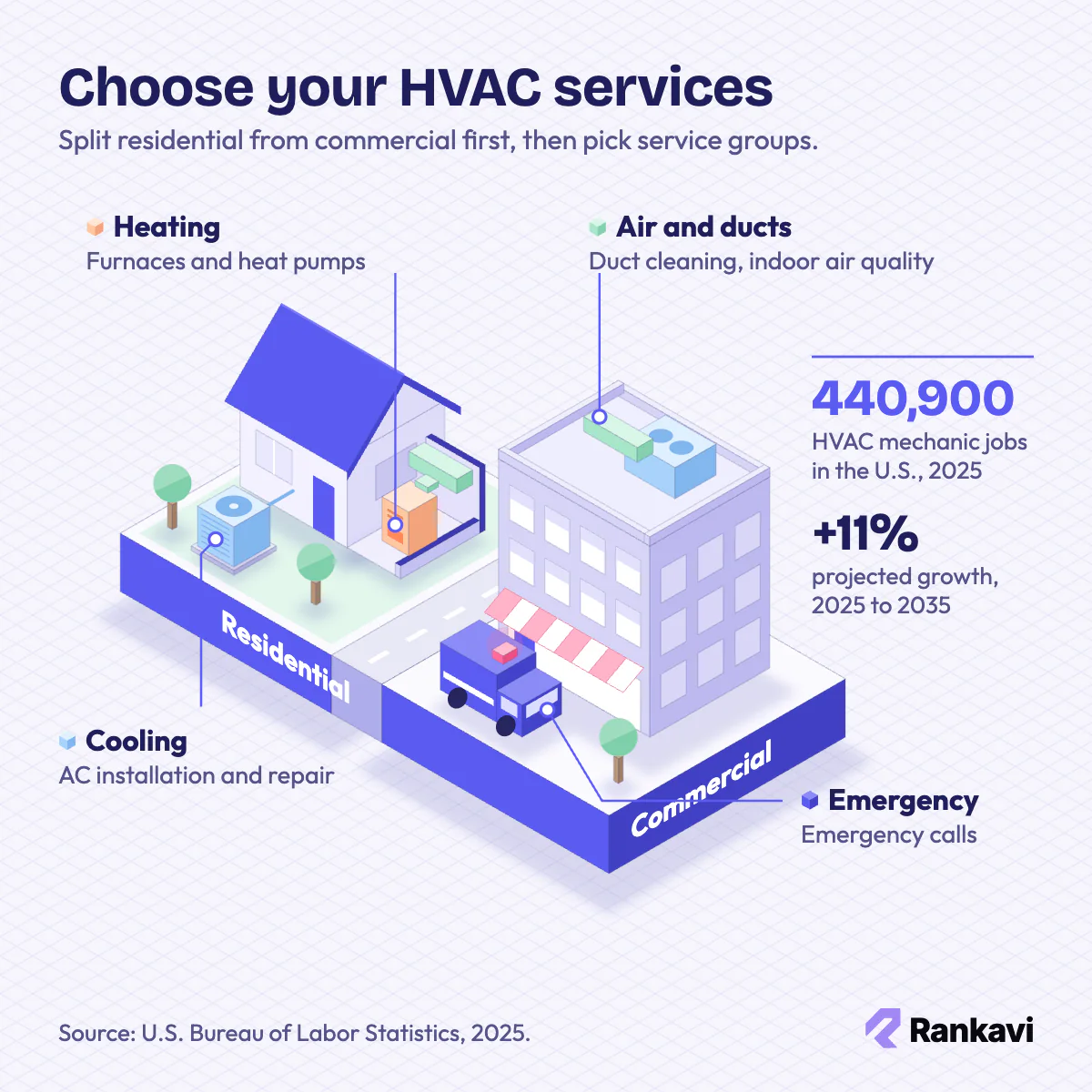
The first split is residential versus commercial work. Residential contractors serve homeowners with repairs, tune-ups and replacements. Commercial contractors serve offices, restaurants and clinics, where contracts run larger and equipment is more complex. Some owners also target new construction through homebuilders.
“If possible, stay away from new construction. Low margins and much higher possibility of not getting paid.”
— An HVAC contractor on the HeatingHelp forum
Most heating and air conditioning businesses build their menu from a familiar set of services. The menu covers air conditioning installation and repair, furnace installation and repair, and heat pump installation. Duct cleaning, indoor air quality work and emergency calls round out the list.
Common HVAC services:
| Service group | Services |
|---|---|
| Cooling | Air conditioning installation, air conditioning repair |
| Heating | Furnace installation, furnace repair, heat pump installation |
| Air and ducts | Duct cleaning, indoor air quality work |
| Urgent | Emergency calls |
The best starting services match the owner’s strongest skills and real local demand. A technician with a long repair background usually opens as a repair and maintenance shop. Local demand depends on the climate, the age of installed systems and the specialties of nearby competitors.
National demand also favors new shops. The U.S. Bureau of Labor Statistics (BLS) counted 440,900 heating, air conditioning and refrigeration mechanic jobs in 2025. The BLS projected 11% employment growth for those workers from 2025 to 2035, much faster than the average for all occupations.
Some new owners skip the independent route and buy into an HVAC franchise instead. Aire Serv is a heating, ventilation and air conditioning franchise brand owned by Neighborly, a home services franchisor. A franchise supplies a known brand, training and marketing support in exchange for ongoing fees. An independent company keeps full control and the whole margin.
2. Write an HVAC Business Plan
Writing an HVAC business plan sets the services, market, costs and revenue goals on paper before money is spent. The plan then serves as the roadmap for the first years of the company.
The U.S. Small Business Administration (SBA) is a federal agency that gives small businesses counseling, capital and contracting help. The SBA lists the standard sections of a business plan. These sections give lenders and partners a complete picture of the company in a familiar order.
Standard business plan sections:
- Executive summary
- Company description
- Market analysis
- Service line
- Marketing and sales plan
- Financial projections
Financial projections carry the most weight in an HVAC plan. The projections estimate revenue, operating costs and the break-even point month by month. HVAC demand peaks in summer and winter. The model must show how the company covers slow spring and fall months.
Banks and SBA lenders read the plan before approving a loan. A lender looks for stable cash flow, realistic demand and proof of licensing and insurance compliance. A plan written for a lender stays detailed, conservative and realistic.
3. Register Your HVAC Company
Registering an HVAC company means filing it with the state under a chosen name and legal structure. The filing creates the legal entity that signs contracts, pays taxes and holds the contractor license.
The common structures are a sole proprietorship, a partnership, a limited liability company (LLC) and an S or C corporation. A sole proprietorship is the simplest, but it leaves personal assets exposed to business debts. Many HVAC startups choose an LLC for its liability protection and flexible taxation.
The business name comes first. Owners confirm the name is unique, then register it with the Secretary of State or the state business agency. A clear, local-sounding name also helps homeowners remember the company.
After registration, the company requests an employer identification number (EIN) from the Internal Revenue Service (IRS). The EIN lets the business open accounts, run payroll and file federal taxes. Many states also require a separate registration for state and local taxes.
A dedicated business bank account keeps company money apart from personal money. The separation protects the LLC’s liability shield and simplifies tax filing at the end of the year.
4. Get Licensed and EPA Certified
Getting licensed gives an HVAC contractor the legal right to install and repair heating and cooling systems for paying customers. Without a license, the company can’t pull permits, pass inspections or bid on public projects.
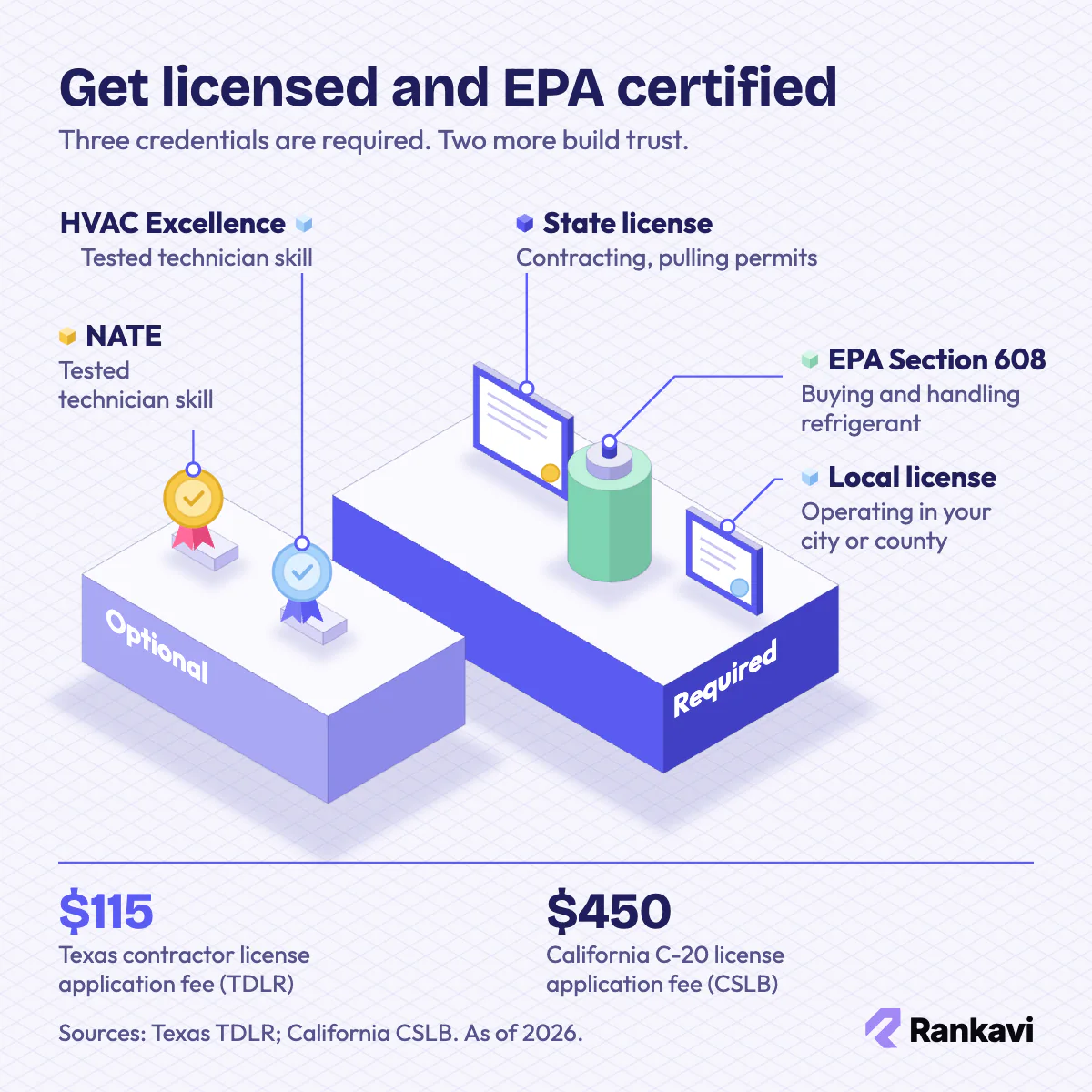
The state contractor license is the main credential, and requirements vary by state and sometimes by city. Most states require several years of supervised field experience. Applicants then pass a trade exam and a business and law exam.
License names, fees and experience rules differ from state to state. Florida regulates the trade through its Department of Business and Professional Regulation. Most cities and counties also require a general business license, renewed annually.
The Texas Department of Licensing and Regulation (TDLR) is the state agency that licenses air conditioning and refrigeration contractors. As of 2026, TDLR listed a $115 application fee for the contractor license. Applicants needed 48 months of supervised experience in the past 72 months, with a shorter route for certified technicians.
California’s Contractors State License Board (CSLB) is the agency that licenses and regulates the state’s construction contractors. The CSLB issues the C-20 warm-air heating, ventilation and air conditioning license. As of 2026, the CSLB required four years of experience as a journeyman or higher and charged a $450 application fee.
The United States Environmental Protection Agency (EPA) is the federal agency that regulates refrigerant handling in heating and cooling work. The EPA’s Section 608 Technician Certification is mandatory for anyone who services equipment that could release refrigerants.
The certification comes in separate types for small appliances, high-pressure systems and low-pressure systems, plus a Universal level. Refrigerant sellers must confirm that a buyer is certified or employs a certified technician. Without the certification, a technician can’t legally buy refrigerant.
Some credentials are optional but help with marketing. North American Technician Excellence (NATE) is the largest nonprofit certification organization for heating, ventilation, air conditioning and refrigeration technicians. HVAC Excellence is a technician certification and school accreditation program for the heating and cooling trade. Both credentials signal tested skill to homeowners.
Key HVAC credentials:
| Credential | Required | What it allows |
|---|---|---|
| State contractor license | Yes | Contracting HVAC work, pulling permits |
| EPA Section 608 certification | Yes, for refrigerant work | Buying and handling refrigerants |
| Local business license | Usually | Operating in the city or county |
| North American Technician Excellence certification | No | Signaling tested HVAC technician skill |
| HVAC Excellence certification | No | Signaling tested HVAC technician skill |
Unlicensed work carries real penalties. Contractors working without the right license face fines, denied permits and unpaid invoices. Some states also order the business to stop work until the license is in place.
5. Insure Your Business
Insuring an HVAC business protects the owner, the crew and the customer from the cost of accidents on the job. HVAC work involves ladders, gas lines and high-voltage wiring, so injury and property damage are real risks.
A standard HVAC insurance package combines three core policies. General liability covers injuries to third parties and damage to a client’s property. Workers’ compensation covers employees hurt on the job. Commercial auto insurance covers the service van and its driver.
Other policies fill specific gaps. Professional liability, also called errors and omissions, applies when the company designs systems or gives advice. Equipment and property insurance protect tools and the office against theft or damage.
Common HVAC coverage:
| Coverage | Protects against |
|---|---|
| General liability | Third-party injuries, client property damage |
| Workers’ compensation | Employee injuries on the job |
| Commercial auto | Accidents in the service van |
| Professional liability | Claims over design work or advice |
| Equipment and property | Theft of or damage to tools and the office |
| Surety bond | Unfinished or substandard work |
Many states make insurance a condition of the license. As of 2026, TDLR required Class A contractors to carry $300,000 per occurrence and $600,000 aggregate in general liability coverage. Class B contractors needed $100,000 per occurrence and $200,000 aggregate in 2026.
Some states and commercial clients also ask for a surety bond. The bond guarantees that the contractor finishes the work as promised. A bonded company looks safer to property managers and general contractors.
6. Fund Your Startup Costs
Funding an HVAC startup covers the equipment, licenses and working capital the company needs before the first invoice is paid. The total depends mostly on whether the owner already owns a truck and a full tool set.
Startup costs fall into two groups. One-time costs include tools, the vehicle, license fees and the website. Recurring monthly costs include insurance premiums, software subscriptions, fuel, marketing and wages. The SBA offers a fillable worksheet that sorts both groups.
“Find and use a good accountant!!! Taxes can eat you alive if you do not stay on top of them.”
— An HVAC contractor on the HeatingHelp forum
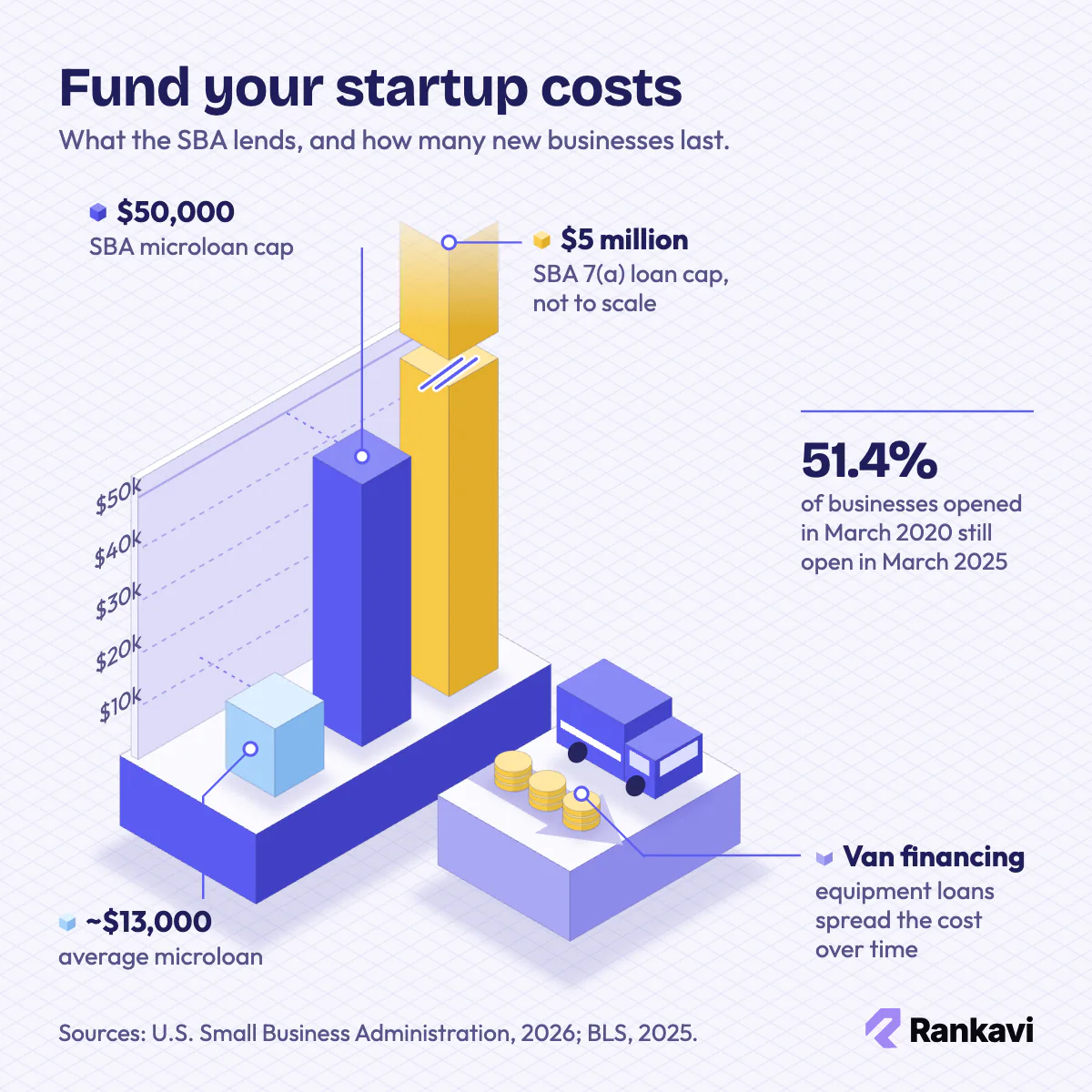
Working capital keeps the company running while revenue builds. A new HVAC company often waits several months before it turns a profit. Owners budget enough cash to cover overhead through that ramp-up. The BLS found that 51.4% of private-sector establishments opened in March 2020 were still operating in March 2025.
Owners without enough savings borrow. The SBA backs several loan programs, including the 7(a) loan and the Microloan program. As of 2026, the SBA capped microloans at $50,000 and 7(a) loans at $5 million. The SBA listed about $13,000 as the average microloan size in 2026.
Equipment financing spreads the cost of a van or major tools over time, with the equipment as collateral. Business credit cards handle smaller purchases but carry high interest. Some founders bring in partners or investors in exchange for a share of the business.
7. Buy Tools and a Service Vehicle
Buying equipment turns a licensed technician into a field-ready HVAC operation. The tool kit has to match every service on the menu, so specialty tools come before extras.
The base kit holds standard hand and power tools. Screwdriver, plier and wrench sets, a hammer, tube cutters and a power drill handle most mechanical tasks. Ladders reach attic units and rooftop equipment.
Specialty HVAC tools handle the diagnostic and refrigerant work. A manifold gauge set, vacuum pump, refrigerant recovery machine and leak detector are standard. A multimeter, HVAC/R thermometer, psychrometer and core removal tool complete the kit.
Specialty HVAC tools:
| Tool group | Tools |
|---|---|
| Refrigerant tools | Manifold gauge set, vacuum pump, refrigerant recovery machine, core removal tool |
| Diagnostic tools | Multimeter, HVAC/R thermometer, psychrometer, leak detector |
Safety gear protects technicians on every job. Standard items include safety boots, gloves, goggles, masks, hearing protection and harnesses for roof work.
The service van or truck works as a mobile workshop. Shelving and bins keep parts organized and easy to reach. A starting inventory of capacitors, contactors, filters, thermostats, refrigerant and fittings prevents repeat trips to the supply house.
8. Price Your Services
Pricing HVAC services determines whether each job covers labor, overhead, materials and profit. Underpricing is a common mistake for new contractors, and low prices leave no room to hire or advertise later.
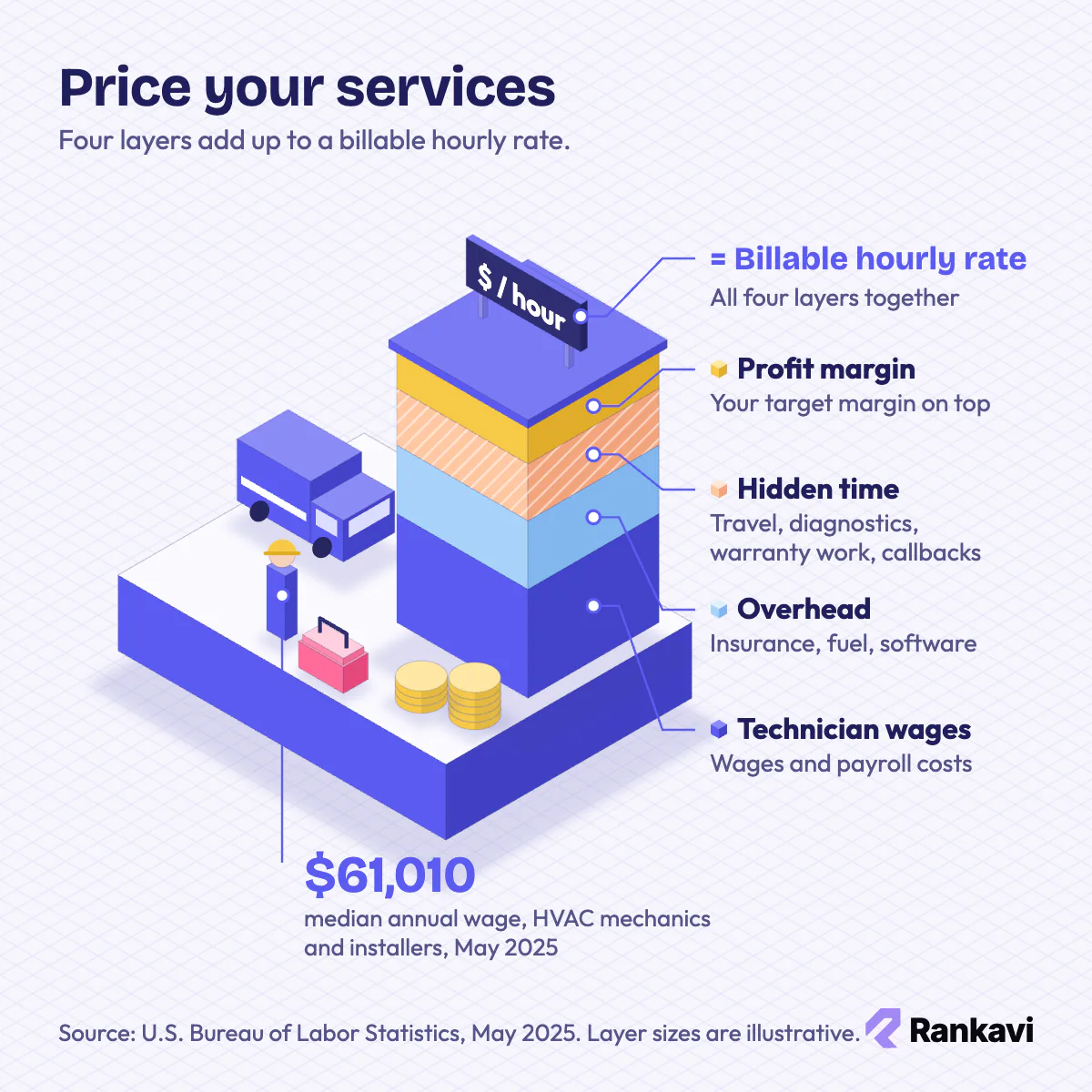
The billable hourly rate is the foundation of every price. The rate starts with technician wages and payroll costs. The BLS reported a median annual wage of $61,010 for HVAC mechanics and installers in May 2025. Overhead such as insurance, fuel and software comes next, and a target profit margin sits on top.
Hidden costs belong in the rate too. Travel time, diagnostic time, warranty work and callbacks all consume paid hours. A callback, a return visit to fix a job, earns nothing unless the price already absorbed its cost.
“Learn and understand Job costing for a profit! This is one of the most difficult things for a new business owner…”
— A veteran heating contractor on the HeatingHelp forum
Three pricing models dominate the trade. Hourly rates suit long or uncertain jobs and many commercial contracts. Flat-rate pricing gives homeowners one predictable price per repair. Labor-and-materials pricing fits installations, where equipment cost varies by system.
HVAC pricing models:
| Model | Best fit |
|---|---|
| Hourly rate | Long or uncertain jobs, commercial contracts |
| Flat rate | Repairs with a predictable scope |
| Labor and materials | Installations with varying equipment cost |
Competitor rates serve as a benchmark, not a template. Once prices are set, a standardized price book lists every service at its rate. Technicians then quote consistent prices on site, and customers trust the quotes.
9. Set Up Scheduling and Accounting Software
Setting up business software keeps scheduling, dispatch, invoicing and bookkeeping in one organized system. A good system lets a small HVAC company run with fewer office hours and fewer missed calls.
Field service management software runs the daily workflow. ServiceTitan is a field service management platform built for HVAC, plumbing and electrical contractors. Jobber and Housecall Pro offer similar scheduling, dispatching, invoicing, payment and customer record tools. Efficient routing also cuts drive time and raises billable hours.
Accounting software tracks expenses, invoices and payroll. Clean books make tax season easier and show cash flow at a glance. Many owners pair the software with a bookkeeper or accountant from the start.
Standard operating procedures put the steps for common jobs in writing. A written process for a tune-up or a no-cool call keeps quality consistent across technicians. The documents also keep standards steady when the owner is off site.
Most new HVAC contractors run the office from home. A dedicated business phone line, a basic computer and field service software are enough before a storefront makes sense.
10. Market to Local Homeowners
Marketing an HVAC company puts its name in front of homeowners before their furnace or air conditioner breaks down. Most HVAC customers search in a hurry, so the company must be easy to find and easy to trust.
A consistent brand makes a small contractor look established. The brand includes the name, logo, colors, uniforms, business cards and a wrapped service van. A wrapped van works as a moving billboard in every neighborhood the crew visits.
A professional website lists services, service areas and contact details. Google Business Profile is Google’s free business listing that controls how a company appears on Google Search and Google Maps. A claimed profile shows up for searches like “HVAC near me.” Reviews from early customers drive both local rankings and trust.
Paid channels speed up the first leads. Google Local Services Ads place a licensed, insured contractor at the top of local results. Facebook and Nextdoor pages reach neighbors, and email or direct mail carries seasonal tune-up offers.
Offline marketing still wins jobs in local trades. Door hangers, flyers and yard signs reach homes near active jobs. Referral partners such as realtors, property managers and general contractors send steady work. Tracking each lead source shows which channels deserve more budget.
11. Grow Your Team and Recurring Revenue
Growing an HVAC business involves adding technicians, service agreements and new services once demand outgrows the owner’s schedule. Service work is labor-driven, so growth depends more on people than on equipment.
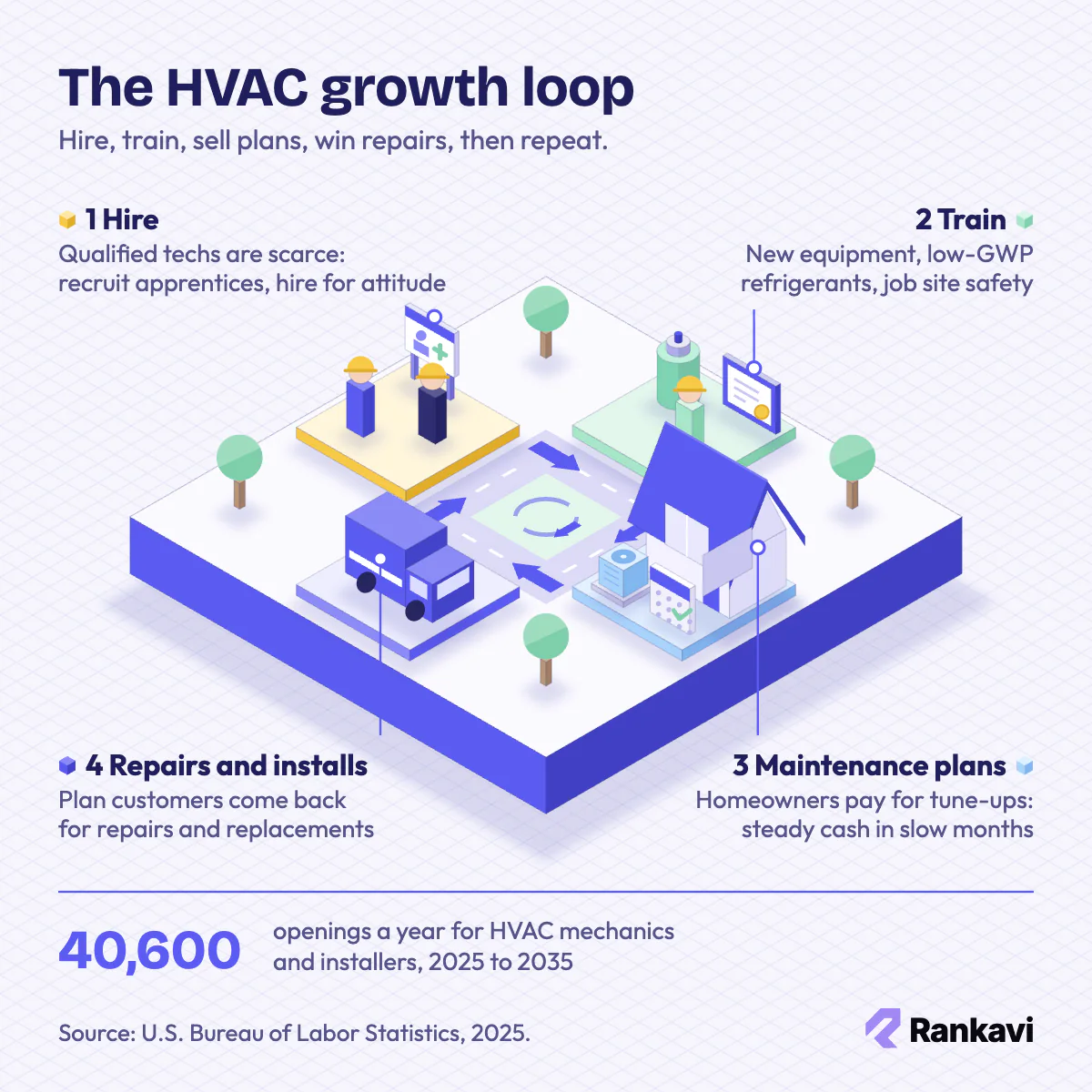
Hiring starts when job volume exceeds the owner’s capacity. Owners first decide between employees and subcontractors. Qualified technicians are scarce, so many companies recruit apprentices and hire for attitude. Reference and background checks screen candidates before they enter customers’ homes.
Pay and treatment decide which technicians stay. The BLS projected about 40,600 openings each year for HVAC mechanics and installers from 2025 to 2035. Those openings give skilled technicians many employers to choose from. A culture of learning and clear paths to advancement keep good technicians from leaving.
“…treating your workers good and paying them enough to not quit is vital to growth.”
— A former HVAC company employee commenting on YouTube
Training turns new hires into productive technicians. Ongoing training covers new equipment, low global warming potential refrigerants and job site safety. The Occupational Safety and Health Administration (OSHA) is the federal agency that enforces workplace safety standards.
Trade associations support that learning. The Air Conditioning Contractors of America (ACCA) is a nonprofit trade association for heating, cooling and refrigeration contractors. The Air Conditioning Contractors of America also publishes Manual J, the standard for residential heating and cooling load calculations.
Maintenance agreements are the steadiest growth engine. Homeowners pay for scheduled tune-ups, and the company gets predictable cash flow in slow months. Agreement customers also return for repairs and replacements.
Established companies add services such as duct cleaning, refrigeration or commercial work. Key metrics show whether that growth pays off. Owners track average ticket size, technician close rate, callback rate and the share of customers on maintenance agreements.
12. Earn Recommendations in AI Search
Earning recommendations in AI search builds a heating and cooling company’s presence on the sites that AI assistants trust. More homeowners now ask ChatGPT, Gemini, Perplexity or Google AI Overviews to name a reliable HVAC contractor nearby.
These assistants rarely invent their answers. The tools repeat what trusted third-party sites publish. Those sites include local directories, review platforms and “best HVAC companies” articles for a city. A new contractor that earns mentions on those sites early has a better chance of being named.
Rankavi places brand mentions on real, indexed websites so AI assistants can find a business, from $12 per article. Its ChatGPT brand mentions service focuses on the answers ChatGPT gives to local service questions.