

Starting an event planning business takes a clear niche, fair planning fees, liability insurance and a trusted bench of vendors. Most planners begin from home with a laptop and a phone. The U.S. Bureau of Labor Statistics (BLS), which publishes federal job data, counted 172,100 meeting, convention and event planner jobs in 2025.
My name is Michal Sieroslawski. I help event planning businesses get found online. Asking an AI assistant is becoming a normal way for hosts to compare event planning businesses. Those suggestions often decide who gets contacted first.
The order settles the niche and fees first, so every filing, policy and vendor deal serves events that pay. Contracts and a portfolio then exist before the first sales pitch. Opening an event planning business follows the nine steps below.
- Choose Your Event Planning Niche
- Write a Lean Event Business Plan
- Price Your Planning Services
- Fund the Launch on a Small Budget
- Register and Insure the Company
- Build a Vendor Network and Contracts
- Win Your First Event Clients
- Grow Through Certifications and Staff
- Join the Planners Google AI Mode Suggests
1. Choose Your Event Planning Niche
Choosing an event planning niche decides which hosts the business serves and which events fill its calendar. That focus also shapes prices, vendors and marketing.
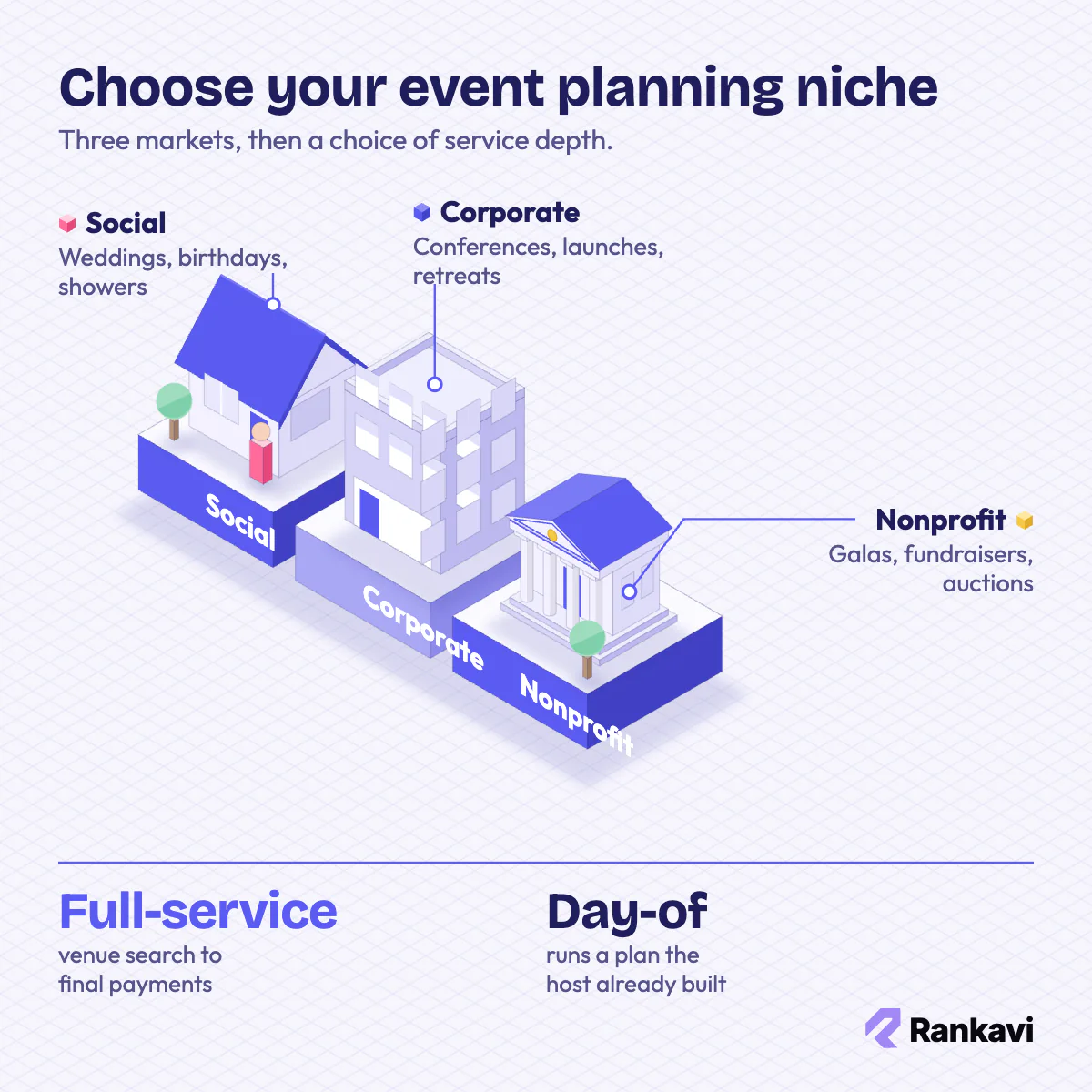
An event planning business organizes gatherings for clients from first idea to final cleanup. Planners book venues, manage budgets, coordinate vendors and run the schedule on the day.
Three markets cover most of the work:
| Market | Typical events |
|---|---|
| Social | Weddings, birthdays, anniversaries, baby showers |
| Corporate | Conferences, product launches, team retreats, trade shows |
| Nonprofit | Galas, fundraisers, auctions, donation drives |
Each market splits into narrower niches. Social work includes micro-weddings, cultural weddings and milestone birthdays. Corporate work includes conferences, product launches and incentive trips. Nonprofit work includes charity galas and benefit auctions.
Niches differ in how they earn. Weddings book far ahead and rarely repeat, so referrals matter most. Companies and nonprofits tend to rebook yearly events, but they often ask for references first. Corporate work runs on weekdays and strict deadlines, while weddings carry high emotional stakes on weekends.
Service depth is the second choice. Full-service planners handle everything from venue search to final payments. Day-of coordinators take over a plan the host already built and run the event itself. Partial planning sits between the two, covering a few tasks such as vendor sourcing or design.
Local demand decides whether a niche can pay. Competitor websites, reviews and price lists show which events are crowded and which are underserved. Google Maps listings and wedding directories such as The Knot show how many planners already serve a niche.
A single niche makes the business easier to find and recommend. Many planners start with one niche. They later add a neighbor that uses the same vendors, such as private parties beside weddings. A niche that is too narrow can starve a small local market.
Hands-on experience shortens the learning curve. Many owners first work for a hotel, venue or established planner before taking their own clients.
“I took a job at a local hotel as a catering sales manager. I was actually not only selling banquet space, I was planning all the events I sold space to.”
— An event planner on the SitePoint forums
2. Write a Lean Event Business Plan
An event business plan sets out the services, clients, prices and first-year cash needs on a few pages. Lenders and partners read it before they commit.
A lean plan covers six sections:
- Business overview: the niche, the service area and the owner’s background.
- Services: what the company handles and what it refers out.
- Target market: the hosts and organizations it serves.
- Competitors: the planners already active in the same area.
- Marketing plan: how the first clients will find the business.
- Financial projections: costs, expected bookings and the break-even point.
The service list matters most in this trade. Clear limits stop scope creep, where a host keeps adding unpaid tasks.
A written scope of work, a cap on revisions and an hourly rate for extras make scope creep billable.
The financial section needs more than a profit line. Break-even equals fixed monthly costs divided by average profit per event. Clients pay deposits months before an event, but costs arrive before final balances. The forecast should show cash by month. A salary line for the owner is easy to forget.
Event risks belong in the plan with a fix for each. Cancellations call for a deposit schedule and a cancellation clause. Vendor no-shows call for a backup vendor list. Late client payments call for staged invoices.
A quarterly review keeps the plan useful in the first year. Booking data then shows which events and packages actually earn money.
Useful numbers to track are inquiries, the share that become bookings, hours spent per event and profit per package. Packages that earn little for the hours they take can be dropped or repriced.
3. Price Your Planning Services
Pricing an event planning business involves picking a fee model that covers planning hours, on-site time and overhead. The client usually pays venues and vendors directly.
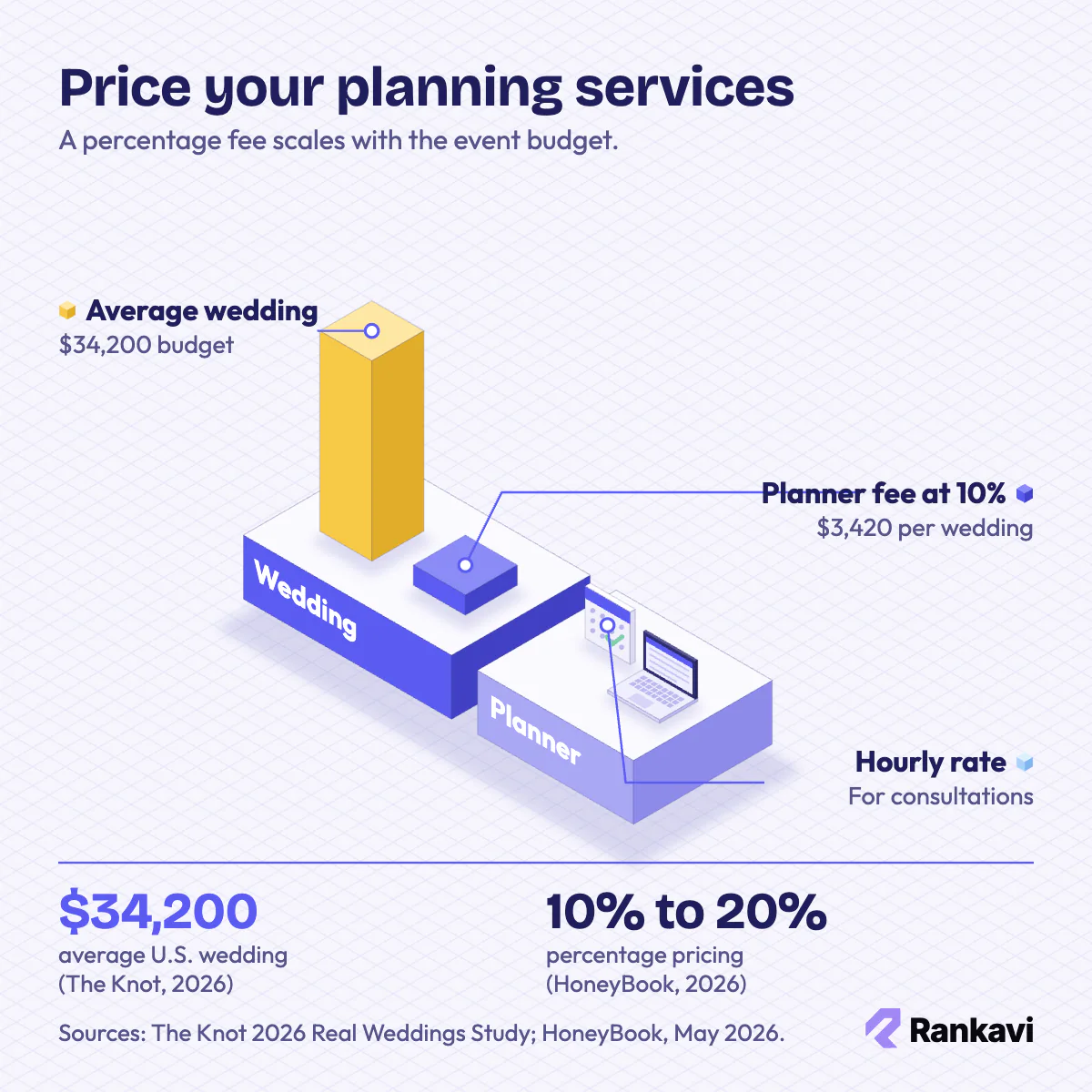
Planners charge by the hour, by a flat fee per event, or by a percentage of event costs. Complex events often combine an hourly rate with a percentage. Hourly rates suit consultations, while percentages suit large weddings and galas.
Each model shifts risk differently. Hourly billing protects the planner from scope creep but caps income on large events. A flat fee gives hosts a fixed cost but punishes underestimating the work. A percentage grows with the budget but can look like a reason to push spending up.
The percentage model gives founders a quick break-even check. HoneyBook, a client management software vendor, wrote in May 2026 that percentage pricing usually adds 10% to 20% on top of actual costs.
Event budgets set the size of that fee. The Knot 2026 Real Weddings Study put the average U.S. wedding at $34,200 for couples married in 2025.
Startup money at a glance:
| Item | Figure |
|---|---|
| Startup cost | $2,000 to $20,000 for a home-based launch |
| Main costs | Computer and software, insurance, website and portfolio, marketing, working capital |
| Typical margin | 15% to 40% profit margin (gross or net not stated) |
| Time to open | One to three months |
Sources: StartCosts, a startup cost estimates website, estimates accessed October 2026.
Worked example: An illustrative planner books 12 weddings a year, each with the average $34,200 budget, and charges 10%. That earns $3,420 per wedding, or $41,040 a year. Liability cover at $29 plus $42 a month costs $852 a year. About $40,188 remains before software, marketing and travel. Matching the $61,160 median planner wage takes 19 weddings.
Three factors move the price up or down: the event type, local living costs and the planner’s track record. The BLS reported a median annual wage of $61,160 for event planners in May 2025, a useful floor for an owner’s pay.
Vendor commissions need open disclosure. Hosts trust a planner more when every referral fee appears in the contract.
Packages make the fee easier to explain. Full planning, partial planning and day-of coordination can each carry a set scope and price. A retainer at signing then secures the date.
4. Fund the Launch on a Small Budget
Funding an event planning startup covers the website, insurance, registration, software and early marketing before fees arrive. No storefront or stock is needed at first.
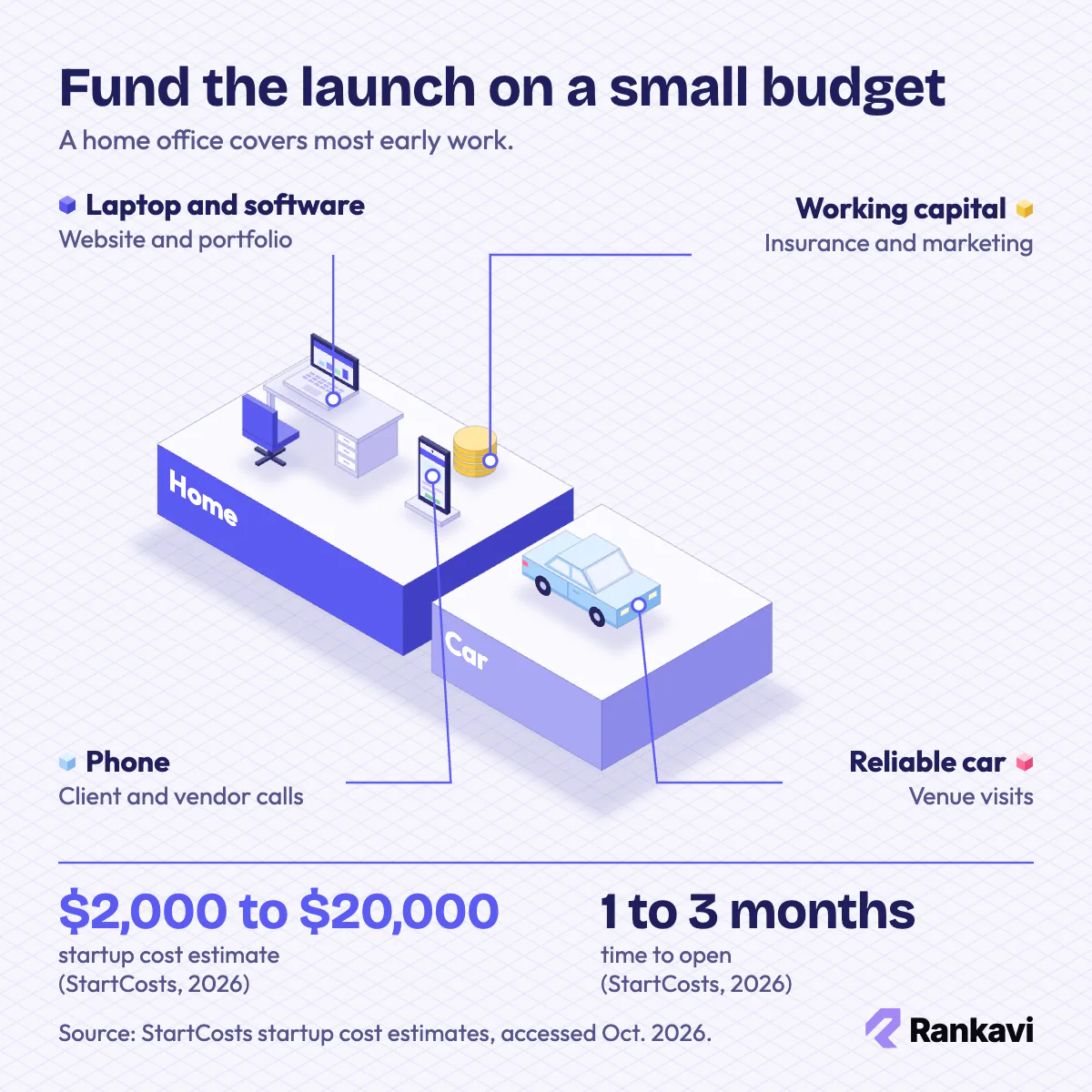
A home office keeps overhead low. A laptop, a phone and a reliable car handle most early work.
Cash flow needs more care than startup spending. Clients often pay in stages, so a retainer at signing protects the planner before vendor deadlines arrive.
Personal savings fund most launches. The U.S. Small Business Administration (SBA) runs a microloan program through nonprofit lenders. Those small loans suit owners who need a modest top-up for marketing.
Other sources include a business credit card, a loan from family and a small bank or credit union loan. Each adds repayment pressure before the first retainer arrives, so borrowing stays small when bookings are not yet proven.
A cash reserve matters because planners often pay vendor deposits before the client’s final balance arrives.
Owners who later add decor or rental inventory need far more capital. That step usually waits until steady bookings prove demand.
5. Register and Insure the Company
Registering and insuring an event planning company protects the owner’s personal assets when a venue or guest files a claim. Most owners form a limited liability company (LLC).
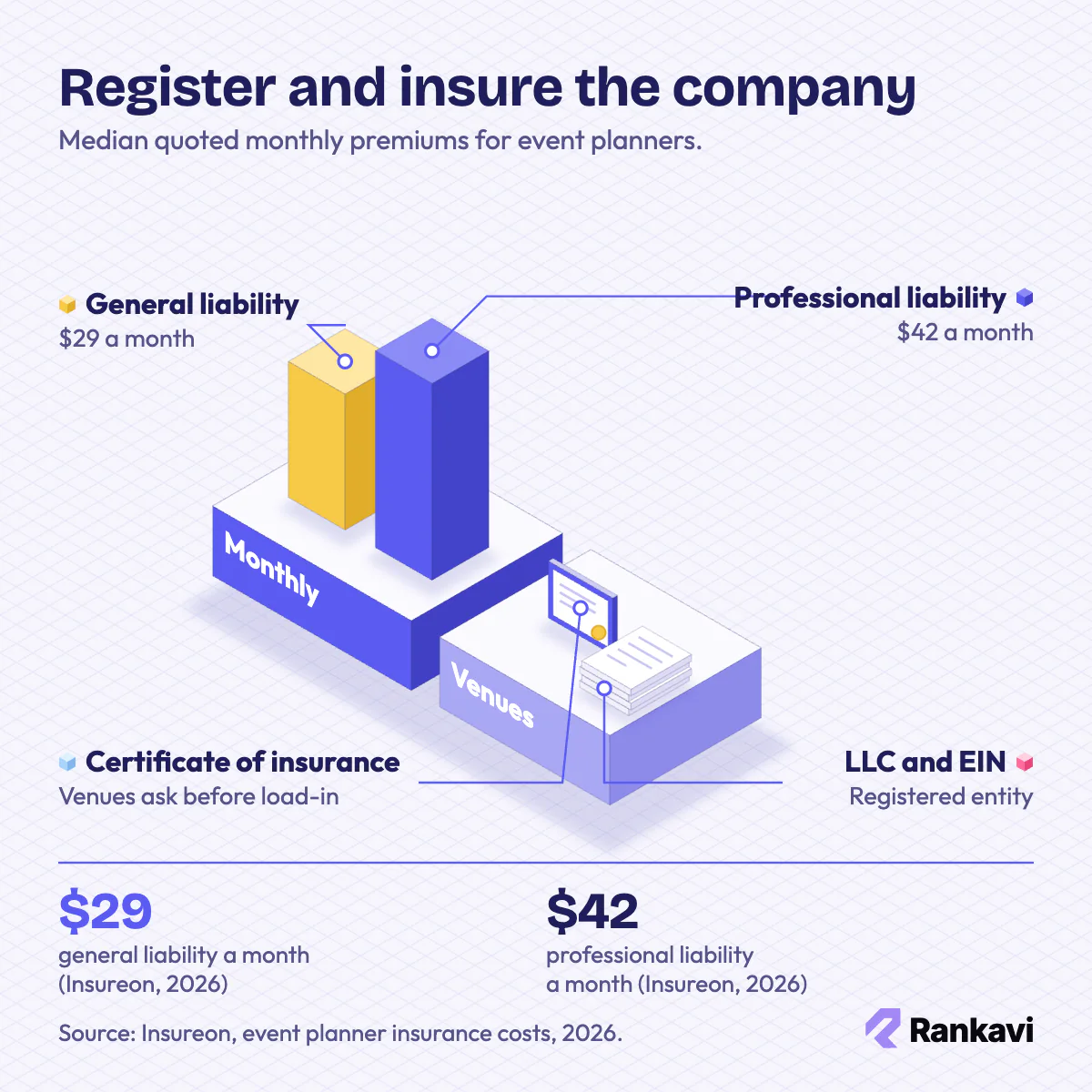
The Internal Revenue Service (IRS) issues a free employer identification number (EIN) for the new entity. A separate business bank account then keeps deposits apart from personal money.
A sole proprietorship needs the least paperwork but leaves personal assets exposed to claims. An LLC separates the two, at the cost of state filing fees and ongoing state requirements. A local attorney can review the entity choice and the client contract once.
Event planners need no special state license in most places. A general city or county business license still applies, and states that tax services may require a sales tax permit.
Three policies form the usual event planner package:
- General liability: covers guest injuries and venue damage.
- Professional liability: covers claims that a planning mistake cost the client money.
- Liquor liability: covers alcohol-related claims at events that serve drinks.
Insureon, an online insurance agency, reported median quoted premiums for event planners as of 2026. General liability ran $29 a month and professional liability $42 a month in that 2026 data.
Venues often ask for a certificate of insurance before load-in. Some also want to be named as an additional insured.
6. Build a Vendor Network and Contracts
A dependable vendor bench is the real product an event planner sells. Caterers, florists, photographers, disc jockeys (DJs), rental firms and venues each deliver part of every event.
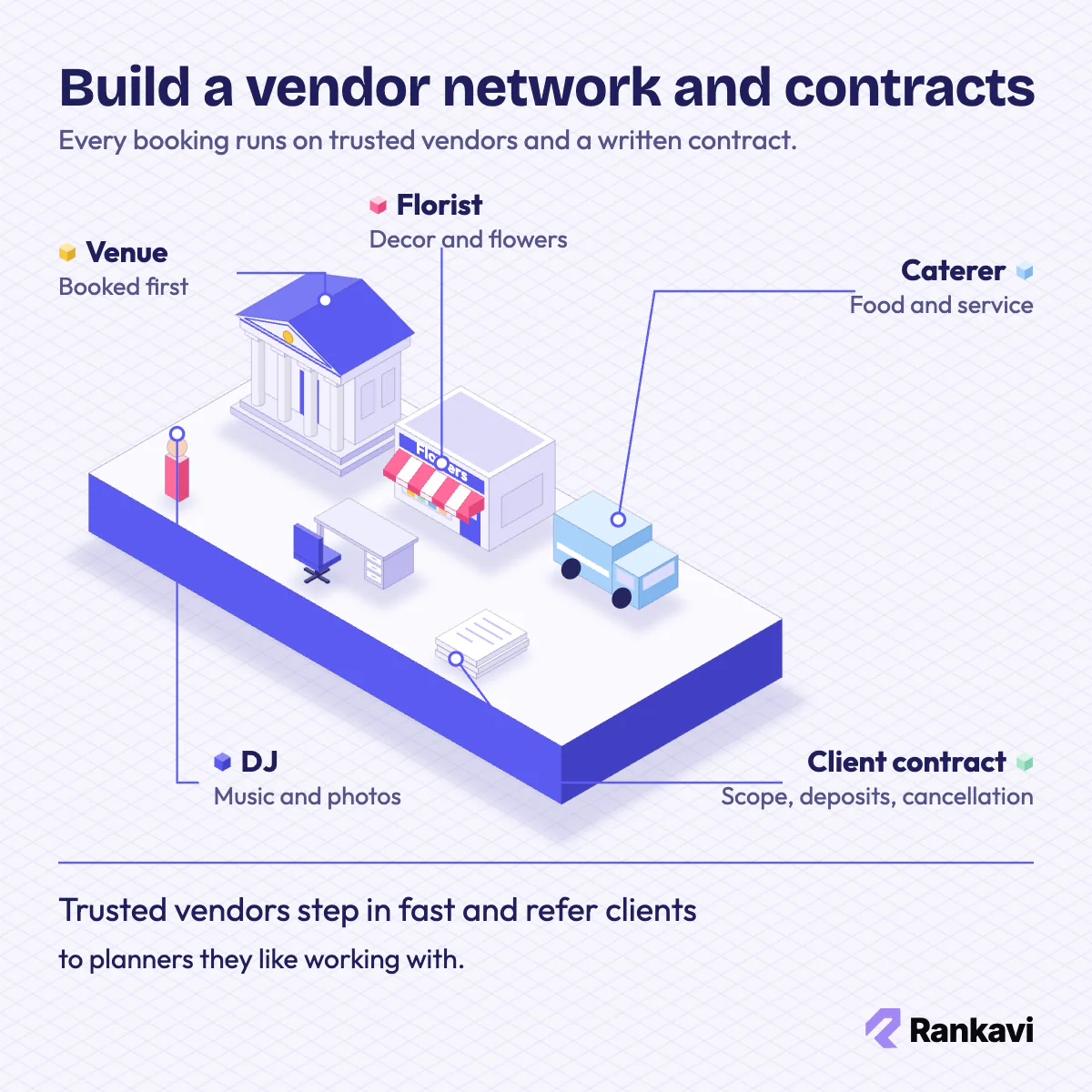
Strong vendor ties pay off twice. Trusted suppliers step in fast when something breaks, and they refer their own clients to planners they like.
Vendors are chosen for reliability, price range and fit with the niche. A small bench with a backup in every category beats a long list of unknown names. Written vendor agreements settle deposits, arrival times and what happens if a vendor cancels.
Every booking needs a written client contract. It covers scope, payment schedule, cancellation terms, vendor responsibilities and a liability waiver.
”…I started with brand presence and no actual contracts. Big mistake.”
— A new event planner commenting on a YouTube video about starting an event planning business
Software keeps many moving parts in order. Planning tools hold timelines and guest lists. A client relationship management (CRM) app tracks leads, and online payments speed up deposits.
7. Win Your First Event Clients
Winning first clients turns a portfolio of real events into paid bookings. Hosts hire planners whose past work they can see.
New planners build that portfolio fast with small events for friends, local charities or community groups. Styled shoots with partner vendors add polished photos before the first paid wedding.
A simple website shows services, packages and photos. Instagram and Pinterest suit this visual trade, since hosts browse ideas there.
A Google Business Profile is the free Google listing that shows a planner on local search and maps. Reviews from early clients there and on Yelp build trust quickly.
Wedding marketplaces add another channel. The Knot Worldwide, which runs The Knot and WeddingWire, lists planners where couples compare vendors.
Venues, hotels and caterers send steady referrals once they trust a planner. A handwritten note of thanks after each joint event keeps those ties warm.
Corporate and nonprofit buyers are reached differently from couples. LinkedIn and local business groups put a planner in front of office managers and charity boards. A consultation call then turns an inquiry into a booking. A clear package list and a written proposal help close it.
8. Grow Through Certifications and Staff
Growth starts with repeat clients and referrals, then moves toward larger corporate and nonprofit events. The BLS projects 6% job growth for event planners from 2025 to 2035, with about 16,800 openings a year.
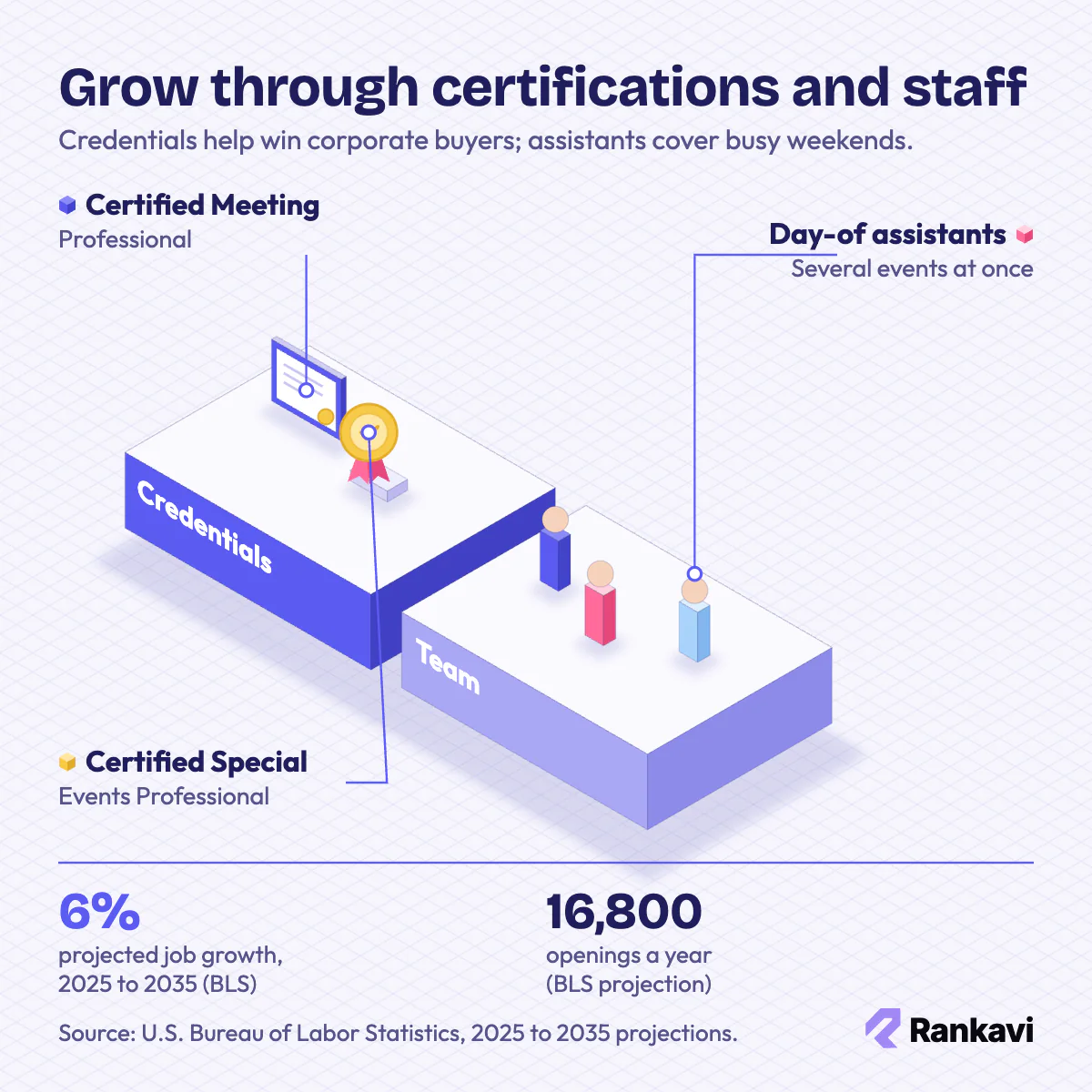
Industry credentials help win corporate buyers. The Certified Meeting Professional is a credential for meeting planners, awarded after an application and a written exam. The Events Industry Council, a nonprofit federation of meetings groups, runs that program. Corporate buyers often look for Certified Meeting Professional holders, and eligibility details sit on the Events Industry Council website.
Special event producers often choose a different badge. The International Live Events Association is a global group for live event professionals. The voluntary Certified Special Events Professional program comes from the International Live Events Association.
Meeting Professionals International is a global association for event professionals with local chapters and clubs. Chapter meetings of Meeting Professionals International put new planners in front of venues and buyers.
One planner cannot be in two places on a busy weekend. Day-of assistants and coordinators let the company run several events at once.
Staff can be contractors or employees. Contractors cost money only when events run and need no payroll. Employees give more control over quality but add payroll duties. Many planners start with contractors and keep a trusted core team.
Post-event surveys show what to keep and what to fix. Happy hosts then become the cheapest source of new bookings.
9. Join the Planners Google AI Mode Suggests
AI visibility earns an event planning business a place in the answers hosts read before they call anyone. Couples and office managers now ask ChatGPT, Gemini and Google AI Mode for local planners.
Those tools repeat what trusted third-party sites say. Wedding directories, local “best planner” roundups and venue blogs shape their suggestions.
Rankavi is a software as a service (SaaS) platform that publishes brand mentions in articles on indexed third-party websites. A young planner can use its AI Mode brand mention service to appear in the sources Google AI Mode reads.