

Starting an electrical business takes a state contractor license, a qualified master electrician, insurance and a stocked work van. The U.S. Bureau of Labor Statistics (BLS) counted 101,565 private electrical contractor establishments in the first quarter of 2026.
My name is Michal Sieroslawski, and I help electrical contractors build their visibility online. AI search is growing, and many homeowners use it to find electrical contractors. Showing up there helps a new electrical contractor reach people it would otherwise miss.
The order below settles prices and funding before any license fee or insurance premium is paid. The license and insurance then land before the first paid job. Starting an electrical business comes down to the thirteen steps listed below.
- Choose Residential, Commercial or Specialty Work
- Write an Electrical Contracting Business Plan
- Price Jobs by Flat Rate or Hourly
- Fund Your Van, Tools and First Year
- Register the Electrical Company
- Earn an Electrical Contractor License
- Insure and Bond the Business
- Buy Testers, Hand Tools and a Work Van
- Set Up Scheduling, Estimating and Invoicing Software
- Hire Journeymen and Apprentices
- Market to Homeowners and General Contractors
- Grow Through Service Plans and New Specialties
- Appear When Homeowners Ask AI for an Electrician
1. Choose Residential, Commercial or Specialty Work
Choosing a market decides which electrical jobs the company bids on and which customers it serves. That choice shapes the tools, the license class, the crew and the cash the business needs.
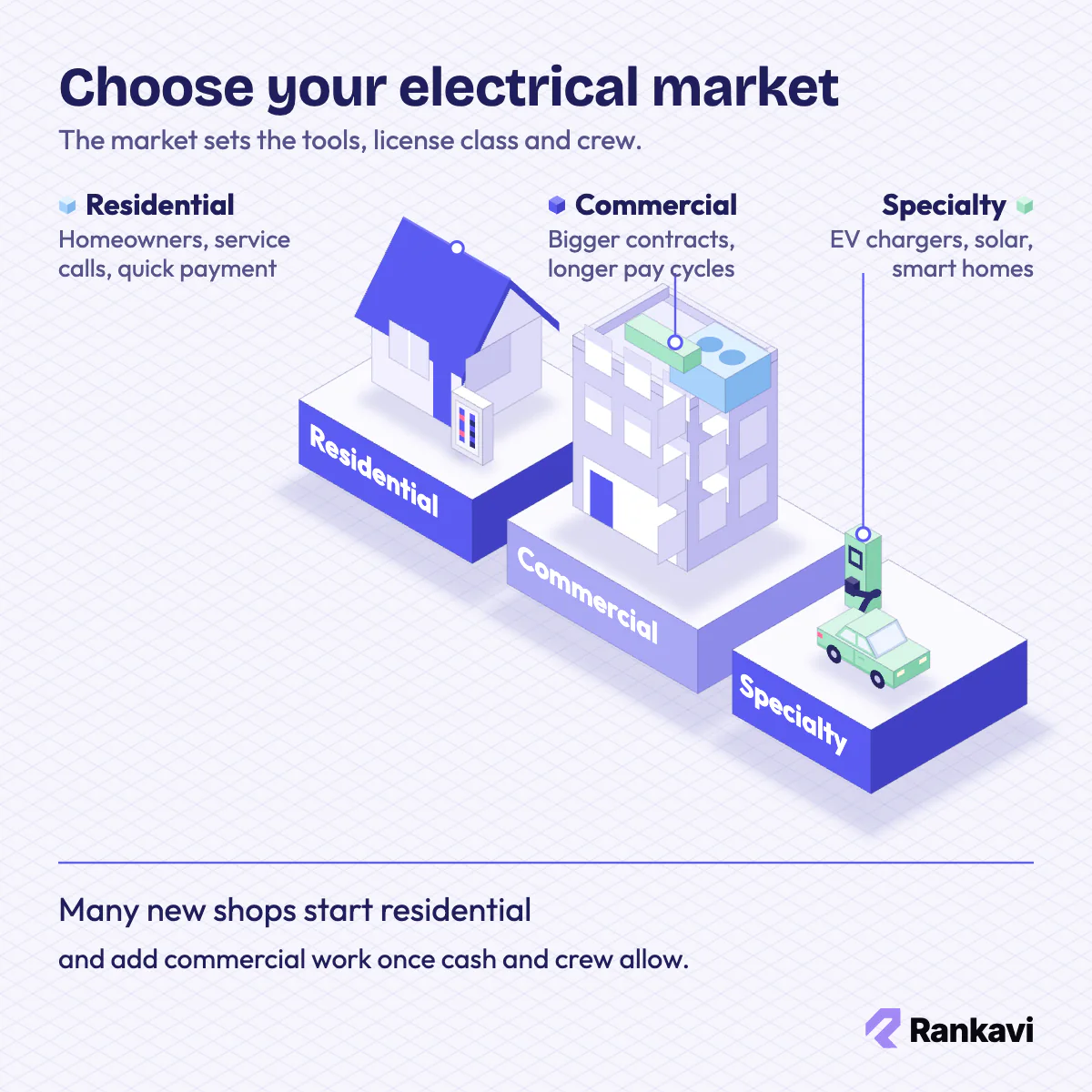
Residential work means homeowners, service calls and quick payment. Bids stay simple, and a steady flow of small jobs builds a review base fast. Commercial work brings bigger contracts, longer pay cycles and heavier paperwork. Many new shops start residential and add commercial work once cash and crew allow.
The choice also depends on the owner’s own experience. A journeyman who mostly did service calls will find residential work easier to price and run. A foreman from a construction crew may fit bid work better.
Each market carries a different cash risk. Residential work costs money to win through ads and reviews, and winters can be slow. Commercial work ties up cash while invoices wait for payment. One large customer can also become a risk.
Common electrical services:
| Service group | Typical jobs |
|---|---|
| Repairs | Troubleshooting, breaker and outlet repairs, emergency calls |
| Upgrades | Panel upgrades, rewiring older homes, lighting |
| New work | New construction wiring, additions, tenant fit-outs |
| Specialty | Electric vehicle (EV) chargers, solar hookups, smart home systems |
Specialty work lets a small contractor stand apart. EV charger installs, solar connections and smart home wiring draw customers who search for exactly those skills. A specialty also gives marketing a sharper message than “full-service electrician.”
A specialty adds trade-offs too. Rules, incentives and product standards can change, so the niche needs a base of ordinary service work. Extra training or certification may also be required before the first job.
Local demand decides whether the plan works. Owners look at housing age, construction activity, population density and the number of rival contractors. Aging homes need panel upgrades and rewiring. Fast-growing suburbs need new construction crews.
Permit offices, census housing data and a search of nearby competitors show which needs are real. A gap, such as no contractor offering a specialty, is a stronger signal than a large population alone.
Some owners buy into a franchise instead. Mister Sparky is a residential electrical franchise brand owned by Authority Brands. Its October 2025 cost guide put a new franchise at $133,273 to $276,702, including a $33,000 franchise fee. An independent shop skips those fees and keeps full control.
A franchise buys a known brand, training and lead support. It also adds ongoing fees and rules set by the franchisor. An independent shop builds its own name from zero.
2. Write an Electrical Contracting Business Plan
Writing a business plan puts the services, customers, costs and revenue goals on paper before money is spent. A lender reads the plan, and the owner tests the numbers with it.
A lender-ready electrical plan covers five standard sections:
- Executive summary: the company, its market and its goals on one page.
- Company description: services, license holder and organization chart.
- Market analysis: local customers, rival contractors and gaps.
- Marketing plan: how the company wins and keeps clients.
- Financial plan: startup budget, monthly costs, revenue and break-even.
Its financial plan carries the most weight. It projects revenue by service type for the first year and marks the break-even month. Electrical work slows when construction slows, so the model tests a weak quarter too.
The plan also names the license holder and the first hires, because those decisions drive the largest costs. A short list of risks shows lenders the owner has thought ahead. Slow payment and the loss of a key electrician are common examples.
“Step 2 is learn about breakeven cost and the proper way to charge for your services.”
— An electrical contractor on the ECN Electrical Forum
Clear goals keep the plan honest. Owners set a five-year target, such as owning one county’s residential market. Monthly reviews then show whether the company is on track.
3. Price Jobs by Flat Rate or Hourly
Pricing electrical work determines whether each job covers labor, materials, overhead and profit. Underpricing is the classic mistake for new contractors because it leaves nothing for hiring or marketing.
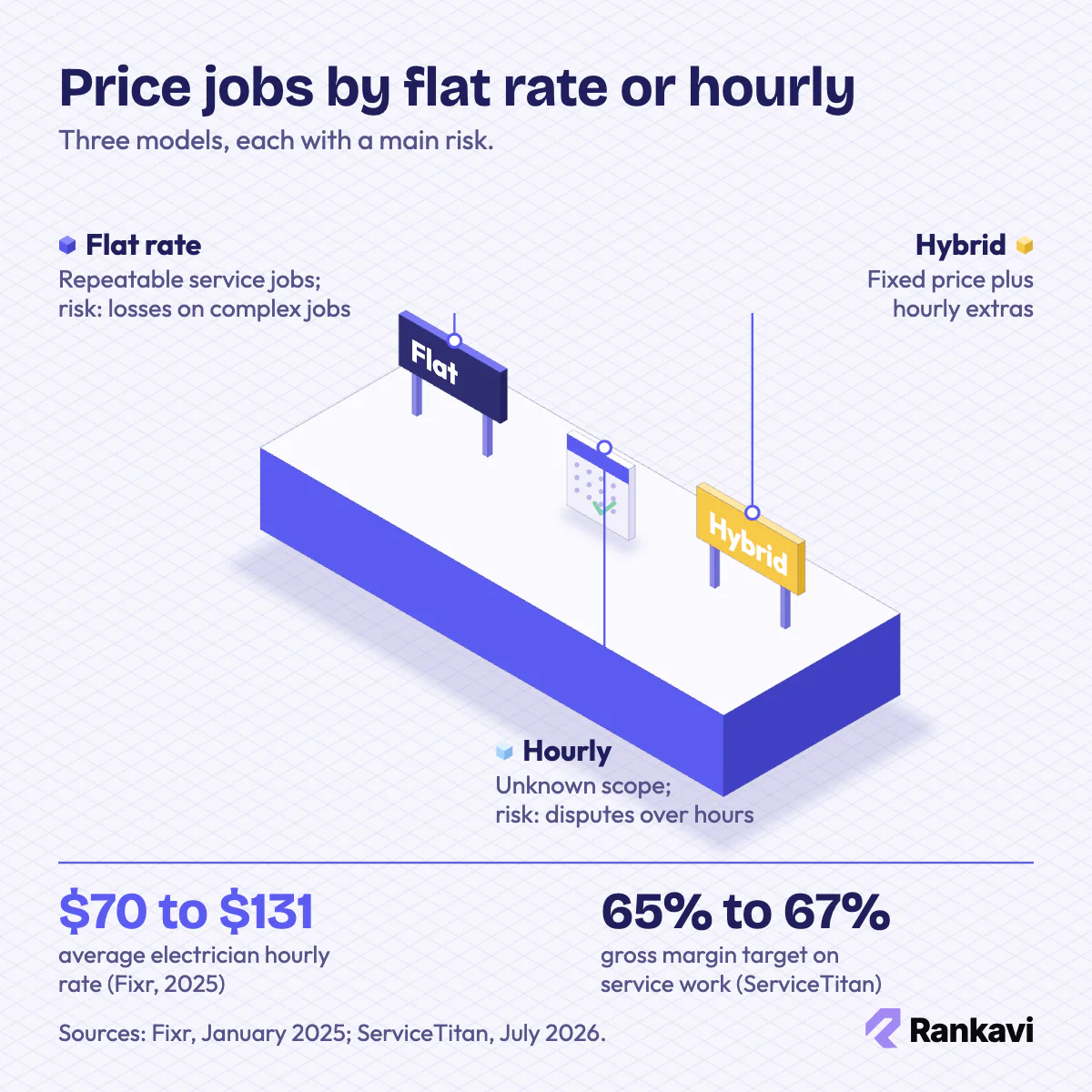
Common pricing models:
| Model | Best fit | Main risk |
|---|---|---|
| Flat rate | Repeatable service jobs | Losses on complex jobs |
| Hourly | Troubleshooting with unknown scope | Disputes when hours run long |
| Hybrid | Fixed price plus hourly extras | Harder to explain to customers |
Every price starts with the true cost of an hour. Wages and payroll taxes come first. Insurance, fuel, software and the van follow. Material costs need a buffer because copper and equipment prices move.
Time on the job is not the only cost. Drive time, supplier trips, permits and callbacks all use paid hours. Pricing that counts only hours at the panel leaves these costs uncovered.
Local rates set the outer limits. Fixr, a home improvement cost guide, put average electrician rates at $70 to $131 an hour in January 2025. In that 2025 guide, most homeowners paid $176 to $327 for a service call.
Gross margin is the benchmark owners check first. ServiceTitan is a field service software company for trade contractors. In July 2026, it set a 65% to 67% gross margin target for electrical service work. A shop below that target in 2026 struggles to cover overhead and still turn a net profit.
Change orders and deposits protect the margin after the quote. A signed change order prevents arguments when extra outlets or fixtures appear on the invoice.
Flat rate suits work that repeats, because the contractor knows the steps and the parts. Hourly pricing suits troubleshooting, because the cause of a fault is unknown until the work starts. A written estimate that states the scope and what it excludes reduces disputes under either model.
“For larger jobs especially ones with factory ordered parts like panels and lighting get a non refundable deposit from owner/rep before its even ordered.”
— An electrical contractor commenting on YouTube
4. Fund Your Van, Tools and First Year
Funding an electrical startup covers the van, tools, licenses, insurance and cash until the first invoices are paid. The total depends on whether the owner already owns a truck and a full kit.
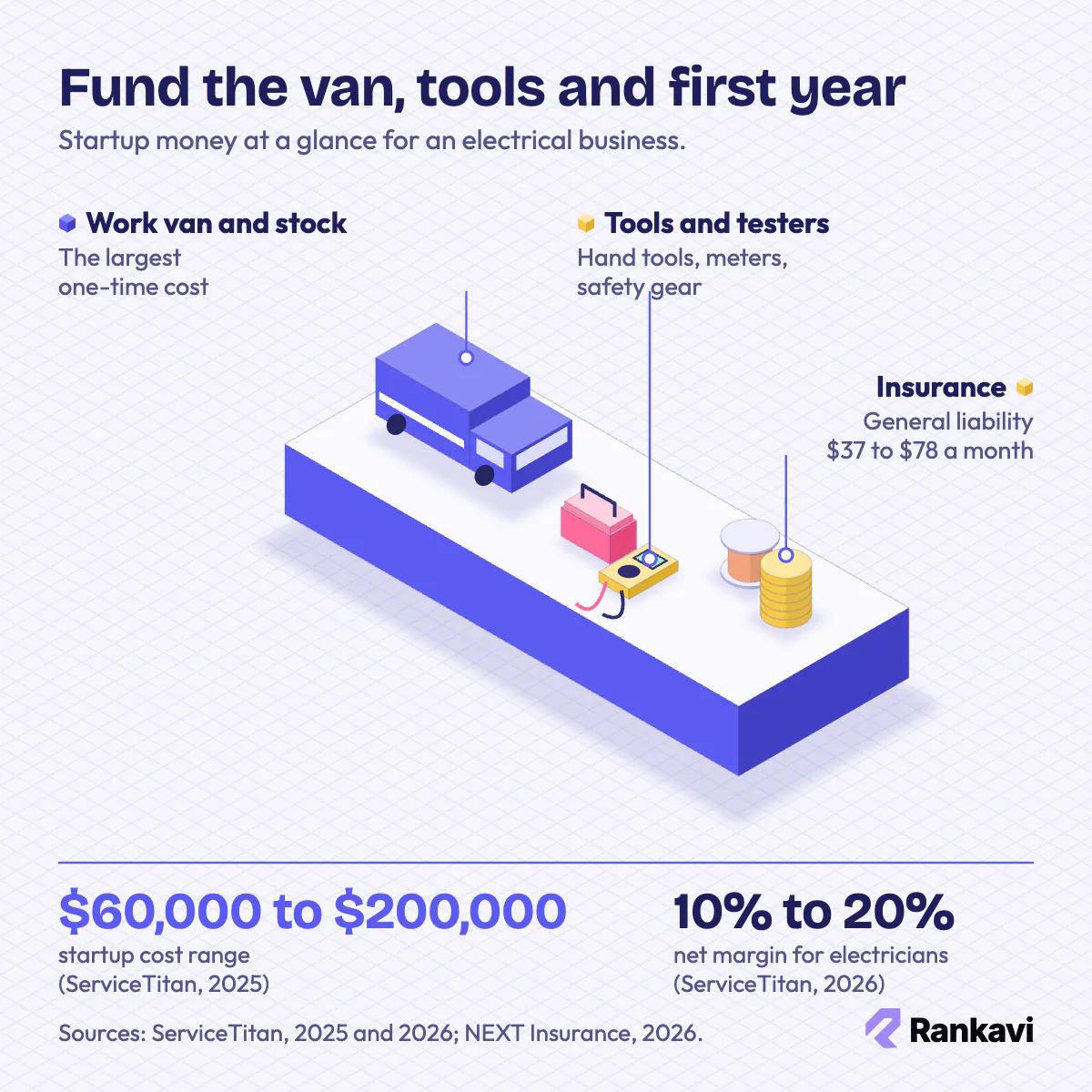
ServiceTitan estimated in June 2025 that an electrical business costs $60,000 to $200,000 to start. That vendor range moves with services, location and market size.
Startup money at a glance:
| Item | Figure |
|---|---|
| Startup cost | $60,000 to $200,000, depending on services, location and market size |
| Main costs | Work van and stock, tools and testers, insurance (general liability $37 to $78 a month), license fees ($110 in Texas; $450 plus $200 in California), software and website |
| Typical margin | 10% to 20% net for electricians |
| Time to open | Weeks to months, set mostly by state license processing and the exam schedule |
Sources: ServiceTitan, a field service software company, vendor estimates, June 2025 (startup cost) and July 2026 (margin). NEXT Insurance customer data for electricians, September 2026 (insurer data). Texas and California licensing board fee pages, 2026. Time to open is qualitative because no source covers every state.
Working capital decides survival. Commercial customers often pay weeks after the job ends, so many founders fund a full year of expenses first.
”…I always have 20K in a business account as my zero, and every january, I pay myself except the original 20K…”
— An electrician with 40 years in the trade, commenting on YouTube
Most owners fund the start with savings. The U.S. Small Business Administration (SBA), a federal agency, runs loan programs that partner lenders deliver to small firms. As of 2026, SBA microloans reached up to $50,000, with an average of about $13,000. Banks lend too, but they ask for collateral and a solid plan.
Equipment financing and leases spread the cost of a van or tools over time. They keep cash free for payroll and insurance, but add monthly payments that must be covered in slow months. Used tools and a used van cut the upfront bill, with the trade-off of repairs.
Family money and investors fill other gaps. A written repayment agreement protects the relationship with relatives. Private investors usually want a share of the profits.
Worked example: In this illustrative case, a solo electrician bills 25 hours a week at $100 an hour. Over 48 weeks, that is $120,000 in labor sales. General liability at $78 a month takes $936 a year. That leaves $119,064 before materials, van, fuel, software and taxes. At a 10% to 20% net margin, the year keeps $12,000 to $24,000 in profit.
5. Register the Electrical Company
Registering an electrical company gives it a legal identity that signs contracts and holds the contractor license. Many states issue the license to the business, so registration comes first.
Most electrical startups form a limited liability company (LLC). One fire claim or injury lawsuit can exceed the value of the business. An LLC keeps that claim away from the owner’s home and savings.
A name without the owner’s surname lets the company grow beyond one electrician. Owners check the state database and a matching web domain, then file.
The Internal Revenue Service (IRS) issues an employer identification number (EIN) online for free. The EIN opens a business bank account and runs payroll. Partners sign a written agreement before they sign anything else.
A sole proprietorship is simpler and cheaper to start, but it leaves the owner’s personal assets exposed to claims. A tax adviser can explain how an LLC is taxed. The structure should be settled before the license application, because the license is issued to that legal entity.
6. Earn an Electrical Contractor License
Licensing an electrical business means meeting the state rules for contracting electrical work, not just performing it. Without the license, the company can’t pull permits or pass inspections.
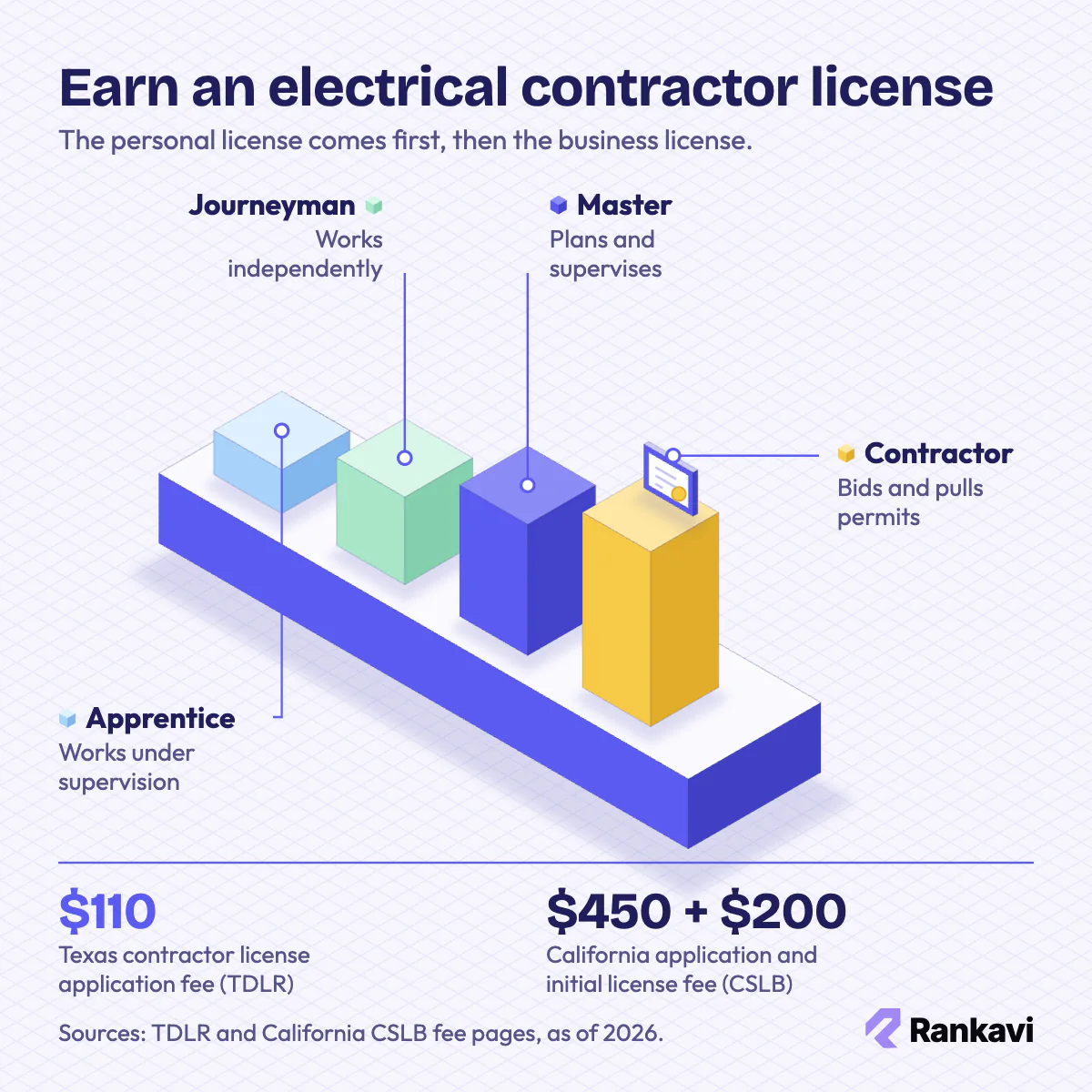
The personal license comes first. Electricians train through trade school or an apprenticeship, log supervised hours and pass written exams. The usual path runs from apprentice to journeyman to master electrician.
Typical electrician license path:
| Level | What it allows |
|---|---|
| Apprentice | Work under a licensed electrician |
| Journeyman | Work independently on most jobs |
| Master | Plan and supervise electrical work |
| Contractor | Bid, contract and pull permits as a business |
A contractor license is a separate business credential. Many states require a master electrician to qualify the company. A business owner without that license can partner with or hire a qualifying master.
The Texas Department of Licensing and Regulation (TDLR) is the state agency that licenses Texas electricians and electrical contractors. As of 2026, TDLR required contractor applicants to employ a licensed master electrician and pay a $110 application fee.
California’s Contractors State License Board (CSLB) licenses electrical contractors under its C-10 class. The board requires four years of journey-level experience. As of 2026, the CSLB charged a $450 application fee and a $200 initial license fee.
Florida sets its route in Florida Statutes section 489.511. One 2026 route asks for 4 years as a supervisor or contractor within the 8 years before applying.
The National Fire Protection Association (NFPA) is a nonprofit that publishes fire, electrical and life safety codes. Its National Electrical Code (NEC), also called NFPA 70, is the U.S. standard for safe electrical design and installation. NFPA issues a new edition every three years. Each state or city picks which National Electrical Code edition its inspectors enforce.
“the smartest move you can make is to befriend a long-standing electrical inspector who knows the code to advise you on code issues that you are not knowledgeable about”
— A commenter on an electrical contractor YouTube video
Most cities and counties also require a general business license. Permits then follow job by job.
Requirements differ widely between states. Some states license only the person, some license the company, and some leave licensing to cities or counties. The state licensing board or local building department gives the authoritative answer for the area.
7. Insure and Bond the Business
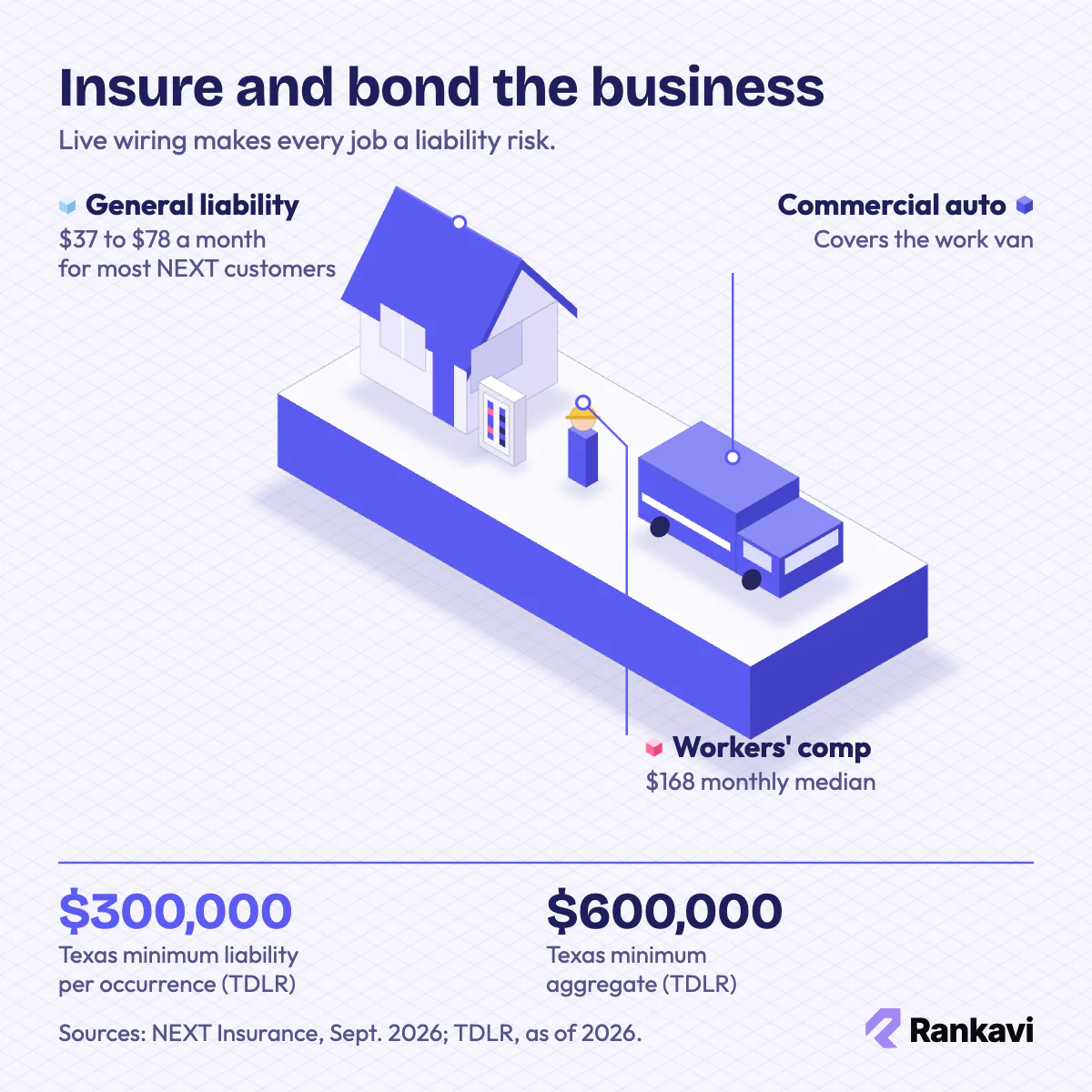
Insuring an electrical company protects the owner, crew and customer from the cost of shocks, fires and damaged property. Live wiring makes every job a liability risk.
Core coverage:
| Coverage | Protects against |
|---|---|
| General liability | Injuries to others and damage to client property |
| Workers’ compensation | Employee injuries on the job |
| Commercial auto | Accidents in the work van |
| Professional liability | Claims over design advice or errors |
| Commercial property | Theft or damage to tools and the shop |
Texas makes liability coverage a license condition. As of 2026, TDLR required $300,000 per occurrence and $600,000 aggregate, plus $300,000 for products and completed operations.
NEXT Insurance, a small business insurer, published its electrician customer data in September 2026. Most of those customers paid $37 to $78 a month for general liability in 2026. Workers’ compensation had a $168 monthly median in that 2026 data.
California adds a bond. The CSLB contractor license bond rose to $25,000 on January 1, 2023. General contractors and property managers also ask for a certificate of insurance before the crew starts.
An insurance agent who knows contractors can match limits to the contracts the company plans to bid. Policy exclusions matter as much as price. A cheaper policy that excludes a service the company sells leaves a gap at claim time.
8. Buy Testers, Hand Tools and a Work Van
A tool kit has to match every job on the service menu. Quality matters more than quantity, because a cheap tester that misreads a live circuit is a safety risk.
Hand tools handle most residential work. Pliers, wire strippers, screwdrivers, a tape measure, cable ties and electrical tape fill the bag. A cordless drill bores through studs and joists.
Three testing tools belong in every bag:
- Voltage tester: confirms a circuit is dead before work starts.
- Multimeter: measures voltage, current and resistance.
- Circuit breaker finder: matches outlets to breakers fast.
Commercial jobs need heavier gear. Line lasers keep long conduit runs straight, and power crimpers handle heavier cable. Rental covers rare tools until the work justifies buying them.
Tool choice should follow the service menu from step 1. A shop focused on EV chargers needs different gear from one focused on rewiring old homes. Buying for the first jobs, then adding tools as the work grows, protects cash.
Safety gear goes on every job. NFPA 70E is the NFPA standard for electrical safety in the workplace, covering arc flash risk and protective equipment. The Occupational Safety and Health Administration (OSHA) enforces federal workplace safety rules on job sites. Insulated gloves, fire-resistant clothing and safety glasses follow those rules.
A van works as a rolling warehouse. Shelving holds breakers, wire, fittings and devices. Good suppliers keep stock on hand and price materials consistently, so quotes stay accurate.
A contractor account at a local electrical supply house often gives better prices and faster pickup than a retail store. A van that is stocked and organized also saves return trips, which cost paid hours.
9. Set Up Scheduling, Estimating and Invoicing Software
Field service software keeps scheduling, estimates, invoices and customer records in one system. Paper slows billing, and late billing starves the business of cash.
Scheduling and dispatch come first. A shared calendar shows open slots, and dispatch sends the nearest electrician. Mobile apps let technicians collect card payments on site.
Larger commercial jobs need progress billing. A contractor bills each finished phase instead of waiting for the end. Software tracks each phase and its payment.
Software has a monthly cost, so the shop should pick tools that match its size. A solo electrician may need only a quoting and invoicing app. A growing crew benefits from dispatch and job tracking. A trial with real jobs shows whether the tool saves time.
Bookkeeping keeps cash flow visible. Accounting software syncs with the field app, and a bookkeeper reconciles the books monthly. Many electricians hire that help early because they trained for wiring, not ledgers.
Written systems cover the rest. Standard steps for quotes, inquiries and record-keeping keep quality consistent when the owner is on a job.
10. Hire Journeymen and Apprentices
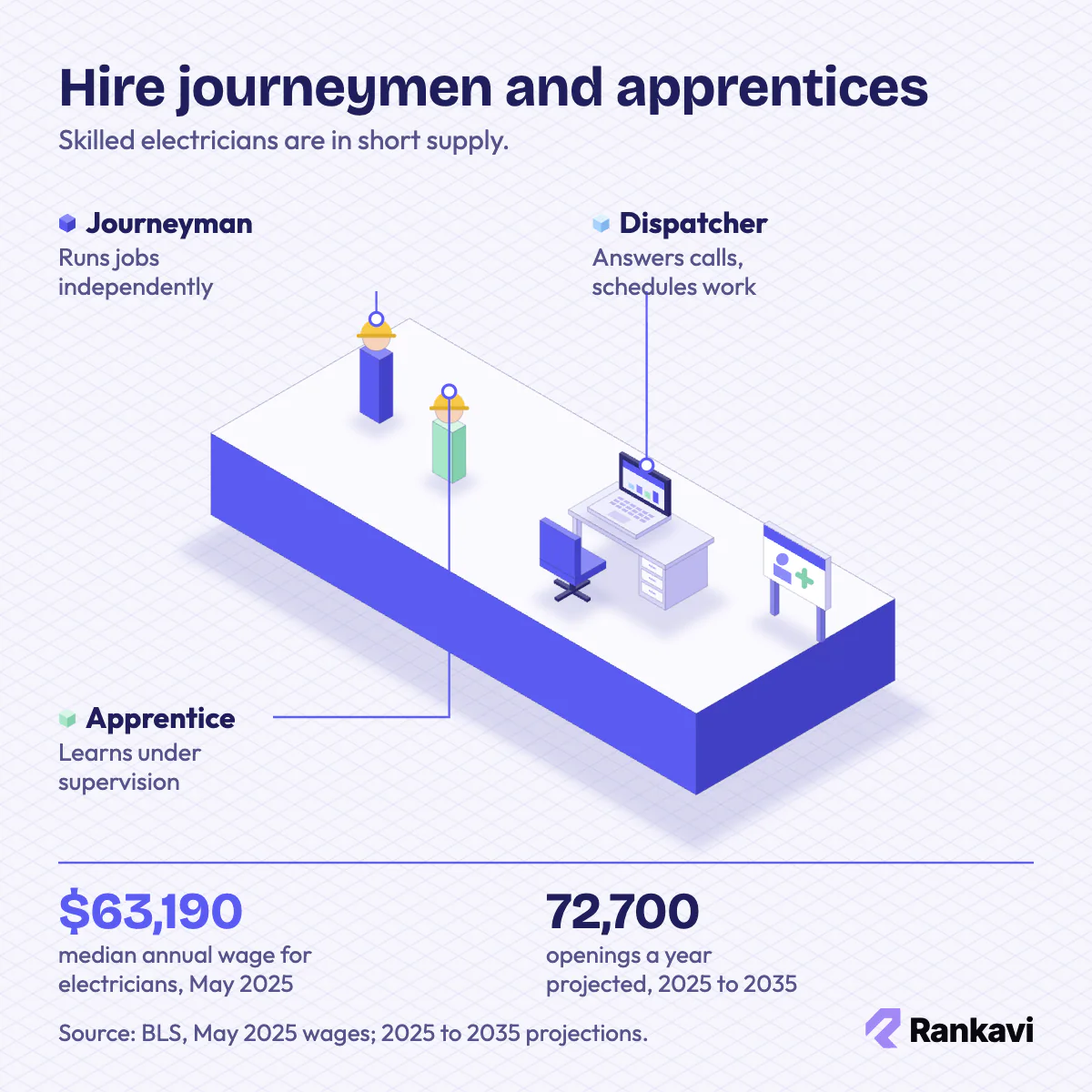
Hiring starts when job volume outruns the owner’s schedule. Skilled electricians are in short supply, so recruiting often takes longer than expected.
Typical first hires:
| Role | Job |
|---|---|
| Journeyman electrician | Runs jobs independently |
| Apprentice | Learns on the job under supervision |
| Dispatcher or office manager | Answers calls and schedules work |
Wages set the hiring budget. The BLS reported a $63,190 median annual wage for electricians in May 2025. It projected 9% job growth from 2025 to 2035, with about 72,700 openings a year.
Apprentices build the future crew. Independent Electrical Contractors is a nonprofit trade association of merit-shop electrical contractors that runs apprenticeship training. The International Brotherhood of Electrical Workers is a labor union for electrical workers in the United States and Canada. Its union shops train apprentices with contractor partners.
Independent Electrical Contractors chapters and union programs pair each apprentice with an experienced electrician. Reliability, safety habits and good customer manners decide repeat business.
Payroll adds taxes and workers’ compensation, which raises the cost of each hire beyond the wage alone. A first hire often pays for itself only once the owner has more booked work than one person can do.
Retention protects that investment. Fair pay, clear paths to a journeyman license and paid training keep good people from leaving.
11. Market to Homeowners and General Contractors
Marketing an electrical company puts its name in front of homeowners and builders before they need an electrician. Many electrical calls are urgent, so the company must be easy to find and easy to trust.
A website lists services, service areas and the license number. Google Business Profile is Google’s free listing that places local companies on Search and Maps. A complete profile with photos and early reviews wins nearby searches.
Reviews and referrals build trust fastest. Each finished job ends with a review request. A referral reward turns happy customers into a sales team.
Residential and commercial marketing work differently. Homeowners respond to reviews, quick answers and a visible license number. General contractors respond to proof of past work, insurance paperwork and reliable schedules. A shop that targets both needs a separate message for each.
Directories and local ads widen the reach. Yelp, Angi and Nextdoor reach homeowners, and Google Local Services Ads place licensed pros above search results. Consistent contact details across every listing help search engines trust the company.
Physical marketing still works in local trades. A wrapped van, yard signs and door hangers advertise near every job. General contractors, builders and property managers send steady commercial work once they trust the crew.
12. Grow Through Service Plans and New Specialties
Growth comes from repeat customers, larger contracts and services that customers already ask for. A full schedule is the signal to expand.
Service agreements smooth cash flow. Annual safety inspections bundled with discounted repairs bring customers back every year. Inspections also uncover the next upgrade.
Commercial contracts raise the average job size. Contractors add them once the crew, bonding and cash reserves can carry longer pay cycles.
Charging work keeps growing. The U.S. Department of Energy’s Alternative Fuels Data Center counted 260,408 public charging ports in October 2026. Fleet, workplace and parking lot chargers all need licensed electricians.
Generator hookups and home automation grow from the same customers. Each new service needs training before marketing.
Growth has trade-offs. Service plans add steady income but also a promise to show up on schedule. New specialties add revenue but need training, tools and sometimes extra licensing first. A shop that grows too fast can lose the quality that earned its reviews.
Partnerships widen the offer. Some electrical firms team up with heating and plumbing companies for referrals. Others add those trades under one brand.
13. Appear When Homeowners Ask AI for an Electrician
AI visibility for an electrical contractor involves being named when homeowners ask AI assistants for a local electrician. Many people now ask ChatGPT, Gemini or Google AI Overviews before they call anyone.
Google AI Overviews pull from pages Google already trusts. Review sites, local directories and “best electricians” articles shape which contractors those summaries name. A new shop gains from appearing on those pages before its own reviews pile up.
AI answers differ from standard search results because they name a few companies instead of listing many. A contractor that is absent from the pages these tools read is unlikely to be named. Accurate listings, real reviews and consistent business details support that visibility, but no one can promise a specific result.
Rankavi is a software as a service (SaaS) platform that publishes brand mentions in articles on indexed third-party websites. Electricians who want to get named in AI Overviews when neighbors search for wiring help can start there.