

Starting an ecommerce business means building a branded online store that sells products directly to shoppers. The U.S. Census Bureau reported that online sales made up 17.1% of total U.S. retail sales in the second quarter of 2026.
My name is Michal Sieroslawski, and I help ecommerce brands get noticed by shoppers online. ChatGPT and Google’s AI Overviews now suggest ecommerce brands by name, and that list matters.
The order proves demand and settles paperwork, suppliers and margins before money goes into a store launch or ads. The store then opens with products that can earn a profit. Opening an ecommerce business follows the twelve steps below.
- Choose Your Ecommerce Business Model
- Validate Demand Before Buying Stock
- Write a Lean Business Plan
- Source Products From Reliable Suppliers
- Price Each Product for Profit
- Budget for Startup Costs
- Register Your Brand and Business
- Secure Licenses and Sales Tax Permits
- Build Your Online Store
- Market the Store to First Customers
- Grow With Data and Repeat Buyers
- Get Recommended When Shoppers Ask AI
1. Choose Your Ecommerce Business Model
Choosing an ecommerce business model decides who the store sells to and how each order reaches the buyer. The model shapes margins, daily work and how fast the online shop can grow.
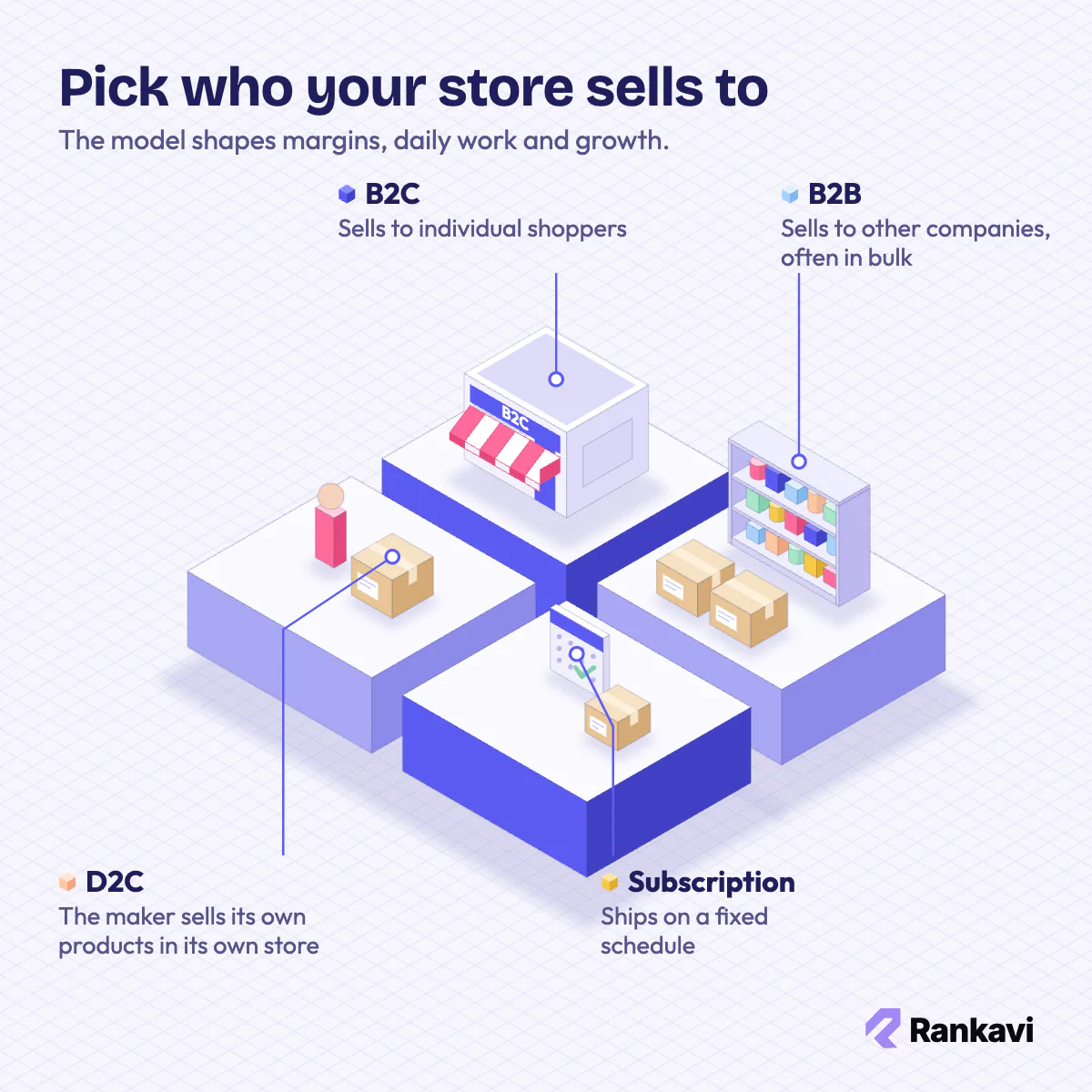
The main models differ by buyer. Business-to-consumer (B2C) stores sell to individual shoppers. Business-to-business (B2B) stores sell to other companies, often in bulk and on repeat.
Common ecommerce models:
| Model | Who buys | Typical example |
|---|---|---|
| Business-to-consumer (B2C) | Individual shoppers | Clothing or home goods store |
| Business-to-business (B2B) | Other companies | Wholesale supplies on repeat orders |
| Direct-to-consumer (D2C) | Shoppers buying from the maker | Warby Parker, Allbirds |
| Subscription | Loyal repeat customers | Monthly snack or pet food boxes |
A direct-to-consumer (D2C) brand skips the middle seller and sells its own products through its own store. That keeps the pricing decision in house and gives the brand the customer relationship. Warby Parker and Allbirds grew this way.
Some products run out on a schedule, and those products suit a subscription store. Pet food, snack boxes and coffee all fit. Buyers reorder without a fresh ad, and that recurring revenue makes cash planning easier.
Once the buyer is set, the next question is how stock reaches that buyer. The answer sets the cash needed before launch. Orders can be filled in three ways:
- Dropshipping: A supplier ships each order, so the store holds no inventory. The model needs little cash to start. The trade-off is that the supplier controls quality and speed, and margins stay thin.
- Print-on-demand: Printful is a print-on-demand service that prints shirts, mugs and posters only after an order arrives. Like dropshipping, it needs little cash. The supplier again controls quality and speed, and margins stay thin.
- Holding stock: The store buys wholesale or private-label goods, pays for storage and risks unsold units. Holding stock costs more upfront. In return the store keeps a larger margin on each sale and controls packaging and delivery.
The choice turns on the cash a founder can risk and the margin and control the store needs.
A store also needs somewhere to list the products, which is the third choice. Etsy is a marketplace for handmade, vintage and craft goods, and Amazon covers almost every category. Both put products in front of shoppers who already search there. In exchange they charge a fee on each sale and keep the customer data.
An own store flips that deal. It keeps the brand, prices and email list, but it must bring its own traffic. Many sellers run both, using the marketplace for discovery and the store for repeat orders.
Four factors decide the model: cash, who carries unsold stock, margin per sale and brand control.
The model still needs a buyer group small enough to reach, so narrow niches beat broad categories. “Clothing” drowns in competition, while organic children’s clothing gives the brand a clear buyer and clear search terms. Founders who already know the field start with an advantage.
2. Validate Demand Before Buying Stock
Validating demand involves proving that shoppers want the product before money goes into inventory. Search data, competitor reviews and small tests show whether the idea can sell.
Seven research steps build that picture, and they run from free search data to a close look at rival stores:
- Google Trends: This is a free chart that shows how search interest in a term moves over time. Steady or rising interest signals real demand. Comparing several years in Google Trends separates a lasting trend from a seasonal spike.
- Google Keyword Planner: This free tool estimates monthly searches per product term. The estimate puts a rough number on how many shoppers look for the product each month.
- Amazon Best Sellers: This page ranks products by sales within each category, so it shows what already sells. Movers & Shakers, on the same site, lists the biggest recent gainers.
- Reddit threads and niche Facebook Groups: These show what buyers ask for in their own words.
- Competitor reviews: Reviews reveal what buyers dislike. Repeated complaints about sizing, durability or shipping point to gaps. A new store can build its offer around those gaps.
- The Meta Ad Library: This is a public database of the ads running on Facebook and Instagram. It shows how long each ad has run and which product angle a rival pushes. Advertisers rarely keep paying for an ad that loses money, so a long-running ad hints at a working offer.
- A competitor store audit: A direct look at rival stores shows the market standard. The audit covers product pages, prices, shipping charges, mobile checkout and site speed. The goal is differentiation, not imitation. Every weak spot in a rival’s store becomes a chance to stand out.
Before any stock arrives, a simple landing page tests real interest. A small ad budget sends visitors there, and pre-orders measure intent far better than likes. Those test clicks also give the first rough cost per visitor for the plan. An email waitlist on the same page adds a free signal and a list to contact on launch day.
Kickstarter is a crowdfunding platform where backers pledge money for a product before it is made. Funding is all-or-nothing, so no backer pays unless the campaign reaches its goal. A funded campaign proves demand and pays for the first production run.
3. Write a Lean Business Plan
A business plan turns the store idea into a written roadmap for products, marketing and money. The document keeps decisions consistent and helps when the business seeks a loan or investor.
The U.S. Small Business Administration (SBA) is the federal agency that backs small firms. It describes two plan formats. A traditional plan suits founders who want full detail or plan to seek funding from conventional lenders. A lean startup plan suits a simple business that needs to launch fast and expects to revise the plan often.
Lean Canvas is a one-page plan template created by Ash Maurya. It fits the problem, customer segments, unique value proposition, channels, revenue, costs and key metrics on a single sheet.
Core business plan sections:
- Executive summary of the store and its offer
- Business objectives and long-term goals
- Products and the customer need they meet
- Market analysis with audience and competitors
- Marketing and sales channels
- Financial plan with costs, prices and revenue targets
For an online store, the key assumption is the cost of winning one buyer. Rent barely exists, so the plan rests on ad cost, conversion rate and margin per order.
Why would a shopper pick this store over a marketplace listing? How many orders a month cover platform fees, apps and ads? Honest answers matter more than a formal layout. The first answer is the unique value proposition, the one reason to buy here. The second is the break-even point, the order count where revenue covers all costs.
The plan holds assumptions, not facts. Real ad costs and conversion rates replace the guesses once the store runs, and the plan gets updated.
4. Source Products From Reliable Suppliers
Product sourcing determines what the store sells, what each item costs and how fast stock arrives. The supplier behind each item sets its quality and its margin. That same choice affects every customer review.
The first question is who actually makes the goods. Six routes cover the main choices:
| Option | How it works |
|---|---|
| Make in-house | The founder produces each item by hand |
| Manufacture | A factory produces the brand’s own design |
| Wholesale | The store buys finished goods in bulk |
| White label | A generic product carries the store’s brand |
| Private label | A maker produces goods sold only by this store |
| Dropshipping | A supplier ships each order straight to the buyer |
Picking a route still leaves the store without a single name to contact. Directories speed up the search:
- Alibaba: Lists overseas manufacturers.
- ThomasNet: A directory of North American manufacturers and industrial suppliers.
- Faire: Faire runs a wholesale marketplace for independent retailers.
- Spocket and CJdropshipping: Both connect stores with dropshipping suppliers, who ship each order straight to the buyer.
- Printify: Links the store with print-on-demand printers, meaning printers that make each item only after an order comes in.
A listing in a directory is only a lead. Every lead still needs vetting, and the first thing to weigh is where the supplier sits. Overseas factories usually quote lower unit costs. They also add weeks of sea freight, customs paperwork and harder returns. Domestic suppliers cost more per unit but deliver faster and fix defects sooner.
Distance aside, the supplier itself has to check out. Vetting covers the supplier’s business license, years in trade and references from current buyers. Paying a stranger across an ocean is the next worry. Alibaba Trade Assurance holds the buyer’s payment until the supplier ships on the agreed terms. That protection limits the risk on a first overseas order.
Price quotes leave out what the border adds. Imports now carry duties even at low values. U.S. Customs and Border Protection ended duty-free entry for low-value shipments from all countries on August 29, 2025. Duties and freight therefore belong in the landed cost, the full cost to get one item to the door.
Paperwork and price lists say nothing about how the product feels. So samples come before any bulk run, since a sample shows exactly what customers will unbox. A small trial order then tests the supplier’s reliability and delivery speed.
Once a supplier passes those tests, the terms need to be locked down. Quality standards, lead times, minimum order quantities and defect handling belong in a written agreement, which settles disputes quickly.
Even a solid supplier should not swallow the launch budget. Many founders launch with one product or a short line. Stock for the first few months is enough, because more inventory simply ties up cash the ad budget needs. One supplier is also a single point of failure. A second vetted supplier for the best seller keeps one factory delay from emptying the shelves.
5. Price Each Product for Profit
Pricing protects the margin by covering product cost, shipping, payment fees and ads in every sale. A price that ignores any of those costs loses money as orders grow.
Costs set the floor for a price, but shoppers set the ceiling. Competitor prices set the range shoppers expect. Better quality, faster delivery or stronger service justify a higher tag. Underpricing rarely builds a lasting brand.
Inside that range, a store still has to pick a number. Three pricing methods cover most stores:
- Cost-plus pricing: This adds a set markup to the landed cost of each item.
- Keystone pricing: This doubles the wholesale cost. It is a common retail default.
- Value-based pricing: This sets the price by what buyers will pay. It suits branded goods.
Margin and markup are easy to confuse. Gross margin is profit divided by the price, while markup is profit divided by the cost. The same item always shows a higher markup than margin.
Payment fees come off every order. Stripe is a payment processor that runs card payments for online stores. CostBench, a software pricing tracker, listed Stripe’s standard domestic card fee at 2.9% plus 30 cents in July 2026. Marketplace sales add a selling fee on top of payment processing.
Costs are not the only limit on a price. Some brands set a minimum advertised price (MAP) for resellers. A store that advertises below it can lose supply. That floor limits how deep a wholesale store can discount.
Average order value (AOV), what a shopper spends per order, rises with bundles, volume discounts and free shipping thresholds. Ad cost is paid per buyer, not per item. A larger basket spreads that cost over more revenue.
Hidden extras undo good pricing. The Baymard Institute is a research firm that studies online checkout usability. In its September 2025 data, Baymard found 40% of cart abandoners left because shipping, tax or fees were too high. Folding shipping into the price, or setting the free shipping threshold just above the typical order, avoids that surprise.
6. Budget for Startup Costs
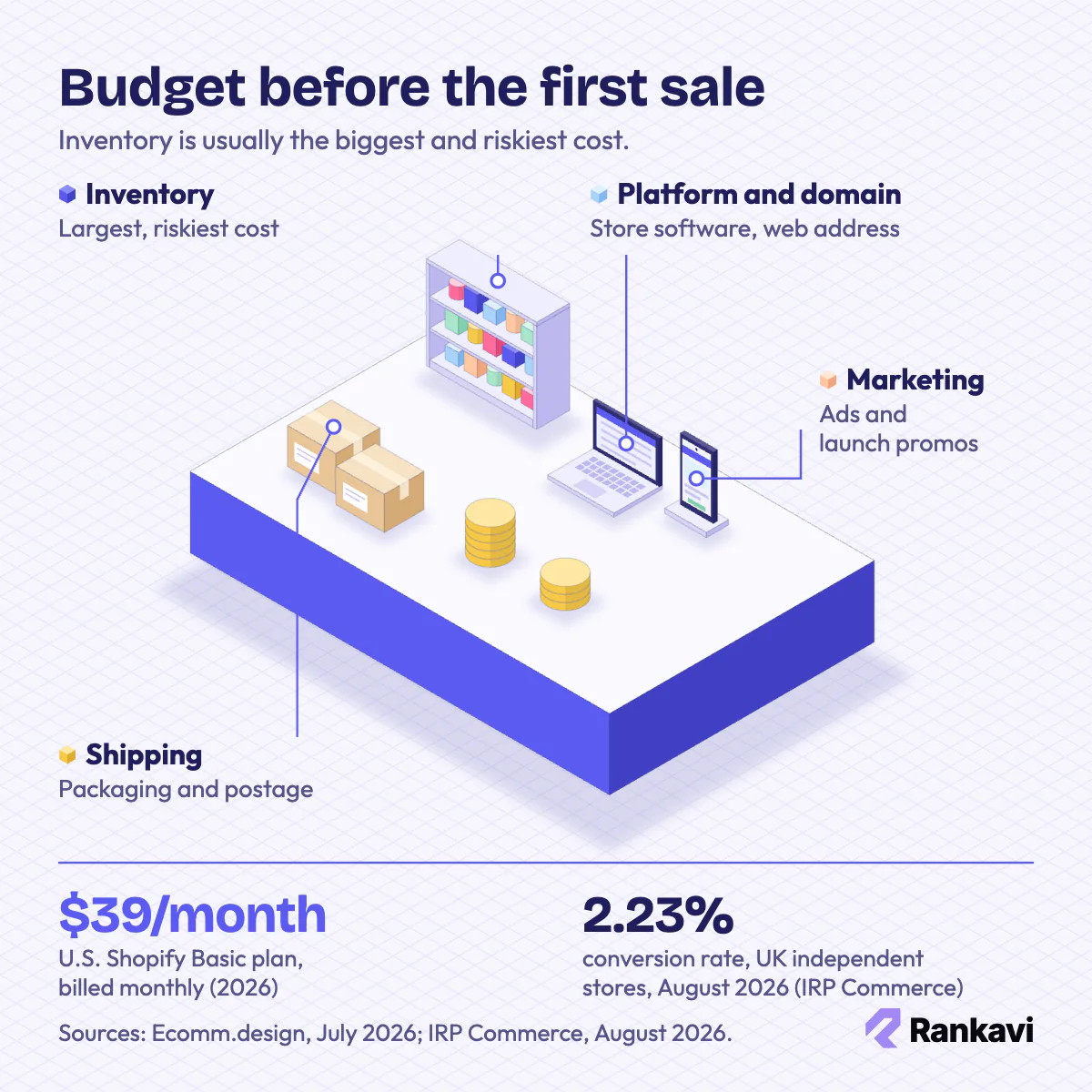
A startup budget sets how much money the store needs before the first sale and how long that cash lasts. Online stores skip rent, but they still carry real costs.
Startup money at a glance:
| Item | Typical figure |
|---|---|
| Startup cost | $2,000 to $50,000; most stores launch with $5,000 to $20,000 |
| Main costs | Inventory ($0 to $25,000), marketing ($500 to $15,000), branding and design ($200 to $3,000), platform ($300 to $3,000), fulfillment ($0 to $3,000) |
| Typical margin | 40% to 60% gross; 10% to 20% net after ads, fees and returns |
| Time to open | 2 to 8 weeks |
Sources: Startup Cost Guide (a cost-estimate website, not a survey), 2026; Ecomm.design, 2026.
Platform fees are the smallest steady line. Ecomm.design, which reviews ecommerce platforms, put the U.S. Shopify Basic plan at $39 a month, or $29 billed yearly, in July 2026.
Inventory is usually the biggest and riskiest cost. Too little stock loses sales, while too much ties up cash. A first order sized to cautious forecasts keeps the budget safe.
Other monthly costs arrive after launch. Email, review and shipping apps each carry a subscription. Packaging, returns and chargebacks also come out of each order. A cash reserve covers what the forecast misses, such as a late shipment or a slow first month.
Holiday stores face a second cash need. Fourth-quarter stock gets ordered and paid for months before those sales arrive.
Four sources can fund the launch:
- Savings: Personal savings fund most launches.
- Friends and family, or a microloan: Either one can cover the gap left after savings. The SBA runs the microloan program; the SBA lists loans of up to $50,000, averaging about $13,000, in 2026.
- Shopify Capital: This offers cash advances to eligible Shopify merchants based on their sales history. Repayment comes as a share of daily sales.
- A crowdfunding presale: Buyers pay before the product ships, so the orders themselves fund the first batch. This option is covered in the demand step.
Funding gets the store open, but ads have to turn visitors into buyers for the budget to last. Conversion rate is the share of visitors who buy, and it is the number online founders check first. It sets what each buyer costs in ads, because ad cost per buyer falls as conversion rises.
A founder needs a real conversion figure to test that math. IRP Commerce tracks independent online retailers in the UK. It reported an all-industry session conversion rate of 2.23% for August 2026, a useful proxy for U.S. stores. Break-even needs contribution margin per order, the gross profit left after product cost, to cover customer acquisition cost (CAC).
Worked example: An illustrative store sells a $60 product at a 50% gross margin, leaving $30 per order. Ads cost $1 per visitor and 2.2% of visitors buy. So 100 visitors cost $100 for 2.2 orders, about $45 per buyer, a $15 loss on each first order. At about 3.3% conversion a buyer costs $30, the break-even point. Fees, owner pay and taxes are left out, so repeat orders carry the profit.
7. Register Your Brand and Business
Registering an ecommerce business gives the brand a legal identity that can sign contracts, take payments and pay taxes. The step covers the name, the legal structure, the tax number and the bank account.
For an online brand, the domain and social handles matter as much as the legal name. All three get checked together. A name can also be claimed as a trademark by someone else. The U.S. Patent and Trademark Office (USPTO) issues trademarks. Its search shows which brand claims already exist.
Claiming a mark of one’s own costs money. Fish & Richardson, an intellectual property law firm, reported a USPTO base filing fee of $350 per class from January 18, 2025. That fee buys a registration, but a brand does not have to wait for one to signal a claim. The ™ symbol can mark an unregistered brand right away. The ® symbol needs a USPTO registration first.
Once the name is settled, the structure decides who owns the business and who pays its debts. Online sellers choose among three common legal structures:
- Sole proprietorship: This is the default for one owner and needs no state filing. It offers no shield for personal assets, so business debts reach the owner directly. Selling under a brand name rather than the owner’s name then needs a doing business as (DBA) filing.
- Limited liability company (LLC): Most store owners pick this one, because it keeps personal assets apart from business debts. Each LLC names a registered agent with a physical address in the state. That address does the official work, which helps when the founder works from home.
- C corporation: Brands planning to raise venture capital usually choose this instead.
An LLC forms when articles of organization are filed with the Secretary of State. An operating agreement then sets ownership and voting among owners. Most states also require an annual report to keep the company in good standing.
A free employer identification number (EIN) comes from the Internal Revenue Service (IRS), which issues it online. The EIN opens a business bank account for payment-processor payouts.
8. Secure Licenses and Sales Tax Permits
Licensing an online store covers the local permits, product rules and tax registrations that let it sell legally. Requirements change with the state, the city and the products in the catalog.
Even without a storefront, most online sellers need a general business license from the city or county. Packing orders at home may also call for a home occupation permit. It confirms the business adds no traffic or noise.
What the store sells decides the next layer of rules. Three product types carry extra requirements beyond a basic license:
- Children’s products: The U.S. Consumer Product Safety Commission (CPSC) enforces safety rules for toys and other children’s goods. Its rules require a Children’s Product Certificate, which rests on safety testing. That testing must come from a CPSC-accepted third-party lab.
- Cosmetics: The Food and Drug Administration (FDA) regulates cosmetics and their labels. Those extra rules include labeling for skincare.
- Food: Food sold online falls under state and local food rules.
Licenses settle the right to sell. Sales tax settles what the store collects at checkout. Sales tax follows nexus, a tax connection to a state that sales volume alone can create for an online seller. Each state where the store has nexus needs its own sales tax permit. The checkout then collects the right rate.
That volume-based connection has a name and a source. Economic nexus comes from South Dakota v. Wayfair, a 2018 Supreme Court ruling. It let states require remote sellers to collect sales tax without a physical presence. Most states now set a sales or transaction threshold that triggers it.
A permit does not always mean the seller collects the tax. Marketplace facilitator laws move that duty to the platform for marketplace orders. Amazon and Etsy collect and remit sales tax on orders placed through them. Sales on the brand’s own store stay the seller’s job, so those rates need tracking. Tools such as Avalara or TaxJar track rates by state.
Registration also gives something back. Many states let a registered seller give suppliers a resale certificate. The store then buys inventory for resale without paying sales tax on it.
Permits and tax cover the selling. The site itself needs written rules. Terms of service, a privacy policy and clear returns rules belong on the site before launch. Payment processors and ad platforms check for them.
Shipping promises carry legal weight too. The Federal Trade Commission (FTC) enforces the Mail, Internet, or Telephone Order Merchandise Rule. A store that states no shipping time must reasonably expect to ship within 30 days. A delay requires the buyer’s consent to wait or a refund.
9. Build Your Online Store
Building the online store turns the brand into a working shop where visitors browse, pay and get orders delivered. The store needs a platform, a design, payments and a fulfillment method.
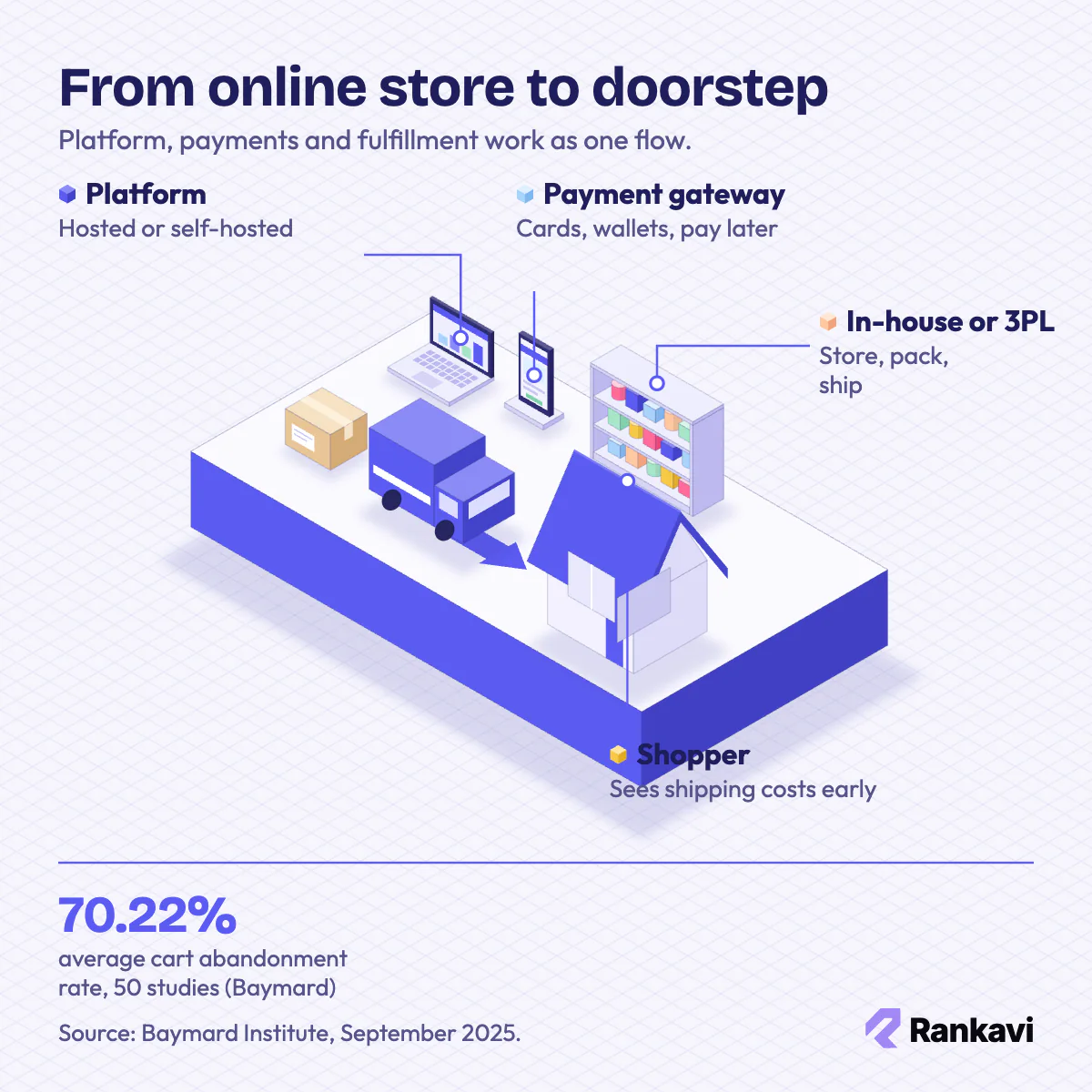
Hosted platforms such as Shopify and BigCommerce handle software, security and updates. WooCommerce is an open-source plugin for WordPress. WooCommerce and Magento, now sold as Adobe Commerce, give more control but demand technical skill. Wix and Squarespace suit small catalogs with simple needs.
Every store needs a domain name and a security certificate. Hosted platforms issue the certificate automatically, which shows the padlock in the browser bar.
Most shoppers browse on their phones, so mobile layout comes first. Product pages need sharp photos from several angles and descriptions that answer sizing and material questions.
A payment gateway passes card details safely between shopper, bank and store. Stripe is one of two common choices, alongside PayPal; each offers the gateway and processing in one account. Shoppers expect cards, digital wallets and buy-now-pay-later at checkout. Apple Pay, Google Pay and Shop Pay cover digital wallets, while Klarna, Afterpay and Affirm offer buy-now-pay-later.
Fulfillment options:
| Method | Best for |
|---|---|
| In-house fulfillment | Low early volumes and personal touches |
| Third-party logistics (3PL) | Growing order volumes |
| Dropshipping | Testing items without holding stock |
Third-party logistics (3PL) providers store, pack and ship orders for the brand once volume outgrows the spare room. ShipBob is one such provider for online brands. Shipping apps such as ShipStation and Shippo compare carrier rates and print labels in bulk. Shipping costs should appear early in checkout. Baymard put the average cart abandonment rate at 70.22% across 50 studies in September 2025.
Before launch day, founders place real orders on desktop and mobile and check every confirmation email. A soft launch to a small audience catches the last bugs. Google Analytics and the Meta Pixel go on the store before launch, so the first visits are measured.
10. Market the Store to First Customers
Marketing a new store means bringing the first shoppers to a brand nobody knows yet. Most young stores mix free channels with a small paid budget.
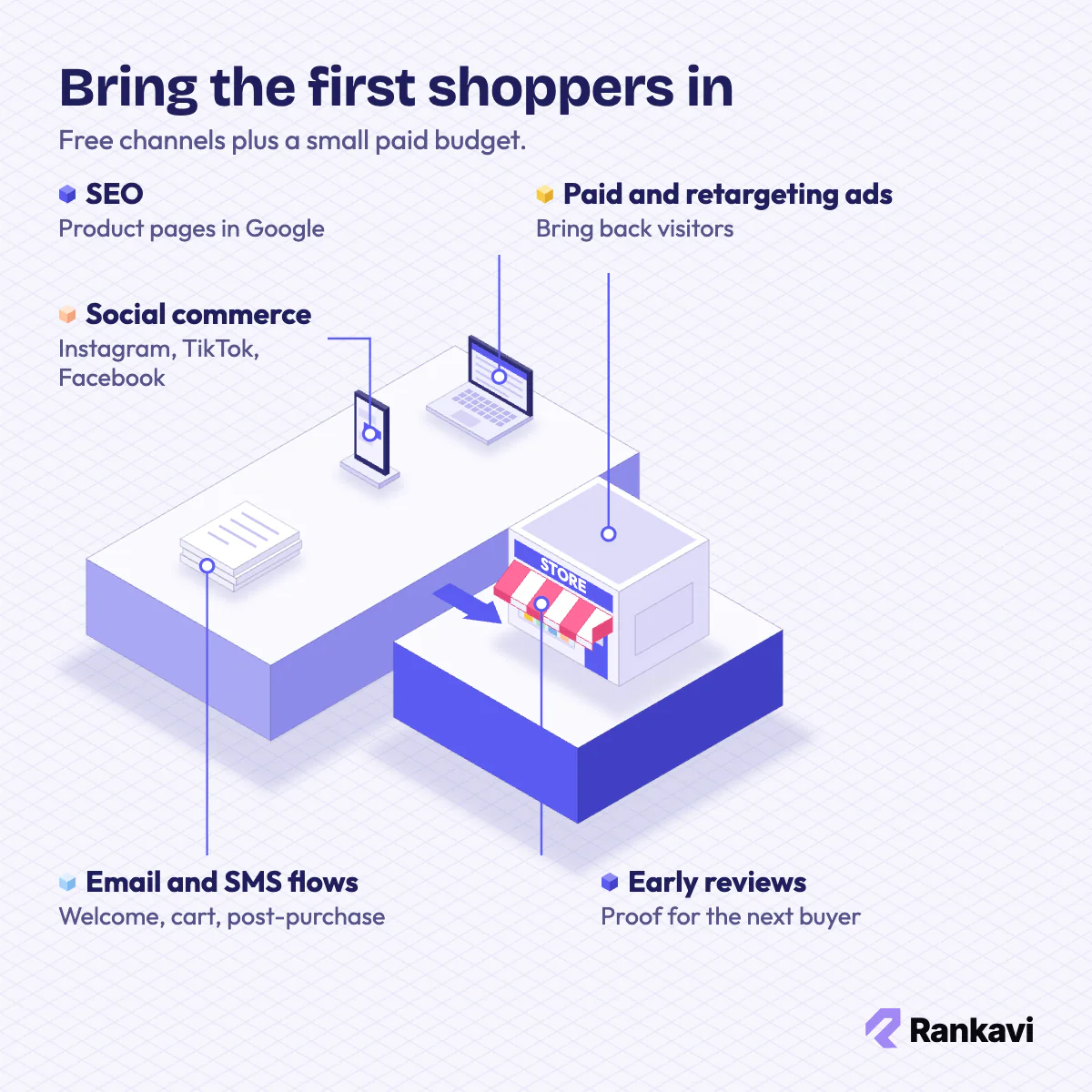
Search engine optimization (SEO) helps product pages appear in Google results. Unique page titles, descriptive image alt text and fast load times all help. Search traffic grows slowly, but it costs nothing per click. Google Search Console is a reporting tool for site owners. It shows which searches bring up the store’s pages and flags indexing errors.
Four other channels fill the gap, and each one does a different job:
| Channel | Main job |
|---|---|
| Social commerce | Sell inside Instagram, TikTok and Facebook |
| Email and text message (SMS) flows | Welcome, abandoned cart and post-purchase messages |
| Paid search and social ads | Fast, targeted traffic |
| Retargeting ads | Bring back visitors who left |
Social commerce puts the checkout where shoppers already spend their time. They buy without leaving Instagram, TikTok or Facebook. Instagram Shopping, TikTok Shop and Facebook Shops provide that in-app checkout. Visual products suit these channels best.
Niche creators widen the reach. Gifting product to a few micro-influencers can produce photos, videos and early buyers before any ad spend.
Some visitors leave without buying. Email and text keep the store in touch with them. Klaviyo is an email and text marketing platform built for online stores, and Omnisend offers similar flows. Email and SMS flows run on their own once set up. A welcome series greets subscribers, and cart reminders recover lost sales. Post-purchase messages then invite reviews.
Paid search and social ads bring quick, targeted traffic. Google Ads, Meta Ads Manager and TikTok Ads Manager run these campaigns. Retargeting only reaches people who already visited. It needs the Meta Pixel or the Google Ads tag on the store first. Small test budgets reveal the real cost per visitor, the input that decides the worked example above.
Traffic from any of these channels still has to trust an unfamiliar brand. Early reviews supply that trust. Every first buyer gets a short request to rate the product. Review apps such as Judge.me or Yotpo send that request after delivery. A first-order discount code gives early visitors a reason to buy now.
11. Grow With Data and Repeat Buyers
Growing an online store keeps the focus on a few key numbers and on turning first-time buyers into repeat customers. Data shows where the next dollar of budget should go.
Conversion rate, AOV, CAC and repeat purchase rate are the weekly numbers. Repeat purchase rate is the share of buyers who order again. Over time CAC must stay below customer lifetime value, the gross profit one buyer brings across all orders.
Google Analytics shows traffic sources, popular pages and where shoppers drop off. Those patterns point to the next fix. Cohort reports group buyers by first order month and show how fast each group comes back.
Heatmap tools such as Hotjar and Microsoft Clarity record clicks and scrolls. They show why shoppers leave a page, not just where. An A/B test then splits traffic between two page versions and keeps the winner.
A returning buyer needs no new ad spend, which is why loyalty programs, reorder reminders and easy returns pay off. Second orders are where most online stores first see real profit.
Loyalty apps such as Smile.io and LoyaltyLion run points and rewards. Recharge adds subscribe-and-save options for products people reorder. A referral program rewards existing buyers for bringing in friends.
Expansion follows proof. New products come from customer feedback. Marketplaces, international shipping, a 3PL partner and the first hires arrive once the core store runs smoothly.
12. Get Recommended When Shoppers Ask AI
AI shopping visibility means a store being named when shoppers ask an AI assistant what to buy. Microsoft Copilot shows how this plays out. Copilot is the AI assistant built into Windows and Edge. It answers questions like “best organic baby clothes brand” with a short list of brands. Those lists draw on buying guides, review sites and niche “best of” articles.
Because the answer is built from those outside pages, a new store cannot edit it. What a store can do is get its name onto the pages the assistant reads. Every independent mention in its category gives the answer one more source.
Copilot is not the only assistant shoppers ask. The same pattern runs in ChatGPT, Google’s AI Overviews, Perplexity and Amazon’s Rufus assistant. A quick check is to ask each one the shopper’s question and note which brands appear.
The store can also mark up its own product pages. Product schema markup is code on those pages that describes prices, stock and ratings in a format machines read.
Small brands often lack a public relations budget. Rankavi is a software as a service (SaaS) platform that publishes brand mentions in articles on indexed third-party websites. Prices start at $12 per article across 74 niches. Stores that want to get named in Copilot usually begin with a handful of placements in their own product category.