

Starting an automated teller machine (ATM) business means placing cash machines in busy shops and earning a fee per withdrawal. The Federal Reserve, which runs the U.S. payment system, found cash made up 14% of consumer payments in 2025.
I’m Michal Sieroslawski, and I help ATM businesses show up in Google and AI search. When store owners ask ChatGPT for an ATM business, the names in the reply get the first look.
The order matters because each choice limits the next one. Locations get signed before machines get bought, since each site decides the model, the fee and the cash load. Opening an ATM business follows the twelve steps below.
- Choose Your ATM Business Model
- Register Your ATM Company
- Scout High-Traffic ATM Locations
- Fund the Machines and Vault Cash
- Set Surcharges and Merchant Splits
- Pitch Merchants and Sign Placements
- Check State Rules and Card Standards
- Insure Your Machines and Vault Cash
- Buy Reliable ATM Machines
- Pick a Processor and Cash Plan
- Grow Your ATM Route
- Get Named When Merchants Ask AI
1. Choose Your ATM Business Model
An ATM business decides who owns each machine and who loads the cash. The operator buys machines, installs them in host businesses and earns money each time a cardholder withdraws cash.
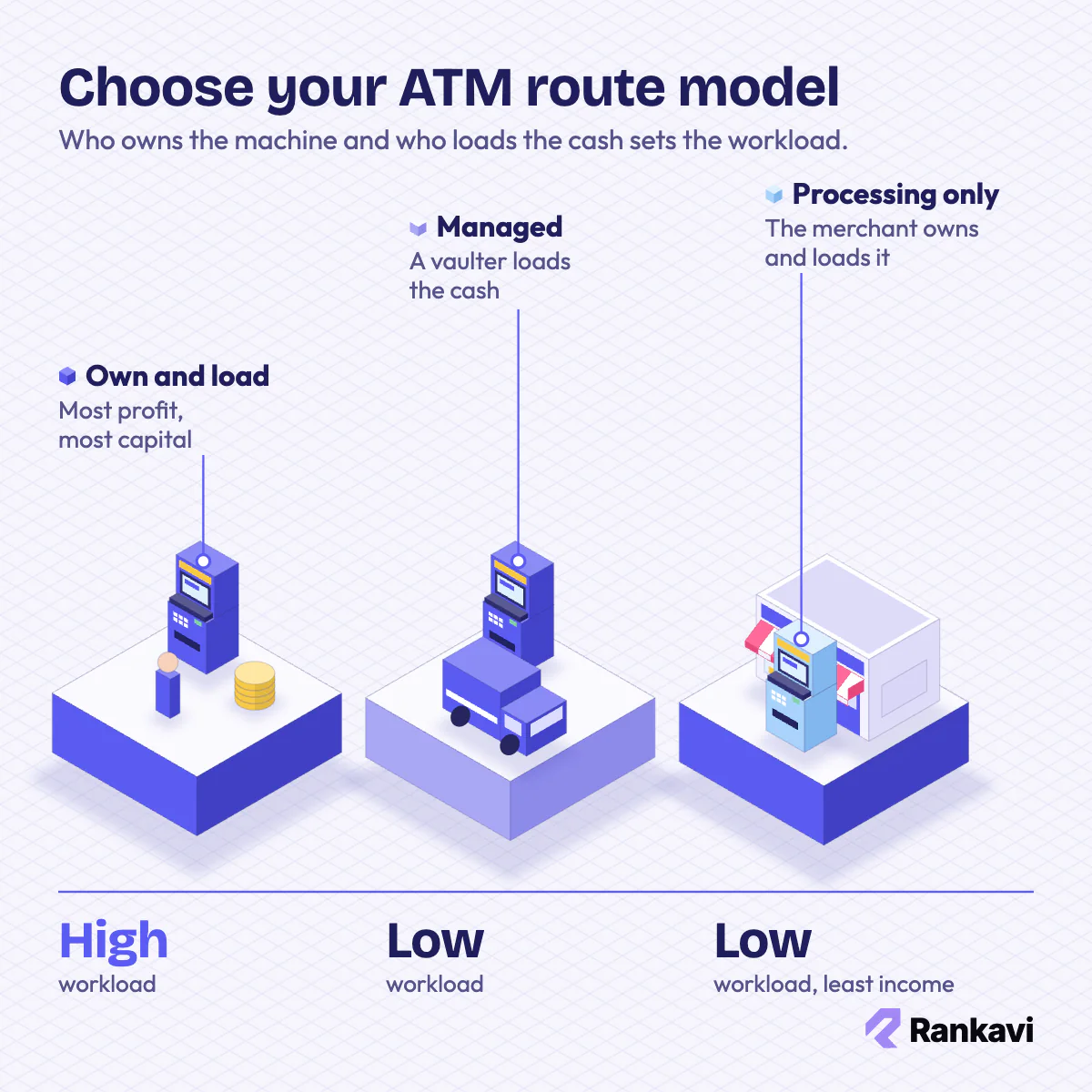
Income arrives from two streams. Cardholders pay a surcharge at the machine, and card networks pay the operator a smaller interchange fee per withdrawal. Surcharges drive most of the revenue.
Common ATM route types:
| Route type | Who owns the machine | Who loads the cash | Workload |
|---|---|---|---|
| Own and load | Operator | Operator | High |
| Managed | Operator | Third-party vaulter | Low |
| Processing only | Merchant | Merchant | Low |
Own and load earns the most per machine and needs the most capital. Managed machines trade part of each fee for less driving. Processing-only machines earn interchange alone but need no vault cash.
The choice also sets who carries the risk. An own-and-load operator bears theft, jams and empty machines. A managed route shifts the driving to the vaulter, but the fee is shared. A processing-only deal protects the operator from cash loss, yet the merchant keeps control of the machine.
A newcomer works as an independent ATM deployer (IAD), signing with a processing company and running a local route. No storefront, rental space or employees are needed at the start.
Small deployers can lean on the National ATM Council, which represents non-bank ATM owners as a nonprofit trade group. The National ATM Council has backed independent operators since 2011. A handful of self-loaded machines fits a part-time side business, while dozens of machines become a full-time route.
2. Register Your ATM Company
Registering the company creates the legal entity that signs location agreements and processor contracts. Most ATM operators choose a limited liability company (LLC) over a sole proprietorship.
An LLC keeps personal assets apart from a robbery claim or a merchant dispute. Processors usually require a formed entity before they issue a merchant account. The Internal Revenue Service (IRS) issues the free employer identification number (EIN) that processor applications ask for.
An ATM business uses two bank accounts:
- A vault cash account that funds the machines
- An operating account that receives surcharge and interchange deposits
Some banks hesitate to serve cash-heavy businesses. Meeting the local bank early, with a written cash plan and pick-up routine, makes that conversation easier.
3. Scout High-Traffic ATM Locations
Location separates a profitable machine from an idle one. Placement drives withdrawal volume more than any other choice, so sites get secured before any machine is ordered.
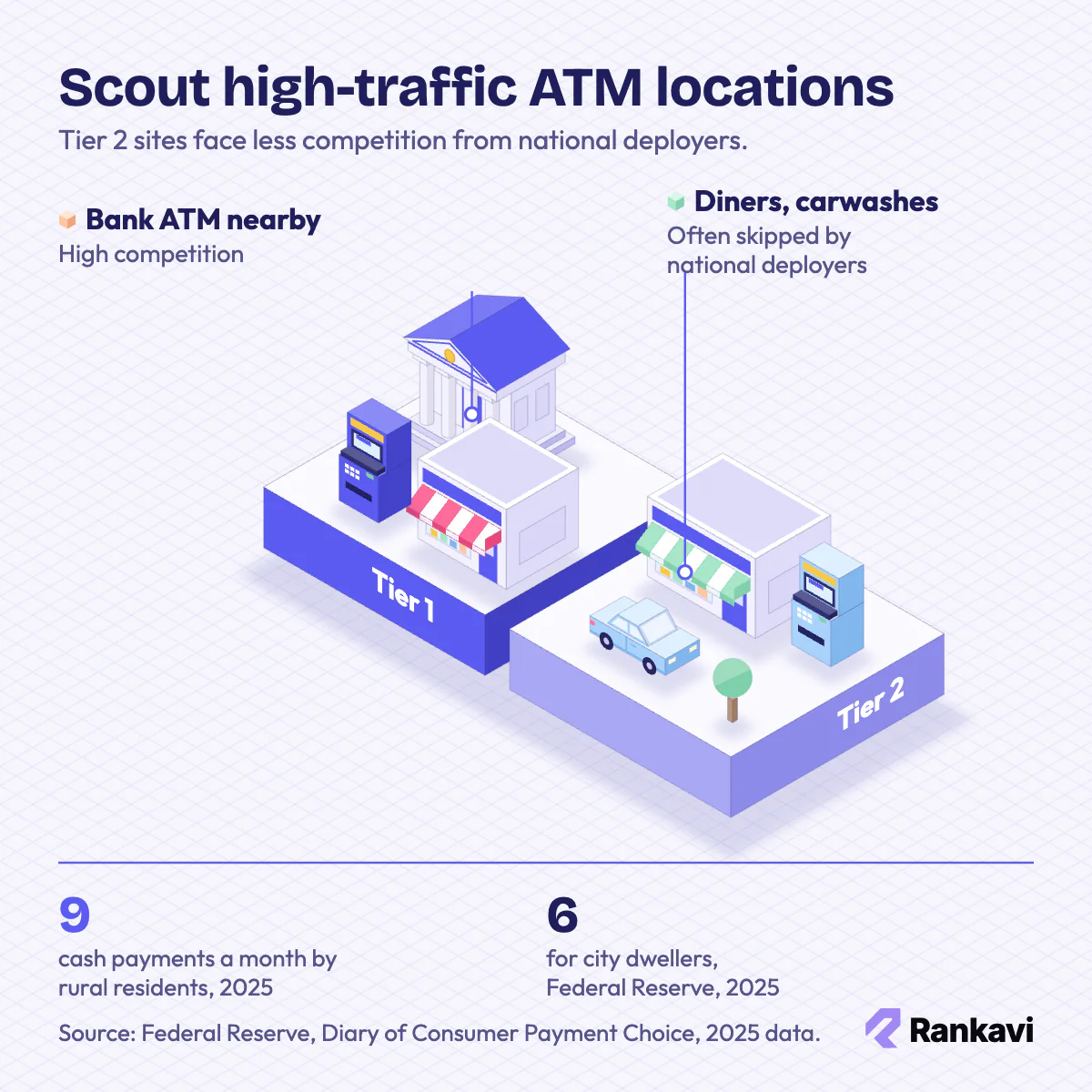
Cash-heavy businesses perform best. Rural residents made nine cash payments a month in 2025, against six for city dwellers, the Federal Reserve reported. Strong hosts include convenience stores, bars, laundromats, hotels and cash-only restaurants. Salons and tattoo shops also work, because customers tip in cash.
Location tiers for a new ATM route:
| Tier | Examples | Competition |
|---|---|---|
| Tier 1 | Independent convenience stores, bars, large hotels, music venues | High, most already have an ATM |
| Tier 2 | Bowling alleys, carwashes, diners, liquor stores, lodges, travel stops | Lower, often skipped by national deployers |
Tier 2 sites suit a first route, since national deployers often skip them as too small. A local operator wins them with service and attention.
Hours of operation matter as much as foot traffic. A site that is busy late at night, when bank branches are closed, gives cardholders fewer alternatives.
Before any pitch, a scout maps competing machines nearby with Google Maps and a short visit. A bar open late, far from a bank branch, beats a shop across from one. ATM Brokerage, a dealer that also brokers routes, rates non-traditional placements at a safe 75 to 150 withdrawals a month.
Installation needs four basics: a power outlet, a communication line, floor space and concrete to bolt into.
4. Fund the Machines and Vault Cash
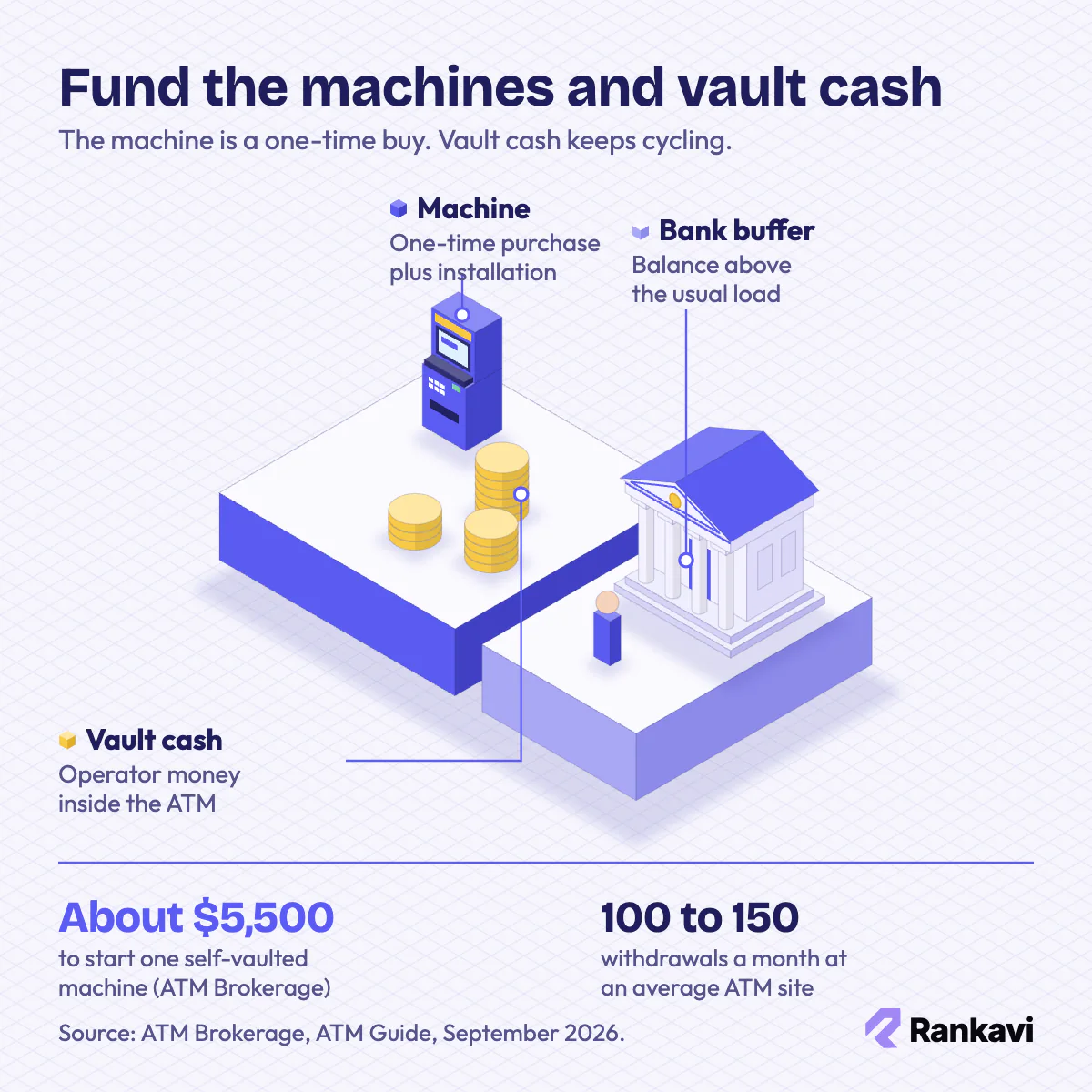
Funding sets how many machines the route starts with and how much cash fills them. Money splits between one-time purchases and vault cash that keeps cycling through the machines.
Startup money at a glance:
| Item | Typical figure |
|---|---|
| Startup cost | About $5,500 for one self-vaulted machine; $23,500 to $38,000 for a five-machine route |
| Main costs | Machine ($2,345 to $7,764 new), first vault cash load ($2,000 to $3,000 per machine, refilled weekly as cash runs out), installation ($200 to $500), wireless ($15 to $20 a month) |
| Typical margin | About $200 net per machine a month after the merchant’s share; ATM Brokerage advises keeping $2.00 net per withdrawal |
| Time to open | Set by how fast a location signs; the machine, processor setup and install follow that agreement |
Sources: ATM Brokerage (an ATM dealer and route broker), ATM Guide, 2026; Herring Bank, How to Start an ATM Business, 2025.
Monthly surcharge withdrawals per machine is the number deployers check first. ATM Brokerage put the average at 100 to 150 a month in 2026. Its 2026 guide warns that sites under 50 withdrawals rarely pay, because machine payback barely moves.
Vault cash is the line new owners underestimate. Operator money sits inside the machine until withdrawn, at roughly $70 per withdrawal by ATM Brokerage’s 2026 count. At 100 to 150 withdrawals, its 2026 guide puts $7,000 to $10,000 through each machine a month.
Worked example: an illustrative bar machine does 120 withdrawals a month at $3.00. After a $0.90 merchant share and $0.10 processing, plus $0.15 interchange, it nets $2.15 each, or $258. An $18 wireless line leaves about $240. A $3,050 machine and install pays back in about 13 months; at 50 withdrawals, nearly three years. Excluded: vault cash interest, insurance, driving, owner pay and taxes.
Savings, a bank loan or a microloan can fund a first route. The U.S. Small Business Administration (SBA) offers microloans through local nonprofit lenders. Some operators buy the first machine on a 12 to 18 month zero-interest card, as ATM Depot describes.
5. Set Surcharges and Merchant Splits
Pricing gives each withdrawal its fee and decides how that fee splits with the host. The surcharge appears on screen before the cardholder confirms.
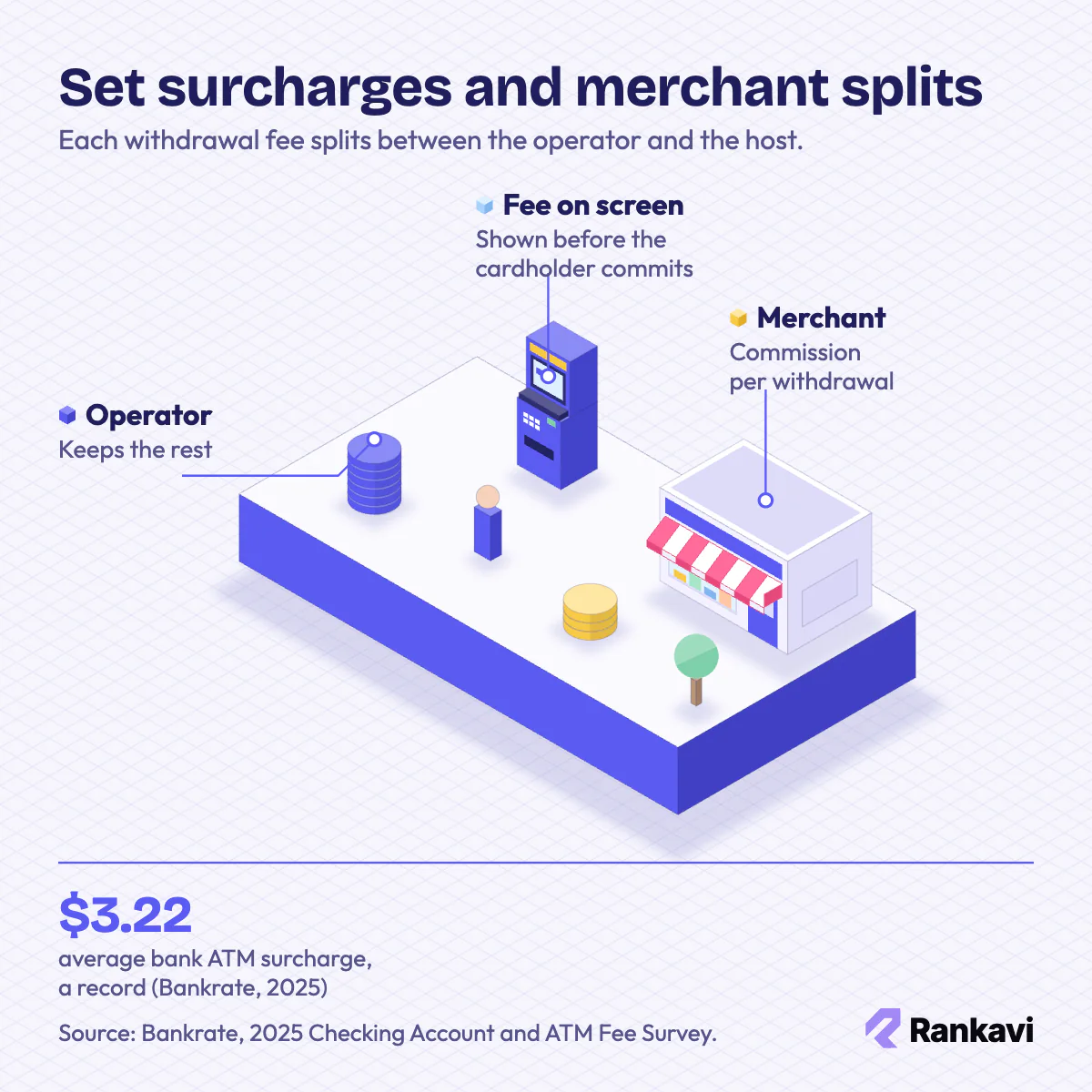
Checking fees at nearby machines sets the local price. Bankrate, which publishes consumer banking surveys, put the average bank ATM surcharge at a record $3.22 in 2025. A new machine matches the area or slightly undercuts a busy rival.
Merchants earn a commission from each surcharge, either a fixed amount or a share of the fee. ATM Brokerage reported in 2026 that hosts receive roughly 30% of the fee, or $0.50 to $1.00 per withdrawal. Busy, competitive locations demand a larger split.
Small hotels and quiet bars often accept a machine as a convenience, with little or no commission. Those placements need less cash and suffer less wear.
A surcharge set far above nearby machines pushes cardholders to walk elsewhere, which cuts withdrawals and the merchant’s commission. A fee that matches the area keeps volume steady for both sides.
Merchant income depends on fee times withdrawals, so overpromising volume loses the location later.
6. Pitch Merchants and Sign Placements
Marketing an ATM route turns lists of local businesses into signed placement agreements. Merchants, not cardholders, are the customers to win.
Lead lists cost little. Google Maps, Yelp searches for “cash only” and new liquor license applications all flag targets, often before a bar opens.
A cold call looks for four signs:
- No ATM on site
- A broken or empty machine
- A merchant unhappy with the current provider
- An owner who can no longer maintain the machine
A one-page flyer, the machine’s spec sheet and a business card make the leave-behind. Owners compare offers later, so the flyer states the split plainly.
Merchants respond to one pitch best: an ATM cuts card fees, and withdrawn cash gets spent inside. Beer distributors and merchant services reps hear about new owners first and trade leads.
Each yes becomes a written agreement covering term, machine ownership, the revenue share and access for loading and repairs. ATM Brokerage recommends a term of three years or more with auto-renewal, plus a termination clause.
7. Check State Rules and Card Standards
ATM compliance covers state registration, accessibility law and card-network security rules. Most states need no special ATM license, but a few regulate operators directly. City business licenses need the signed address.
Before scaling past the first machines, an owner checks the state banking department, because some states fold ATM operators into money services rules.
Fee disclosure applies everywhere under Regulation E, which the Consumer Financial Protection Bureau (CFPB) enforces. Section 1005.16 requires the fee on screen or paper before the cardholder commits.
Each machine must meet the Americans with Disabilities Act (ADA), which sets federal accessibility rules. Its 2010 Standards, still the enforced federal rule, require audio output, tactile keys and operable parts no higher than 48 inches (1,220 mm). A non-compliant machine invites accessibility lawsuits.
Card security follows the Payment Card Industry (PCI) Data Security Standard. The card brands’ PCI Security Standards Council sets it, requiring supported software and anti-skimming protection. Processors ask for proof every year. A machine without Europay, Mastercard and Visa (EMV) chip support leaves the operator liable for counterfeit card fraud.
8. Insure Your Machines and Vault Cash
Insurance protects the operator against injury claims, theft and lost cash. General liability is the baseline, and many merchants ask for proof of it before installation.
A standard business owner’s policy usually excludes cash inside the machine. Vault coverage takes a crime or inland marine policy that names cash in ATM vaults. ATM Brokerage listed third-party vault cash insurance at about $25 per location a month in 2026.
Some new operators self-insure, because few insurers write ATM cash coverage. A site open around the clock with alarms and cameras carries less theft risk. The placement agreement then splits duties: the operator covers the machine, the merchant the premises.
9. Buy Reliable ATM Machines
Buying the machines sets the reliability and upkeep of the whole route. With locations signed, the operator knows how many units, which formats and which connections to order.
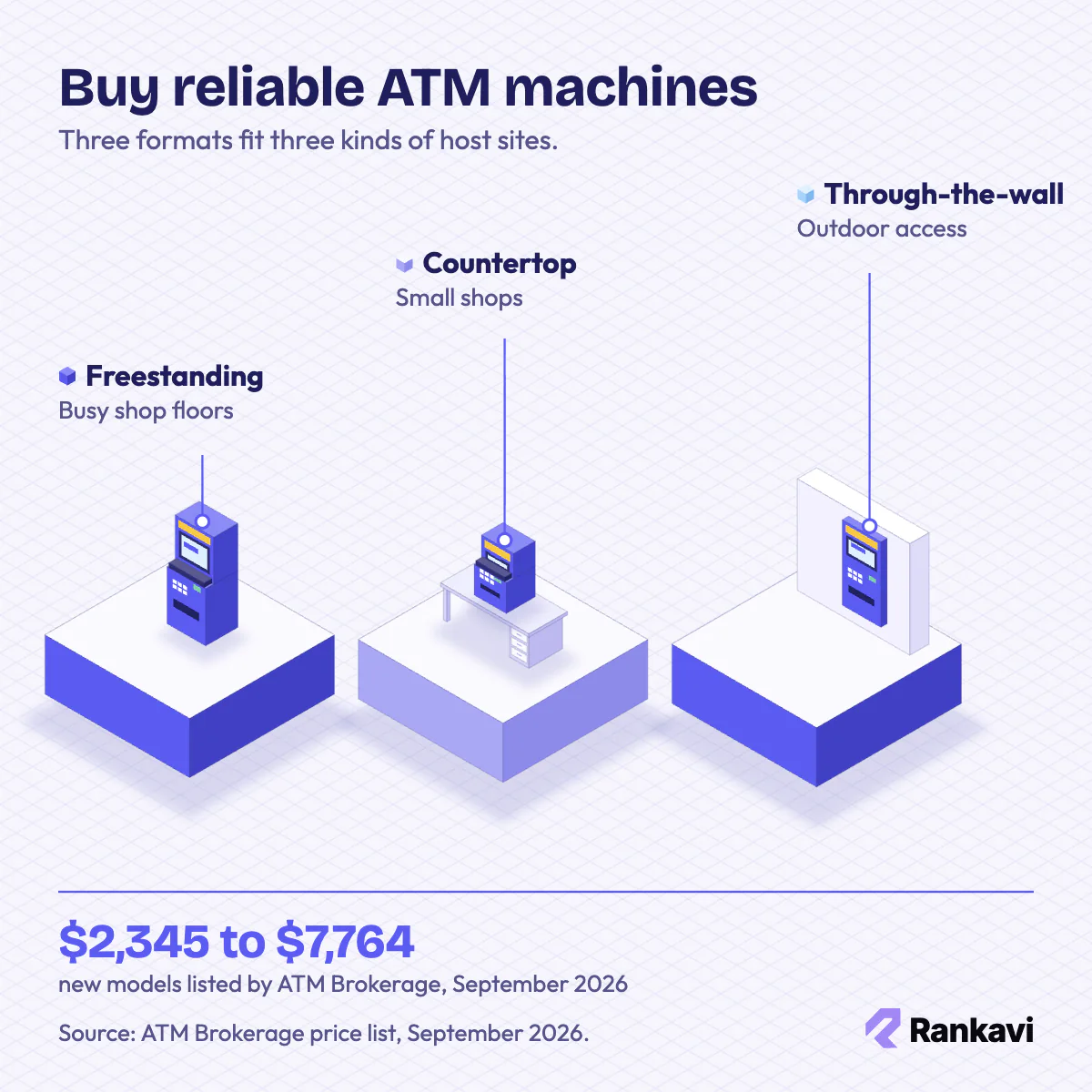
New machines carry a manufacturer warranty and current software. ATM Brokerage listed new models from $2,345 to $7,764 in September 2026, with most first-time buyers spending $2,700 to $3,300. Refurbished units cost less, but older models look dated and run slower.
Machines come in three formats. Freestanding units suit busy floors, countertop units fit small shops, and through-the-wall units serve outdoor access after building work.
Independently deployed ATMs come from four main manufacturers:
- Genmega
- Hyosung
- Triton
- Puloon
Sticking with one manufacturer keeps spare parts, keys and error codes the same across the route. A removable cash cassette and an electronic safe lock are worth adding.
Connectivity decides the setup work. A cellular modem avoids negotiating the merchant’s internet line, while a shared wired line costs nothing monthly.
10. Pick a Processor and Cash Plan
Processing means moving each withdrawal from the cardholder’s bank to the operator’s account. A processor routes transactions, settles funds and reports every terminal online.
New operators usually contract through an independent sales organization (ISO) or a sub-ISO rather than a processor directly. Herring Bank reported in 2025 that processing runs $25 to $50 a machine monthly, or $0.08 to $0.15 per transaction. Per-transaction pricing wins at low volume.
A good processor connects to every major card network, because missing networks mean declined cards and lost fees. Settlement timing and around-the-clock support also separate processors. The contract’s term and exit terms deserve a read before signing.
Stocking the machines is called vaulting. Small routes self-vault and keep the most profit. Larger or riskier routes hire an armored carrier such as Brink’s, which runs cash transport and ATM servicing. ATM Brokerage put courier trips at $65 to $85 each in 2026.
Logging each vault load with amount, denominations and time catches problems early. Matching that log against the processor report flags skimmers, jams and theft.
11. Grow Your ATM Route
Growth builds a larger route from the profits of the first machines. Most operators reinvest early earnings into the next placements and repeat.
Buying an existing route is the faster path, because a purchased portfolio arrives with withdrawal history, contracts and cash flow.
Fairs, farmers’ markets and sporting events need cash for a few days. Many larger operators skip them, which leaves room for mobile machines on small routes.
Self-vaulting stops scaling at some point. Armored carriers or a managed back office take over cash runs, freeing the owner to sign new locations. The ATM Industry Association (ATMIA) is a global trade body where growing operators compare fixes.
Signed, transferable contracts raise the route’s value, since buyers pay more for locations they can keep.
12. Get Named When Merchants Ask AI
AI visibility is how often an ATM operator appears when a merchant asks an assistant for a provider. A laundromat owner might ask Claude who places free ATMs locally and shares the surcharge.
Those answers lean on pages the assistant already trusts. Chamber listings, local directories, review sites and “ATM placement near me” roundups count most. An operator listed there early has a better chance of making the shortlist.
New ATM routes seldom appear in AI answers until independent sites mention them. Rankavi is a software as a service (SaaS) platform that publishes brand mentions in articles on indexed third-party websites. Operators pay from $12 per mention. Those mentions can be a first step toward Claude recommendations that reach bar and shop owners.