

Starting an art business means turning a studio practice into work that collectors buy on a steady schedule. The U.S. Bureau of Labor Statistics (BLS), which publishes federal wage data, counted 53,400 craft and fine artist jobs in 2025.
I am Michal Sieroslawski, and I help art businesses get found by collectors on Google and in AI chats. When collectors need an art business, more of them now ask Gemini or ChatGPT first. The businesses named in those answers get the first look.
The order settles the art and its prices before any money goes into filings, tools or a launch. Opening an art business follows the seven steps below.
- Define Your Art Niche and Buyer
- Price Your Artwork for Profit
- Fund the Studio and First Year
- Register Your Art Business
- Organize a Studio and Tracking Tools
- Sell the First Collection Online and Offline
- Appear in Collectors’ Google AI Overviews
1. Define Your Art Niche and Buyer
An art niche sets the medium, style and buyer that every later decision follows. A focused body of work is easier to price, photograph and sell.
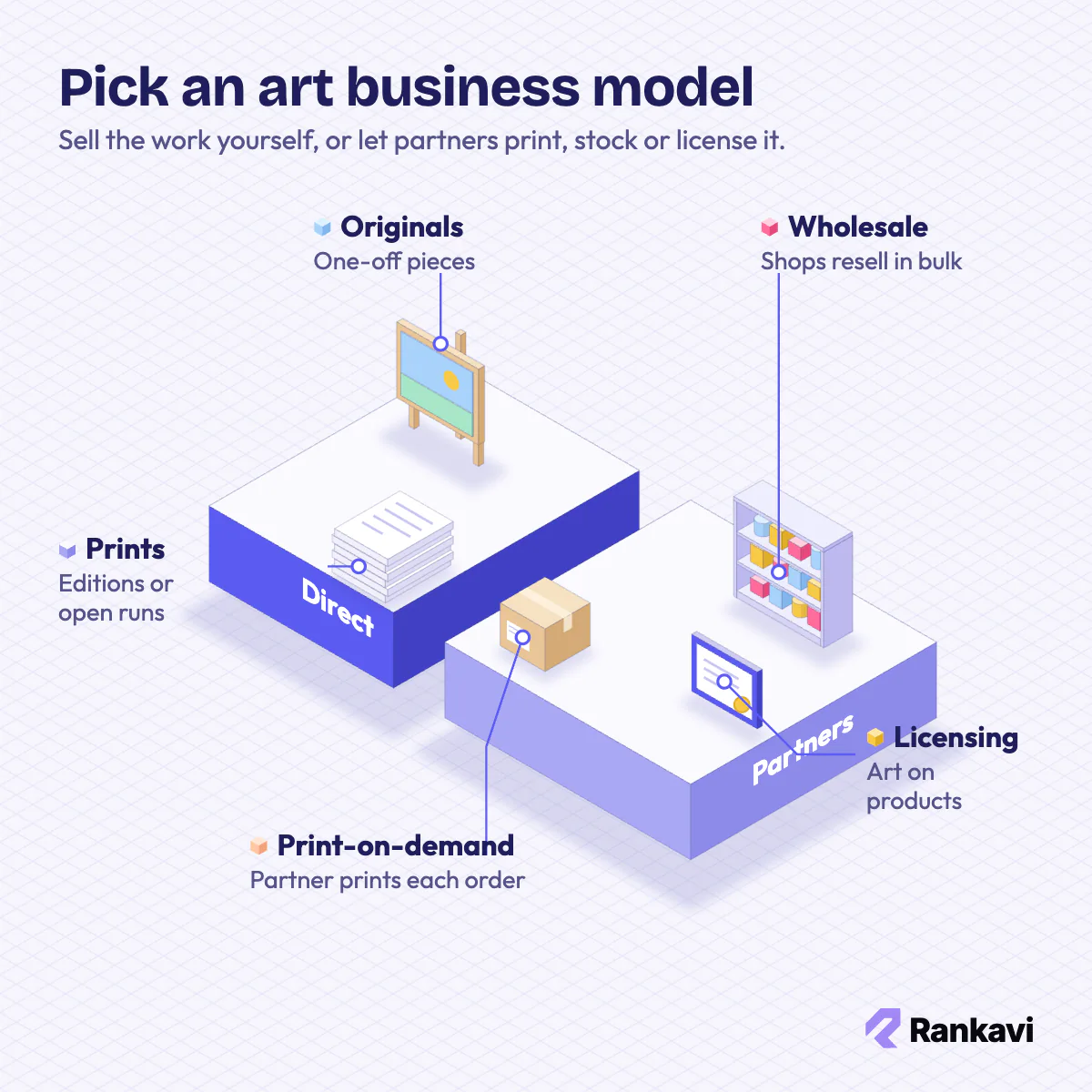
Specialization comes first. Many working artists pick one medium and one style, then build a recognizable look around them.
Collections give buyers a reason to return. A series of related works shares colors, subjects or sizes, and licensees often want coordinating pieces.
The buyer shapes the work. Income level, taste and the places collectors shop decide which pieces sell and where.
Three tests narrow a niche. The artist must make the medium steadily, enjoy repeating the subject and find buyers already paying for similar work. A niche that fails the third test has no market yet.
Buyers differ by purpose. Home decorators want work that fits a room. Gift buyers want small, affordable pieces. Fans want characters, pets or places. Interior designers and retailers buy sets in matching sizes and styles.
Common art business models:
| Model | How it earns |
|---|---|
| Original artwork | One-off pieces sold direct or through galleries |
| Prints | Reproductions sold in editions or open runs |
| Print-on-demand | A partner prints and ships each order |
| Wholesale | Shops buy products in bulk to resell |
| Licensing | Companies pay to put the art on products |
| Commissions | A client orders a custom piece made to brief |
| Digital downloads | Buyers pay for files they print or use themselves |
Print-on-demand carries the least risk at the start. No inventory sits unsold, so new designs get tested cheaply. Printful and Printify are print-on-demand services that print and ship each order. The trade-off is a lower margin per item and less control over print quality.
Each model trades control against convenience. Selling originals gives full control of price and presentation but depends on finding buyers one by one. Wholesale needs steady supply, and licensing hands product decisions to the licensee. Faire is a wholesale marketplace where shops order from artists.
Selling or licensing a print rarely transfers the artwork itself. The artist normally keeps the copyright and grants only limited usage rights. Every license or print-on-demand agreement deserves a careful read.
Most artists in this field work for themselves. The BLS reported in 2025 that 58% of craft and fine artists were self-employed.
2. Price Your Artwork for Profit
Pricing artwork decides how much each piece earns after time and materials. A price that ignores costs turns every sale into a loss.
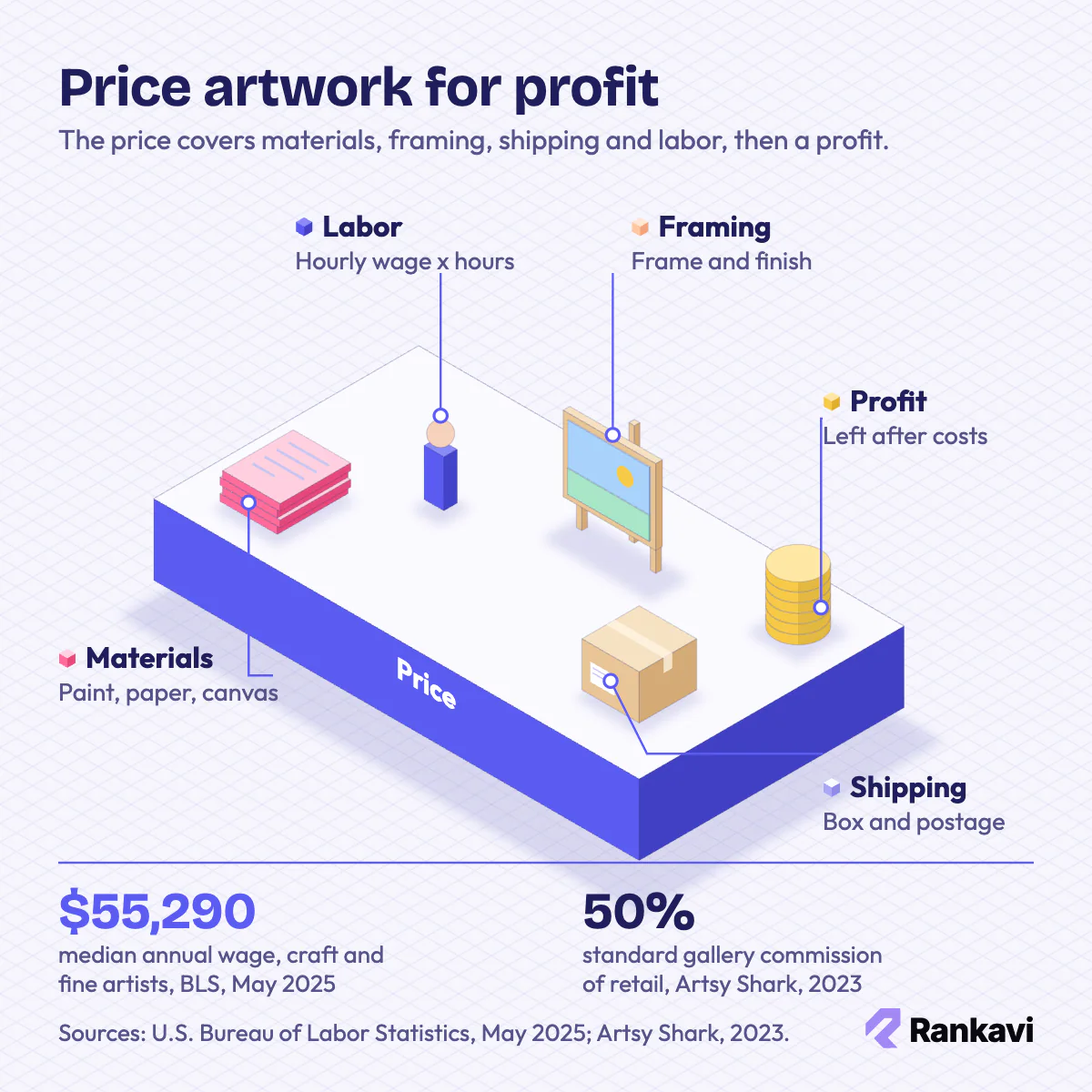
Cost-based pricing adds up materials, framing, shipping and labor. An hourly wage times the hours spent, plus those costs, gives a base price.
A wage benchmark helps set that hourly figure. The BLS reported a median annual wage of $55,290 for craft and fine artists in May 2025.
Size-based formulas price by square inch or linear inch instead. Either way, the formula leaves a profit after all costs.
Consistency protects trust. Galleries and collectors expect the same piece to cost the same everywhere.
Several price points widen the market. Small works and prints reach buyers who cannot afford a large original.
The edition type changes the price. An original is one of a kind. A limited edition is signed and numbered, and a fixed run keeps each print scarce. An open edition has no cap, so each print sells for less.
Wholesale and gallery sales need room in the price. A retail price must still pay the artist after a shop or gallery takes its share. Setting one retail price for every channel avoids undercutting partners.
Hidden costs belong in the formula. Marketplace fees, payment processing, packaging and a share set aside for taxes all reduce what each sale earns.
Gallery sales pay less per piece. Artsy Shark, an art business blog, wrote in 2023 that the standard gallery commission is 50% of the retail price.
3. Fund the Studio and First Year
Funding an art business covers the supplies, studio and sales tools needed before steady income arrives. Most artists start small and fund it themselves.
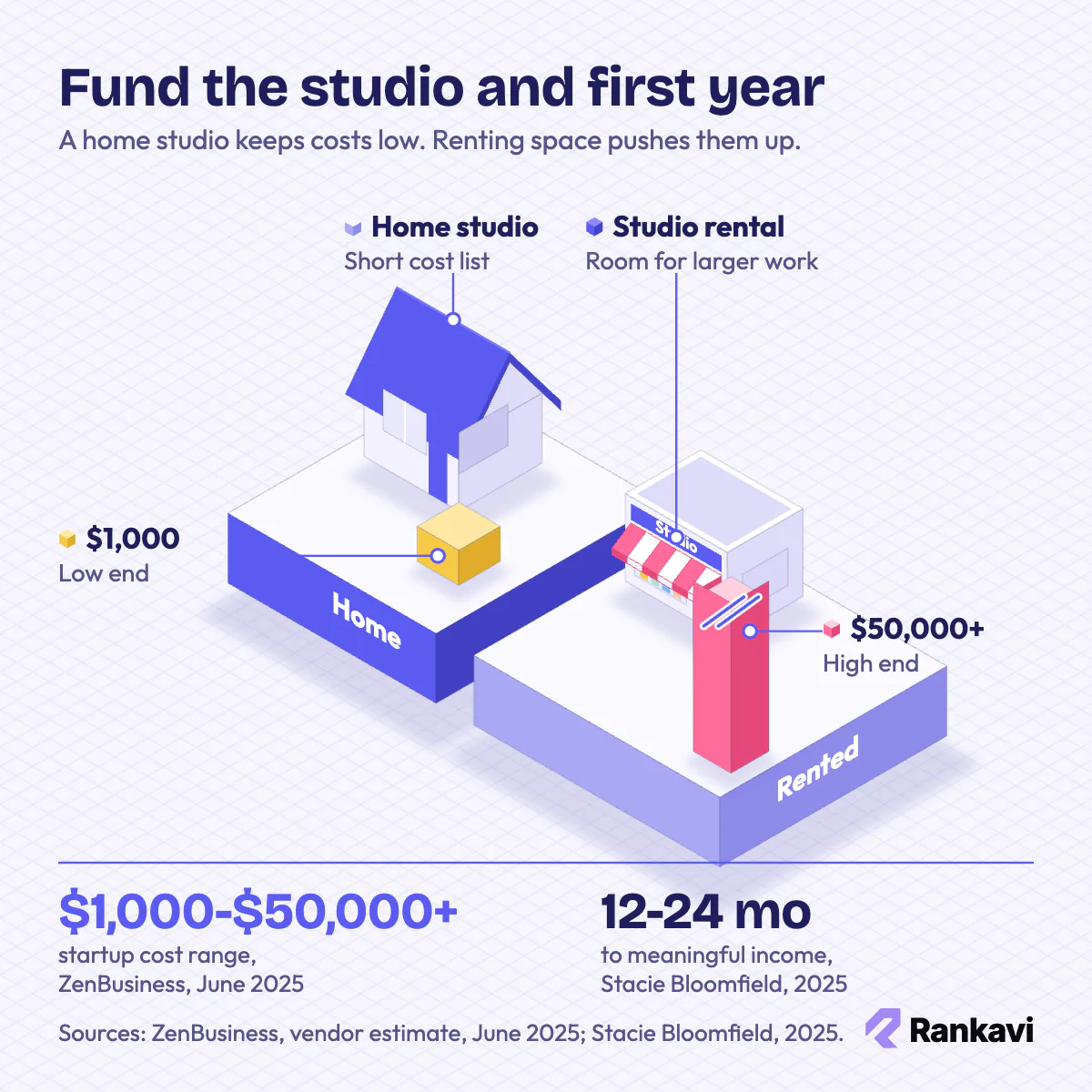
Startup costs fall into a few groups: materials, equipment and software, studio rental, shipping and marketing. A home studio keeps the list short.
Startup money at a glance:
| Item | Figure |
|---|---|
| Startup cost | $1,000 to $50,000+, depending on medium, studio and marketing |
| Main costs | Materials, equipment and software, studio rental, shipping, marketing |
| Typical margin | No published net margin for artists; galleries keep about 50% of retail on consigned work |
| Time to open | A first collection can list within weeks; meaningful income often takes 12 to 24 months |
Sources: ZenBusiness, a business formation company, vendor estimate, June 2025. Artsy Shark, 2023. Stacie Bloomfield, 2025.
Personal expenses belong in the budget too. Rent, food and bills still need paying while sales build.
Income takes time. Stacie Bloomfield, founder of the Gingiber design studio and an author, wrote in 2025 that consistent artists often reach meaningful income within 12 to 24 months.
Funding usually comes from savings, a part-time job, artist grants or crowdfunding. Many artists keep a day job until art income covers the basics.
Funding sources each carry a catch:
- Savings or a day job: keeps control but slows growth.
- Grants: cost nothing to repay but are competitive and often exclude startup supplies.
- Crowdfunding: suits a defined project with an audience, and platforms such as Kickstarter charge fees.
- Loans or credit cards: supply cash quickly but must be repaid before income is steady.
Costs do not stop after the first sale. Marketplace fees, payment processing, a website subscription, art fair booth fees, packaging, shipping and framing recur as the business grows.
Bridge income covers the gap while sales build. Commissions, prints, low-priced editions, workshops and presales of a planned collection bring in cash faster than original work.
A business that never turns a profit risks being treated as a hobby by the tax authority. A hobby label limits deductions, so records and a separate bank account show that the work is run for profit.
4. Register Your Art Business
Registering an art business gives it a legal form, a name and a tax identity. Most artists begin as sole proprietors and switch to a limited liability company (LLC) later.
A sole proprietorship needs little paperwork, but personal and business money mix. An LLC separates them and suits artists with assistants or bigger sales.
A city or county business license usually applies to anyone selling artwork. A trade name other than the artist’s own name needs a doing business as (DBA) filing.
A seller’s permit lets the business collect sales tax. A resale certificate then lets it buy materials for resale without paying sales tax.
Artists who hire studio help need an employer identification number (EIN). The Internal Revenue Service (IRS) issues it as the federal tax agency and never charges for it. A separate bank account then keeps art sales and supply receipts apart.
Local rules vary by state and city. A business license, a seller’s permit and a DBA each come from a different office. State and county websites list what applies.
Business insurance covers risks the registration does not. Policies can protect artwork, equipment and a studio against damage, theft or a customer injury at a show.
Copyright protects the art itself. The U.S. Copyright Office, which registers copyright claims, charged $45 for a Single Application as of 2026. Registration is needed before suing over a U.S. work.
5. Organize a Studio and Tracking Tools
A studio setup keeps the art, the inventory and the records in order from the first sale. Many artists work from home before renting space.
Rented studios bring room for larger work and visitors. Artist collectives sometimes share studios with display space in the same building.
A decent smartphone camera handles photos and short process videos. Free editing apps cover the rest.
Good photos sell art online. Even daylight, a plain background and a straight-on angle show color and detail. Extra shots of texture and scale answer what buyers cannot ask.
Studio safety is part of setup. Solvents, resins, dust and kilns call for ventilation. Finished work needs a dry storage place and sturdy packing materials.
Artwork Archive is inventory software built for artists. It tracks each piece, its location, its price and its buyer, while accounting software records sales and expenses.
A small studio runs on three core tools:
- Camera: a smartphone for photos and process videos.
- Inventory software: records each artwork and where it sits.
- Accounting software: tracks sales, costs and receipts.
6. Sell the First Collection Online and Offline
Selling the first collection turns finished work into income and buyer feedback. A simple website and an email list come before any big launch.
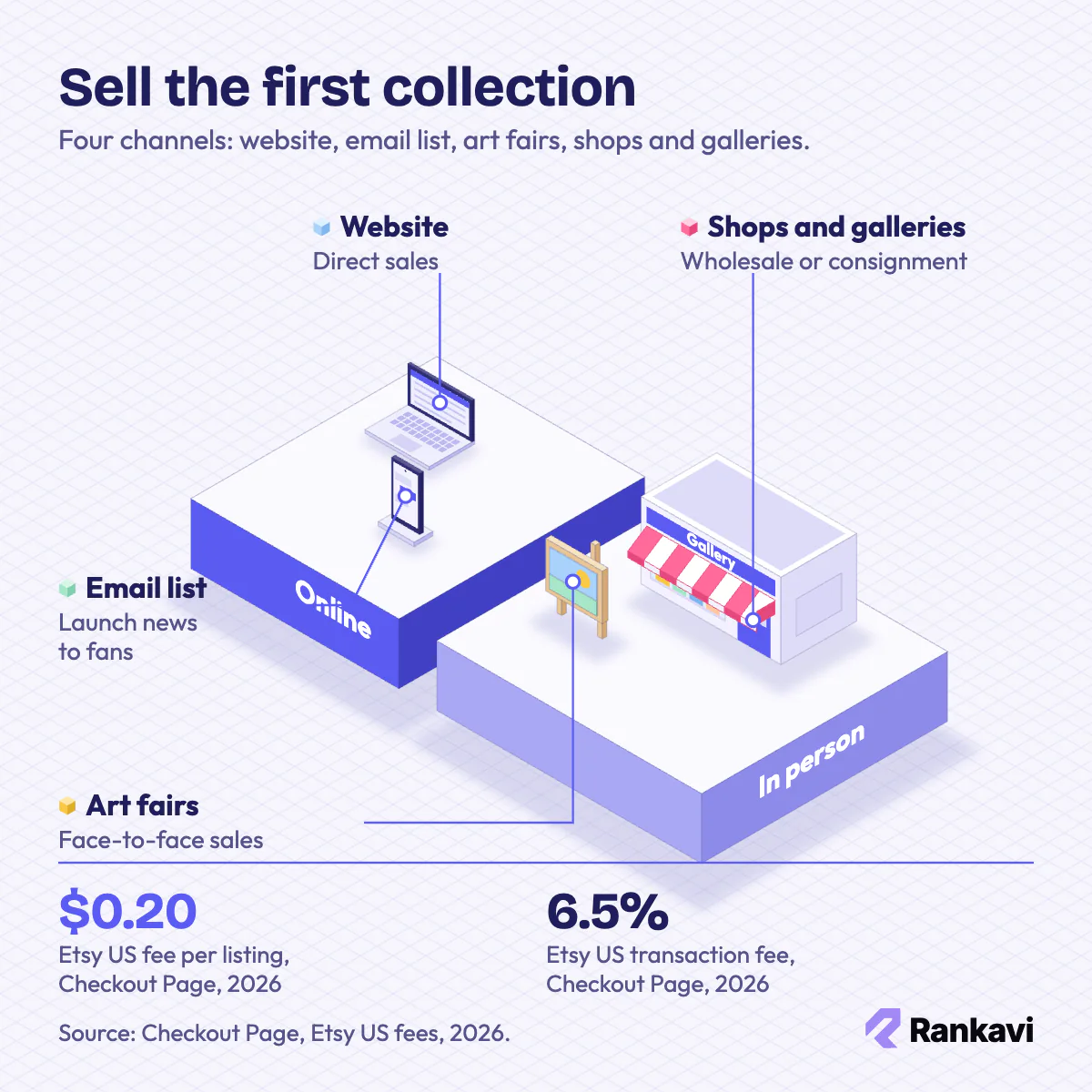
A one-page site with a short bio, a photo of the artist and a few works is enough at first. More pages follow later.
An email list reaches fans directly. Mailchimp is an email marketing service with a free starter plan. Social feeds change often, while a list stays with the artist.
Etsy is an online marketplace for handmade goods, art and vintage items. Checkout Page reported 2026 US fees of $0.20 per listing, a 6.5% transaction fee and 3% + $0.25 payment processing.
A mailing list grows from simple offers. A sign-up form on the website and a sheet at every fair collect addresses. A preview of new work gives subscribers a reason to join.
Short launches create urgency. A collection goes on sale for a short window, then returns later with new pieces.
Every channel carries a trade-off. A website keeps the full price but brings no traffic by itself. Marketplaces bring traffic but take fees. Fairs and galleries cost booth fees or commission. Several channels spread that risk.
A first collection usually sells through four channels:
- Website: direct sales with no commission.
- Email list: launch news to existing fans.
- Art fairs: face-to-face sales and feedback.
- Shops and galleries: wholesale or consignment reach.
7. Appear in Collectors’ Google AI Overviews
AI visibility places an art business in the answers collectors read before they buy. Many buyers now search for local artists or gift art and read the AI Overviews summary first.
Those summaries draw on trusted third-party pages. Art blogs, local guides and “artists to watch” lists decide which studios get named.
Local and gift searches favor consistent details. The same studio name, artist bio and medium across every profile and listing help AI summaries describe the business correctly.
Rankavi is a software as a service (SaaS) platform that publishes brand mentions in articles on indexed third-party websites. A new studio can use AI Overviews mention campaigns to appear on art and gift sites.