

Starting an Amazon business means picking a selling model, registering a legal entity and listing products in Amazon’s marketplace. Amazon reported in 2024 that independent sellers, mostly small businesses, generate more than 60% of sales in its store.
I’m Michal Sieroslawski, and I help Amazon businesses become easier to find online. Shoppers increasingly turn to AI assistants like ChatGPT and Perplexity for suggestions. The businesses named in those answers get the first look.
The order matters. Validating demand and registering first takes the surprises out of the first stock order. The launch plan then turns early listings into reviews. The following list shows how to start an amazon business in twelve steps.
- Choose Your Amazon Business Model
- Research Products Shoppers Already Want
- Register the Business Behind Your Store
- Price Each Product for Profit
- Fund the First Inventory Order
- Source Stock From Reliable Suppliers
- Open a Seller Central Account
- Build Listings That Convert Browsers
- Pick a Fulfillment Method
- Market the Launch Inside Amazon
- Grow Into More Products and Channels
- Show Up When Buyers Ask AI for Products
1. Choose Your Amazon Business Model
An Amazon business model decides where products come from and how much money the seller puts up front. Every later step, from suppliers to fulfillment, follows from this choice.
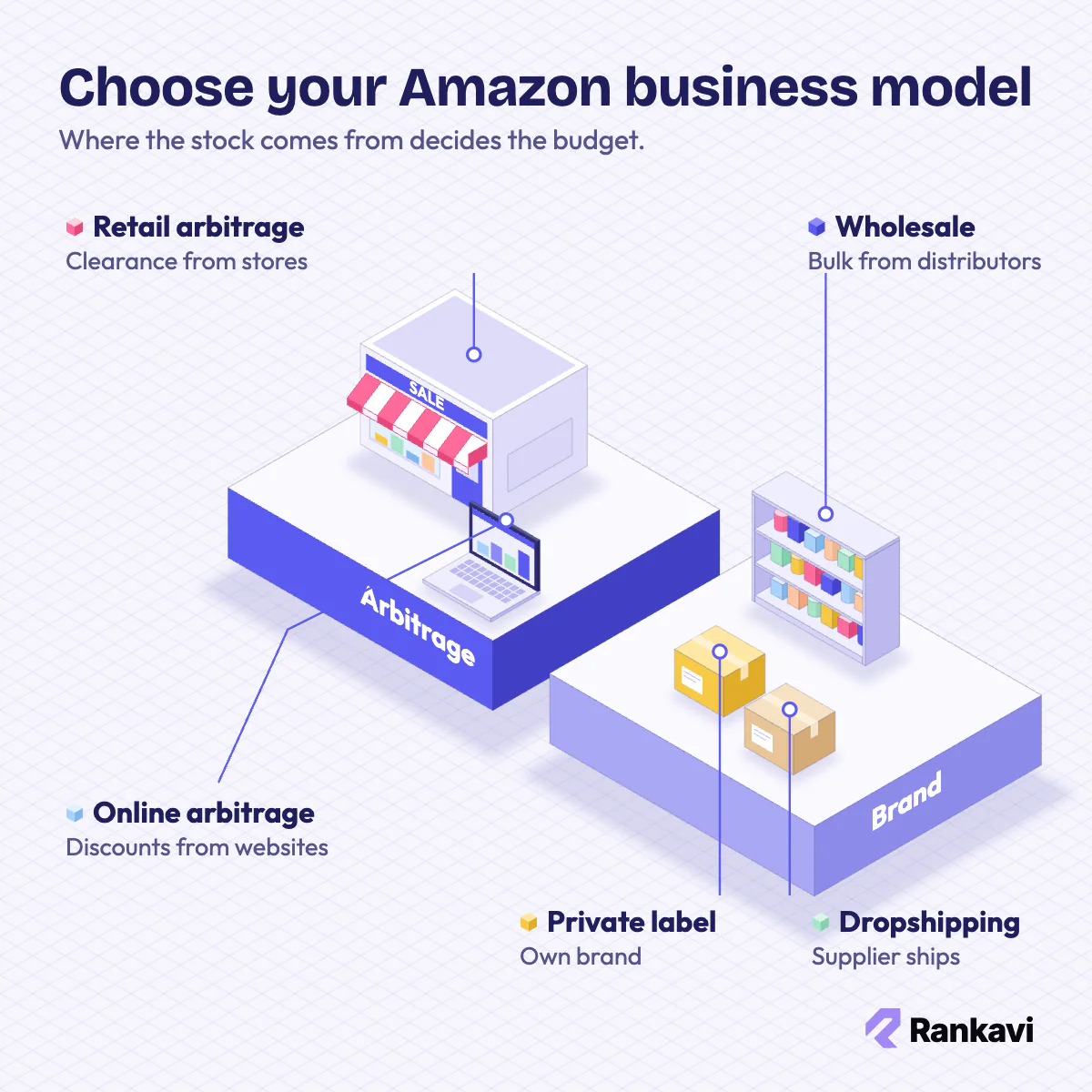
The model sets the upfront cost, so the options differ mostly in how much stock they need. Some models need bulk stock, while others start with less cash. Common Amazon business models include:
- Wholesale: Wholesale sellers buy branded goods in bulk from manufacturers or distributors. They resell other companies’ brands.
- Private label: Private label sellers pay a factory to make products under their own brand name. This model also needs bulk stock. It is the only model that builds a brand the seller owns.
- Online and retail arbitrage: Arbitrage sellers buy discounted items from websites or physical stores and resell them on Amazon. This model needs less cash and launches fast. Many sellers chase the same deals, though, so competition is heavy and growth is hard.
- Dropshipping: Dropshippers list products without holding any stock. Amazon’s dropshipping policy requires the seller to remain the seller of record on every order. That means the seller, not the supplier, is named as the seller. Breaking that rule risks account suspension, and supplier delays can slow delivery times.
- Handmade: Amazon Handmade is a separate program for artisans who make their own items. Sellers must apply to Amazon Handmade and get approval before they list anything.
A seller also has to pick how to work with Amazon. Most new sellers use Seller Central as third-party sellers. This means they own their stock and set their own prices. Vendor Central works differently. Amazon invites vendors, buys stock from them at wholesale and sets the retail price itself.
The model also shapes how a product shows up on Amazon. Arbitrage and wholesale sellers usually add an offer to a page other sellers already use. Those sellers then compete for the Buy Box, the main buy button on that page. Private label sellers create their own page instead. They control that page through brand registration.
Selling other companies’ brands brings one more step. Some brands and categories are gated, which means Amazon asks for approval before listing. For this reason, wholesale and arbitrage sellers keep supplier invoices to prove their stock is authentic.
Common Amazon business models:
| Model | Where stock comes from | Best fit | Brand owned by seller |
|---|---|---|---|
| Online arbitrage | Discounted items from retail websites | Small budget, quick start | No |
| Retail arbitrage | Clearance items from physical stores | Small budget, local sourcing | No |
| Wholesale | Bulk orders from brands or distributors | Scalable reselling | No |
| Private label | A manufacturer making the seller’s own brand | Long-term brand building | Yes |
| Dropshipping | A supplier that ships after each sale | Minimal upfront stock | No |
| Handmade | Items the seller makes personally | Crafters and makers | Own products |
Four factors narrow the choice: cash for stock, weekly time, tolerance for risk and the wish to own a brand. The choice is not permanent, because one seller account can run several models. Many sellers start with arbitrage. They add wholesale or private label once cash builds up.
2. Research Products Shoppers Already Want
Product research involves testing demand, competition and risk before any money goes into stock. A product that already sells steadily gives a new seller a safer first order. So the search starts with products that shoppers already buy.
A product’s physical traits narrow the search before any tool is needed. Small, light items cost less to store and ship, which keeps early costs low. Good candidates also come in bulk. They have related products that a store can add later, so one product can grow into a wider range.
With those traits in mind, a seller needs real product ideas to test. Amazon offers three places to find them:
- Amazon’s own lists: Best Sellers, Movers & Shakers, New Releases and Most Wished For show what shoppers buy now.
- Product Opportunity Explorer: This tool in Seller Central adds demand and competition data.
- Search-bar autocomplete: The suggestions that appear while typing in Amazon’s search bar show the exact phrases shoppers type.
An idea still needs proof that it sells. Each product page shows a Best Sellers Rank, a number that ranks a product’s sales against others. A strong rank signals steady sales.
The rank only compares products within one category, so the subcategory rank is the useful one. Keepa, a price-tracking service, charts the price and sales rank history of Amazon products. Google Trends shows whether interest is steady, seasonal or fading. That separates a lasting product from a fad.
Strong demand only helps if a new seller can win some of the sales. Listings where Amazon itself sells, or where many sellers crowd in, are harder to win. A market led by one entrenched brand with thousands of reviews is also harder to enter.
Once a product shows demand and room to compete, reviews show how to beat what already exists. Customer reviews on similar products expose gaps in the market. Shoppers describe what they like, what breaks and what they wish existed. Those complaints become the brief for a better version.
Filtering to one, two and three star reviews speeds this up. Reading the Questions & Answers section also speeds this up. Ordering a competing product shows its flaws first-hand.
A better product still has to be allowed on Amazon. Amazon limits some categories and brands, so restricted products need a separate check. Some brands also file intellectual property complaints against resellers. A quick eligibility check in Seller Central avoids buying stock that cannot be listed.
Passing the eligibility check does not settle intellectual property, so it needs its own check before buying. A product can be eligible to list and still draw an infringement complaint. A search of Google Patents and the federal trademark database shows whether a brand or design is protected.
Even a product that is allowed and free of legal claims can carry extra risk for a first order. These risky products fall into three groups:
- Costly-to-handle items: Fragile items, clothing with many sizes and items with high return rates cost more to handle.
- Hazmat items: Batteries and liquids can trigger a hazmat review before Amazon warehouses accept them. Hazmat is short for hazardous materials.
- Regulated items: Children’s products, food, cosmetics and electrical goods fall under outside rules. The Consumer Product Safety Commission and the Food and Drug Administration set many of them.
These checks work better when a seller compares several products instead of judging one alone. A shortlist of three to five candidates beats committing to the first idea. Each candidate gets a score on demand, competition, risk and room to improve. Samples of the finalists come before a full order.
Amazon’s lists, Product Opportunity Explorer and Google Trends are free. Paid tools such as Jungle Scout and Helium 10 add speed and sales estimates. They are optional at this stage.
Policy study comes before the first listing. Veteran sellers on the Amazon Seller Forums point newcomers to Amazon Seller University. It offers free training inside Seller Central.
3. Register the Business Behind Your Store
Business registration creates the legal seller, usually a sole proprietorship or a limited liability company (LLC). That entity signs supplier contracts and receives Amazon payouts.
Amazon does not require an LLC. Individuals can sell under their own name. Still, the choice of entity matters for two reasons. It limits personal liability. It also keeps taxes and contracts organized.
The two structures differ mainly in that risk.
A sole proprietorship is the default structure, and it offers no liability protection. An LLC separates personal assets from business debts and lawsuits. That protection is why many product sellers choose an LLC before their first bulk purchase.
Taxes stay much the same, though. Federal tax rules treat a single-member LLC as part of the owner by default. Profit is still reported on Schedule C of the owner’s tax return. So an LLC alone does not lower taxes.
An owner who picks an LLC has to form it in a state. Formation usually happens in the state where the owner lives and works. Forming elsewhere often means registering in the home state too. The owner then pays two sets of fees. The Secretary of State’s office takes the filing, and fees differ by state. The paperwork has three parts:
- Articles of organization: This is the main filing that creates the LLC with the state.
- Registered agent: This is the contact who receives official papers for the business. The agent needs a physical address in the state.
- Operating agreement: This document sets out how the LLC runs. The owner signs it.
A formation service can file these for a fee.
Once the entity exists, it needs its own tax number and its own bank account. The entity needs an employer identification number (EIN), which the Internal Revenue Service (IRS) issues for free. Amazon asks for that tax information during seller registration. A dedicated business bank account keeps Amazon deposits apart from personal spending.
That separation matters for an LLC. Mixing personal and business money is known as commingling. It can weaken the liability protection of an LLC.
All of these records have to match, because Amazon compares them. During seller registration, Amazon checks the legal name, address, government identification and bank account against each other. Names that differ between documents are a common cause of rejection. The legal name from the formation documents and a documentable physical address avoid that problem.
Approval does not end the work, because registration also brings recurring duties. A registered business takes on four ongoing duties:
- Annual reports: Owners file annual reports.
- Sales tax: Owners track sales tax. Amazon collects sales tax in marketplace-facilitator states, but income tax stays with the seller.
- Seller’s permit: A state seller’s permit lets a business buy inventory without sales tax. The business shows a resale certificate to do this.
- Local business license: Many cities and counties also require a general business license.
An accountant who knows ecommerce keeps those deadlines in order.
One risk sits outside all of this paperwork. An LLC does not replace product liability insurance. Amazon requires coverage once a seller’s sales pass a set level. Many sellers buy it earlier.
Typical registration steps:
- Choose a sole proprietorship or an LLC
- Check name availability and file the formation documents with the state
- Appoint a registered agent and sign an operating agreement
- Get an EIN from the IRS
- Open a business bank account
- Register for sales tax and any local business license where required
4. Price Each Product for Profit
Product pricing sets the margin left after product cost, Amazon fees and shipping. For that reason, sellers work out the price before any money goes into stock. A price can look competitive and still lose money if one fee is left out. Referral fees are only one line.
As of 2026, Amazon referral fees for most categories run 8% to 15% of the sale price. Fulfillment fees based on size and weight also come out of each sale. So do monthly storage, returns processing and the selling plan fee.
To see the full cost, a seller first needs to know landed cost. Landed cost is the real cost of one unit: the factory price plus freight, duties and prep. Net profit per unit is the price minus landed cost, Amazon fees and ad cost per unit. The Amazon FBA Revenue Calculator estimates fees before any stock is bought.
Once costs are clear, the seller can decide how to set the price. Three pricing approaches are common:
- Cost-plus pricing: This approach adds a set margin to landed cost.
- Competitor-based pricing: This approach follows the prices of rival offers.
- Launch pricing: This approach starts low to win early sales. The price rises once reviews build.
Competitor prices matter most when several sellers share one listing. In that case, price helps decide who wins the Buy Box. The Buy Box is the main “Add to Cart” button on a product page. Amazon now calls it the Featured Offer. A competitive price raises a seller’s chance of taking it.
Price is not the only factor, though. Delivered price, Prime-eligible fulfillment, seller metrics and stock availability also count.
Private label sellers often skip this contest. They own the listing through Brand Registry, so they often have no rival offers.
To judge whether a price is competitive, sellers can check pricing signals that Amazon gives inside Seller Central. A competitive external price shows what the product costs elsewhere online. The lowest Amazon price shows the cheapest current offer for a similar item.
Sellers can also use automated repricing tools. These tools adjust prices as competitors move. A repricer with no limit can keep cutting the price and start a race to the bottom. In practice, each product needs a minimum price floor to stop this. That floor stays above landed cost, shipping and selling fees.
Discounts lower the price too. Coupons, Subscribe & Save and event deals all cut the real selling price. The margin must therefore survive the deepest planned discount. Jungle Scout, a seller-software company, reported in 2024 that 57% of surveyed sellers earn margins above 10%. That 2024 survey found only 28% clear 20%.
The margin also limits how much a seller can spend on ads. Most new sellers check break-even advertising cost of sales next. Advertising cost of sales (ACOS) divides ad spend by ad revenue. Amazon Ads says ACOS must stay below the profit margin, or ads lose money. A product’s margin before ads therefore sets its ceiling on ad spend.
A second measure looks at all sales, not just ad sales. Total advertising cost of sales (TACoS) divides ad spend by all sales, organic ones included. Organic sales are the ones that did not come from an ad. TACoS shows whether ads are building organic rank.
5. Fund the First Inventory Order
A startup budget covers product costs, Amazon fees and the other expenses that come before the first payout. The money has to last until sales replace it.
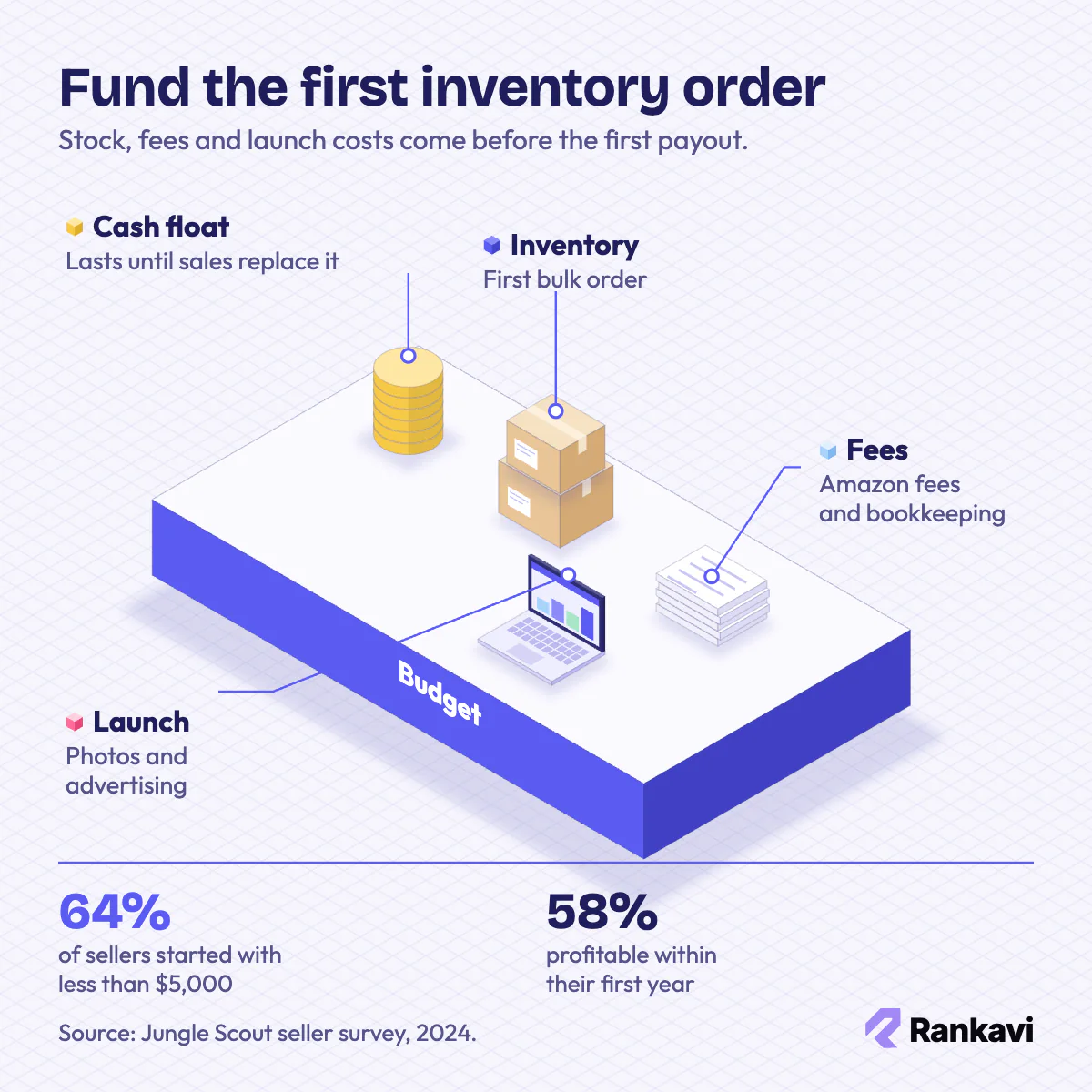
Startup money at a glance:
| Item | Typical figure |
|---|---|
| Startup cost | Under $1,000 to over $10,000; 64% of sellers spent less than $5,000 |
| Main costs | First inventory and samples, Amazon selling fees ($39.99 a month Professional plan, 8% to 15% referral fees in most categories), launch promotions and ads |
| Typical margin | Average profit margin of 21% (weighted); 57% of sellers above 10% |
| Time to open | 48% of sellers launch within 3 months, 74% within 6 months |
Sources: Jungle Scout (seller-software vendor survey), How Much Money Do Amazon Sellers Make? (2024); Amazon, Sell on Amazon pricing page (2026).
Savings are the usual source. Business credit cards and small-business microloans can add cash. Both carry costs that eat into thin margins. Amazon Lending is by invitation only, so a new seller cannot apply. Some suppliers accept a deposit first and the balance before shipping, which spreads out the cash.
The model chosen in step one drives the startup cost. Arbitrage needs only a modest inventory float. Wholesale and private label demand larger bulk orders, plus packaging, photography and launch advertising.
The factory price is only part of the cost. Landed cost adds freight, import duties, inspection, barcodes and labels, and inbound shipping to Amazon. Cash stays locked from the supplier payment until the first Amazon payout, which takes weeks or months.
Cash flow is the main squeeze for new Amazon sellers. Profit margins are thin, and stock must be reordered before the last units sell. Seasonal demand cycles make that timing harder.
A first order is easier to size with a test batch than a full minimum order. Estimated daily sales from research tools and the supplier lead time give the days of stock to hold. Storage limits can cap how much Amazon accepts. Unsold stock can be removed or liquidated, which returns only part of the cost.
Profit per unit, set in the pricing step, decides whether the first order pays back. Jungle Scout’s 2024 seller survey found 58% of sellers turned profitable within their first year. In that 2024 survey, 22% got there within three months.
Worked example: an illustrative seller has $4,000: $2,400 for 400 units at $6, $600 setup and $1,000 launch ads. Each unit sells for $25. A 15% referral fee and an assumed $5 fulfillment fee leave $10.25 per unit. Selling all 400 units leaves $4,100 above the stock cost, or $2,500 after the $1,000 in ads and $600 setup. Plan fees, storage, returns and taxes come on top.
“…one of my earliest mistakes was purchasing too much inventory too quickly. When you discover a profitable product, it is tempting to invest heavily.”
— An Amazon seller on the Amazon Seller Forums
6. Source Stock From Reliable Suppliers
Product sourcing gives the business a dependable supply of goods at a price that leaves a profit. The supplier relationship shapes quality, delivery speed and margin.
The right kind of supplier depends on how the business sells. Supplier type follows the business model:
- Private label: These sellers put their own brand on a product, so they work with a manufacturer.
- Wholesale: These sellers buy from a brand or an authorized distributor. Many apply for a direct account with the brand.
- Arbitrage: These sellers source from local stores and online retailers.
Once the model is clear, the seller needs a place to find suppliers. Marketplaces such as Alibaba, SaleHoo and Wholesale Central list many suppliers in one place. Global Sources is another route. Thomasnet is a route for U.S. manufacturers. Trade fairs such as the Canton Fair offer one more way to find them.
These listings include two kinds of supplier, and the difference affects price. A factory sets its prices directly. A trading company stands between the buyer and the factory and adds its own margin on top.
Vetting comes before the first order. On Alibaba, Verified Supplier and Trade Assurance badges lower the risk. They do not remove it, though. Quotes from three to five suppliers make it easier to compare them. References and a video call add more detail on each one.
A backup supplier prevents stockouts.
After choosing a supplier, the seller settles the deal. Four main terms need agreement:
- Minimum order quantity: This is the smallest order the supplier will accept.
- Lead time: This is how long it takes from placing the order to receiving the goods.
- Payment terms: These set when and how the seller pays the supplier.
- Incoterms: These trade terms, such as Free on Board (FOB), set who pays for shipping and bears risk.
Good terms do not help if the goods are poor, because bad stock puts the seller account at risk. Counterfeit goods lead to complaints and listing removals. To catch problems early, many sellers order samples first. They also inspect a shipment before it goes to an Amazon warehouse. Inspection firms such as Bureau Veritas and Intertek check goods before shipment.
When stock comes from overseas, it must clear import steps before it reaches Amazon. A freight forwarder is the company that moves the goods. A customs broker files the entry, which is the paperwork that declares the goods to customs. A harmonized tariff code classifies the product and sets the duty, the tax charged on imports.
Proof of where stock came from matters as well. Amazon can ask for proof that stock is authentic. Wholesale and arbitrage sellers keep their invoices for that reason.
Most products also need a barcode.
Each product needs a Global Trade Item Number (GTIN), a unique number that identifies it.
The GTIN is usually encoded as a Universal Product Code (UPC), the barcode printed on the package. Amazon checks those codes against Global Standards 1 (GS1) records. GS1 US issues the official American barcodes. Codes bought from resellers often fail that check. Some products qualify for a GTIN exemption instead.
7. Open a Seller Central Account
A Seller Central account is the online base where the business lists products, manages stock and tracks orders. For an Amazon business, this dashboard works as both storefront and back office.
A new seller signs up at sellercentral.amazon.com. This creates a North America account that covers Amazon.com, Amazon.ca and Amazon.com.mx. Vendor Central is another Amazon system. That is a separate system, and Amazon offers it by invitation only.
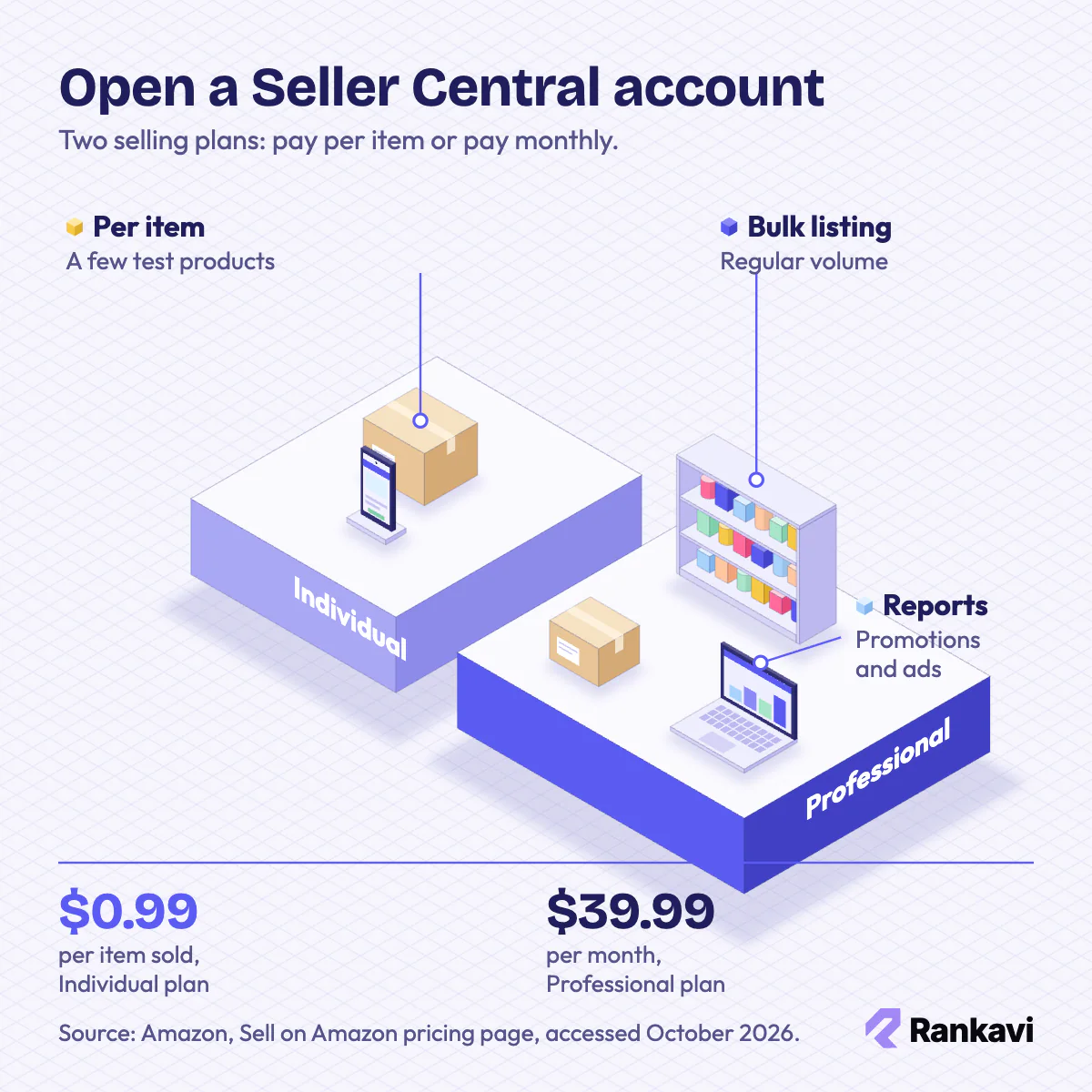
During sign-up, the seller picks one of two selling plans. As of 2026, the Individual plan charges $0.99 per item sold, so it suits low volumes. The Professional plan charges $39.99 per month in 2026. At about 40 items a month, the two plans cost the same.
Cost is not the only difference between the plans. The Professional plan unlocks bulk listing, promotions and reports. The Individual plan cannot win the Buy Box, the main purchase button on a product page. It also cannot run Amazon Ads. Both plans pay referral fees, which are a share of each sale paid to Amazon. A seller can switch plans at any time, so the first choice is not permanent.
Selling plans compared:
| Plan | How it is charged | Suits |
|---|---|---|
| Individual | $0.99 per item sold | Testing a few products |
| Professional | $39.99 per month | Regular volume, ads and promotions |
Source: Amazon, Sell on Amazon pricing page, accessed October 2026.
Verification comes next. It asks for an email address, a phone number and tax information. It also needs a bank account and an internationally chargeable credit card. Government-issued identification completes the check. Approval can take days or months. Names and addresses that differ between documents are the most common cause of delay.
Amazon limits how many accounts a business can hold. It allows one seller account per business, and a duplicate account risks suspension. Two-step verification protects the login by asking for a code as well as a password.
An approved account still cannot sell in every category. Some categories are gated, which means they need separate approval after the account opens. Account approval alone does not allow selling in them.
Private label sellers sell products under their own brand, so they usually protect that brand next. Most enroll in Amazon Brand Registry, which offers free brand protection and A+ Content. Enrollment needs a trademark filed with the U.S. Patent and Trademark Office (USPTO). The USPTO is the agency that issues federal trademark registrations.
The account runs online, so the business needs little physical space at first. Most sellers run the business from home. Fulfillment by Amazon (FBA) is Amazon’s service that stores, packs and ships orders from its warehouses. This removes the need for a private warehouse. A spare room for samples, packaging and paperwork is usually enough.
8. Build Listings That Convert Browsers
A product listing turns a catalog entry into a sales page that shoppers can find and trust. Each product gets its own detail page, and its sizes and colors are grouped on that page as variations.
Every detail page has an Amazon Standard Identification Number (ASIN), the product ID Amazon assigns. Most products also need a GTIN, usually a UPC. Private label products without a barcode can apply for a GTIN exemption.
Each item gets a stock-keeping unit (SKU), the seller’s own code. The Add a Product tool in Seller Central starts the listing. Creating a listing is free. Fees begin only when an item sells.
A product may already be in the catalog. If it is, the product keeps its current page. Amazon requires resellers to add an offer to that listing rather than create a duplicate. New and private label products have no page yet, so they get a fresh listing.
A fresh listing has to be built from scratch, and its words decide whether shoppers find it. Before writing, sellers study the top listings in their category to learn which keywords shoppers search for. These are the parts of a strong listing:
- Title with the main keyword: The title carries the main keyword shoppers search for.
- White-background main image: The main image shows the whole product on a pure white background. It has no text, logos or watermarks. It must meet a minimum pixel size, which turns on the zoom feature. Amazon rejects main images that break these rules, so many sellers pay a freelancer to remove the background.
- Bullet points for key features: Bullets list key features and carry more keywords.
- Description with sizing and usage details: The description explains sizing and use and carries keywords.
- Backend search terms: These hidden fields add extra keywords without cluttering the visible text. Competitor brand names and repeated words do not belong there.
- Correct GTIN, category and variation setup: All three must be set up correctly.
Attributes such as size, color and material also need filling in. Shoppers narrow results with search filters, and these attributes feed those filters. So empty fields hide a listing from filtered searches.
Missing fields can cause an even bigger problem. Amazon suppresses listings with missing fields or policy breaks. A suppressed listing is hidden from shoppers until the seller fixes it. The Listing Quality tools show what to fix.
Once a listing is live, the seller needs to know how often visits turn into sales. This conversion shows in the Detail Page Sales and Traffic report as Unit Session Percentage. Brand-registered sellers have extra tools to work on that number. They can add A+ Content to the page. They can also run tests on titles and images with Amazon’s built-in experiment tool.
9. Pick a Fulfillment Method
A fulfillment method determines who stores, packs and ships every order. Amazon offers two main paths. Many sellers use both for different products.
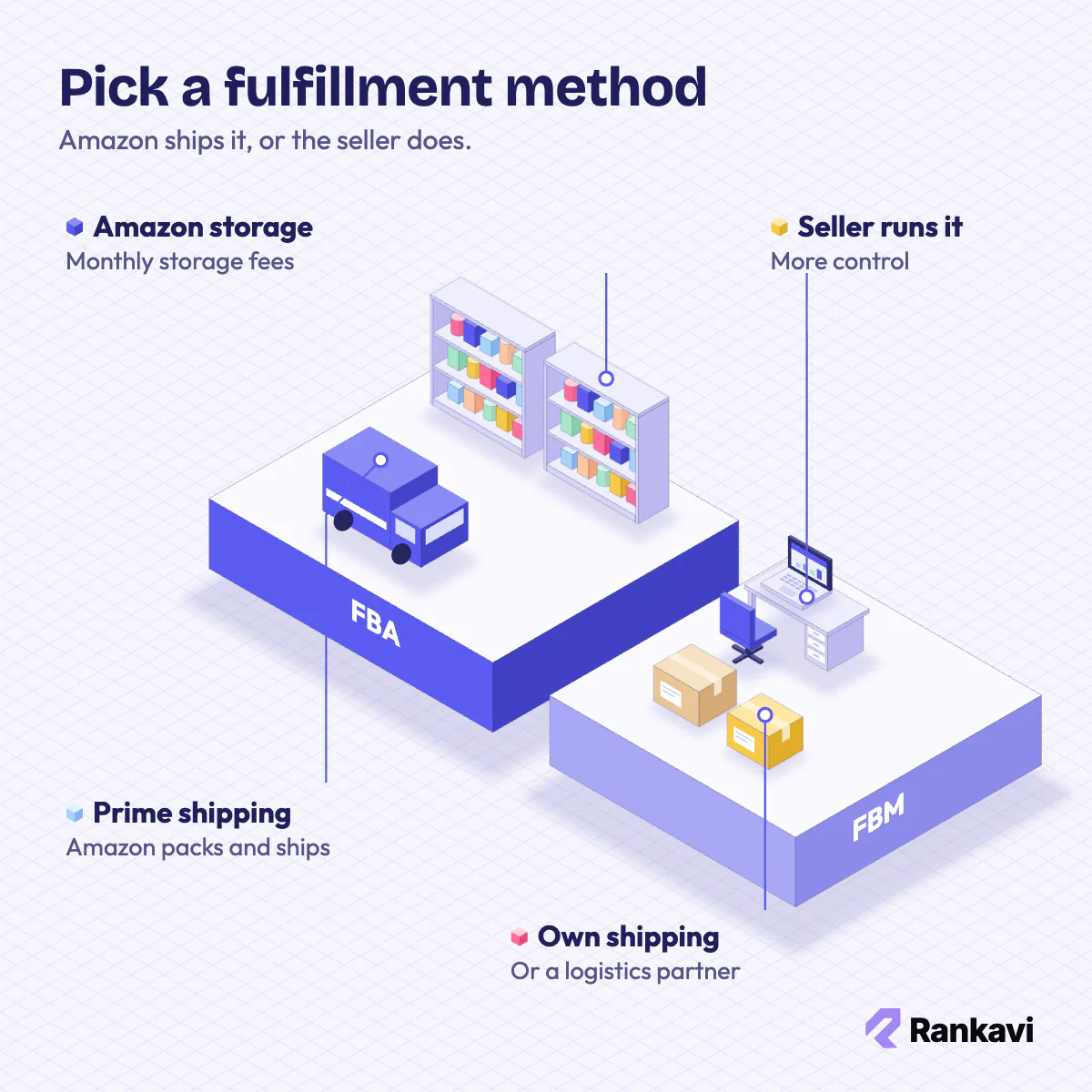
The first path, FBA, hands the work to Amazon’s warehouse network. Amazon takes over storage, picking, packing, shipping and returns. Amazon also handles customer service. FBA products qualify for Prime shipping.
Amazon charges for this service. The seller pays fulfillment fees based on each item’s size and weight, plus monthly storage fees. Aged inventory, low stock and returns processing can add more charges. Amazon’s FBA Revenue Calculator estimates these fees for each product.
FBA also means getting stock into Amazon’s warehouses, which is called inbound stock. Each unit needs a Fulfillment Network Stock Keeping Unit (FNSKU) label. This is Amazon’s own barcode for tracking each seller’s units.
The Send to Amazon workflow builds the shipment. The Amazon Partnered Carrier program offers discounted rates for sending it in. Sending only what sells in about a month keeps storage costs down.
The second path, Fulfilled by Merchant (FBM), keeps logistics with the seller. The business ships orders itself or hires a third-party logistics company. This takes more daily work. In return, the seller gets more control over stock and direct contact with customers.
FBM sellers can still show the Prime badge. Seller Fulfilled Prime lets approved FBM sellers display it if they meet Amazon’s delivery standards. The two methods can also work in sequence. Many sellers test demand with FBM, then move proven products to FBA.
Fees are only part of the choice. The product itself often decides which method fits. Small, fast-selling items suit FBA. Oversize, fragile, custom or slow-selling items often suit FBM. Slow stock sits in the warehouse longer, so storage fees punish it. Hazmat items, meaning hazardous materials, need a separate review before FBA accepts them.
FBA and FBM compared:
| Method | Who ships | Main trade-off |
|---|---|---|
| FBA | Amazon | Prime eligibility, but storage and fulfillment fees |
| FBM | The seller or a logistics partner | More control, but more daily work |
Whichever method a seller picks, products must arrive undamaged. Good packaging protects them on the way to a warehouse or a customer. Amazon publishes packing and shipping requirements for FBA shipments.
Once orders arrive, Amazon tracks how well each seller fulfills them. Account Health in Seller Central monitors late shipments, cancellations, valid tracking and the order defect rate. The order defect rate is the share of orders that have a problem. Poor scores lead to warnings. In serious cases, they lead to suspension.
10. Market the Launch Inside Amazon
Launch marketing places new listings in front of shoppers before organic rankings build. Amazon’s built-in discovery helps, but a new product starts with no sales history.
The usual first step is Sponsored Products. These are pay-per-click (PPC) ads, which means the seller pays each time a shopper clicks. They appear in search results for chosen keywords. Their spend is judged against the break-even ACOS set in the pricing step.
A second ad type, Sponsored Brands, needs Brand Registry, Amazon’s program for brand owners.
Automatic targeting suits new sellers. With it, Amazon picks the search terms at first. The Search Term Report then shows which of those terms convert, or lead to sales. The seller moves the winning terms into manual exact-match campaigns, which target those exact terms. Negative keywords block the terms that waste spend.
Even a well-built campaign depends on the listing behind it. Ads only run when the offer can win the Buy Box, the listing is active and stock is available. The Buy Box is the main purchase box on a product page, where shoppers add the item to their cart.
Once ads run, two numbers show where a campaign leaks. Click-through rate is the share of shoppers who click an ad after seeing it. Conversion rate is the share of those clicks that turn into sales. Low clicks point to a weak title or main image. Low conversion points to the listing or reviews.
Deals and coupons create early momentum. Amazon offers deals, promotions and coupons, and several of these require the Professional plan:
- Deals: Lightning Deals and Best Deals follow event windows such as Prime Day. Lightning Deals carry fees.
- Promotions: These include percentage-off promotions and buy-one-get-one offers.
- Coupons: Shoppers clip these coupons to get the discount. Coupons carry a fee.
Because some of these tools carry fees, the discount must still clear break-even.
Reviews follow the first sales, and Amazon sets firm rules for them. Sellers may request reviews through Amazon’s own tools. They may never pay for them. Review swaps, incentives and refunds in exchange for reviews all break Amazon’s rules. Each one risks suspension.
Brand owners have one more way to gather early reviews within the rules. They can enroll new products in Amazon Vine. Vine offers free units to invited reviewers called Vine Voices.
Brand-registered sellers can build an Amazon Store page. The Store Builder offers templates for featured products, subpages and videos. Amazon reviews each Store before it goes live.
11. Grow Into More Products and Channels
Growth for an Amazon seller builds on products that already sell profitably. Steady expansion beats a fast push into untested products. Amazon reported that U.S. independent sellers averaged more than $250,000 in annual sales in 2023.
Growth starts from what already works. A product is ready to build on when it sells steadily, stays in stock and earns a margin after fees. Two tools in Seller Central track these signs. Business Reports show sales over time. The Inventory Performance Index scores how well a seller manages stock.
Once a product proves itself, the natural next product is a related one. A related item reaches the same customers and often comes from the same suppliers. That shared base lowers the risk of each new listing. For example, a seller of dog clothing can add leashes or grooming tools.
Variations and bundles work in a similar way. They add options under listings that already exist, so the seller does not start from zero. To choose what to add, a seller can use Brand Analytics. It shows what an existing customer base also searches for.
New products widen what a seller offers, while new sales channels widen who can buy it. These Amazon services open new channels:
- Amazon Multi-Channel Fulfillment: This service ships orders from other storefronts, such as Shopify or Etsy, using FBA stock. FBA means Fulfillment by Amazon, where Amazon stores and ships a seller’s goods. One inventory then serves several sales channels.
- Buy with Prime: This program adds Prime delivery to a seller’s own website.
- Amazon Global Selling: This program opens Amazon marketplaces abroad. Selling in other countries brings value-added tax (VAT) and customs rules.
- Amazon Business: This program serves company buyers.
Every new product and channel needs more stock, and stock costs money. Storage limits and aged-inventory fees add to these costs. These costs punish slow movers. Larger orders from suppliers also tie up more cash.
Software and staff carry that extra workload. Growing sellers can turn to three sources of help:
- Selling Partner Appstore: Amazon’s Selling Partner Appstore lists apps for inventory, repricing and analytics. Repricing apps adjust prices.
- Service Provider Network: This directory lists vetted photographers and agencies. Vetted means they have been checked.
- Freelancers: Many growing sellers hire freelancers for photography, listings or customer messages. They often do this before adding full-time employees.
Each new product brings its own category rules and intellectual property risk. Intellectual property covers brands, designs and inventions that belong to someone. For this reason, a growing seller needs to check Account Health regularly.
12. Show Up When Buyers Ask AI for Products
AI search visibility means a product gets named when buyers ask ChatGPT, Perplexity or Google AI Overviews what to buy. These assistants build their answers from pages they trust. Those pages include category roundups, comparison posts, gift guides, Reddit threads and YouTube reviews.
An Amazon listing alone rarely feeds those answers. Star ratings stay inside Amazon. AI tools lean on independent articles that name a brand and explain why it fits. Each new article of that kind adds one more source an assistant can cite. Amazon’s own assistant, Rufus, answers from the listing, reviews and customer questions.
Outside articles drive these answers, so a seller first needs to know which articles the assistants already use. A simple test shows the current position. The seller asks each assistant the questions buyers ask about the product category. The answers reveal which brands and sites appear. Those sites become the targets. Repeating the test each month tracks progress.
A consistent brand name, specs and prices across the listing, Brand Store and website help assistants identify the product. Any sponsored or affiliate content needs a disclosure under Federal Trade Commission rules. Results build over weeks to months.
Buyers often ask for “the best” item in a category or under a set budget. Rankavi is a software as a service (SaaS) platform that publishes brand mentions in articles on indexed third-party websites. No placement can promise a citation, but every article widens the pool Google draws on for AI search visibility.