

Starting an Airbnb business means turning a room, apartment or house into a legal, guest-ready short-term rental. The Airbnb Newsroom counted more than 5.5 million hosts in May 2026. The work covers market research, local rules, a furnished space, pricing and steady operations.
I’m Michal Sieroslawski, and I help Airbnb businesses build their visibility online. AI tools now shape how travelers choose Airbnb businesses, so a mention there is valuable.
Local rules get checked on each address before any offer or lease, and financing comes before signing anything. That order keeps a new host from paying for a home the city will never let them rent. Here are the twelve steps to start an Airbnb business, from first idea to first customers, listed below.
- Research Your Airbnb Market
- Write a Business Plan
- Register Your Business
- Set Your Nightly Rates
- Fund Your Startup Costs
- Find the Right Property
- Get Short-Term Rental Permits
- Insure the Rental Property
- Furnish and Equip the Space
- Organize Daily Operations
- Market Your Listing
- Earn Mentions in AI Travel Answers
1. Research Your Airbnb Market
Airbnb market research means studying local demand, competing listings and seasonal patterns before buying or listing a property. Good research replaces guesswork with data about what guests book and pay.
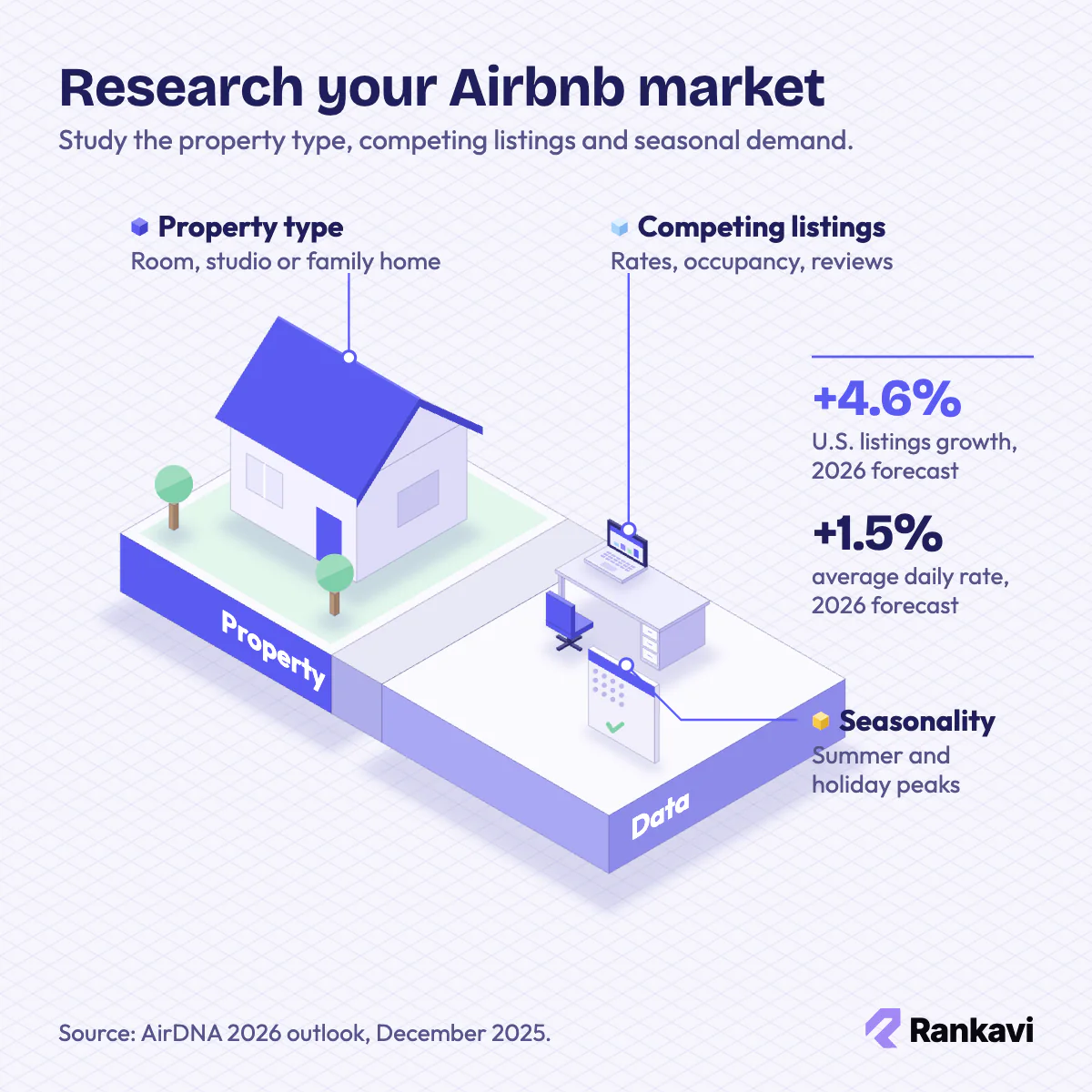
The research can start on the site itself. Airbnb is an online marketplace where hosts list rooms and homes for short stays. Its search results are the best window into a local market. New hosts search their city without dates, filter by entire home or private room and read dozens of descriptions. Guest comments on those listings reveal common complaints and wished-for amenities.
Descriptions and reviews show what guests want. Numbers show what the market pays. Three metrics anchor the analysis, and the third combines the first two:
- Average daily rate (ADR): This is the typical price per booked night in the market.
- Occupancy rate: This is the share of nights that get booked.
- Revenue per available rental (RevPAR): Multiplying ADR by occupancy gives this figure, the single income number most investors compare.
These figures only help when they describe similar homes. A comp set makes them specific. It means a group of listings that match the planned property on size, type and neighborhood. City-wide averages hide wide swings between neighborhoods, so the comp set stays close to the target address.
Price and occupancy say nothing about how guests book. Average length of stay and booking lead time fill that gap. Long stays mean fewer cleanings, while a market of weekend trips needs more turnovers.
Booking habits also shift through the year. Demand rarely stays flat. Summer and holidays usually bring peaks, while bookings often dip around back-to-school season. Google Trends shows when travelers search for stays in a given destination.
Those peaks and dips have local causes. A convention center, university, hospital or major employer brings travelers outside the tourist season. Event calendars show short spikes that a monthly average hides.
AirDNA is a short-term rental data company that tracks these numbers market by market. Its December 2025 outlook forecast U.S. available listings growing 4.6% in 2026 and average daily rates rising 1.5% in 2026. More listings chasing similar demand means each new host must win on fit, not just on being available.
Market-wide forecasts still leave the question of one address. Two tools answer it. AirDNA’s Rentalizer estimates revenue for a single address. Mashvisor is a rental property analytics platform that estimates Airbnb revenue, occupancy and nightly rates from local comparable listings. Running the same address through both tools shows how far their estimates differ.
Winning on fit starts with the property itself. Property type decides which guests arrive. A compact studio suits solo travelers, while a larger home attracts families and groups. Those guests then expect different things. Business travelers expect fast internet; families look for a full kitchen.
2. Write a Business Plan
An Airbnb business plan sets out the target guest, the chosen market, operating model and financial projections in one document. Lenders and partners ask for it. Writing one also forces the host to test the numbers before buying anything.
For a rental, the plan rests on one assumption above all: projected occupancy at a realistic nightly rate. Comparable listings from the research step supply both figures. From there, the plan adds startup costs, monthly fixed costs, platform fees and a payback schedule.
The U.S. Small Business Administration (SBA) lists the usual sections of a traditional plan. They include an executive summary, market analysis, a funding request and financial projections. Lenders and investors commonly request this detailed format.
A risk section tests the plan against bad news. A worst-case scenario models lower occupancy, a new city rule or more competing listings nearby.
The plan should also name the operating model. Hosts work in three main models, and the risks differ sharply between them:
- Spare-room host: Rents out a room in the home the host already lives in.
- Dedicated unit owner: Owns a separate unit used only for guests.
- Rental arbitrage operator: Leases a property and then sublets it to guests. Arbitrage plans need the landlord’s written consent as a stated condition, because many leases ban subletting.
Finally, the plan records the owner’s goal in writing. Modest side income from one room and a multi-unit company demand different amounts of time, capital and help.
3. Register Your Business
Registering an Airbnb business puts the property and its contracts in a company’s name instead of the host’s. Many hosts form a limited liability company (LLC) before buying or leasing. A sole proprietorship, where the host simply operates under their own name, is simpler to start. The trade-off is that it leaves personal assets exposed to guest claims.
Financing pushes in the same direction, since lenders who write short-term rental loans often prefer to lend to an LLC. Registering early therefore smooths the loan process later.
Setting up that company takes one main filing. Hosts form an LLC by filing articles of organization with the state’s Secretary of State, which keeps business records. The filing names a registered agent, the person or firm that receives legal papers for the business.
Once the company exists, it needs its own tax identity. The Internal Revenue Service (IRS) is the federal tax agency, and hosts get a free employer identification number (EIN) there. That number identifies the business for taxes and opens a business bank account. Keeping booking payouts in that account simplifies bookkeeping. It also supports the liability shield.
Rental income is usually taxable, though many hosting expenses are deductible. One narrow exception applies: IRS Topic 415, accessed October 2026, lets owners who rent their home for fewer than 15 days skip reporting that income. An accountant who knows short-term rentals helps claim depreciation on furniture. Depreciation spreads that cost across several tax years.
The tax form depends on the services offered, not just the rent collected. IRS Publication 527, for 2025 returns, puts rentals with substantial services such as regular cleaning or changing linen on Schedule C. Those hosts may also owe self-employment tax. Rentals without such services report on Schedule E instead.
4. Set Your Nightly Rates
Airbnb pricing gives each night a rate that covers costs, matches the market and still earns a profit. It starts from a break-even floor and works upward.
The floor is the lowest rate that still pays the bills. To find it, divide monthly fixed costs by the nights the host expects to sell, after the platform fee. Per-stay costs push the floor higher. Laundry and supplies that the cleaning fee does not cover both count here. Any rate below the floor loses money.
Occupancy is the share of available nights that get booked, and most hosts check it first. AirDNA tracks short-term rental data. Its July 2026 midyear outlook forecast U.S. short-term rental occupancy averaging 57.4% in 2026, slightly above the pre-pandemic 57.0%. A rate that only breaks even at far higher occupancy than the local market delivers is a warning sign.
With the floor set, the host needs a way to build above it. Two methods do that. Market-based pricing stays close to comparable listings nearby, so the rate follows the competition. Target-based pricing adds the owner’s monthly profit goal and spreads it across expected bookings.
Rates should move with demand. Two tools move rates for the host. Smart Pricing is Airbnb’s built-in tool, and it adjusts the nightly rate within a minimum and maximum the host sets.
PriceLabs is a third-party dynamic pricing tool. It updates rates and minimum stays on Airbnb and other rental platforms daily. Third-party tools like it also adjust for seasons and events. Those platform suggestions tend to favor more bookings, while owners also care about revenue per night.
Rates are not the only setting that shapes which bookings arrive. Airbnb adds four more levers:
- Weekly and monthly discounts: These lower the rate for longer stays. A longer stay also means fewer turnovers.
- Last-minute discounts: These cut the price as check-in nears.
- Early-bird discounts: These reward guests who book further ahead.
- Minimum-night setting: This blocks stays shorter than the limit the host picks. It prevents one-night bookings that each still need a full cleaning.
New listings often launch slightly below comparable rentals to collect early reviews, then raise rates once the reviews build trust. Airbnb’s 2026 Help Center lets a new listing offer a 20% discount on its first 3 bookings. One charge sits apart from the nightly rate. A cleaning fee, usually scaled to property size, covers turnover labor.
5. Fund Your Startup Costs
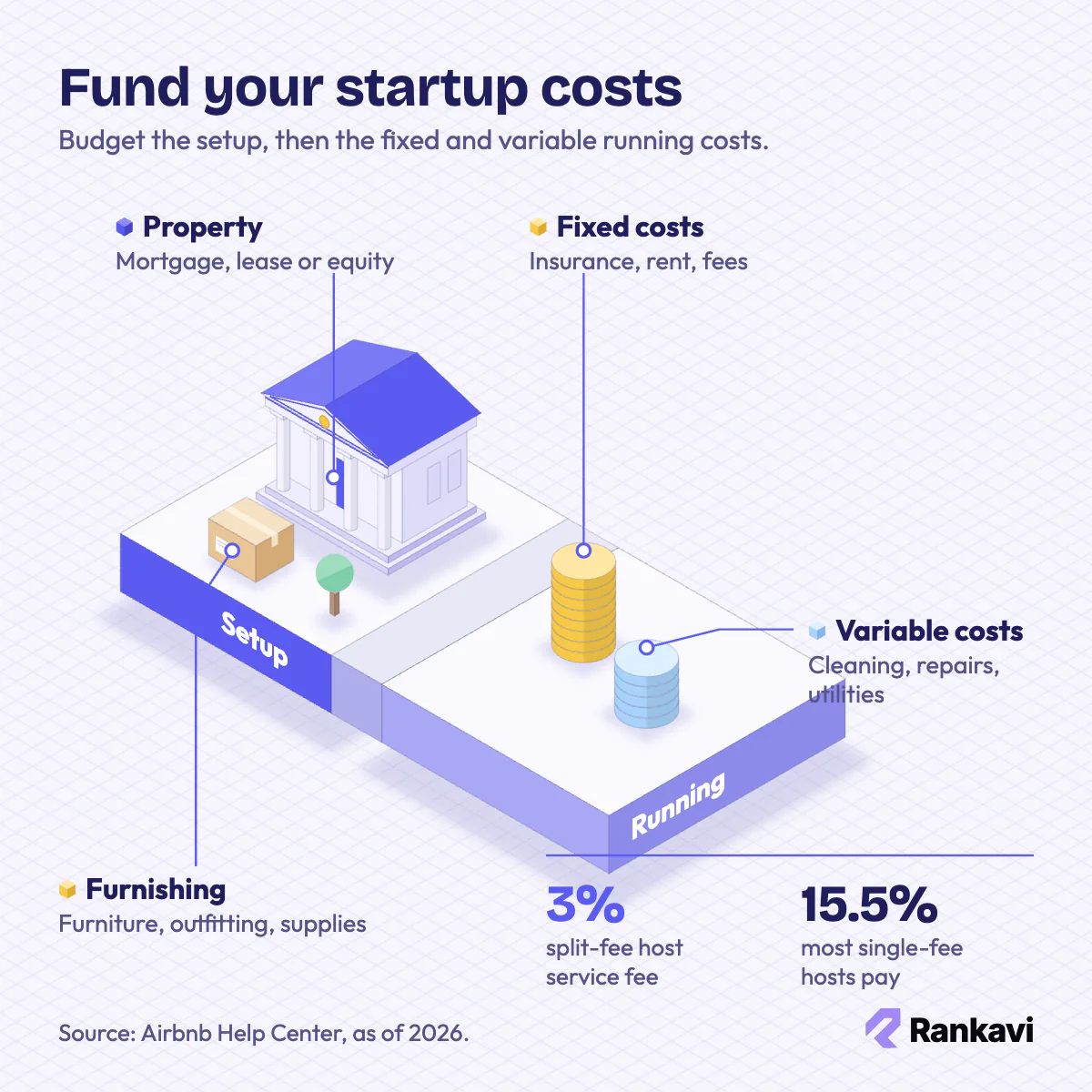
Funding an Airbnb business covers the property, furnishings, insurance and enough cash to run until bookings arrive. A written budget comes before the property search, because the down payment and furnishing bill decide which homes are affordable.
Startup money at a glance:
| Item | Typical figure |
|---|---|
| Startup cost | $8K-$15K for a studio or one-bedroom, up to $22,000-$35,000 for three bedrooms, before any purchase or lease deposit |
| Main costs | Furnishing ($8,100-$14,800 for a two-bedroom), rental insurance ($800-$2,000/year), permits ($50-$500), Airbnb host fee (3% split or 15.5% host-only) |
| Typical margin | About 30% to 70% of gross bookings left after operating costs, before mortgage or rent payments |
| Time to open | Varies with city registration wait times and furniture lead times |
Sources: strnumbers.com (2026), a short-term rental analytics vendor; Awning (2026), a property management company; Airbnb Help Center (2026). Cost ranges are vendor estimates.
Those figures cover the opening bill, but spending continues after the first guest checks in. Costs after opening split into two groups. Variable costs move with how busy the place is, and they include cleaning, toiletries, repairs and utilities. Fixed costs arrive whether or not anyone books, and they cover insurance, rent or mortgage, accounting and software.
Platform fees changed recently. Guesty, a property management software vendor, reports that since October 27, 2025, listings connected to such software pay a 15.5% host-only fee. Guests on those listings pay no separate service fee. The Airbnb Help Center, as of 2026, says most remaining split-fee hosts pay 3% and that all home hosts are moving to the single fee.
Rent or mortgage sits among those fixed costs. The following are the three ways buyers usually finance a purchase:
- Conventional mortgage: A standard home loan from a bank or other lender.
- Short-term rental loan: A debt service coverage ratio (DSCR) loan is a common short-term rental loan. It qualifies the buyer on the property’s expected rental income, not personal income.
- Home equity line of credit (HELOC): A credit line drawn against the equity in a home the buyer already owns.
Hosts without capital still have routes in. Co-hosts manage other owners’ listings for a share of earnings, and arbitrage operators lease a unit to sublet.
Taxes soften part of the opening bill. Some setup spending can be deducted early. IRS Publication 583, revised December 2024, allows deducting up to $5,000 of business start-up costs in the first year. The December 2024 rules shrink that limit once start-up costs pass $50,000, and remaining costs are amortized.
The worked example below shows how many nights a listing must sell to pay for itself.
Worked example: An illustrative two-bedroom costs $18,000 to set up and $2,750 a month to carry. At $200 a night, the 15.5% host-only fee leaves $169. Break-even is about 17 booked nights, or 56% occupancy. At 20 nights it clears about $630 a month, recovering setup in 29 months. Figures exclude income tax and owner pay.
6. Find the Right Property
Choosing a property determines how often the calendar fills and how much each night earns, but legality comes first. Before any offer or lease, the host confirms that this exact address may host short stays.
Three sets of rules decide that. City zoning sets what the neighborhood allows. A homeowners association (HOA) is the group that governs a shared community, and it has rules of its own. Individual buildings can add their own bylaws on top.
For an HOA, those rules live in one document: the covenants, conditions and restrictions (CC&Rs). Some HOAs ban stays under thirty days. Some cities allow hosting only in the owner’s primary residence. A property that fails these tests never earns a dollar, no matter how good its location.
Clearing the rules still leaves a cost. Where an HOA allows hosting, monthly dues still apply. Every income projection carries them as a fixed expense.
Once an address is legal, demand sets how full the calendar gets. That pushes the search toward areas with steady tourism, events or business travel. Within those areas, walkability, parking and distance to the airport or main attractions narrow the list further.
The kind of building matters too, because it changes both the odds of approval and the appeal to guests. Hosts choose among four main property types:
- Single-family home: It suits groups and avoids shared walls.
- Condo: It answers to an HOA.
- Accessory dwelling unit (ADU): This is a second, smaller home that sits on the owner’s own lot.
- Cabin or tiny home: It sells on being unusual, and that novelty is the draw for guests.
What decides between them is which rules the host can clear and which guests the host wants to attract.
Every candidate gets its own projection of income, expenses and cash flow before an offer. Software gives a first estimate, and comparable listings near that address show whether that estimate is realistic. A home inspection comes next, because repairs found late would delay the first booking.
Buying is not the only way in. Rental arbitrage lets a host sign a lease instead and get the landlord’s written permission to sublet. Local law must also allow non-owners to host. Renting out a spare room is often called house hacking. The owner already controls the space, so hosting can be tested with little money at risk. That makes it the lowest-risk start.
7. Get Short-Term Rental Permits
Permitting links the chosen address to a city registration, tax accounts and a safety inspection. Hosts who skip these steps risk fines or the removal of their listing.
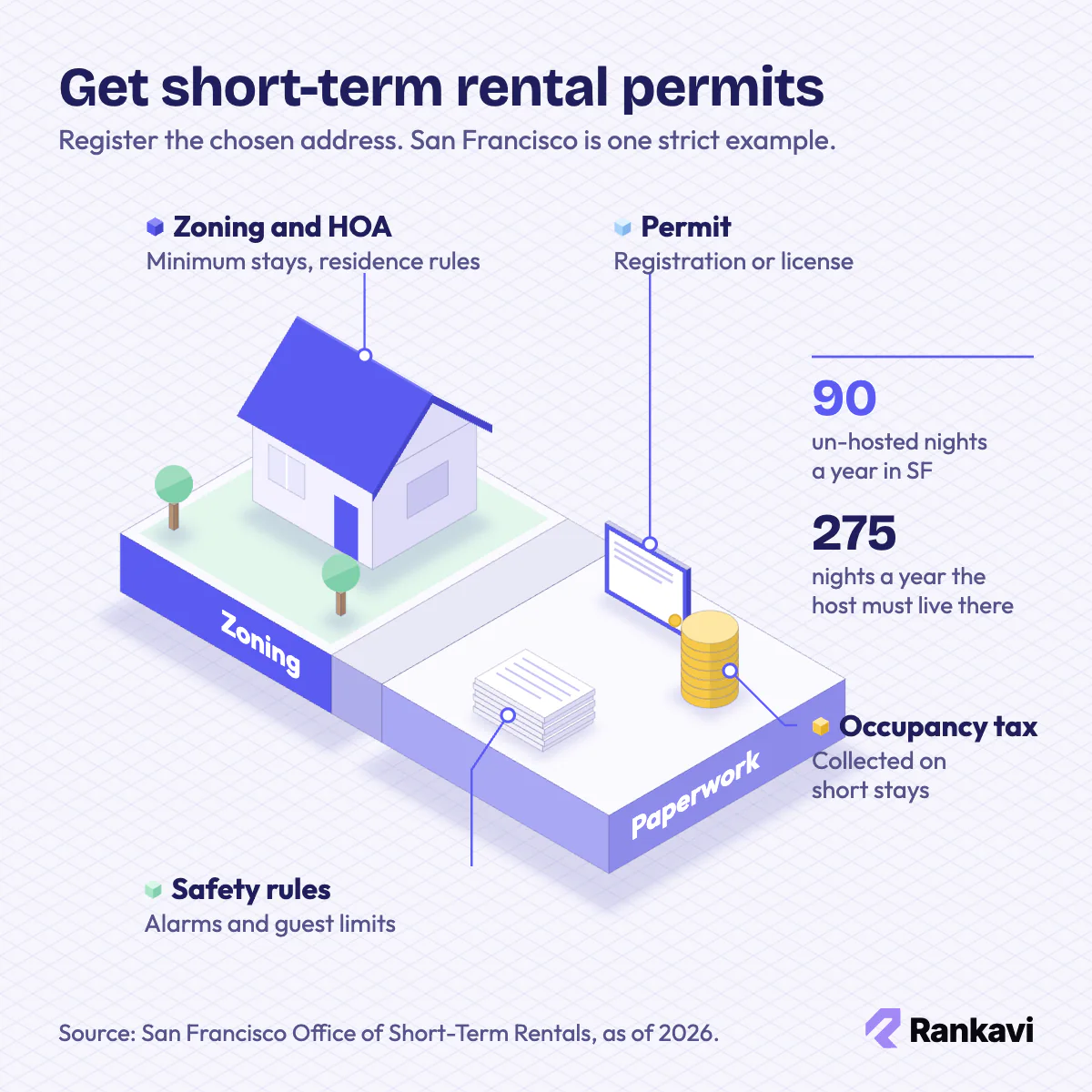
Approvals often stack in layers: zoning clearance, the rental permit or registration, and a safety inspection.
The paperwork carries different names from place to place. Many cities require a short-term rental permit, a business license or both.
New York City shows how strict this can get. The Mayor’s Office of Special Enforcement is the city office that registers short-term rentals under Local Law 18. Since 2023, the Mayor’s Office of Special Enforcement has required registration for stays under 30 days. Its May 2025 announcement of the first Local Law 18 lawsuit cites penalties of up to $5,000 for unregistered rental transactions.
The San Francisco Office of Short-Term Rentals certifies hosts in that city. As of 2026, hosts there must live in the unit 275 nights a year and rent un-hosted for at most 90.
Occupancy taxes are local taxes on short stays, and they apply to most of them. Who handles the money varies. In some places Airbnb collects and remits them. Elsewhere, the host registers with the tax office and files returns directly.
The final layer looks at the home itself rather than the paperwork. Local codes may also require smoke and carbon monoxide alarms and a maximum guest count tied to bedrooms.
Common local requirements:
| Requirement | What it controls |
|---|---|
| Zoning clearance | Whether short stays are allowed in that zone |
| Rental permit or registration | Permission to host at all |
| Business license | Legal operation as a company |
| Occupancy tax registration | Collection of local lodging taxes |
| Safety inspection | Alarms, exits and maximum guests |
8. Insure the Rental Property
Rental insurance protects the owner when a standard homeowners policy excludes paid hosting. The right coverage has to be in place before the first guest checks in. Dedicated policies typically cover property damage, guest injury liability and, in some cases, lost income while repairs happen.
Hosts usually choose between three products:
- Homeowners policy with a home-sharing endorsement: An endorsement is an add-on that extends a policy the owner already holds. This option can suit a spare room inside an occupied home.
- Landlord policy: This type covers a home that is rented to others rather than lived in by the owner.
- Dedicated short-term rental policy: This type is built for frequent paid stays. Proper Insurance is a specialty insurer that sells short-term rental policies meant to replace a homeowners or landlord policy.
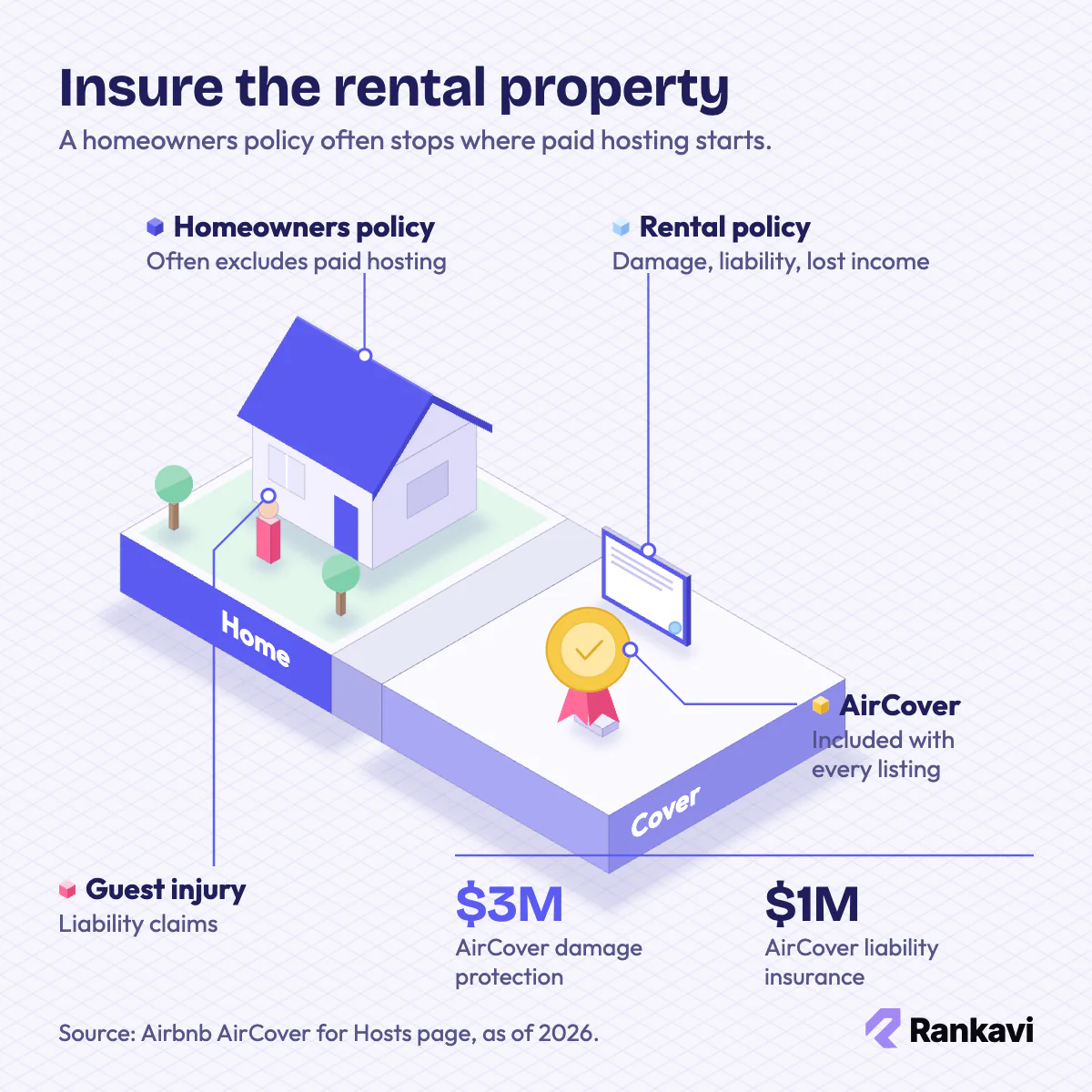
Some protection arrives with the listing itself. AirCover for Hosts is the protection program Airbnb includes with every listing. Its 2026 host page lists $3 million in damage protection and $1 million in liability insurance. Many hosts still buy a separate policy. Platform claims follow Airbnb’s own rules and do not cover bookings made elsewhere.
Mortgage lenders and landlords often ask to see proof of rental coverage before allowing hosting. A security deposit or damage waiver adds one more buffer against a single bad stay.
Flood is a separate gap. In 2026, the Federal Emergency Management Agency (FEMA) says most homeowners insurance does not cover flood damage. The National Flood Insurance Program (NFIP) is the federal program, managed by FEMA, that sells flood policies. FEMA’s 2026 guidance notes a typical 30-day wait before a policy starts.
9. Furnish and Equip the Space
Furnishing an Airbnb turns an empty property into a comfortable, photo-ready stay that matches its price tier. Luxury guests expect high-end pieces, while budget travelers want clean, functional rooms.
Spend on the bed first. Guests rent the space mainly for sleep, and mattress complaints show up often in reviews. A quality mattress and good pillows protect the rating from the first stay.
A stocked kitchen sets a listing apart, especially for longer stays. Other amenities guests value include a washer and dryer, streaming television, fast internet and room-darkening curtains. Top local listings show which ones the market expects.
Streaming and remote work need a little extra thought. A streaming device lets guests sign in to their own accounts. Remote workers look for a desk and a good chair. Airbnb lists a dedicated workspace as an amenity.
Guests have to get through the door before any of this helps. Keypad entry through a smart lock removes the key handoff, so guests can arrive at any hour.
Safety gear belongs on the list too. That gear includes smoke and carbon monoxide alarms, a fire extinguisher and a first aid kit.
Airbnb’s 2026 Help Center bans security cameras that monitor any part of a home’s interior. Noise decibel monitors are allowed indoors, outside bedrooms, bathrooms and sleeping areas. They measure sound levels without recording audio, which helps hosts spot parties.
Guests often arrive after dark in unfamiliar surroundings. Broken walkways, loose paving stones and weak outdoor lighting become real hazards, and a walk-through before launch catches them.
Guest-ready essentials:
| Area | Key items |
|---|---|
| Bedroom | Quality mattress, pillows, room-darkening curtains |
| Kitchen | Cookware, utensils, coffee and basic staples |
| Entry | Smart lock, outdoor lighting, noise decibel monitor |
| Living space | Fast internet, streaming television |
| Laundry | Washer and dryer |
| Safety | Smoke and carbon monoxide alarms, fire extinguisher, first aid kit |
| Workspace | Desk and chair |
10. Organize Daily Operations
Daily operations keep every check-in, cleaning and guest message running on schedule. These systems need to exist before the listing goes live, because the first booking can arrive within hours.
Hosting style comes first. Some hosts greet every guest with a short orientation. Others run fully remote stays with digital check-in and automated messages.
Cleaning happens after every stay. A written checklist covers each room, linens and restocking. Cleaners should be booked before launch, along with a handyman for repairs.
Every cleaning has to line up with the booking calendar. Turno is a cleaning scheduling app that creates cleaning jobs from each booking’s check-in and checkout dates.
A par level for each supply, such as toilet paper and coffee, tells cleaners when to restock.
Some trouble cannot wait for the next cleaner to arrive. An after-hours contact handles lockouts and broken appliances, because problems arrive at any hour.
Guest communication shapes reviews. Automated messages cover three moments in a stay:
- Booking confirmation: This message confirms the booking the guest just made.
- Check-in instructions: These tell the guest how to get into the property.
- Checkout reminder: This reminds the guest about checkout.
Identity (ID) verification and short pre-booking questions help screen guests, and fair hosts never discriminate.
Bookings can also come from more than one booking platform at once, and each platform keeps its own calendar. Hostaway is a property management system with a channel manager. It syncs calendars and rates across booking platforms, which prevents double bookings on listings that use several of them.
Some owners would rather not run any of this themselves. They delegate to a co-host or property management company. That help handles guests, cleaning and calendars for a share of revenue.
The Co-Host Network is Airbnb’s directory of local co-hosts, searchable from the listing editor. It is not offered in every country.
11. Market Your Listing
Marketing an Airbnb listing turns a ready property into booked nights through photos, copy and early reviews. Photos carry the most weight, because guests judge a listing by its cover image.
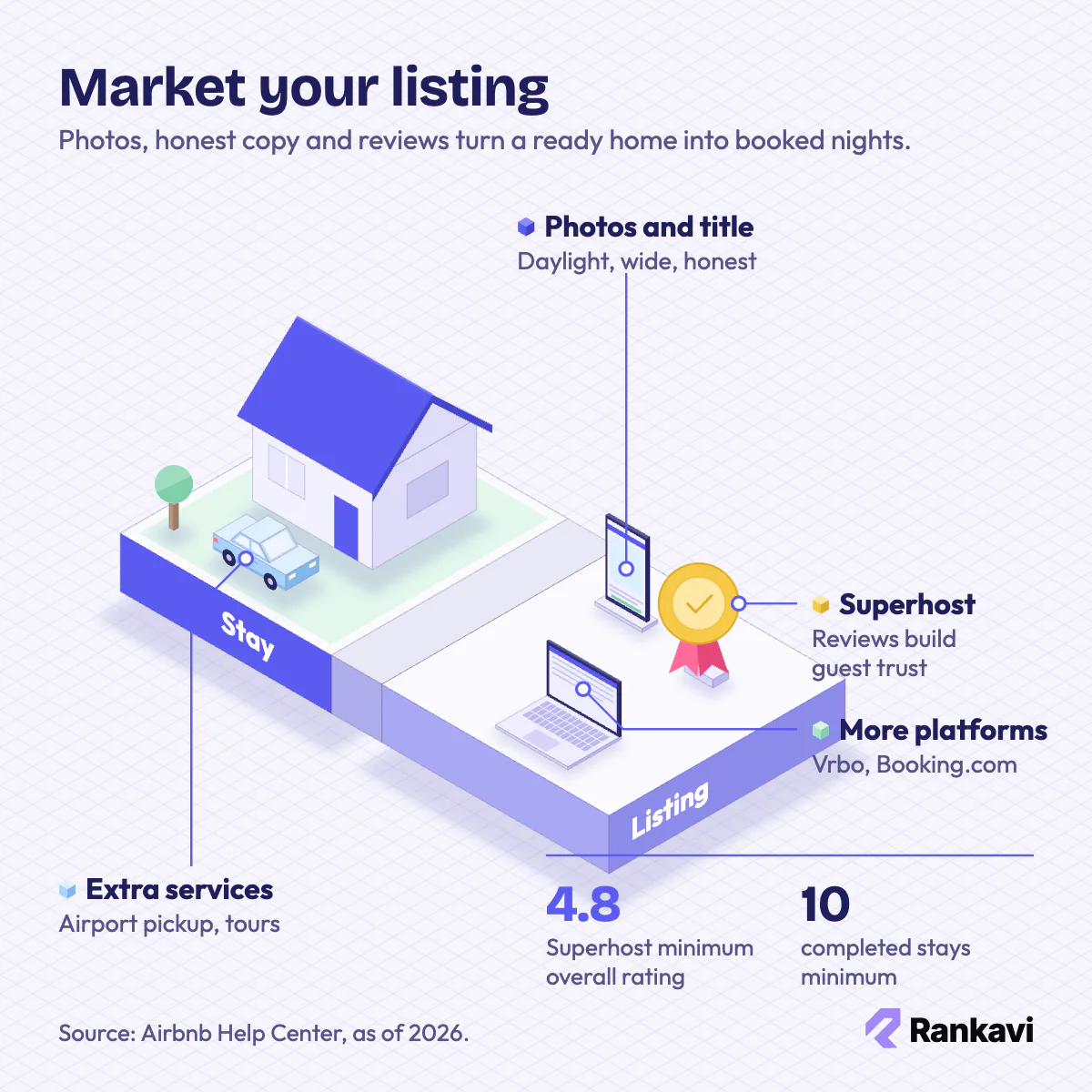
Strong photos use daylight with every curtain open, horizontal orientation and wide corner angles. They show the interior, exterior and every standout amenity honestly.
Once a photo pulls a guest in, the words have to answer what the guest wonders next. A good title answers a guest’s first questions: room or entire home, and near what landmark. An honest description names any drawback. A clear hook, such as a hot tub or self check-in, separates the listing from competitors.
Instant Book lets guests confirm a stay without waiting for host approval.
Hosts can reach guests through four booking channels:
- Airbnb: One of several online travel agencies (OTAs).
- Vrbo: Owned by Expedia Group, Vrbo is a vacation rental marketplace.
- Booking.com: Booking.com is an online travel agency that lists hotels alongside rentals.
- Direct booking website: A site the host owns, which Hostaway can build. It lets repeat guests book outside these platforms.
Each channel reaches a different audience, so many hosts list on more than one to fill more nights.
Reviews drive future bookings. Superhost is the badge Airbnb gives hosts who meet rating, stay, cancellation and response thresholds. Airbnb’s 2026 Help Center rules require a 4.8 overall rating, at least 10 completed stays, a cancellation rate under 1% and a 90% response rate.
Superhost is not the only badge a listing can earn. Guest Favorite is a separate Airbnb badge for the homes guests rate most highly. Airbnb bases it on ratings, review feedback, cancellations and quality incidents. Its 2026 Help Center gives guests and hosts 14 days after checkout to submit a review.
Extra services lift income: guided tours, airport pickup, mid-stay cleaning or occasion decorating. Airbnb lets hosts charge for these through special offers or payment requests.
12. Earn Mentions in AI Travel Answers
AI visibility means a rental gets named when travelers ask ChatGPT, Gemini, Perplexity or Google AI Mode where to stay. Those tools lean on local travel guides, neighborhood roundups and “best places to stay” articles.
Travelers increasingly ask questions like “quiet two-bedroom near the convention center with parking.” A listing described on independent sites with those specifics gives AI tools something concrete to repeat.
Rankavi is a software as a service (SaaS) platform that publishes brand mentions in articles on indexed third-party websites. Hosts can order unlinked mentions from $12 each. Hosts whose guests search on Google can also build Google AI Mode citations through the same articles.