

Starting a wholesale business means buying goods in bulk from manufacturers and reselling them in smaller lots to retailers. The U.S. Bureau of Labor Statistics counted about 6.1 million wholesale trade jobs in September 2026.
Before the steps, a quick note: I’m Michal Sieroslawski, and I help wholesale businesses build their visibility online. As AI search grows, retailers ask ChatGPT for suggestions, and being recommended there counts.
The order puts prices and cash needs ahead of any lease or stock purchase. Permits come before the first tax-free supplier order. Each of the eleven steps below builds on the last, from wholesale idea to first paying customer.
- Choose a Wholesale Niche and Model
- Research Retail Buyers and Competitors
- Price With Markups, Minimums and Terms
- Fund Inventory and Working Capital
- Register the Distribution Company
- Lease Warehouse Space
- Get a Seller’s Permit and Resale Certificate
- Source Reliable Suppliers
- Set Up Inventory and Order Software
- Pitch Retailers With a Line Sheet
- Appear When Retailers Ask Google AI Overviews
1. Choose a Wholesale Niche and Model
Choosing a niche decides which products the business buys, which retailers it serves and how it earns money. A narrow category also makes supplier talks and marketing easier.
Most new wholesalers focus on one category, such as home goods, pet supplies, beauty products or building materials. Prior industry knowledge helps here. A former store buyer already knows what sells and which brands retailers trust.
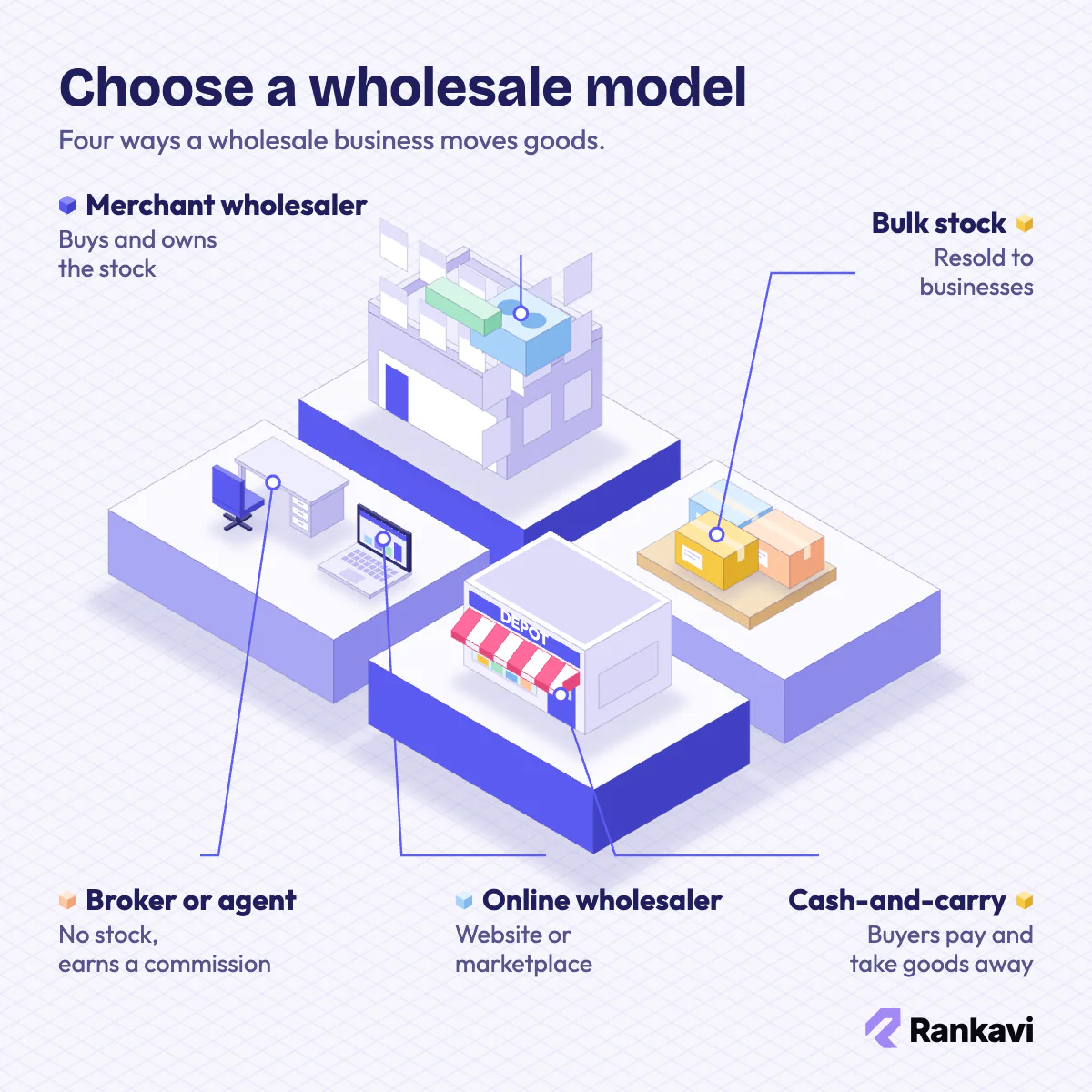
Main wholesale models:
| Model | How it works |
|---|---|
| Merchant wholesaler | Buys and owns the stock, stores it and resells it to businesses |
| Cash-and-carry | Runs a depot where buyers pay and take goods away, with no delivery |
| Broker or agent | Connects buyers and makers without owning stock and earns a commission |
| Online wholesaler | Sells bulk orders through a website or a wholesale marketplace |
| Authorized distributor | Holds a brand’s contract to resell in a set territory |
| Importer | Buys from overseas factories and resells at home, adding duties and long lead times |
| Drop-ship wholesaler | Lists products while the supplier ships each order, so no warehouse is needed |
Brokers carry the lowest financial risk, because they never pay for inventory. Merchant wholesalers carry more risk but control prices, stock and service. Many founders begin as brokers and buy stock once demand is proven.
The best starting model depends on the founder’s situation. Little capital points to brokering or drop-shipping. Buying experience in one category suits a merchant wholesaler. Contacts at overseas factories suit importing. Local customers who like to collect goods suit cash-and-carry.
Product traits shape daily costs. Small, light goods ship cheaply, while bulky items eat freight budgets. Items that retailers reorder often, like office supplies or pet food, bring steadier income than seasonal lines.
A quick score helps compare niches. Reorder frequency, margin, shipping cost, competition and regulation all count. Food, cosmetics, children’s products and electronics carry compliance rules that raise the cost of entry. Steady reorders, cheap shipping and few rules make a safer start than a seasonal or heavily regulated niche.
Demand can be tested before any stock is bought. Marketplace listings, search trend data and talks with target retailers show what stores struggle to source. Walking an industry trade show reveals what buyers already order and which rivals exhibit.
Several mistakes sink new wholesalers. Carrying many unrelated categories spreads cash thin. Relying on one supplier leaves the business exposed if that supplier fails. Commodity goods compete on price alone, and a brand may later sell direct to shoppers and skip the wholesaler.
2. Research Retail Buyers and Competitors
A wholesale company succeeds only when retailers need its products for their own shoppers. Research starts with the stores, not the warehouse.
A buyer profile names the target accounts. Gift boutiques, independent grocers, salons and hardware stores each buy differently. Mainstream goods may later suit chains such as Target or Walmart, while niche lines start with small shops.
The person who orders differs by account type. An independent shop’s owner often buys directly. A chain routes decisions through a buyer or category manager. Knowing who decides shapes the pitch and its timing.
Buying habits matter as much as store type. Retailers differ in first-order size, reorder rhythm and preferred payment terms. Many stores place holiday orders well before the season, so seasonal lines need an early pitch.
Chains add requirements that small shops skip. Vendor onboarding, barcodes, electronic ordering and compliance penalties all raise costs. Longer payment terms also strain cash, so independent stores are the usual starting point.
A look at rival distributors exposes the gap. Their catalogs and websites reveal product lines, minimum orders and delivery speed. A newcomer wins on one of those points, such as smaller minimums or faster restocking.
Rivals come in several types. National and regional distributors, brands that sell direct and online wholesale marketplaces all compete for the same shelf space.
A fair comparison covers the same points for each rival: minimums, price tiers, payment terms, delivery speed and catalog breadth. Requesting a catalog or opening a trial account shows real terms, since some distributors hide prices behind a login.
The findings should end in one sentence naming the edge over rivals. Lower minimums, faster restocking or a regional focus are examples. A buyer should be able to repeat that sentence.
Demand needs proof before stock is bought. Interviews with target buyers, a sample order or a pre-order show whether stores will actually pay. Counting the stores in the delivery area that fit the buyer profile gives a rough market size.
A short business plan turns the research into numbers. It covers the market, target buyers, supplier terms, financial projections and the operating plan. Lenders and some suppliers ask to see it before extending credit.
A plan for a wholesaler needs a cash-flow forecast, because stock and customer credit tie up money. The plan also names risks. Reliance on a few big customers or one supplier, seasonality and price cuts by rivals all count.
3. Price With Markups, Minimums and Terms
Wholesale pricing sets the price per unit, the smallest order a retailer may place and when the retailer pays. Every price leaves room for the store to profit.
The wholesale price covers the landed cost of each item plus the distributor’s margin. The retailer then marks the item up again. A manufacturer’s suggested retail price (MSRP) keeps shelf prices consistent across stores.
Markup and margin are not the same. Markup is the amount added to cost, while margin is the share of the selling price that is profit. Mixing them up leads to prices that look right but earn less than planned.
Landed cost includes more than the factory price. Inbound freight, import duties, insurance and handling all belong in it. A price set on unit cost alone can lose money on every order.
Pricing often works backward from the shelf. Retailers often use keystone pricing, which sets the shelf price at double the wholesale price. The wholesale price must let the store reach its target and still leave the distributor a margin.
Common pricing tools:
| Tool | Purpose |
|---|---|
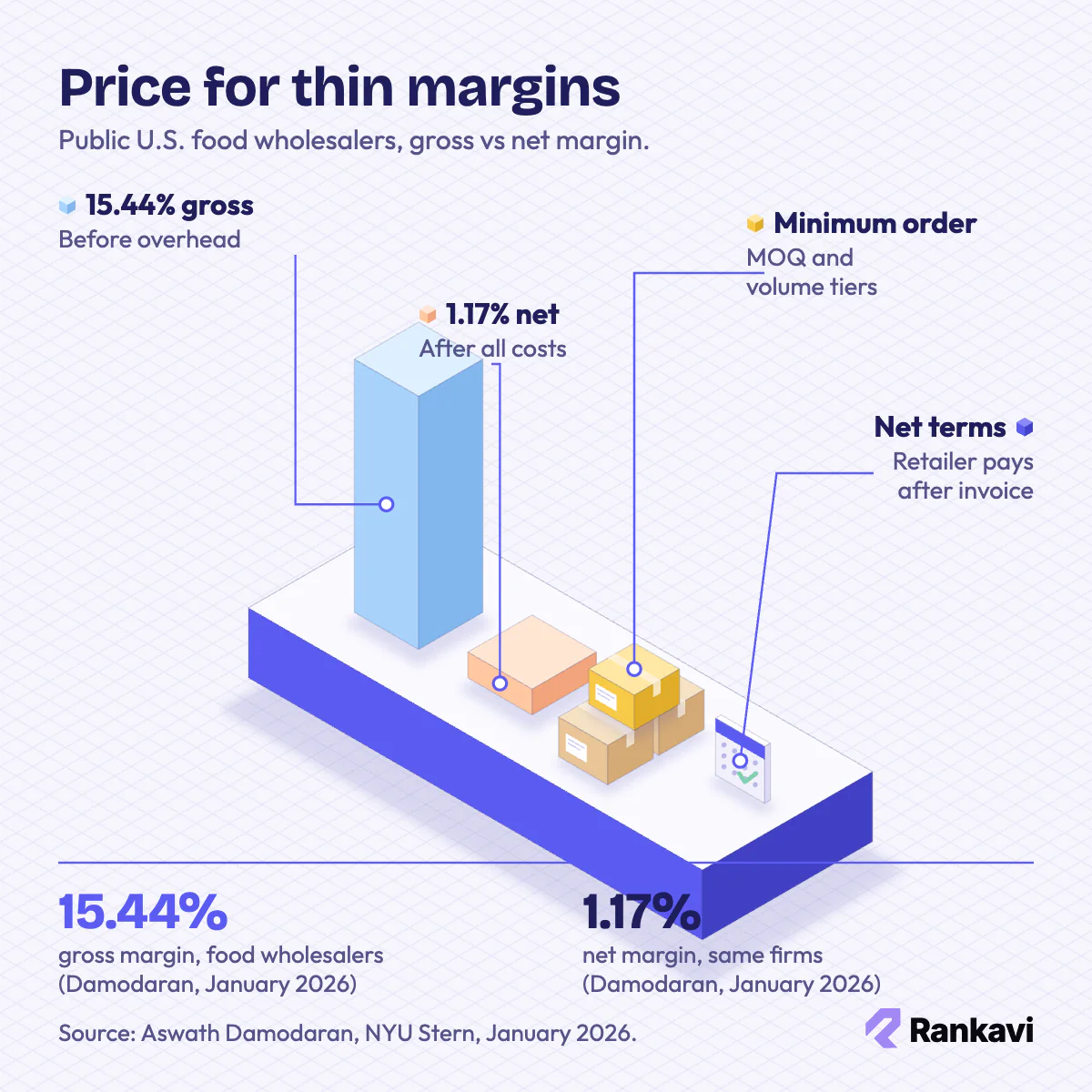
| Minimum order quantity (MOQ) | Keeps each order large enough to cover handling |
| Volume tiers | Lowers the unit price as order size grows |
| Payment terms | Lets the retailer pay a set number of days after the invoice |
| MSRP | Guides the shelf price so stores do not undercut each other |
A minimum advertised price (MAP) policy differs from MSRP. MSRP is only a suggestion, while MAP limits how low a retailer may advertise a product.
A minimum order can be set in units or in dollars. A lower minimum for reorders keeps loyal stores buying. Case packs, sold in set multiples, simplify picking. A free-shipping threshold works as a softer alternative to a hard minimum.
Margins in wholesale are thin, so every price point counts. Publicly traded U.S. food wholesalers averaged a 15.44% gross margin and a 1.17% net margin in January 2026 data from NYU Stern’s Aswath Damodaran.
Net terms help retailers but delay cash for the wholesaler. Large chains often expect to pay weeks after delivery. Small boutiques may accept upfront payment or a deposit. A wholesaler who also sells direct keeps prices at or above the MSRP.
Terms differ by account. New or small retailers usually pay upfront or by deposit. Established accounts may earn net terms after a credit application and trade references. An early-payment discount can speed collection. Late fees and a grace period belong in writing.
Longer terms tie up working capital. Every extra week before payment means inventory and invoices that cannot fund the next order. Terms should match the cash the business can carry.
Written policies on returns, damaged goods and restocking prevent disputes. Separate price lists for independent shops and larger chains keep each account’s terms clear. Price increases work best with advance notice to retailers.
4. Fund Inventory and Working Capital
Funding a wholesale business covers the first inventory, storage, software and the cash gap while retailers pay their invoices. Inventory is almost always the largest line.
Costs split into one-time and recurring items. Racking and deposits are one-time, while rent, software, insurance and freight repeat monthly or per order. The budget should show both kinds.
Startup money at a glance:
| Item | Figure |
|---|---|
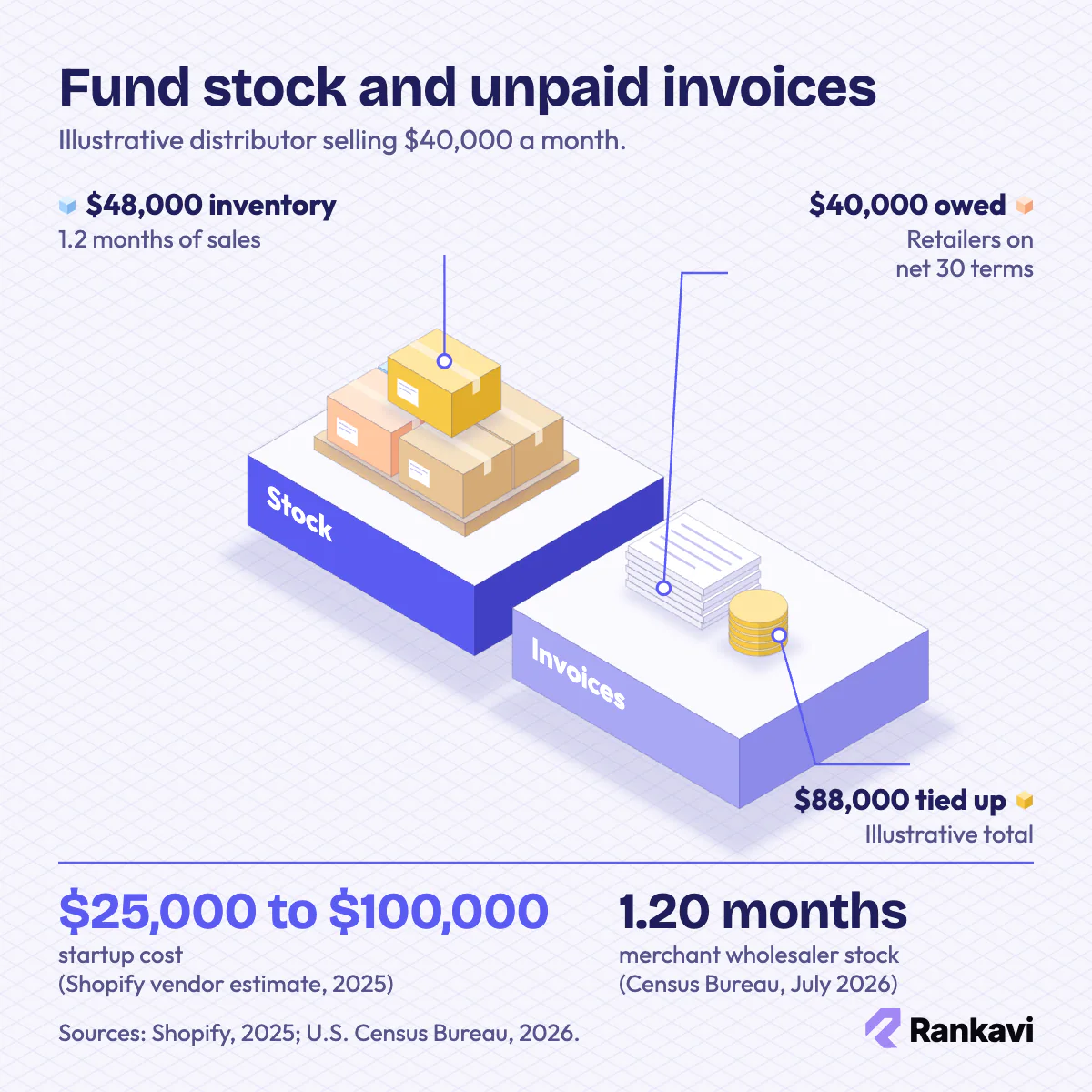
| Startup cost | $25,000 to $100,000, higher with a large first inventory or warehouse |
| Main costs | Inventory ($15,000 to $60,000), warehouse and distribution setup ($3,000 to $15,000 a year), software, licenses and insurance, freight and packaging |
| Typical margin | Gross margin target of 15% to 30%; publicly traded distributors averaged 30.57% gross and 6.05% net (a proxy) |
| Time to open | Varies; supplier lead times and state permit processing set the pace |
Sources: Shopify, which offers an ecommerce platform, vendor estimates, September 2025 (startup cost, main costs, margin target). Aswath Damodaran, NYU Stern School of Business, Retail (Distributors) margins of U.S. publicly traded firms, January 2026. Time to open is qualitative because no named source gives a figure.
Shopify is an ecommerce platform, and its September 2025 guide put wholesale startup costs at $25,000 to $100,000. That figure is a vendor estimate, not a survey. Inventory takes the biggest share in every version of the budget.
Stock levels decide how much cash sits on shelves. U.S. merchant wholesalers held 1.20 months of inventory per month of sales in July 2026, in U.S. Census Bureau data. Founders use that ratio to size the first order and the reorder rhythm.
Worked example: An illustrative distributor buys $30,000 of goods a month and sells them for $40,000, a 25% gross margin. Rent of $750 leaves $9,250 before wages and freight. Holding 1.2 months of sales in stock means $48,000 of inventory. Net 30 buyers owe another $40,000. About $88,000 sits in stock and invoices, near the top of the startup range.
Working capital fills that gap. Many founders combine savings with a business line of credit or a short-term loan.
Each source has a trade-off. Savings carry no repayment pressure but limit how much stock can be bought. A line of credit gives flexible cash for restocking, though it costs interest while drawn. A short-term loan suits a one-time stock purchase.
Lenders ask for the business plan and projected cash flow. The U.S. Small Business Administration (SBA) is the federal agency that backs small business loans, and its microloans reach $50,000 as of 2026.
Supplier terms ease the strain. A supplier that offers its own net terms lets the distributor sell goods before paying for them. New accounts usually earn those terms after a few paid orders.
Cash flow is where wholesalers feel the squeeze. Stock is paid for before it sells, and the invoice is paid weeks after it ships. Growth widens the gap, so faster sales can strain cash instead of easing it.
Over-buying traps cash in slow items. A first order that covers the fastest sellers keeps cash free, and slow items can wait for proven demand.
5. Register the Distribution Company
Registering gives the distribution company a legal identity for supplier accounts, permits and bank loans. Suppliers and retailers check that identity before opening an account.
A limited liability company (LLC) is the common choice, because it separates personal assets from business debts. Larger distributors sometimes choose an S corporation or C corporation for tax reasons. A sole proprietorship is simplest but leaves the owner personally exposed.
An LLC limits personal liability for business debts but does not replace insurance. A claim over a defective product can still hurt the business. State rules for filing, annual reports and fees differ. The state’s business filing office confirms the steps. A trade name that differs from the legal name usually needs its own registration.
An employer identification number (EIN) is free from the Internal Revenue Service (IRS), which runs federal tax collection. Wholesale suppliers ask for it on credit applications and tax forms. A separate business bank account keeps supplier payments and retailer receipts clean.
Mixing personal and business money makes tax filing and loan applications harder.
Product liability insurance matters for goods that pass through the company. A defective item can lead to a claim against everyone in the supply chain. Retail chains often require proof of coverage before the first order.
Coverage should match the products handled. Food, cosmetics or children’s items raise different claim risks than office supplies. Stored stock also needs cover for fire and theft.
6. Lease Warehouse Space
A wholesale business needs storage space more than a storefront. Bulk goods take room, so the location decision is about cost per square foot and access for trucks.
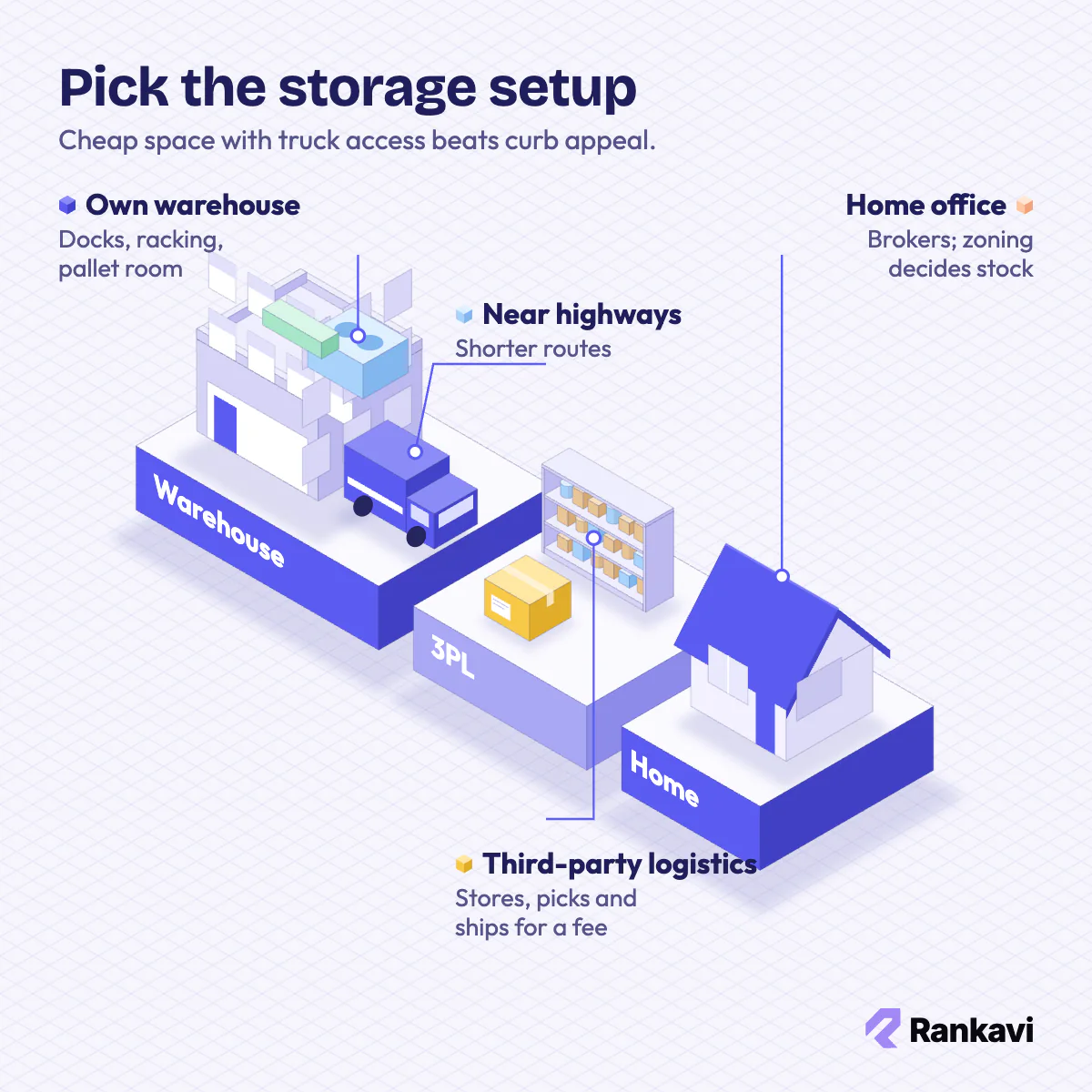
A modest warehouse or flex unit away from prime retail streets keeps rent low. Loading docks, racking and room for pallets matter more than curb appeal. Sites near highways shorten delivery routes to retail accounts.
Lease terms deserve a careful read. Length, renewal options, who pays for repairs and charges beyond base rent all change the true cost. A short lease keeps flexibility while the business is unproven.
A site visit should check truck access, dock height, ceiling height for racking, floor condition and power. Some products need temperature control or fire-safe storage. Space should also allow for growth, since moving stock later costs time and sales.
A third-party logistics (3PL) provider is the main alternative. The 3PL stores the stock, picks orders and ships them for a fee. That option suits online wholesalers and founders testing a product line.
A 3PL provider turns fixed rent into a per-order fee. The trade-off is less control over packing quality and speed. Fees and minimums differ by provider, so quotes should be compared.
Some brokers and small distributors start from a home office. Local zoning rules decide whether stock may be kept there. Buyers who visit to collect goods need a site that is easy to reach.
7. Get a Seller’s Permit and Resale Certificate
A seller’s permit means the state has registered the wholesaler to collect sales tax. The same registration backs the resale certificates used on both sides of each sale.
A wholesaler buys inventory tax-free by giving suppliers a resale certificate. It then collects resale certificates from its own retail customers. Those certificates prove that the goods are for resale, not final use.
A certificate is only as good as its paperwork. A missing one leaves a tax-free sale without proof. Buyers who will not resell the goods do not qualify to give one. Files should stay organized and easy to find in a tax audit.
Typical permit steps:
- Register for a seller’s permit with the state tax agency.
- Give suppliers a resale certificate for inventory purchases.
- Collect and file resale certificates from every retail buyer.
- Get a local business license where the city or county requires one.
Distributors that sell across state lines can use one shared form. The Multistate Tax Commission (MTC) is an intergovernmental state tax agency that publishes a uniform resale certificate. As of 2026, the Multistate Tax Commission listed 36 states that accept that form.
Some products need extra permits. Food distributors register with food safety regulators, and alcohol or tobacco wholesalers need state licenses. Each state sets its own rules for these categories.
Names, fees and forms differ by state, so the state tax agency’s website lists the exact steps. Shipping to other states can raise separate registration questions. The tax agency in each state has the answers.
8. Source Reliable Suppliers
Supplier choice determines product quality, delivery speed and the margin on every order. A distributor is only as reliable as the companies that supply it.
Suppliers range from large manufacturers to small independent makers and overseas factories. Factory-direct buying gives the best price but the largest minimum orders. Industry directories and referrals from other distributors point to vetted sources.
Buying directly from a manufacturer gives a better price but demands larger orders. Buying from another distributor costs more but allows smaller lots. Some brands restrict who may resell, so an authorized-distributor agreement is worth asking about early.
Overseas factories add duties, longer lead times and currency swings to the price. Landed cost, not factory price, shows the true margin. Samples and a small trial order test quality before a large commitment.
Trade groups open doors too. The National Association of Wholesaler-Distributors (NAW) is a U.S. trade association for distribution companies, founded in 1946. Sector associations linked to it help a newcomer meet manufacturers.
Supplier checks before signing:
| Check | What to confirm |
|---|---|
| Reliability | A record of on-time delivery and steady stock |
| Quality | Products that meet industry standards and safety rules |
| Compliance | Certifications and fair labor practices |
| Terms | Written prices, lead times and quality control steps |
New accounts get easier after the first one. Suppliers often ask for trade references, so one paid account opens the next door.
“Kept adding suppliers and it became easier since they all ask for trade references…”
— A longtime online seller on the Amazon Seller Forums
A written supplier agreement prevents disputes. It covers pricing, delivery schedules, returns and exclusivity. Two suppliers for each key product protect the business when one fails.
Payment terms, return rights and defect handling are negotiable and belong in writing. On-time delivery and fill rates should be tracked after signing, since a supplier’s record can slip.
9. Set Up Inventory and Order Software
Inventory software is the most important tool for a growing wholesaler. It tracks stock levels, flags changes in demand and prevents piles of unsold goods.
Software choice depends on size. A spreadsheet works for a handful of products, while a growing catalog needs software that syncs stock, orders and invoices. Links to accounting software save double entry. Useful features include barcode scanning, lot tracking for items with expiry dates, multiple price lists and reorder alerts.
Order flow follows a fixed path. A retailer places an order, the warehouse picks and packs it, and a carrier delivers it. An invoice goes out with the shipment, and the software tracks its due date.
Many distributors add a business-to-business (B2B) ordering portal. Retail buyers log in, see their own price list and reorder without phone calls. Shopify offers native B2B features such as company price lists and payment terms on its Shopify Plus plan.
A portal costs setup time and needs accurate catalog data. Small distributors with few accounts may take orders by email at first. Messy product data causes errors in new software, so item numbers and units should be cleaned first.
Reorder points close the loop. The software alerts the buyer when stock drops below a set level. Seasonal products get earlier reorder dates, since suppliers need longer lead times before busy periods.
Regular stock counts catch gaps between the software and the shelves. Counting one section each week avoids shutting the warehouse for a full count.
10. Pitch Retailers With a Line Sheet
Retail buyers decide on facts, not stories. A line sheet gives them those facts on a page or two.
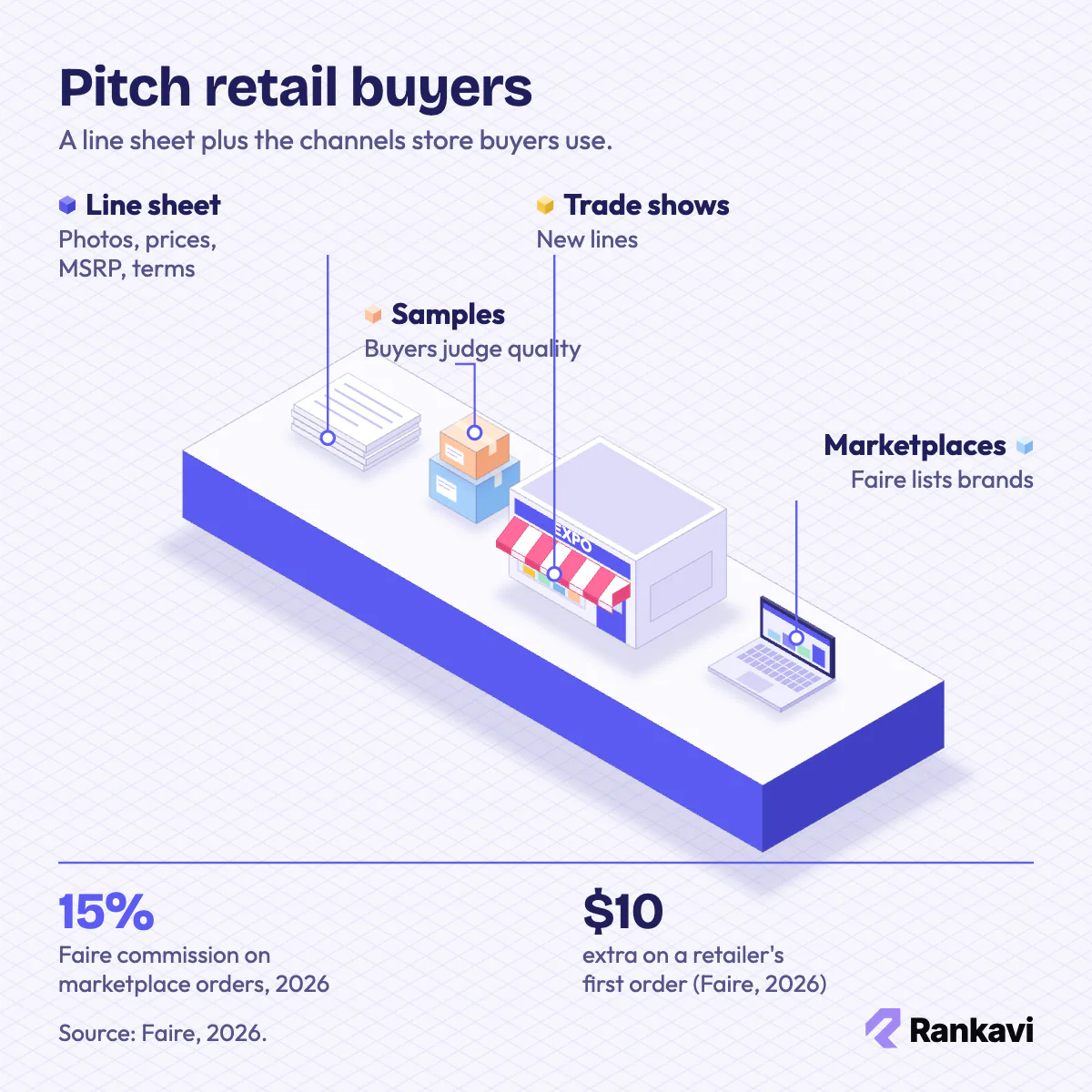
The line sheet lists each product with photos, descriptions, wholesale prices, the MSRP, minimum orders and terms. An order form goes with it, so a buyer can order at the end of a meeting.
Clear product photos and a short note on the company help. Prices must match the terms listed elsewhere, since a mismatch costs trust.
Retail buyers come from five main channels:
- Direct outreach: Calls or emails to store owners who match the buyer profile.
- Samples: Products sent to promising stores so buyers can judge quality.
- Trade shows: Industry events where retail buyers look for new lines.
- Wholesale marketplaces: Online platforms that list brands for independent retailers.
- Trade publications: Ads in magazines and newsletters that store buyers read.
Each channel has a trade-off. Direct outreach costs only time but needs many contacts. Trade shows reach many buyers at once but carry booth and travel costs. Marketplaces bring ready buyers but take fees.
Faire is an online wholesale marketplace that connects brands with independent retailers. As of 2026, Faire charged brands 15% on marketplace orders plus $10 on a retailer’s first order. Orders through a brand’s own Faire link carry no commission.
Every new account gets a credit check before net terms. A retailer with a slow payment history can still buy with upfront payment. Small first orders build trust on both sides.
Repeat orders matter more than first orders. A simple reorder process and a follow-up after each sample keep accounts active. Follow-ups also show buyers that deliveries will be reliable.
11. Appear When Retailers Ask Google AI Overviews
Store owners now search for suppliers the same way shoppers search for products. A boutique owner may ask Google for wholesale candle suppliers and read the AI summary first.
Google AI Overviews are AI-generated summaries at the top of Google results, built from pages Google already trusts. Supplier directories, trade publication roundups and “best wholesale suppliers” articles feed those answers. A new distributor named on those pages has a fair chance of appearing.
Rankavi is a software as a service (SaaS) platform that publishes brand mentions in articles on indexed third-party websites. A young distributor can use an AI Overviews brand mention service to appear in articles store buyers read. Steady service and paid invoices still build the reputation behind those mentions.