

Starting a welding business takes proven skill with metal, a reliable rig, local permits and liability insurance. The U.S. Bureau of Labor Statistics (BLS), which publishes federal job data, projected about 40,300 welder openings each year from 2025 to 2035.
I am Michal Sieroslawski, and I help welding businesses show up in Google and AI search. AI search is a growing way for contractors to find welding businesses, and recommended names start ahead.
Settling the service model and budget first keeps a welder from buying the wrong rig. Paperwork, certification and insurance then land before the first paid job. Starting a welding business comes down to the ten steps listed below.
- Choose Mobile Repair, Shop or Fabrication Work
- Fund the Welder, Truck and Cash Reserve
- Register the Welding Company
- Earn AWS Certification and Hot Work Permits
- Insure Against Burns, Fires and Stolen Tools
- Buy a Welder, Plasma Cutter and Safety Gear
- Quote Jobs and Collect Payment on Site
- Market to Contractors, Farms and Fleets
- Hire Certified Welders and Add Services
- Show Up in Contractors’ Google AI Overviews
1. Choose Mobile Repair, Shop or Fabrication Work
A welding company starts by picking where the work happens and who pays for it. Mobile repair, a fixed shop and custom fabrication each need different tools, insurance and customers.
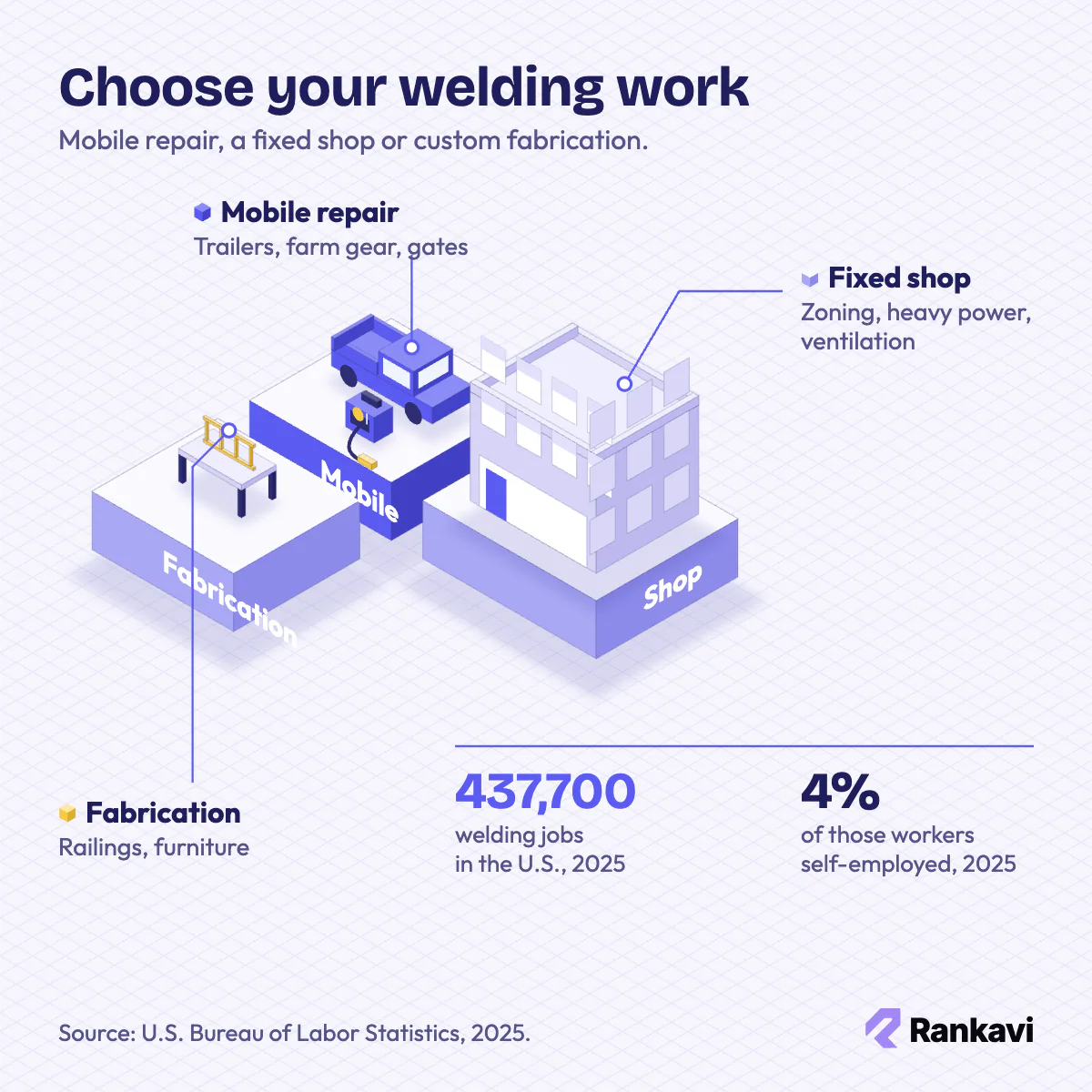
Mobile welders drive a rig to the job. They fix broken trailers, farm equipment, gates and heavy machinery on site. Low overhead makes mobile work the common starting point.
“…the owner/operator is loosing their shirt. They need it repaired pronto.”
— A YouTube commenter on a video about starting a welding business
A fixed shop takes in parts and builds projects under one roof. Shops suit railings, furniture, trailers and production runs. The space needs industrial zoning, heavy power and good ventilation.
Specialties narrow the field. Common niches include structural steel, agricultural repair, automotive and motorcycle work, and ornamental ironwork. A niche lets a new welder build skill and charge for it.
Customers differ by model. Mobile work serves farms, fleets, contractors and property owners who need a repair fast. Shops draw walk-in repairs and local businesses. Fabrication shops sell to builders and manufacturers, usually through drawings and bids.
Each model carries a different trade-off:
- Mobile repair: the lowest startup cost, but drive time goes unpaid and weather can stop work.
- Fixed shop: steadier work under one roof, but rent and utilities continue when jobs are slow.
- Fabrication: larger jobs and repeat orders, but a lumpy backlog and quoting mistakes can erase profit.
Many owners start mobile and add a shop once repeat customers justify the lease. That path shows which services customers ask for before a lease is signed. A home garage may need a home-occupation permit, and neighborhood rules can limit noise, sparks and fumes.
Few welders work for themselves today. BLS counted 437,700 welding jobs in 2025, and only 4% of those workers were self-employed. BLS put their median pay at $53,750 a year in May 2025.
Local demand decides the niche. Owners map rival welding shops on Google Maps and read their reviews. Conversations with contractors, farmers and fleet managers reveal the services nobody covers well.
The BLS figures need context. Most welders work for employers, so the median pay above describes an employee wage, not an owner’s income. Owner earnings depend on billable hours, pricing and overhead.
2. Fund the Welder, Truck and Cash Reserve
Funding a welding business covers the welder, the work truck, safety gear and cash for the slow first months. The service model chosen in step one sets the size of that budget.
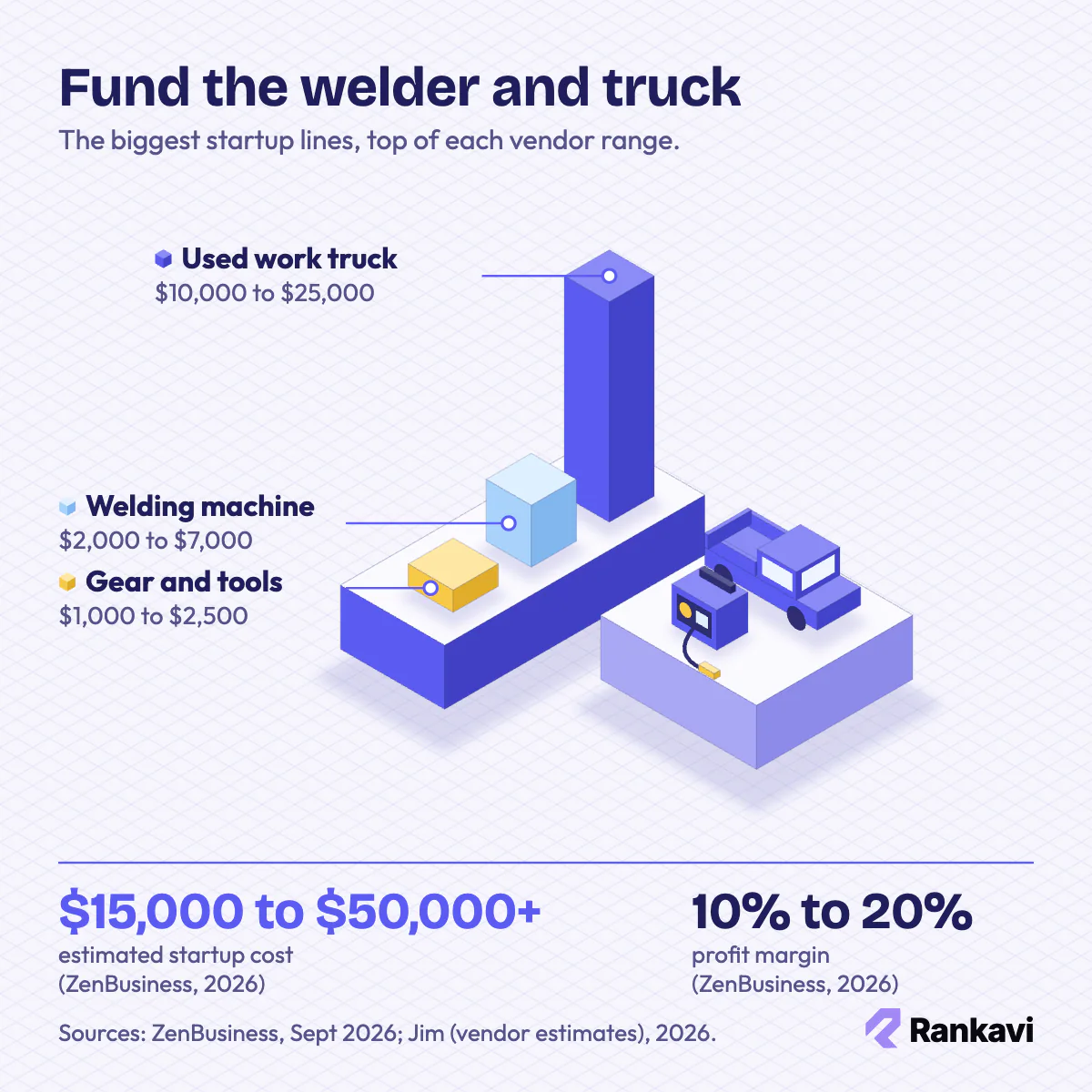
ZenBusiness, a business formation service, estimated welding startup costs at $15,000 to $50,000 or more in September 2026. Jim, a payment app vendor, priced a used work truck at $10,000 to $25,000 in its 2026 guide.
The same 2026 vendor guide put a welding machine at $2,000 to $7,000. Safety gear and hand tools added $1,000 to $2,500 in Jim’s 2026 estimate.
Startup money at a glance:
| Item | Figure |
|---|---|
| Startup cost | $15,000 to $50,000 or more, including equipment, facility and certification |
| Main costs | Used work truck ($10,000 to $25,000), welding machine ($2,000 to $7,000), safety gear and hand tools ($1,000 to $2,500), general liability ($510 a month) |
| Typical margin | 10% to 20% profit margin; gross or net not stated |
| Time to open | State licences take 4 to 8 weeks to process in one vendor estimate |
Sources: ZenBusiness, a business formation service, September 2026, startup cost and margin. Jim, a payment app vendor, 2026, vendor estimates for truck, welder, gear and licence timing. MoneyGeek, an insurance comparison site, September 2026, modeled liability premium.
Worked example: In this illustrative case, a solo mobile welder bills 25 hours a week at $90 an hour. Four weeks bring $9,000. General liability at $510 and tool cover at $48 cost $558 a month. That leaves $8,442 a month for every other running cost and owner pay. Billable hours, not the welder itself, decide whether the rig pays off.
Personal savings fund most first rigs. Many welders buy tools gradually while still employed. Others reinvest early job income instead of borrowing.
Loans fill the gaps. The U.S. Small Business Administration (SBA) offers microloans up to $50,000 as of 2026, averaging about $13,000. Microloans cover machinery, equipment and working capital. Nonprofit intermediary lenders issue them, not the SBA directly.
Other sources suit other needs:
- Equipment financing: the welder or truck is the collateral, so approval is often easier for a new owner.
- Business line of credit: covers consumables and small purchases, and interest accrues only on money used.
- Family or partner money: works best when the terms are written down.
Merchant cash advances carry very high effective costs and are best avoided. Personal and business money should stay apart from the start.
A cash reserve protects the slow months. It should cover fixed costs such as truck payments, fuel, gas, consumables and owner pay for several months. Contractors often pay weeks after an invoice, so the owner funds steel and gas first. Deposits on larger jobs shrink that gap.
Lenders expect a business plan, tax returns and projected cash flow. A new owner with thin credit can start with used gear and add equipment gradually.
Equipment purchases may also carry tax benefits. A certified public accountant (CPA) can confirm which deductions apply. The limits for welders and trucks change by year.
3. Register the Welding Company
Registering a welding company gives it a legal identity that signs contracts, opens accounts and carries insurance. Commercial clients and general contractors often ask for it before a first job.
Most small welding firms form a limited liability company (LLC). One failed weld on a trailer hitch or railing can bring a claim. The LLC keeps a welder’s house and savings out of that lawsuit.
A sole proprietorship exists automatically with the first paid job but offers no liability protection. A single-member LLC is taxed like a sole proprietorship by default. An S corporation election can lower self-employment tax later. It adds payroll and filings, so an accountant decides when it pays off. Insurance in step 5 is still needed, since an LLC does not cover every claim.
Mixing personal and business money can weaken the LLC’s protection. A garage shop also needs local zoning or home-occupation approval. Mobile welders who work regularly in another state may need to register there as well.
The name comes first. The Secretary of State database shows whether a welding name is already taken. The state filing then creates the entity.
Welding suppliers and steel yards open trade accounts under a federal tax number. The Internal Revenue Service (IRS) issues that employer identification number (EIN) free online. A separate business bank account then holds deposits for steel and gas.
Clients and general contractors often request a W-9 form before paying. An EIN on that form keeps the owner’s Social Security number off client paperwork. Suppliers may also run a credit application before offering payment terms.
4. Earn AWS Certification and Hot Work Permits
Licensing a welding business means meeting state and local rules and proving weld quality before paid work starts. Requirements differ by state, city and type of work.
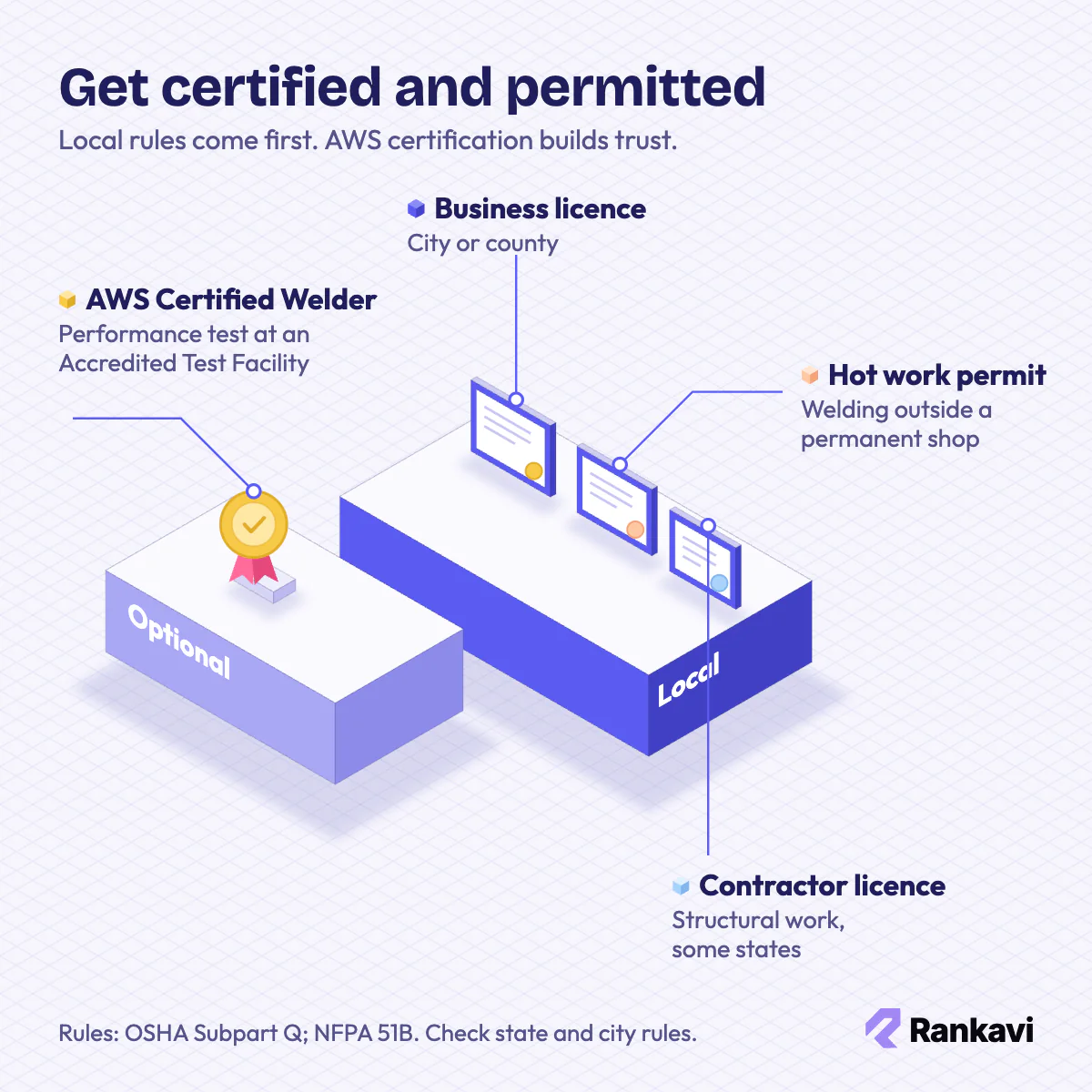
The American Welding Society (AWS), a nonprofit that advances welding and cutting processes, runs the Certified Welder program. The American Welding Society tests welders hands-on at AWS Accredited Test Facilities, with no prerequisite courses.
Many commercial welding clients ask for AWS certification, even where no law requires it. Structural steel work often follows the AWS structural welding code.
Some states require a specialty contractor licence for structural steel or building work. The state contractor board lists the rules. Most cities and counties also require a general business licence.
Fire departments watch welding closely. Many require a hot work permit for welding outside a permanent shop. A fixed shop also needs zoning that allows welding.
Federal safety rules apply too. The Occupational Safety and Health Administration (OSHA) enforces workplace safety. Its Subpart Q rules cover welding, cutting and brazing. That rule wants the area inspected first, preferably under a written permit.
The National Fire Protection Association (NFPA) publishes NFPA 51B, the standard for fire prevention during hot work. Subpart Q points welders to it.
5. Insure Against Burns, Fires and Stolen Tools
Insuring a welding business protects the owner from claims for fires, burns and damaged property. Sparks and hot slag can start a fire long after the welder leaves.
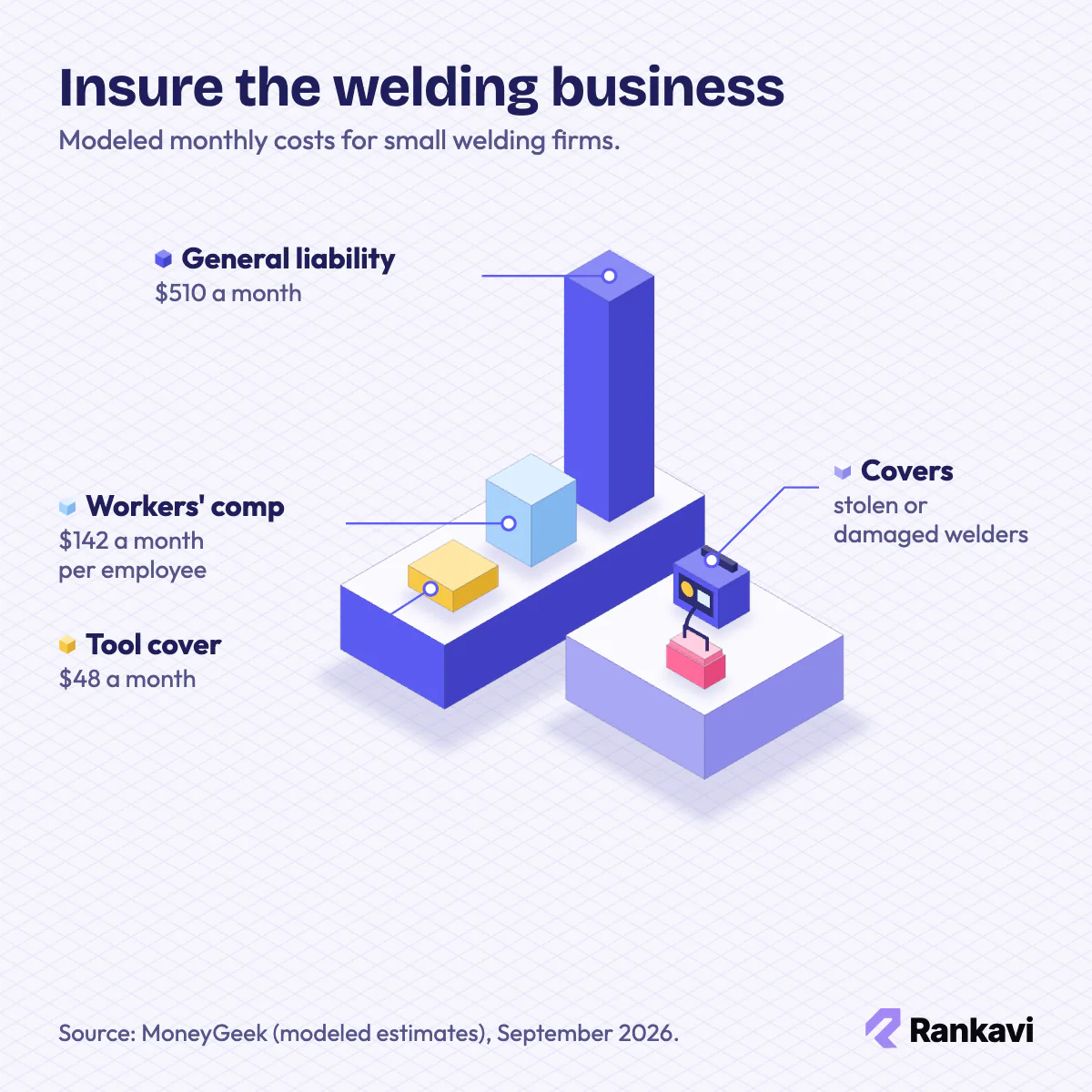
General liability pays when a spark burns a client’s building or a bystander gets hurt. MoneyGeek, an insurance comparison site, modeled the average at $510 a month for small welding firms in September 2026. Contractors ask for a certificate of insurance before a welder steps on site.
Commercial auto covers the work truck. A personal auto policy usually excludes business use on job sites.
Tools and equipment cover, often written as inland marine insurance, pays for a stolen or damaged welder. MoneyGeek put typical tool cover at $48 a month in its 2026 estimate.
A home insurance policy usually excludes business activity, so a garage welder needs a business policy as well. Premiums vary by state, claims history and the type of work, so quotes from several insurers show the real price.
Workers’ compensation follows the first employee. MoneyGeek’s September 2026 average for welding firms was $142 a month per employee.
6. Buy a Welder, Plasma Cutter and Safety Gear
Buying welding equipment turns the chosen service list into a working rig. A mobile repair rig differs from a fabrication shop setup.
Three welding processes cover most jobs:
| Process | Best use |
|---|---|
| Metal inert gas (MIG) | Auto body, trailers and production work |
| Tungsten inert gas (TIG) | Stainless steel, aluminum and precision jobs |
| Shielded metal arc (stick) | Outdoor repairs, farm equipment and dirty steel |
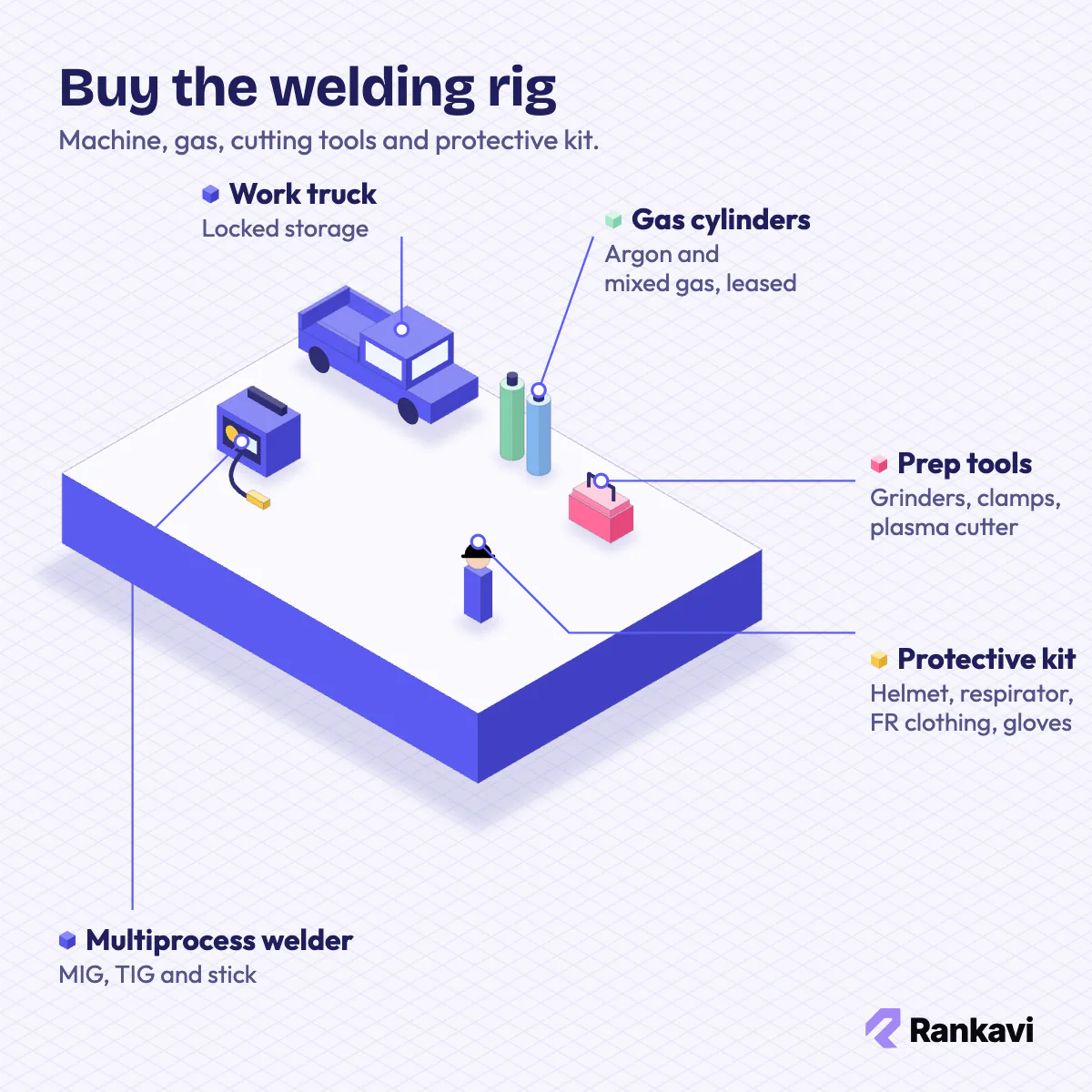
Mobile welders add an engine-driven welder that runs without shore power. Miller Electric is a U.S. welder maker, and its Multimatic line handles MIG, TIG and stick in one unit.
Cutting and prep tools come next. Angle grinders, clamps, a cutting torch or plasma cutter, and measuring tools cover most jobs.
The basic protective kit holds four items:
- Auto-darkening helmet: guards the eyes and face from arc light.
- Respirator or fume extractor: keeps smoke and fumes out of the lungs.
- Flame-resistant clothing: stops sparks from burning through.
- Gloves and boots: protect hands and feet from hot metal.
Airgas is a U.S. distributor of industrial gases and welding supplies. It leases cylinders for argon and mixed shielding gas. A used heavy-duty truck with locked storage carries the whole rig.
7. Quote Jobs and Collect Payment on Site
Quoting welding work sets a price that covers labor, materials, overhead and profit on every job. Most welders charge by the hour or quote a flat project price.
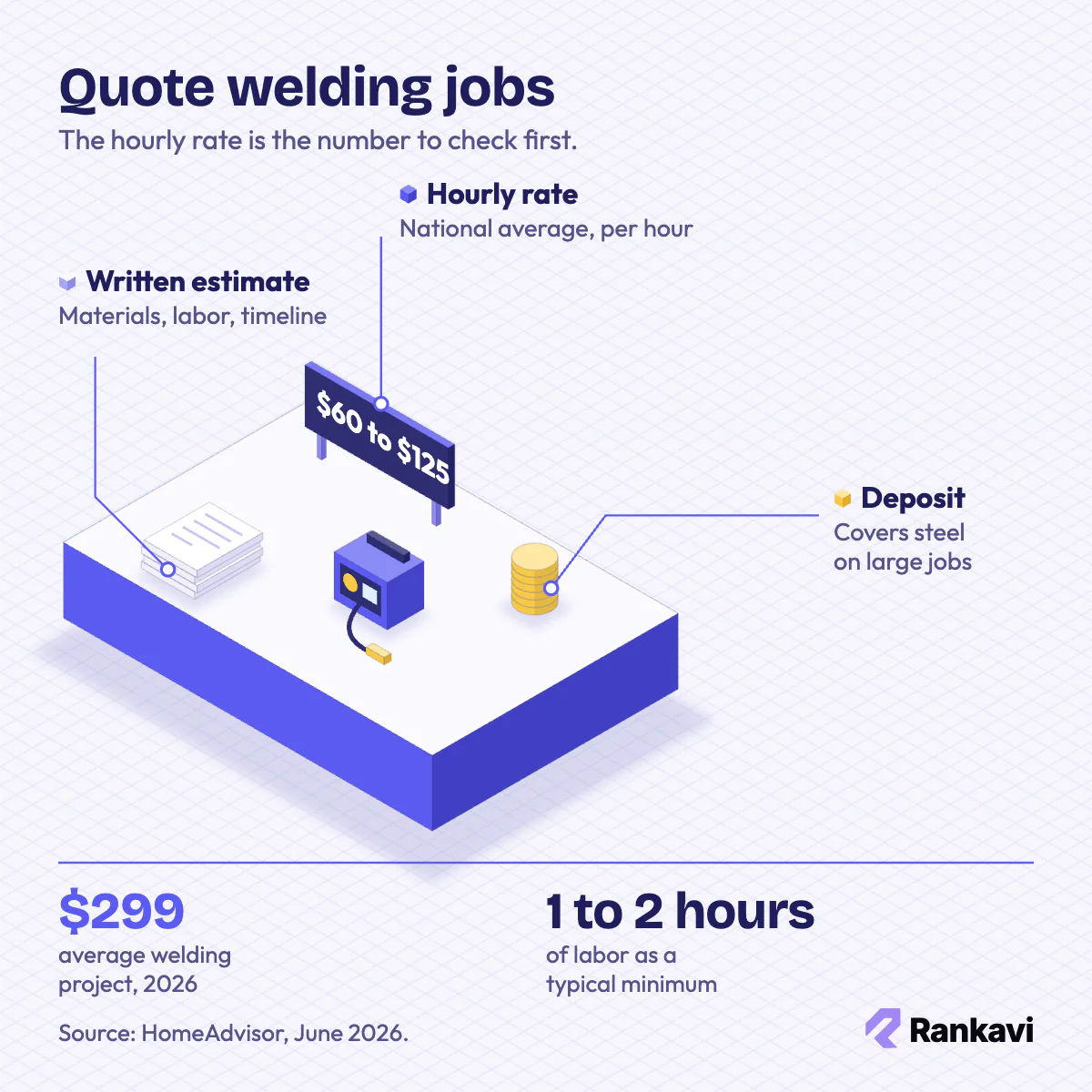
The hourly rate is the number owners check first. HomeAdvisor, a home services marketplace, put the national average at $60 to $125 an hour in June 2026. Rates below that range rarely cover a truck, insurance and gas.
Small jobs still need a floor. HomeAdvisor reported in 2026 that most welders charge a minimum of one or two hours of labor. The average welding project cost $299 in that June 2026 guide.
Hourly pricing suits repairs with unknown problems. Flat pricing suits repeat jobs like gates and railings. A flat quote carries a buffer for surprises. A rate set without drive time and setup loses money on every call.
Material costing comes first. Steel, filler wire, shielding gas, grinding discs and paint all go into the estimate. Drive time and setup belong there too.
“List every thing you will use like gas, welding wire, steel, paint, wire brushes, and what it cost (even your time).”
— A member of the Hobart Weld Talk forum
A written estimate lists materials, labor and the timeline. Larger jobs often take a deposit that covers steel before work starts. Field service software then handles invoices and card payments on site.
8. Market to Contractors, Farms and Fleets
Welding work comes mostly from local relationships and word of mouth. A visible online listing backs up that reputation.
Google Business Profile is the free listing that puts a welder on Google Maps. Owners add services, a service area and photos of finished welds. Reviews from early customers build trust.
Direct outreach brings the first contracts. Welders visit construction sites, farms, auto shops and equipment dealers. Business cards and flyers go to hardware stores and supply counters.
“…door to door handing out business cards will bring waaaaay more work than social media ads.”
— A mobile welder commenting on YouTube
Before-and-after photos sell the craft. A simple website and one social media channel show finished gates, repairs and builds.
Referrals keep the calendar full. One general contractor or restaurant group can send repeat work for years.
A clear service area and a named specialty help customers decide quickly. Fast replies matter most for urgent repairs, where the customer’s equipment sits idle.
9. Hire Certified Welders and Add Services
Growing a welding business decides when to add people, machines and new services. Owners usually hire once they turn down more work than they can finish.
The first hire is often an AWS-certified welder for structural or repair work. Employees on a payroll avoid worker classification trouble with the IRS.
Repeat commercial accounts steady the income. Maintenance contracts with fleets, farms and plants smooth out slow seasons.
New services widen the market. A computer numerical control (CNC) plasma table speeds up cutting. Custom fabrication, artistic metalwork and heavy equipment repair add higher-value jobs.
10. Show Up in Contractors’ Google AI Overviews
General contractors, farmers and property managers now ask AI tools to name a welder near a job site. Google AI Overviews, ChatGPT and Perplexity answer with businesses that trusted sites already mention.
Those sites include local directories, review platforms and “best welders in” round-ups for a city. A new welding shop gains from being named on them early, alongside its Google reviews.
Rankavi is a software as a service (SaaS) platform that publishes brand mentions in articles on indexed third-party websites. Mentions on directories and trade sites help a welder build brand visibility in Google AI Overviews over time.