

Starting a web design business means selling website design and builds to clients under a registered company. Most founders begin solo at home. The U.S. Bureau of Labor Statistics (BLS), which publishes federal job data, counted 220,100 web developer and digital designer jobs in 2025.
My name is Michal Sieroslawski. I help web design businesses become easier to find online. As AI search grows, business owners ask ChatGPT for suggestions, and being recommended there counts.
The order fixes the niche, samples and prices before money goes into software, filings or insurance. Each step then builds on the one before it. The following list shows how to start a web design business in eight steps.
- Choose a Web Design Niche
- Build a Portfolio Before the First Client
- Price Your Web Design Packages
- Budget the Startup Costs
- Register and Insure the Business
- Set Up Tools and a Client Workflow
- Win the First Clients Through Referrals
- Join ChatGPT’s AI Picks for Web Designers
1. Choose a Web Design Niche
A web design niche means the one type of client or platform a studio serves best. Specialists win referrals faster, while generalists compete with every freelancer and drag-and-drop builder.
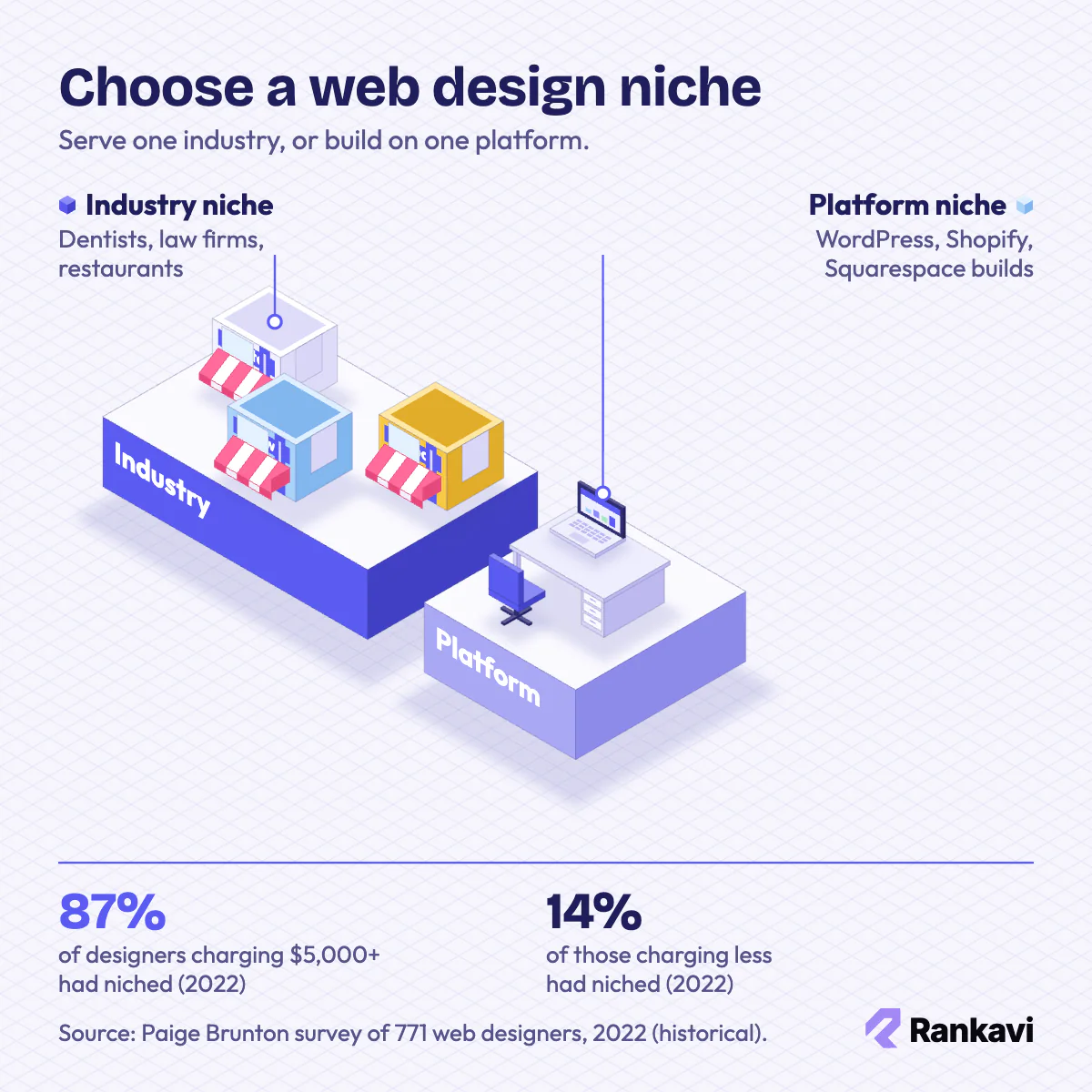
Niches come in two kinds. An industry niche serves one trade, such as dentists, law firms or restaurants. A platform niche sells builds on one tool, such as WordPress, which is a free, open-source content management system.
Two kinds of niche:
| Niche type | Example focus | Main benefit |
|---|---|---|
| Industry niche | Dentists, law firms, restaurants | Copy and features repeat across clients |
| Platform niche | WordPress, Shopify, Squarespace | Faster builds on one familiar tool |
Niching also lifts prices. Paige Brunton, a Squarespace designer and educator, surveyed 771 web designers in 2022. In that now historical 2022 snapshot, 87% of designers charging $5,000 or more had niched, against 14% of those charging less.
Two more niche types exist. A service niche centers on one recurring job, such as redesigns, site migrations or accessibility fixes. A hybrid niche combines both kinds, such as online stores for one trade on one platform.
A good niche passes four checks. Clients can afford a professional site, share the same problems, are easy to find, and suit the designer’s interests. A narrow niche shrinks the prospect pool but makes the studio easier to remember. The niche can also change after the first few projects show which clients pay best.
Service scope belongs in the same decision. Some studios only design, while others also build, host and maintain each site. Design only suits creative work, while design plus build is the most common solo start. Full service brings recurring client relationships but more support work.
Demand checks come next. Local map searches show how many businesses in the niche have slow or outdated sites. Owners in the niche can be asked what their current site fails to do. Competing builders and marketplaces mostly sell on price, so a niche competes on specialist knowledge instead.
Some industries carry rules that generalists miss, such as accessibility duties or health and payment data rules. Knowing them can justify a specialist position, though clients should confirm legal questions with counsel.
2. Build a Portfolio Before the First Client
A portfolio shows a prospective client the quality, style and results a designer delivers. Buyers judge a web designer by past sites, so samples come before any sales.
Mock projects fill the gap before paid work arrives. A designer redesigns a real local business site. Another option is a sample site for an invented company in the niche.
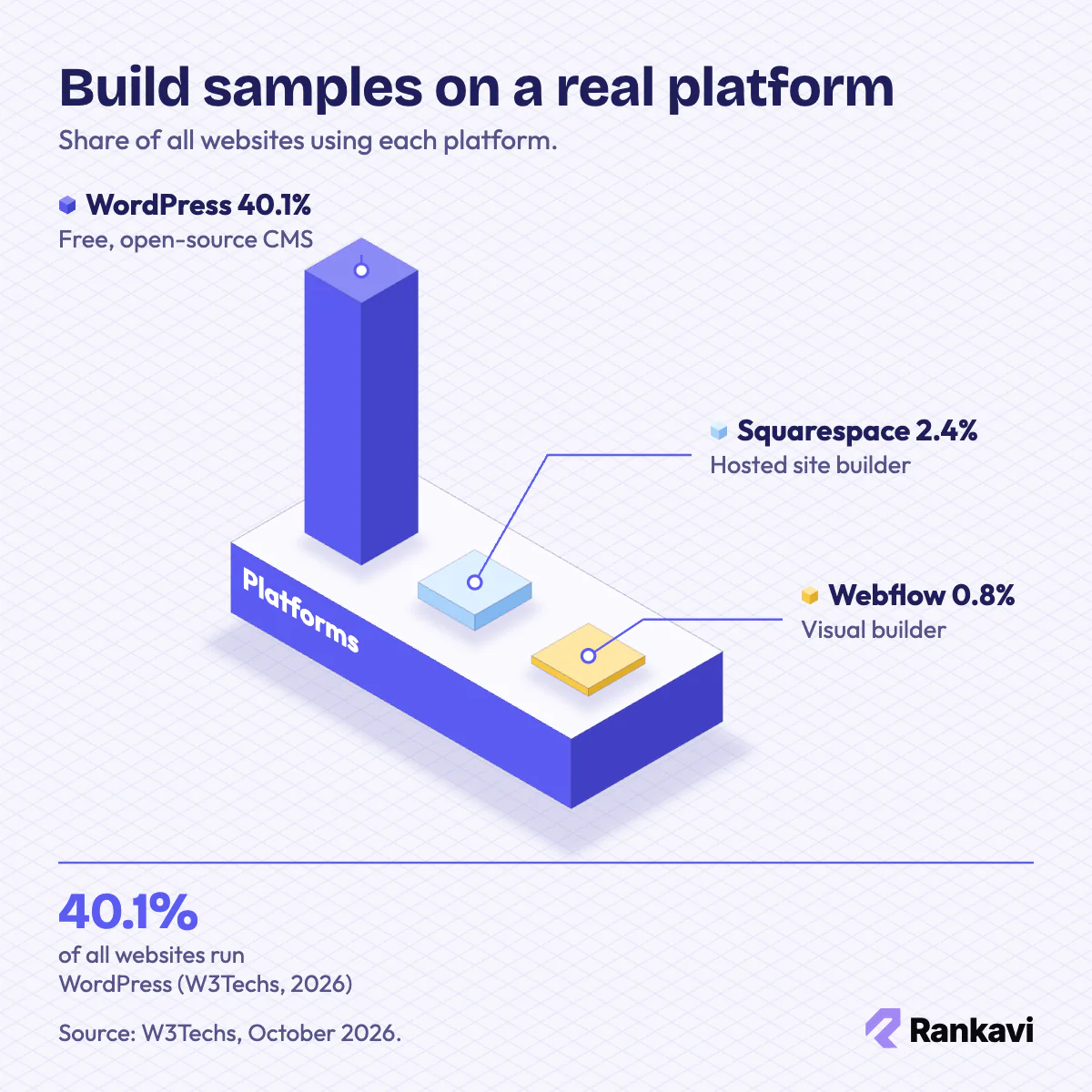
Platform choice shapes those samples. W3Techs, a web technology survey site, found WordPress on 40.1% of all websites in October 2026.
Webflow is a visual website builder with built-in hosting. W3Techs counted Webflow on 0.8% and Squarespace on 2.4% of all websites in October 2026.
Three to five polished samples work better than a dozen thin ones. Each should match the chosen niche. Together they show range, such as a service site, a store and a landing page. A concept redesign should be labeled as such, with the owner’s permission before it is published. Free work for a nonprofit can earn a real testimonial.
Without client results, measurable quality signals stand in. Page speed scores, accessibility checks and mobile screenshots show technical skill. Before-and-after screenshots show visible improvement.
Short case studies turn samples into proof. Each one states the client problem, the design choices and the result. The studio’s own site doubles as the first sample buyers see. It should sit on its own domain, load fast and link to every case study. Profiles on design showcase sites can add reach, but the owned site stays the main portfolio.
3. Price Your Web Design Packages
Pricing sets how a web design business earns from each project and each month of care. Two models dominate: flat project fees and hourly billing.
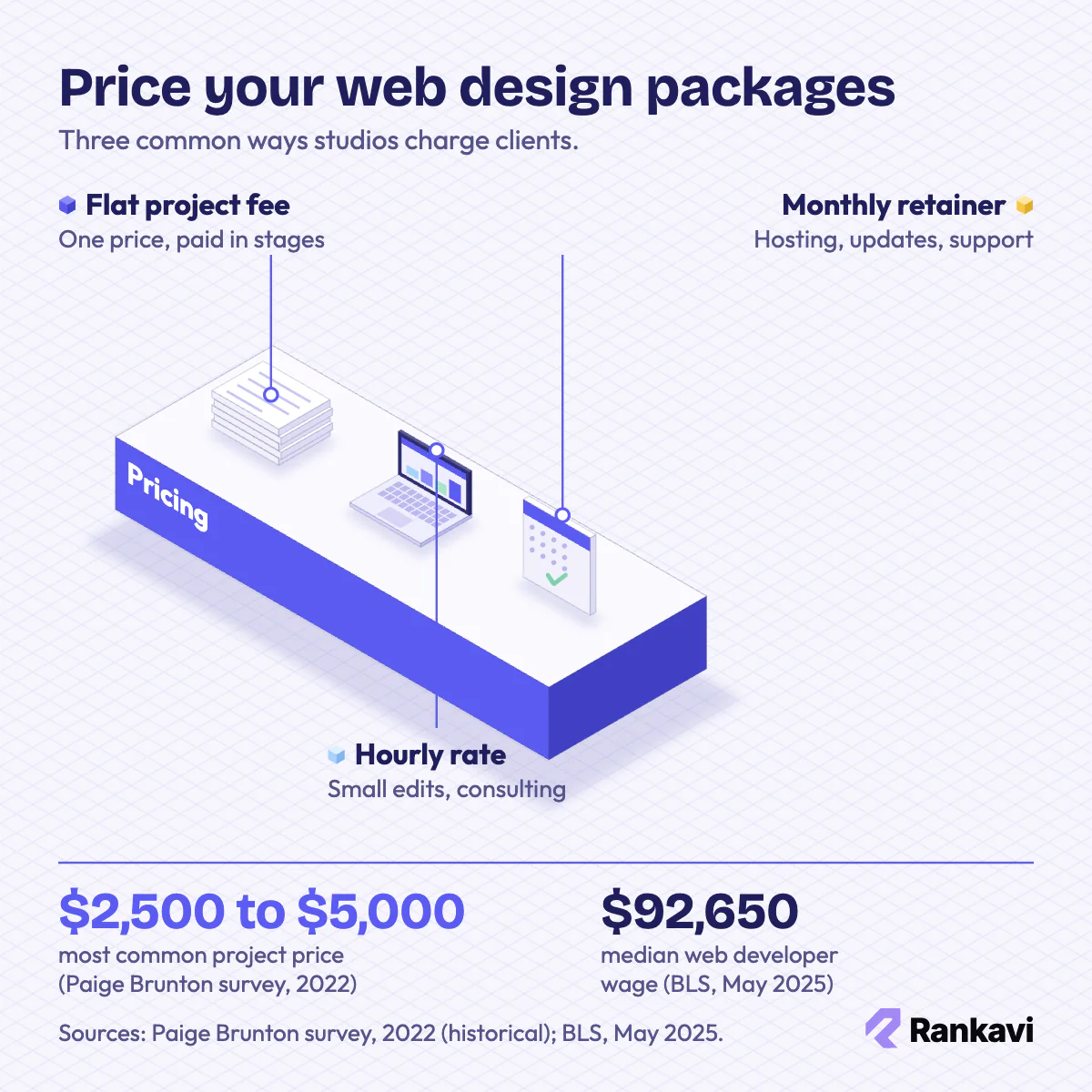
Web design studios use three common pricing models:
- Flat project fee: one price for a defined scope, paid in stages.
- Hourly rate: billed time, common for small edits and consulting.
- Monthly retainer: recurring fee for hosting, updates and support.
Packages split a project into discovery, design, build and launch. Each phase gets a clear deliverable, so clients see what each payment buys.
Brunton’s historical 2022 data put the most common project price at $2,500 to $5,000. Newer designers mostly charged less, while designers with two or more years charged more.
Packages work best as three tiers. A starter tier covers a few pages on a template. A standard tier adds custom design and basic search setup. A premium tier adds online sales or integrations. Extras such as copywriting, logo design, rush delivery and added revision rounds sell as add-ons.
Each model has a trade-off. Hourly billing caps income, since faster work earns less. Flat fees reward speed but need a firm scope. Value-based pricing ties the fee to the client’s result, such as bookings or sales, and suits an established niche.
Payment terms protect cash flow. A common split takes a deposit up front and the balance at launch. Written revision limits and change orders price extra requests instead of absorbing them. When a client asks for a discount, cutting scope protects the rate better than cutting the price.
Overhead sets the floor under every price. The BLS reported a $92,650 median wage for employed web developers in May 2025, a useful benchmark for a solo owner’s salary target.
Retainers smooth uneven project income. A maintenance plan for hosting, updates and backups turns one-off builds into steady monthly revenue.
4. Budget the Startup Costs
A startup budget covers the computer, software, website, registration, insurance and early marketing before the first invoice clears. Most solo studios start lean from home.
Startup money at a glance:
| Item | Figure |
|---|---|
| Startup cost | $7,520 to $21,250 for a full studio setup; less when the owner already has a computer |
| Main costs | Computer and software ($1,500 to $4,500), branding and marketing ($1,000 to $3,000), website and domain ($500 to $1,500), insurance ($500 to $1,500 a year) |
| Typical margin | 15% to 25% average profit (the source does not say net or gross) |
| Time to open | A few weeks for registration and setup; no published benchmark exists for solo studios |
Sources: business plan software vendor estimates (Upmetrics, updated April 2026).
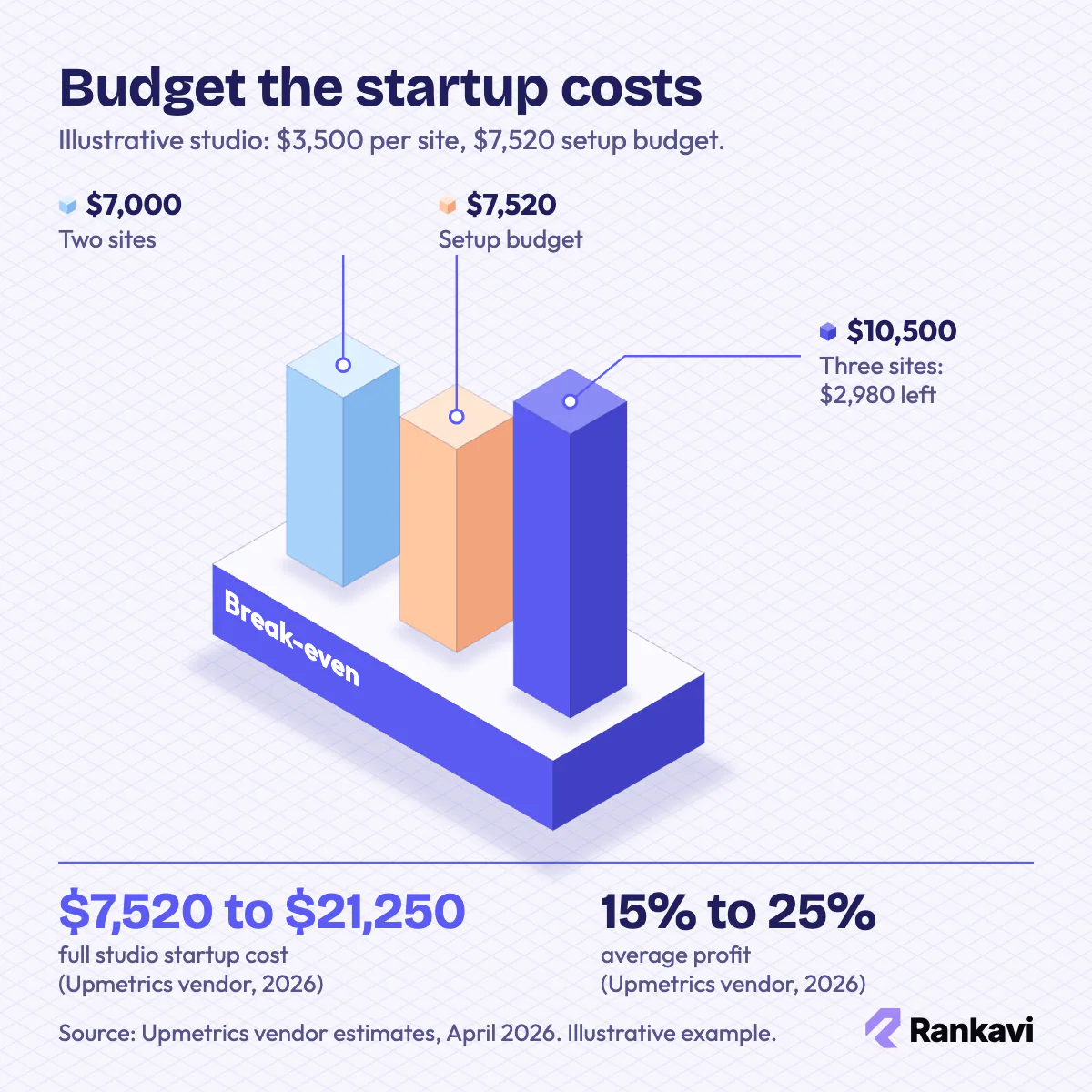
Upmetrics is a business plan software company. Its vendor estimate put full web design startup costs at $7,520 to $21,250 in April 2026. Owners who already own a capable computer start well below that range.
Worked example: An illustrative solo studio spends the low-end $7,520 on its setup. It charges $3,500 per site, inside the common price range above. Two sites bring $7,000, which still leaves the studio short. A third site lifts revenue to $10,500, leaving $2,980 after the setup budget. The third project is the break-even point.
That example counts revenue, not profit. Monthly software, hosting and taxes still reduce what the owner keeps, so the real break-even arrives later. The example is illustrative.
Costs split into two kinds. One-time costs include the computer, logo and registration. Recurring costs include software, hosting, domain renewals, insurance and payment processing fees. Adding the recurring items into a monthly overhead number shows what the studio must cover before it pays the owner.
Several costs are easy to forget. Payment processors take a percentage plus a fixed fee on each payment. Stock assets, fonts and premium plugins add per-project costs. Self-employment tax and quarterly estimated payments mean part of every invoice should be set aside. Many startup costs count as deductible business expenses, so a tax professional can confirm what applies.
Premium plugins, paid ads and extra software seats can wait until the first paying client. A separate business bank account, a contract template, backups and liability coverage should not be cut.
Working capital carries the owner between deposits. Clients often pay in stages, so a cash reserve covers several slow months.
Savings and a day job usually pay for a design studio’s launch, since client income starts slowly. Loans are a backup. The U.S. Small Business Administration (SBA), which backs small business loans, offers microloans up to $50,000 as of 2026, averaging about $13,000.
5. Register and Insure the Business
Registering a web design business protects the owner’s personal assets and gives clients a company to contract with. Many designers start as sole proprietors, then form a limited liability company (LLC).
Studios apply for a free employer identification number (EIN) from the Internal Revenue Service (IRS), which issues federal tax numbers. Clients ask for it on tax forms, so the owner’s Social Security number stays private.
Forming an LLC takes a state filing, a registered agent and often an annual report, and fees vary by state. A short operating agreement and a separate business bank account help keep the liability protection intact. Mixing personal and business money can weaken it. An accountant can advise on tax treatment before a structure is chosen.
An EIN is free from the IRS. Third-party sites that charge for the same number are not needed. The number appears on tax forms clients request.
A written contract protects both sides on every website build. It sets the scope, revision rounds, payment stages and who owns the finished design files.
Other clauses matter on a web build. Final ownership transfers only after the last payment. Fonts, stock images, themes and plugins carry their own licenses. The client is responsible for the content supplied. Hosting and maintenance are excluded unless sold separately. Accessibility duties should also be assigned in writing. A lawyer can review a template once before it is reused.
Errors and omissions (E&O) insurance covers claims that a design mistake cost a client money. A broken checkout or a missed launch date are typical risks for a web studio.
An LLC does not cover the owner’s own professional mistakes, which is the gap E&O insurance fills. Limits, the deductible and exclusions decide what a claim pays. Most policies cover claims made during the policy period, so coverage should stay continuous. Larger clients often ask for a certificate of insurance before signing, so the policy comes before the first signed contract.
6. Set Up Tools and a Client Workflow
A client workflow turns each project into the same repeatable steps from first call to launch. Templates for proposals, contracts and invoices come before the first client.
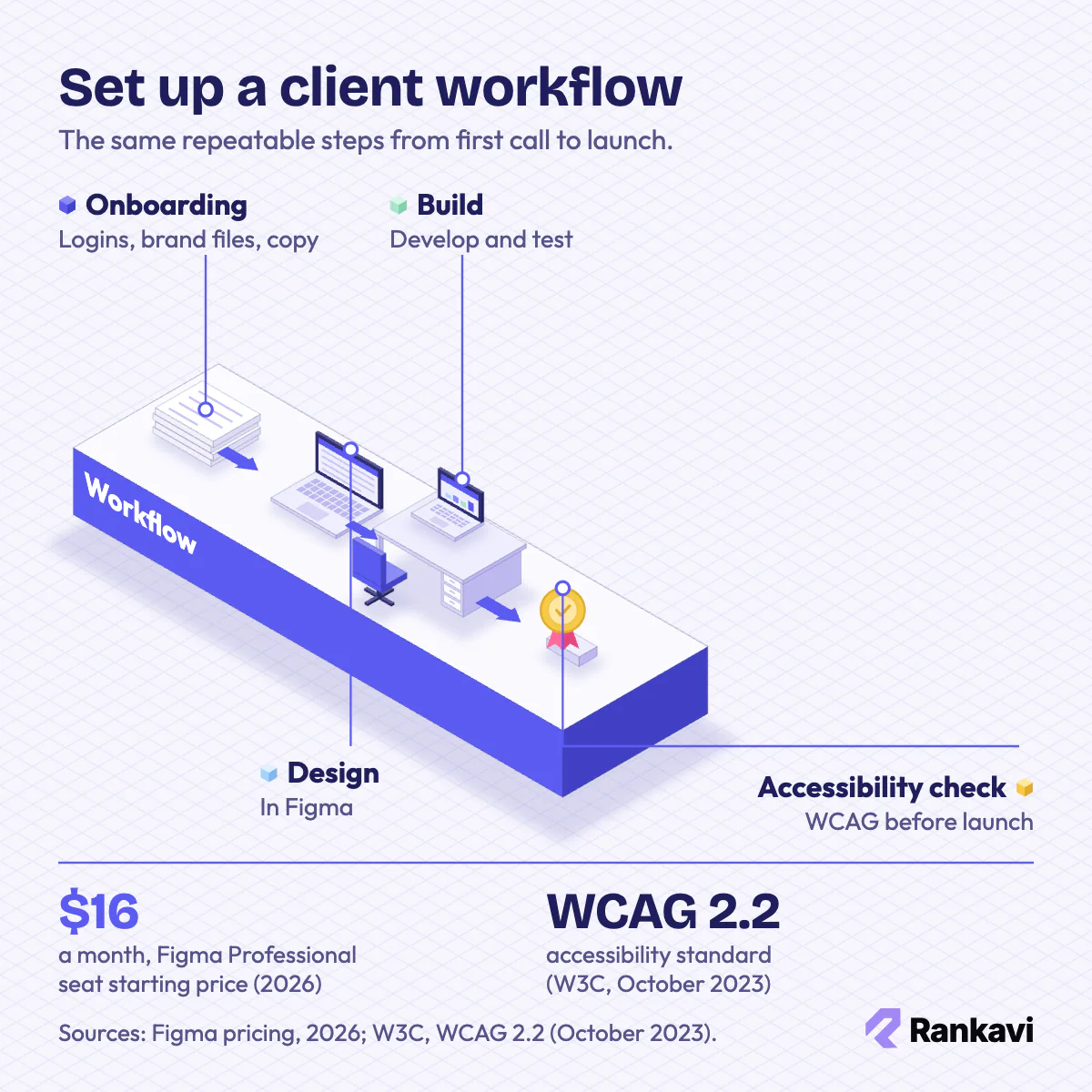
Figma is a browser-based interface design tool. As of 2026, its Professional plan starts from $16 a month per full seat.
Core tools:
| Tool type | Examples |
|---|---|
| Design software | Figma, Adobe Creative Cloud |
| Build platform | WordPress, Webflow, Squarespace |
| Project management | Asana, Trello, Notion |
A typical project runs through research, site structure, content, visual design, development, testing and launch. An onboarding checklist gathers logins, brand files and copy at the start.
Each project follows the same order. A signed contract and deposit come first, then the onboarding checklist. Clients approve the site structure before design starts, and the design before the build. Content deadlines belong in the contract, since late copy delays launches.
A final review round and a launch checklist close the project. After launch, a short handover covers logins, backups and who handles updates.
Accessibility testing comes before every launch. The Web Content Accessibility Guidelines (WCAG) are the accessibility standard published by the World Wide Web Consortium (W3C). Version 2.2 appeared in October 2023.
Public sector clients raise the stakes. The U.S. Department of Justice (DOJ) enforces the Americans with Disabilities Act (ADA). Its 2024 rule requires WCAG 2.1 at the middle conformance level for state and local government websites.
7. Win the First Clients Through Referrals
Referrals earn a new web design studio its first clients through people who already trust the owner. Friends, former employers and local business owners hear about the studio first.
Early outreach often starts before the studio officially opens. In the 2022 Paige Brunton survey, now historical, 61% of designers landed paying clients before launching, and referrals ranked as the top source.
A direct message to former colleagues and local owners works better than a general announcement. It names the niche, shows one sample and asks for an introduction. Local business groups and trade associations put the studio in front of owners who already share the niche’s problems.
Past clients keep sending leads when the studio stays in touch. A check-in after launch can offer a maintenance plan, which keeps the relationship active.
Social media works best on one or two platforms. LinkedIn suits business clients, while Instagram suits visual brands and small shops.
Agencies offer another early income stream. White-label work means building sites that an agency sells under its own name, which fills slow months.
Happy clients become the next referrals. A short testimonial request after launch adds proof to the portfolio.
8. Join ChatGPT’s AI Picks for Web Designers
AI visibility places a web design studio in the answers business owners get from AI assistants. Owners now ask ChatGPT, Gemini and Perplexity which designer to hire for a new site.
Those assistants repeat what trusted pages say. Design directories, review sites and “best web designers” roundups shape which studios appear in their answers.
Rankavi is a software as a service (SaaS) platform that publishes brand mentions in articles on indexed third-party websites. A new studio can earn mentions in articles ChatGPT can cite when owners compare designers.