

Starting a vending machine business means buying machines, placing them at busy host sites and restocking them on a route. The National Automatic Merchandising Association (NAMA) is the U.S. vending trade association. Its foundation reported 8.1% yearly growth for convenience services since 2023 in a 2026 census.
My name is Michal Sieroslawski, and I work on helping vending machine businesses get found online. Chat-based search is changing how location owners find vending machine businesses. A mention in those replies can bring in customers before any ad does.
The order mirrors real routes. A signed host site comes before spending, and machines arrive only after permits clear. Each of the twelve steps below builds on the last, from vending machine idea to first paying customer.
- Choose Your Vending Machine Type
- Research Local Demand
- Write a Simple Business Plan
- Register the Business
- Secure High-Traffic Locations
- Fund the Startup Costs
- Get Vending Licenses and Permits
- Insure the Machines
- Buy Machines and Stock Products
- Service Your Route
- Grow the Route
- Show Up When Property Managers Ask AI
1. Choose Your Vending Machine Type
Choosing a vending niche means deciding what the machines will sell and to whom. That choice sets the equipment, the permits and the locations a vending business can use.
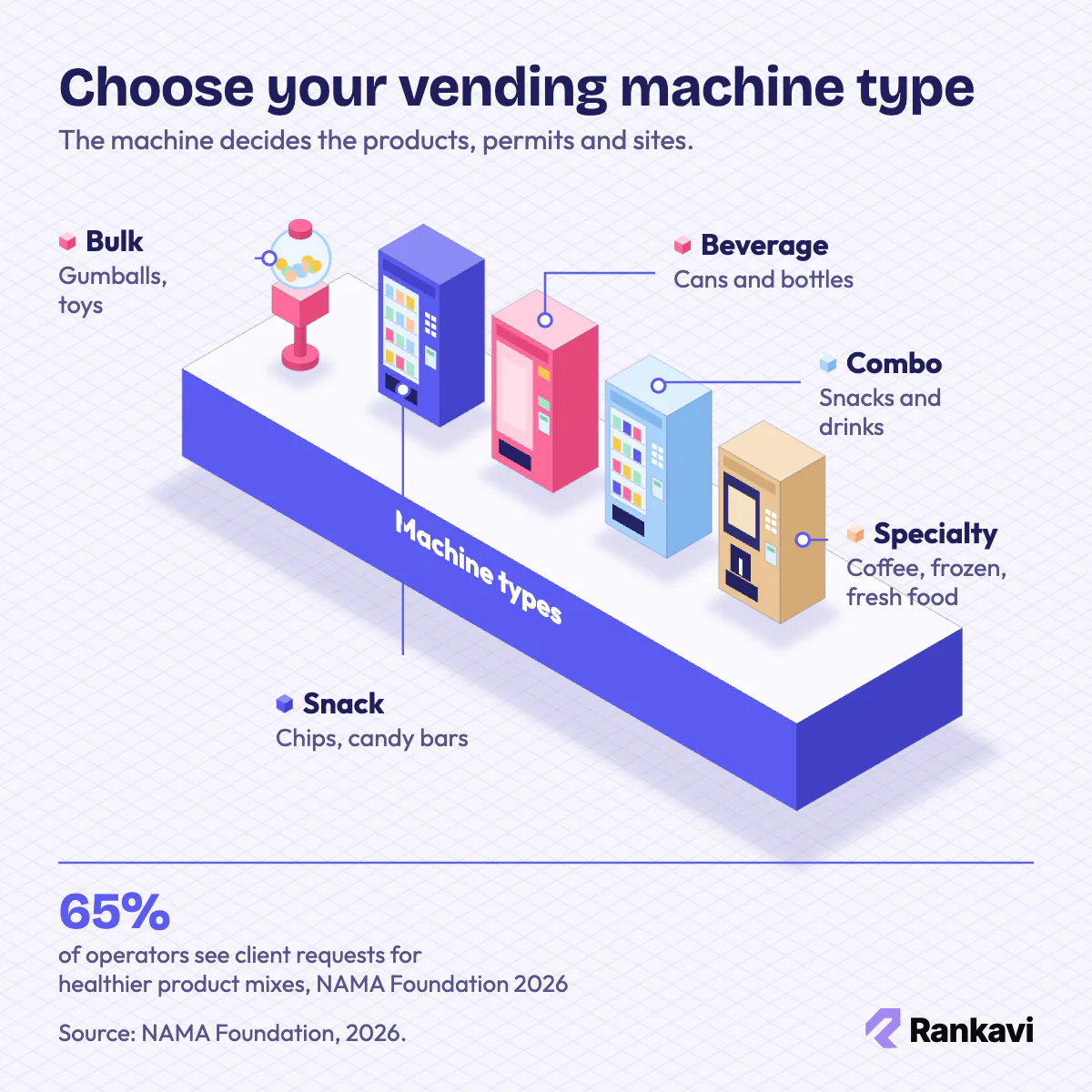
Vending machines come in five common types:
- Bulk machines: These sell gumballs, candy and capsule toys. They work mechanically and need no outlet, so they fit almost any counter.
- Snack machines: These hold chips, candy bars and crackers. They need an electrical outlet nearby.
- Beverage machines: These sell canned and bottled drinks. They need an electrical outlet nearby too.
- Combo machines: These hold snacks and drinks together in one cabinet. They also need an outlet.
- Specialty machines: These serve coffee, frozen treats or fresh food. Coffee and refrigerated units need an electrical outlet nearby.
Power needs narrow the choice further. A machine with no outlet within reach simply cannot run there.
Product category matters as much as the machine itself. Packaged snacks and sealed drinks are the simplest category to run. Fresh, frozen and hot food must stay at a safe temperature, which adds temperature rules and health permits.
Fresh food also carries a waste risk that packaged snacks avoid. Sandwiches and salads that miss their date get thrown out, while chips and candy bars keep far longer.
A machine is not the only way to sell food and drinks at a site. A micro market is the main alternative. It uses open shelves and coolers with a self-checkout kiosk in a large breakroom. 365 Retail Markets is a company that makes such kiosks and software for corporate offices and factory breakrooms.
The product mix also decides which buyers a machine can win. Specialty niches give a new operator room to stand apart. Healthy vending, breakfast items and diet-specific products serve buyers that soda machines ignore. The NAMA Foundation reported in 2026 that 65% of operators see client requests for healthier product mixes.
Demand like that still shows up site by site, so the niche should match the people at the site. A gym crowd wants protein and hydration. An office crowd wants convenience and variety.
No niche makes the work hands-off, since every machine still needs service.
“It’s not passive at all, machines frequently need to be fixed and filled.”
— A Reddit user in the r/passive_income community
2. Research Local Demand
Before any machine is bought, market research involves measuring who will buy from it and how often they pass it. Demand research keeps a vending company from buying equipment for sites that never sell.
The NAMA Foundation estimated U.S. convenience services revenue at $31.1 billion for 2025 in its March 2026 census.
New operators study the demographics and buying habits of an area first. Students, shift workers, office staff and gym members each want different products at different hours.
Demand also shifts with the calendar. Schools and colleges empty out in summer. A busy campus site in October can sell little in July.
Three sources show who passes a site and when:
- American Community Survey (ACS): This free Census Bureau survey reports population, age and income for ZIP Code areas on data.census.gov.
- Google Maps Popular times: This graph shows how busy a listed place usually is at each hour of the day. It works as a quick check on a specific address before any visit.
- Foot traffic counts: An owner visits a site at several times of day and counts passersby. Busy entrances, break rooms and waiting areas move the most product.
A steady crowd still is not enough if someone already serves it. Many regions have established vending companies. Sites with no machine, or with a neglected one, offer the best opening for a newcomer.
An existing machine tells its own story. Empty slots point to fast sales. Faded, dusty packaging points to slow sales or little service.
3. Write a Simple Business Plan
A business plan sets out the route’s goals, budget and revenue targets on paper. Even a short plan guides later choices about machines and locations.
A vending plan usually covers six sections:
| Section | What it covers |
|---|---|
| Executive summary | The business idea and its goals |
| Business description | Machine types, products and service area |
| Market analysis | Target customers and local demand |
| Competition | Other operators near the target sites |
| Operations | Restocking, maintenance and route schedule |
| Financial projections | Expected sales, costs and break-even point |
The last section, financial projections, covers the break-even point. Break-even is the point where sales cover all costs. Dividing fixed costs by the profit on each item shows how many items must sell to reach it.
Those figures matter to readers outside the business as well. Banks and lenders usually ask for a plan before they approve a loan. The plan also shows property owners that the operator takes the placement seriously.
A vending plan does not need dozens of pages. Intended locations, a startup budget and revenue targets cover the essentials for a first route.
The U.S. Small Business Administration (SBA) describes two plan formats. A traditional plan is detailed and comprehensive. A lean startup plan is fast to write and holds only key elements.
Help with either format costs nothing. The Service Corps of Retired Executives (SCORE) is an SBA-backed nonprofit. It offers free mentors and a free business plan template.
4. Register the Business
Registering a vending company gives it a legal identity separate from its owner. Most route operators choose a limited liability company (LLC), and a few start as sole proprietors.
Liability is what decides between the two. Machines stand in lobbies and break rooms, so a tipped unit or a spoiled sandwich lands on the business. An LLC keeps those claims away from the owner’s home and savings.
Getting that separate identity on the record takes paperwork, and each piece serves a different purpose. Registering the business breaks down into five filings and accounts:
- Articles of organization: Forming an LLC starts with this filing, a short document describing the company. It goes to the state, usually the Secretary of State.
- Registered agent: The LLC also names a registered agent. The agent receives official papers and legal documents for the business.
- Employer identification number (EIN): An EIN comes free online from the Internal Revenue Service (IRS), which issues it within minutes. State tax offices and location contracts ask for it, because commission checks go to a named business. Under the North American Industry Classification System (NAICS) 2022, a federal system that sorts businesses by industry, vending machine operators use code 445132 on such forms.
- Business bank account: A separate business bank account follows the EIN. Coins and card deposits from many sites need clean records.
- Doing business as (DBA) name: Owners trading under a brand name file a DBA name. That filing often goes to the county clerk.
Those steps settle the legal form, but the tax treatment can shift later. As profit grows, an LLC can file IRS Form 2553 to elect taxation as an S corporation.
5. Secure High-Traffic Locations
Location selection decides how much a vending machine sells. Experienced operators sign the host site before they buy the machine, because an unplaced machine earns nothing.
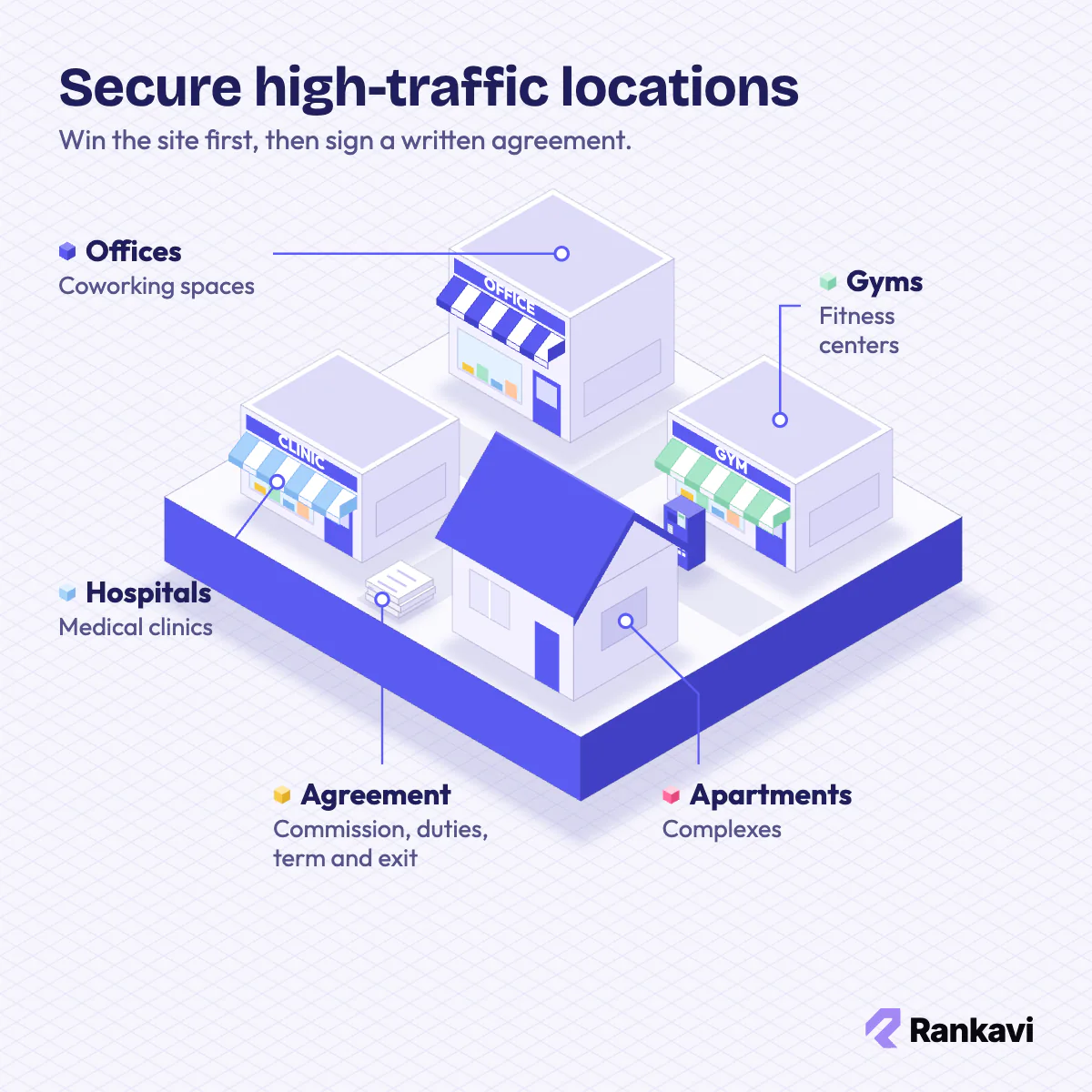
Six kinds of sites make strong vending hosts:
- Office buildings and coworking spaces
- Gyms and fitness centers
- Hospitals and medical clinics
- Colleges and universities
- Apartment complexes
- Gas stations and car washes
Monthly sales per machine is the number to check first. LegalZoom, a legal-services company, estimated the average vending machine at about $300 in monthly revenue in 2024. A site that cannot beat that figure rarely repays a new machine.
Host payment is the second number to check. Host deals take three forms:
- Commission: The host takes a share of what the machine sells. LegalZoom reported in 2024 that property owners take 5% to 25% of monthly machine revenue. Higher commissions only make sense where foot traffic is far above average.
- Flat monthly rent: The host charges the same amount every month, whatever the machine sells.
- No payment: Some hosts take nothing at all.
A commission drops when sales drop, while a flat rent costs the same in a slow month.
No structure gets agreed to without the person who controls the space, so that is where the pitch goes. In an office that is usually a facility manager, in an apartment complex a property manager, and in a gym the owner. Pitches work best as a free amenity for staff or customers.
Interest from that person still does not prove the space fits a machine, so a walkthrough comes before any signature. The operator checks for a nearby outlet, floor space, a clear delivery path and the hours when restocking is allowed.
Placement must also follow the 2010 Standards for Accessible Design under the Americans with Disabilities Act (ADA). They require at least one machine of each type to keep its controls within a 48-inch high reach.
Once the space works, the terms belong on paper. A written location agreement records the commission, service duties, liability, contract length and exit terms. An exclusivity clause keeps rival machines out of the site, and a notice period sets how ending the deal works.
Not every new owner wants to make these pitches alone. Some pay locators, firms that find host sites on an operator’s behalf. Locators charge placement fees, and some promise sites that never perform, so operators check references first.
6. Fund the Startup Costs
Startup funding covers the machines, stock and fees a route needs before it earns. Signed locations come first, so the budget matches a known number of machines.
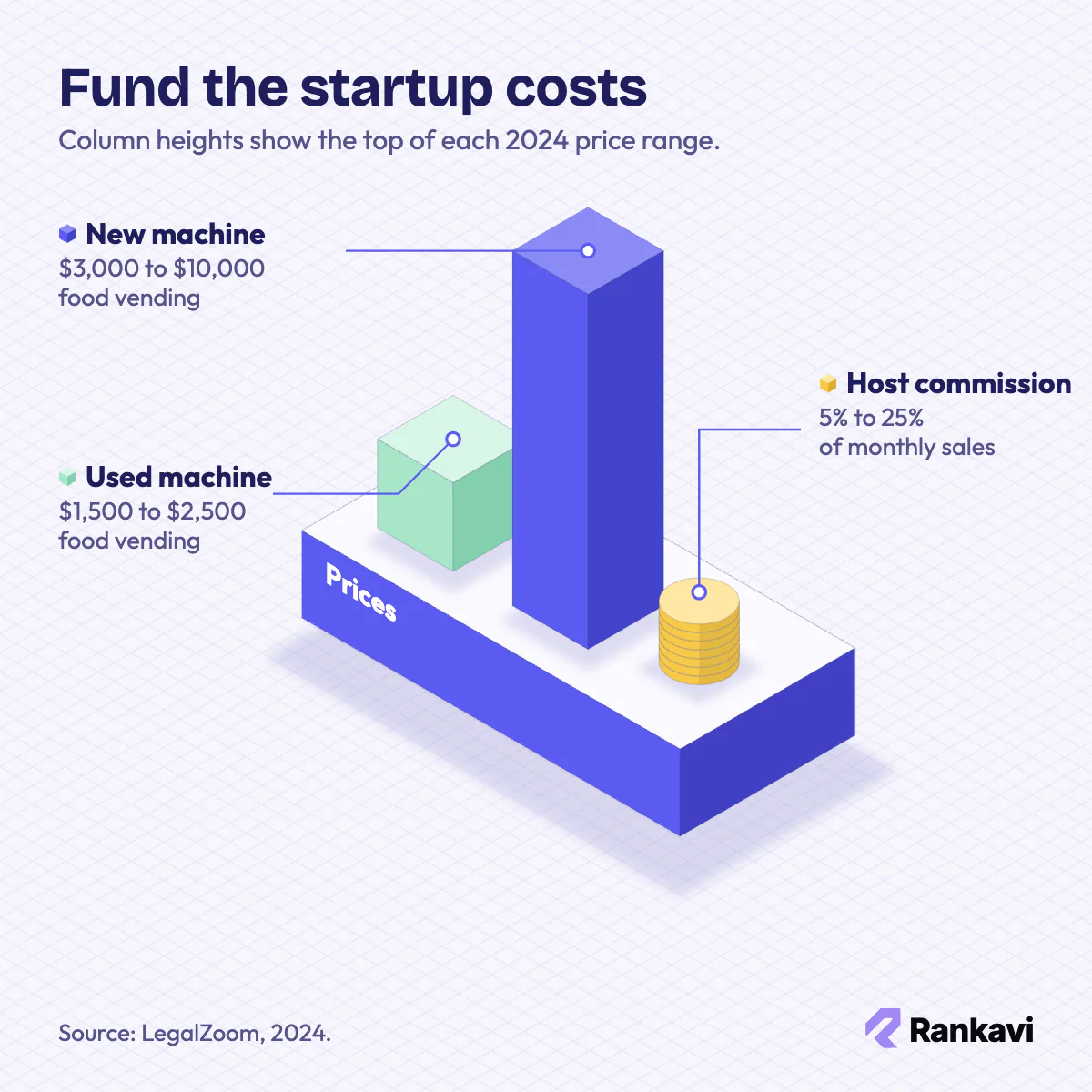
Startup money at a glance:
| Item | Typical figure |
|---|---|
| Startup cost | $2,000 to $10,000 for one machine; $10,000 to $50,000 or more for several |
| Main costs | Machines ($1,500 to $2,500 used, $3,000 to $10,000 new), first stock ($200 to $300 per snack machine), host commission (5% to 25% of sales), insurance, card readers |
| Typical margin | 15% to 30% net profit; some top owners report over 50% |
| Time to open | Varies; set mainly by how fast a host signs and permits clear |
Sources: LegalZoom (a legal-services company), September 2024 estimates.
Machine choice drives the total. A refurbished snack unit keeps the first purchase small, while a new refrigerated fresh-food machine multiplies it.
Owners cover that bill in six main ways:
- Cash: Founders can pay for machines out of savings. Buying with cash keeps a slow first site from turning into debt.
- Equipment financing: The machine is purchased on credit instead of with savings.
- Leasing: Leasing a machine keeps cash free for stock and permits. The lease payments continue, though, even when a site sells slowly.
- SBA microloans: These loans are capped at $50,000 as of 2026. The SBA, the federal Small Business Administration, runs that program through nonprofit lenders.
- Kiva: Kiva, a nonprofit lending platform, offers U.S. loans of $1,000 to $15,000 at 0% interest with no fees, as of 2026.
- SBA 7(a) loan: Larger routes can use an SBA 7(a) loan. It covers equipment, supplies and working capital.
Tax rules soften the cost of buying. Section 179 of the tax code lets a business deduct part or all of a machine’s cost in year one.
Machines and stock are not the whole budget. A cash reserve for repairs belongs in it too, because a broken machine earns nothing until it is fixed.
Worked example: An illustrative route has three used snack machines at $2,000 each. Adding $250 of stock apiece makes $6,750 to start. At $300 a month per machine, the route grosses $900. A 20% net margin, after commission and product cost, leaves about $180 a month. Payback takes roughly 38 months, before interest, owner pay and taxes. Doubling sales per machine halves that wait.
That is why placement matters more than machine price.
“If you cannot buy your vending machine with cash — you’re not ready.”
— A commenter on a YouTube vending startup video
7. Get Vending Licenses and Permits
Vending permits determine where and what an operator may legally sell. Three levels of government write those rules: the state, the county and the city. The rules also change with the product inside the machine. An operator whose route crosses several towns may need a business license in each one.
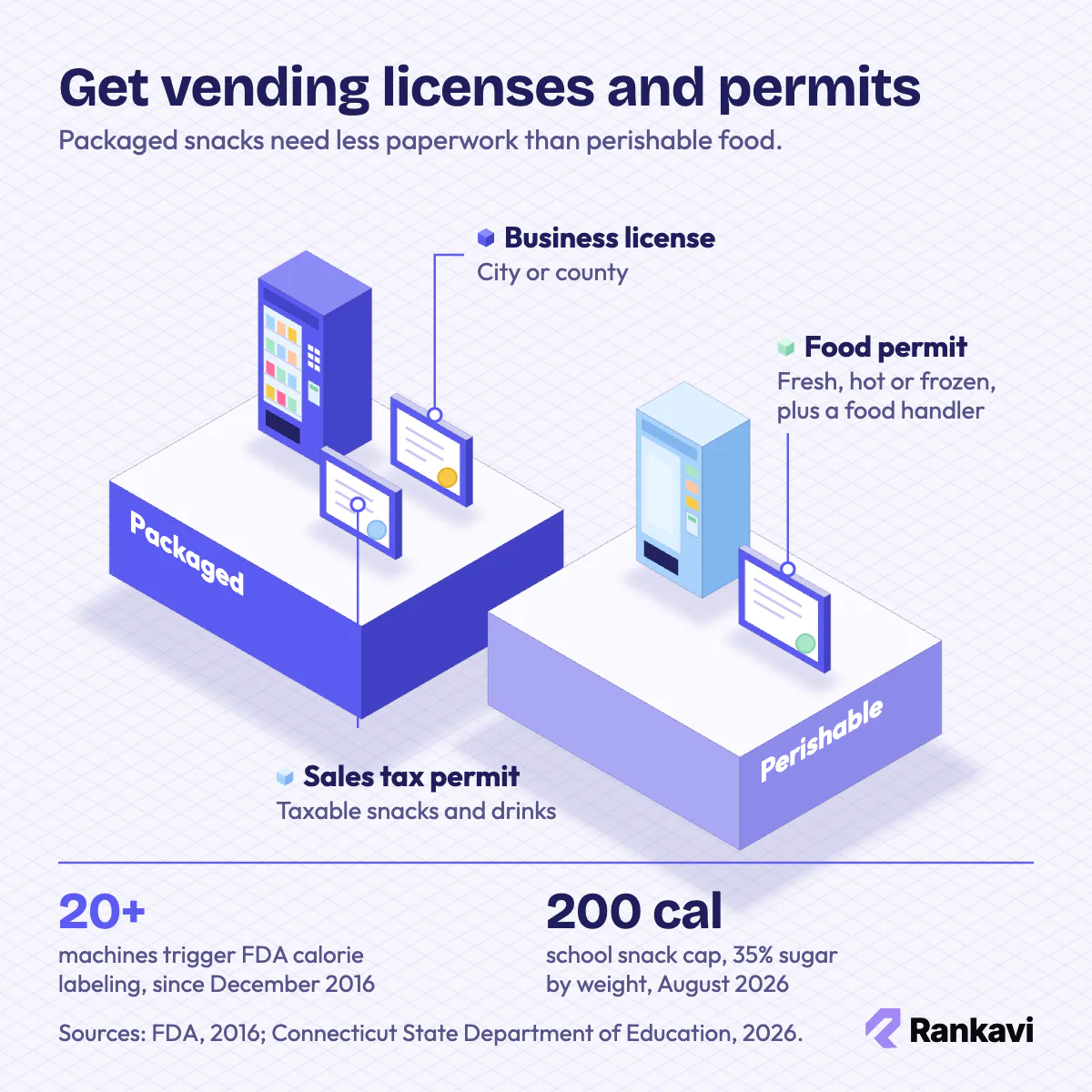
Common licenses and permits:
| Permit | When it applies |
|---|---|
| General business license | Most cities and counties |
| Sales tax permit | Machines selling taxable snacks and drinks |
| Per-machine license or decal | Some states, counties and cities |
| Food establishment permit | Fresh, hot, refrigerated or frozen food |
| Food handler certificate | Operators of perishable food machines |
The sales tax permit in that table deserves a closer look. Snacks and drinks sold from machines are generally taxable. The operator therefore registers with the state tax agency and files returns on a set schedule.
Texas shows how that duty plays out town by town. The Texas Comptroller of Public Accounts, which runs state sales tax, treats vending operators as itinerant vendors. That term covers sellers who move from place to place. Because of it, operators collect local sales tax wherever each machine stands.
The food permits in the table depend on what sits inside the machine. Packaged snacks and sealed drinks rarely need a health permit. Fresh, hot and frozen items do, plus a certified food handler. ServSafe, a food safety training program from the National Restaurant Association, offers a widely recognized food handler certificate.
State and local permits cover the basics of a route. Certain products and certain buildings add federal rules on top of them. Four of those federal rules reach vending machines:
- Calorie labeling: The U.S. Food and Drug Administration (FDA) regulates food labels. Since December 2016, it has required calorie disclosure from operators with 20 or more machines. That threshold means large fleets carry the rule and small ones do not.
- Tobacco machines: Tobacco faces tighter limits than snacks. FDA rules allow cigarette and smokeless tobacco machines only where no one under 21 is present or allowed to enter.
- School machines: These follow Smart Snacks in School, set by the U.S. Department of Agriculture (USDA). The USDA runs school nutrition programs. A Connecticut State Department of Education summary, revised in August 2026, caps snack items at 200 calories and 35% sugar by weight.
- Federal buildings: The Randolph-Sheppard Act is a federal law for vending on federal property. It gives licensed blind vendors priority to run vending facilities there, including machines.
8. Insure the Machines
For a vending route, business insurance protects the operator when a machine or product causes harm. Coverage also satisfies the hosts who let machines onto their property.
A route owner may carry five kinds of coverage:
- General liability insurance: Covers injuries and property damage linked to the business. A customer hurt by a tipping machine is a typical claim.
- Product liability coverage: Adds further protection beyond the general liability policy, tied to the items sold from the machines.
- Property coverage: Adds further protection for the operator’s own property.
- Commercial vehicle insurance: Covers the van or truck used on the route.
- Workers’ compensation: Applies once the route hires a helper. The SBA lists it as required for every business with employees.
The last two coverages depend on whether the route uses a work vehicle and hires help.
These policies do not have to be bought one at a time. A business owner’s policy (BOP) bundles the typical coverages into one package. The SBA says a bundle can simplify buying and save money.
Property owners often ask for proof of liability coverage before placement. Hospitals and large sites may require higher limits than an office or a gas station. The proof is a certificate of insurance, a document that lists what the policy covers. Some hosts also ask to be named as an additional insured.
Harm to customers is only one risk at a location. Machines also face accidents and vandalism. A forklift crash or a break-in can destroy a unit. For that reason, the location agreement should state who pays for damage.
9. Buy Machines and Stock Products
Buying equipment turns the plan into working machines on the route. The purchase includes the machines, payment hardware and the first load of products. Each of those three parts carries its own decision, and the machines come first.
New machines offer warranties and current technology. Used machines cost less but may need repairs. Many first-time operators mix both. An operator who wants new units can buy straight from the makers. Seaga is a vending machine manufacturer in Freeport, Illinois, and it also owns Automated Merchandising Systems (AMS).
Payment hardware is the second part of the purchase. Most customers now pay by card or phone. That is why cashless payment belongs in every machine from the start.
The same card reader can also save the operator a trip. Remote monitoring hardware reports sales and stock levels without a site visit. Nayax is a provider of card readers with built-in telemetry. The reader sends that sales data on its own. Cantaloupe offers similar readers, and those feed sales into its Seed platform.
Knowing which machines and readers to buy still leaves the question of whom to buy them from. Supplier choice needs care. Some sellers overprice machines or bundle them with weak locations. Buyers guard against this by comparing several suppliers and inspecting used units in person. That check covers three parts:
- The cooling unit: This is the part that keeps the inside of the machine cold.
- The coin mechanism: This is the part that takes coins and returns change.
- The bill validator: This is the part that reads paper money and checks it is real.
Inspection catches a bad machine. Federal rules also give buyers some protection against a bad seller. The Business Opportunity Rule is a Federal Trade Commission (FTC) rule for sellers who promise locations along with machines. Such a seller must give a one-page disclosure document seven days before the buyer signs or pays.
Once the machines are set, they need something to sell. Products come from wholesale clubs such as Sam’s Club and from distributors. Vistar is a Performance Food Group division that delivers snacks and drinks to vending operators. The operator buys at wholesale and sells at retail. LegalZoom put the cost of fully stocking a basic snack machine at $200 to $300 in 2024.
10. Service Your Route
On a working route, regular service keeps every machine stocked, clean and working. Regular visits protect sales and the relationship with each host.
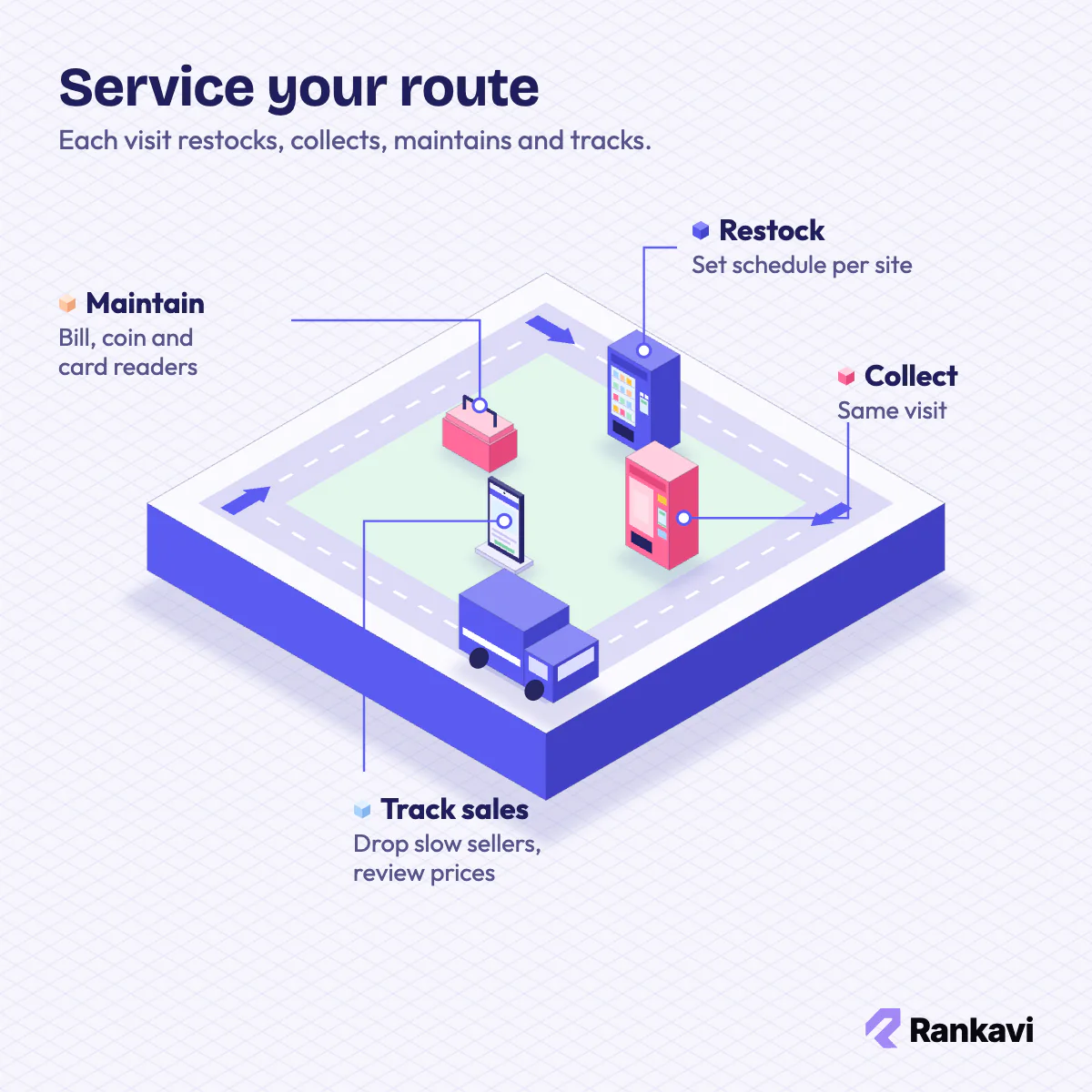
Everything a machine needs gets done in a single stop. A service visit covers four tasks:
- Restocking: Each operator sets a restocking schedule for every site.
- Cash collection: Cash comes out of the machine on the same visit.
- Cleaning: The machine gets wiped down on that same stop.
- Product rotation: Rotation follows first in, first out. Older stock moves to the front so it sells first.
How often those stops come due depends on the account.
“A decent account usually will have to be serviced at least twice a week. Some will need every day.”
— A former vending route worker on the Grassroots Motorsports forum
Preventive maintenance stops small faults from becoming lost sales. Technicians test the bill and coin acceptors, the card reader and the spiral coils. A van kit of common spare parts lets a technician fix most faults on the first visit.
Each visit also produces numbers, and those numbers decide what goes back in the machine. Sales data guides the product mix. Data Exchange (DEX) is the vending standard that records cash, product movement and audit data for download. Slow sellers leave the machine, and best sellers get more slots. Price reviews follow changes in wholesale costs.
Machines that hold cold food carry one more routine. Refrigerated and frozen machines need daily temperature records. Health inspectors expect to see those logs during an inspection. The FDA Food Code is the model that local health rules build on. It sets 41°F or below for cold holding.
11. Grow the Route
Once sites prove themselves, growth involves adding machines, products and upgrades on that base. Each new unit repeats a tested setup, which is why the vending model scales well.
That repetition can go in several directions at once. A growing route has four main levers:
- More machines: Operators add units in warehouses, industrial parks and universities.
- New products: Operators rotate new items around a core of best sellers.
- Machine upgrades: Older machines get touchless payment.
- A niche: Operators add a focus such as healthy or breakfast vending.
Adding machines raises a question of where to put them. New sites near existing ones keep the route tight, so one trip restocks more machines with less driving. Buying an existing route from another operator is a faster path, since its machines already have sites and sales history.
Simple signage tells building occupants about the machines. Good relationships with property managers lead to referrals and extra sites.
Each of these steps costs money, and reinvested profit funds the expansion. Operators review results first, then buy the next machine for the next proven location. Growth also runs into a limit on time. At some point one person cannot service every stop, and the first hire adds payroll and insurance costs.
The NAMA Show is the yearly trade show of the National Automatic Merchandising Association for vending and micro markets. Equipment makers and product suppliers exhibit there side by side.
12. Show Up When Property Managers Ask AI
AI visibility means a vending company being named when a property manager asks an assistant like Claude for one. Assistants build those answers from pages they already trust, such as local directories, review sites and regional business roundups. The same question may go to ChatGPT, Gemini or Perplexity instead.
Since the answer comes from those pages, a company needs to appear on them. Google Business Profile, Yelp and the Better Business Bureau are examples of such directories and review sites. The company name, phone number and service area should read the same on each one.
A route owner who gets listed on those pages early gives the assistant something concrete to cite. Each independent page naming the company and its service area makes a recommendation to a site manager more likely.
Articles are another kind of page an assistant can cite. For a route owner, Rankavi gets the company named in articles on real, indexed sites, from $12 per article. Facility managers increasingly ask Claude for local vendors, and Claude mentions on trusted pages help it answer with a name.