

Starting a tutoring business takes subject expertise, a clear student group and a simple way to book and collect payment. Most tutors begin from home or online with a laptop. The U.S. Bureau of Labor Statistics (BLS), which publishes federal job data, counted 175,070 employed tutors in May 2025.
My name is Michal Sieroslawski. I help tutoring businesses appear when parents search online. Many parents now begin their search for a tutoring business inside an AI chat. Being one of the names those tools mention is becoming important.
The order settles subjects and prices before any money goes into filings or tools. A tutoring business then opens with policies in place before the first parent calls. Below are the seven steps, in the order most tutoring founders take them.
- Choose Your Tutoring Subjects and Students
- Price Your Tutoring Sessions
- Fund a Low-Cost Tutoring Launch
- Register, Screen and Insure the Business
- Set Up Scheduling, Payments and Policies
- Find Your First Tutoring Clients
- Surface When Parents Ask AI About Tutors
1. Choose Your Tutoring Subjects and Students
A tutoring niche is the subject, grade band and goal the business serves. “High school chemistry for exam season” sells better than “general tutoring”.
Subject choice starts with deep knowledge. Tutors usually pick the subjects from their degree, teaching license or working life.
One narrow niche usually sells better than many subjects. A second subject makes sense once the first has a steady roster.
Students come with different goals, and each goal changes the service. Grade recovery needs weekly sessions through the school year, while test prep follows a fixed program toward an exam date.
Student age shapes the whole service. Elementary learners need patience and games, while high school students need exam skills and advanced subject depth. Parents buy for children, while college and adult learners buy for themselves, so the message and the booking process differ.
Demand is seasonal. Test prep rises before exam dates, and homework help rises after school starts. A niche works best when its busy season matches the months the tutor has free hours.
Local demand decides whether a niche can pay. Competitor tutors’ websites, parent groups and school calendars show which subjects are crowded and which are missing.
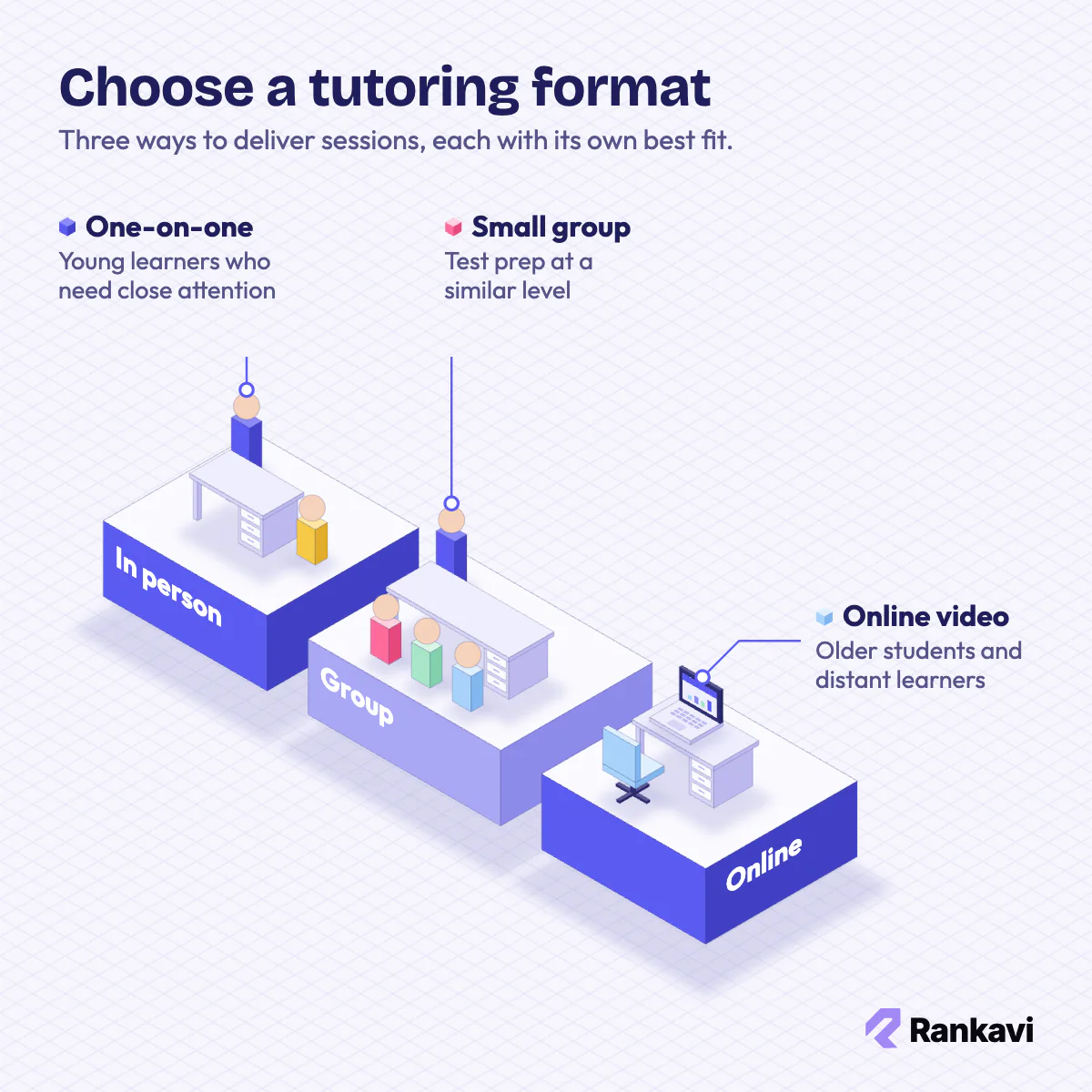
Session format is the next choice. In-person lessons need a safe setting, such as a shared room with other people nearby. Travel time limits how many sessions fit in a day:
| Format | Best fit |
|---|---|
| One-on-one in person | Young learners and students who need close attention |
| Small group | Test prep classes with students at a similar level |
| Online video | Older students and learners outside the local area |
A one-page plan ties these choices together. It lists the niche, the price, the income goal and the weekly hours needed to reach it. Counting how many students those hours support shows whether the local market is large enough.
2. Price Your Tutoring Sessions
Pricing a tutoring business sets an hourly rate that covers preparation time, travel and taxes. Session time is only part of the working day.
A simple formula sets the floor. Desired annual income plus business costs plus taxes, divided by billable hours, gives the minimum hourly rate. Billable hours cover only taught time, while preparation, messaging and travel add unpaid hours.
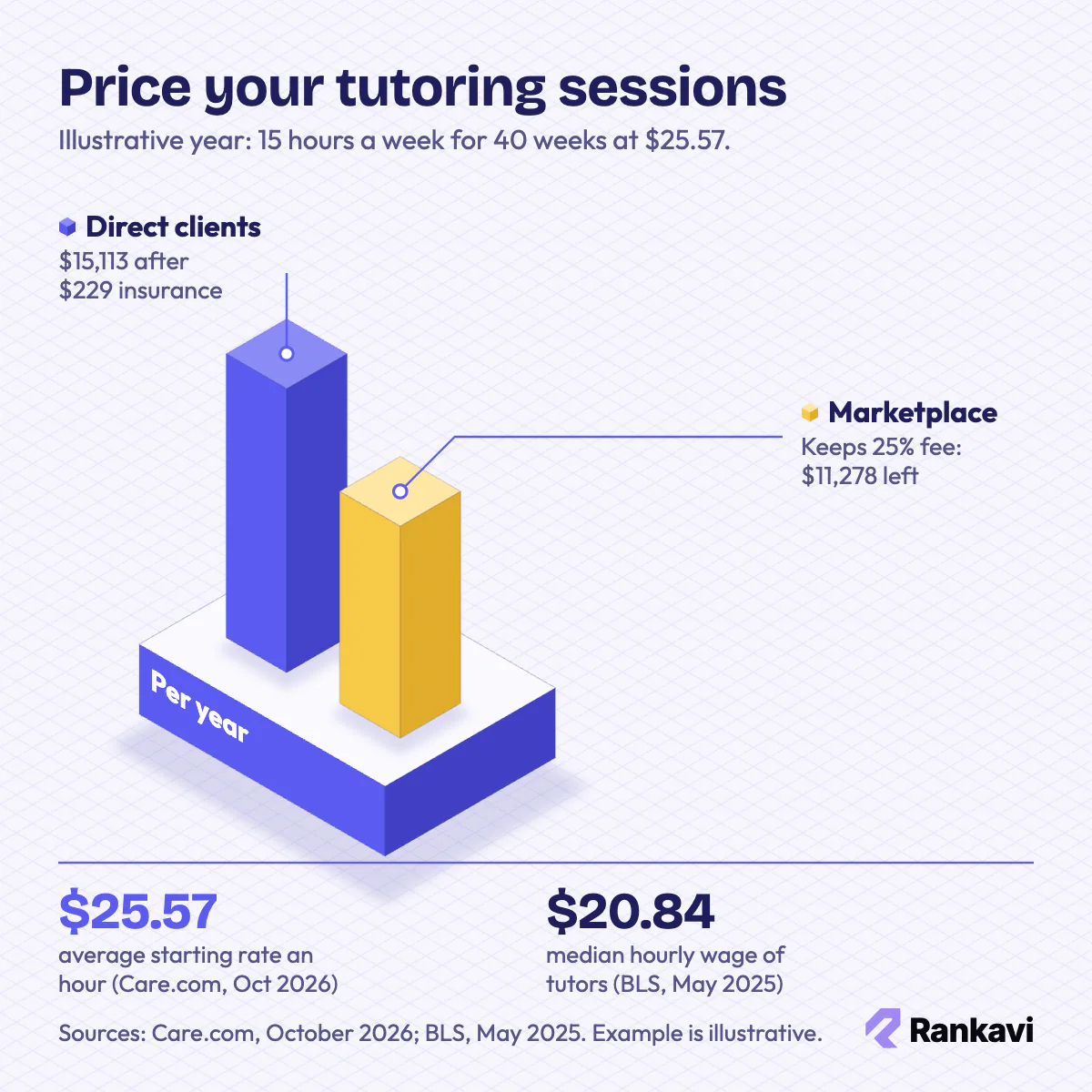
Care.com is an online marketplace where families hire caregivers and private tutors. Its data put the national average starting rate for a private tutor at $25.57 an hour in October 2026.
Employed tutors earn less, which gives a useful floor. The BLS reported a median hourly wage of $20.84 for tutors in May 2025. That wage excludes self-employment costs, so it works as a floor and not as a match for a freelancer’s rate.
The Care.com figure is a starting rate, so tutors with strong credentials can charge more. Three factors move the rate: subject difficulty, the tutor’s credentials and local living costs. A certified teacher with exam results charges more than a college student.
Example: An illustrative tutor works 15 hours a week for 40 weeks, booked directly or through a marketplace.
| Item | Direct clients | Through a marketplace |
|---|---|---|
| Average starting rate per hour | $25.57 | $25.57 |
| Share the tutor keeps | 100% | 75% |
| Kept per hour | $25.57 | $19.18 |
| Income kept over 600 hours | $15,342 | $11,507 |
| After $229 yearly insurance | $15,113 | $11,278 |
A marketplace trades a share of each fee for a steady flow of students. Direct clients keep the full rate but need the tutor’s own marketing.
Small-group sessions charge a lower rate per student, but total earnings per hour can be higher. Rates usually rise when the schedule is full or after a new credential, and existing families get advance notice.
Packages smooth cash flow. A block of prepaid sessions keeps students coming back. A monthly plan with fixed weekly slots pays the tutor in advance.
Standardized test preparation commands higher rates than homework help. Parents pay more for a clear goal such as a target score on a college admission test.
“You can’t make a decent living that way, and these people are guaranteed to brag about their special prices and make your other local customers feel bad. Set a fee and stick to it.”
— A private tutor on the LD OnLine forum
3. Fund a Low-Cost Tutoring Launch
Funding a tutoring startup covers equipment, insurance, registration and early marketing before the first fees arrive. No storefront or stock is needed.
Startup money at a glance:
| Item | Figure |
|---|---|
| Startup cost | $2,000 to $5,000 for a home-based or online launch; $5,000 to $10,000 with an office and extra tutors |
| Main costs | Laptop and webcam, liability insurance, background check, website, local marketing |
| Typical margin | 45.82% gross and 8.79% net for listed U.S. education companies (a proxy, not solo tutors) |
| Time to open | A few weeks for most solo tutors; state filing times vary and no published average exists |
Source: Simply Business, a small business insurance marketplace (vendor estimate, December 2023); Aswath Damodaran, New York University Stern School of Business, margins by sector (January 2026, proxy).
Most tutors fund the launch from personal savings. A small cash reserve also covers the slow weeks around school holidays. Prepaid lesson packages also bring cash in before the costs arrive.
Break-even equals the startup cost divided by net income per hour taught. That shows how many paid hours repay the launch. The higher cost tier adds tutors, which brings payroll or contractor rules that vary by state.
Equipment needs stay modest. A reliable laptop with a webcam, stable internet and a headset microphone cover online lessons. A whiteboard, workbooks and practice tests complete the teaching kit.
Taxes need a plan from the first session. Net earnings of $400 or more in 2026 trigger self-employment tax at 15.3%. The Internal Revenue Service (IRS) sets and collects federal taxes.
Quarterly payments follow from that rule. In 2026, the IRS expects estimated tax payments from owners who expect to owe $1,000 or more.
Business costs lower the tax bill. Mileage to students’ homes, teaching materials and a share of phone and internet costs are common deductions.
4. Register, Screen and Insure the Business
Registering a tutoring business protects the owner and shows parents the service is legitimate. Many tutors start as sole proprietors, while others form a limited liability company (LLC) for liability protection.
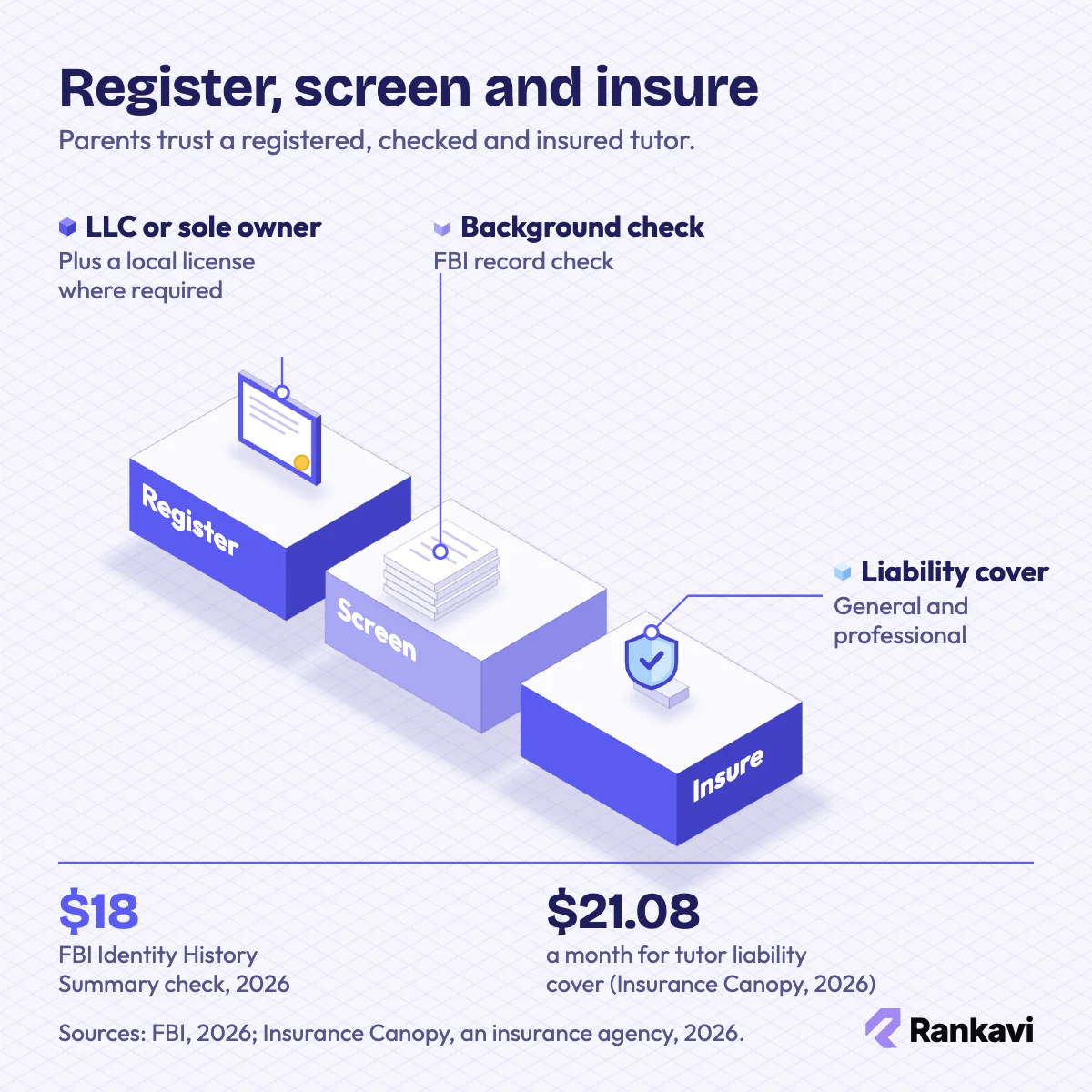
A limited liability company separates personal assets from business debts. A sole proprietorship costs less to set up but leaves personal assets exposed.
Private tutors need no teaching license in most states. A city or county business license may still apply, and home-based tutors may need a home occupation permit.
A trade name that differs from the owner’s legal name usually needs a doing business as (DBA) filing. A separate bank account and an employer identification number (EIN) keep tutoring money apart.
Background checks matter more in this trade than in most. The Federal Bureau of Investigation (FBI) runs the national criminal records system. It charged $18 for an Identity History Summary check in 2026.
The National Tutoring Association, a U.S. nonprofit that certifies tutors, offers an optional credential. National Tutoring Association certification requires membership, training webinars, logged tutoring hours and a background check.
General and professional liability form the usual tutor policy. Insurance Canopy, an insurance agency, listed that cover from $21.08 a month or $229 a year in 2026.
“In general, the kitchen/dining table, with other people around, is the best location; you don’t want to be in a closed room alone especially with a disturbed adolescent”
— A private tutor on the LD OnLine forum
5. Set Up Scheduling, Payments and Policies
A written tutoring policy keeps cancellations, late payments and scheduling disputes from eating into paid hours. Parents sign it before the first session. Policies work best when applied the same way to every family.
The policy usually covers four points:
- Cancellation window: how much notice a family gives before a missed session is still billed.
- Payment timing: whether sessions are paid in advance, weekly or monthly.
- Session length: the standard lesson time and any travel charge.
- Communication: how and when parents receive progress updates.
A trial lesson lets the family and the tutor test the fit before a block of sessions is prepaid. Prepayment matters because early dropouts are common in this trade. Families who pay for a block of sessions tend to show up for them.
“Be prepared for dropouts. Often I have as many as half the students who start with me come to one or two sessions and then give up.”
— A private tutor on the LD OnLine forum
Scheduling software lets families book open slots and sends automatic reminders. The same tools often take card payments and send invoices.
Online lessons need a video platform and a digital whiteboard. Zoom and Google Meet both handle screen sharing for worked problems.
Tutors teach the method and do not complete graded work for students. A written policy states this, which protects the tutor’s reputation with parents and schools.
The first session works best as an assessment. A short diagnostic shows gaps in knowledge and sets goals the parent can track.
6. Find Your First Tutoring Clients
Word of mouth fills most tutors’ first schedules. Friends, neighbors and former students’ families hear about the service first and pass the name along.
Teachers who tutor on the side face one limit. Many school contracts restrict tutoring a teacher’s own students for pay.
Local outreach still works well in this trade. School counselors, libraries and community boards reach parents who need help this term.
A simple website lists subjects, grades, prices and a booking link. A Google Business Profile is Google’s free listing that places a tutor in local search and Maps results.
Tutoring marketplaces bring early students quickly. Wyzant is an online marketplace that matches students with independent tutors. In 2026, Wyzant kept a 25% platform fee, so tutors kept 75% of their posted rate.
Marketplaces bring volume but compete on price. Direct booking suits tutors who want to set their own rates.
Many tutors therefore move repeat families to direct booking once trust exists. Reviews then do the selling, and a short request after a good test result often produces the strongest testimonial.
7. Surface When Parents Ask AI About Tutors
AI visibility earns a tutoring business a place in the answers parents read before they book a trial lesson. Parents now ask ChatGPT, Gemini and Google AI Overviews which local or online tutor to choose.
Those answers lean on third-party sources. Tutor directories, local parenting blogs and “best tutors” roundups shape which names appear.
Rankavi is a software as a service (SaaS) platform that publishes brand mentions in articles on indexed third-party websites. A new tutor can earn AI Overviews brand references through those articles. Google AI Overviews cite such pages when parents compare tutors.