

Starting a T-shirt business means choosing a buyer group, a print method and a sales channel before the first order. Print-on-demand (POD) launches a shirt brand with no inventory, while screen printing suits a bulk first run.
I’m Michal Sieroslawski, and I help T-shirt brands get found online. AI answers are quickly becoming a starting point for shoppers. Being one of the names those tools mention is becoming important.
Testing designs and pricing each shirt before spending keeps cash in the bank until demand is proven. Legal setup, tags and the store then wrap a product buyers already want. The path to a running T-shirt business runs through the eleven steps below.
- Choose Your T-shirt Niche
- Test Designs Before Printing
- Build a Small First Collection
- Decide How Each Shirt Gets Printed
- Price Every Shirt for Profit
- Fund the First Production Run
- Register and Protect the Brand
- Label Garments to Federal Rules
- Open an Online Store
- Market the First Drop
- Surface in Google AI Overviews
1. Choose Your T-shirt Niche
Choosing a T-shirt niche means picking one group of buyers whose identity a shirt can express. A narrow audience shapes the designs, the photos and every product listing.
General graphic tees compete with every big retailer on price. A tee line for a hobby, a profession or a hometown competes on meaning instead. Buyers pay for that meaning.
Group buyers make strong first niches for a shirt brand. Cheer gyms, dance studios, sports parents, schools and booster clubs order one design in many sizes, often every season.
Five niches bring repeat group orders:
- Cheer and dance teams
- Youth sports parents
- School spirit wear and fundraisers
- Birthdays, bridal parties and reunions
- Local boutiques
Group orders are only one path. Six other niche types work for tees, and each one has its own buyer:
- Hobby: pickleball, fishing, gardening or climbing
- Profession: nurses, teachers, electricians or truckers
- Identity or faith: heritage, pride or church groups
- Place: hometowns, neighborhoods or state pride
- Humor: in-jokes that one community recognizes
- Cause: environmental, animal rescue or awareness campaigns
Whatever the type, a niche needs to be narrow. Narrowing it step by step makes it specific enough to write for. Sports becomes cheer. Cheer becomes competitive all-star cheer. Then it becomes parents of one team. A niche is narrow enough when its buyers gather in one Facebook group or subreddit.
The wearer is not always the buyer. Parents buy for athletes. Coaches, booster club leaders and event organizers buy for groups. Copy and photos should speak to the person at checkout.
Demand needs checking before a niche is chosen. Three kinds of sources help test it:
- Google Trends: It shows whether interest in a niche is steady, rising or a one-time spike.
- Search tools: Etsy suggestions, eRank and Marmalead show which phrases buyers type. eRank and Marmalead are Etsy keyword tools.
- Reddit and Facebook Groups: These show how large the audience is and how it talks.
Competition offers one more test, because it shows whether buyers exist. Custom Ink and Bonfire already run group orders. Redbubble and TeePublic sell designs from many artists. Some competitors prove there is demand. But a page of near-identical designs from dozens of sellers signals a crowded niche. That niche needs a sharper sub-niche or a distinct style.
Niches also differ in how long demand lasts. Three types exist:
- Evergreen: Professions, hobbies and hometowns sell steadily.
- Seasonal: School spirit and cheer season spike on a calendar.
- Trend: Niches built on memes fade fast. They suit a side line better than a foundation.
Fan niches built on teams, characters, brands or celebrities usually need a license from the owner. Marketplaces often remove these designs. A niche built around the community, such as trail runners, avoids that risk.
A clear design style finishes the niche decision. Hand-drawn humor, minimal type, retro lettering and vintage washes each signal a different buyer. One style fits the first line. Pinterest boards and Etsy bestsellers in the niche show which styles buyers already choose.
2. Test Designs Before Printing
Testing designs involves showing mockups to real buyers before any shirt is printed. Demand data costs far less than a box of unsold tees.
Etsy is an online marketplace for handmade, vintage and custom goods. Its shirt listings show which phrases and themes already sell. High review counts and repeat bestsellers point to proven demand. Thin search results can point to a gap.
Once a brand has a few design ideas, it needs mockups. A mockup is the artwork placed on a photo of a blank shirt. Canva is an online design tool that makes mockups, and so does Placeit. Printful and Printify are print-on-demand companies, and both offer free mockup generators.
Each design should appear on the shirt color it will be printed on. A design that reads well on white can vanish on heather gray. Testing a few designs at once, and changing one thing at a time, keeps the results comparable.
With mockups ready, the brand can post them to its social accounts and to niche groups. It can then count saves, comments and direct messages. Each venue gives a different signal:
- Instagram Stories polls: These give quick A-or-B votes.
- Niche Facebook Groups and subreddits: Members give candid comments. Each community has its own self-promotion rules, and the brand must follow them.
- Pinterest: Saves here show interest that lasts beyond a single post.
Likes cost buyers nothing, so they say little about buying. Link clicks, add-to-carts and paid pre-orders show how far a buyer moved toward paying, so they weigh more than hearts.
A pass mark set before the test starts keeps the verdict honest. One example is a minimum number of pre-orders per design. Screen printers often set minimum runs, so the printer’s minimum is a sensible floor.
Friends and followers can feel obliged to be kind. A small Meta Ads or TikTok Ads budget avoids that bias by showing a mockup to strangers in the niche.
Pre-orders give the strongest signal. A simple order form collects size, color and payment. It turns interest into cash before production starts. Google Forms and Stripe Payment Links can collect these orders. So can pre-order apps for Shopify, an e-commerce platform that hosts branded stores.
The Federal Trade Commission (FTC) enforces the Mail, Internet, or Telephone Order Merchandise Rule, which covers payment taken before shipping. In 2026 FTC guidance, an ad with no ship date means the seller needs a reasonable basis to ship within 30 days.
If shipping will be late, the seller must send a delay notice that offers a full refund. A design that never gets printed needs a full refund too.
Mockups cannot show fabric feel, ink texture or true color. So one physical sample of a top performer should come before a full run. Test designs must also stay clear of trademarked phrases, logos and brand parodies. Posting them publicly can draw takedowns.
After the test, winners go to print. Near-misses get a new slogan or color. The rest are dropped. The saved data then shapes the first collection.
3. Build a Small First Collection
A first collection gives the brand a focused set of designs that buyers can understand at a glance. A handful of strong designs in one niche markets better than dozens of loose ideas.
The collection starts with one hero design. A few supporting designs share its fonts, colors and drawing style. This shared look lets a buyer who sees one shirt recognize the rest as one brand. Each design can also come in a few colors. Extra designs wait until sales show what to add. Both habits keep the first run focused.
Designs come from three places:
- Making them: The owner creates original work. Adobe Illustrator, Procreate, Affinity and Inkscape suit this kind of work.
- Hiring a freelancer: Fiverr, Upwork and 99designs list freelancers. The U.S. Copyright Office says a commissioned work counts as made for hire only under an express written agreement. That holds only for certain types of work. Either way, the agreement should be written and signed before final files are paid for.
- Licensing existing art: Canva’s graphics carry license terms, as do Adobe Stock and Envato Elements. AI image tools such as Midjourney and Adobe Firefly have license terms too.
Artwork rights decide whether a design can legally sell at all. Merchandise clauses decide whether an element can be the main selling point of a shirt. Fonts need a license check too. Google Fonts are released under open licenses. Fonts bundled in design apps may not allow merchandise use.
AI art carries an extra risk beyond its license terms. The U.S. Copyright Office concluded in January 2025 that purely machine-generated material cannot be protected. It also found that prompts alone are not authorship. As a result, a competitor could copy a purely AI-generated design freely.
Fan art, celebrity likenesses, brand logos and song lyrics are the usual causes of takedown notices.
Print vendors publish their own artwork file specifications. These usually call for a transparent-background Portable Network Graphics (PNG) image or a vector file. Checking those specs before finishing a design avoids rework.
Blank shirts set the feel of the whole product. Comparing blanks by model number matters more than comparing them by brand. Three main options stand out:
- Gildan 5000 and 64000: Gildan is a Canadian maker of basic blanks. It sits at the budget end.
- Bella+Canvas 3001: Bella+Canvas is a Los Angeles blank brand. It offers a softer, retail-fit cut.
- Comfort Colors 1717: Comfort Colors gives a heavier, garment-dyed, vintage look. Garment-dyed means the shirt is dyed after it is sewn.
Next Level 3600 is another common blank. Distributors such as SanMar, S&S Activewear and alphabroder carry most of these blanks. Buyers who care about sourcing can look for Oeko-Tex or Global Organic Textile Standard certification on the blank.
Sample orders protect the brand before launch. One sample per design and blank combination covers four checks:
- Color accuracy: The printed color is compared against the screen and the brand palette.
- Print placement: The print should be centered and at the planned distance from the collar.
- Fit: Each size is checked against the size chart.
- Wash durability: After several washes, the shirt is checked for cracking, peeling, fading or shrinking.
Printful and Printify both sell sample orders. The results decide whether to change the design, the blank or the file before a full order.
4. Decide How Each Shirt Gets Printed
The print method determines the cost per shirt, the order minimum and how much work happens at home. Four methods cover most new T-shirt brands.
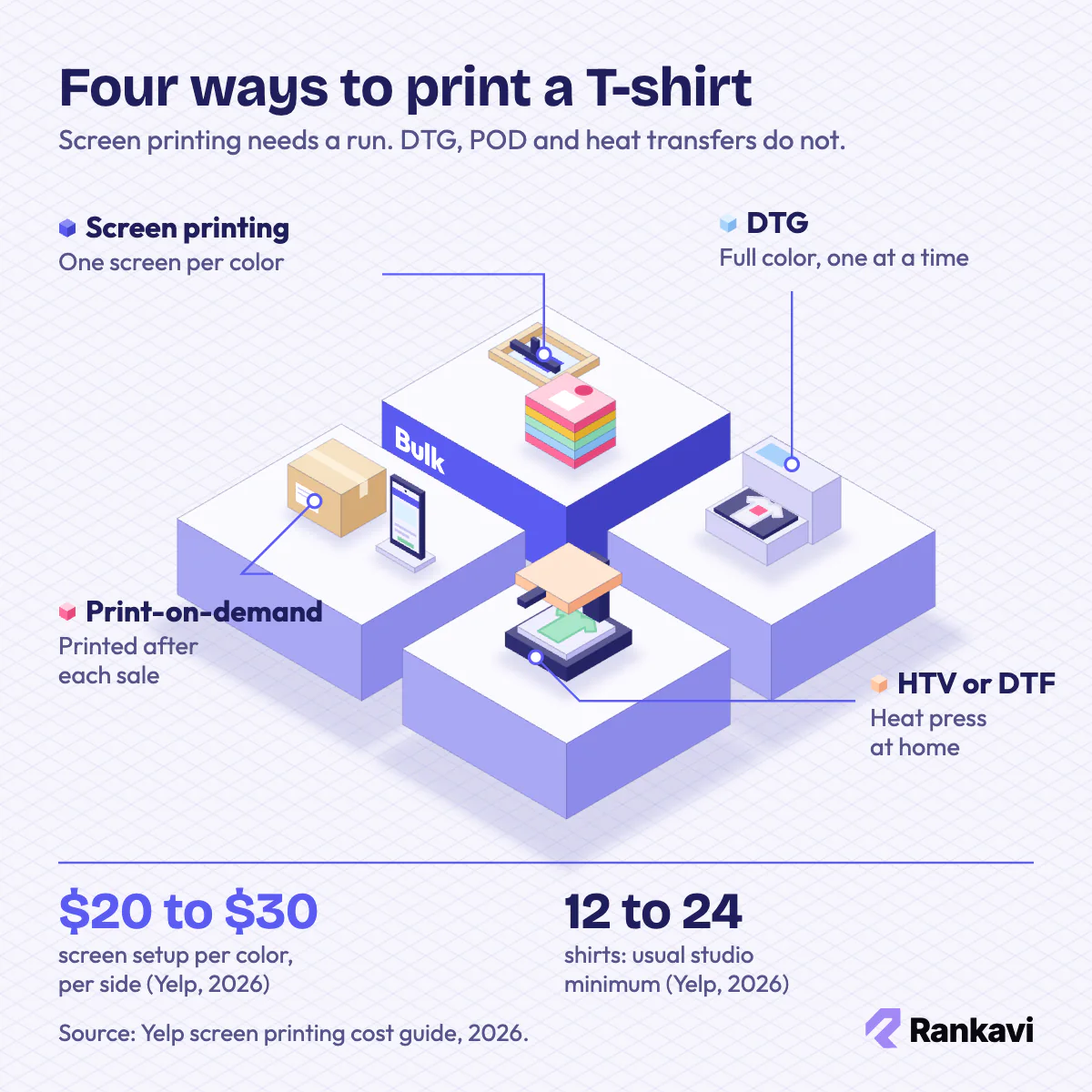
Fabric limits the options. Printful’s guide says direct-to-garment (DTG) printing works best on cotton and cotton-rich blends. Dark shirts also need pre-treatment and a white underbase, a layer of white ink under the colors.
Screen printing works on cotton, polyester and nylon without pre-treatment. Sublimation prints only on polyester, so it rarely suits a cotton tee brand.
Cost and wear also differ by method.
The four methods differ in cost, feel and wear:
- Screen printing: A shop pushes ink through a mesh screen, using one screen per color. Yelp’s 2026 cost guide, built from US shop quotes, puts setup at $20 to $30 per color, per side. That fee spreads across the whole run, so screen printing pays off on volume. Yelp’s 2026 data shows most studios require 12 to 24 shirts. In 2026, a one-color print on 24 to 60 light tees runs about $9 each. Yelp’s quoted price includes the blank shirt. The ink sits on the surface, gives bold color on dark shirts and lasts longest under heavy washing, per Printful.
- Direct-to-garment (DTG): A DTG printer works like an inkjet printer for fabric. It prints full-color artwork one shirt at a time, with no setup per color. The trade-off is a higher cost per shirt. The ink soaks into the fibers, so the finish feels soft and fades gradually.
- Print-on-demand (POD): A POD company prints, packs and ships each order after a customer buys. The brand holds no stock, so POD removes inventory risk. In return, each shirt costs more and takes longer to arrive. The brand also has less control over neck labels and packaging. Printful is a POD company with its own print centers. Printify is a POD marketplace that routes orders to partner shops. Gelato and Gooten are other POD providers.
- Heat transfer vinyl (HTV) and direct-to-film (DTF): Both need a heat press at home. They suit names, numbers and short custom runs. Vinyl needs hand weeding, which means picking away the extra vinyl around the design. Hand weeding slows vinyl at volume. Heat transfer vinyl can also crack or peel with heavy washing. DTF lets a brand order printed transfers and press them onto its own blanks. DTF transfers can feel heavier on the fabric. Ninja Transfers, a DTF transfer vendor, prices an 11-inch-square transfer at $10 for 1 to 14 pieces in 2026. That 2026 price falls to $3.50 each at 250 or more. The same vendor’s 2026 guide puts a heat press at $300 to $1,000. A full in-house DTF printing setup runs $5,000 to $20,000, per that 2026 estimate.
Print-on-demand and DTG suit testing a design with no stock. Screen printing suits a design that already sells steadily. A heat press suits brands that personalize orders with names or numbers. Many brands start on print-on-demand or DTG. They move proven designs to screen printing later, so the first choice does not lock the brand in.
“I started with $100 heat press I got off of Amazon and I’ve made many mistakes and I reuse the T-shirts that I’ve made mistakes on to practice with instead of just tossing them out…”
— A print shop owner commenting on a YouTube T-shirt business guide
Before any bulk order, one printed sample should go through several washes. Brands should also ask printers about minimums, setup and reorder fees, turnaround, ink type and which blanks they print.
Screen printers usually want vector files, while DTG and DTF vendors usually want transparent PNG images. Printer file specs come first.
| Method | Best for | Minimum order |
|---|---|---|
| Screen printing | Large runs of one design | A dozen or more shirts per design |
| DTG | Full-color art, small runs | None |
| POD | Testing with no stock | None |
| HTV or DTF | Names, numbers, custom orders | None |
5. Price Every Shirt for Profit
Pricing a T-shirt sets the gap between the full unit cost and what a buyer pays. That gap must cover fees, shipping and marketing, not just the blank.
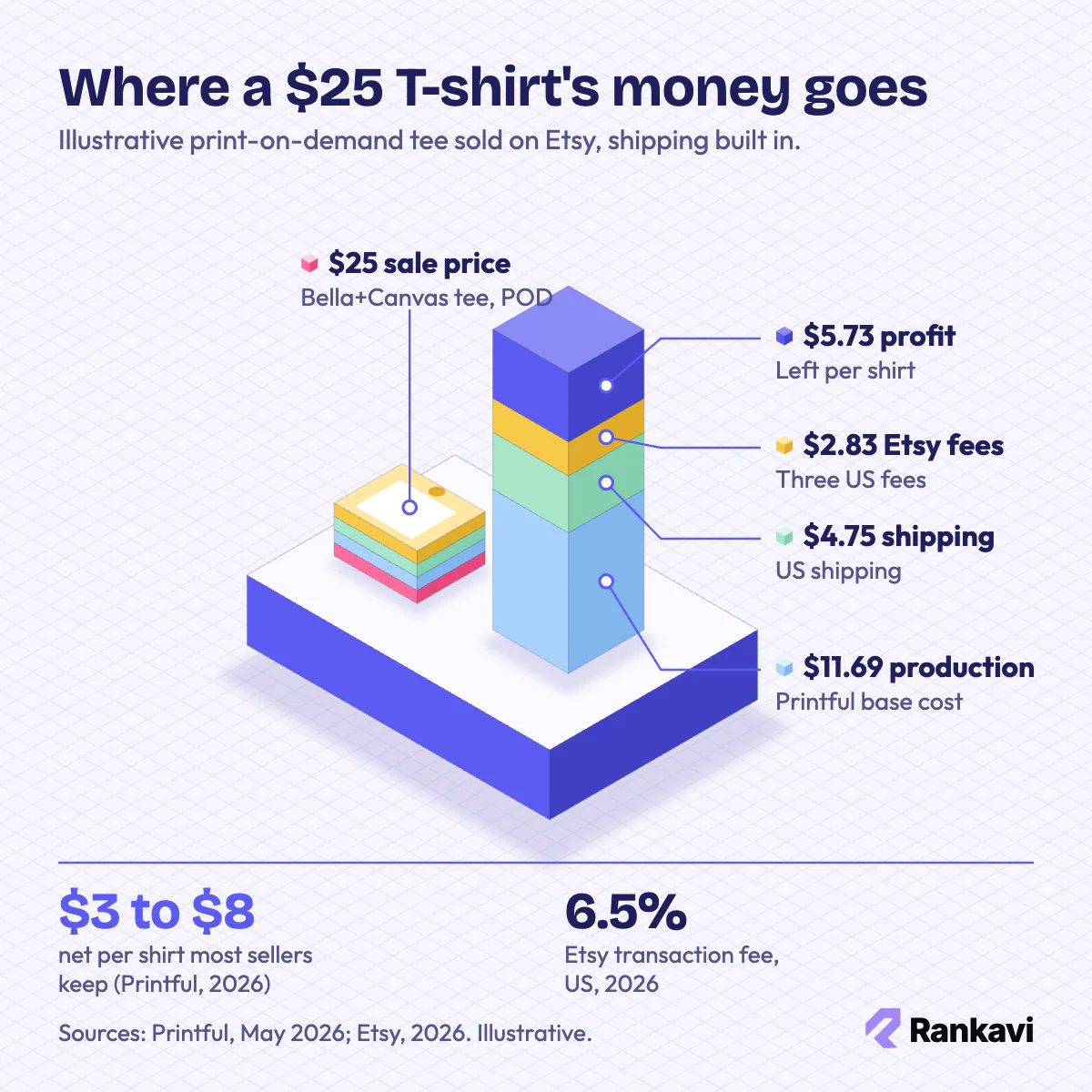
The first cost is making the shirt. Printful, a print-on-demand (POD) vendor, listed a base production cost of $11.69 for a Bella+Canvas 3001 tee in May 2026.
The shirt then has to reach the buyer, so shipping adds to the cost. Printful’s May 2026 guide says domestic US shipping usually starts at $4.75 per shirt.
Once the shirt sells, the marketplace takes its share of the sale. As of 2026, Etsy charges $0.20 per listing, a 6.5% transaction fee and 3% + $0.25 for payment processing on US orders.
These costs show what a price must cover, but they do not pick the price. Three pricing methods each start from a different point:
- Cost-plus pricing: This method adds a target profit to the unit cost.
- Competitor-based pricing: This method checks what similar shirts sell for on Etsy.
- Value-based pricing: This method charges for the meaning a niche attaches to a design.
A niche tee often supports value-based pricing, while a generic tee does not.
Worked example: This illustrative case sells a print-on-demand Bella+Canvas tee on Etsy for $25, shipping included. No Offsite Ads fee applies. Production costs $11.69 and shipping $4.75. Etsy fees total about $2.83: $1.63 transaction, $1.00 processing and $0.20 listing. Subtracting all three costs from $25 leaves $5.73 per shirt. At 100 shirts a month, that earns about $573 before marketing.
Markup and margin are different numbers. Markup is profit divided by cost. Margin is profit divided by price. In the 2026 example, costs total $19.27 and profit is $5.73, a 29.7% markup but a 22.9% margin.
Printful’s May 2026 vendor estimate puts most custom tees at $20 to $30 online. Printful’s May 2026 guide says net profit typically lands at $3 to $8 per shirt. It adds that most T-shirt businesses see average profit margins of 30% to 50% in 2026. In 2026 the example’s 22.9% margin sits below that range, because it includes print-on-demand production, shipping and Etsy fees.
The lowest safe price covers unit costs and flat fees, divided by one minus the percentage fees. In 2026 on Etsy, percentage fees are 9.5%, which is 6.5% transaction plus 3% processing.
In the 2026 example, flat costs are $16.89: $11.69 production, $4.75 shipping, $0.20 listing and $0.25 processing. The break-even price is therefore about $18.66 in 2026.
The example left out one Etsy fee, and that fee changes the result sharply.
Etsy’s Help Center page “How Etsy’s Offsite Ads Work” sets the 2026 Offsite Ads fee at 15% of an ad-driven order. In 2026 that fee drops to 12% once a shop makes $10,000 in 12 months. As of 2026, shops under $10,000 can opt out, while larger shops must take part.
In the 2026 example, the 15% fee on a $25 shirt costs $3.75 and cuts profit from $5.73 to about $1.98. That fee alone can erase the profit on a single shirt.
Discounts and free shipping also reduce profit. A price floor set before any sale keeps a coupon from erasing the margin. In 2026, fixed monthly costs such as a $39 store plan must be spread across the shirts sold before the profit is real. Team or wholesale orders need a price that still works after the discount.
6. Fund the First Production Run
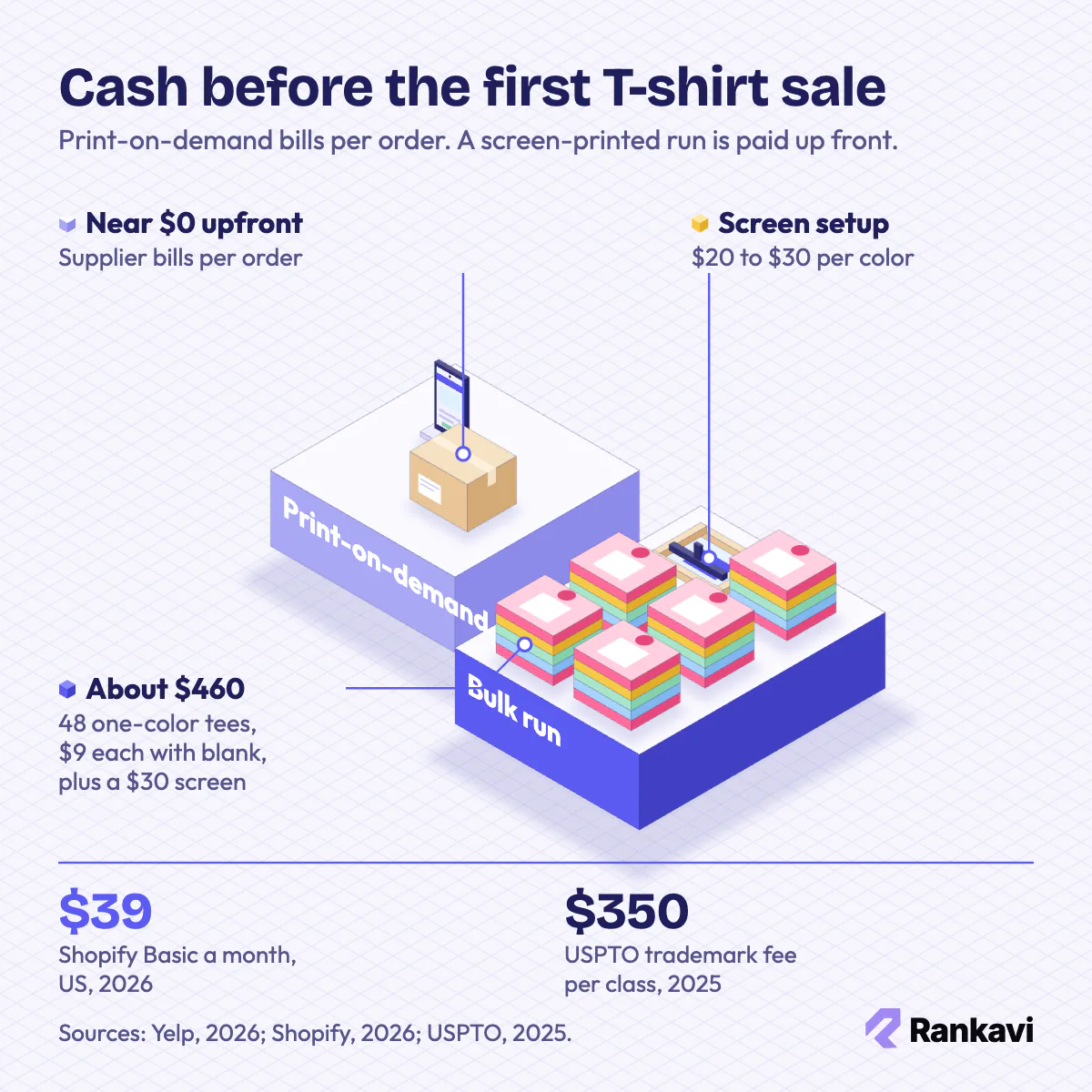
Funding a T-shirt business covers blanks, printing, samples, a store plan and early marketing. The print method decides how much of that cash leaves before the first sale.
Startup money at a glance:
| Item | Figure |
|---|---|
| Startup cost | Near $0 upfront with print-on-demand; about $460 for 48 one-color screen-printed tees ($9 each with blanks included, plus one $30 screen) |
| Main costs | Blanks and printing ($9.25 to $11.69 per POD tee), US shipping (from $4.75), basic store plan ($39 a month), trademark filing ($350 per class) |
| Typical margin | $3 to $8 net profit per shirt; average profit margins of 30% to 50% (Printful vendor estimate) |
| Time to open | Days with print-on-demand; longer for a bulk run, depending on print shop turnaround (no named source) |
Source: Printful, a print-on-demand vendor, vendor estimates, May 2026; Yelp US screen printing quotes, 2026; Shopify, which runs hosted online stores, US pricing, 2026; U.S. Patent and Trademark Office, which issues trademarks, 2025 fee changes; Ninja Transfers, a DTF transfer vendor, 2026.
Print-on-demand needs the least cash. The supplier bills only after a customer pays. Printful listed a Gildan 5000 tee at $9.25 in May 2026. That was its cheapest blank in that comparison.
A bulk screen-printed run works the other way. The business pays for blanks, setup and stock before any shirt sells. That money stays tied up until the stock sells. Splitting quantities by size helps, because it avoids a surplus in sizes that sell slowly. Early sales then pay for the reorder.
Personal savings usually cover a bulk run. Microloans backed by the Small Business Administration (SBA), which runs federal loan programs, fill gaps. In 2026 the SBA lists microloans of up to $50,000 through SBA funding intermediaries. These loans can pay for inventory and supplies.
Four other sources can fund a first run:
- Pre-orders: Customers pay before printing. Only sold shirts get printed.
- Crowdfunding: Kickstarter and Indiegogo raise money from backers before production starts.
- Business credit card: An introductory rate with no interest can bridge a run. A balance left after that period starts to cost interest.
- Platform financing: Programs such as Shopify Capital are based on a store’s past sales. That suits a second run rather than a first.
Whichever source pays for the run, the founder needs to know when the run pays for itself. That point is called break-even. It equals the total run cost divided by the net profit per shirt. Samples, packaging and a cushion for reprints belong in that run cost. A separate business bank account keeps these numbers clear for lenders.
7. Register and Protect the Brand
Registering a T-shirt company protects the founder’s personal assets from the debts of the brand. Most small shirt brands start in one of two forms: a sole proprietorship or a limited liability company (LLC).
A sole proprietorship is the simpler of the two. It needs no state filing, but it gives no liability shield. If the brand uses a name other than the owner’s own, it usually needs a “doing business as” (DBA) filing.
An LLC takes more setup, and in return it adds that shield. The founder forms it with the Secretary of State of the state where they live. Fees and annual reports vary by state. The LLC then shields personal savings if a customer or supplier sues. Mixing personal and business money can weaken it, so a separate bank account matters.
An employer identification number (EIN) from the Internal Revenue Service (IRS) opens wholesale accounts with blank distributors. The IRS issues an EIN free of charge, so paid third-party sites are unnecessary.
An LLC protects the founder, but it does not protect the brand name. A brand name only protects sales once nobody else owns it. The U.S. Patent and Trademark Office (USPTO) registers trademarks.
Someone else may already use the name, so a name search should come before filing. The USPTO trademark search shows existing marks. State business-name databases, Google, Etsy and Amazon show unregistered users. Domain and social handle checks belong at the same time.
The USPTO turns down marks too similar to existing ones for related goods, a problem called likelihood of confusion. Generic names such as “Cool Tees” are also weak or unregistrable.
Many founders secure the domain and social handles first, then file once sales prove the name. The USPTO base filing fee rose to $350 per class in January 2025.
That fee applies to each class, so the number of classes drives the cost. A class is a USPTO category of goods or services. A logo on mugs or stickers needs a separate class and fee. Five USPTO classes matter to a shirt brand:
- Class 25: Clothing, including T-shirts.
- Class 21: Mugs.
- Class 16: Stickers.
- Class 18: Tote bags.
- Class 35: Online retail store services.
Even within Class 25, where the mark sits on the shirt affects the filing. A large design printed across the front can draw an ornamental refusal. The USPTO issues it when buyers see decoration rather than a brand. Showing the mark on a neck label or hang tag helps. So does printing it small on the chest. Both placements help the filing show use as a brand.
Trademark and copyright protect different things. Trademark protects the brand name and logo. Copyright protects the artwork and applies automatically. Slogans and short phrases cannot be copyrighted, so a trademark is the route for them.
Registration is not a one-time step. A declaration that the mark is still in use is due between the fifth and sixth year after registration. Unsolicited invoices that imitate USPTO notices are a known scam. Fees and deadlines belong in the USPTO’s own system.
8. Label Garments to Federal Rules
Labeling a T-shirt requires fiber content, country of origin and the maker’s identity on each branded garment. The Federal Trade Commission (FTC), the federal consumer protection agency, enforces these textile rules.
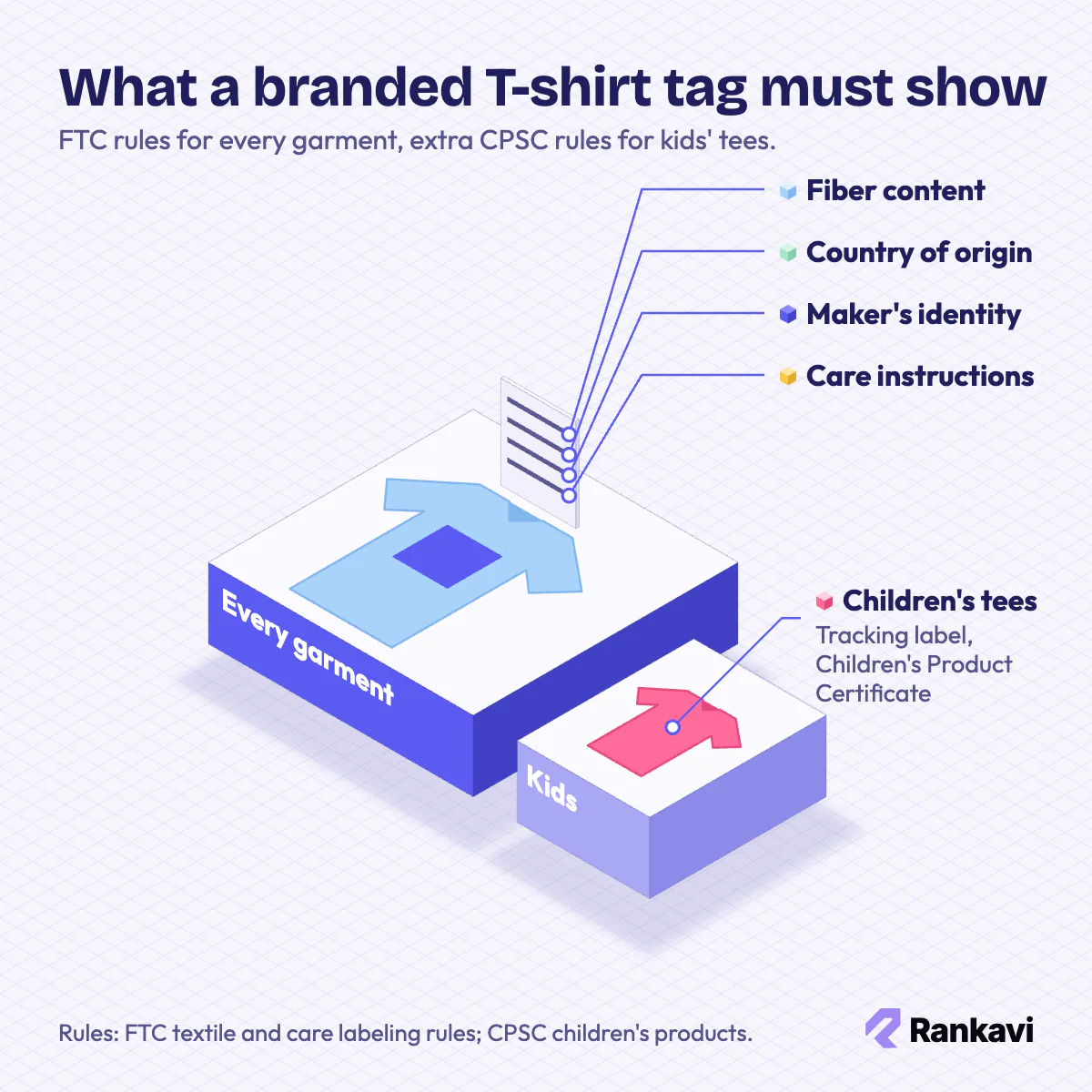
The Textile Fiber Products Identification Act is the federal law behind the first three of these tag details. Care instructions come from a separate FTC rule. A branded tag must show these four items:
- Fiber content: Fibers are listed by weight, from most to least. Each one uses a generic name, such as cotton or polyester. In 2026 FTC guidance, a fiber under 5% is listed as “other fiber.”
- Country of origin: This follows where the blank was made, not where the design was printed. A blank is the plain shirt before printing. Printing in the U.S. does not make an imported shirt “Made in USA.” That claim needs a product made completely in the U.S. from U.S. materials.
- The maker’s identity: The maker can print its legal business name. It can also use a free Registered Identification Number (RN) from the FTC, which is open to U.S. businesses only. A brand name or logo alone is not enough.
- Care instructions: The Care Labeling Rule requires care labels on clothing. The label must give washing, drying, bleaching and ironing instructions where relevant. It must stay permanently attached and stay readable for the garment’s life. The seller needs a reliable basis for each instruction, such as the blank maker’s data or its own testing.
Blanks from Gildan, Bella+Canvas and Next Level usually ship with their own tags. Keeping that tag is fine, but it names the blank brand instead of the seller’s brand.
A brand can swap the blank maker’s tag. The new tag must repeat the required fiber, origin and identity details. The FTC also asks the brand to keep records of the removed label for three years.
Online listings must also state whether an item is made in the U.S., imported or both.
Shirts made for children face extra rules. The Consumer Product Safety Commission (CPSC), the agency that regulates children’s products, sets them. Per CPSC business guidance, children’s products need permanent tracking labels. They also need a Children’s Product Certificate based on third-party lab testing.
A sales tax permit from the state lets the business collect tax on direct sales. Avalara, a sales tax software company, notes that Etsy must collect sales tax on platform sales. Sales through a brand’s own site stay the seller’s job.
9. Open an Online Store
An online store turns designs into products that anyone can buy at any hour. Most new tee brands sell through a marketplace, their own site, or both. Each channel trades traffic for control.
A marketplace is a shopping site where many sellers list products. Its strength is built-in buyers. Etsy brings buyers who already search for personalized shirts, a stream of traffic a new site lacks. Redbubble and TeePublic are other marketplaces that print and ship for artists. A marketplace limits branding and customer data.
An own site gives full control but needs its own traffic. As of 2026, Shopify’s Basic plan costs $39 a month on monthly billing in the US. Wix, Squarespace, WooCommerce and BigCommerce are other store builders.
Selling on one channel first keeps the setup manageable. The brand can add the second channel once orders are steady.
Print-on-demand (POD) apps connect to Shopify and send each order to the printer automatically. Printful, Printify and Gelato sync with both Shopify and Etsy. Each order flows to the printer, which then ships it under the brand’s name. One sample order first lets the brand check print quality and delivery time.
Once the channel and printer are in place, the store itself needs six basics before launch:
- Theme: The theme is the store’s design layout, and it should be mobile-friendly.
- Product pages: Each page shows mockups or photos, a size chart, and fabric and fit details. It also lists colors and shipping times.
- Core pages: The store needs Home, Collection, About, Contact and FAQ pages.
- Policy pages: These pages cover shipping, returns, privacy and terms.
- Payments: The store takes cards plus PayPal, Shop Pay, Apple Pay and Google Pay.
- Sales tax: Shopify Tax or Stripe Tax collects sales tax automatically.
Shipping setup depends on who holds the stock. Print-on-demand brands skip this step, since the printer ships. Brands that hold their own stock need shipping supplies. A thermal label printer, poly mailers and a scale speed up packing as order volume grows. Pirate Ship and ShipStation sell discounted shipping labels.
A test order, a phone check and removing the storefront password finish the launch.
10. Market the First Drop
Marketing a first drop puts the collection in front of the niche that inspired it. Short videos, group orders and an email list bring the first sales without paid ads.
A first drop runs on a clock. Teasers and a waitlist start a few weeks before launch. The finished shirts and an end date come next. Then the sales window closes on a firm date. Honest urgency means a real end date, not a countdown that resets.
TikTok and Instagram Reels show shirts in motion, on real people, in real settings. Four kinds of clips work well:
- Behind-the-scenes clips: These show printing and pressing. Seeing the real work builds trust in a small brand.
- Design reveals: These show a new design for the first time.
- Try-ons: Real members of the niche wear the shirts on camera.
- Packing clips: These show orders being packed.
Two tools help with clips. TikTok offers a Commercial Music Library of cleared audio for business accounts. Cleared audio is music a business account is allowed to use. CapCut is a video editing app for short clips.
Coaches, teachers, boutique owners and event organizers order shirts in groups. One local team order can sell dozens of shirts from a single design. Leagues, schools, booster clubs and run clubs are natural targets. A group-order pitch works best with four elements:
- A mockup: This shows the group the result before ordering.
- A minimum quantity: This sets how many shirts the group must order.
- A deadline: This sets the date when the order closes.
- A Google Form: This collects names and sizes from each person in the group.
Niche communities have rules of their own. The brand should join niche Reddit, Facebook and Discord communities as a participant before it posts. Each community’s self-promotion rules apply.
Small creators in the niche can wear the shirts too. The FTC says creators must disclose free products or other perks from a brand, near the endorsement itself. Plain wording such as “ad” or “thanks to the brand for the free product” works. Vague tags such as “collab” do not.
A unique discount code for each creator shows who drives sales.
An email list turns those followers into launch-day buyers. A waitlist page collects the first subscribers by offering early access or a first-drop discount. Limited drops with a clear end date give that list a reason to buy now. Klaviyo, Mailchimp and MailerLite are email marketing tools that send these messages.
Sending marketing email also brings legal rules. The federal email marketing law (CAN-SPAM Act) requires a working unsubscribe link in each marketing email. Each one must also include a postal address. The FTC says opt-out requests must be honored within 10 business days.
Once sales start, the brand needs to know which channel earned them. Urchin Tracking Module (UTM) parameters are short tags added to the end of a link that name its source. With UTM parameters on every link, Google Analytics 4, Google’s website tracking tool, shows which channel earned each sale. The following five numbers show what worked:
- Email signups: This counts how many people joined the list.
- Click rates: This shows the share of people who clicked a link.
- Add-to-cart rate: This shows the share of visitors who put a shirt in their cart.
- Conversion rate: This shows the share of visitors who bought.
- Sales per channel: This shows how many sales each channel brought in.
Paid ads make sense only after one video or email has proven itself.
11. Surface in Google AI Overviews
AI visibility for a T-shirt brand means being named when shoppers ask Google, ChatGPT or Perplexity for shirt ideas. Those tools answer by repeating what trusted gift guides, reviews and “best tees” roundups already say.
A new shirt brand that earns mentions on those sites early has a better chance of appearing in the answers. Brands that want to show up in Google AI Overviews answers need that coverage on pages Google already trusts.
Rankavi is a software as a service (SaaS) platform that publishes brand mentions in articles on indexed third-party websites. Articles for shirt brands start at $12 and are published as written.