

Starting a trucking business takes a commercial license, a tractor and trailer, federal operating authority and trucking insurance. The U.S. Bureau of Labor Statistics (BLS) publishes federal job data and counted 2,221,200 heavy and tractor-trailer truck driver jobs in 2025.
My name is Michal Sieroslawski, and I’m an entrepreneur who helps trucking companies appear when shippers search online. Chat-based search is changing how shippers find trucking companies. A mention in those replies can bring in customers before any ad does.
The order settles the freight niche and the rate math before money goes into filings. Authority, insurance and the truck then line up so the first load moves legally. Here are the thirteen steps to start a trucking business, from first idea to first customers, listed below.
- Choose a Freight Niche and Operating Model
- Write a Trucking Business Plan
- Price Loads by Cost per Mile
- Fund the Truck and Cash Reserve
- Form an LLC and Get an EIN
- Secure Truck Parking and a Home Base
- Buy or Lease a Tractor and Trailer
- Obtain USDOT Numbers and Operating Authority
- Insure the Truck, Cargo and Liability
- Set Up ELDs, Dispatch and Factoring
- Hire and Qualify Drivers
- Book Loads From Brokers and Shippers
- Surface in Google AI Overviews for Freight
1. Choose a Freight Niche and Operating Model
A new trucking company first picks the freight it will haul and the authority it will run under. Both choices shape the truck, the insurance and the startup budget.
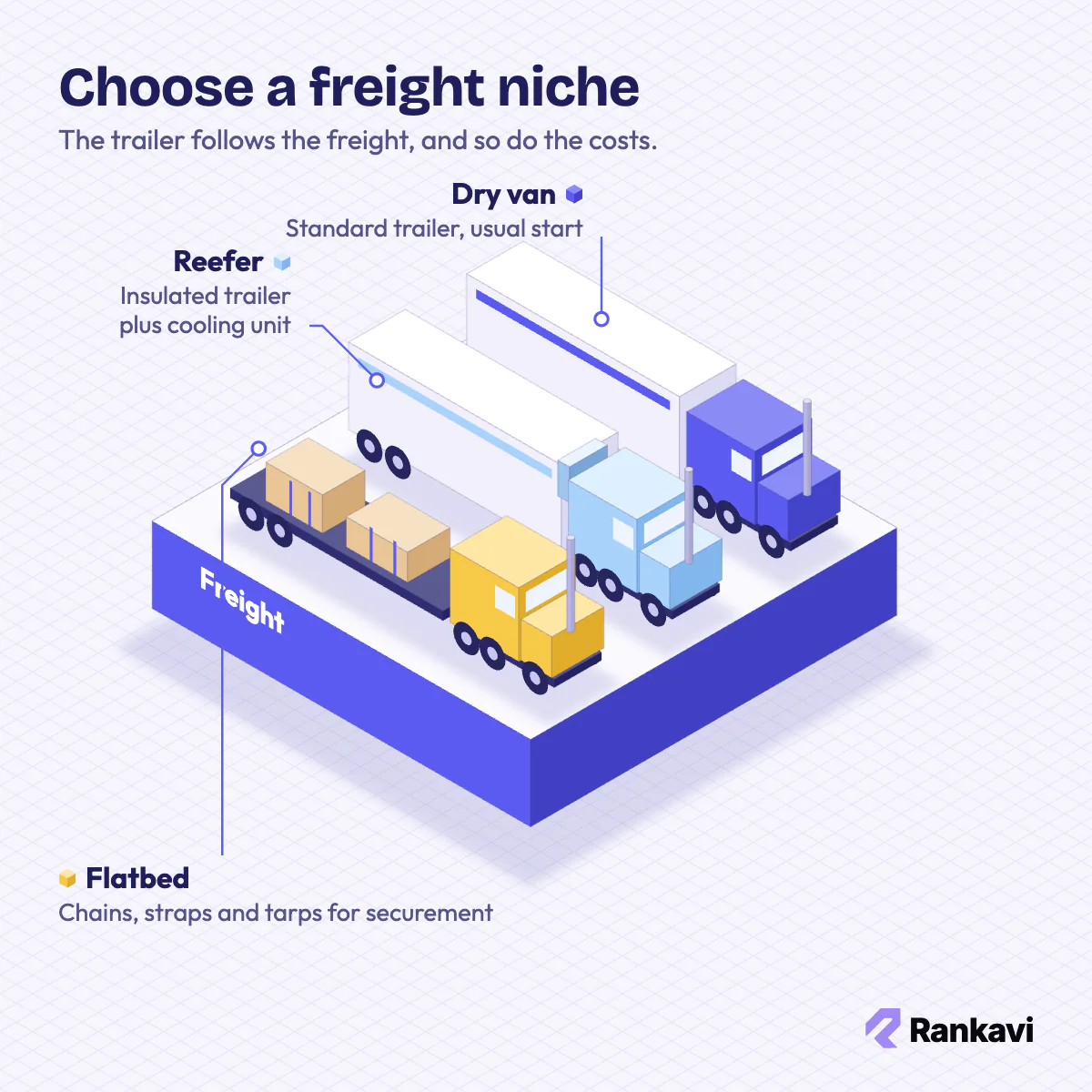
Dry van freight is the usual starting point because the trailer is standard and widely available. Refrigerated (reefer) loads need an insulated trailer with a cooling unit. Flatbed work adds chains, straps and tarps for securement. Hazardous materials need an extra endorsement and costlier coverage.
Smaller niches exist too. Hotshot hauling uses a heavy-duty pickup with a gooseneck trailer for smaller, time-sensitive loads. Power-only work pulls trailers owned by someone else, so no trailer is bought. Tanker and step deck work need specialized trailers. Each niche trades lower competition for higher equipment cost or extra rules.
Three operating models:
| Model | How it works | Main trade-off |
|---|---|---|
| Leased to a carrier | The truck runs under another company’s authority | Steady freight, less control |
| Own authority | The business holds its own federal authority | Full control, full compliance load |
| Lease-purchase | A carrier or dealer leases the truck toward ownership | Low entry cost, strict contract terms |
Many owner-operators drive as company drivers first. That time teaches freight markets, routing and real operating costs. A carrier-backed start also lowers risk while the new owner learns the business side.
Pay in a leased-on deal is usually a share of load revenue or a rate per mile. The contract states who pays fuel and upkeep. Lease-purchase contracts need a close read. The key question is what happens to the truck and past payments if the driver leaves.
Hauling only inside one state can fall under that state’s rules instead of federal authority. Hauling across state lines for pay needs federal authority, covered in step 8. A first-time owner with little cash is usually safest leased to an established carrier. Own authority can follow once real costs are known.
“You may want to get a job at a trucking company and start learning the business from the ground up.”
— A member of the TruckersReport forum
The Owner-Operator Independent Drivers Association (OOIDA), founded in 1973, is a trade association that serves owner-operators and small fleets. Its business resources help drivers weigh the move to ownership.
2. Write a Trucking Business Plan
A trucking business plan states the freight, the lanes, the customers and the money behind the company. Lenders and equipment dealers ask for one before they approve financing.
The plan covers an executive summary, a company description, a market analysis and the services offered. Sales and marketing, management and financial projections complete it. Each part answers a question a lender asks about a single-truck carrier.
The financial projections need the most detail. They state loaded miles per week, the share of empty miles, the rate per mile and the cost per mile. They then show the break-even point and a monthly cash flow for the first year. Lenders also look at personal credit, the down payment and whether revenue covers the truck payment.
Haul length is the plan’s central assumption. Short-haul and regional work keeps the driver home more often. Long-haul runs cover more miles per week but raise fuel, wear and time away.
A lean plan suits owners who expect fast changes. It fits key activities, partners, resources, customer segments and the cost structure on one page.
3. Price Loads by Cost per Mile
Pricing a trucking load sets the rate per mile or per load that covers costs and leaves a profit. The owner calculates that number before accepting any freight.
Carriers get paid in two ways. A per-mile rate pays for each loaded mile driven. A flat rate pays one amount from pickup to delivery, whatever the exact distance.
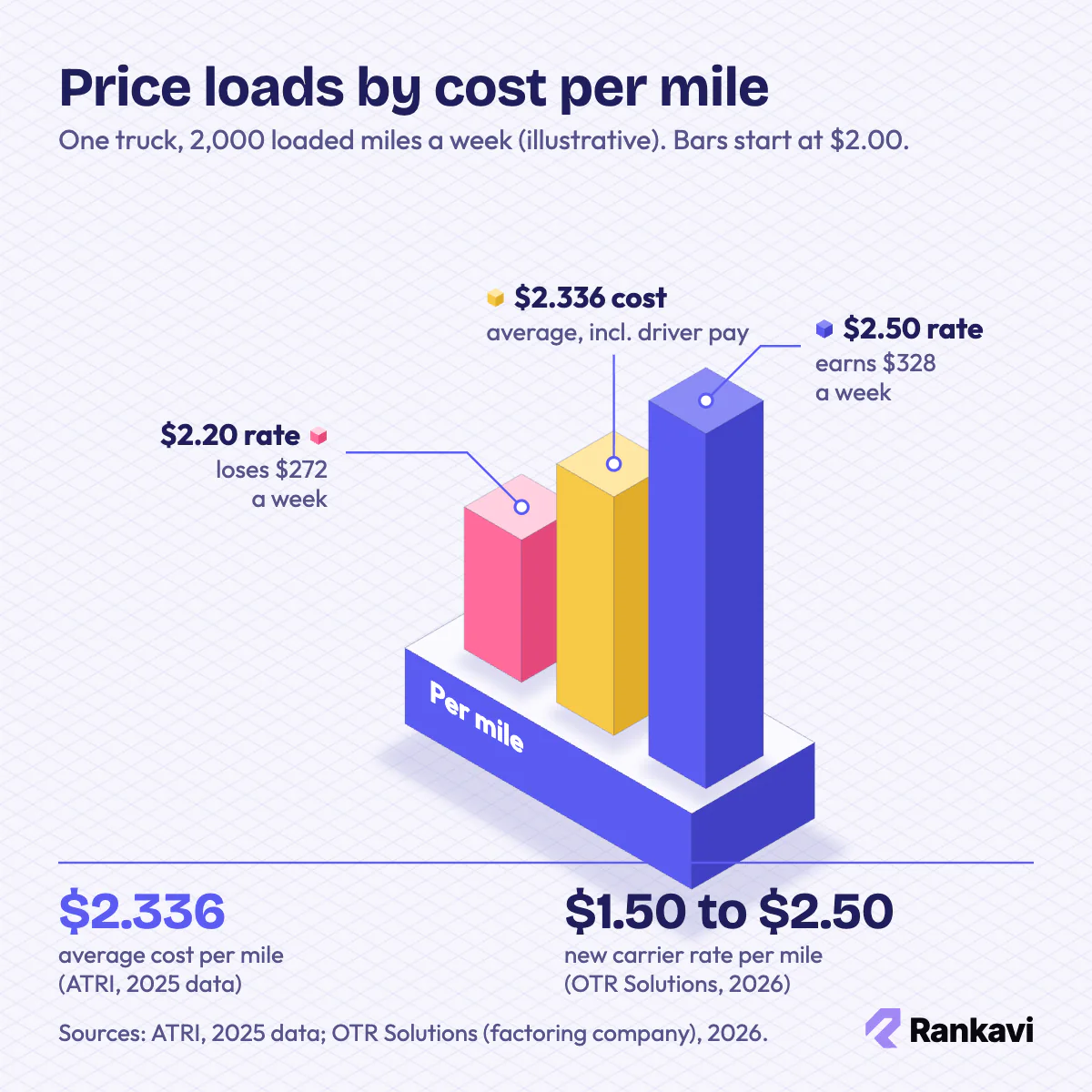
Cost per mile is the benchmark that decides every load. The American Transportation Research Institute (ATRI) publishes a yearly trucking cost study and put the average carrier cost at $2.336 per mile for 2025. Non-fuel costs alone reached $1.854 per mile in that 2025 data.
OTR Solutions, a freight factoring company, estimated in 2026 that new carriers earn $1.50 to $2.50 per mile. A rate near the bottom of that range sits below the 2025 industry cost line.
Deadhead miles are miles driven empty. Those miles burn fuel and wear the truck but earn nothing. A good load therefore counts the empty miles to the next pickup too.
Cost per mile equals total yearly costs divided by total miles driven, loaded and empty together. The break-even rate equals that cost. The target rate adds the profit the owner wants on each mile. A load below break-even loses money even when the truck stays busy.
Rate research starts on a load board. The owner checks posted rates for several loads on the same lane, in both directions, then averages them.
Startup money at a glance:
| Item | Typical figure |
|---|---|
| Startup cost | $10,000 to $30,000 before the truck; new trucks $120,000 to $200,000, used $45,000 to $100,000 |
| Main costs | Truck payment, insurance, fuel, maintenance, permits and authority filings |
| Typical margin | 21.19% gross and 3.79% net for U.S. public trucking firms (proxy); truckload operating margin below 1.0% in 2025 |
| Time to open | 60 to 90 days on the carrier’s own authority |
Source: OTR Solutions, a freight factoring company (vendor estimates, 2026); Aswath Damodaran, NYU Stern (January 2026); ATRI (2025 data, July 2026); SelecTrucks, a used truck dealer (vendor estimate, February 2026).
Worked example: Picture an illustrative single truck that runs 2,000 loaded miles a week. At $2.50 a mile, the week grosses $5,000. At the average cost of $2.336 a mile, which includes driver pay, the week costs $4,672. That leaves $328 before any deadhead. At $2.20 a mile, the same week brings $4,400 and loses $272.
4. Fund the Truck and Cash Reserve
Funding a trucking company covers the truck, the first insurance payment, the filings and a reserve for slow weeks. Most new carriers combine savings with equipment financing.
Banks and specialist lenders finance trucks through equipment loans. The truck itself serves as collateral. Rates depend on credit history, time in business and the age of the equipment.
Lenders usually ask for a down payment. Strong credit and documented driving experience improve the terms. A larger down payment can help an owner with weaker credit.
A cash reserve protects the business from slow broker payments and breakdowns. Fuel gets paid at the pump, while brokers pay invoices weeks later. Several months of operating costs set aside keep the truck running through those gaps.
Slow payment is the usual cash trap. A truck that earns well on paper can still run short. Fuel, insurance and the truck payment fall due before the invoices are paid. Factoring, covered in step 10, is one way to close that gap.
“…never ever assume that the engine or gear box will run well always assume that they won’t”
— A carrier on the TruckersReport forum
The U.S. Small Business Administration (SBA) is the federal agency that guarantees small business loans from approved lenders. As of 2026, SBA microloans average about $13,000 and can fund working capital and equipment.
5. Form an LLC and Get an EIN
Forming the company separates the owner’s personal assets from the debts and claims of the trucking business. Most small trucking companies register as a limited liability company (LLC) with their state.
A sole proprietorship is the default when no entity is filed. That setup offers no liability protection, and a single crash claim can reach the owner’s home. An LLC keeps business debts with the business.
An employer identification number (EIN) is a nine-digit federal tax number from the Internal Revenue Service (IRS). The application is free and runs online. Banks ask for the EIN before opening a business account.
A separate business bank account keeps fuel, repairs and load payments apart from personal spending.
An LLC protects personal assets only when the business stays separate in practice. Mixing personal and business money can weaken that protection. The LLC does not replace insurance, which step 9 covers. Clean records make quarterly fuel tax reports much easier.
6. Secure Truck Parking and a Home Base
A trucking company needs a physical business address and a safe place to park the rig between loads. Federal registration asks for the company’s principal place of business.
Truck parking is a real cost for a new carrier. Many residential streets and homeowner rules ban parked tractors. Owners rent space at a truck yard, a secured lot or a shipper’s site.
The home base also sets the home state for plates and fuel tax accounts. A base near the target lanes cuts empty miles at the start and end of each week.
7. Buy or Lease a Tractor and Trailer
New trucks bring warranty coverage and fewer early repairs, while used trucks lower the upfront cost. The choice depends on cash flow, credit and the planned lanes.
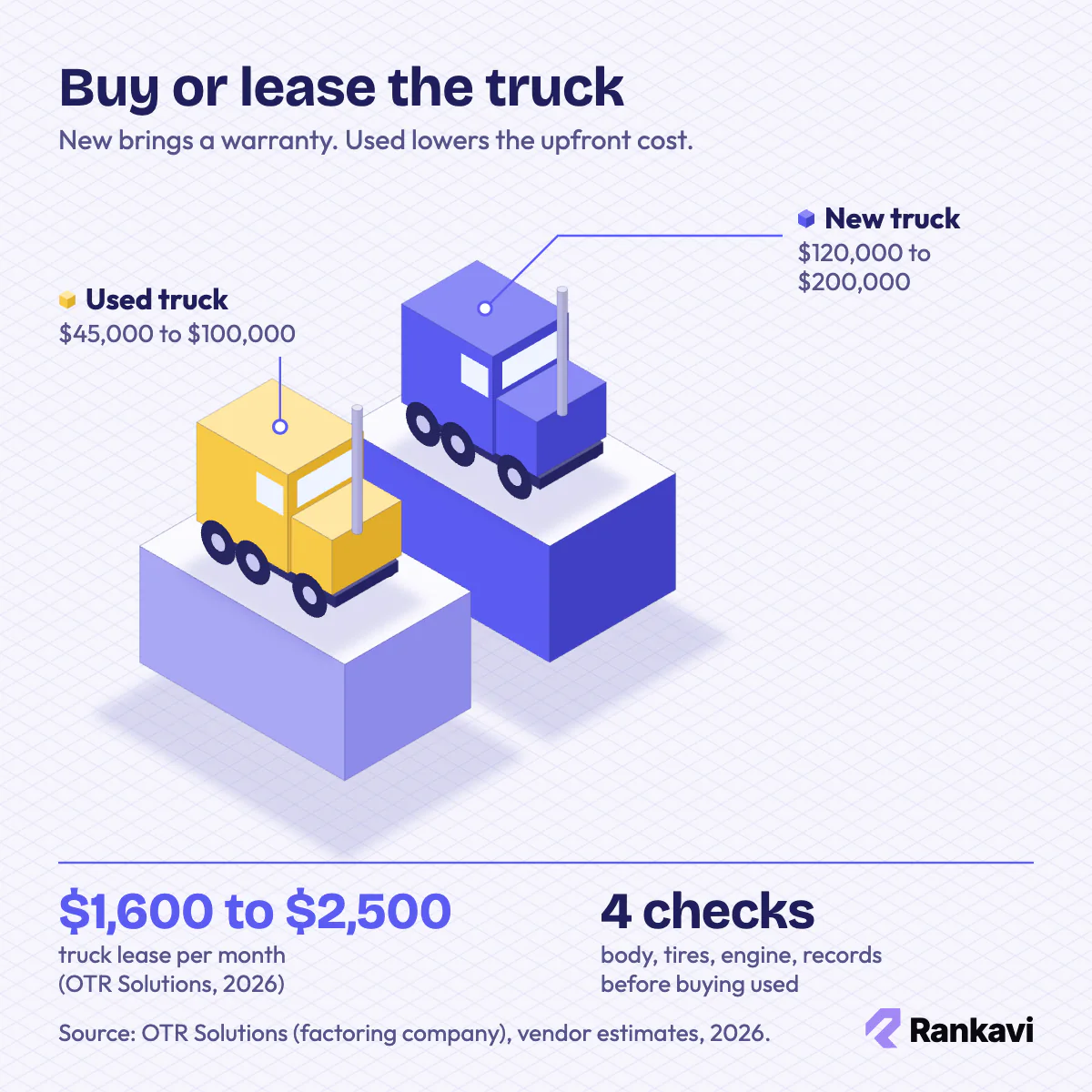
A used truck needs a close inspection before purchase, and a dealer’s inspection report adds protection. Buyers check four areas:
- Body: visible damage and rust
- Tires: tread depth on every axle
- Engine: mileage and performance
- Records: maintenance and oil change history
A lease needs less cash upfront but costs more over time. OTR Solutions estimated truck leases at $1,600 to $2,500 a month in 2026. Lease-purchase deals tie the driver to one carrier while payments run.
Cab and trailer follow the niche. A sleeper cab suits long-haul runs, while a day cab fits regional work. Dry van trailers cost the least, and reefer trailers cost the most.
“The money you spend on a reliable dually and flatbed could buy your first tractor and trailer.”
— An owner-operator on the TruckersReport forum
8. Obtain USDOT Numbers and Operating Authority
Operating authority means federal permission to haul freight for hire across state lines. The Federal Motor Carrier Safety Administration (FMCSA), which issues carrier numbers, grants it once insurance is on file.
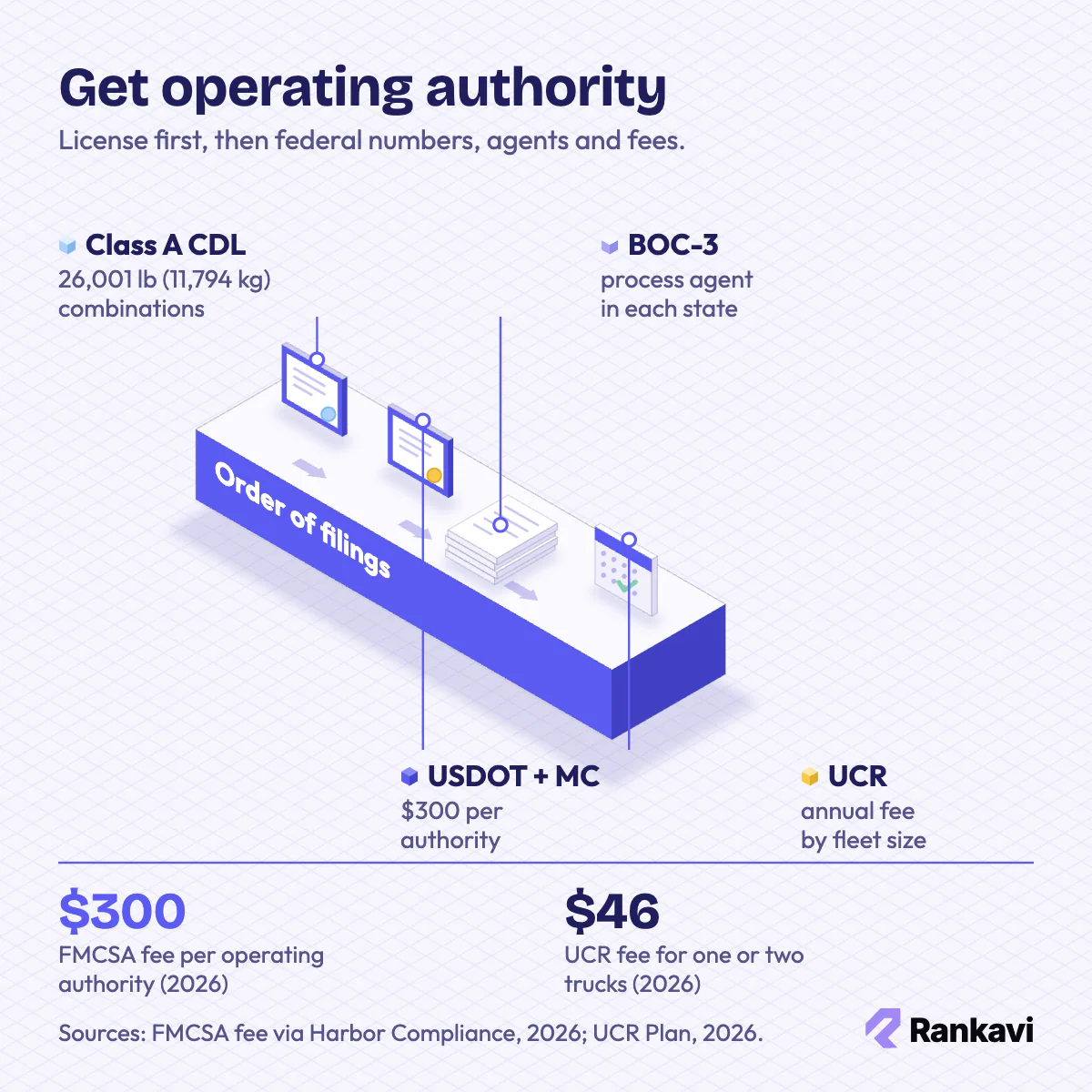
A commercial driver’s license (CDL) comes first. Federal rules in 2026 require a Class A license for combinations rated at 26,001 pounds (11,794 kg) or more. The driver also passes a Department of Transportation (DOT) physical exam.
Each carrier then files for a U.S. Department of Transportation (USDOT) number and a motor carrier (MC) number. As of 2026, FMCSA charges $300 per operating authority. A process agent form (BOC-3) names legal contacts in each state.
Unified Carrier Registration (UCR) is a federal-state program that charges interstate carriers an annual fee by fleet size. The 2026 fee for one or two trucks is $46.
Recurring state and federal filings:
| Filing | Purpose |
|---|---|
| International Registration Plan (IRP) | Apportioned plates recognized across states and Canadian provinces |
| International Fuel Tax Agreement (IFTA) | One base-state license and quarterly fuel tax reports |
| Form 2290 | Annual heavy vehicle use tax paid to the IRS |
The International Registration Plan is an agreement between U.S. states and Canadian provinces for shared truck registration. The International Fuel Tax Agreement lets a carrier report fuel taxes quarterly through one base state. Form 2290 applies to trucks with a taxable gross weight of 55,000 pounds or more, per 2026 IRS guidance.
9. Insure the Truck, Cargo and Liability
Trucking insurance protects the carrier, the truck and the freight when a crash or claim happens. Federal rules set a minimum liability level for every for-hire interstate carrier.
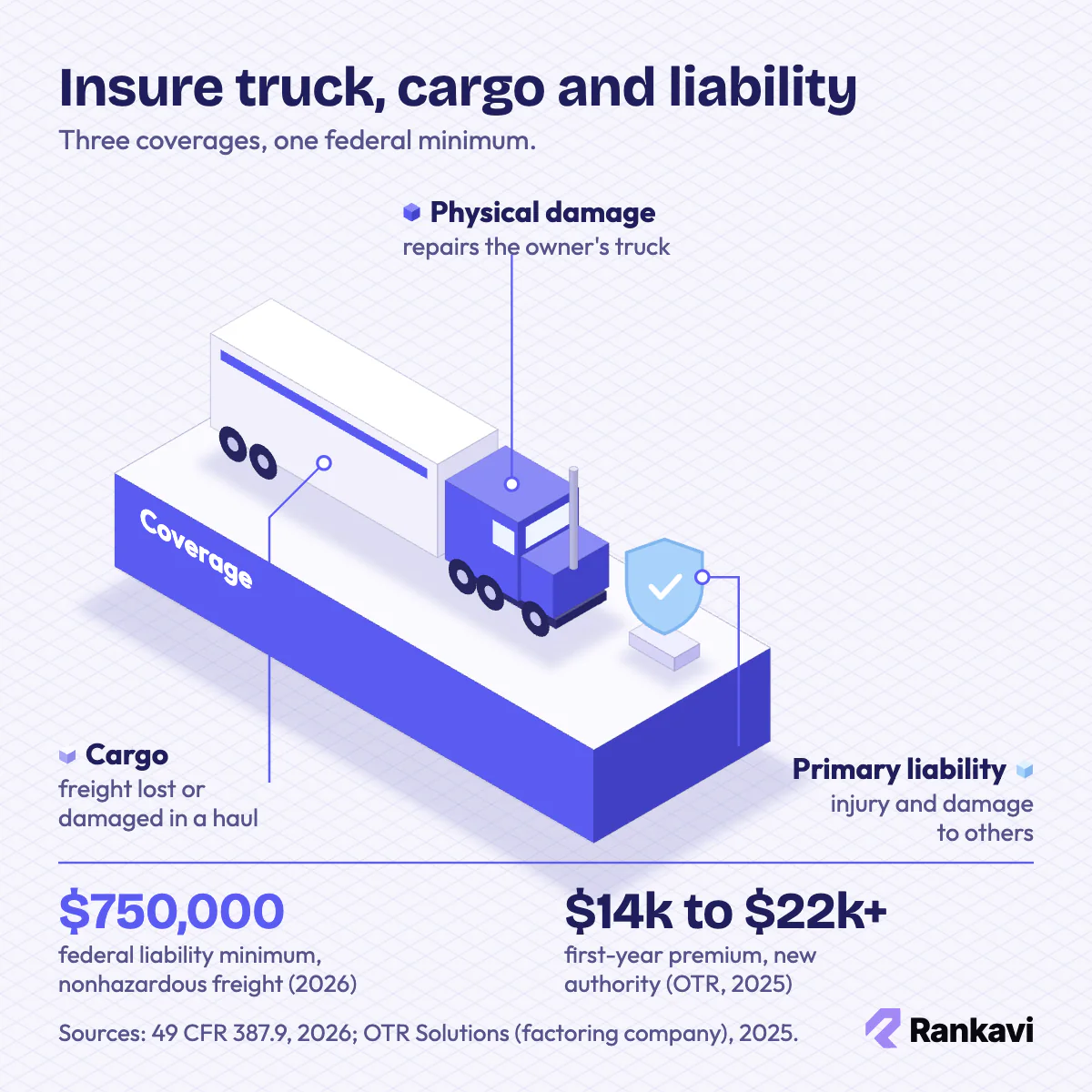
Federal rules in 2026 require $750,000 of liability for nonhazardous freight in vehicles of 10,001 pounds or more. Many brokers and shippers require higher limits. The insurer files proof of coverage with FMCSA directly.
Physical damage coverage repairs or replaces the owner’s own truck. Cargo coverage pays claims for freight that is lost or damaged during a haul. Bobtail or non-trucking liability covers a leased-on truck driven without a load.
OTR Solutions estimated first-year premiums for new authorities at $14,000 to $22,000 or more in 2025. Driving history, truck age, cargo type and operating radius all move the price.
10. Set Up ELDs, Dispatch and Factoring
Back-office setup tracks hours, miles, invoices and repairs so the truck stays legal and paid. Most of it runs on a phone or tablet.
Non-exempt carriers must use an electronic logging device (ELD) registered with FMCSA. The device records driving hours automatically. ELD data also feeds mileage reports for fuel taxes.
Freight factoring buys unpaid load invoices for a fee. The carrier gets cash within a day instead of waiting weeks for brokers. Factoring helps new carriers cover fuel while invoices age.
Bookkeeping software tracks fuel, maintenance, tolls, insurance and loan payments. Owners set aside money for quarterly estimated taxes. Fuel, repairs, depreciation and premiums are common deductions.
A preventive maintenance schedule catches small faults before they strand the truck. Oil changes, brake checks, tire rotation and fluid checks follow a fixed calendar.
11. Hire and Qualify Drivers
Adding drivers requires a qualification process, drug and alcohol testing, and a plan to keep good people. Each hired driver also raises payroll and insurance costs.
BLS reported a median annual wage of $58,640 for heavy and tractor-trailer truck drivers in May 2025. That wage sets the floor for a competitive offer.
The FMCSA Pre-Employment Screening Program shows a candidate’s crash history and roadside inspection results. Carriers review that record before an offer. A driver qualification file then holds the license, medical card and checks.
Every carrier with CDL drivers needs a drug and alcohol testing program. Small fleets and single-truck owners usually join a testing consortium. The consortium manages random selection and lab work.
Driver turnover is costly in trucking. Fair pay, predictable home time and respect keep drivers longer.
Hiring also changes the cost math in step 3. Driver pay, payroll taxes and extra insurance join the cost per mile. A second truck only makes sense when the first one earns a steady margin. ELD safety scores give a fair basis for performance rewards.
12. Book Loads From Brokers and Shippers
Most new carriers find their first freight on load boards, then build direct shipper relationships. Brokers post loads, and carriers call to book and negotiate.
DAT Freight & Analytics is a freight marketplace that runs a large load board for brokers and carriers. Truckstop runs a similar board. Fast calls and firm rate negotiation win better loads.
Spot loads pay by the load on the day, while contract freight repeats at an agreed rate. Spot freight suits a new carrier that needs to fill the truck. Contract freight gives steadier income but takes time to win. A carrier works toward a mix of both.
Direct shippers pay better and remove the broker’s cut. Carriers meet them through repeat runs, trade shows and LinkedIn. A simple website and a Google Business Profile help shippers verify the company.
No single customer should supply most of the revenue. Several steady shippers and brokers protect the business when one account slows down.
13. Surface in Google AI Overviews for Freight
Shippers and logistics managers now ask ChatGPT, Gemini, Perplexity and Google AI Overviews for reliable regional carriers. Those answers lean on trade directories, carrier reviews and freight industry articles.
A new carrier gains from being named on those third-party pages early. Rankavi is a software as a service (SaaS) platform that publishes brand mentions in articles on indexed third-party websites. Carriers can place articles AI Overviews can cite when shippers research a lane.