

Starting a travel business means forming an agency that plans trips and earns supplier commissions. Most start from home under a host agency. The U.S. Bureau of Labor Statistics (BLS), which publishes federal job data, counted 61,500 travel agent jobs in 2025.
I’m Michal Sieroslawski, and I help travel agencies show up in Google and AI search. Asking an AI assistant is becoming a normal way for travelers to compare travel agencies. A mention in those replies can bring in customers before any ad does.
The order settles the niche and model before money goes into fees, filings or software. Commissions arrive only after clients travel, so funding comes early. Starting a travel business comes down to the eight steps listed below.
- Choose a Travel Niche and Client
- Plan Around a Host, Franchise or Solo Model
- Fund the First Year of Bookings
- Register and Insure the Agency
- Check Seller of Travel Rules
- Set Up Booking Tools and Suppliers
- Market to Friends, Referrals and Social
- Enter Travelers’ Google AI Mode Shortlists
1. Choose a Travel Niche and Client
A travel niche means the one type of trip or traveler an agency plans for best. Specialists get referred, while generalists compete with every booking website.
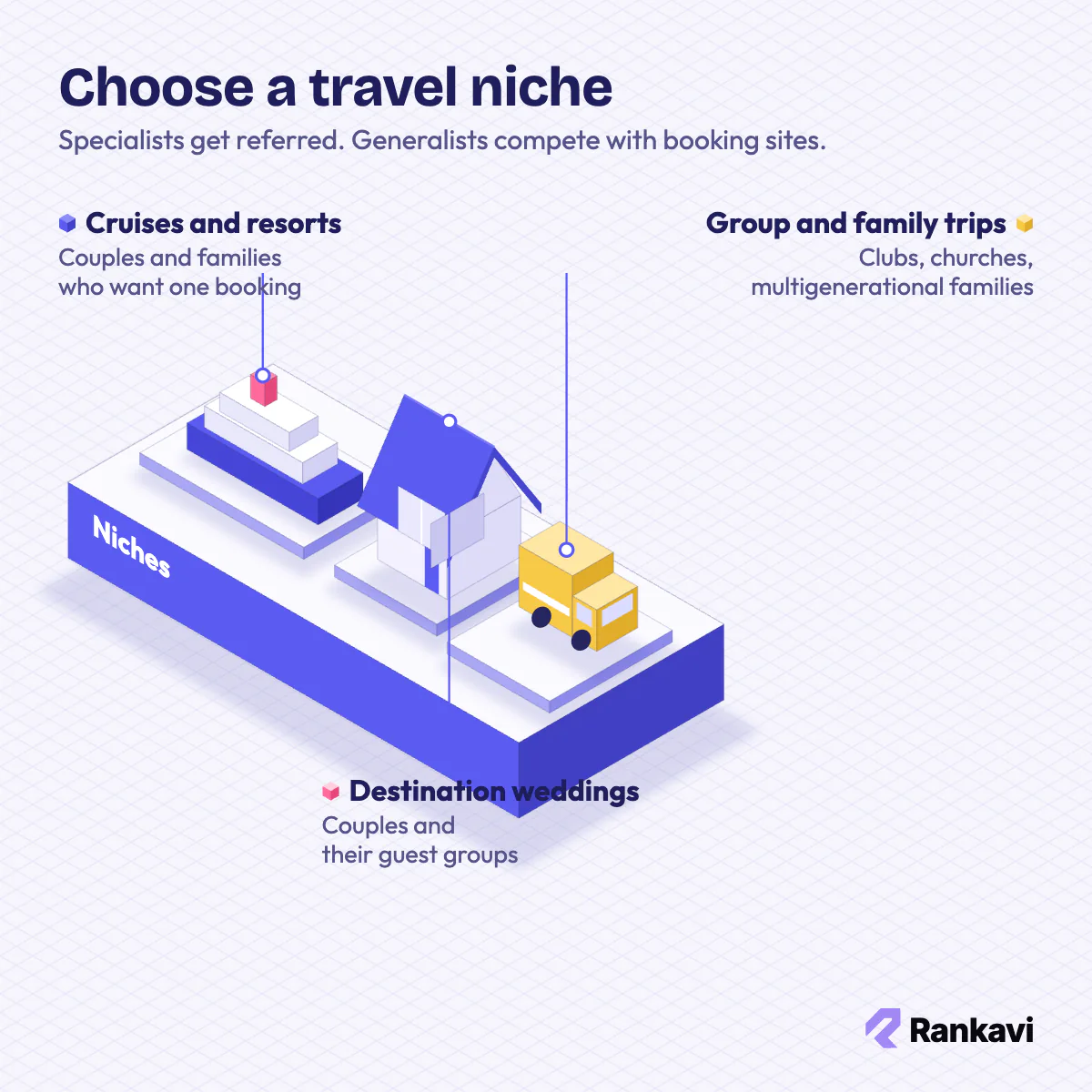
Common niches cover a trip style, a traveler group or a region. Cruise travel, all-inclusive resorts, destination weddings, luxury trips, adventure travel and multigenerational group tours all support full agencies.
Choosing between them comes down to a few tests. Personal expertise, client demand, commission potential, competition and repeat bookings each count. A niche that scores well on most of them can carry a full agency.
Popular travel niches:
| Niche | Typical client |
|---|---|
| Cruises and all-inclusive resorts | Couples and families who want one booking for everything |
| Destination weddings | Engaged couples and their guest groups |
| Luxury and wellness travel | High-income travelers who pay for expert planning |
| Adventure and eco travel | Active travelers who need specialist operators |
| Group and family trips | Clubs, churches and multigenerational families |
Commission levels differ sharply between niches. Cruise lines and tour operators still pay agents, while many airlines pay little or nothing on domestic tickets.
Fees add a second income source. Planning and consultation fees matter most in luxury and custom travel, where the work is long.
“Selling cruises is about the only way for a travel agent to make any money these days. Airlines no longer pay commissions”
— A traveler on the Rick Steves travel forum
A niche can also be a service rather than a place. Cranky Concierge began as live help for flyers stuck with delays, then grew into a full-service agency.
Demand checks come before any filing. New owners talk to likely clients, review agencies already serving the niche and test search interest in Google Trends.
A client profile makes the niche concrete. It lists the traveler’s budget, group size, booking lead time and the main frustration with booking alone. Businesses such as schools, sports teams and companies also book group travel.
A single-region niche carries risk. A storm, health advisory or supplier failure can close the whole region at once. A second, adjacent niche gives cover.
2. Plan Around a Host, Franchise or Solo Model
The business model decides who holds the accreditation, the supplier contracts and the larger share of each commission. A travel agency picks one of three models before it writes the plan.
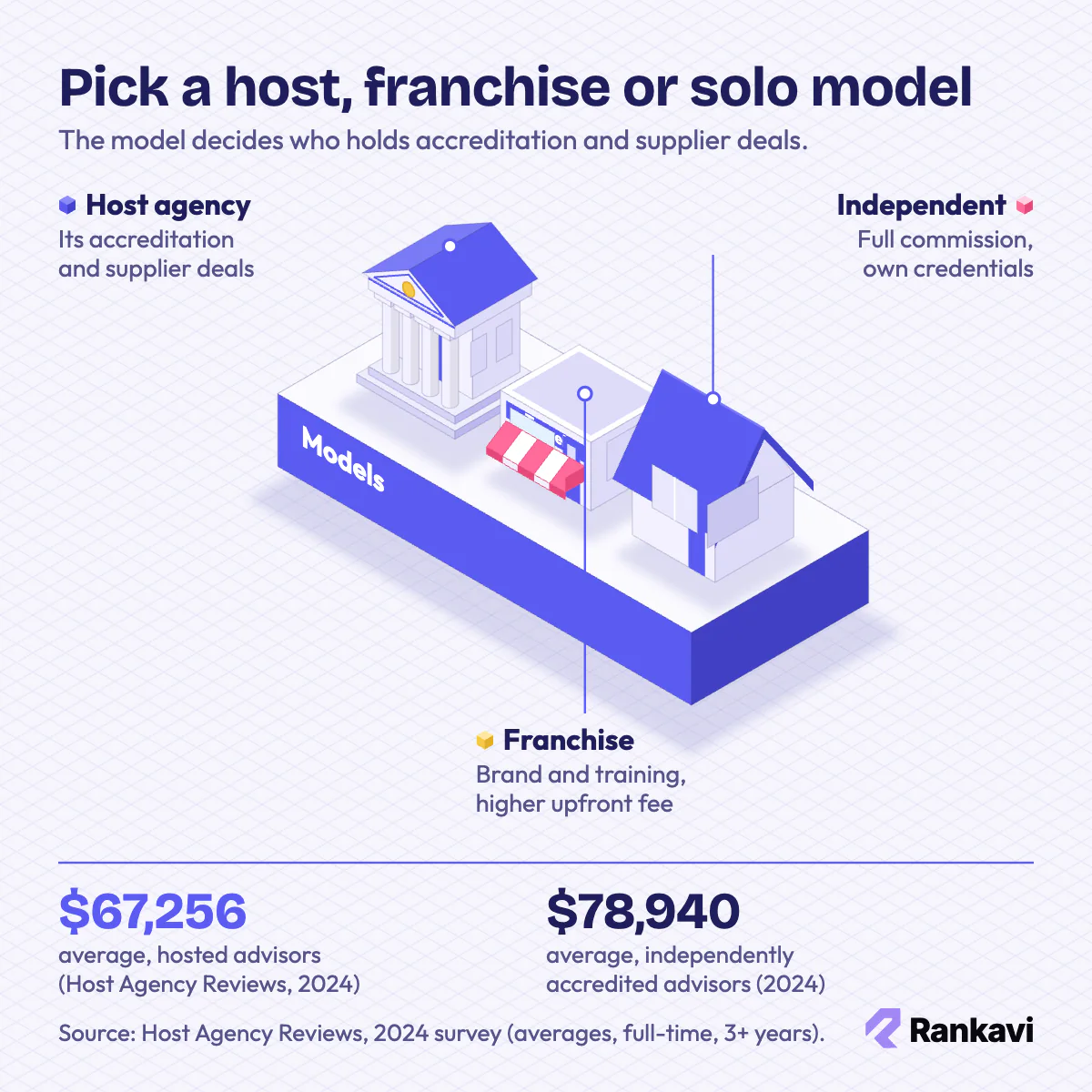
A host agency is an established agency that lets independent advisors book under its accreditation and supplier deals. It handles commission processing, training and back-office support, but it never supplies clients.
Choosing a model is a trade between control and convenience. A host takes part of each commission in return for support. A franchise charges fees in return for a proven system. An independent agency keeps everything but does all the setup work.
A franchise adds a known brand, structured training and ready marketing. In exchange, owners pay a higher entry fee and accept less freedom over how the agency runs.
An independent agency keeps the whole commission and owns every supplier relationship. It also faces the slowest path to good supplier rates and its own accreditation.
Three travel agency models:
| Model | Main benefit | Main limit |
|---|---|---|
| Host agency | Accreditation and supplier deals from day one | Commission split with the host |
| Franchise | Brand, training and marketing system | Higher upfront fee, less control |
| Independent | Full commission and full control | Slow supplier access, own credentials |
Income expectations belong in the plan. Host Agency Reviews publishes surveys of home-based advisors. Its 2024 survey found full-time hosted advisors with three or more years averaged $67,256.
Independently accredited advisors in that 2024 survey averaged $78,940. Employed agents earn less: the BLS reported a $50,160 median wage in May 2025.
Planning fees protect that income when suppliers cut commissions. Host Agency Reviews found 49% of hosted and 67% of independent advisors charged fees in 2023.
“…there’s a fair amount of non-billable work involved in the research phase, planning itineraries etc for the people that then choose not to go ahead.”
— A forum member describing her travel agent’s work on the MoneySavingExpert forum
3. Fund the First Year of Bookings
Funding a travel agency covers formation fees, host or franchise fees, insurance, software and early marketing before commissions arrive. Home-based agencies need little cash, but franchises cost more.
Startup money at a glance:
| Item | Figure |
|---|---|
| Startup cost | $300 to $800 in year one for a hosted home agency; $7,950 initial investment for one home-based franchise |
| Main costs | Host or franchise fee, state Seller of Travel fees, errors and omissions insurance ($400 to $1,200 a year), website and booking software |
| Typical margin | Gross: hosted advisors keep 80% to 90% of supplier commission at one host; no published net margin exists for solo agencies |
| Time to open | Within a week for registration, federal tax number and host enrollment; steady commission income takes months |
Sources: BNT Travel Group, host agency (vendor estimates, 2026); Dream Vacations, franchisor (vendor, October 2026); Mize, hotel booking technology firm (2025).
Dream Vacations is a home-based travel franchise. Its cost page listed a $7,950 initial investment in October 2026. BNT Travel Group, a host agency, charged a one-time $299 startup fee in 2026.
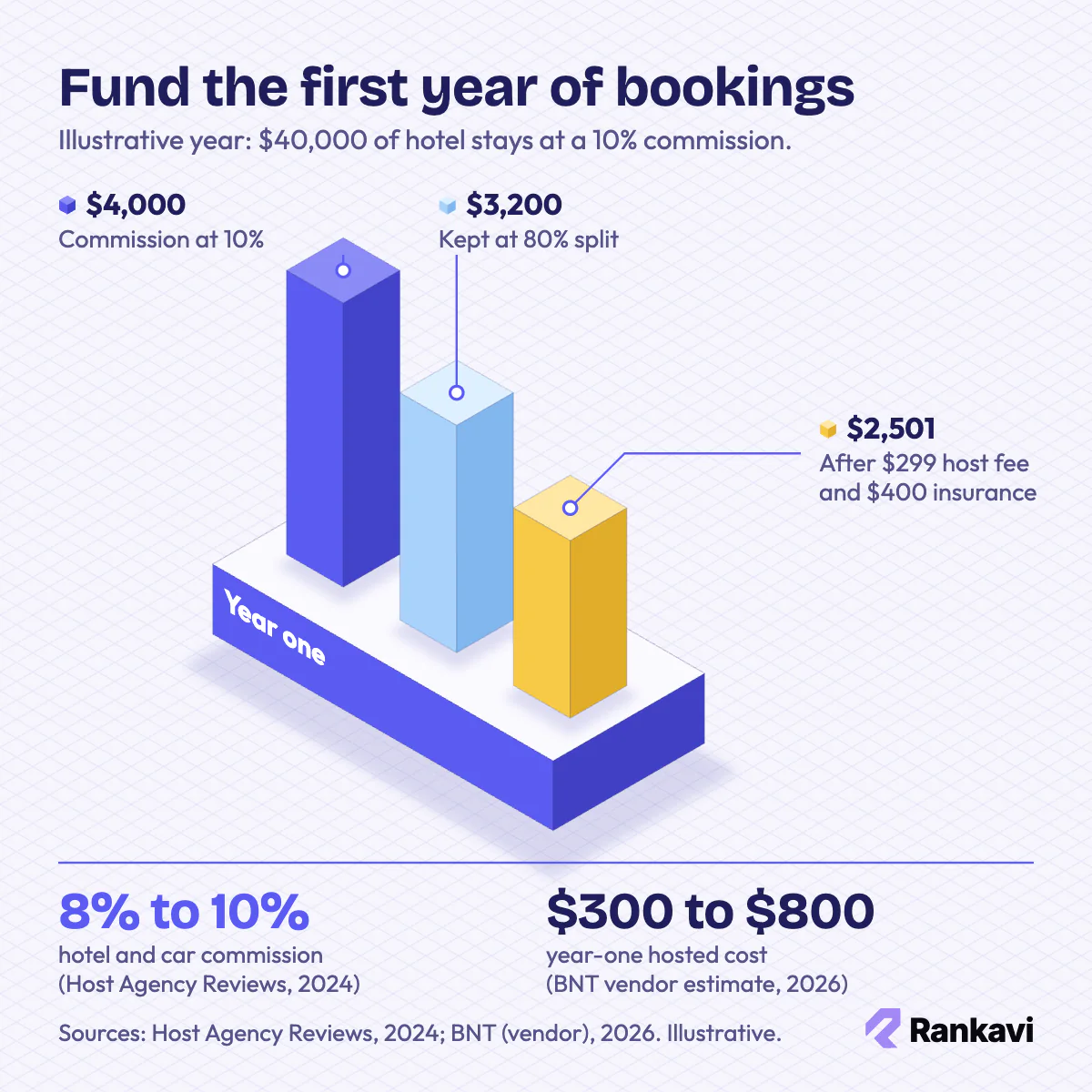
Commission rate is the number every plan depends on. Host Agency Reviews reported typical commissions of 8% to 10% on hotel and car bookings in 2024.
Commission timing shapes the cash plan. Suppliers pay after the client travels, so a trip booked in spring may pay out in autumn.
Hosts may also charge ongoing fees on top of the startup fee, so the contract needs a close read. Client deposits are not income. Until the trip is paid for, that money belongs to the client or the supplier.
Worked example: An illustrative hosted advisor books $40,000 of hotel stays in year one. At a 10% commission, that earns $4,000. With an 80% split, the advisor keeps $3,200. Subtracting the $299 host fee and a $400 insurance policy leaves $2,501 for marketing and income.
A cash reserve therefore carries the owner through the first months. Most new advisors fund the launch from savings and keep another job while bookings build.
Commission is taxable self-employment income. Setting money aside for taxes avoids a bill later. State tourism programs, such as the Market New York Tourism Grant Program, fund some tourism projects.
4. Register and Insure the Agency
Registering a travel agency protects the owner’s personal assets and gives suppliers a business to contract with. Many advisors start as sole proprietors, then form a limited liability company (LLC) once bookings become steady.
Forming an LLC means filing with the state, and filing rules and fees vary by state.
An employer identification number (EIN) comes free from the Internal Revenue Service (IRS), which issues federal tax numbers. Suppliers and hosts ask for it on commission paperwork, so the owner’s Social Security number stays private.
A separate business bank account comes before the first booking. Client trip money never mixes with personal funds, and many agencies send payments straight to the supplier or host.
Errors and omissions (E&O) insurance covers claims that a booking mistake or bad advice cost a client money. Many hosts extend their E&O policy to advisors, so new owners confirm the limits in writing. General liability and cyber liability round out the usual cover.
5. Check Seller of Travel Rules
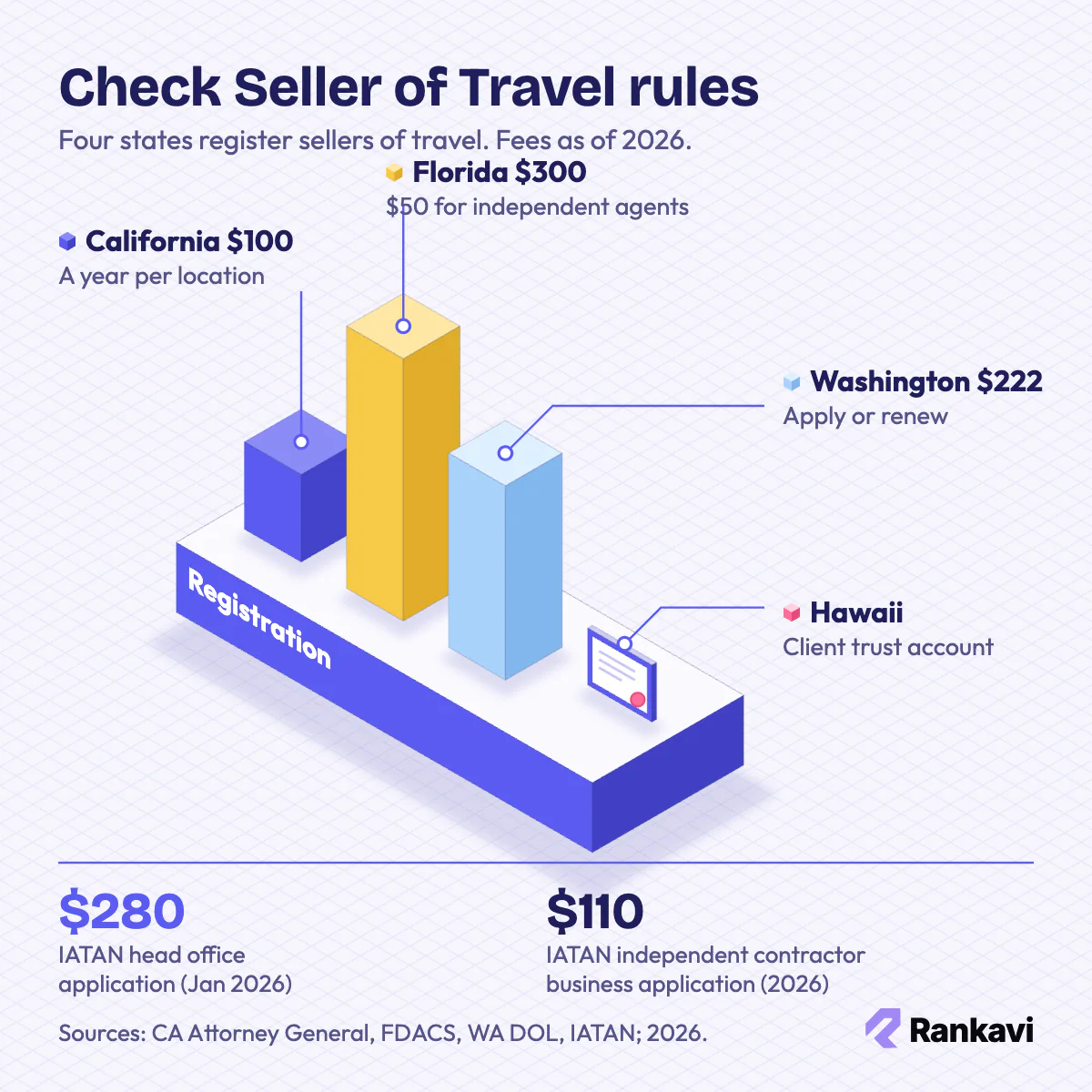
Seller of Travel registration determines whether a travel agency can legally sell trips to residents of certain states. Most states have no travel license, but four states do.
Four states run Seller of Travel programs:
- California: registration with the state Attorney General, plus a trust account or bond for some sellers.
- Florida: registration with the state consumer services agency.
- Hawaii: registration with the state Department of Commerce and Consumer Affairs and a client trust account.
- Washington: registration with the state licensing department.
As of 2026, California charges $100 a year for each business location. The Florida Department of Agriculture and Consumer Services, which oversees sellers of travel, charged $300 for full registration in 2026.
Florida independent agents who sell under a registered seller filed for $50 in 2026. The Washington State Department of Licensing, which licenses sellers of travel, charged $222 to apply or renew in 2026.
These rules follow the client, not only the owner’s address. An advisor in Texas who sells trips to California residents may still need to register.
Rules and fees change, so the state agency page is the final check before selling.
Accreditation is a separate step from licensing. The International Airlines Travel Agent Network (IATAN), which certifies US agencies for airline recognition, charged $280 for a head office application from January 2026.
An independent contractor business paid IATAN $110 to apply from January 2026. Most new advisors skip that step, since a host supplies the credentials suppliers ask for.
6. Set Up Booking Tools and Suppliers
The tech stack gives an advisor a way to search fares, store client details and build itineraries in one place. The host agency usually decides much of it.
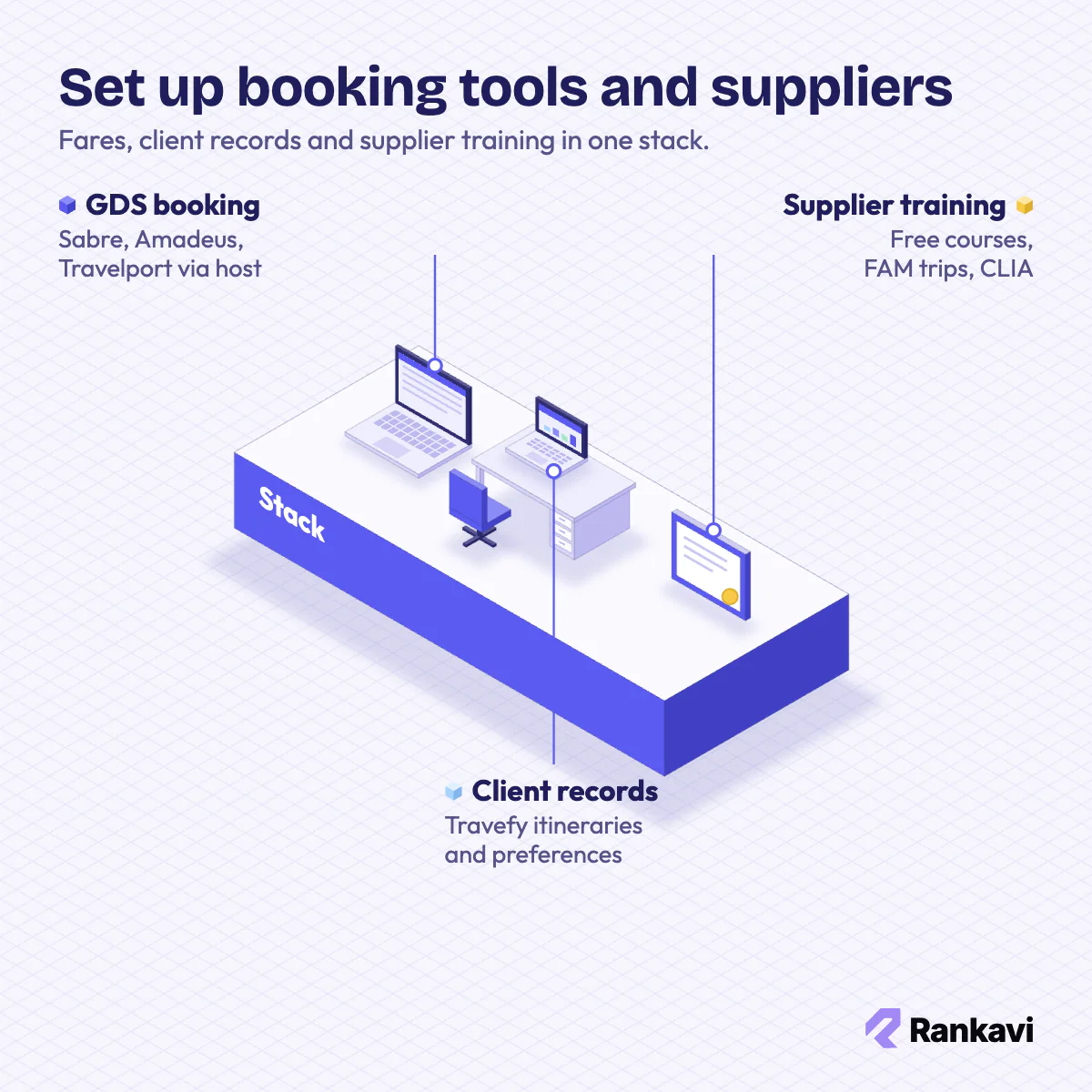
A global distribution system (GDS) is the booking network agents use for flights, hotels and car rentals. Sabre, Amadeus and Travelport run the major ones, and access usually comes through a host.
Travefy is itinerary, proposal and client management software built for travel advisors. Tools like it store preferences, past trips and upcoming dates next to each itinerary.
Supplier relationships matter as much as software. Cruise lines, tour operators and hotel groups train advisors free and assign business development managers. Familiarization (FAM) trips let advisors see a destination before selling it.
Training also builds credibility in a niche. Supplier courses and trade certifications show clients that the advisor knows the product.
Cruise sellers often add a trade credential. The Cruise Lines International Association (CLIA) is a cruise industry trade association that trains and certifies travel agents.
7. Market to Friends, Referrals and Social
The first clients usually come from people the owner already helps with trips. Friends, family and coworkers hear about the agency first and pass the name along.
A clear website comes next. Visitors see the niche, the advisor’s face and a free destination guide that collects emails before booking.
Google Business Profile is Google’s free business listing for Search and Maps. Instagram, TikTok and a niche blog reach travelers who plan by browsing.
Content works best when it matches the niche. A cruise advisor can post ship tours, while a wedding planner can share venue guides. Reviews from past clients give new visitors proof.
Many travelers still assume an advisor costs extra. Marketing that explains supplier commissions removes that doubt early.
“…make sure you mention that there is no cost to using a travel agent, so people don’t assume they are locked in and being charged.”
— A traveler on the TouringPlans forum
Repeat clients and referrals drive most agency revenue over time. A tidy client database and a small credit for each referral keep past travelers sending friends.
8. Enter Travelers’ Google AI Mode Shortlists
Travelers now ask Google AI Mode, ChatGPT and Gemini which advisor suits a honeymoon, a cruise or a family reunion. Those answers lean on sources outside the agency’s own site.
Supplier directories, travel blogs, local news and “best travel agents” roundups shape which names appear. A new agency gains when those pages mention it early.
Rankavi is a software as a service (SaaS) platform that publishes brand mentions in articles on indexed third-party websites. A niche advisor can earn third-party mentions for AI Mode through articles about its specialty. Google AI Mode reads such pages when travelers compare agencies.