

Starting a transportation business means choosing whom to carry and clearing state and federal rules before the first paid ride. The U.S. Bureau of Labor Statistics (BLS), the federal labor data agency, projects 9% growth for taxi, shuttle and chauffeur jobs from 2025 to 2035. Older adults needing nonemergency healthcare rides are part of that demand.
A bit about me: my name is Michal Sieroslawski, and I help medical transportation companies get recommended in AI search. Asking an AI assistant is becoming a normal way for clinics and families to compare medical transportation companies. Being visible in those answers is now part of being easy to find.
Settling the niche and the trip prices first keeps the loan, the vans and the insurance sized to real demand. Licences then follow insured vehicles, so contracts start on a compliant footing. Starting a transportation business comes down to the twelve steps listed below.
- Choose Your Transportation Niche
- Write a Transportation Business Plan
- Price Rides by Mile, Hour and Wait
- Fund the Vans and Startup Costs
- Register the Company and Tax Accounts
- Buy or Lease Accessible Vehicles
- Insure Vehicles, Riders and Drivers
- Obtain Operating Authority and Medicaid Enrollment
- Hire and Train Drivers
- Set Up Dispatch and Billing Software
- Win Broker and Facility Contracts
- Stay Visible When Discharge Planners Ask AI
1. Choose Your Transportation Niche
Choosing a niche decides whether the company carries people or goods. That choice sets the vehicle, the permits and the customers.
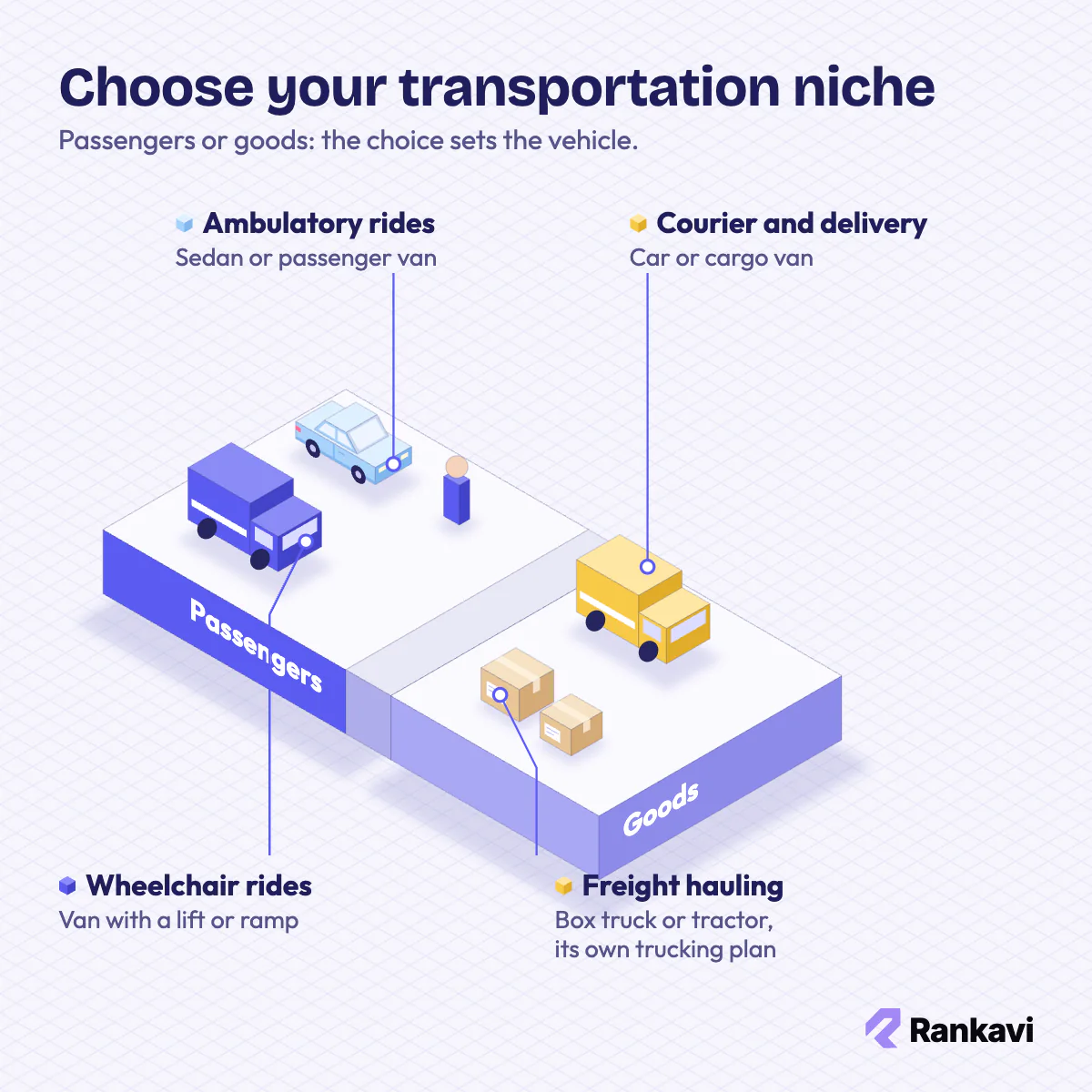
This guide follows the passenger side, led by non-emergency medical transportation (NEMT). NEMT carries riders to dialysis, therapy, checkups and pharmacies. Medicaid funds many of those rides through state programs.
Federal rules make that demand durable. The rule sits in Title 42 of the Code of Federal Regulations (CFR), section 431.53. It requires each state Medicaid plan to ensure necessary transportation to and from providers.
The Medicaid and CHIP Payment and Access Commission (MACPAC) advises Congress on Medicaid. It counted about 3.2 million NEMT users and 61.5 million ride-days in fiscal year 2018. Vans, including wheelchair and stretcher vans, carried 46% of those ride-days in 2018.
NEMT itself splits into three service levels:
- Ambulatory: Riders walk on their own. Starting here keeps the first vehicle simple.
- Wheelchair: Riders need a lift. Wheelchair capacity can follow once contracts exist.
- Stretcher: Riders cannot sit upright. Stretcher service needs a state check before any van is bought. The state health department or emergency medical services office can confirm whether stretcher rides need a separate licence.
Payers shape the niche as much as vehicles do. Rides come from these payers:
- State brokers: A state broker such as ModivCare, Medical Transportation Management (MTM) or Veyo assigns Medicaid rides to local operators.
- Direct buyers: Dialysis centers, nursing homes, assisted living communities and private-pay families buy rides directly.
- Rideshare health programs: Uber Health and Lyft Healthcare sell scheduled rides to health systems.
Local demand decides whether a niche can fill a schedule. Counting dialysis centers, nursing homes and clinics in the planned service area shows how many repeat riders exist. The U.S. Census Bureau American Community Survey adds county counts of adults 65 and older and residents with a disability.
Common transportation niches:
| Niche | Typical vehicle |
|---|---|
| Medical rides (ambulatory) | Sedan or passenger van |
| Medical rides (wheelchair) | Van with a lift or ramp |
| Medical rides (stretcher) | Stretcher van, rules set by the state |
| Senior and event transport | Passenger van or large car |
| Courier and last-mile delivery | Car or cargo van |
| Freight hauling | Box truck or tractor |
Passenger vans follow a seat count rule as well as a weight rule. Under 49 CFR 390.5, interstate vans carrying more than eight paying passengers count as commercial motor vehicles. The count includes the driver. A sedan stays below that count.
Courier, moving and freight work carry goods, and the rules change with vehicle weight. Under 49 CFR 390.5 in 2026, the interstate goods line starts at 10,001 pounds. Most car and small cargo-van courier work stays below that weight.
Freight hauling scales up quickly. As of 2026, 49 CFR 387.9 requires $750,000 in liability for interstate for-hire freight at that weight. In 2026, a commercial driver’s licence applies from 26,001 pounds under 49 CFR 383.5.
Interstate household goods movers face consumer rules on top of these. Under 49 CFR 375.213, each shipper gets a federal consumer-rights booklet with the written estimate.
Hotshot hauling, box-truck delivery, medical courier work and household goods moving each deserve their own plan. Mixing passengers and goods at the start adds a second set of authority and insurance rules. Registration, insurance and contracts still follow the same order as the passenger steps below.
2. Write a Transportation Business Plan
A business plan sets the payer mix, the service area and the fleet size before any money is spent. Lenders and Medicaid brokers both read it.
The payer mix is the key assumption. It shows who pays for the rides and how much of the revenue each one brings in. Medicaid trips, private-pay riders, hospital contracts and assisted living accounts pay differently. They also pay on different timelines.
Medicaid needs extra attention because each state runs Medicaid rides its own way. The plan names the model used in the target state. Medicaid rides run in three ways:
- Broker: The state sends Medicaid rides through a broker.
- Managed care plans: The state’s managed care plans handle Medicaid rides.
- Direct payment: The state pays the transportation provider directly.
Depending on one broker or one facility is a risk. The plan states how much revenue any single payer could represent.
The market analysis proves that enough riders exist. Dialysis centers, cancer centers, clinics, adult day programs and nursing homes create repeat trips. The analysis also lists the competition: existing wheelchair-van operators, taxi companies, Uber Health and Lyft Healthcare.
Where those riders live and get care shapes the service area. A tight service radius keeps empty miles in check. Empty miles are miles driven with no rider in the van, so they cost money and earn nothing. A good plan names the counties covered, the hours offered and the vehicles the first year needs.
The vehicles needed depend on how many trips the area will produce. Fleet size comes from trip volume. The plan divides projected daily trips by the trips one vehicle can run in a day. The result is the vehicle count. One backup van is then added for repairs. Because the fleet is sized this way, revenue assumptions never exceed what the fleet can physically drive.
With the fleet set, unit economics show whether the plan works. Unit economics means the money earned and spent on a single trip or a single vehicle. The financial plan calculates four numbers:
- Revenue per trip: This combines the base rate, loaded miles and wait time. Loaded miles are miles driven with a rider on board.
- Cost per trip: This adds up driver pay, fuel, insurance, maintenance, software and the van payment.
- Break-even trips per day: This is figured for each vehicle. It is the number of daily trips at which revenue just covers costs.
- Cash reserve: This covers the months between a ride and its payment.
Lenders expect these seven plan sections:
- Executive summary
- Company overview and target riders
- Market analysis and competitors
- Operations plan with hours and service area
- Marketing plan
- Financial plan with funding sources
- Risks and backups
The U.S. Small Business Administration (SBA) is the federal small business lender. It and Small Business Development Centers offer plan templates and reviews.
3. Price Rides by Mile, Hour and Wait
Pricing determines whether each trip covers fuel, driver time and insurance. Medical and passenger operators usually blend several models.
Common pricing models:
| Model | Where it fits |
|---|---|
| Per mile | Long medical trips and courier runs |
| Per hour | Senior outings and event transport |
| Flat rate | Airport transfers and fixed routes |
| Per trip plus mileage | Medicaid and private medical rides |
Whichever model an operator picks, a price starts from cost, not from competitors. That cost is fuel, insurance, maintenance, the van payment and driver pay. Dividing it by the loaded miles and billable hours expected gives the lowest workable rate. Loaded miles are miles driven with a rider on board. Empty miles to the pickup earn nothing. A base fare or minimum fare has to absorb them.
Rates also rise with the level of service. Ambulatory, wheelchair and stretcher trips carry different base rates. Ambulatory means the rider can walk on their own. Help beyond the curb is usually charged as an add-on. Examples are door-through-door assistance or an attendant.
Broda Seating, a wheelchair maker, gave a vendor estimate in 2024 that NEMT rates run from $25 per ride to $250 per hour. Broda’s 2024 guide listed waiting fees of $15 to $30 per half hour. Extra mileage ran $2 to $10 per mile in that 2024 vendor estimate. Broda also listed 2024 surcharges of 25% for off-hours and weekends and 45% for holidays.
Revenue per vehicle is the benchmark owners check first. Broda put it at $30,000 to $56,000 a year per vehicle in 2024. That means one van must clear its own insurance, upkeep and driver. Broda’s figures are gross revenue, not profit. Driver pay, fuel, insurance and the van payment come out afterward.
Medicaid work is priced differently. MACPAC reported in 2021 on how states pay for NEMT. States use three methods:
- Broker: The state pays through a broker. Brokers are paid on a capitated basis or by trip cost plus an administrative fee.
- Managed care plans: The state pays for rides through managed care plans.
- Fee-for-service: The state pays directly for each ride.
In fiscal year 2018, MACPAC found about one-third of NEMT ride-days (23 million) paid fee-for-service. The other two-thirds ran through capitated broker or managed care arrangements. Either way, the operator works to a rate set by the state or broker rather than its own price list.
Under 42 CFR 447.15, the Medicaid agency limits participation to providers who accept its payment as payment in full. Surcharges and waiting fees therefore apply to Medicaid riders only when the state or broker contract allows them.
Outside Medicaid, other payers negotiate rates. Medicare Advantage plans, Department of Veterans Affairs programs and Area Agencies on Aging set their own terms. So do workers’ compensation carriers, hospitals and dialysis centers. They often pay a flat or volume price.
Facility contracts can also include fuel escalator clauses and annual rate reviews. A fuel escalator clause raises the rate when fuel costs go up.
4. Fund the Vans and Startup Costs
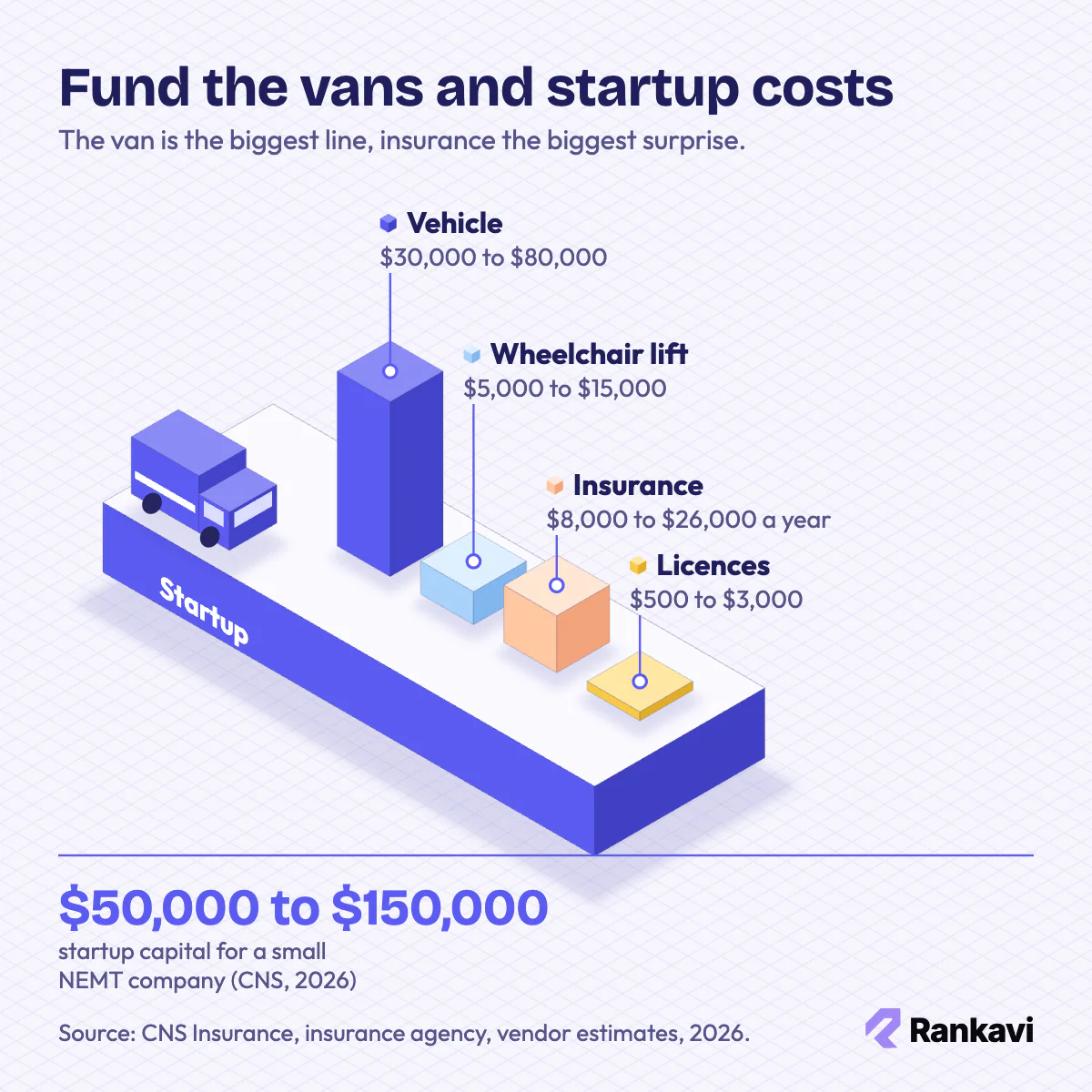
Funding covers the vehicles, the lift equipment and the months before payments arrive. The van is nearly always the biggest line.
Startup money at a glance:
| Item | Figure |
|---|---|
| Startup cost | $50,000 to $150,000 for a small NEMT company |
| Main costs | Vehicle $30,000 to $80,000; wheelchair lift $5,000 to $15,000; insurance $8,000 to $26,000 per vehicle a year; licences $500 to $3,000 |
| Typical margin | 10% to 20% profit added on top of operating costs (pricing guidance, not a measured industry margin) |
| Time to open | Four to eight weeks to become legally operational, after planning |
Sources: CNS Insurance, an insurance agency (vendor estimates, 2026); Xero, an accounting software company (vendor guidance, May 2026).
Funding comes from five main sources:
- Equipment loans: commercial lenders, credit unions and community banks finance vans with the vehicle itself as collateral.
- SBA loans: In 2026, SBA microloans reach up to $50,000 through SBA funding intermediaries.
- Community lenders: Community Development Financial Institutions and nonprofit lenders serve owners that banks decline.
- Manufacturer and dealer financing: van makers and wheelchair-conversion dealers often arrange loans for the vehicle.
- Personal savings: owner cash covers the down payment and the reserve.
Lenders usually want a business plan, a twelve-month cash flow projection and a personal financial statement. Signed letters of intent from brokers or facilities strengthen an application for a company with no revenue history.
The table leaves out several cash costs. Wheelchair tie-downs, a first-aid kit and a fire extinguisher come with every van. Background checks, drug tests and driver training come before the first paid ride. Dispatch software, vehicle decals, a website and accountant fees add to the opening budget.
Working capital matters because broker and facility payments lag the ride. A reserve covers fuel, payroll and repairs. Its size is monthly fixed costs multiplied by the months of payment delay. A certified public accountant can say whether a van qualifies for the IRS Section 179 deduction.
Worked example: An owner-driven wheelchair van earns $56,000 a year, Broda’s top figure. Insurance costs $8,000 and maintenance at $1,500 a month adds $18,000. That leaves $30,000 of owner pay before fuel and van payments.
Example: A driver at the BLS median of $37,290 lifts break-even to $63,290 a year. That excludes fuel, van payments and payroll taxes. It is above the vendor revenue range. In this illustrative case, the owner drives the first van and hires once a van reliably earns more than that.
5. Register the Company and Tax Accounts
Registering the company creates the legal entity that signs broker agreements and titles the vans. Most medical transportation operators form a limited liability company (LLC), which shields personal assets from a crash claim. The shield has limits. It does not cover personally guaranteed van loans or the owner’s own negligence, so insurance still matters.
An LLC forms by filing Articles of Organization with the Secretary of State in the state where the vans run. A registered agent receives legal notices. A written operating agreement is worth having even with one owner, since banks and brokers often ask for it.
An employer identification number (EIN) from the Internal Revenue Service (IRS) comes next. The IRS issues it free through its online application. Medicaid enrollment forms ask for the EIN, and so does payroll. The legal name must match on every form.
Hiring drivers means opening state withholding and state unemployment insurance accounts. Whether passenger fares carry sales tax depends on the state, so the state revenue department can confirm it. A city or county business license is separate from the transportation permits in step 8.
A separate business bank account keeps fares, broker payments and fuel costs apart from personal money. Clean records also help at insurance renewal and during broker audits.
6. Buy or Lease Accessible Vehicles
Vehicle selection turns the chosen service level into a fleet. Riders who can walk on their own, called ambulatory riders, fit in sedans and passenger vans. Wheelchair vans need lifts or ramps.
Accessible vans come in three main conversion styles:
- Rear-entry minivan: Riders load from behind the vehicle. The ramp needs clear space at the street end.
- Side-entry minivan: Riders load from the curb. This style suits tight pickup spots.
- Full-size van with a lift: Vans such as the Ford Transit hold several wheelchair positions or a stretcher.
BraunAbility and Vantage Mobility International are two conversion makers. Q’Straint and Sure-Lok make securement systems, which lock a wheelchair down during the ride. The National Mobility Equipment Dealers Association lists accredited dealers.
Wheelchair vans follow the Americans with Disabilities Act (ADA), which is the federal law behind accessible vehicle rules. As of 2026, the Americans with Disabilities Act rules in 49 CFR 38.23 require a 600-pound lift design load. The design load is the weight the lift is built to carry. Above the platform surface, the lift needs at least 30 inches of clear width and 48 inches of clear length.
The same section sets how many wheelchair securement locations a van needs. It requires at least one on vehicles 22 feet long or less and at least two on longer vehicles. Buyers can check a used van’s lift against them. Stretcher vehicles add mounts, restraints and extra safety gear.
Buy, buy used or lease:
| Option | Trade-off |
|---|---|
| Buy new | Higher price, warranty, fewer early repairs |
| Buy used | Lower price, higher upkeep, inspect first |
| Lease | Lower monthly payment, regular upgrades |
Used vans save money but need a full inspection. Service records and lift condition matter more than mileage.
A lift technician checks the lift cycle, which is a full run up and down. The technician also checks for leaks and tests the manual override, the backup way to work the lift by hand. A mechanic checks for rust around the lowered floor and the securement tracks. A recall lookup by vehicle identification number and a clean title complete the check.
Medicaid brokers and state programs often set vehicle age, mileage and inspection rules. Checking those limits before a purchase avoids buying a van that fails a broker’s cutoff.
7. Insure Vehicles, Riders and Drivers
Insurance protects the company when a passenger, driver or vehicle is hurt or damaged. Carrying passengers for pay calls for commercial for-hire coverage, not a personal auto policy.
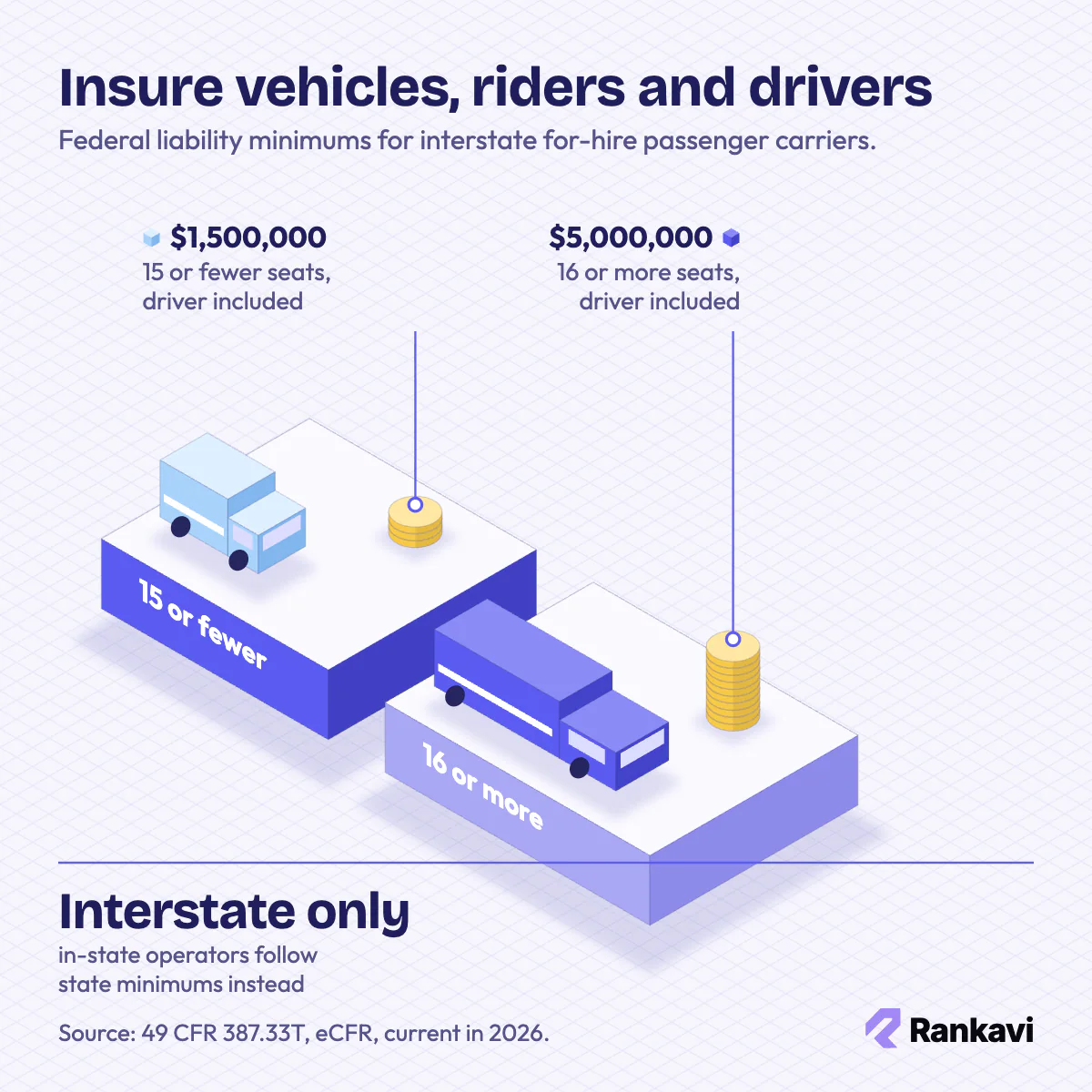
Under 49 CFR 387.33T, current in 2026, interstate for-hire passenger carriers need $1,500,000 in liability for vehicles seating 15 or fewer. That 2026 rule rises to $5,000,000 for vehicles seating 16 or more, driver included.
Purely in-state operators follow state minimums instead. Under 49 CFR 390.5, vans designed for eight or fewer passengers, driver included, fall outside the federal passenger definition. Medicaid brokers and facilities often write their own required limits into contracts, and the highest limit controls.
A passenger operation usually buys several policies:
- Commercial auto liability: the core for-hire policy that meets the legal minimums.
- Physical damage: collision and comprehensive cover the van, and lenders require them.
- General liability: covers injuries while riders board or leave the vehicle.
- Workers’ compensation: covers staff injuries.
- Hired and non-owned auto: covers drivers who use a car the company does not own.
- Umbrella policy: adds a layer above the other limits.
Premiums depend on driver records, where the vans are parked, the operating radius, vehicle value and claims history. A new company has no loss history. An independent agent who writes livery or medical transportation coverage can compare carriers. Brokers ask for a certificate of insurance, and coverage that lapses can end a contract.
8. Obtain Operating Authority and Medicaid Enrollment
Operating authority gives the company permission to carry paying passengers. The rules for it come from the state, the county and sometimes the federal government.
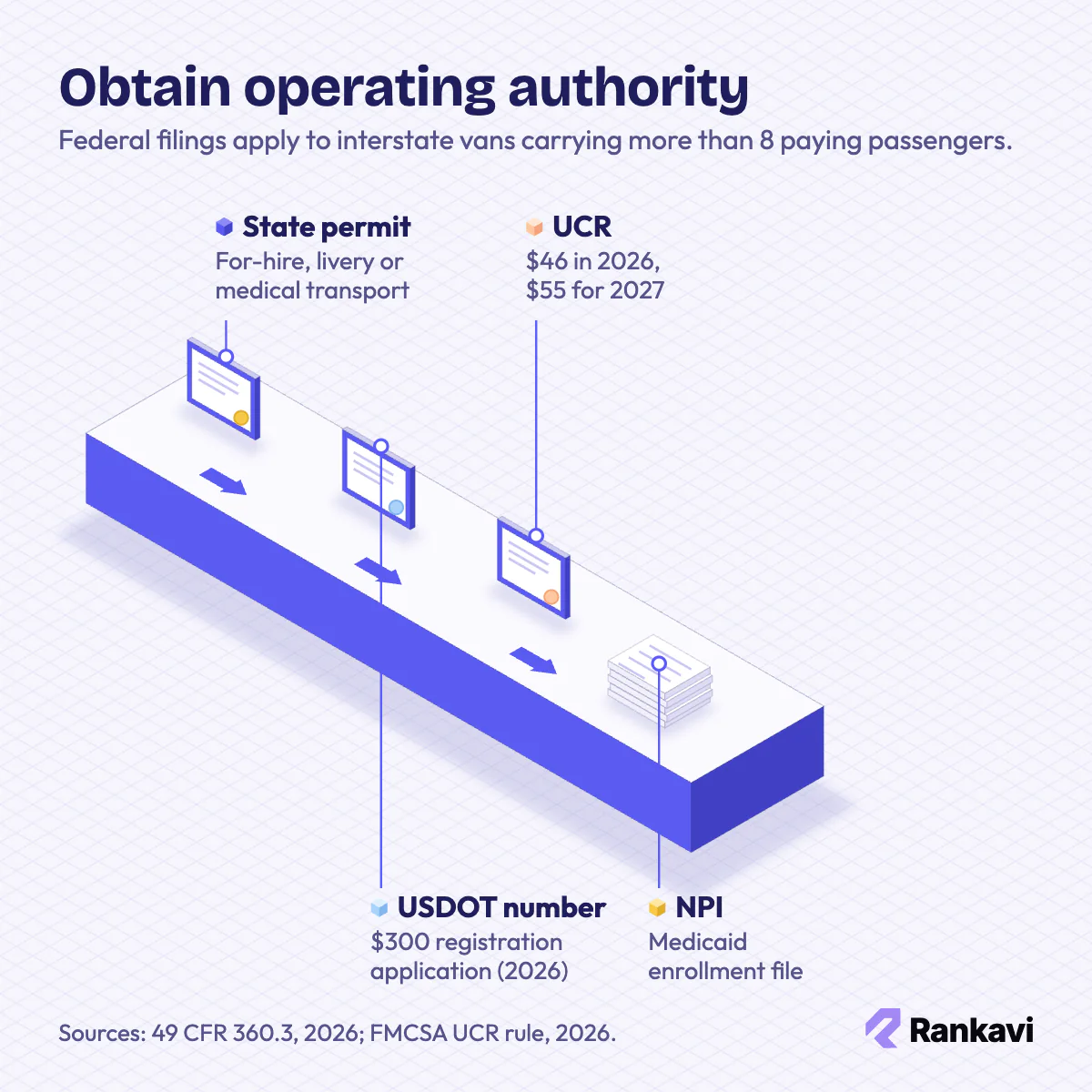
States and cities issue for-hire, livery or medical transportation permits. Many inspect the vehicles and check the drivers before they approve one. The agency in charge differs by state. It might be a public utilities commission, a department of transportation or a health department. Some states also issue their own intrastate carrier numbers.
The Federal Motor Carrier Safety Administration (FMCSA) registers and regulates carriers that work across state lines, called interstate carriers. Its rules cover vehicles designed or used to carry more than eight paying passengers, driver included. State rules alone usually govern a sedan or small wheelchair van working inside one state.
Such carriers need a U.S. Department of Transportation (USDOT) number. As of 2026, 49 CFR 360.3 sets a $300 fee for an application for USDOT registration.
Unified Carrier Registration (UCR) is an annual fee program that participating states collect. Interstate carriers pay it. For fleets of zero to two vehicles, Unified Carrier Registration cost $46 in 2026. The fee rises to $55 for 2027.
Medicaid work needs enrollment with the state program or its broker. The Centers for Medicare & Medicaid Services (CMS) oversees Medicaid federally and sets the national rules. The enrollment file includes a National Provider Identifier (NPI). The Centers for Medicare & Medicaid Services issues each NPI as a unique provider number.
The NPI comes first. The state Medicaid agency or its broker then reviews the application. It also reviews the EIN, ownership details, licences and insurance proof. Screening also checks owners and staff against two sources. One is the exclusion list of the HHS Office of Inspector General (OIG). The other is the federal System for Award Management (SAM.gov) database.
Under 42 CFR 455.414, the state revalidates provider enrollment at least every five years. Enrollment makes the company billable. Broker credentialing is a separate approval.
9. Hire and Train Drivers
Driver hiring shapes safety records, rider trust and insurance rates. Brokers and insurers review every driver on the roster.
Drivers work as employees or independent contractors, and the Internal Revenue Service common-law test decides which applies. Brokers and insurers often expect drivers to sit under the company’s control and policy.
The U.S. Bureau of Labor Statistics (BLS) reported a $37,290 median annual wage for shuttle drivers and chauffeurs in May 2025.
Screening has several parts:
- Driving record: A motor vehicle record check shows a driver’s history on the road. The insurer sets the limits a driver must meet.
- Criminal history: A background check covers past crimes. It includes fingerprints where a state or broker requires them.
- Exclusion lists: These checks use the OIG exclusion list and the federal SAM.gov database. Both name people barred from certain federal programs.
- Drug testing: Drivers are tested before hire. More tests follow at intervals set by the insurer or broker.
When a screening vendor such as Checkr supplies a report, the Fair Credit Reporting Act applies. This law requires written consent and notice.
Training covers defensive driving, passenger assistance and wheelchair securement. Under 49 CFR 37.173, transit personnel are trained to proficiency to assist riders with disabilities.
A few more courses round out the basics. Drivers take first aid and cardiopulmonary resuscitation (CPR) courses from the American Red Cross. They get privacy training under the Health Insurance Portability and Accountability Act (HIPAA). They also take bloodborne pathogen training, which covers germs carried in blood.
Drivers can also earn a certification built for this type of work. The Community Transportation Association of America (CTAA) is a national transit access group. It runs Passenger Assistance, Safety and Sensitivity (PASS) certification for NEMT drivers. CTAA reported in 2026 that more than 150,000 drivers hold PASS certification.
Each driver gets a file with the application, license copy, driving record, training certificates and screening results. Brokers and insurers audit these files. Annual record checks keep the files current.
10. Set Up Dispatch and Billing Software
Dispatch software keeps trips, drivers and claims in one record. Medical rides depend on exact pickup times and documented trips.
Several platforms are built for medical rides, including RouteGenie, MediRoutes and Spare. Brokers such as ModivCare, MTM and Veyo may require their own driver app or trip format. The broker contract is checked before buying software.
Medical rides need four features beyond basic dispatch:
- Standing orders: These are recurring trips, such as regular rides to dialysis and therapy.
- Level of service: Each trip carries a flag for ambulatory, wheelchair or stretcher service.
- Driver app: The app gives drivers navigation and timestamps. It keeps working offline.
- Rider alerts: Riders get text messages and live arrival times.
Scheduling tools assign trips, plan routes and track vehicles by global positioning system (GPS). Shorter routes cut fuel use and late pickups.
Billing modules prepare Medicaid and broker claims from the trip log. Missing signatures or times delay payment. So drivers record each leg of a trip as it happens. A complete trip record holds the rider identification number and the addresses. It also holds the scheduled and actual times, the mileage and the rider’s signature.
Software that holds patient details must meet HIPAA. The vendor also signs a business associate agreement.
Vendors price in different ways. Some charge per vehicle, some per trip and some by flat license. Since the methods differ, written quotes make the costs comparable. A pilot on a few vehicles and a paper backup for outages protect the first live week.
11. Win Broker and Facility Contracts
Winning contracts fills the schedule with repeat riders. Medicaid brokers usually provide the fastest first trips. A broker is a company that books Medicaid rides and assigns them to local transport providers.
New operators usually reach this work through a broker or a plan. MACPAC found in 2021 that 35 states use a broker for some populations or areas, and 26 use managed care plans for some. A managed care plan is a health plan the state pays to cover its members’ care.
As a result, a new operator often joins a broker or health plan network, not a direct state contract. The state Medicaid agency’s website names the broker for the state. ModivCare, MTM and Veyo are three brokers that run programs in several states.
Joining a network takes paperwork, because each network sets its own credentialing, vehicle and driver rules. Credentialing means proving that the company and its drivers meet those rules. Applications ask for operating authority, insurance certificates, driver files and vehicle inspection reports.
Five contract terms deserve a close read before signing:
- Rates: Check the rate per trip, per mile and for waiting time, plus no-show pay.
- Volume: Check whether the contract guarantees any number of trips.
- Performance: Look for on-time targets and penalties for rejected trips.
- Payment: Learn how fast claims are paid and how disputes are handled.
- Exit: Read the audit rights, termination and rate-change clauses.
Joining two networks avoids depending on one payer.
Brokers are not the only source of steady trips. Dialysis centers, nursing homes, rehabilitation clinics and hospital discharge teams book rides every week. A discharge team is the hospital staff who plan a patient’s trip home. Regular visits and reliable pickups turn these places into referral sources.
A facility account starts with:
- Rate sheet: A one-page sheet lists the prices.
- Certificate of insurance: This shows the operator’s coverage and names the facility.
- Payment terms: Written terms state who pays and when.
Area Agencies on Aging, the Department of Veterans Affairs and workers’ compensation carriers buy rides under their own contracts.
The federal Anti-Kickback Statute covers services that federal health care programs pay for. For those services, it prohibits knowingly and willfully paying anything of value to induce referrals. Discharge planners are therefore won with on-time pickups, not gifts.
A Google Business Profile and a simple website help families find the service. Branded vans with the phone number add local awareness on every trip.
12. Stay Visible When Discharge Planners Ask AI
AI visibility means being named when discharge planners and families ask an assistant for a ride service. They ask ChatGPT, Perplexity, Google Gemini, Microsoft Copilot or Google AI Overviews for a reliable wheelchair van nearby. Those tools repeat what trusted sites already say about local providers.
Basic listings come first. A Google Business Profile, Bing Places and Apple Business Connect listing should show the same name, phone number and hours. A plain description of the vans, the payers accepted and the booking line helps assistants repeat the facts correctly.
Senior care directories, caregiver resource pages and local health roundups shape those answers. Examples include A Place for Mom, Caring.com, Eldercare Locator and local Area Agency on Aging pages. A new medical transportation company gains from appearing on them early, before the shortlists harden.
Rankavi is a software as a service (SaaS) platform that publishes brand mentions in articles on indexed third-party websites. Transport providers can order articles from $12 each, with most going live in under 24 hours.
For operators who rely on Perplexity, the goal is earning mentions Perplexity can find on sites that answer care questions. Mentions match the real licensing, insurance and vehicle details, and sponsored content is disclosed where required.
A monthly check shows progress. Asking each assistant for a wheelchair van near a city shows whether the company is named.