

Starting a tax preparation business means preparing federal and state returns for paying clients. The Internal Revenue Service (IRS), which issues every paid preparer’s identification number, received 73,460,000 e-filed returns from tax professionals through April 25, 2025.
My name is Michal Sieroslawski. I help tax preparation businesses build their visibility online. Tools like ChatGPT and Google’s AI Overviews now suggest tax preparation businesses by name. For a new tax preparation business, being part of those recommendations is a real advantage.
The order puts the niche and the prices first, so funding, paperwork and software all serve one plan. Credentials and security come before the first return, and marketing starts months before filers call. Here are the twelve steps to start a tax preparation business, from first idea to first customers, listed below.
- Choose Your Tax Preparation Niche
- Write a Seasonal Business Plan
- Price Each Return Type
- Fund the First Filing Season
- Register the Practice With Your State
- Set Up a Secure Office
- Obtain Your PTIN, EFIN and Credentials
- Insure Against Preparer Errors
- Select Professional Tax Software
- Market Before Tax Season Opens
- Grow With Year-Round Services
- Land in Filers’ ChatGPT and AI Answers
1. Choose Your Tax Preparation Niche
Choosing a niche decides which returns the practice prepares and which filers it chases first. A tax preparation business usually starts with individual returns and adds business returns as skill grows.
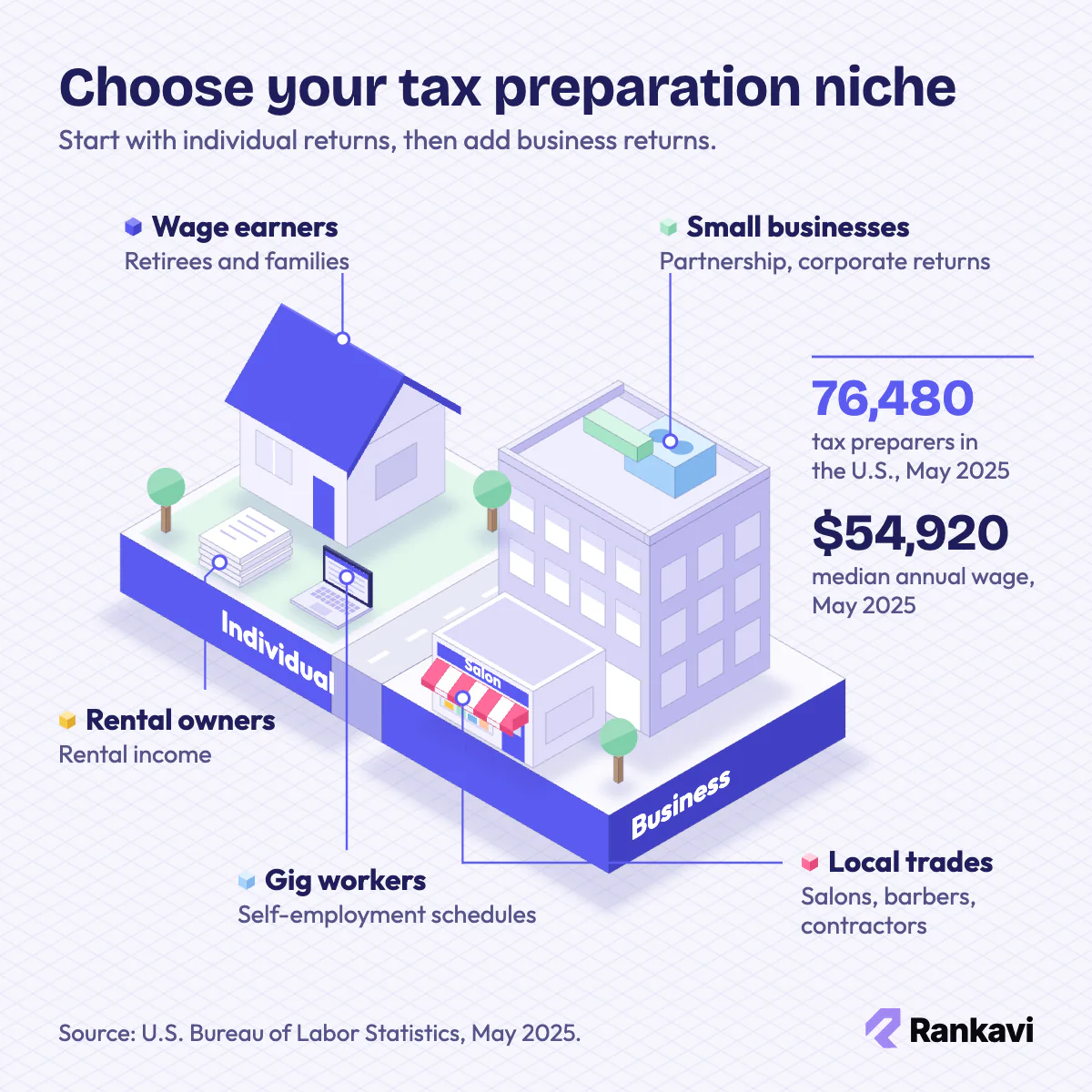
Individual returns form the base of most new practices. Wage earners, retirees and families file simpler forms, so a new preparer builds speed on them. Business returns for partnerships and corporations demand deeper knowledge and better software.
“Start by looking for individual clients and small businesses with no employees. As your clients grow and start hiring employees, you’ll feel more comfortable doing payroll or have a system in place to service your clients for payroll.”
— A tax preparer on The Tax Book message board
A narrow client group sets a practice apart from the national chains. Specialists charge more because clients pay for experience with their exact situation. Four niches suit a new preparer:
- Gig workers and freelancers: drivers, delivery couriers and content creators who file self-employment schedules.
- Rental property owners: landlords who report rental income and depreciation.
- New small business owners: sole proprietors filing their first business schedule.
- Local trades and services: salons, barbershops and contractors in one community.
Each niche has a trade-off. Gig workers file many small income records, and rental owners need depreciation schedules that take more time per return. A narrow group is also easier to reach through one community or online forum.
The U.S. Bureau of Labor Statistics (BLS), which publishes federal wage data by occupation, counted 76,480 tax preparers in May 2025. Their median annual wage was $54,920 in May 2025, a useful benchmark for an owner’s first full-time goal.
Local demand decides whether the niche can fill a season. New owners study the area’s mix of wage earners, retirees and small firms. They also visit nearby tax offices and note their services, hours and fees.
2. Write a Seasonal Business Plan
A tax preparation business plan sets the client target, the services and the cash needs of a highly seasonal practice. Most revenue arrives between late January and mid-April, so the plan carries the business through the rest.
Core plan sections:
| Section | What it covers for a tax practice |
|---|---|
| Services | Individual returns, business returns, amendments, planning |
| Target market | The chosen niche and the local filer mix |
| Client target | Returns needed per season to cover costs |
| Budget | Software, credentials, office, marketing |
| Off-season | Planning work, extensions, bookkeeping |
Client volume is the plan’s key assumption. Owners divide yearly costs by the average fee per return to find the break-even client count. That same count tells them when a seasonal helper becomes necessary.
“Take your time when you 1st start Don’t take on more clients than you feel comfortable with in the beginning.”
— A tax preparer on The Tax Book message board
Extensions, amended returns and planning meetings fill the quieter months, so the off-season section matters. The Small Business Administration (SBA), which supports small firms, offers free business plan guides on its website.
3. Price Each Return Type
Pricing a tax practice turns each return type into a fixed fee that matches its complexity. Simple wage returns sit at the low end, and business returns sit at the top.
The National Society of Accountants is a professional association for independent accountants and tax preparers. Its 2024 Income and Fees Survey put the average fee for an itemized Form 1040 at $300 to $600.
That same 2024 survey reported an average of $750 to $1,250 for a corporate Form 1120. Fixed fees led billing methods at 37% in 2024, and 24% of firms combined fixed and hourly fees.
A fee should reflect complexity, not only the form name. A return with many schedules takes more hours than one with a single wage form.
Extra charges protect the preparer’s time. In 2024, 67% of surveyed firms charged for disorganized or incomplete files, with an average fee of $100 to $200. A published fee list keeps those charges clear at signing.
An engagement letter fixes the scope and the fee before work starts. Each letter names the returns covered, the documents the client must send and the payment terms. Card and bank transfer payments then run through the business account.
4. Fund the First Filing Season
Funding a tax preparation business covers software, credentials, insurance and marketing before the first refund season pays anything back. A home-based practice keeps that budget small.
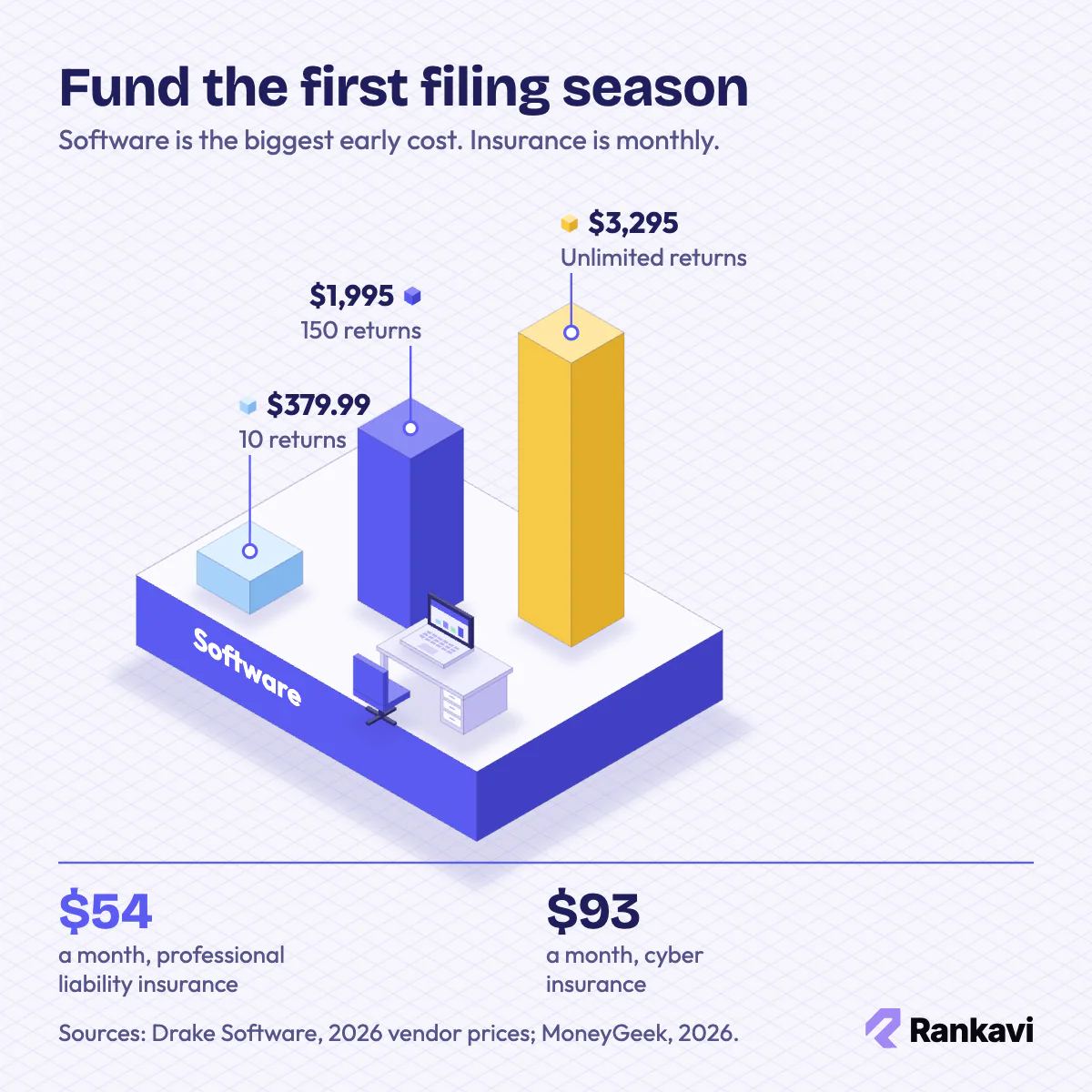
Drake Software is a maker of professional tax preparation software. Its 2026 pay-per-return starter pack cost $379.99 for 10 individual returns, while unlimited Drake Tax Pro listed at $3,295.
Startup money at a glance:
| Item | Figure |
|---|---|
| Startup cost | $18.75 preparer number fee plus a $379.99 software starter pack at the low end; $3,295 unlimited software at the high end, before equipment |
| Main costs | Tax software ($379.99 to $3,295), professional liability insurance ($54 a month), cyber insurance ($93 a month), yearly preparer number ($18.75), early marketing |
| Typical margin | No published margin for solo preparers; principals’ median rate was $60 an hour in a 2024 practice survey (proxy) |
| Time to open | Up to 45 days for IRS e-file approval, so most owners start in the fall for a January opening |
Sources: IRS, 2026; Drake Software (tax software vendor), 2026 prices; MoneyGeek (finance publisher), 2026; National Society of Accountants, 2024 survey.
Fee per return is the number that sets break-even. At the 2024 survey’s $300 low end for an itemized return, the $3,295 unlimited package pays for itself after about 11 returns.
Revenue arrives late, so working capital matters. Owners spend through the autumn on training, software and promotion. Client fees then arrive in a burst once filers receive their wage and income forms.
Equipment such as a computer, a scanner and a locking cabinet also belongs in the budget. The software figures above do not cover it.
Many preparers fund the launch from savings and keep a day job for the first season or two. A part-time start keeps the client load manageable while the owner learns.
5. Register the Practice With Your State
Registering a tax preparation business protects the owner by creating a legal entity separate from personal assets. Most solo preparers choose a sole proprietorship or a limited liability company (LLC).
An LLC limits personal liability for business debts and client claims. Owners file formation papers with the Secretary of State and pick a business name. A sole proprietorship skips that filing but leaves personal assets exposed.
The IRS issues an employer identification number (EIN) to new tax firms at no charge. Banks ask for it, and it keeps the owner’s Social Security number off business forms. A separate business bank account then holds every client payment.
Some cities and counties add a local business license for tax offices. Owners check those rules before the e-file application, which asks for the firm’s legal details.
A local accountant or attorney can explain which structure fits the practice before the papers are filed.
6. Set Up a Secure Office
A tax office keeps client documents, devices and meetings private in one fixed place. The choice lies between a home office and a small storefront.
A home office needs a dedicated room with a door that locks. Wage forms, bank details and identity papers pass through that room every season. Separation from family space protects both privacy and the home office deduction.
A storefront suits preparers who expect walk-in clients. A spot near accountants or lawyers draws filers who already think about money. A small waiting area and a private desk let clients talk freely.
Paper records need a lockable filing cabinet and a shredder. Old files are destroyed once their retention period ends.
7. Obtain Your PTIN, EFIN and Credentials
Federal credentials give a preparer the legal right to sign and e-file client returns. Every paid preparer needs one number, and an e-filing practice needs a second.
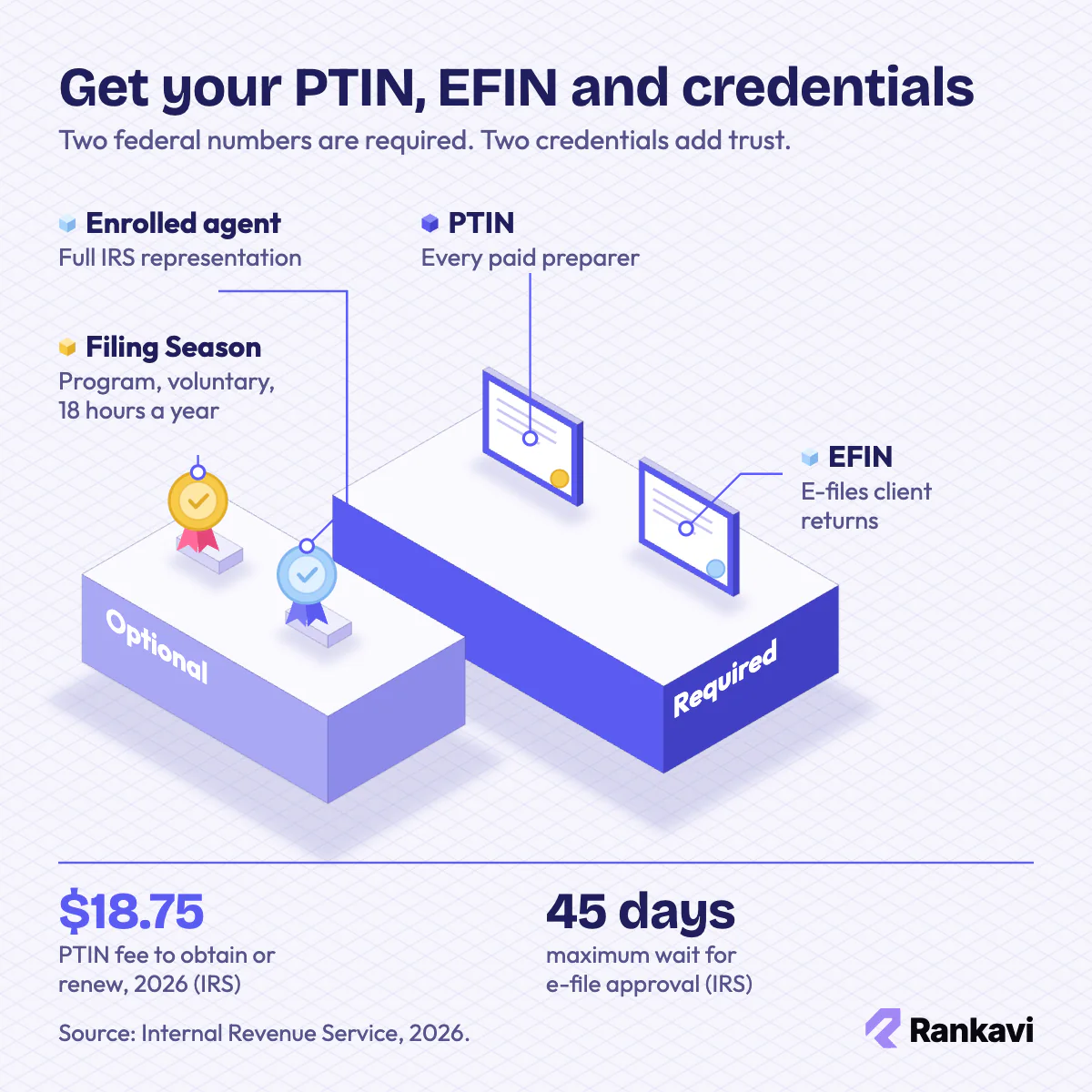
A preparer tax identification number (PTIN) is required for anyone who prepares federal returns for pay. As of 2026, the IRS charged $18.75 to obtain or renew one online. Each preparer in a firm holds a personal PTIN and renews it every year.
An electronic filing identification number (EFIN) lets the firm transmit returns electronically. A suitability check reviews credit, tax compliance and criminal history. Approval can take up to 45 days, so owners apply well before January.
Federal credentials compared:
| Credential | Required? | What it adds |
|---|---|---|
| PTIN | Yes, for every paid preparer | The right to prepare returns for pay |
| EFIN | Yes, to e-file client returns | Electronic filing for the firm |
| Annual Filing Season Program | No | A record of completion and a directory listing |
| Enrolled agent | No | Full representation rights before the IRS |
The Annual Filing Season Program is a voluntary IRS program for preparers without a professional license. It requires 18 hours of yearly education, including a six-hour refresher course with a test. Participants then appear in a public IRS directory.
Several states add their own rules. The California Tax Education Council (CTEC) is the nonprofit that registers paid preparers in California. As of 2026, new CTEC registrants needed a 60-hour course and a $5,000 tax preparer bond.
8. Insure Against Preparer Errors
Insurance for a tax practice means covering the cost of a client claim after a preparation mistake or data breach. A wrong deduction or a missed deadline can trigger penalties a client wants repaid.
Professional liability insurance, also called errors and omissions insurance, is the core policy. MoneyGeek, a personal finance publisher, put its average for tax preparers at $54 a month, or $652 a year, in 2026.
Cyber insurance covers breach costs such as client notification and data recovery. MoneyGeek’s 2026 average for that cover was $93 a month. In the 2024 National Society of Accountants survey, 65% of firms carried cyber liability insurance.
California’s registration bond protects clients rather than the preparer. Any claim the surety settles is repaid by the preparer.
Policies differ in what they exclude, so owners read the exclusions before buying cover.
9. Select Professional Tax Software
Professional tax software determines which returns the practice can file and how fast each one moves. Consumer filing apps lack the volume, e-file and review tools a paid practice needs.
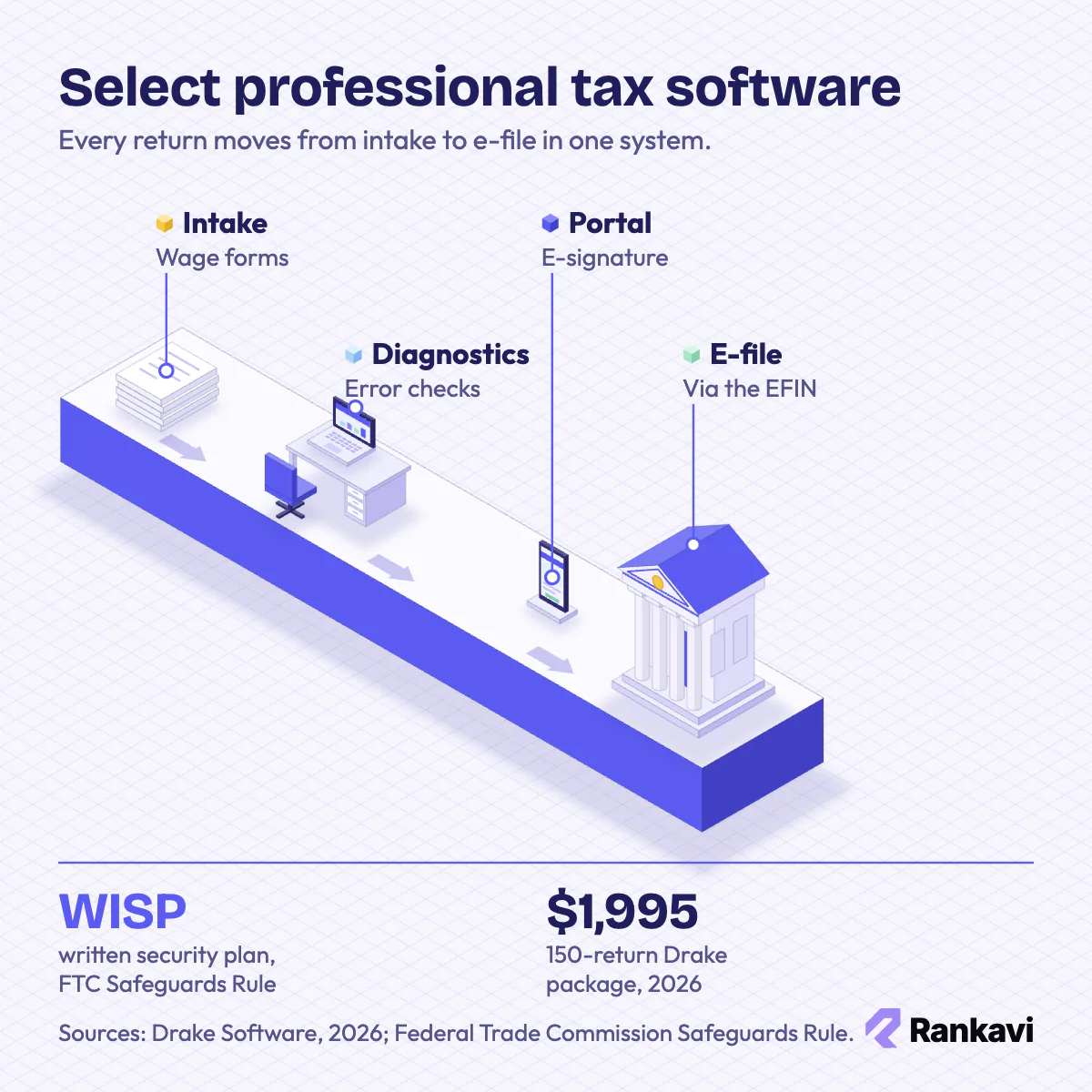
Four features separate professional packages from consumer apps:
- Form coverage: individual returns with their schedules, plus partnership and corporate returns.
- Integrated e-file: federal and state transmission through the firm’s EFIN.
- Diagnostics: built-in error checks before a return is signed.
- Client portal: secure document upload and electronic signatures.
Vendors sell either pay-per-return plans or unlimited packages. Pay-per-return suits a first season with few clients. In 2026, Drake also sold a 150-return individual package for $1,995, a middle step before unlimited filing.
Data security sits on top of the software. The Federal Trade Commission (FTC) enforces the Safeguards Rule, which treats tax preparers as covered financial institutions. That rule requires a written information security plan (WISP) with multifactor login, encryption and backups.
Every return follows the same workflow. Intake collects wage forms, prior returns and identity checks. Preparers then enter data, review diagnostics, collect signatures and e-file.
A trial or demo shows how a package handles real returns, so owners test it first.
10. Market Before Tax Season Opens
Marketing a new tax practice earns booked appointments before filers pick a preparer for the year. Most clients choose in January, so promotion starts in the autumn.
Word of mouth brings the first clients. In the National Society of Accountants’ 2024 survey, 83% of firms used referrals, while only 7% called websites very useful. Family, friends and former coworkers become the first returns and the first reviews.
“Do not rely on advertising. Newspapers and yellow pages will bring you more calls from the chamber-of-commerce and local charities than it will customers.”
— A tax practitioner on The Tax Book message board
Three low-cost channels support those referrals:
- Google Business Profile: a free Google listing, which is how the office appears in Maps and local search.
- Simple website: services, a fee range and online booking.
- Local partners: barbers, salons, churches and community centers that pass along names.
Reviews close the loop. Each happy client gets a review request right after filing, while the refund still feels fresh.
A short note of thanks to clients who refer others keeps those referrals coming.
11. Grow With Year-Round Services
Growth for a tax practice builds steady income outside the filing season through planning and recurring work. Bookkeeping, payroll and quarterly estimate reminders keep clients in touch all year.
Tax planning meetings turn one-time filers into annual clients. Small business owners pay for projections, entity advice and estimated tax schedules. Those meetings also surface next season’s returns early.
Year-round work needs a clear scope and its own fee. Planning then stays separate from the fixed return price.
Representation is the next credential step. Enrolled agents may represent clients before the IRS in audits and collections. In August 2026, the IRS listed a $317 fee for each of the three exam parts.
Seasonal staff extend capacity once the owner’s calendar is full. Each helper needs a personal PTIN before touching a return. H&R Block is a national tax chain that sells franchises, as do Jackson Hewitt and Liberty Tax.
12. Land in Filers’ ChatGPT and AI Answers
Visibility in AI answers places a tax practice in the lists filers read before they book a preparer. People now ask ChatGPT to name a trusted preparer nearby or one who handles freelancers.
ChatGPT repeats what trusted third-party pages already say. Local directories, review sites and “best tax preparer” roundups shape which offices get named. A new practice benefits from appearing on those pages before its reputation is fully built.
Rankavi is a software as a service (SaaS) platform that publishes brand mentions in articles on indexed third-party websites. Preparers who want AI answer citations can begin with accurate articles about the returns they file.