

Starting a storage unit business means buying, building or converting a facility and renting its units by the month. Demand is broad: the Self Storage Association’s 2025 Demand Study found that 12.6% of U.S. households rented a unit in 2024.
My name is Michal Sieroslawski, and I help self-storage businesses get found online. Renters increasingly ask AI apps about self-storage businesses, and the ones mentioned gain an edge.
Storage is a real estate business first, so the land decides almost everything. Demand data and a parcel come before any loan, and the loan comes before zoning money is spent. The twelve steps below show how to start a storage unit business, in order.
- Choose Your Storage Facility Model
- Research Local Storage Demand
- Write a Storage Unit Business Plan
- Register Your Company
- Find the Right Site
- Fund the Purchase or Build
- Secure Zoning, Permits and the Build
- Insure the Facility and Tenant Goods
- Price Your Units
- Run Daily Operations With Software
- Market the Facility to First Renters
- Get Named by AI Assistants
1. Choose Your Storage Facility Model
A self-storage business means renting secure space to households and companies on a month-to-month basis. Rent is nearly the whole revenue base, so occupancy and rental rates decide the profit. Each facility model changes both.
Renters arrive for many reasons. Households store furniture during a move or a downsize. Small companies keep inventory and equipment, while students park belongings between terms.
Five groups rent storage units:
- Households between homes or decluttering
- Small businesses storing inventory and equipment
- Students between school terms
- Owners of vehicles, boats and recreational vehicles (RVs)
- Collectors storing wine, art and documents
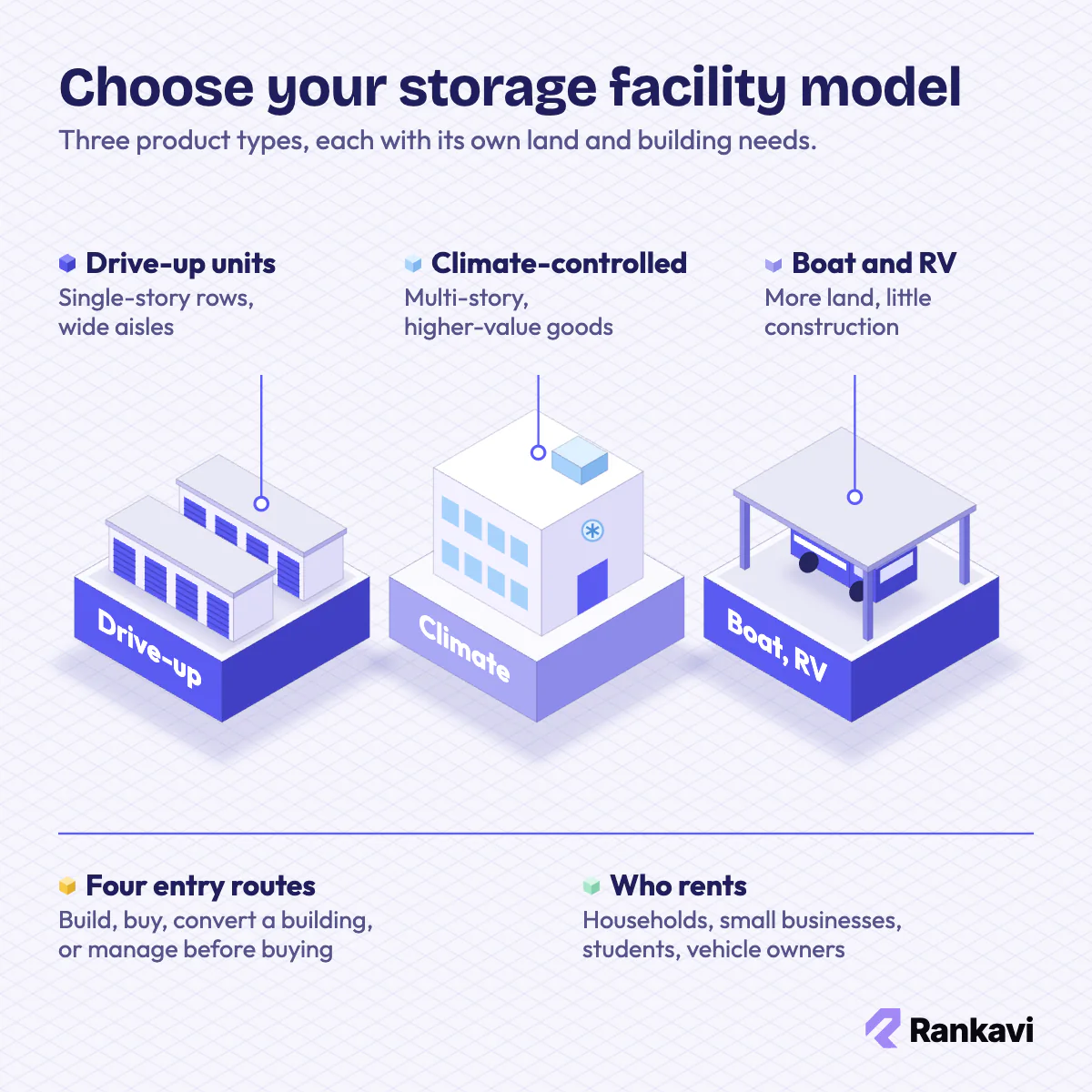
New owners pick one of four entry routes:
- Build: Ground-up development gives the most control over the unit mix. It also has the longest wait before any rent arrives.
- Buy: An existing facility brings rent from day one. The price is higher, and the buyer inherits the current unit mix.
- Convert: An empty retail store or warehouse becomes a facility. Hidden structural and retrofit costs are the main risk.
- Manage first: Running a struggling facility for its owner teaches the business before any purchase. The manager earns a fee but owns no property.
Each route implies a product. Drive-up units suit a single-story site with wide aisles and open fastest. Climate-controlled units suit multi-story buildings and higher-value goods such as furniture, documents and electronics. Boat and RV parking needs more land but little construction.
Other formats exist at the edges of the market. Shipping containers placed on a lot are a cheap way to start small. Portable storage, such as Portable On Demand Storage (PODS), delivers containers to renters. It is a logistics business more than a real estate one. Many real sites mix drive-up and climate-controlled units.
Market type also guides the choice. Dense urban areas favor climate-controlled and multi-story buildings. Rural and suburban areas favor drive-up units and vehicle parking. A first-time owner with a small budget usually starts with drive-up units or parking. One with more capital often buys a stabilized facility.
Rent is not the only income. Tenant insurance, lock and box sales and truck rental add smaller streams. Pricing and insurance have their own steps below.
Training exists before the first unit rents. The Self Storage Association, the industry’s not-for-profit trade group since 1975, offers a Certified Self Storage Manager designation.
2. Research Local Storage Demand
Market research decides whether a proposed facility can earn enough to cover its debt and expenses. Most investors package that research into a feasibility study before they commit any capital.
A feasibility study answers one question: will renters come? It projects rental rates, income, expenses and property value. Many first-time owners hire a self-storage consultant to prepare it.
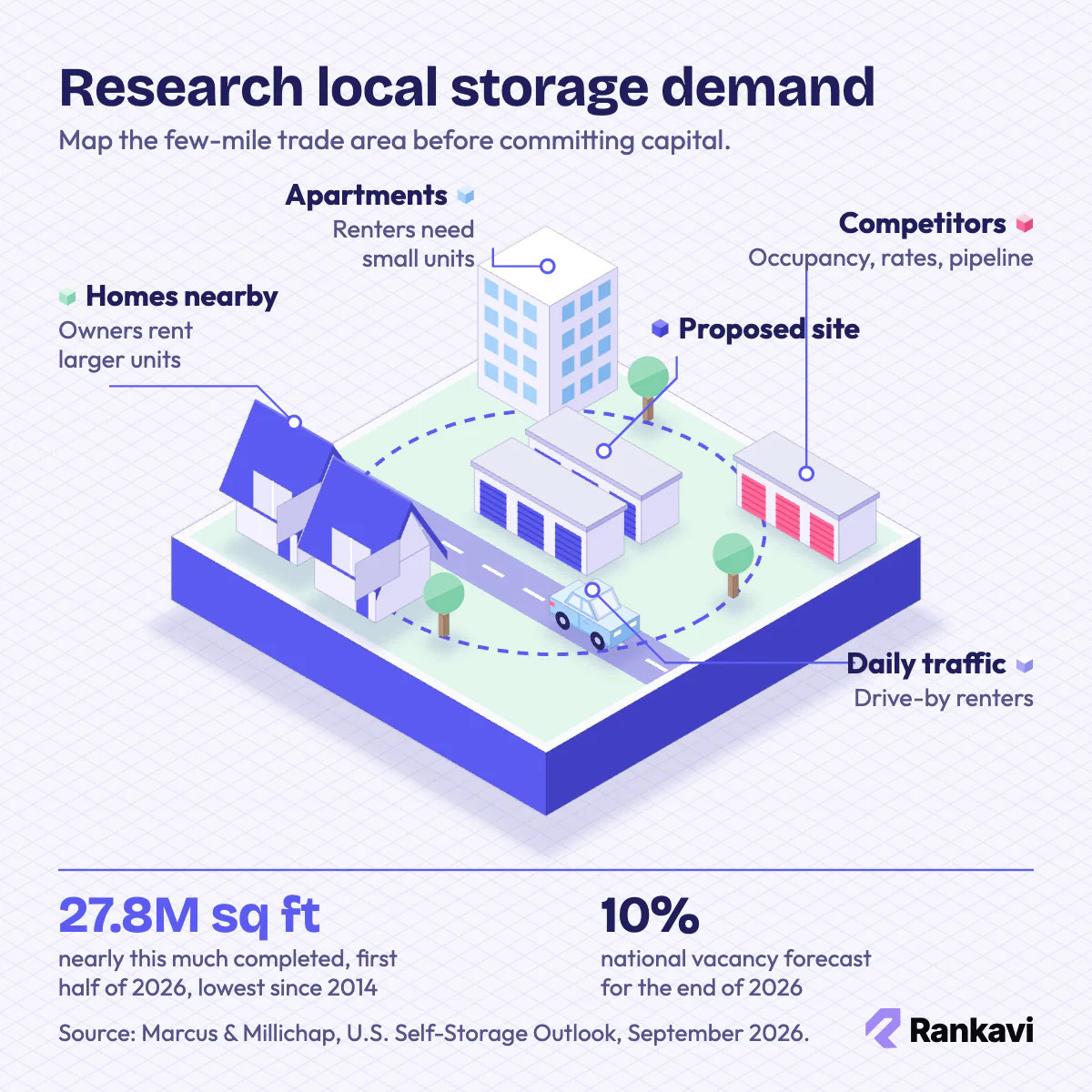
Storage draws renters from a trade area of only a few miles. Researchers map median household income and age inside that radius. Middle-income renters from young adulthood to middle age form the core market.
Growth signals matter as much as today’s numbers. New housing, steady home sales and rising population all point to future demand. Daily traffic counts too, since many renters choose a facility they pass every day.
Nationally, new supply is slowing. Marcus & Millichap is a commercial real estate brokerage that publishes market research. It counted nearly 27.8 million square feet completed in the first half of 2026. Its September 2026 outlook called that the lowest first-half volume since 2014. The same 2026 outlook forecast national vacancy falling to 10% by year end.
A competitor check covers four items for the trade area:
- Occupancy at each existing facility
- Monthly rates by unit size
- Facilities under construction or planned
- Unit types on offer, such as climate control
A gap in the trade area can guide the model choice. Few climate-controlled units nearby, for example, favors that product over one more row of drive-up units.
Housing mix shapes the unit sizes. Apartment renters tend to need small units, while homeowners rent units that hold a full room or a garage’s contents.
3. Write a Storage Unit Business Plan
A business plan shows lenders how the facility will fill, earn and repay its loan. Its key assumption is the lease-up curve, because a new site earns little rent in its first year.
Storage plans lean on per-square-foot figures. Projections show rent, expenses and net operating income (NOI) per rentable square foot for several years. Lenders compare those numbers with the competitor survey from the demand study.
The marketing section lists the unit mix, the pricing approach and the competitive picture. A break-even analysis then shows the occupancy at which rent covers expenses and loan payments.
4. Register Your Company
Registering the company separates each facility’s liabilities from the owner’s other assets. Most storage owners hold each site in its own limited liability company (LLC). A tenant lawsuit then reaches that one property’s company, not other sites or savings.
The Internal Revenue Service (IRS) issues the employer identification number (EIN) for free. That number opens the business bank account. Rents, loan payments and property taxes then stay out of personal accounts.
Partners write down their shares early. Storage deals often pair an operator with equity investors. The operating agreement sets each party’s percentage and who signs for the land.
5. Find the Right Site
The site decides occupancy more than any other single factor in self storage. Owners tie up a parcel or an existing facility before spending money on loans and permits.
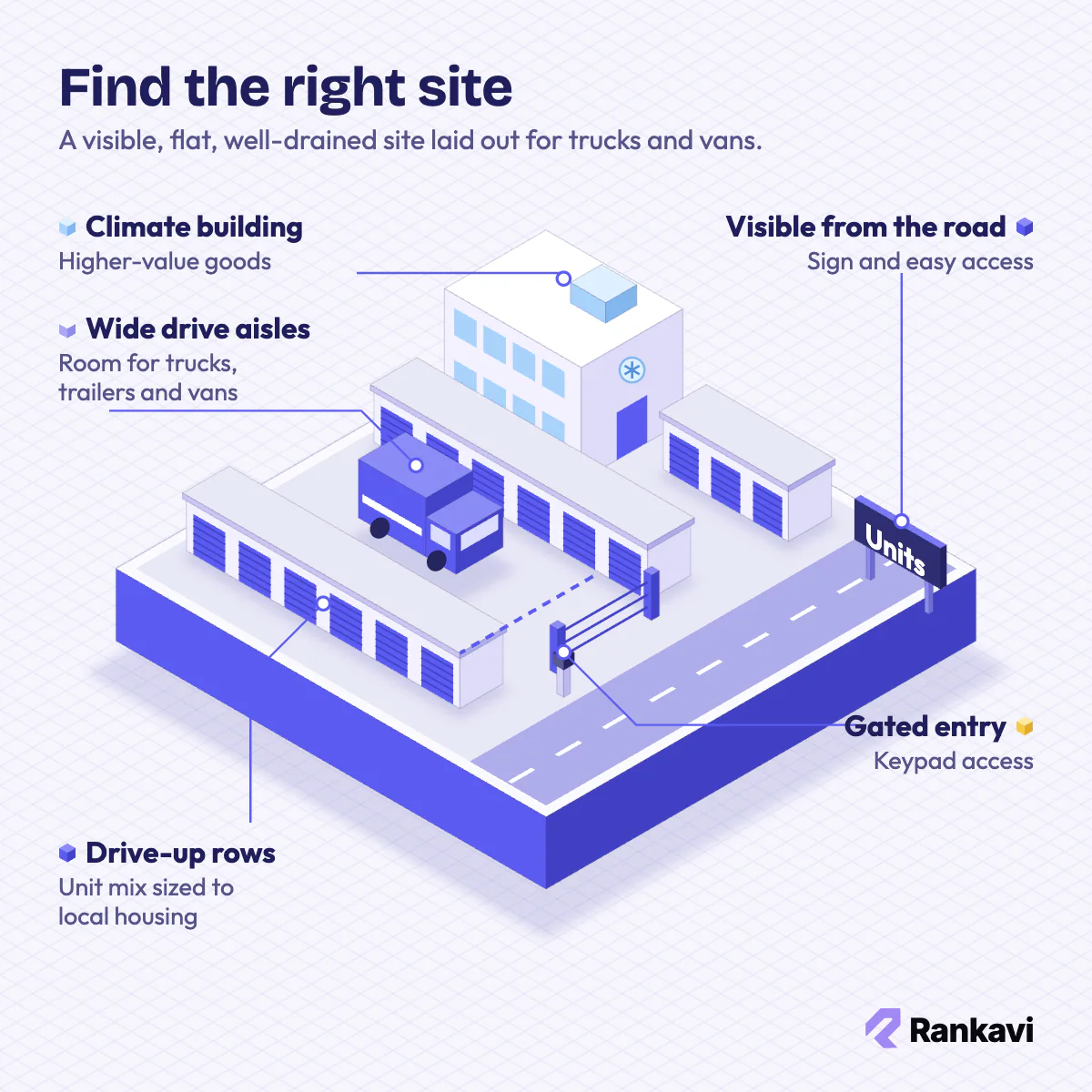
Good sites are easy to reach and visible from a major road. They sit close to homes, apartments or commercial areas. Flat land with good drainage suits storage, while flood-prone or steep parcels risk damaged goods.
Zoning is checked before any contract goes firm. A parcel already zoned for self-storage removes the biggest hurdle in the project. Buyers often sign a purchase contract with a contingency that lets them walk away if approval fails.
Buying an existing facility brings rent from day one. Known occupancy and revenue ease financing. The trade-offs are a higher price, possible deferred maintenance and little control over the unit mix. A self-storage broker helps find and negotiate the deal.
Large operators such as Public Storage, Extra Space Storage and CubeSmart set the benchmark for a modern site. Their local listings show what renters already expect.
“Learn Zoning. Get a zoning map by each city and county. Get the zoning codes and ask them which codes allow storage. You want to know and not assume.”
— A self-storage owner on the Self-Storage Talk forum
6. Fund the Purchase or Build
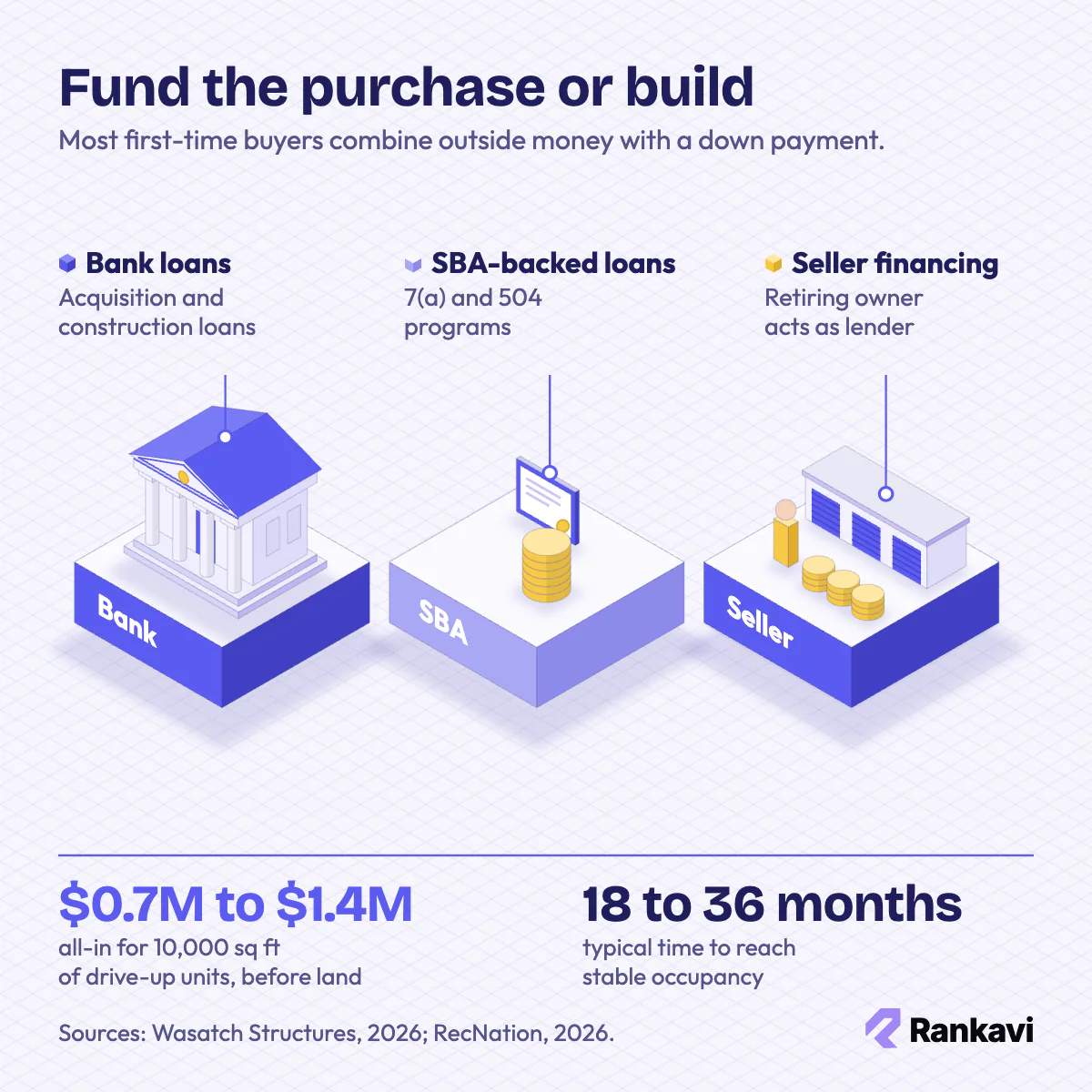
Funding covers the land, the buildings and the cash a facility burns before it fills. Wasatch Structures, a self-storage builder, priced a 100-unit Mountain West build at up to $1.4 million in 2026, before land.
Startup money at a glance:
| Item | Typical figure |
|---|---|
| Startup cost | $700,000 to $1.4 million all-in for about 10,000 rentable square feet of single-story drive-up units, before land; converting an existing building runs $35 to $75 per square foot in construction, before the building’s price |
| Main costs | Building shell and doors (50% to 60% of hard costs), site work and utilities (20% to 30%), gates, technology and signage (5% to 10%), soft costs such as engineering and permits (8% to 15% on top), plus land |
| Typical margin | 40% to 60% NOI margin once occupancy stabilizes |
| Time to open | 6 to 9 months of construction for single-story drive-up, then 18 to 36 months to reach stable occupancy |
Sources: Wasatch Structures, 2026; Storeganise, 2026; RecNation, 2026.
Occupancy is the number every storage founder checks first. RecNation reported in 2026 that new facilities typically need 18 to 36 months to stabilize. Marcus & Millichap’s 2026 average cap rate of 6.59% then sets what a stabilized facility is worth.
Worked example: An illustrative 10,000-square-foot drive-up site costs $1 million before land. Full, at $1.18 per square foot a month, it bills $141,600 a year. At 85% occupancy and a 50% margin, NOI is about $60,200. At a 6.59% cap rate that is worth about $913,000, below cost. Expenses are covered at roughly 40% occupancy, before interest and taxes.
The shortfall is in value, not cash flow. A cheaper parcel or higher local rents must close that gap.
Converting an existing building can cut the construction bill. Storeganise, a storage software vendor, estimates conversion construction at $35 to $75 per square foot in 2026. An existing facility is priced off its income instead, so the cap rate effectively sets its price.
Banks offer acquisition, construction and bridge loans. The U.S. Small Business Administration (SBA) is the federal agency that guarantees 7(a) loans up to $5 million as of 2026. Under an SBA rule dated May 18, 2026, 7(a) and 504 loans can combine for up to $10 million from July 4, 2026.
Lenders want good credit, a cash down payment and often a third-party management company for first-time builders. Seller financing lets a retiring owner act as the lender, while accredited investors can supply equity for a share of profits.
7. Secure Zoning, Permits and the Build
Zoning approval determines whether a storage facility can legally stand on the chosen parcel. A parcel that needs rezoning can take months or years, and residents sometimes oppose storage as an eyesore.
Common licenses and permits:
| Permit | When it applies |
|---|---|
| Business license | Every facility, from the city or county |
| Zoning permit | Confirms the use complies with local zoning |
| Construction permit | New builds and major renovations |
| Fire department permit | Many localities, especially indoor units |
| Sign permit | Road signs and building signage |
| Sales tax license | Sales of locks, boxes and moving supplies |
An early meeting with the city planner saves time. Owners ask which studies the city requires, and a clean site layout often moves through review faster.
Design decisions go into that layout. The unit mix follows the local housing, and driveways fit trucks and moving vans. Paths meet Americans with Disabilities Act (ADA) access rules. Legal, engineering and construction professionals each handle part of the build, and weather or material supply can still delay opening.
8. Insure the Facility and Tenant Goods
Lenders require proof of insurance before they release construction or purchase funds. Storage needs the usual property and liability cover plus two policies specific to the industry.
Property insurance covers the buildings against fire, theft and storms, and general liability covers injuries on the premises. Business interruption insurance replaces rent lost after a covered fire or flood.
Customer goods legal liability insurance covers tenants’ stored goods in the facility’s care. Sale and disposal liability insurance covers legal costs if an owner wrongly auctions a tenant’s unit. Owners with employees also carry workers’ compensation.
9. Price Your Units
Monthly rent is set per unit size and type, starting from the competitor survey. Rates then move with demand once renters arrive.
Street rates are under national pressure. Marcus & Millichap projected in September 2026 that average asking rent would fall 0.8% to about $1.18 per square foot. That would extend a four-year streak of annual declines.
Climate-controlled units command higher rent than drive-up units, since they protect furniture and documents. Larger units earn more per month but less per square foot.
A full facility isn’t automatically a profitable one. Economic occupancy measures rent actually collected, not just units rented. A site full of discounted or unpaid units can earn less than a fuller-priced site with empty units.
Revenue management keeps rates current. Owners raise rents for long-term tenants, cut needless discounts and run promotions when demand softens.
“…rather than plan to move walls around, you move rates to make certain units sizes more or less attractive, and also adjust your overall unit mix with future expansions.”
— A self-storage developer on the Self-Storage Talk forum
10. Run Daily Operations With Software
Daily operations involve billing, security and collections, now mostly run by software. Access control replaces much of the old on-site office.
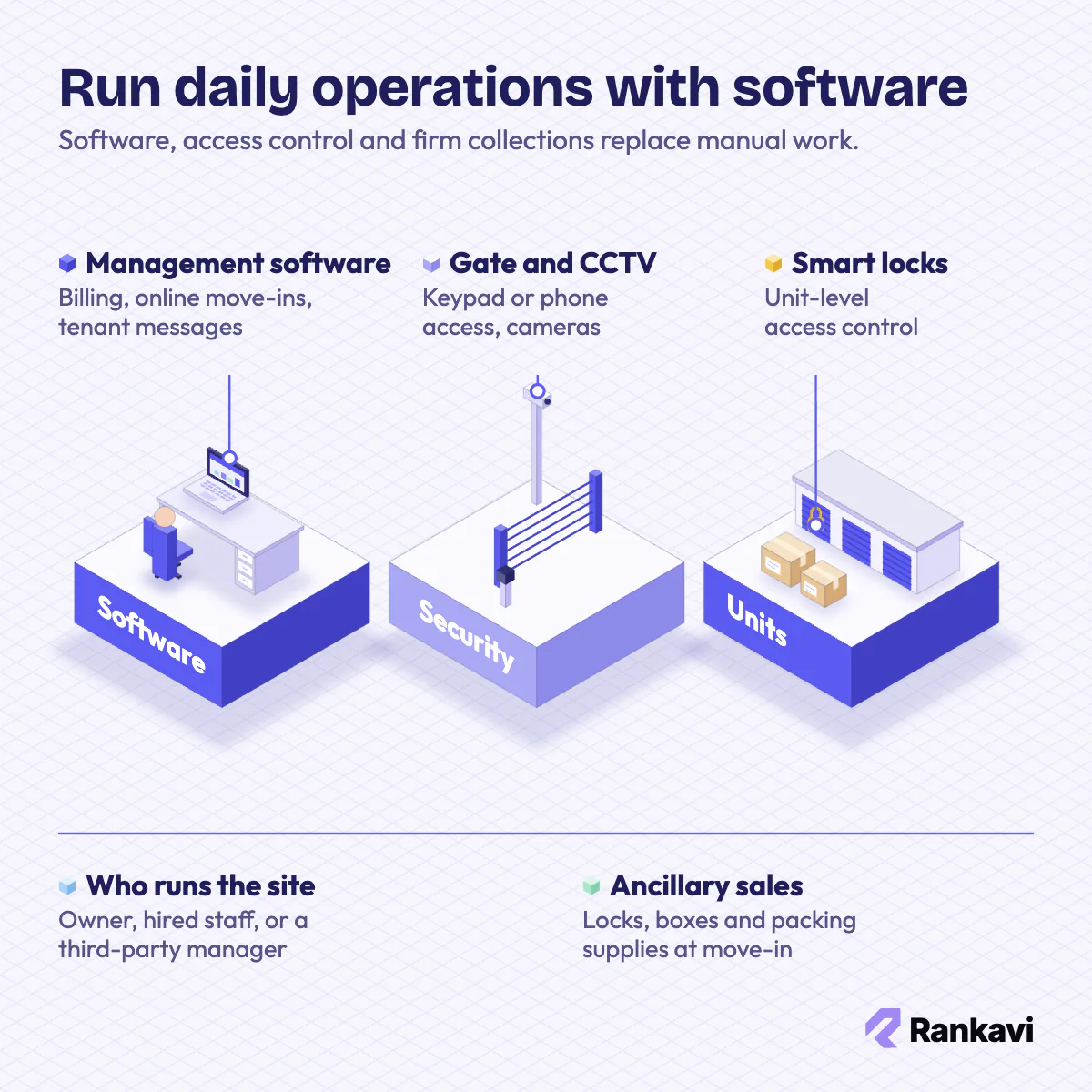
Management software runs billing, payments, online move-ins, tenant messages and reports. Storable is a storage software company formed from SiteLink, storEDGE and SpareFoot, which is a marketplace for renters. It sells two common systems, Sitelink and Storable Edge.
Storage security rests on four core tools:
- Gated entry with keypad or phone access
- Closed-circuit television (CCTV) cameras
- Alarm systems
- Smart locks on individual units
Some family owners manage the site themselves. Others hire staff or hand operations to a third-party management company with a remote call center. Management companies usually charge a share of revenue. That cuts net income but frees the owner from daily work. Owners who run a site without staff on site rely on kiosks and remote support.
Collections need firm rules. Late fees, reminders and lockouts keep units from sitting unpaid. State lien laws then govern how an owner auctions an abandoned unit’s contents.
Locks, boxes and packing supplies sell well at move-in. Truck rentals can follow once the site fills.
11. Market the Facility to First Renters
Marketing puts the facility in front of people at the moment they need storage. Most renters start that search online, while drive-by traffic still delivers many move-ins.
A mobile-friendly website lists unit sizes, rates and features. Renters can reserve, sign and pay online, which wins those who compare facilities late at night.
Owners claim a free Google Business Profile, which shows the facility in Search and Maps, before opening. First tenants are asked for reviews. SpareFoot is a marketplace where renters compare and reserve units, and it adds another listing.
Signage captures the drive-by renter. A clear entrance sign tells drivers how close the facility is. Grand-opening promotions give them a reason to stop.
Moving companies, real estate agents and apartment managers meet people in transition every week. Those referral partners send steady renters.
12. Get Named by AI Assistants
AI visibility means a storage facility gets named when movers ask an assistant where to rent a unit. A family relocating across town might ask ChatGPT for a climate-controlled unit near their new zip code with 24-hour access.
Those answers draw on listing sites, review counts and local roundups of storage options. A facility that shows up on those pages during lease-up has a better chance of being named.
Rankavi is a software as a service (SaaS) platform that publishes brand mentions in articles on indexed third-party websites. Storage owners can order articles from $12 apiece, and every mention is unlinked. The ChatGPT mentions page targets the sources ChatGPT tends to cite for storage comparisons.