

Starting a sticker business takes a clear niche, print-ready designs, a production method and a cheap way to ship. Shopify is an ecommerce platform, and its 2026 sticker guide valued the global sticker market at $4.88 billion in 2025.
I am Michal Sieroslawski, and I help sticker businesses get noticed by buyers online. AI search is growing, and many buyers use it to find sticker businesses. Those suggestions often decide who gets contacted first.
The order tests demand before any money goes into printers or stock. Pricing comes after production costs are known. The following list shows how to start a sticker business in nine steps.
- Choose Your Sticker Niche
- Validate Demand Before Printing
- Design Print-Ready Sticker Art
- Pick a Production Method
- Price Stickers for Bigger Orders
- Register and Protect the Brand
- Set Up the Shop and Shipping
- Market Stickers to First Buyers
- Feature in Sticker Fans’ ChatGPT and AI Answers
1. Choose Your Sticker Niche
Choosing a sticker niche decides who buys the designs and which formats the shop prints. A narrow audience makes every later step easier.
Most sticker shops follow one of three patterns. Fan-community shops serve a fandom the owner already belongs to, such as gamers or anime fans. Illustration shops sell one recognizable art style. Humor shops sell short, oddly specific text stickers that buyers share online.
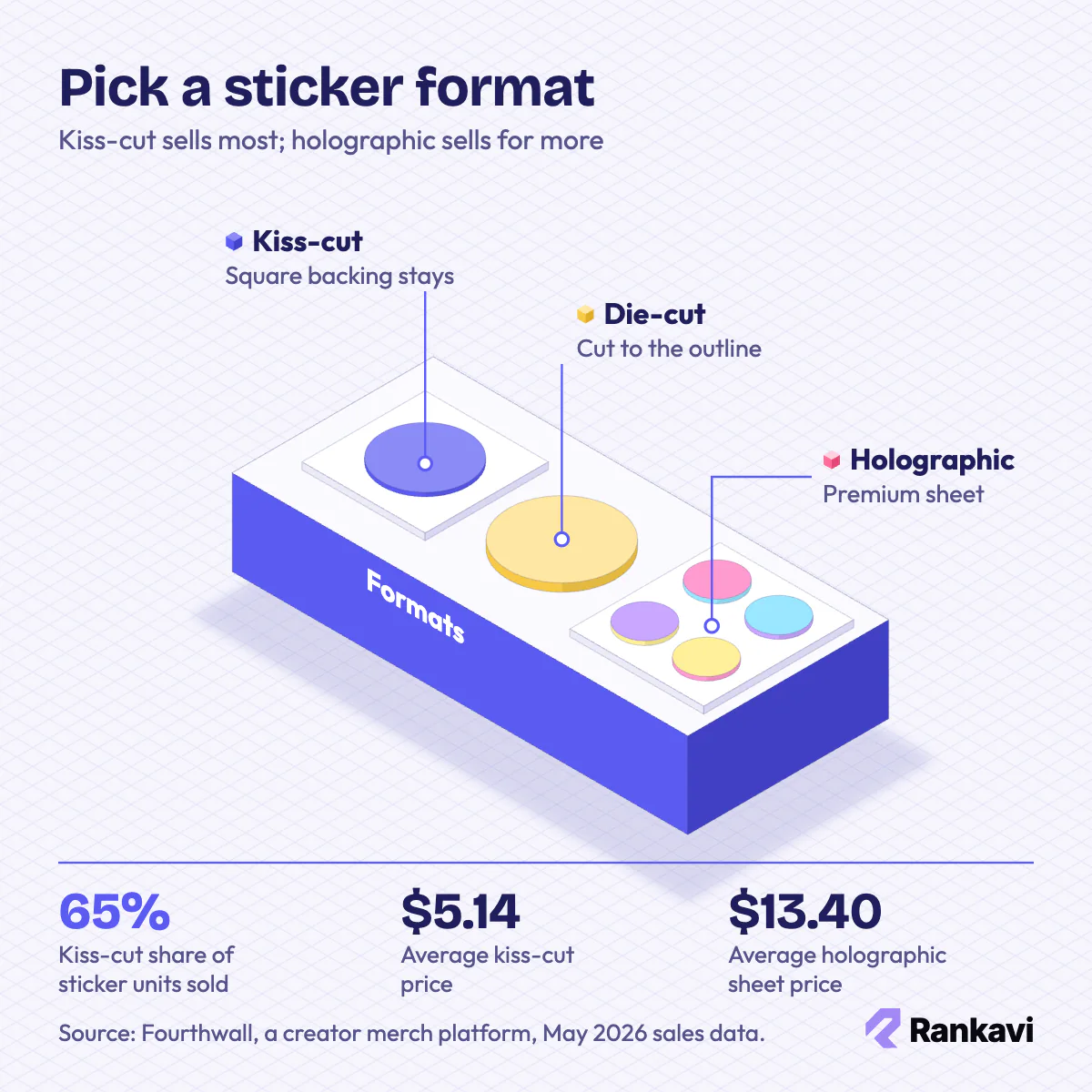
Format is the second choice. A kiss-cut sticker is cut through the vinyl only, so a square backing stays. A die-cut sticker is cut to the design’s outline, backing included. Sheets hold several matching designs, and vinyl decals suit lettering and logos.
Fourthwall is a creator storefront and print-on-demand platform. Its May 2026 sales data showed kiss-cut stickers at about 65% of sticker units sold. The May 2026 figures put holographic sheets at $13.40 on average, against $5.14 for a kiss-cut.
Startup money at a glance:
| Item | Figure |
|---|---|
| Startup cost | Near zero upfront with print on demand; $500 to $1,200 for a home printing setup |
| Main costs | Inkjet printer, cutting machine, sticker paper or vinyl, laminate, packaging |
| Typical margin | 40% to 55% on print-on-demand stickers |
| Time to open | Varies with design count; a print-on-demand shop needs only finished files and a sample |
Sources: Fourthwall, a creator merch platform, vendor estimates, May 2026.
A focused start beats a broad one. A new seller can pick one group, such as teachers or plant lovers, and expand later. Gaps in competitor shops show which designs that group still lacks.
A good niche passes a few tests. The audience is easy to name, and its members already spend money on items that show identity. The theme supports many different designs. Fans gather in places that are easy to find online.
Demand also has a calendar. Evergreen niches such as pets or plants sell all year. Seasonal niches peak on fixed dates, and trend niches tied to a meme can fade within weeks. One evergreen niche with a seasonal line on top is the safer start.
Licensed characters carry risk at this stage. Niches built on studio characters can get a shop taken down. Original designs for the same audience avoid that problem, and step 6 covers the legal side.
The Fourthwall figures describe one platform, not the whole market. An average price is also not profit, because a holographic sheet holds more designs and costs more to make.
2. Validate Demand Before Printing
Sticker ideas need proof of demand before the shop spends money on stock. A weekend of testing can save weeks of designing for nobody.
Rough sketches go up on TikTok, Instagram or X first. Reddit and Discord groups give more honest feedback from niche communities. Comments and saves show which concepts deserve finished artwork.
Saves, shares and messages asking where to buy show real buying interest. Likes alone do not. Friends and family are biased, so reactions from strangers count for more. Testing three to five concepts at once makes the winner clear.
Search data adds a second check. Google Trends shows whether interest in a theme is rising or fading. Etsy is a marketplace for handmade and craft goods. Its search results and eRank keyword data show whether buyers already look for similar stickers.
Google Trends reads best over several years. That way a seasonal spike or a fad is not mistaken for steady demand. Competing listings with recent reviews confirm that buyers exist. A market with no competitors at all can be a warning sign instead of an opening.
A pre-sale gives the strongest signal. The seller posts a mockup with a sign-up form and a launch price. Firm commitments from strangers prove the idea, and those early orders fund the first print run.
A pass mark set before the test starts keeps a few likes from passing as proof. A pre-sale also creates a duty to ship. Money taken in advance is owed until the order arrives. A firm ship date and a refund option are needed. Original art is safer than fan art for testing, because licensed characters can draw takedown notices. A strong result leads to finished artwork. A mixed result earns one revised retest, and a weak result ends the idea. Dropping a weak idea cheaply is a successful test.
3. Design Print-Ready Sticker Art
Sticker art has to read clearly at small sizes and survive printing and cutting. Design rules and file settings matter as much as the drawing itself.
Strong sticker designs use high contrast, bold outlines and a small color palette. A design that loses its punch at small size needs rework. A line of stickers in one consistent style also sells better than mixed styles.
Canva suits beginners and text-led designs. Procreate on iPad is the standard for hand-drawn work. Adobe Illustrator and the free Inkscape create vector art that scales cleanly. Sellers who can’t draw can hire illustrators on Fiverr, Behance or Dribbble. Most charge $50 to $200 per design, a May 2026 Fourthwall estimate.
Hired work needs clear terms. Written commercial-use rights, the number of revisions and delivery of source files should be agreed first. Fonts and stock art also carry licenses, and free-for-personal-use files cannot go on stickers that are sold.
Printers expect a high-resolution file in cyan, magenta, yellow and key (CMYK) color. Each file needs a bleed around the edge and a safe zone inside the cut line. A Portable Network Graphics (PNG) file with a transparent background suits custom shapes.
Printers also need a cut line, a separate path that marks where the blade runs. Fonts should be converted to outlines so they print as drawn. Bright neon colors often print duller than they look on screen, so a physical proof helps before a full run.
Common sticker materials:
| Material | Best use |
|---|---|
| Vinyl | Water bottles, laptops and outdoor items |
| Matte paper | Notebooks and planners, with fine detail |
| Holographic | Premium versions with a rainbow effect |
| Clear | Windows and items that get washed |
4. Pick a Production Method
A production method sets the upfront spend, the cost per sticker and who packs each order. Sticker sellers choose between home printing, bulk printers and print on demand.
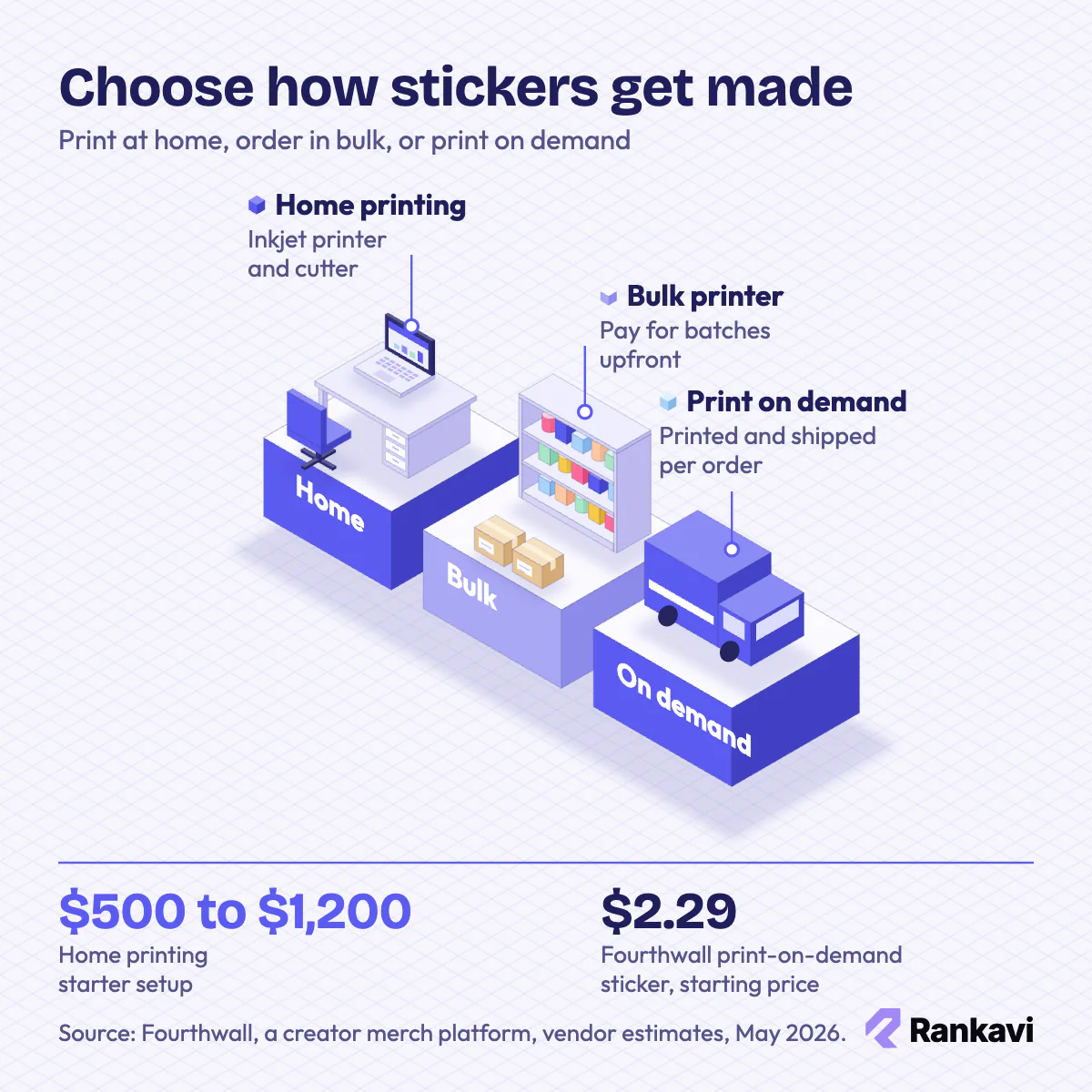
Home printing uses an inkjet printer, sticker paper and a cutting machine. Laser toner bonds poorly to vinyl, so inkjet models fit better. Cricut is a brand of home cutting machines. Cricut and Silhouette cutters trace each design and cut kiss-cut or die-cut shapes. Cold laminate sheets add waterproofing.
Sticker Mule is an online custom printer, and StickerGiant works the same way. Both print large batches and ship them to the seller. The cost per sticker falls as the order grows. The catch is cash tied up in stock before the designs prove themselves.
Print-on-demand (POD) services print, cut and ship each order after a customer pays. Printful is a print-on-demand company that, like Printify, connects to online stores. Fourthwall listed its own print-on-demand stickers from $2.29 each in May 2026. Margins are lower, but the risk is close to zero.
Each method needs a sample first. Colors look different on vinyl than on a screen. One test order catches cut errors, weak adhesive and faded ink before buyers see them.
A hybrid path suits many sellers. Designs are tested through print on demand or a small home batch. Steady best sellers then move to a bulk printer. Slower designs can stay on print on demand.
Home printing hides costs in ink, blades, cutting mats, wasted sheets and the hours spent cutting and packing. Bulk orders set minimum quantities and add production and shipping time. Print on demand gives the least control over quality and packaging.
Samples are worth testing beyond looks. Water, sunlight and rubbing show how well a sticker lasts. Edge lifting, corner accuracy and color shift between screen and print also show up on a sample.
5. Price Stickers for Bigger Orders
Sticker pricing determines whether each order covers printing, fees, packaging and profit. A single cheap sticker rarely earns much on its own.
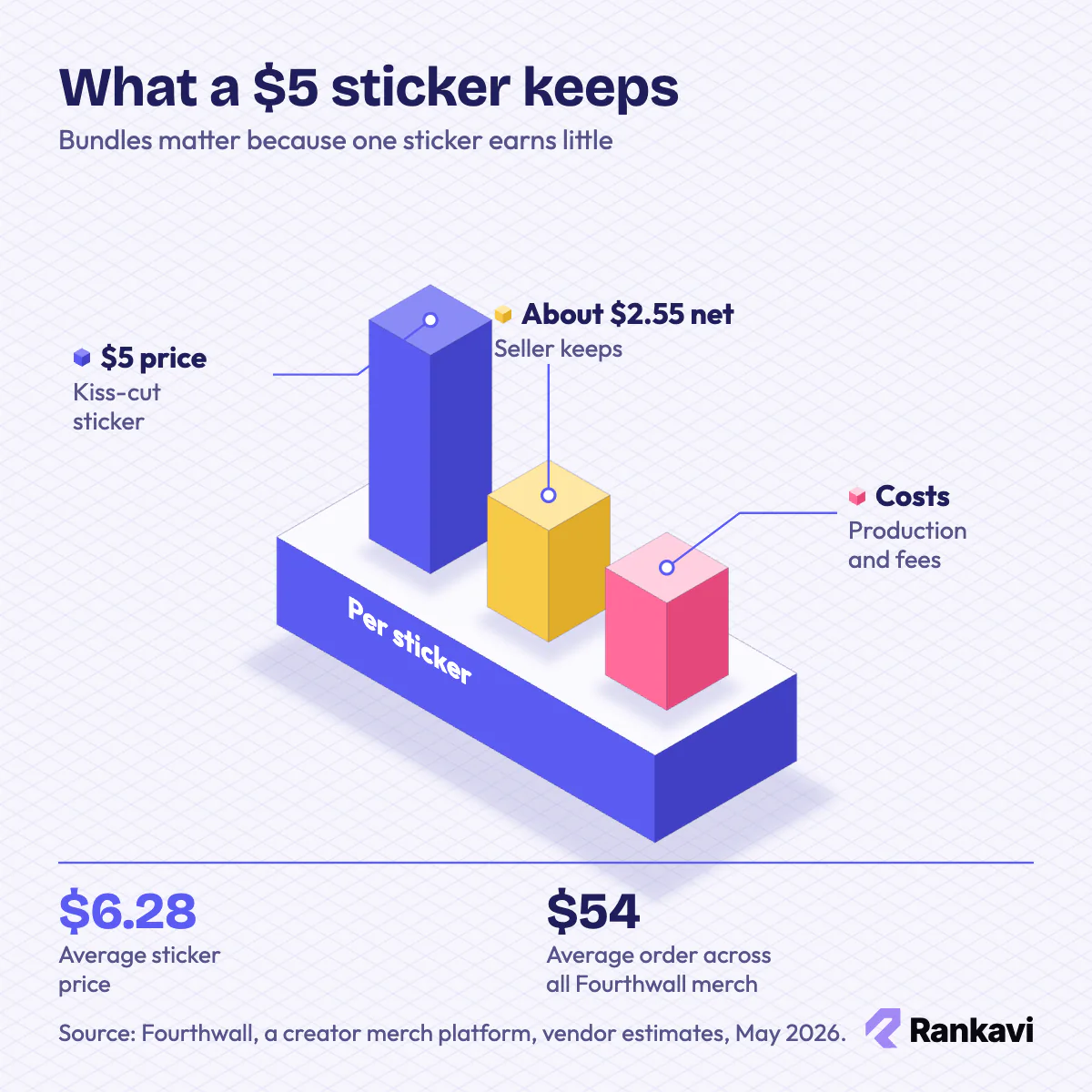
Profit per sticker equals the retail price minus the production cost and the selling fees. Packaging and postage also come out of that gap. Fourthwall estimated in May 2026 that a $5 kiss-cut sticker nets about $2.55 after production and fees. Its card processing fee in 2026 was 2.9% plus $0.30 per order.
Ways to raise order value:
| Tactic | How it works |
|---|---|
| Theme packs | Several related stickers sold as one set |
| Mix-and-match bundles | Buyers choose any few designs for one price |
| Premium finishes | Holographic or waterproof versions of a best seller |
| Checkout add-ons | Mini stickers offered just before payment |
| Free shipping threshold | Free postage only above a minimum spend |
Order value is the benchmark sticker sellers check first. Fourthwall’s May 2026 data showed an average sticker price of $6.28 against a $54 average order across all its merch. A one-sticker order barely covers postage, so break-even depends on selling several stickers per order.
Holographic versions don’t need to outsell standard ones. They only need to exist for buyers who want something special. Underpricing to match the cheapest marketplace stickers often leaves nothing after postage.
A starting price comes from adding materials, packaging, postage, fees and some allowance for time. Dividing that total by one minus the target margin gives the price. A target margin of half means dividing by 0.5, not adding half.
Fourthwall’s May 2026 $54 average order covers all its merch, so it is not a sticker-only benchmark. Spoiled sheets and refunds also eat into profit, so a small buffer belongs in the price.
6. Register and Protect the Brand
Registering a sticker business means choosing a legal structure and protecting the art it sells. Most solo sticker sellers start as sole proprietors.
A sole proprietorship is the default structure for one owner and needs little paperwork. A limited liability company (LLC) shields a sticker seller’s personal savings from shop debts. The Internal Revenue Service (IRS) issues sticker shops a free employer identification number (EIN). A separate bank account keeps sticker income apart.
Copyright protects original sticker art once it exists in fixed form. The U.S. Copyright Office is the federal office that registers creative works. As of 2026, it charges $45 for a single-author online application and $65 for a standard one. Registration adds stronger legal options against copycats.
A shop name or logo needs a separate trademark filing. The U.S. Patent and Trademark Office (USPTO) is the agency that registers trademarks. Its base application fee became $350 per class in January 2025, Fish & Richardson, a law firm, reported.
Fan art carries real risk. Stickers that use licensed characters or celebrity faces without permission invite takedowns and lawsuits. Parody claims rarely protect products sold for profit.
AI-generated art needs care. Protection for purely AI-made designs may be weak, and platforms and printers may set their own rules for AI art.
7. Set Up the Shop and Shipping
Shop operations cover where stickers sell, who handles sales tax and how each order reaches the buyer. These choices shape daily workload more than design does.
Etsy, Amazon and Redbubble bring shoppers who already search for stickers. As of 2026, Etsy charges U.S. sellers a $0.20 listing fee and a 6.5% transaction fee. Checkout Page reported a 2026 processing fee of 3% plus $0.25. An own store on Shopify gives full control of branding and customer data. TikTok Shop and Instagram Shop suit sellers who already post content.
Sales tax follows the platform choice. Since the 2018 Supreme Court ruling in South Dakota v. Wayfair, sellers can owe tax in states they’ve never visited. Marketplaces collect it for most sales, while an own store leaves the seller responsible.
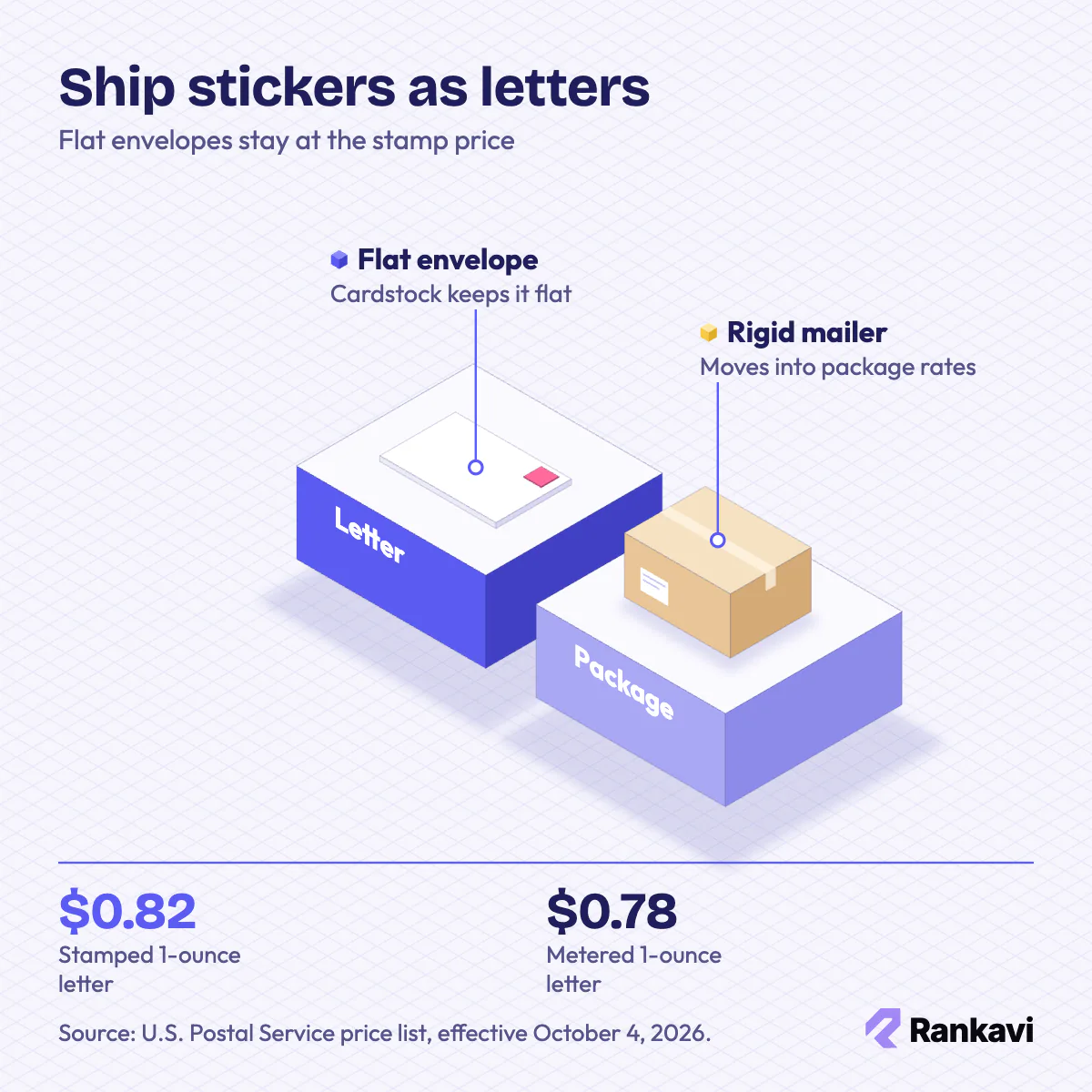
Letter mail is the cheapest way to ship stickers. The U.S. Postal Service (USPS) sets those prices, and a stamped 1-ounce letter costs $0.82 from October 4, 2026. A metered letter costs $0.78 under the same October 2026 price list.
A thick or rigid mailer moves the order into package rates. Pirate Ship is a shipping-label tool that sells discounted USPS rates without a monthly fee. Cardstock inside a flat envelope keeps stickers from bending.
Each marketplace has its own fee list and rules. The full cost of a sale should be checked before listing. A flat fee per order hurts low-value orders most. International orders add customs forms and different rates, so some sellers ship only within the country at first.
8. Market Stickers to First Buyers
Most sticker brands grow through organic social media first. Stickers are visual, cheap and easy to show in short videos.
Process videos show printing, cutting and packing orders. Photos of stickers on laptops, water bottles and journals outperform flat mockups. Unboxing clips from real buyers add social proof.
An email list brings buyers back for each new drop. A small sign-up discount grows the list. Launch emails and reminders about new packs then turn first buyers into repeat customers.
Paid ads are hard to make profitable with low order values. A single sticker leaves little room to pay for each new customer. Ads make more sense once bundles raise the average order.
Collaborations with creators in the same niche reach a ready audience. Community posts work best as real contributions, since many groups ban sales posts. Craft fairs and conventions let buyers handle stickers in person and give quick feedback on designs.
A best seller shows where to grow. The winning design can get new sizes, colors and holographic versions. Later, the same art can move onto notebooks, tote bags and phone cases.
9. Feature in Sticker Fans’ ChatGPT and AI Answers
Sticker buyers now ask ChatGPT where to find cute laptop stickers, anime sticker packs or custom vinyl decals. The reply often names a few shops pulled from pages the model trusts.
Those pages include gift guides, “best sticker shops” roundups, artist directories and blog reviews. A new sticker shop that appears on them early has a better chance of being named.
Rankavi is a software as a service (SaaS) platform that publishes brand mentions in articles on indexed third-party websites. Sellers seeking brand recommendations in ChatGPT can use it to get named on sticker and merch pages.