

Starting a reselling business means buying goods below market value and selling them for more online or in person. ThredUp, which runs an online clothing resale marketplace, projected in its 2026 Resale Report that U.S. secondhand apparel will reach $78.8 billion by 2030.
My name is Michal Sieroslawski, and I help reselling businesses get recommended in AI search. AI search is a growing way for buyers to find reselling businesses, and recommended names start ahead.
The order below settles demand and price rules before money goes into stock. Registration and a resale permit come before tax-free wholesale buys. The ten steps below take a reselling business from plan to launch.
- Choose a Resale Niche With Proven Demand
- Price Items From Sold Listings
- Fund Your First Inventory
- Register the Reselling Business
- Get a Resale Certificate and Sales Tax Permit
- Source Inventory and Basic Tools
- Set Up Listing and Shipping Routines
- Sell on Marketplaces and Your Own Store
- Grow From Side Hustle to Full Time
- Land in Copilot AI Shopping Answers
1. Choose a Resale Niche With Proven Demand
Choosing a niche decides which products a reseller hunts, where they sell and who buys them. A focused category builds the product knowledge that spots underpriced items fast.
Most resellers start with goods they already understand. A sneaker fan reads release cycles, and a book lover knows which editions collectors want. That knowledge protects against overpaying and against fakes.
Niche fit depends on more than interest. Small, light goods cost less to store and ship, while furniture needs floor space and costly freight. High-value brands attract fakes, so authenticity risk belongs in the choice.
Trend items can sell fast and then fade, while evergreen categories sell more steadily. Seasonal goods such as winter coats peak for a short window, which shapes cash flow. Marketplaces also restrict some categories, so each platform’s prohibited items rules get checked before stock is bought.
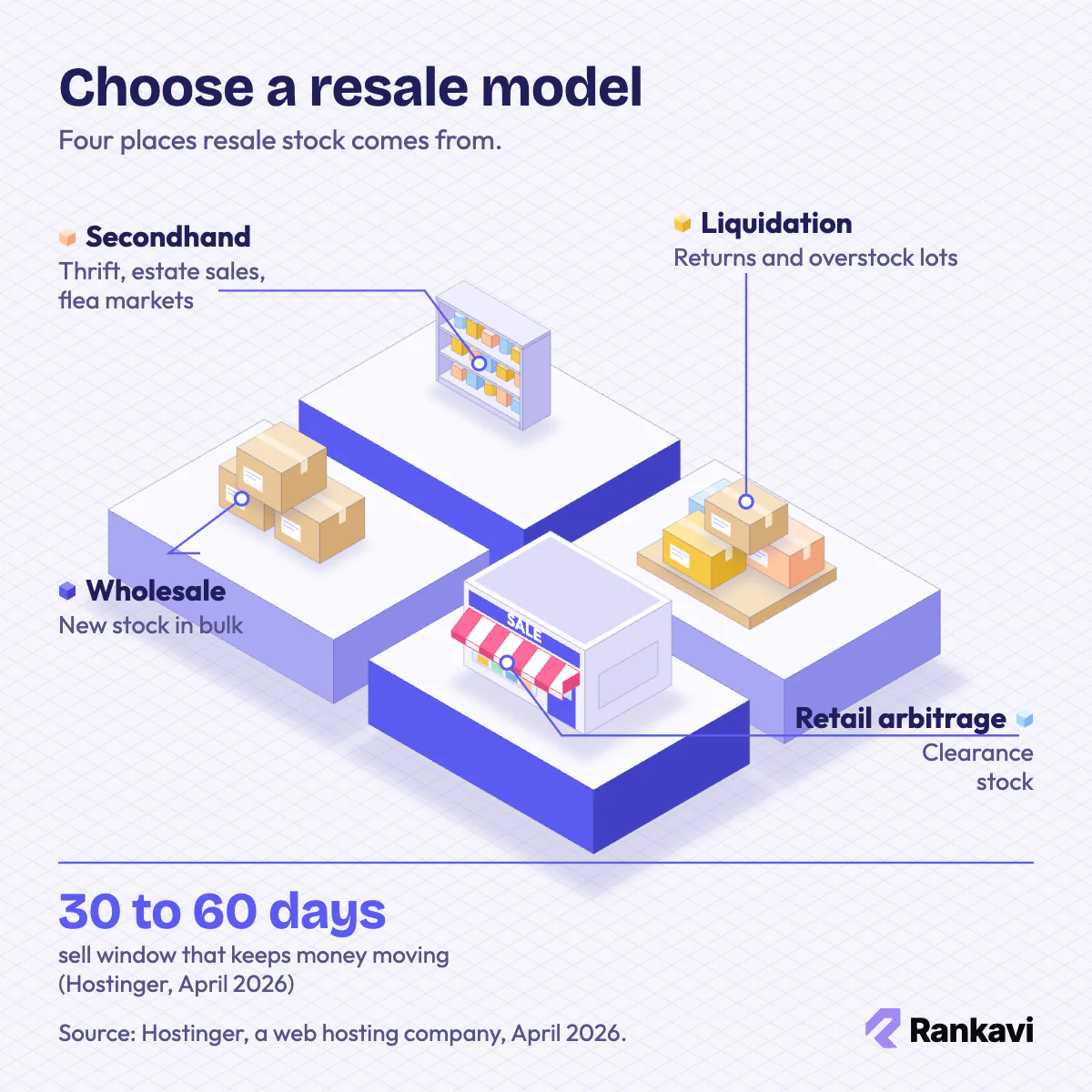
Common resale models:
| Model | Where the goods come from |
|---|---|
| Secondhand | Thrift stores, estate sales, flea markets and private sellers |
| Retail arbitrage | Clearance and discounted products from retail stores |
| Wholesale | Distributors and manufacturers selling new stock in bulk |
| Liquidation | Customer returns and overstock sold in lots |
Demand gets tested before money is spent. The Sold Items filter on eBay shows what buyers paid. eBay is an online marketplace for used goods. Asking prices prove nothing, because anyone can list high and never sell.
Sell-through rate measures how fast listings in a category turn into sales. Hostinger, a web hosting company, wrote in April 2026 that items selling within 30 to 60 days keep money moving. Slower categories tie up the budget for the next buying trip.
Sell-through rate equals sold listings divided by sold plus active listings over the same period. A higher rate means buyers outnumber sellers in that category.
A small test buy shows whether a niche works before a large commitment. A short run of items from one category, listed and tracked, reveals how many sell and at what profit.
A narrow niche builds expertise faster than a broad one. Vintage denim is a tighter focus than all clothing. Adjacent categories can be added once sales are steady.
2. Price Items From Sold Listings
Pricing sets the buy limit and the asking price for every item before it leaves the store shelf. Sold comparables give the ceiling, and costs set the floor.
Profit on each item follows one formula. Profit equals the sale price minus the item cost, platform fees, shipping and packaging. A reseller runs that math on a phone before every purchase.
Fees take the first cut. As of 2026, eBay charged most U.S. sellers 13.6% on the sale up to $7,500, plus $0.40 per order over $10. Orders of $10 or less carried a $0.30 per-order fee in eBay’s 2026 schedule.
Many resellers buy only at a fixed multiple of the cost. A firm buy rule leaves room for fees, returns and the hours spent cleaning and listing. Cheap items need a bigger multiple, since fixed fees eat a larger share.
Condition moves the price within the sold range. An item with minor wear lists near the low end, while new-with-tags pieces list near the top. Shipping costs get baked into the price or charged separately.
Sold comparables must match the item. Brand, model, size, color and condition all need to line up, and lots or damaged items are left out. The median sold price resists outliers better than the average. Auction results and fixed-price results are not interchangeable, so each type is compared on its own.
The platform fee is not the only cost. Promoted listing ads, returns, sales tax paid at purchase, supplies and sourcing trips also cut profit. The maximum buy price equals the expected sale price minus fees, shipping, supplies and the target profit.
Unsold items need a repricing plan. Gradual markdowns, offers to watchers and cross-listing on another platform move slow stock before it ties up cash.
3. Fund Your First Inventory
Funding a reselling business covers the first inventory, supplies, platform fees and the cash tied up in unsold stock. Inventory is the largest line, and it can start small.
Startup money at a glance:
| Item | Figure |
|---|---|
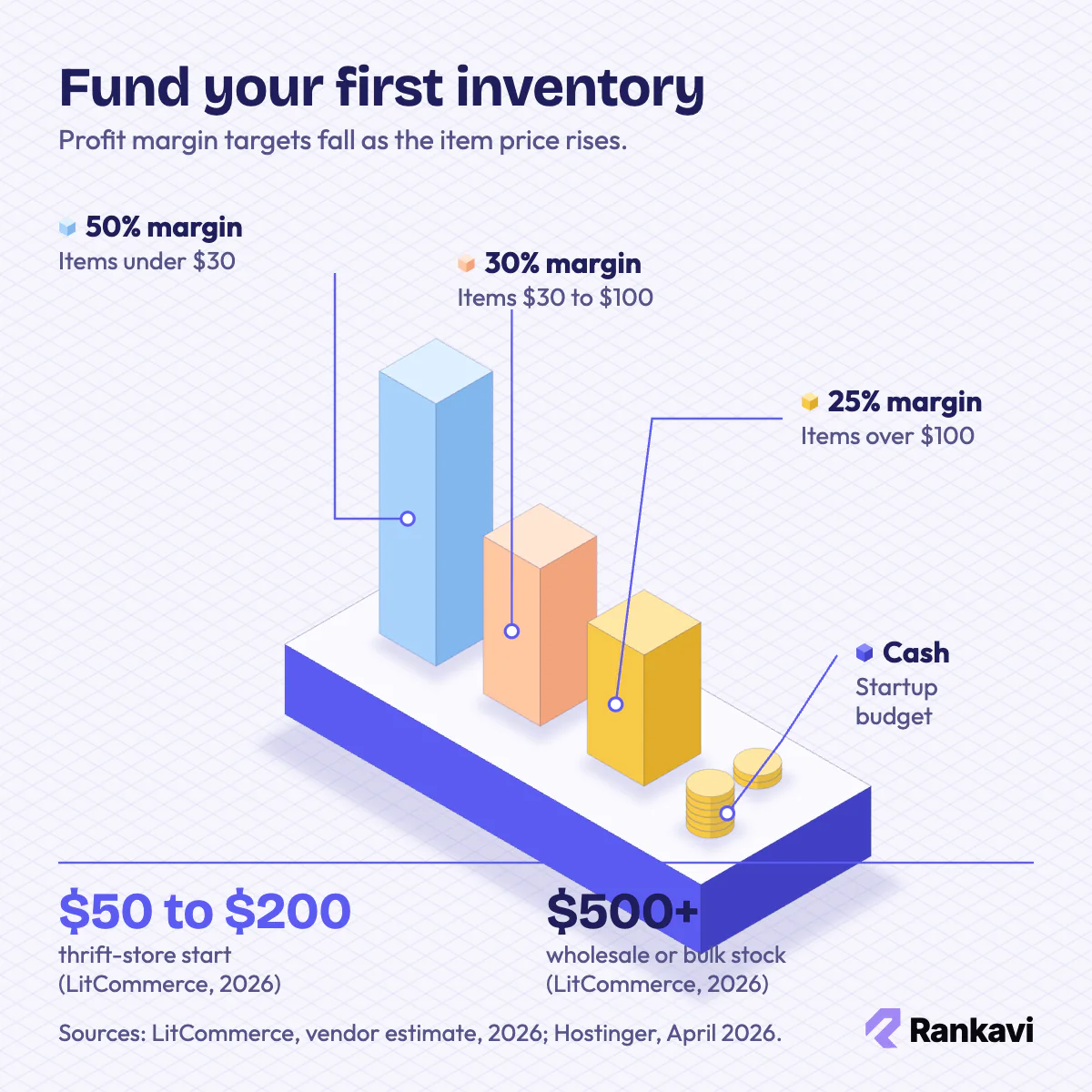
| Startup cost | $50 to $200 for a thrift-store start; $500 to several thousand dollars for wholesale or bulk stock |
| Main costs | First inventory, marketplace fees, shipping supplies, a seller’s permit and storage |
| Typical margin | Profit margin targets of 50% on items under $30, 30% on $30 to $100 and 25% over $100 |
| Time to open | Days to a few weeks; state permit processing sets the pace |
Sources: LitCommerce, a multichannel listing software vendor, vendor estimate, 2026 (startup cost). Hostinger, a web hosting company, seller guidance, April 2026 (margin targets). Time to open is qualitative because permit processing varies by state.
Retail arbitrage and thrift sourcing need little upfront money. Wholesale and liquidation lots require larger buys before a single sale. Most founders fund the start from savings. Some borrow from the U.S. Small Business Administration (SBA), which runs a microloan program through nonprofit lenders.
Funding sources run from selling personal belongings to borrowing. Savings and sold household items carry no interest. Credit cards and loans add repayment pressure, and unsold stock cannot cover a balance. Borrowing before any sale has proven the niche is the riskiest route.
Worked example: This illustrative thrift jacket costs $8 and sells for $45 with free shipping. The eBay fee is 13.6% of $45, or $6.12, plus $0.40, so $6.52. An assumed $8 shipping label and $0.50 of packaging bring total costs to $23.02. The reseller keeps $21.98, nearly a 49% profit margin. A $200 starting budget buys 25 such jackets, so selling all of them returns about $550 in profit.
That total assumes every jacket sells at the full price. Returns and slow sellers lower the real result. Margin is profit divided by the sale price. Markup is profit divided by cost, so the two terms differ.
Early profit goes back into stock. Each round of sales buys a slightly bigger round of inventory. Unsold items are cash on a shelf, so a small reserve for fees and slow weeks keeps sourcing going.
Payouts can lag a sale, so cash stays tied up between purchase and payment. The reserve covers that gap. A share of each payout should also be set aside for income tax, since profit is taxable.
4. Register the Reselling Business
Registering gives the reselling business a legal identity for permits, marketplace accounts and the bank. A sole proprietorship needs no state filing, while a limited liability company (LLC) does.
Many resellers start as sole proprietors under their own name. An LLC shields personal assets from business debts and lawsuits. It also makes a separate business bank account easier to open.
An employer identification number (EIN) comes free from the Internal Revenue Service (IRS), which runs federal tax collection. Marketplaces and wholesale suppliers often ask for one on their tax forms.
Payment platforms report big sellers to the tax agency. In 2025 the IRS confirmed Form 1099-K applies only above $20,000 and more than 200 transactions a year. Smaller sellers still owe tax on every dollar of profit.
Receipts prove the cost of goods sold. Without them, the whole sale price can look like profit on a tax return.
A separate business bank account keeps sales and costs in one place. Marketplace payouts go there, which makes the receipts and the profit easy to match. Local rules vary, so a city or county business license may also apply, and home-based sellers check lease terms.
5. Get a Resale Certificate and Sales Tax Permit
A seller’s permit means the state has registered the reseller to collect sales tax. The permit number also backs the resale certificates used for tax-free inventory buys.
Each state with a sales tax runs its own registration. In California, the Department of Tax and Fee Administration is the agency that registers every retailer. The California Department of Tax and Fee Administration (CDTFA) also issues the resale certificate form. Other states call the same document a sales tax license.
Typical permit steps:
- Register for a sales tax permit in the home state.
- Give suppliers a resale certificate for inventory bought to resell.
- Collect sales tax on direct sales where the business must.
- File sales tax returns on the schedule the state sets.
A resale certificate works only for goods bought for resale. Supplies such as tape, boxes and a ring light stay taxable. Thrift stores and garage sellers rarely accept certificates at all.
Large marketplaces collect and remit sales tax on many orders for their sellers. Direct sales at flea markets or through an own store remain the reseller’s job. Some cities also require a general business license.
Resale certificate rules differ by state, so the home state’s tax agency sets the exact form and the allowed purchases. Sales tax collected from buyers belongs to the state. It is tracked apart from sales revenue so the return matches the records.
6. Source Inventory and Basic Tools
Sourcing determines the cost basis of every item and therefore the margin. Good sourcing mixes cheap secondhand finds with steadier supply as the business grows.
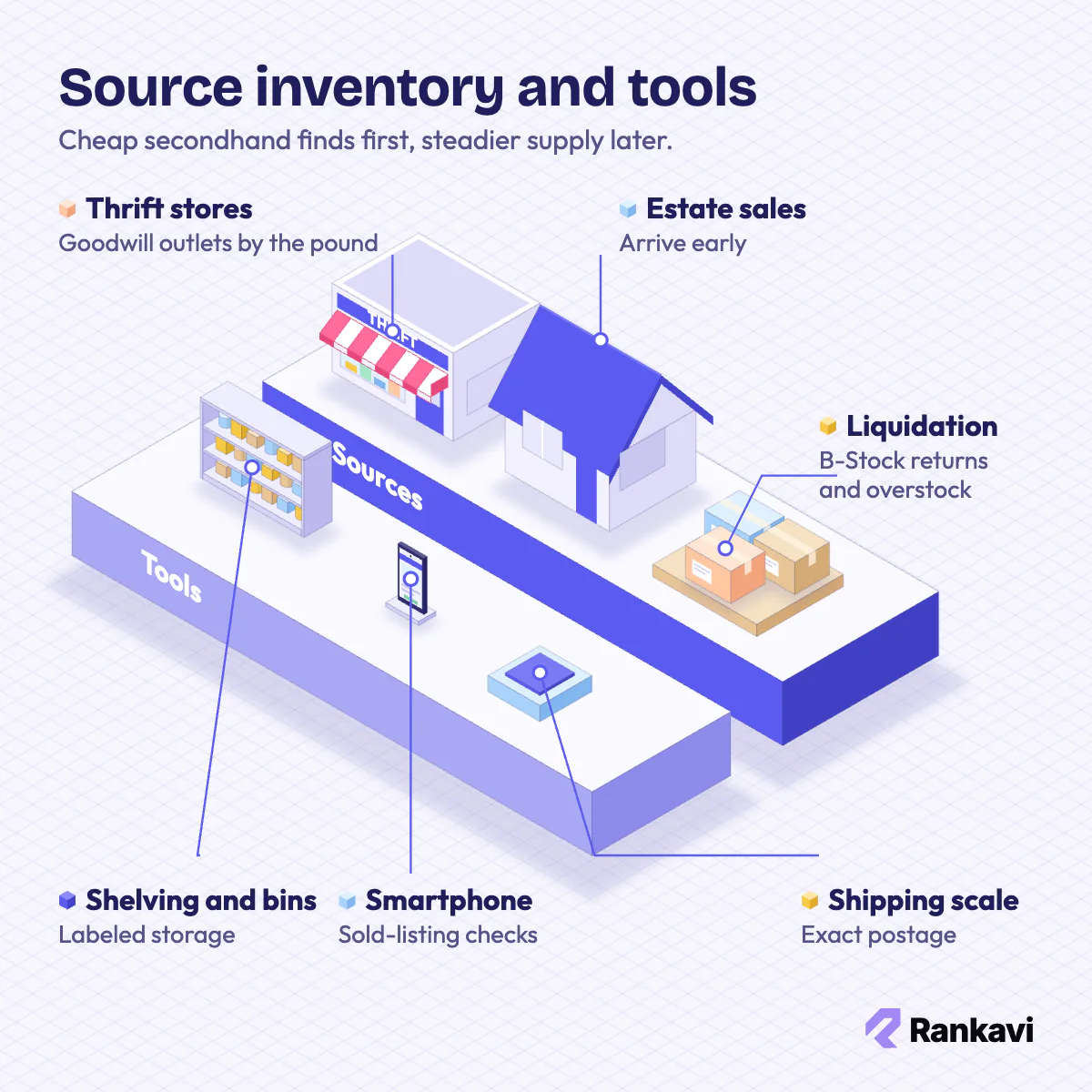
Thrift stores, estate sales, garage sales and flea markets are the classic starting points. Goodwill, a nonprofit network of thrift stores, runs outlet stores that sell some goods by the pound. Estate sales reward early arrival, and late visits bring discounts on leftovers.
B-Stock is a business-to-business liquidation marketplace where large retailers sell customer returns and overstock. Lots arrive uninspected, so condition varies. Small lots teach the risk before a full pallet ties up cash.
Retail arbitrage depends on timing, because clearance prices and stock levels change. Wholesale suppliers sell new goods in bulk and may ask for a resale certificate. Branded goods need an authenticity check of labels, stitching and serial numbers before purchase. Electronics are tested before buying whenever the seller allows it.
Starter tools for a reseller:
| Tool | Use |
|---|---|
| Smartphone | Sold-listing checks, photos and listing apps |
| Shipping scale | Exact weights for postage labels |
| Light and plain backdrop | Clean, consistent product photos |
| Shelving and labeled bins | Storage that finds any item in seconds |
Storage limits growth sooner than money. Bulky items earn bigger margins but need floor space. Many resellers start in a spare room, then rent a storage unit.
7. Set Up Listing and Shipping Routines
A listing routine turns raw inventory into live, searchable listings at a steady daily pace. Speed matters, because stock in a bin earns nothing.
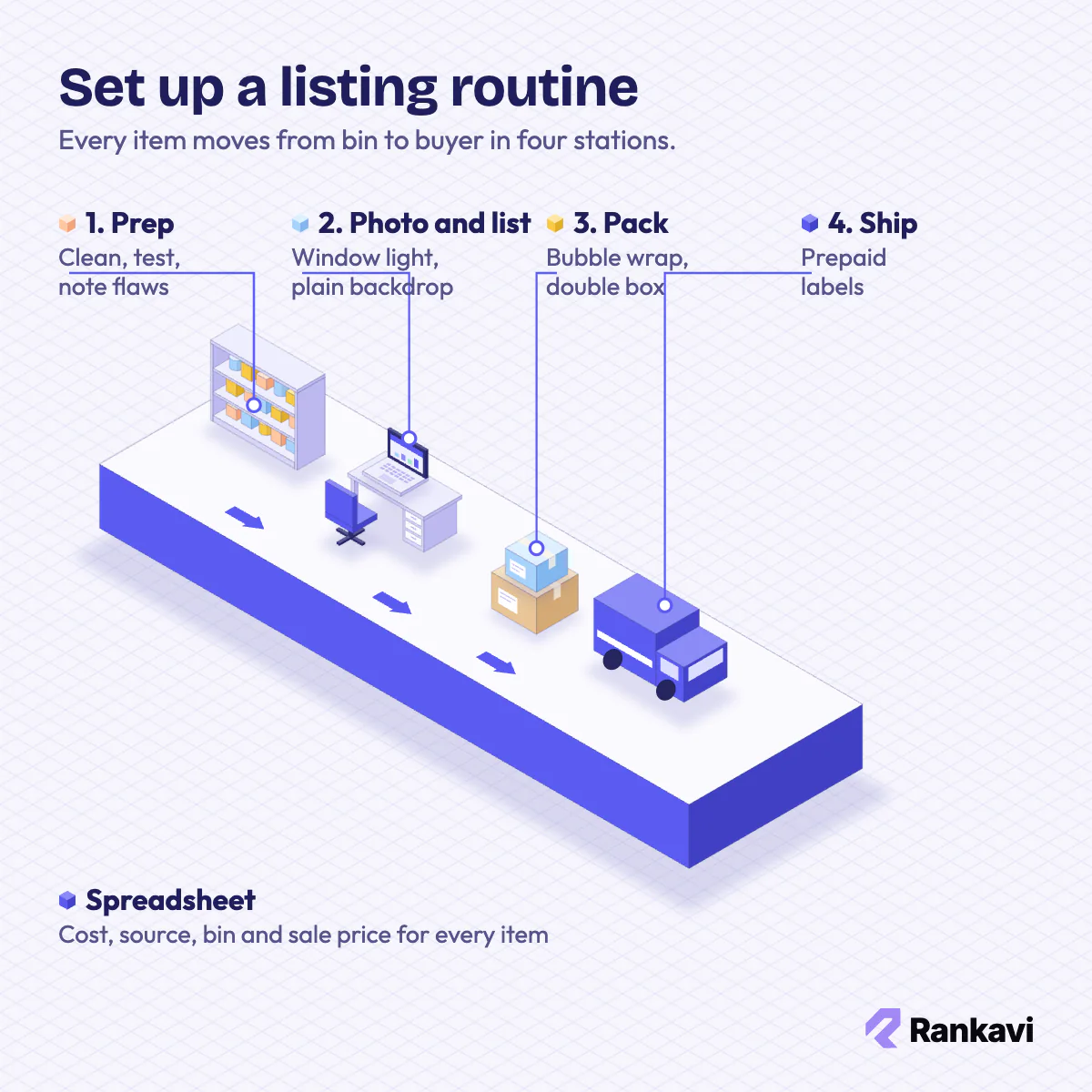
Preparation comes first. Clothing gets steamed and lint-rolled, and electronics get tested button by button. Every flaw goes into the description, because honest listings cut returns.
Photos sell secondhand goods. Natural window light and a plain backdrop work for most items. Shots show the front, back, labels, size tags and any wear.
A simple spreadsheet tracks each item from purchase to sale. It records the cost, the source, the bin location and the final price. Those records reveal which sources and categories pay.
Shipping supplies stay ready at the packing table. Prepaid labels from the marketplace save trips to the counter. Fragile pieces get bubble wrap and double boxing.
Descriptions use the words buyers search for, such as brand, size, color and material. Handling time promises must match what the packing routine can deliver. Returns are part of selling online, so the return policy is set before the first listing. Tracking or insurance on valuable parcels protects against loss.
8. Sell on Marketplaces and Your Own Store
Choosing sales channels puts each item in front of the buyers already searching for it. Every platform has its own audience, fee structure and listing rules.
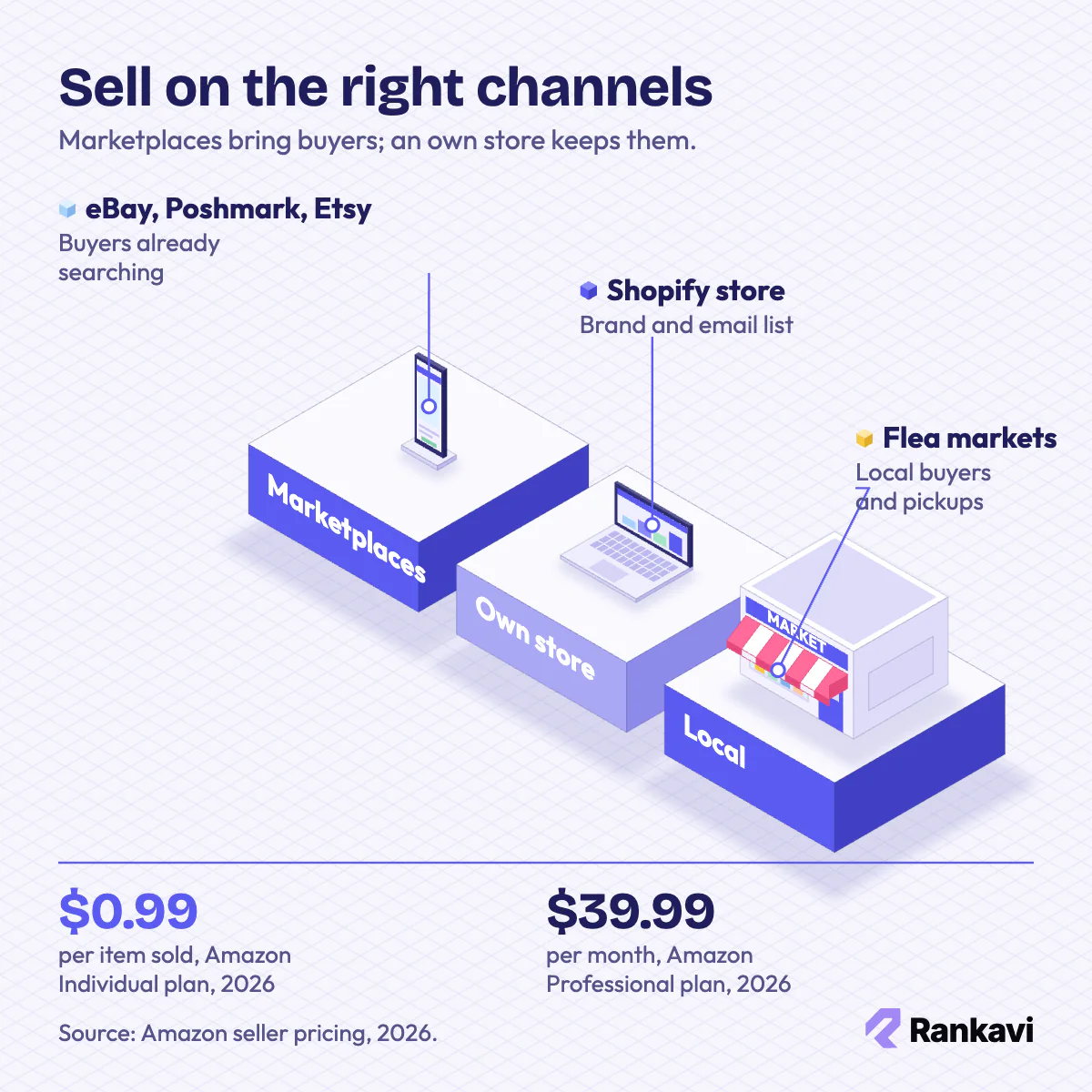
Poshmark is a social marketplace for clothing, shoes and accessories that issues prepaid shipping labels. Etsy is a marketplace for handmade and vintage goods. Facebook Marketplace suits furniture and bulky local pickups.
Main resale channels:
| Channel | Best fit |
|---|---|
| eBay | Electronics, collectibles, car parts and vintage goods |
| Poshmark and Depop | Clothing, shoes and accessories |
| Etsy | Vintage items with a story |
| Amazon | New or like-new products sold at scale |
| Facebook Marketplace | Furniture and bulky local pickups |
Amazon suits new goods more than used ones. As of 2026, its Individual plan cost $0.99 per item sold, and the Professional plan cost $39.99 a month. Category referral fees come on top of either plan.
Cross-listing puts one item on several platforms at once. Tools that delist sold items automatically prevent double sales. An own store on Shopify builds a brand and an email list, while flea markets add local buyers.
Marketplaces bring ready buyers but charge fees and control the customer relationship. An own store keeps the customer list and more of each sale, but it must find its own traffic. Each channel has its own rules for condition grades, shipping and returns, so listings are adapted per platform.
9. Grow From Side Hustle to Full Time
Growth involves more active listings, faster sell-through and bigger sourcing deals. A reseller who lists every day grows faster than one who only sources more.
Listing volume is the first lever. In 2026 eBay gave regular sellers 250 listings a month with no insertion fee. Most part-time resellers can grow well past their current count before listing fees apply.
Sell-through and profit per hour show what to scale. Categories that sell slowly get cut, and fast sellers get more sourcing time. Monthly reviews of the spreadsheet guide those calls.
Help arrives when listing falls behind sourcing. Photography, packing and shipping are the easiest tasks to hand off. Contacts with estate sale companies and liquidators then open bulk deals, and a warehouse follows.
Hiring help turns labor into a cost on every item, so profit per hour needs a recheck. Taxes grow with income, so bookkeeping and tax savings must keep pace. Leaving a job calls for a cash buffer and steady monthly income from sales.
10. Land in Copilot AI Shopping Answers
AI visibility places a resale shop in the answers shoppers get from AI assistants. Microsoft Copilot, Microsoft’s AI assistant, now answers questions such as where to buy vintage jeans or a used camera.
That habit is already common. ThredUp’s 2026 Resale Report found 48% of secondhand shoppers use AI shopping tools during their search. Copilot builds those answers from gift guides, “best vintage shops” lists and niche review pages.
Rankavi is a software as a service (SaaS) platform that publishes brand mentions in articles on indexed third-party websites. A vintage seller can start with a few Copilot brand placements on sites that cover its category. Reviews and repeat buyers still do most of the work.