

Starting a rental property business takes a clear strategy, a financed property and tenants who pay on time. The U.S. Census Bureau, which runs the federal Housing Vacancy Survey, put the homeownership rate at 65.0% in the second quarter of 2026. Every household outside that share is a potential tenant.
My name is Michal Sieroslawski. I help rental property businesses get found by tenants on Google and in AI chats. When tenants need a rental property business, more of them now ask Gemini or ChatGPT first. So being recommended in those chats matters more every year.
The order settles rent math and financing before any purchase, so every filing and permit serves a property that pays. Tenants arrive only once the unit is legal, insured and managed. Each of the eleven steps below builds on the last, from rental property idea to first paying customer.
- Choose a Rental Property Strategy
- Research Local Rental Markets
- Write a Rental Business Plan
- Price Rent and Run the Numbers
- Finance Your First Rental Property
- Form an LLC and Insure Your Rentals
- Buy the Right Rental Property
- Meet Local Rental Laws and Permits
- Set Up Property Management Systems
- Market Units and Screen Tenants
- Put Your Rentals in Tenants’ AI Answers
1. Choose a Rental Property Strategy
A rental property business earns money by leasing homes or commercial space to tenants. The first decision is how long each tenant stays and what type of property the business owns.
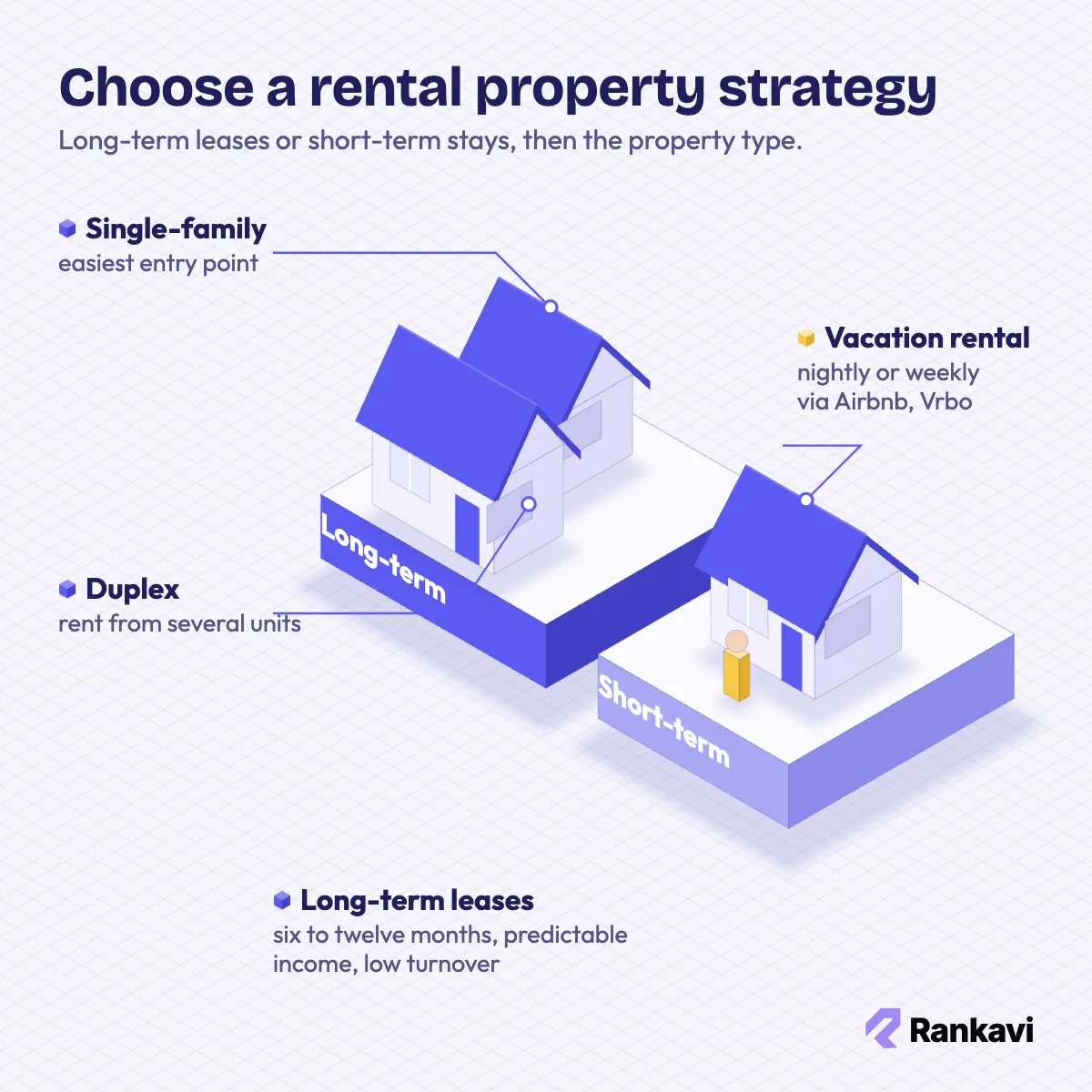
Long-term rentals sign tenants to leases of six to twelve months or longer. Income stays predictable, turnover stays low and tenants usually pay most utilities.
Short-term rentals host guests nightly or weekly through Vrbo and Airbnb, which runs an online marketplace for short-term stays. Nightly rates run higher, though cleaning, utilities and local rules add work.
Mid-term rentals sit between the two. Furnished units lease for one month to several months, which suits traveling nurses and remote workers. Turnover stays lower than with nightly stays.
Property type shapes the workload next. Single-family homes are the easiest entry point. Small multi-family buildings such as duplexes spread rent across several units, and commercial space suits investors with deeper pockets.
Three investment strategies suit most new landlords:
- Buy and hold: rent a property out and keep it for income and appreciation.
- Buy, rehab, rent, refinance, repeat (BRRRR): recycle capital from one renovated property into the next.
- House hacking: live in one unit of a small multi-family building and rent the others.
The ideal tenant follows from these choices. Students, young families, traveling nurses and vacationers each want different locations, finishes and lease terms.
Each strategy trades one burden for another. Short-term rentals earn more per night but demand the most time and the most local approvals. Long-term rentals earn steadier income with less daily work. Budget, free time and risk tolerance decide the fit.
2. Research Local Rental Markets
Strong rental markets combine steady job growth, rising population and few empty units. Market research compares neighborhoods on those signals before any money changes hands.
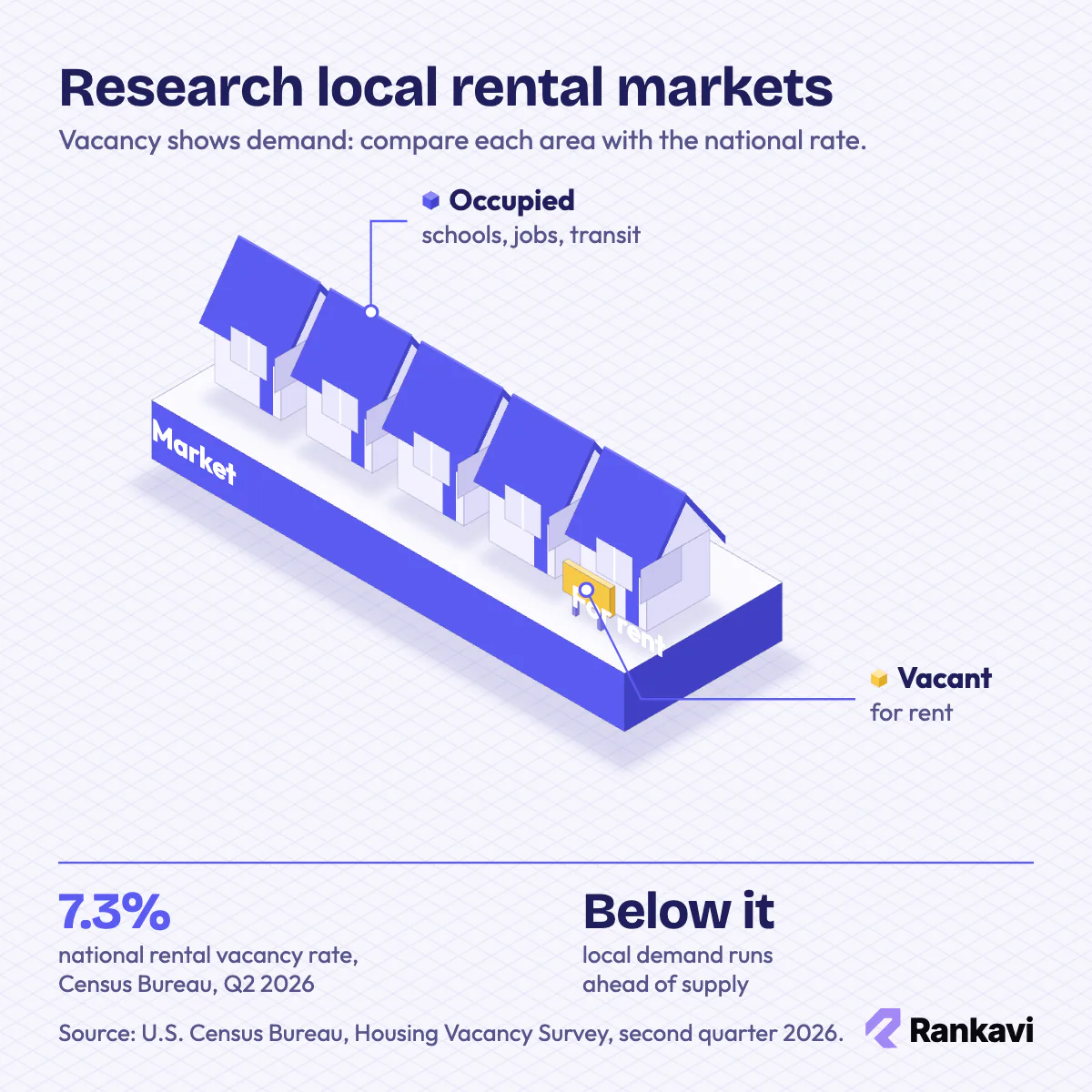
Vacancy rates show demand directly. The Census Bureau put the national rental vacancy rate at 7.3% in the second quarter of 2026. A local rate well below that signals tenants competing for homes.
Comparable rents set realistic income. New investors pull asking rents for similar units from Zillow, which runs a home and rental marketplace, and from Rentometer. Those rents then get compared with home prices.
Neighborhood factors decide who rents there. Good schools draw families, transit and employers draw workers, and low crime protects both demand and property value.
Property taxes and landlord laws vary by city. Two nearby towns can differ sharply in tax bills, rent rules and permits. Each town gets its own check.
Job concentration is a risk. A town that relies on one large employer can lose tenants quickly if that employer cuts jobs. Several employers across different industries make demand steadier.
A short visit adds what data misses. Walking the area shows the condition of nearby homes, the number of rental signs and how quickly units are leased.
3. Write a Rental Business Plan
A rental business plan means a written map of the strategy, target market, numbers and management approach. Lenders and partners read it before they commit money.
Goals come first. A plan states whether the business chases cash flow, appreciation or both. It also names a target unit count.
Typical plan sections:
| Section | What it covers |
|---|---|
| Executive summary | Goals and what success looks like |
| Market analysis | Target neighborhoods, demand and competing rentals |
| Marketing plan | How the business finds and keeps tenants |
| Management | Self-management or a property manager |
| Financial plan | Income, expenses and cash flow per property |
The management section decides daily workload. Owners with full-time jobs often plan for a property manager from the start. Hands-on owners plan their own maintenance routine.
An exit plan completes the document. It states whether the business will hold the properties long term, sell them or refinance them. Lenders and partners read that choice as a sign of how risk is handled.
4. Price Rent and Run the Numbers
Pricing a rental sets the monthly rent that covers the mortgage, taxes, insurance and upkeep with money left over. Comparable rents set the ceiling, and costs set the floor.
Startup money at a glance:
| Item | Figure |
|---|---|
| Startup cost | About $51,570 (15% down) to $85,950 (25% down) on the $343,800 median asking price (derived), plus closing costs and repairs |
| Main costs | Down payment, closing costs, home inspection, repairs, cash reserves |
| Typical margin | 58.08% gross and 13.23% net for U.S. real estate investment trusts (proxy, not small landlords) |
| Time to open | Varies with loan approval, inspection and repair work |
Sources: U.S. Census Bureau, 2026; Fannie Mae, which sets conventional loan rules, April 2026; Aswath Damodaran, NYU Stern, January 2026 (REIT proxy).
Rent sits close to the local market rate. Units priced above comparable listings sit empty longer, and lost months cost more than a slightly lower rent.
Operating costs go beyond the mortgage. Property taxes, insurance, repairs, capital reserves, vacancy and management fees all come out of rent before profit appears.
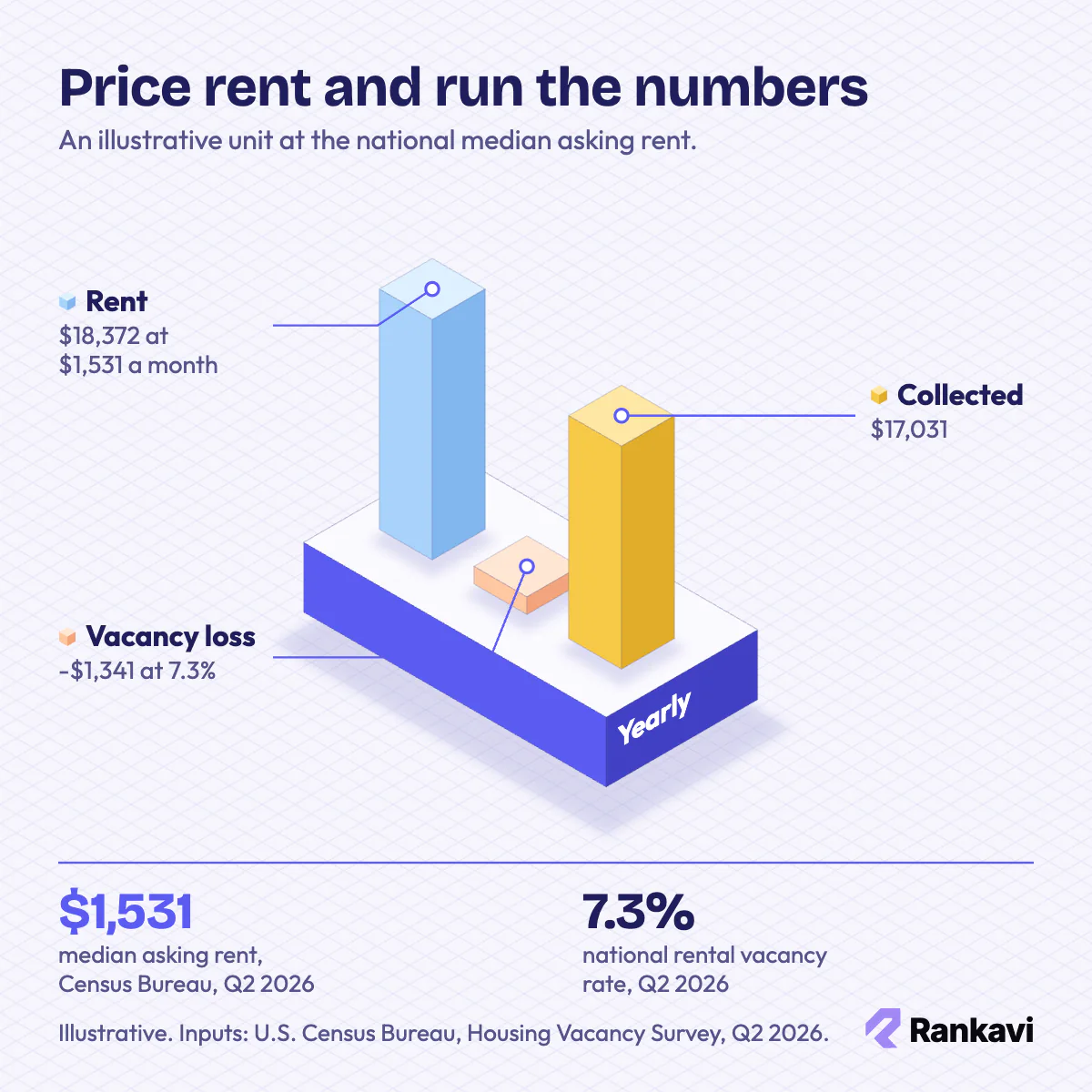
Vacancy is the benchmark landlords check first, because every empty month cuts rent that fixed costs still need. The Census Bureau put median asking rent for vacant units at $1,531 for April to June 2026.
Example: an illustrative unit rented at the national median asking rent, losing the national vacancy share.
| Line | Amount |
|---|---|
| Rent, 12 months at $1,531 | $18,372 |
| Vacancy loss at 7.3% | -$1,341 |
| Rent actually collected | $17,031 |
Cash flow is the money left after every cost. Positive cash flow from day one protects the business when a roof fails or a unit sits empty.
Gross rent is not profit. Mortgage interest, taxes, insurance and repairs all reduce it, and a vacant month reduces it further. A cost list built before the offer shows whether the property truly pays.
A price that looks cheap can still lose money. Low rent, high taxes or an old roof can turn a bargain into a drain. Running the numbers on each candidate prevents that.
5. Finance Your First Rental Property
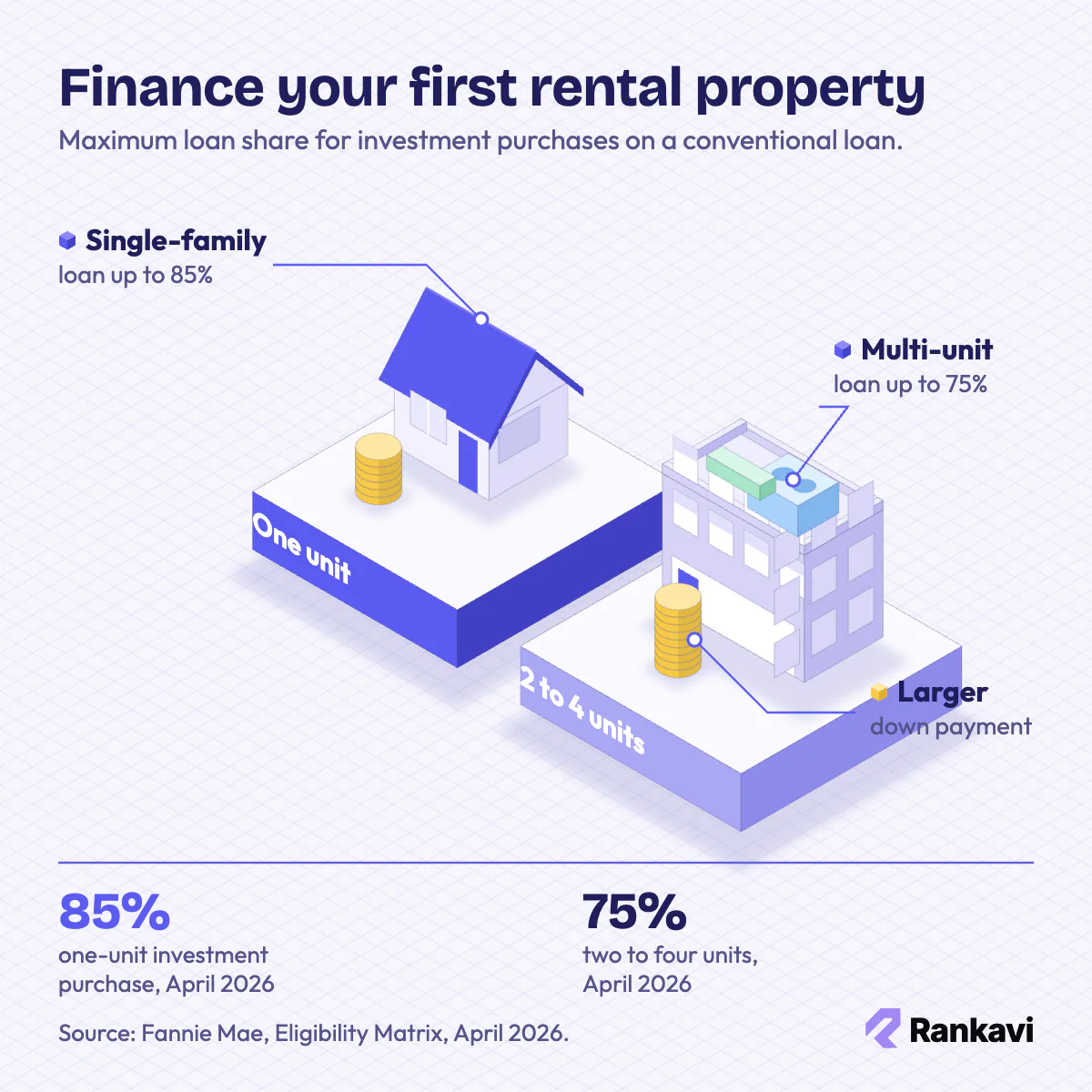
Financing a rental involves choosing how to pay for the property and how much cash to put down. Investment property loans ask for larger down payments than home loans. Fannie Mae, which sets the rules most conventional loans follow, capped investment purchases at 85% of value for one unit in April 2026. Buildings with two to four units capped at 75% under that April 2026 matrix.
Five financing routes cover most first purchases:
- Conventional mortgage: a bank or credit union loan for an investment property.
- Debt service coverage ratio (DSCR) loan: a loan that qualifies on the property’s rent instead of personal income.
- Home equity line of credit: borrowing against equity in a home already owned.
- Private money: faster loans from individuals or companies at higher rates.
- Owner-occupied loan: a home loan for a small multi-family building the owner lives in.
Cash buyers skip interest but tie up capital. Most investors borrow to keep money free for repairs and the next purchase.
Each route trades cost against speed. Private money closes fast but charges more. It often serves as a short bridge before a cheaper loan. Lenders weigh credit score, income and the rent a property can earn.
Cash reserves matter as much as the down payment. Closing costs, early repairs and several months of mortgage payments sit in the bank before the first tenant moves in.
6. Form an LLC and Insure Your Rentals
Forming a rental limited liability company (LLC) protects personal assets from lawsuits and debts tied to the property. Many landlords hold each property or a small group in an LLC.
The Internal Revenue Service (IRS) issues an employer identification number (EIN) for the LLC. That number opens a business bank account that keeps rent separate from personal money.
Some lenders only lend to individuals, so investors check loan terms before titling property in an LLC. A real estate attorney or tax professional confirms the right setup.
Landlord insurance replaces a homeowner’s policy once tenants move in. It covers the building, lost rent and liability, while tenants insure their own belongings with renters insurance.
An umbrella policy adds liability coverage above the landlord policy. Lenders require proof of property coverage before closing.
Separate entities can limit risk across properties. One LLC per property keeps a lawsuit over one building from reaching the others. The trade-off is more filings, more bank accounts and more bookkeeping.
7. Buy the Right Rental Property
The right property rents quickly, needs predictable repairs and cash flows at the rent the market supports. Real estate agents and online listings supply candidates.
Each candidate gets the same test. Location, condition, age, taxes and expected rent go into one spreadsheet so properties compare side by side.
A professional home inspection comes before closing. Roofs, foundations, plumbing and electrical systems decide the true repair budget.
Renovations follow the purchase. Durable flooring, fresh paint and working appliances help a unit rent faster and survive tenant turnover.
An offer can depend on the inspection. If the report finds major defects, the buyer can negotiate the price, ask for repairs or walk away. A cash reserve for repairs belongs in the budget before the offer, not after it.
8. Meet Local Rental Laws and Permits
Rental compliance covers the registrations, inspections and fair housing rules a landlord follows before leasing. Requirements vary by state, county and city.
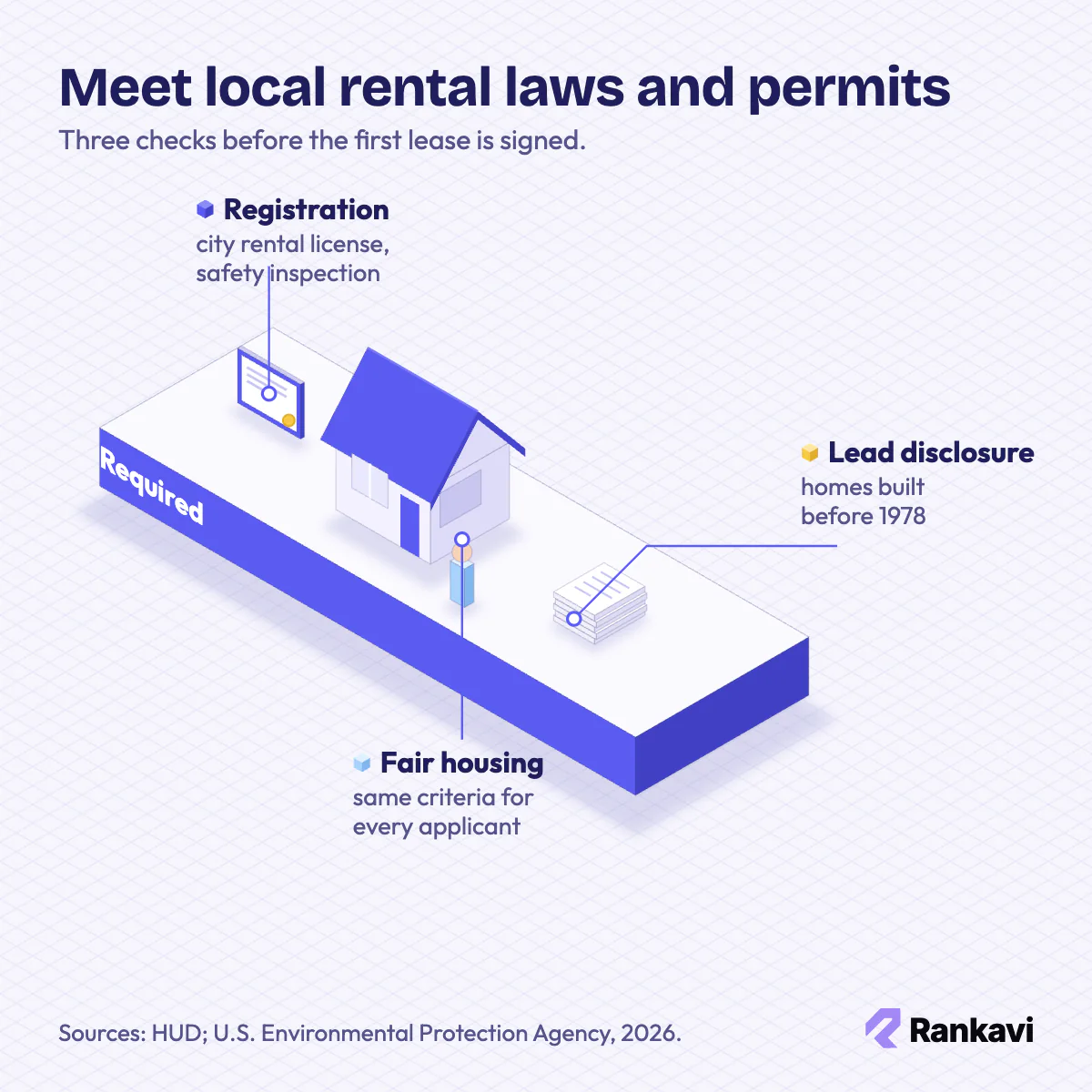
Many cities require rental registration or a rental license, often with a safety inspection. Zoning rules also confirm that the property may legally hold tenants.
Short-term rentals face stricter rules. Cities may require a permit, cap rental nights, collect occupancy tax or ban the practice in some zones.
Homeowners associations can add limits of their own. Some ban rentals entirely or restrict their length. The association rules and the lease terms both need review before a purchase.
The U.S. Department of Housing and Urban Development (HUD) enforces the federal Fair Housing Act. That law bans discrimination by race, color, religion, sex, disability, familial status or national origin in advertising, screening and leasing.
The U.S. Environmental Protection Agency (EPA) sets a rule that requires a lead-based paint disclosure for most housing built before 1978. Landlords keep the signed forms for three years, as of 2026. Health and safety codes also set standards for smoke alarms, heat and water.
9. Set Up Property Management Systems
Property management systems keep rent collection, maintenance and bookkeeping running without daily scrambling. Owners either manage units themselves or hire a property management company.
Self-management saves fees but takes time. Property managers handle showings, screening, rent collection and repairs, and they suit owners with jobs or distant properties.
Property management software collects rent online, logs repair requests and stores leases. Accounting software tracks income and expenses for each property.
A maintenance routine protects the asset. Regular inspections catch leaks and damage early, and a list of trusted plumbers, electricians and handymen speeds up repairs.
A property manager charges a fee that comes out of rent. Self-management avoids that fee but costs time, and late-night repair calls fall on the owner. The better choice depends on how many units the owner holds and how much time is free.
Rental income goes on Schedule E of the federal tax return. The IRS Publication 527 for 2025 depreciates residential rental buildings over 27.5 years. Interest, repairs and management fees also reduce taxable rental income.
10. Market Units and Screen Tenants
Tenant marketing turns a ready unit into a signed lease with a reliable renter. Clear photos, an accurate description and a fair rent bring qualified applicants.
Online listings reach most renters. Zillow, Apartments.com and Facebook Marketplace carry rental listings, and a yard sign still works in walkable neighborhoods.
Screening checks credit, income, rental history and background. The same written criteria apply to every applicant to stay within fair housing rules.
A written policy keeps screening fair and consistent. The policy lists the income, credit and history standards before listings go live. Every applicant then meets the same rule.
The lease agreement sets the rules. It states the term, rent, due date, late fees, security deposit and maintenance duties for both sides.
11. Put Your Rentals in Tenants’ AI Answers
AI visibility earns a rental business a place in the answers tenants read before they tour. Renters now ask ChatGPT, Gemini and Perplexity which landlords and apartments in a city are worth a look.
Those assistants repeat what trusted third-party sites say. Rental directories, local news and neighborhood guides shape which landlords get named.
Rankavi is a software as a service (SaaS) platform that publishes brand mentions in articles on indexed third-party websites. A small landlord can build the kind of brand mentions ChatGPT picks up when renters ask where to live.