

Starting a real estate business means opening a licensed brokerage that earns commissions on property sales. The National Association of Realtors (NAR), which represents real estate professionals, counted 1,438,569 members in late June 2026. That count shows how crowded the field is for a new firm.
I’m Michal Sieroslawski, and I help real estate businesses get found online. AI search is a growing way for buyers and sellers to find real estate businesses, and recommended names start ahead.
The order settles commission math and funding before filings. Each license fee then serves a firm that can pay its bills. The path to a running real estate business runs through the eleven steps below.
- Choose Your Real Estate Niche
- Study Your Local Housing Market
- Write a Brokerage Business Plan
- Price Commissions and Agent Splits
- Fund the First Year of Operations
- Register the Brokerage as an LLC
- Earn Broker and Firm Licenses
- Insure Against Errors and Omissions
- Set Up MLS Access and a Trust Account
- Market the Brokerage to Buyers and Sellers
- Join the Agents AI Chats Recommend
1. Choose Your Real Estate Niche
A real estate niche means the type of property and client a brokerage serves first. Narrow focus helps a new firm stand out against older offices with bigger names.
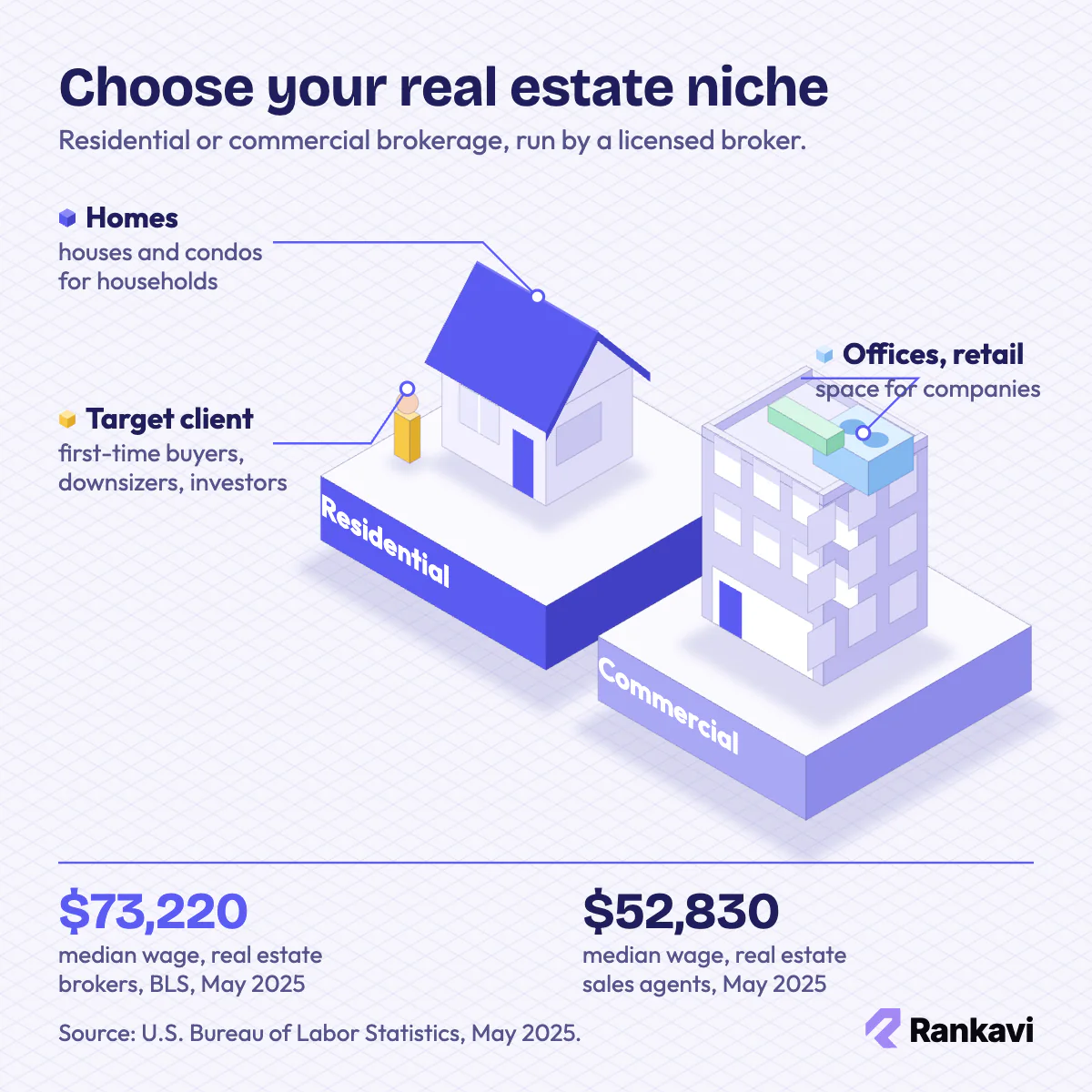
Agents and brokers hold different roles. Agents work under a supervising broker and follow that broker’s policies. A broker can run an independent firm, supervise agents and manage client money.
That extra responsibility shows up in pay. The U.S. Bureau of Labor Statistics (BLS), which publishes wage data by occupation, put the median broker wage at $73,220 in May 2025. Sales agents earned a median $52,830 in that May 2025 survey.
Residential and commercial brokerage split the market first. Residential firms sell houses and condos to households, while commercial firms handle offices, retail space and industrial buildings for companies.
Specialty services add a second layer:
- Luxury homes: high-value listings that need polished marketing.
- First-time buyers: families moving out of rentals for the first time.
- Property management: leasing, rent collection and repairs for landlords.
- Investor sales: rental homes and small apartment buildings for investors.
Retirees downsizing, relocating employees and local investors each need different hours, skills and marketing. One of them becomes the target client.
Each niche pays in a different way. Commercial deals pay larger commissions but close more slowly, while residential sales bring more volume and more competition. Property management earns monthly fees instead of one commission per sale, which smooths uneven income.
A niche is a starting focus, not a permanent choice. Changing it later also changes the brand, website and referral network. The first pick deserves a short comparison of local demand, competing offices and the owner’s contacts.
2. Study Your Local Housing Market
Market research shows whether a town has room for one more brokerage. It compares local firms, sales activity and unmet needs before the owner signs anything.
Competing brokerages come first. Each local firm’s share of listings and closed sales reveals who dominates and which neighborhoods lack a strong name.
Sales pace sets the ceiling on income. NAR counted 1.62 million homes for sale in August 2026, equal to 4.9 months of supply. That August 2026 supply was the highest in over ten years, so buyers hold more bargaining power.
Local numbers matter more than national ones. Months of supply, days on market and closed sales by neighborhood show whether a target area runs hot or slow.
County recorder offices publish deed transfers and sale prices, which helps before the firm has listing database access. A neighborhood with many sales but no dominant listing firm shows the clearest opening.
Service gaps point to an opening. Weak websites, slow follow-up or no training for new agents leave room for a firm that fixes them.
Agents are the second market. A new brokerage also studies which local agents feel underserved by their firms, because those agents become its first recruits.
3. Write a Brokerage Business Plan
A brokerage business plan sets the vision, model, revenue goals and policies in one written document. Banks and partners read it before they commit money.
The plan picks one of three operating models:
| Model | How it works |
|---|---|
| Brick and mortar | A physical office with conference rooms for clients and closings |
| Virtual | Agents work remotely on shared software, with little office cost |
| Franchise | A national brand supplies name recognition, training and tools for ongoing fees |
Revenue goals rest on realistic agent output. The typical Realtor closed nine transaction sides in 2025, with a median gross income of $59,200, in NAR’s 2026 Member Profile. A plan multiplies sides per agent by the firm’s share of each commission.
Policies and procedures complete the plan. Office rules, management structure and agent training decide how the firm runs once listings arrive.
The model choice changes the break-even point, meaning the number of closed sides that cover fixed costs. A virtual firm carries lower fixed costs than an office, while a franchise adds ongoing fees to every deal.
4. Price Commissions and Agent Splits
Commission pricing decides how much a brokerage earns on every sale and how much each agent keeps. Most firms charge a percentage of the final sale price.
Startup money at a glance:
| Item | Figure |
|---|---|
| Startup cost | About $5,000 to $20,000 for a small independent firm; $250,000 or more for a large franchise |
| Main costs | Licensing and legal fees, errors and omissions insurance, office or virtual setup, software, marketing and recruiting |
| Typical margin | 32.21% gross and 1.19% net for listed real estate operations and services companies (proxy, not small brokerages) |
| Time to open | Varies with entity filing and state firm-license processing |
Sources: Superior School of Real Estate, a North Carolina licensing school, estimate updated February 2026; Aswath Damodaran, NYU Stern, January 2026 (industry proxy).
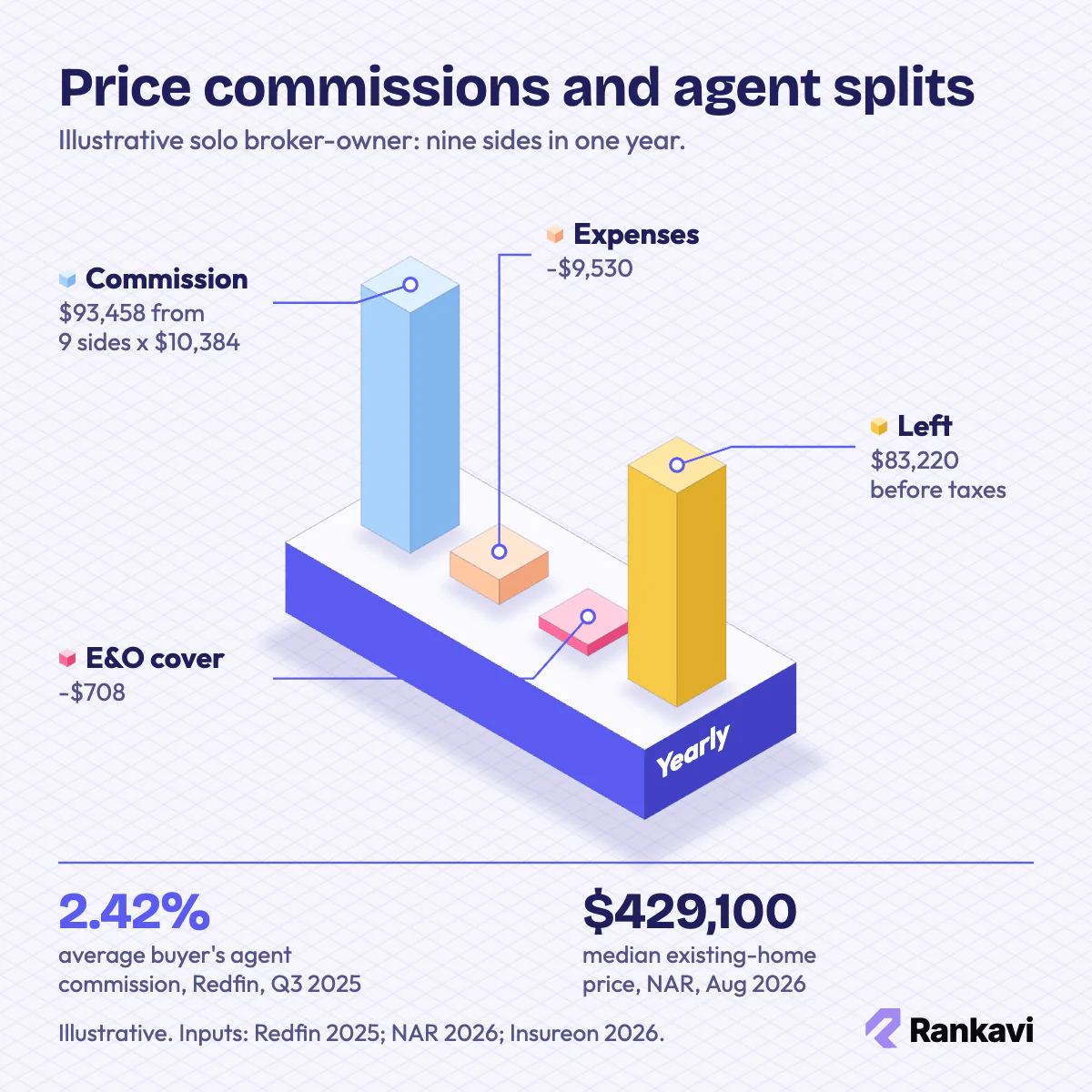
Commission rate per side is the number broker-owners check first. Redfin, which operates a real estate brokerage, reported an average buyer’s agent commission of 2.42% in the third quarter of 2025. Homes under $500,000 averaged 2.52% in that 2025 Redfin data.
Listing and buyer commissions are negotiable. Since August 17, 2024, NAR rules require a written buyer agreement before an agent tours a home with a buyer. Compensation in that agreement is not set by law.
Agent splits divide the firm’s commission. NAR found that 86% of Realtors worked as independent contractors in its 2026 Member Profile. A traditional split sends a share to the brokerage, while a cap model lets productive agents keep more.
Agent fees fill the gap between splits and costs. Many brokerages charge desk, technology or transaction fees to cover software, insurance and marketing.
A higher split attracts agents but leaves less for the firm. The split must still cover the firm’s fixed costs, or growth in agent count only grows losses.
Worked example: an illustrative solo broker-owner closes nine sides a year at the $429,100 median price and 2.42% commission. Each side earns about $10,384, so nine sides bring in $93,458. Minus $9,530 in expenses and $708 for errors and omissions cover, $83,220 remains before taxes. A $20,000 launch plus those costs totals $30,238, which about three sides cover.
5. Fund the First Year of Operations
Brokerage funding covers launch costs and the slow months before commissions arrive. Closings take weeks, so cash leaves well before income starts.
Startup costs fall into five groups:
- Licensing and legal: state filing fees, license fees and attorney help.
- Insurance: errors and omissions coverage and liability policies.
- Office: rent, furniture and utilities, unless the firm runs virtually.
- Technology: website, client database and transaction tools.
- Marketing and recruiting: brand design, advertising and agent onboarding.
Lenders hesitate with brokerages, which own few assets to pledge. Personal savings, partners and credit unions fill most gaps. The U.S. Small Business Administration (SBA), which backs small business loans, offers microloans and 7(a) loans through partner lenders.
Business expenses keep running after launch. NAR put the typical Realtor’s median business expenses at $9,530 for 2025, with vehicle costs the largest line. A cash reserve covers several months of those costs.
A virtual setup lowers the cash needed up front. A physical office costs more but gives clients and agents a visible local base.
6. Register the Brokerage as an LLC
Registering a brokerage creates the legal company that holds the firm license and signs agent contracts. Most new firms file as a limited liability company (LLC) with the Secretary of State.
An LLC separates personal assets from business debts. A corporation suits larger firms with investors, while a sole proprietorship skips filings but leaves the owner exposed.
An operating agreement states who owns which share and how a partner can leave. A lawyer or accountant can explain the tax treatment before filing.
The Internal Revenue Service (IRS), the federal tax agency, issues an employer identification number (EIN) for the LLC. That number opens the operating bank account that receives commissions.
North Carolina requires a firm name without the owner’s surname to be registered as an assumed name in each county served. Partners also sign a written agreement on revenue shares before the first deal.
7. Earn Broker and Firm Licenses
Brokerage licensing gives the owner and the company legal permission to collect commissions. State real estate commissions issue both licenses and set their own rules.
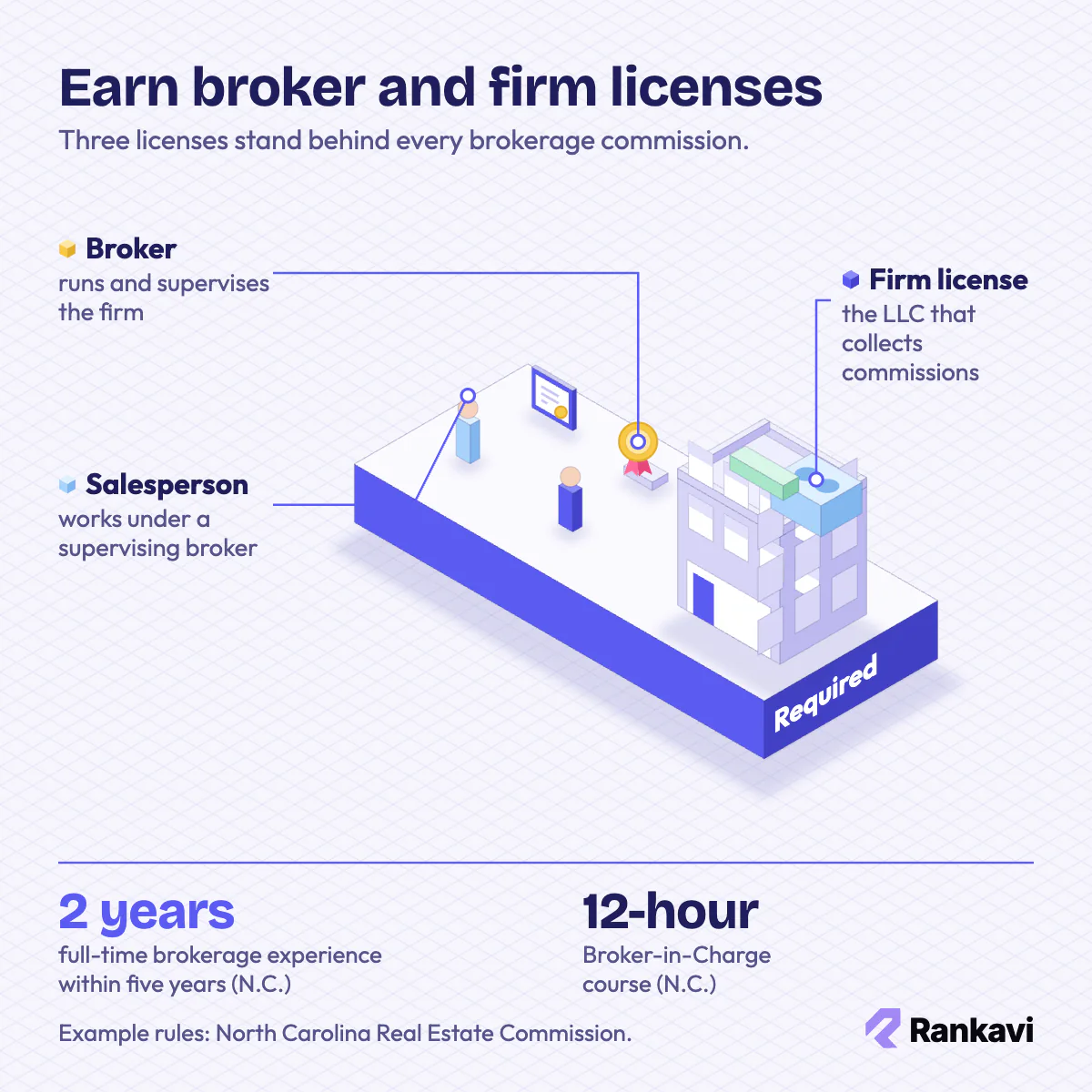
A broker license comes after time as a licensed salesperson. States require active sales experience, extra pre-licensing education and a passed broker exam.
Requirements differ by state, so the state commission’s website settles the details before any course is booked.
The North Carolina Real Estate Commission, which licenses brokers and firms in that state, shows how strict the bar is. A broker-in-charge needs two years of full-time brokerage experience within five years and a 12-hour course.
Firms organized as companies need a separate license:
| License | Who holds it |
|---|---|
| Salesperson license | Agents who work under a supervising broker |
| Broker license | The person who runs and supervises the firm |
| Firm license | The LLC or corporation that collects commissions |
In North Carolina, an LLC or corporation must hold its firm license before it receives any commission. One broker then takes legal charge of agents, trust money and advertising.
8. Insure Against Errors and Omissions
Brokerage insurance protects the firm when a client blames it for a costly mistake. Errors and omissions (E&O) insurance pays legal costs when a buyer says a defect went undisclosed.
Insureon, an online insurance agency, put E&O for real estate agents and brokers at $59 a month, or $708 a year, in May 2026. Those May 2026 figures are medians of quotes on its platform.
General liability covers injuries and property damage at open houses. Insureon listed it at $33 a month, or $400 a year, on that May 2026 page.
Some states require E&O coverage for every licensee. New brokers check the state commission’s rules before the firm license takes effect.
A firm also confirms whether one policy covers its agents or only the owner.
9. Set Up MLS Access and a Trust Account
Brokerage operations connect the firm to shared listings, client money and daily software. These systems must work before the first listing goes live.
A Multiple Listing Service (MLS) is a shared database where member brokers in one area post listings. Access to the Multiple Listing Service usually comes through the local Realtor association.
A trust account holds earnest money, rents and security deposits apart from business funds.
Earnest money is the deposit a buyer pays to show serious intent. North Carolina requires the account title to include “Trust Account” or “Escrow Account” and a monthly reconciliation.
Daily work runs on a small software stack:
- Client database: tracks leads, past clients and follow-ups.
- Transaction management: stores contracts, disclosures and signatures for each deal.
- Website with listing search: shows MLS listings to buyers browsing online.
A home office suits a virtual firm when zoning allows it. Provisional brokers in North Carolina need a supervised workspace, which pushes growing firms toward a small office.
10. Market the Brokerage to Buyers and Sellers
Brokerage marketing turns a new firm name into listing appointments and buyer calls. Brand, referrals and visible listings do most of the work.
A memorable name, logo and yard sign build recognition. Every sign shows the firm name, so neighbors connect each sale with the brokerage.
Referrals bring the first deals. New firm owners announce the launch to past clients, friends and local groups, then host open houses most weekends.
Listing videos and social media reach buyers who browse online. Short walkthrough clips show a home and the brokerage behind it.
Productive agents widen that reach. Fair commission splits, training and marketing support attract agents who bring their own clients.
11. Join the Agents AI Chats Recommend
AI visibility earns a brokerage a place in the answers buyers and sellers read before calling an agent. Home sellers now ask ChatGPT which local agents price homes well and sell fast.
Those assistants repeat what trusted third-party sites say. Local news, agent directories and neighborhood guides shape which brokerages get named.
Rankavi is a software as a service (SaaS) platform that publishes brand mentions in articles on indexed third-party websites. A young firm can use it to get brand mentions in ChatGPT for the towns it serves.