

Starting a print on demand business takes a focused niche, original designs and a print partner. That partner makes each item only after it sells. Grand View Research, which publishes market size reports, valued the global print on demand market at $10.8 billion in 2025.
My name is Michal Sieroslawski. I help print-on-demand brands build their visibility online. Asking an AI assistant is becoming a normal way for shoppers to compare print-on-demand brands. A mention in those replies can bring in customers before any ad does.
The order tests demand and samples before any money goes into ads, and it fixes prices before paperwork and launch. Starting a print on demand business comes down to the nine steps listed below.
- Choose a Print on Demand Niche
- Validate Demand With Search and Sales Data
- Create Designs You Own the Rights To
- Pick a Print Partner and Order Samples
- Price Every Product From Its Full Cost
- Register the Business and Sales Tax
- Launch on One Channel and Market It
- Scale the Catalog With Order Data
- Surface in AI Merch Recommendations
1. Choose a Print on Demand Niche
Choosing a niche decides who the store sells to, which products it carries and how its designs speak. A print on demand store without a niche competes with every generic shirt online.
Print on demand is a fulfillment model in which an item is produced only after a customer orders it. The seller creates the design and sets the retail price. A print partner then prints, packs and ships the order under the seller’s brand.
A useful niche is a buyer group with its own language, occasions and identity. “Pet owners” is too broad. “French bulldog owners who hike” gives designs a clear audience. “Memorial gifts for dog owners” adds a reason to buy.
Niches narrow in levels. “Pet owners” is a broad market, “dog owners” is a niche and “French bulldog owners who hike” is a micro-niche. Starting narrow is easier to design for. Widening later is easier than narrowing.
Common niche types include:
- Hobbies: pickleball, fishing, gardening and hiking give buyers a way to show what they enjoy.
- Professions: nurses, teachers and electricians buy shirts and mugs for pride, humor and gifts.
- Pets: breed-specific designs and memorial gifts tie to strong feelings.
- Life events: weddings, retirement, new babies and graduations create gift moments.
- Community and place: faith, causes and regional pride let buyers show identity.
Evergreen niches, such as pets and professions, sell all year. Seasonal niches peak around Mother’s Day, Father’s Day, Halloween or Christmas and need a plan for slow months. Trend niches spike and fade, so they work as add-ons rather than a base.
A niche passes a first check when buyers identify with it and buy gifts for it. They also gather in known places, such as subreddits or Facebook Groups. Room for many design ideas also matters. A niche that runs dry after a handful of designs is too narrow.
Niches built on licensed brands, such as Disney, Marvel or sports teams, give the trademark owner control over the catalog. Original niches avoid that risk.
Joining the audience is not required, but its slang and inside jokes must be understood. Designs that miss them look generic.
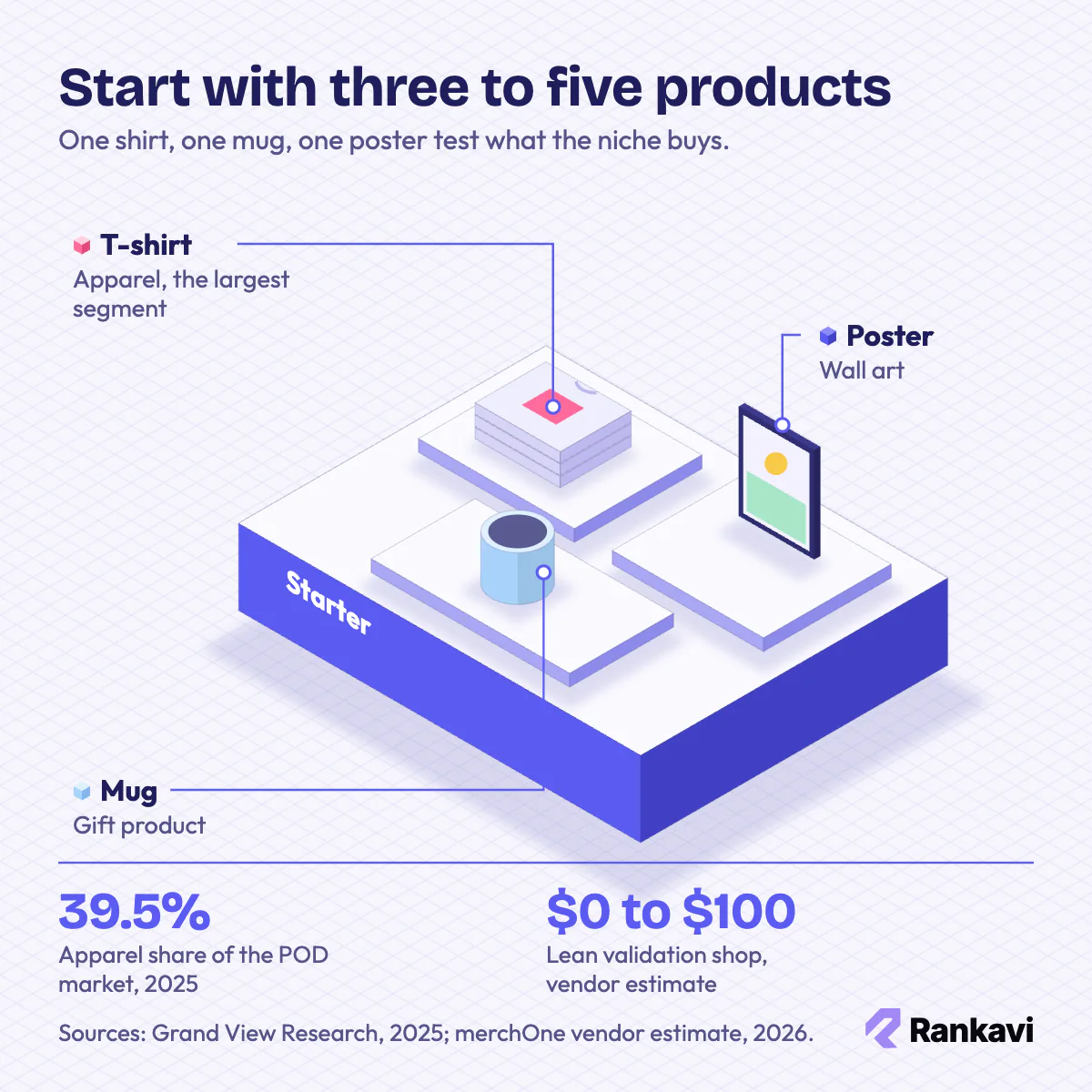
A small starter line beats a full catalog. Three to five products, such as one shirt, one mug and one poster, show which formats an audience prefers. Apparel held the largest share of the market, 39.5% in 2025, in that Grand View Research report.
Startup money at a glance:
| Item | Print on demand figure |
|---|---|
| Startup cost | $0 to $100 for a lean validation shop; $300 to $750 for a branded launch; $1,000+ for paid ads and pro design |
| Main costs | Product samples, storefront plan, design work, domain, first ad tests |
| Typical margin | 20% to 40% profit margin (vendor estimate; net or gross not stated) |
| Time to open | Varies: listings can go live quickly, but sample orders add production and shipping time |
Sources: merchOne (a print on demand fulfillment company), vendor estimate, August 2026; Printful (a print on demand company), vendor estimate, June 2026. Time to open is qualitative because no source gives a figure.
The inventory-free model has trade-offs. Each unit costs more than a bulk order would. Shipping time sits outside the seller’s control, and cash moves in an awkward order:
“Someone buys a shirt for example and you have to pay printify the cost of the shirt. The payment from the customer does not come through for multiple days meaning the seller fronts the cost of the product for a few days.”
— A viewer commenting on a YouTube print on demand tutorial
2. Validate Demand With Search and Sales Data
Validating demand shows whether real shoppers already search for and buy products in the chosen niche. That evidence comes before any design work.
Google Trends is a free Google tool that compares search interest over time and by region. Steady or seasonal interest supports a niche. A short spike that fades within weeks does not.
Marketplace bestsellers reveal what already sells. Etsy is a marketplace built around handmade, vintage and personalized goods. Similar shops there and on Amazon show the products, price ranges and design styles buyers reward. Autocomplete in both search bars surfaces the phrases shoppers type.
Google Trends values run from 0 to 100 and are relative, not search counts. Comparing the niche with a known benchmark term gives the number meaning. A five-year view shows the difference between a seasonal niche and a fad. A repeating yearly peak marks the first. A single spike marks the second. The regional view shows whether the audience lives where the shop will sell.
Etsy does not show sales for each listing. Shop sales totals, review counts, recent review dates and Bestseller badges serve as proxies. Redbubble and TeePublic bestseller pages show what sells on other print on demand marketplaces.
Keyword tools such as eRank, Semrush and Ahrefs add numbers to those phrases. The best targets combine steady search demand with low to medium competition.
Buyer-intent phrases such as “gift for nurse” or “personalized” separate shoppers from browsers. Gift buyers and end users also search differently, so “gift for nurse” differs from “nurse shirt”. Reddit and Facebook Groups show the wording each group uses.
Demand checks before the first design:
| Check | What it reveals |
|---|---|
| Search trends | Whether interest lasts or spikes |
| Marketplace bestsellers | Which products and price ranges sell |
| Keyword tools | Demand compared with competition |
| Buyer situations | When and why someone buys |
Buyer situations make the niche concrete. A seller lists the moments that trigger a purchase: a birthday, a memorial, a wedding or a new hobby. A niche without clear buying moments stays too abstract.
A niche passes when interest is steady or recurs yearly, buyer-intent keywords show measurable volume, and competing shops prove sales. Newer shops with few reviews should still appear in results. A spike tied to one event, or a top page dominated by one shop, weakens the evidence. A simple scoring sheet keeps candidate niches comparable.
3. Create Designs You Own the Rights To
Design work means producing original artwork the seller can legally print and sell. Every design element needs clear rights before it reaches a product.
Sellers have three main design routes. Artists scan or photograph their own work and clean it up in Photoshop or a free image editor. Others hire freelancers on Fiverr or Upwork, or build simple designs in a provider’s free design tool.
Intellectual property is the biggest risk in print on demand. Copyrighted characters, sports logos, brand names and celebrity likenesses invite takedowns and legal claims.
Writing “inspired by” or “parody” does not make a protected character or logo safe. Short slogans can also be registered trademarks. The U.S. Patent and Trademark Office (USPTO), which registers trademarks, runs a free search of registered and pending marks. The search covers exact phrases and close variants.
Designs made with artificial intelligence (AI) image tools carry a second risk. The U.S. Copyright Office, which oversees copyright registration, concluded in January 2025 that purely AI-generated material gets no copyright. Prompts alone did not give enough creative control, so a design made only from prompts has no copyright to enforce.
A hired designer signs over ownership in writing, and the seller keeps records of payment.
Under 17 U.S.C. § 204(a), a transfer of copyright ownership is not valid unless it is in writing and signed by the owner of the rights. The agreement should also state that the work is original and that source files are delivered. Mockups then turn each finished design into a product photo before anything is printed. Lifestyle mockups, such as a shirt on a hiker, help shoppers picture the item.
Stock images, fonts and public domain art need the same care. A stock or font license for personal use does not always cover products for sale. Each license states whether merchandise is allowed. Creative Commons licenses with non-commercial terms do not permit selling products. Public domain status also varies by country, and a character’s trademark can outlive its copyright.
Print partners publish file templates with the safe print area for each product. A transparent Portable Network Graphics (PNG) file is common for apparel. Following the template avoids rejected or misplaced prints.
4. Pick a Print Partner and Order Samples
A print partner determines product quality, delivery speed and the catalog a store can offer. The choice is the closest thing a print on demand business has to a factory.
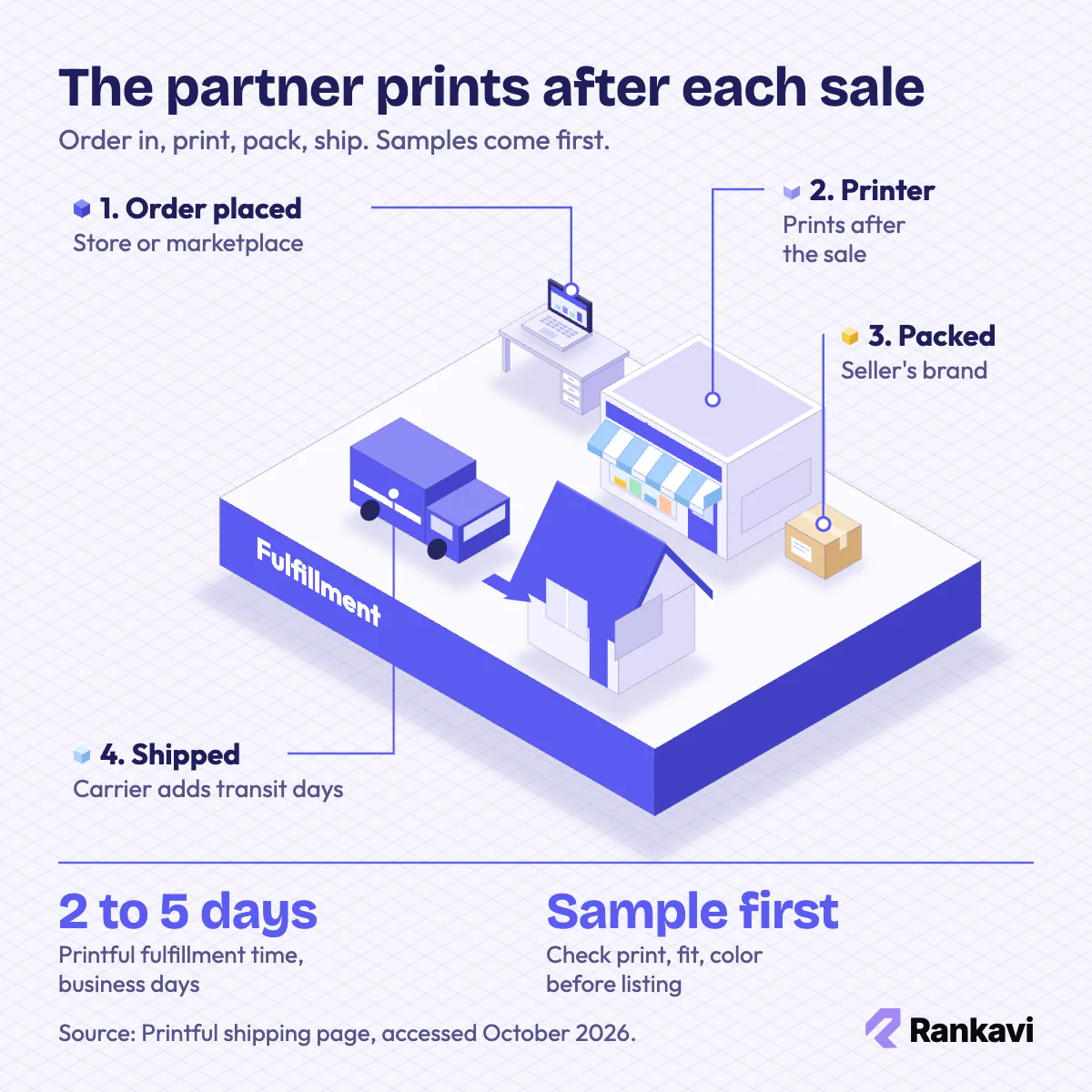
Printful is a print on demand company that prints orders in its own facilities. Printify is a platform that routes orders to a network of independent print providers. That network offers more choice, but quality varies more between providers. Other networks, such as Gelato, Gooten and Prodigi, work in similar ways. Gelato is known for printing near the buyer, and Prodigi for fine art prints.
The print method matters as much as the partner. Direct-to-garment (DTG) printing suits detailed art on cotton. Direct-to-film (DTF) transfers work on more fabrics. Sublimation dyes polyester and coated items such as mugs. Embroidery suits caps and polos. A partner without the needed method is the wrong match, whatever its price.
Print partner comparison points:
| Factor | What to check |
|---|---|
| Catalog | Products the niche needs |
| Production and shipping times | Speed to the main selling regions |
| Integrations | Connection to the chosen marketplace or store |
| Branding options | Labels, pack-ins and custom packaging |
| Support | Handling of damaged, lost or misprinted orders |
Production time comes before shipping time. Printful’s shipping page, accessed in October 2026, puts its fulfillment time at two to five business days per order. Carrier transit then adds its own days. Printing near the buyer’s region cuts transit time and customs delays. Cross-border orders can add duties, so checkout should show who pays them.
Samples settle the quality question. A seller orders each core product and checks print placement, color, fabric feel, sizing and packaging. Washing a sample shows whether the print cracks or fades. Sizing is measured against the size chart. A sample also gives real photos for listings. When two partners offer the same product, ordering from both allows a side-by-side comparison.
Integration automates the daily work. Once the partner connects to the store, each new order flows to production without manual steps. Tracking details then return to the buyer automatically.
Policies on misprinted, damaged and lost orders should be read before the first sale. They state who pays for a reprint, how long the reporting window lasts and whether photo proof is needed. Branding options run from a plain packing slip to custom neck labels and inserts. Using one partner keeps order handling simple. A second partner can fill gaps later, for example for posters.
5. Price Every Product From Its Full Cost
Pricing sets how much each sale keeps after every cost is paid. Print on demand prices start from the full cost of a sale, not from the partner’s base price.
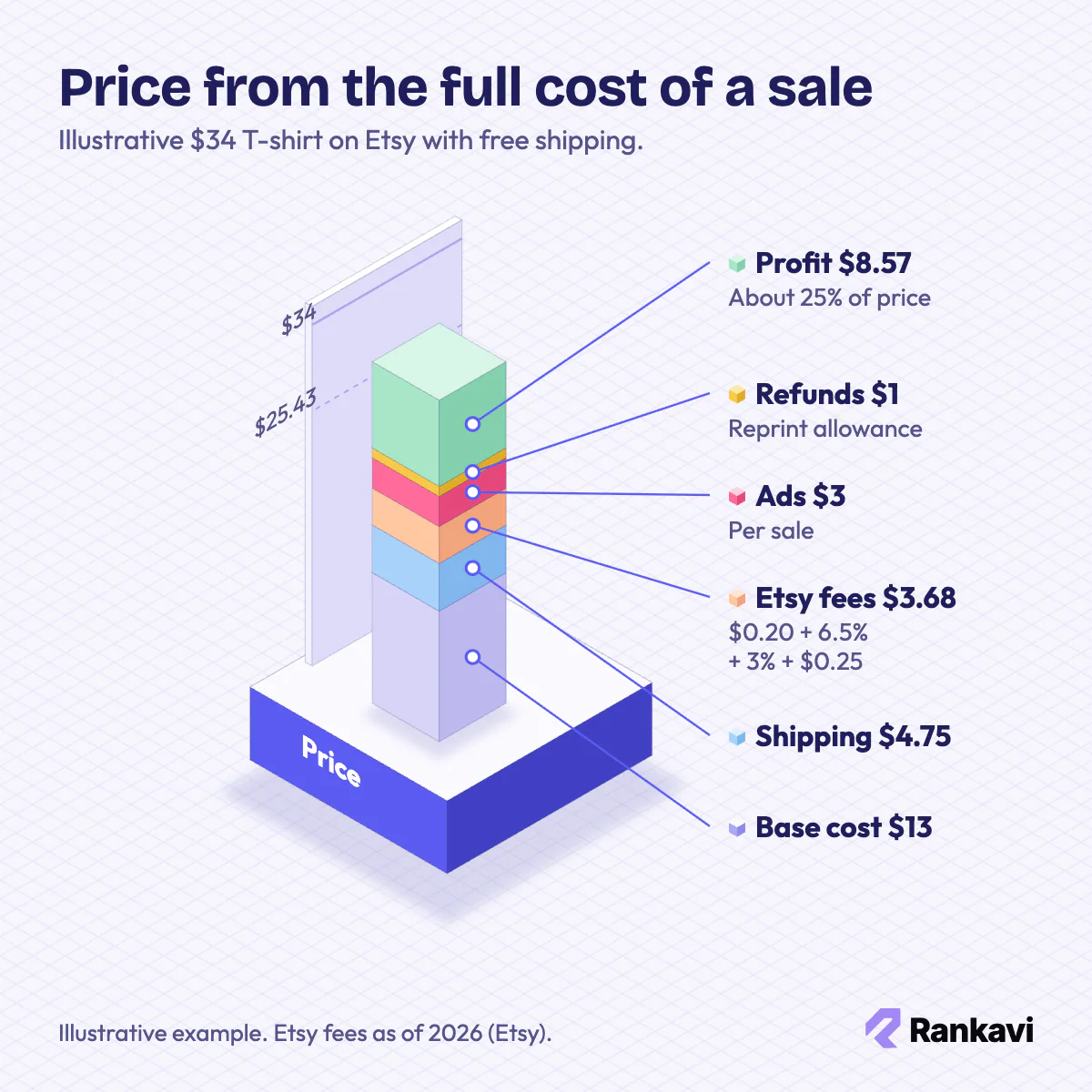
Full cost adds the base product price, shipping, marketplace fees, payment processing, advertising and an allowance for refunds or reprints. The retail price minus those costs is the contribution profit. That profit divided by the price gives the real margin.
Working backward helps: the target profit is added to every cost, and the sum gives the lowest workable price. Some partners offer paid plans that lower base costs. Such a plan pays off only at higher monthly order volume.
Break-even return on ad spend is the price divided by the profit before ads. An ad that returns less than that ratio loses money on the sale.
Marketplace fees come next. As of 2026, Etsy charges US sellers a $0.20 listing fee and a 6.5% transaction fee. Etsy Payments adds 3% plus $0.25 per order in 2026.
Product type changes pricing room. merchOne, citing Printful’s 2026 category estimates, put poster and wall art gross margins near 50% to 65%. The same 2026 source put T-shirts near 45% to 55%. Those gross margins ignore ads and fees, so they differ from the contribution profit in the example below.
Example: A seller prices a niche T-shirt on Etsy with free shipping (illustrative base, shipping and ad figures).
| Input | Value |
|---|---|
| Retail price | $34.00 |
| Base product cost | $13.00 |
| Shipping to the buyer | $4.75 |
| Etsy fees ($0.20 listing, 6.5% transaction, 3% + $0.25 processing) | $3.68 |
| Ad spend per sale | $3.00 |
| Refund and reprint allowance | $1.00 |
| Contribution profit | $8.57 (about 25% of the price) |
Free shipping often lifts checkout rates. Sellers who offer it fold the shipping cost into the product price, as the example does.
6. Register the Business and Sales Tax
Registering a print on demand business gives it a legal form, a tax identity and a clean separation of money. Most sellers handle it before the first public sale.
Many sellers start as a sole proprietorship, which needs little paperwork. A limited liability company (LLC) shields the owner’s savings from claims against the shop. Print on demand sellers often form one once revenue grows or design disputes become a risk.
The Internal Revenue Service (IRS), the federal tax agency, issues an employer identification number (EIN) for free. A separate business bank account keeps sales income and partner charges apart. A shop name other than the owner’s legal name usually needs a doing business as (DBA) filing.
Sales tax depends on the channel. Marketplaces such as Etsy collect sales tax in many states under marketplace facilitator laws. Sales through an independent store usually leave registration and filing with the seller.
Etsy also has a disclosure rule. Sellers who use a print partner list it as a production partner in Shop Manager settings.
Sales tax rules differ by state, so a seller checks each state’s tax agency for registration rules. Rules on taxing clothing also vary by state. Income from the shop is reported on the owner’s tax return, and a sole proprietor usually files Schedule C. A local business license may also apply, depending on the city and county.
7. Launch on One Channel and Market It
A sales channel puts the products in front of buyers who are already shopping. Most new print on demand sellers start on one channel and add more later.
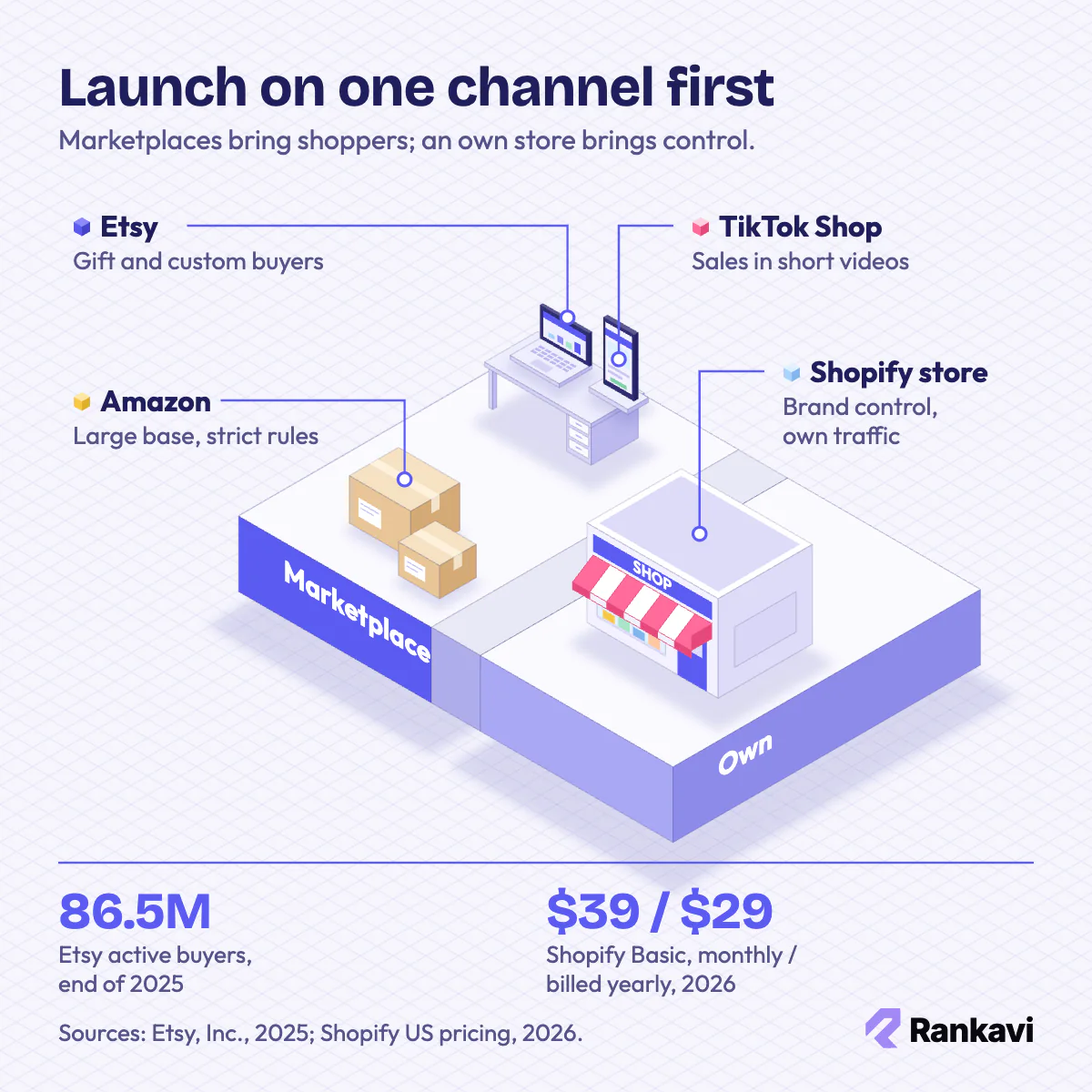
Marketplaces and independent stores trade traffic for control. Etsy, Inc. reported 86.5 million active buyers on its marketplace at the end of 2025. Shopify is a commerce platform for independent stores; its US Basic plan cost $39 monthly or $29 billed yearly in 2026.
Main sales channels for print on demand:
| Channel | Strength | Trade-off |
|---|---|---|
| Etsy | Built-in gift and custom buyers | Listing fees and crowded search |
| Amazon | Very large shopper base | Strict rules and less branding |
| TikTok Shop | Sales inside short videos | Content needed every week |
| Shopify store | Brand control and customer data | Seller brings all traffic |
Many sellers start where the buyers already are:
“Personally I would start out with Etsy first, then expand to your own site later on, at a time of your choosing.”
— A print on demand seller in a Reddit discussion
Listings carry most of the selling work. Descriptive titles use the phrases buyers type, such as “funny dog dad shirt” instead of “cool tee.” Tags and descriptions repeat those phrases in natural wording. Sample photos and mockups show scale, color and detail.
Short-form video suits visual products. Pinterest suits gift and decor ideas because pins keep surfacing over time. Clips of designs, mockups and packed orders work on TikTok, Instagram and Pinterest. A test order before launch confirms that payment, production and tracking all work.
8. Scale the Catalog With Order Data
Growth turns a handful of tested products into a catalog built on proven demand. Order data decides what gets added, changed or dropped.
The first orders hold the most useful numbers. A seller tracks each product’s cost, shipping, fees, ad spend, reprints and support questions. A strong seller with a weak margin needs a new price, bundle or size mix.
Key numbers include profit per order, ad cost per sale, refund rate and repeat purchases. Products with steady sales and thin profit get a price test first. Products with few sales after real traffic are better dropped than defended.
Winning designs earn new formats. A design that sells on shirts moves to hoodies, mugs or posters for the same audience. New designs follow the occasions that already convert.
Marketplace growth has a ceiling, because the platform owns the customer and the rules:
“Absolutely no control over your own brand, over your own products and you are absolutely dependent on the marketplaces.”
— A T-shirt seller on the Fastlane Forum
A second channel or partner needs a clear reason. Lower ad costs, a new country or a missing product justify the extra work. Reviews and customer messages point to the next fix.
Planning for seasons helps the catalog. Designs for holidays need listing time before the peak, because shoppers search weeks ahead. Reviews also show whether a partner’s quality holds as order volume grows. A weak provider is replaced before it damages ratings.
9. Surface in AI Merch Recommendations
AI visibility means a print on demand brand appears when shoppers ask assistants for gift or merch ideas. Buyers now ask ChatGPT, Gemini and Perplexity for niche shirts, mugs and posters.
ChatGPT is OpenAI’s AI assistant, and it repeats what trusted third-party pages say. Gift guides, niche blogs, “best of” lists and review sites shape which small brands get named. A new shop with a few of those mentions has a better chance of appearing.
Rankavi is a software as a service (SaaS) platform that publishes brand mentions in articles on indexed third-party websites. Brands pay $12 per article and up, with most articles live in under 24 hours. Its ChatGPT mention building page covers showing up when shoppers ask ChatGPT for unique gifts.