

Starting a pressure washing business takes hands-on skill, a reliable washer rig, local licences and liability insurance. LawnGuru, a home services marketplace app, put the national average residential job at around $275 in September 2026.
I’m Michal Sieroslawski, and I help pressure washing businesses build their visibility online. As AI search grows, homeowners ask ChatGPT for suggestions, and being recommended there counts.
The order below sets services and prices before any money goes into equipment. Paperwork and insurance then land before the first paid job. The eleven steps below show how to start a pressure washing business, in order.
- Choose Residential or Commercial Exterior Cleaning
- Price Jobs by Square Foot and Surface
- Fund the Rig and First Marketing
- Register the Pressure Washing Company
- Obtain Licenses and Wash Water Approval
- Insure Against Property Damage Claims
- Buy a Pressure Washer, Surface Cleaner and Trailer
- Set Up Estimates, Contracts and Invoicing
- Market With Yard Signs and Google Reviews
- Add Soft Washing, Gutters and Crews
- Win Homeowner Mentions in Google AI Overviews
1. Choose Residential or Commercial Exterior Cleaning
Choosing a service mix decides which surfaces the company cleans and which customers it chases. That one choice shapes prices, equipment and insurance for every later step.
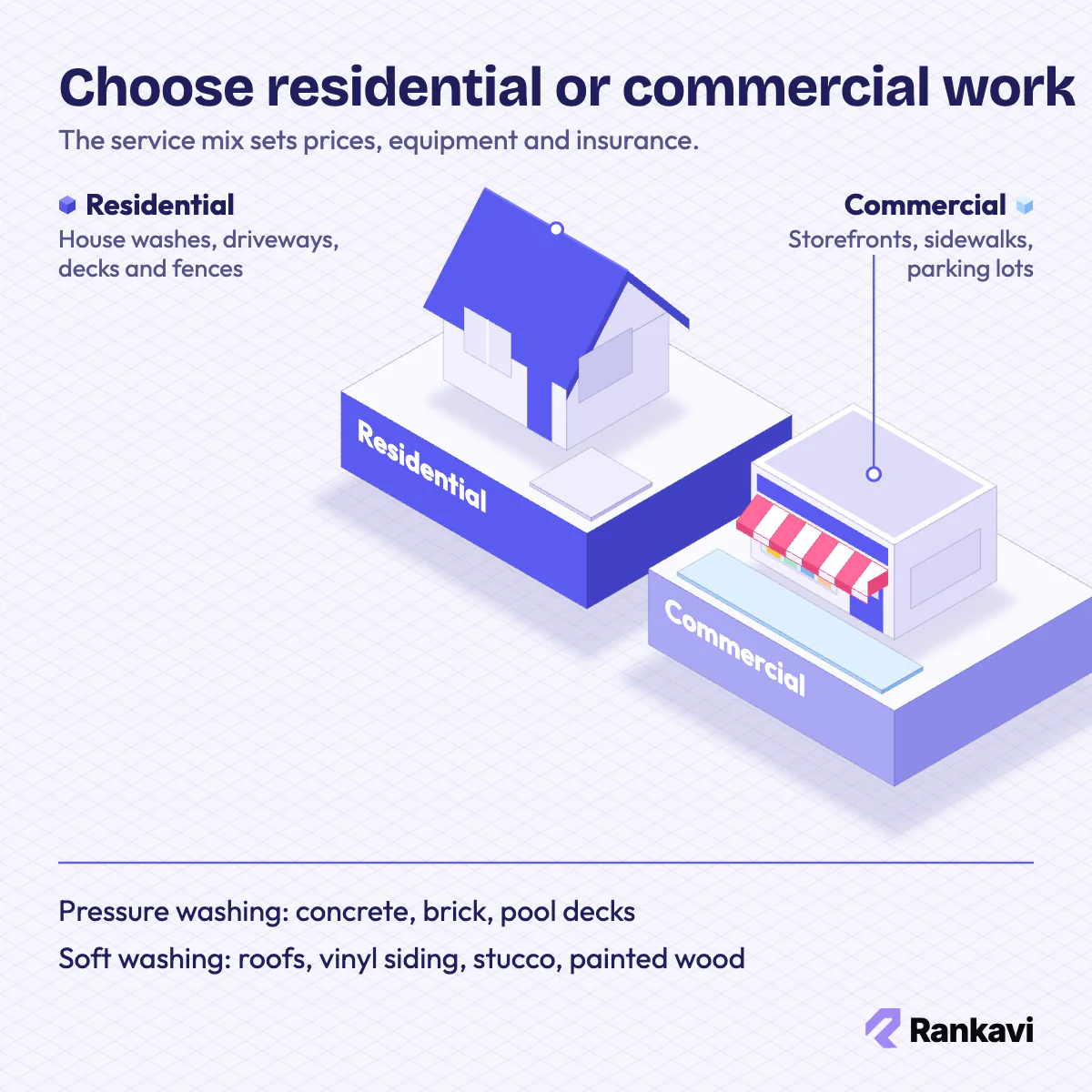
Pressure washing blasts dirt off hard surfaces like concrete, brick and pool decks. Soft washing pairs low pressure with cleaning solutions for roofs, vinyl siding, stucco and painted wood. Many firms offer both methods.
Residential work covers house washes, driveways, decks and fences. Commercial work covers storefronts, sidewalks, parking lots and building exteriors. Commercial accounts often book repeat cleanings on a schedule.
Residential and commercial buyers differ in how they decide and pay. A homeowner often says yes in a day and pays when the job ends. A property manager may need a walkthrough, a written bid and proof of insurance. Payment then comes by invoice.
Commercial work also runs on a different clock. Restaurants and storefronts are often cleaned overnight or before opening, while homes are cleaned in daytime and on weekends. Grease-heavy sites such as drive-throughs and dumpster pads may need hot-water equipment.
Most new owners start with homes, because sales are quick and a mistake costs less. Photos, reviews and a steady routine then make it easier to pitch property managers and homeowner associations. Starting in commercial work from day one suits owners who already know property managers.
Skill comes before the first invoice. New operators rent a washer and practice on family driveways and patios. Paid or unpaid time with an established crew teaches surfaces, chemicals and pace.
“Find a local pressure washing contractor to do an unpaid internship with for 90 days”
— A member of the Pressure Washing Resource forum
Power Washers of North America (PWNA), a nonprofit trade group, trains exterior cleaning contractors. PWNA offers certificate courses in house washing, roof cleaning, flatwork and wood restoration.
A quick local search shows how crowded the market is. Owners then check rival services, reviews and service areas. Demand swings by season, with spring the busiest stretch in most regions.
Counting apartment complexes, shopping centers and restaurants within a short drive shows how much commercial work exists nearby. A busy commercial area with few rivals focused on it is an opening. An area full of rivals who all chase homes may favor the opposite choice.
2. Price Jobs by Square Foot and Surface
Pricing pressure washing sets a fee for each job that covers chemicals, fuel, labor time and profit. Most operators quote by area, by the hour or by a flat service rate.
Square-foot pricing multiplies a rate by the surface area. Hourly pricing multiplies estimated hours by a rate. Flat rates set one price per service, such as a driveway.
The three methods suit different jobs. Square-foot rates fit houses, driveways and decks with clear dimensions. Hourly pricing fits irregular or heavily soiled jobs where time is hard to predict. Flat rates fit standard packages that customers can compare easily.
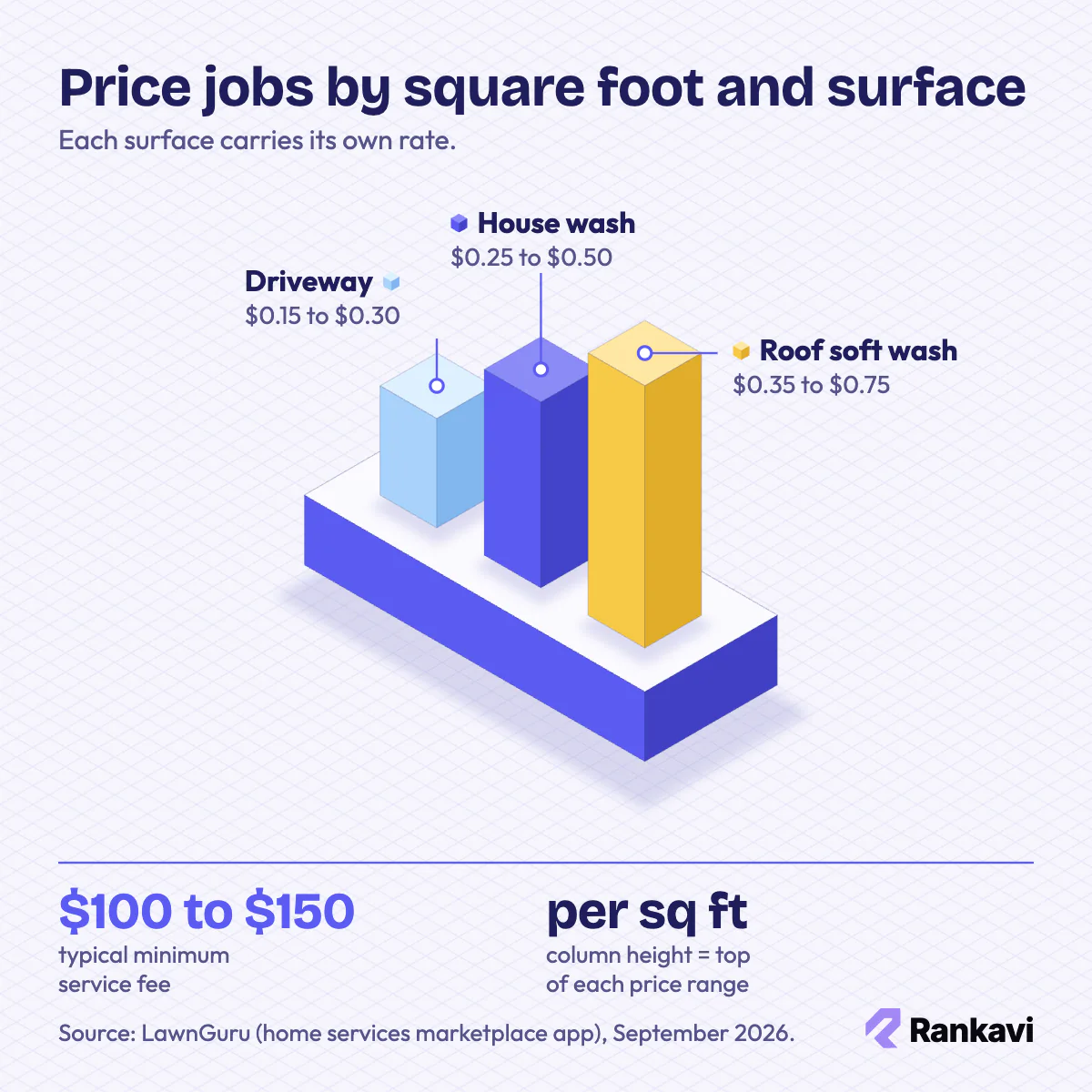
Each surface carries its own rate. LawnGuru’s September 2026 guide listed house washes at $0.25 to $0.50 per square foot. Concrete driveways ran $0.15 to $0.30, and roof soft washing $0.35 to $0.75 in 2026.
Small jobs still need a floor. LawnGuru reported in 2026 that most contractors charge a minimum service fee of $100 to $150. That minimum covers drive time and setup.
A square-foot rate needs a defined area. Living area, footprint and washable wall area are three different numbers for one house. The quote should say which one it uses. County property records and satellite map tools give a rough area before a visit. A measuring wheel confirms it on site.
A rate also has to cover real costs. Labor, chemicals, fuel, water, equipment wear, vehicle costs, a share of overhead and owner pay all come out of each job. Pricing from these costs, instead of copying a rival, shows whether a rate loses money.
Underpricing is a common early mistake. King of Pressure Wash, which runs a training membership, wrote in January 2025 that premium operators close only 30% to 40% of quotes. Low-price operators close 80% to 90%, yet earn less, that 2025 article added.
That source sells training, so the figures reflect one vendor’s view. Close rate still matters beyond it. A low price wins more jobs. Each job brings less profit, so the busiest operator is not always the best paid.
Several factors move a quote up or down from the base rate. Two-story homes, heavy mold or algae, rust stains, hard access and long travel distances all raise the price. Bundles of several services and recurring maintenance plans usually lower the rate for the customer, in return for steadier work. Good, better and best packages let customers pick a level without haggling.
Markup and margin are not the same thing. Markup is added to cost, while margin is measured against the sale price. The owner-reported margin in the table below is a rough guide.
Houses washed per day is the number owners check first. Joshua Brown, founder of Brown’s Pressure Washing, told UpFlip, which publishes owner interviews, in November 2024 that one crew cleans four homes a day. He charged $300 per job in that 2024 interview.
Startup money at a glance:
| Item | Figure |
|---|---|
| Startup cost | $220 to $48,000, depending on an owned vehicle and kit; basic equipment $3,000 to $4,000, full rigs $12,000 to $15,000 |
| Main costs | Pressure washer ($3,500 to $4,000), general liability ($70 a month), commercial auto ($170 a month), a marketing budget matched to equipment spend |
| Typical margin | 20% to 30% profit margin reported by one established owner; gross or net not stated |
| Time to open | Varies with local licence and permit timing; no national figure exists |
Sources: UpFlip, small business education site, November 2024, startup range and owner-reported margin. King of Pressure Wash, training membership, January 2025, equipment. Insuranceopedia, an insurance comparison site, provides the insurance vendor estimates, July 2026.
Worked example: In this illustrative case, a solo owner washes three 2,000-square-foot houses a week at $0.30 per square foot. Each job bills $600, so a 12-week spring brings $21,600. Liability at $70 and auto at $170 a month cost $720 over those three months. That leaves $20,880 before chemicals, fuel and owner pay, enough to cover a $4,000 kit several times.
3. Fund the Rig and First Marketing
Funding a power washing startup covers the washer rig, chemicals and early marketing until jobs pay the bills. Many owners start small out of a pickup truck and upgrade later.
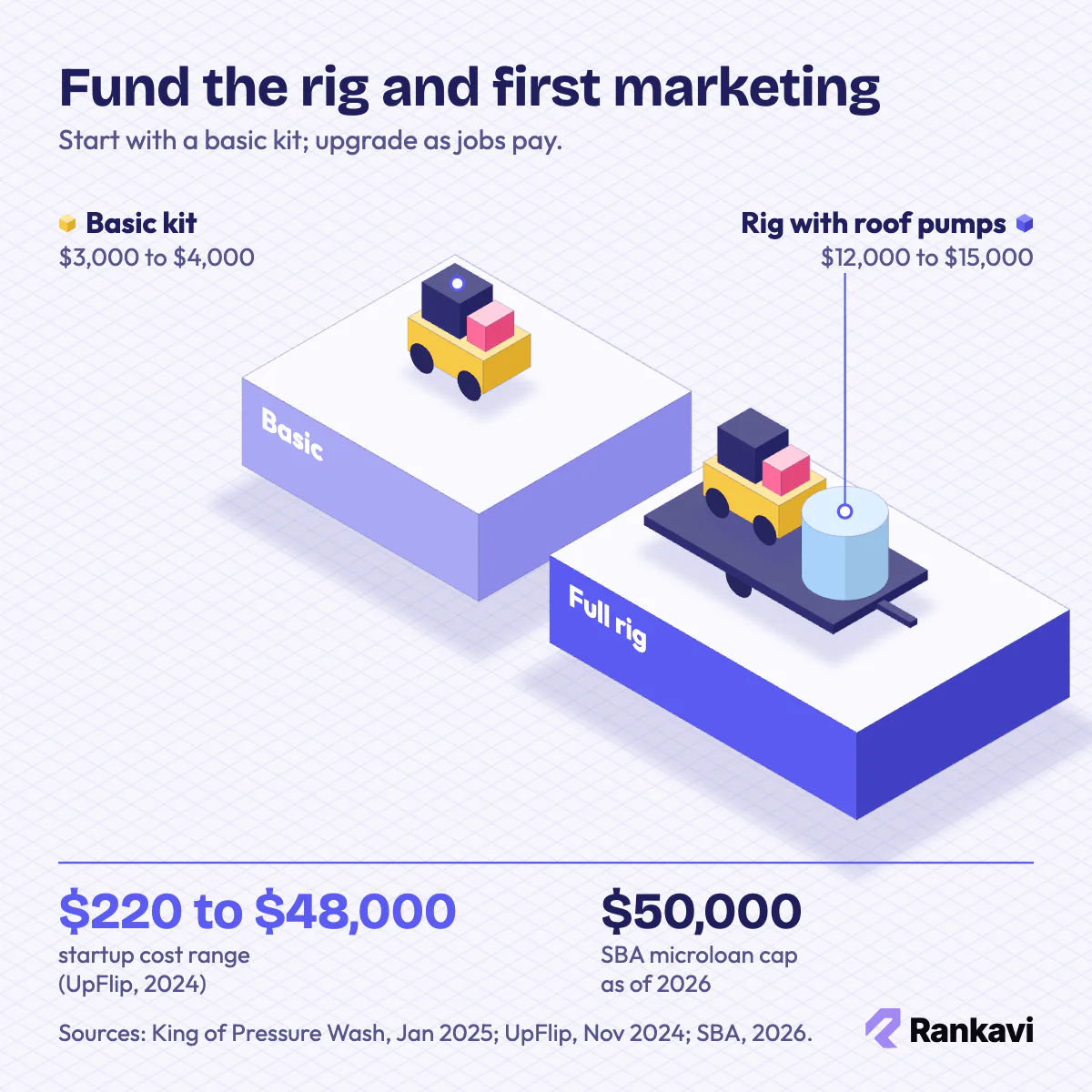
UpFlip, a small business education site, put startup costs at $220 to $48,000 in November 2024. The low end assumes the owner already has a truck and a washer.
King of Pressure Wash estimated a basic kit at $3,000 to $4,000 in January 2025. Setups with roof pumps reached $12,000 to $15,000 in that 2025 guide. The same article advised matching the equipment spend with an equal marketing budget.
Personal savings fund most first rigs. The U.S. Small Business Administration (SBA), which funds nonprofit lenders, offers microloans up to $50,000 as of 2026. Equipment financing fills other gaps.
Funding choices trade cost against risk. Buying outright avoids interest but drains cash needed for marketing. Financing spreads the cost but adds a monthly payment before steady work exists. Lenders may ask for a personal guarantee. Used equipment cuts the price but carries repair risk.
An accountant can confirm whether equipment qualifies for a tax deduction. Owners also need working cash beyond the rig. Fuel, chemicals, phone, software and insurance come due before the first invoices are paid. Grants for a new service business are rare, so a funding plan should not depend on one. A separate business bank account keeps startup spending tracked.
A one-page business plan lists services, target customers, prices and a monthly revenue goal. It tests the numbers before any purchase.
A simple break-even check helps with the rig decision. Dividing the kit cost by the profit left from an average job shows how many jobs repay it. A larger rig only makes sense once booked work can support the payments.
4. Register the Pressure Washing Company
Registering a washing company gives it a legal identity that signs contracts, opens accounts and carries insurance. Commercial clients often ask for it before a first job.
Most small washing firms form a limited liability company (LLC). One etched driveway or stripped deck can bring a claim. The LLC keeps the owner’s personal savings apart from that claim.
The protection has limits. Owners who mix personal and business money, or skip the paperwork, can lose it. Sole proprietorships are simpler and cheaper to start, but they leave personal assets exposed to the same claim. Filing fees and annual report rules vary by state, so the Secretary of State website lists the current requirements.
The name comes first. A search on the Secretary of State website confirms the name is free. The filing then creates the entity.
A free employer identification number (EIN) comes online from the Internal Revenue Service (IRS), which runs federal taxes. Approved applicants receive it immediately. The EIN opens a business bank account, which keeps the LLC’s protection intact.
A separate business bank account also makes bookkeeping and taxes simpler. Every expense in this guide, from chemicals to insurance, is then recorded in one place.
5. Obtain Licenses and Wash Water Approval
Licensing a pressure washing company means meeting state, county and city rules before work starts. Requirements differ widely, so the local clerk is the first call.
Most towns require a general business license. Some states and cities add an occupational licence for pressure washing. Roof cleaning work can fall under a handyman or contractor licence.
Rules differ by city and county as well as by state. A call to the city clerk and the county office covers both levels. Some places also require contractor registration above a set job value. The clerk can explain any threshold before the first large quote.
Wash water draws the most attention. The U.S. Environmental Protection Agency (EPA) runs the National Pollutant Discharge Elimination System (NPDES) under the Clean Water Act. Discharging pollutants to U.S. waters without an NPDES permit is illegal.
The Ohio Environmental Protection Agency, which enforces state water rules, treats power washing wastewater as industrial wastewater. Its June 2025 fact sheet bans discharging it into storm drains. Crews instead collect it or get permission to use a sanitary sewer.
Cleaning chemicals add to the concern. Sodium hypochlorite, degreasers and surfactants can harm plants, soil and local waterways. Many crews use berms or mats to contain runoff. A pump recovers the water, and covers protect lawns and plants. Local stormwater rules differ, so the city or county water office should confirm what is allowed.
A sales tax permit applies when the business sells taxable services or products. State rules decide which washing services count.
6. Insure Against Property Damage Claims
Insuring a washing business protects the owner from claims for broken windows, stripped paint and injured bystanders. High-pressure water can cut skin and crack glass in a second.
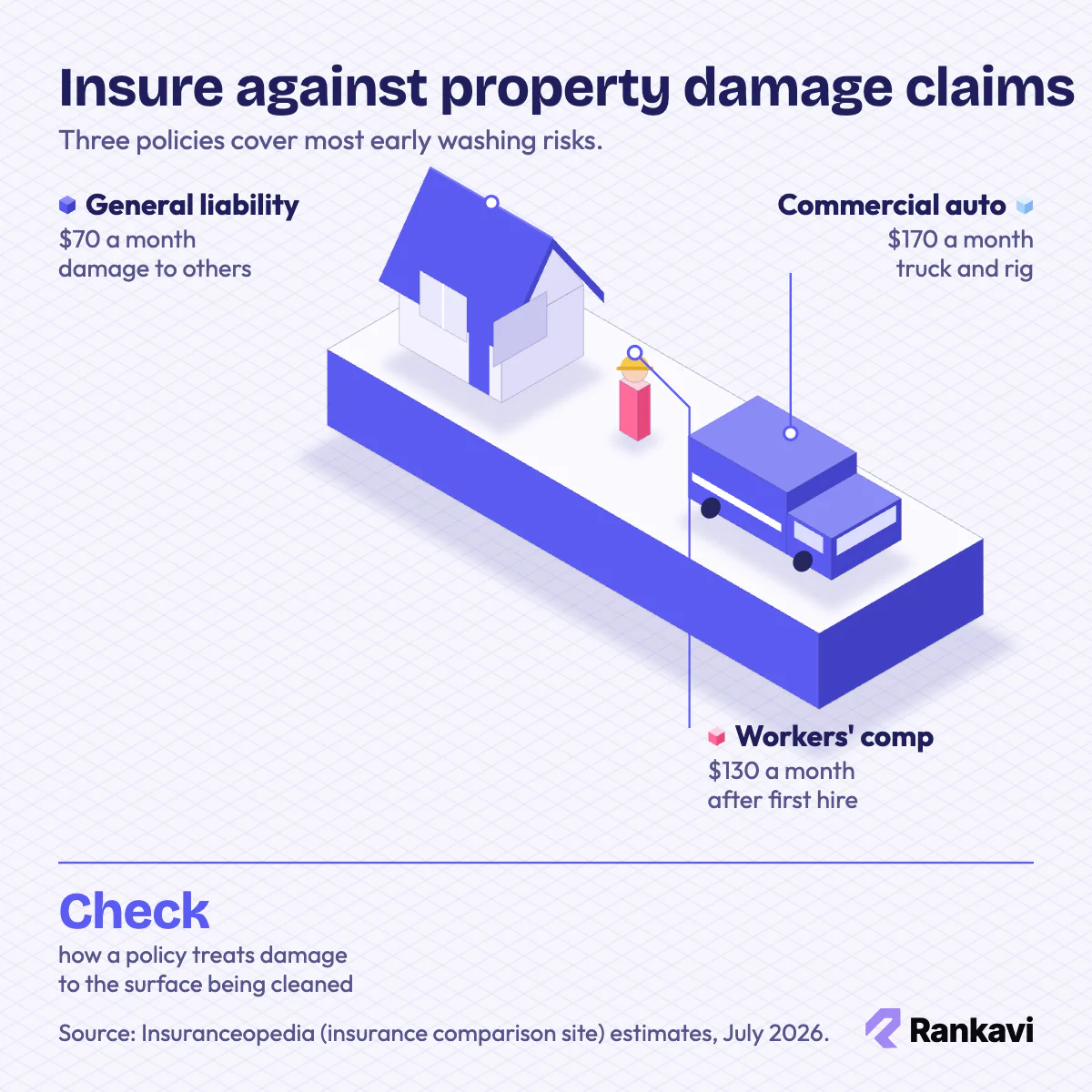
General liability pays for injuries and property damage to others. Insuranceopedia, an insurance comparison site, put it at $70 a month for pressure washers in July 2026. Many clients ask for proof before signing.
Proof usually comes as a certificate of insurance from the agent. Commercial clients and property managers often require one before the first job. That links this step to the work chosen in Step 1.
Standard liability policies often exclude damage to the surface being cleaned. Owners ask the agent how an etched driveway or stained siding would be handled.
Commercial auto covers the truck that tows the rig, at $170 a month in Insuranceopedia’s 2026 estimate. Equipment coverage pays for a stolen or damaged washer.
Policies differ in what they cover, so the quote should be compared line by line. Exclusions, deductibles and limits matter as much as price. Chemical use, roof work and work for commercial clients can each change the premium or the terms. An independent agent can compare several insurers for the same rig.
Workers’ compensation follows the first hire. Insuranceopedia’s July 2026 figure for pressure washers was $130 a month.
7. Buy a Pressure Washer, Surface Cleaner and Trailer
Buying washing equipment turns the service menu into a working rig. A house wash rig differs from a heavy concrete setup.
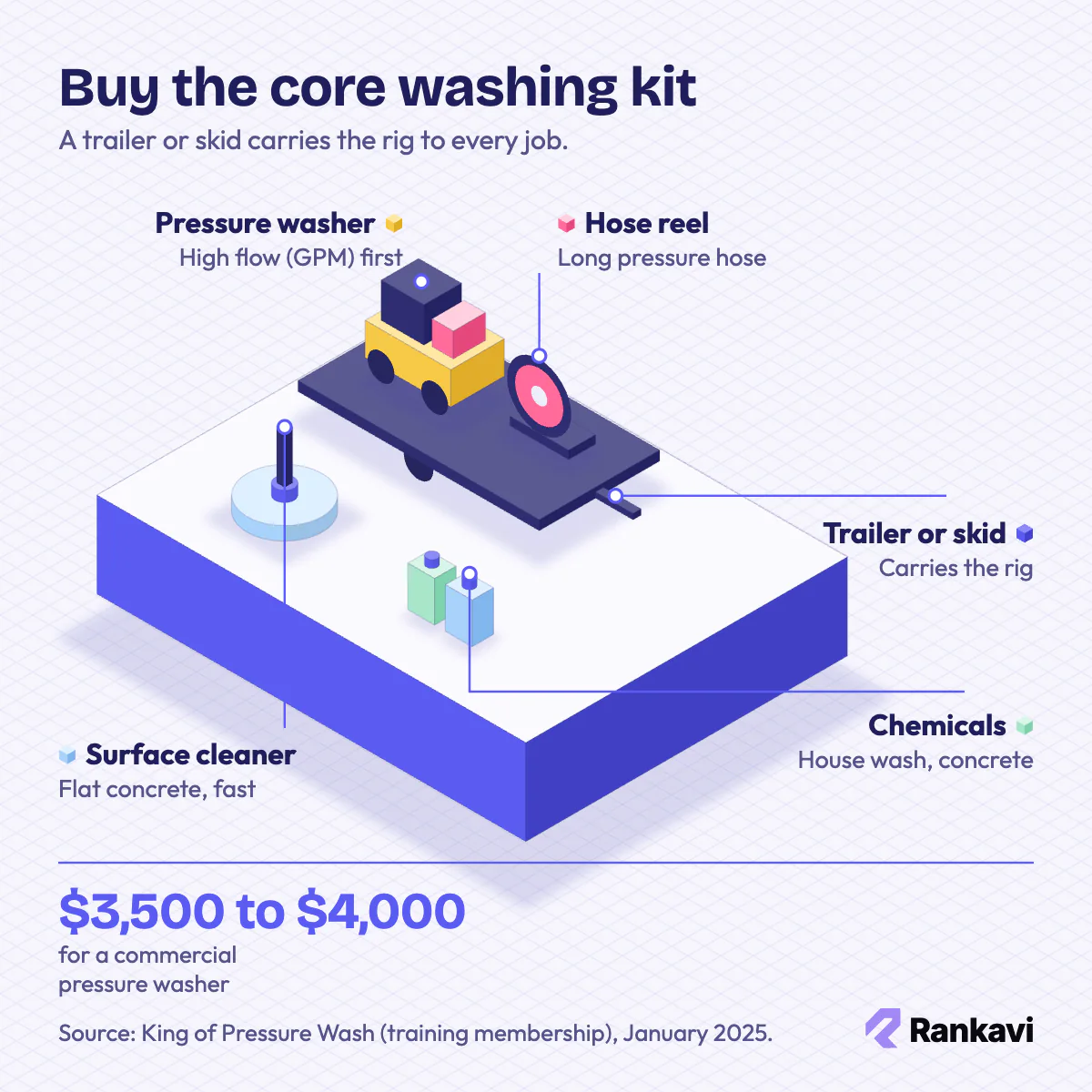
The washer is the core purchase. Professionals look at gallons per minute (GPM) and pounds per square inch (PSI). Higher flow rinses faster, while pressure breaks up stuck grime.
Pressure and flow do different jobs. Too much pressure can etch concrete, strip paint and force water behind siding. Flow carries away loosened dirt and chemicals. Soft washing relies on chemicals and low pressure. The rig then needs a way to draw and apply solution.
A starter washing kit holds five core items:
- Pressure washer: a commercial machine with high flow.
- Pressure hose: a long hose that reaches around a house.
- Garden hose: a supply line from the water source.
- Downstream injector: draws chemical into the low-pressure stream.
- Surface cleaner: a spinning deck for driveways and patios.
“Get a minimum 3 gpm machine that can pull chemicals/soap. Get an A frame ladder to help get the hard spots.”
— A member of the Pressure Washing Resource forum
A surface cleaner cleans flat concrete far faster than a wand. Even stripes and no wand marks look more professional.
A trailer or a truck-bed skid carries the washer, tanks and hose reels. A clean, organized rig also works as a moving advertisement.
The choice between a gas and an electric washer, and between cold and hot water, depends on the surfaces. Gas machines move with the truck and need no outlet. Hot water cuts grease faster, which helps at restaurants and dumpster pads but costs more. A starter rig for homes usually runs on cold water.
Water supply also needs a plan. Most homes offer an outdoor spigot, but some sites do not. A water tank on the trailer covers those jobs, though it adds weight. Safety gear such as gloves, eye protection and non-slip boots belongs in the first purchase too.
Chemicals match the jobs taken. House wash, concrete cleaner and gutter cleaner cover most residential work. Graffiti and rust removal need specialty products.
8. Set Up Estimates, Contracts and Invoicing
Running washing jobs smoothly requires written estimates, signed agreements and fast invoicing. Paper notes break down once jobs stack up.
A service agreement lists the scope, cleaning method, surface risks and payment terms. Signed agreements reduce disputes over streaks, plants or old damage.
Photos taken before the job record the starting condition of siding, concrete and landscaping. They protect the owner against claims for damage that was already there. A quote that states the method, the surfaces and the price removes most disagreements later.
Field service software handles quotes, scheduling, invoices and card payments. Customers pay on the spot instead of days later.
Most field service tools combine quoting, scheduling and payment in one place. Card processing fees apply to each payment, so they belong in the price. Deposits for large jobs and a clear quote expiry date protect the schedule from no-shows.
Owners also track average ticket, close rate and cost per lead. Those numbers show which price and which channel pay off.
Safety rules belong in the same system. Crews follow chemical handling steps, roof safety protocols and personal protective equipment checks on every job.
9. Market With Yard Signs and Google Reviews
Marketing a pressure washing company puts its name in front of local homeowners before the spring rush. Visual proof sells this service better than words.
Google Business Profile is Google’s free listing for Maps and local search. Owners add services, a service area and fresh photos. Reviews from early customers build trust fast.
A complete listing helps local searches. Accurate service areas, a phone number that matches the website and regular photo updates all strengthen it. Asking each happy customer for a review right after the job works best, while the result is fresh.
Before-and-after photos show the result in one glance. Each job feeds the website, the listing and neighborhood social media groups.
Lead marketplaces and paid search ads can fill a calendar quickly. Those channels often charge per lead whether or not the job is won, so the spending needs a cap. Free channels grow slower but cost nothing per lead.
Low-cost local channels:
| Channel | Why it works |
|---|---|
| Yard signs | Neighbors see the clean house next door |
| Door hangers | Reach the street after each job |
| Chamber of Commerce | Connects with local businesses |
| Referral rewards | Turn happy clients into a sales team |
“Make sure your vehicle is spotless. You are representing your cleaning skills.”
— A contractor on the Pressure Washing Resource forum
Consistency matters more than variety. Two or three channels kept up all year beat many channels tried briefly.
10. Add Soft Washing, Gutters and Crews
Growing a washing company builds on add-on services, steadier seasons and a trained crew. Each step raises revenue without a new customer base.
Add-on services raise the ticket on every visit. Gutter cleaning, window cleaning, roof soft washing and deck restoration fit the same customers.
Each add-on needs its own skills, chemicals and insurance check. Roof work carries fall risk and damage risk, so it needs training before it is sold. Adding one service at a time keeps quality high.
Off-season work smooths cash flow. Commercial accounts, gutter cleaning in fall and holiday light installation fill quiet months.
Hiring starts when the owner turns work away.
Hiring brings extra costs beyond the hourly wage. Employer taxes, workers’ compensation and training time all add to labor.
Subcontractors cost less to manage, but classification rules apply. The IRS website explains the difference between an employee and a contractor. The U.S. Bureau of Labor Statistics (BLS) reported a $17.23 median hourly wage for vehicle and equipment cleaners in May 2025. That occupation is the closest federal proxy for wash crew pay.
Written checklists keep quality steady across crews. Recurring maintenance plans and scheduled commercial contracts bring customers back each year.
11. Win Homeowner Mentions in Google AI Overviews
AI visibility for a washing company involves being named when homeowners ask search tools for a local cleaner. Google AI Overviews, ChatGPT and Gemini now answer many of those searches.
These answers pull from review sites, local directories and “best pressure washing” lists. Appearing on those pages early helps a young company while its own review count is still small.
Consistent business details help these systems recognize a company. The name, service area and services should match across the Google Business Profile, the website and any directory listing. Customer reviews that describe the work in plain words give search tools material to quote.
Rankavi is a software as a service (SaaS) platform that publishes brand mentions in articles on indexed third-party websites. Washing firms that want brand mentions in Google AI Overviews can start there.