

Starting a pool cleaning business takes water chemistry skills, basic tools, a work truck, local licences and liability insurance. Skimmer, a pool service software company that publishes an annual industry report, counted 10.4 million U.S. residential pools in 2026.
I’m Michal Sieroslawski, and I help pool cleaning companies build their visibility online. AI tools now shape how pool owners choose pool cleaning companies, so a mention there is valuable.
The order below fixes the service model and monthly price before money goes into a truck. Certification, paperwork and insurance then land before the first paid visit. Each of the twelve steps below builds on the last, from pool cleaning idea to first paying customer.
- Choose Residential or Commercial Pool Service
- Write a One-Page Pool Route Plan
- Price Weekly Service per Pool
- Fund the Truck and Starter Kit
- Register the Pool Cleaning Company
- Get Pool Operator Certification and Licenses
- Insure Against Chemical and Property Claims
- Buy a Test Kit, Pole and Chemical Stock
- Set Up Route Software and Service Logs
- Attract Pool Owners in Dense Neighborhoods
- Grow the Route and Hire a Technician
- Stand Out in AI Pool Service Answers
1. Choose Residential or Commercial Pool Service
Choosing a pool service model decides which pools the company maintains and which customers it chases. Weekly residential maintenance is the usual starting point for a solo owner.
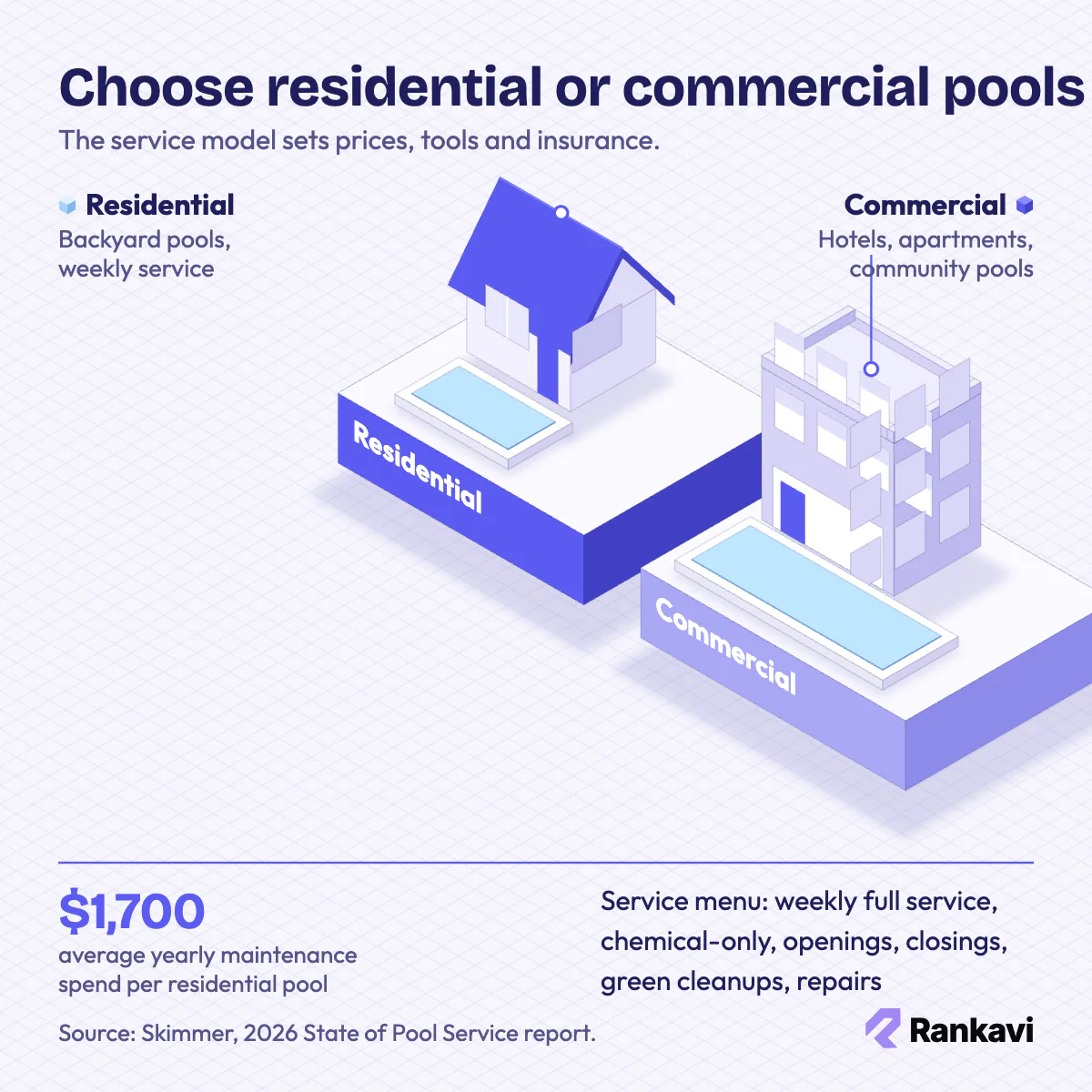
Residential service covers backyard pools at private homes. Commercial service covers hotels, apartment complexes, homeowners associations and community pools. Those accounts bring bigger pools, health inspections and longer sales cycles.
Residential customers pay by card each month and can cancel easily. Commercial accounts often sign written contracts and pay invoices, which steadies income but delays cash.
Commercial pools also face health department inspection, so many need a certified operator on the job. A new solo owner usually starts residential and adds small commercial accounts later.
The service menu grows from one weekly visit. Full service means skimming, brushing, vacuuming, emptying baskets and balancing chemicals. Chemical-only visits, openings, closings, green pool cleanups and repairs sit around that core.
Demand holds up because owners pay for upkeep every year. Skimmer’s 2026 industry report put average residential spending on pool maintenance at about $1,700 a year.
A local market check comes next. Owners drive pool-heavy neighborhoods, list rival companies and read their reviews. Gaps such as saltwater pools or eco-friendly service point to a niche.
Climate decides the calendar. Sun Belt routes run all year, while northern pools close after summer. Seasonal operators lean on openings, closings and indoor commercial pools.
Skill comes before the first customer. New operators learn water chemistry, filtration and safety through courses and paid work on an established route.
“Most definitely join up with a Pool Shop to get a job learning all you can about servicing pools and learning about equipment general servicing”
— A commenter on Reddit’s r/pools community
Jobber, a field service software company, publishes a startup cost guide for pool routes. Its February 2025 update put total startup costs at $2,000 to $25,000.
Pool Founder, which publishes pool service startup guides, puts margins in context. Its February 2026 guide put solo operators on tight routes at 20% to 40% net margins.
Startup money at a glance:
| Item | Figure |
|---|---|
| Startup cost | $2,000 to $25,000, with most of the spread coming from the vehicle |
| Main costs | Work vehicle ($5,000 to $20,000), equipment and supplies ($500 to $1,000 and up), insurance ($500 to $1,200 a year), licence and registration ($50 to $500), software ($400) |
| Typical margin | 20% to 40% net for solo operators on tight routes |
| Time to open | A few weeks; the pool operator classroom course itself takes two days |
Sources: Jobber, a field service software company, vendor estimates, February 2025 (startup cost and main costs). Pool Founder, a pool service software company, vendor estimate, February 2026 (margin). Pool & Hot Tub Alliance course details, 2026 (time to open).
2. Write a One-Page Pool Route Plan
A pool route plan sets the service area, target pool count and monthly revenue goal before any purchase. One page beats a long document nobody reads.
A lean plan covers the executive summary, market analysis, operations, team, financials and milestones. Route sellers and lenders often ask to see it.
Pools per day is the number the plan rests on. Pool Founder’s February 2026 guide put the industry average at 16 to 18 pools a day on a full-service weekly route. Below that pace, drive time eats the margin.
Climate sets how many months each pool is billed. A northern route bills fewer months than a Sun Belt route. With the same pool count, it earns less.
Route density decides that pace. Pools close together mean less driving and more stops, so a tight service area beats a scattered one.
The revenue forecast multiplies weekly pools by the monthly rate and the months of service. That figure tests whether the price covers costs and owner pay.
Buying an existing route is another way to reach the target pool count. The plan compares that purchase price with the cost of winning the same pools through marketing.
3. Price Weekly Service per Pool
Pricing pool service determines whether each stop covers chemicals, fuel, time and profit. Most companies bill a flat monthly rate for one weekly visit.
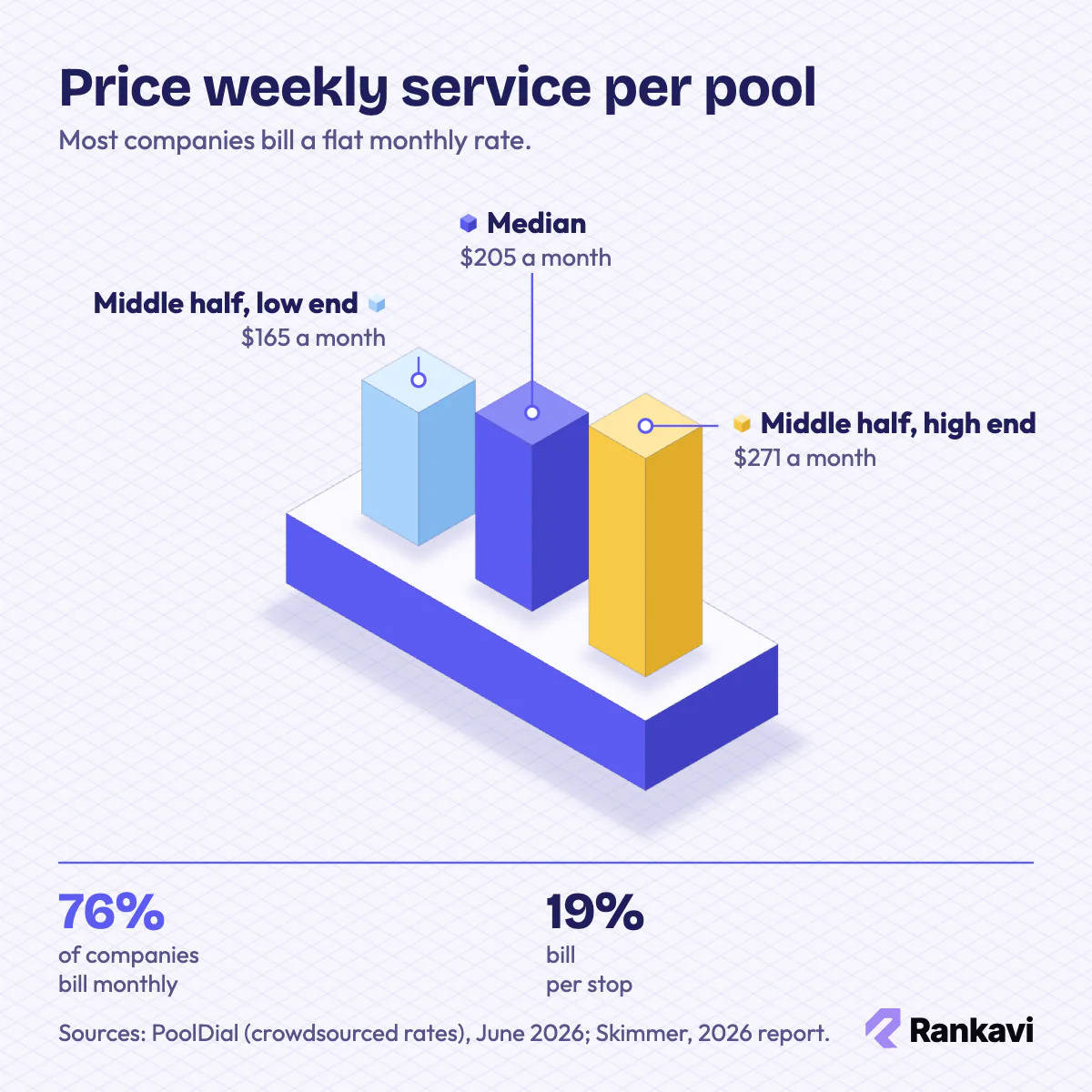
Skimmer’s 2026 State of Pool Service report found that 76% of companies bill monthly and 19% bill per stop. In that 2026 survey, 45% included chemicals in the monthly price.
PoolDial, a pool service software platform, publishes crowdsourced rate benchmarks. Its June 2026 analysis of 122 submissions found a $205 median monthly price. The middle half of those 2026 rates ran from $165 to $271.
Three pricing methods dominate. Cost-plus pricing adds a markup to material, labor and overhead. Market pricing follows local rivals, and target-margin pricing works back from a chosen gross margin.
Tiered packages give customers a choice. A basic tier covers chemicals only. A standard tier adds cleaning, and a premium tier adds filter care and equipment checks.
Underpricing is the classic early mistake. Cheap rates attract the customers most likely to leave, and they make later increases hard. A first-month discount closes hesitant prospects without anchoring a low rate.
A monthly rate divides into weekly visits. A price floor built from drive time, chemicals and fuel per stop shows the lowest rate that still pays.
Pool size, a spa, a heater and heavy leaf fall add work to each visit. Each can justify a higher rate. A green or neglected pool needs a one-time cleanup fee instead of the standard rate.
The service agreement states the terms behind the price. These cover skipped visits, late fees, cancellation notice and annual rate increases.
Worked example: In this illustrative case, a solo owner serves 60 weekly pools at $205 a month each. That route bills $12,300 a month. General liability at $67 and commercial auto at $173 cost $240 a month. That leaves $12,060 before chemicals, fuel, software and owner pay. At 16 pools a day, the whole route fits into four working days.
4. Fund the Truck and Starter Kit
Funding a pool service startup covers the truck, tools, chemicals, insurance and early marketing until monthly billing pays the bills. The vehicle is usually the largest line.
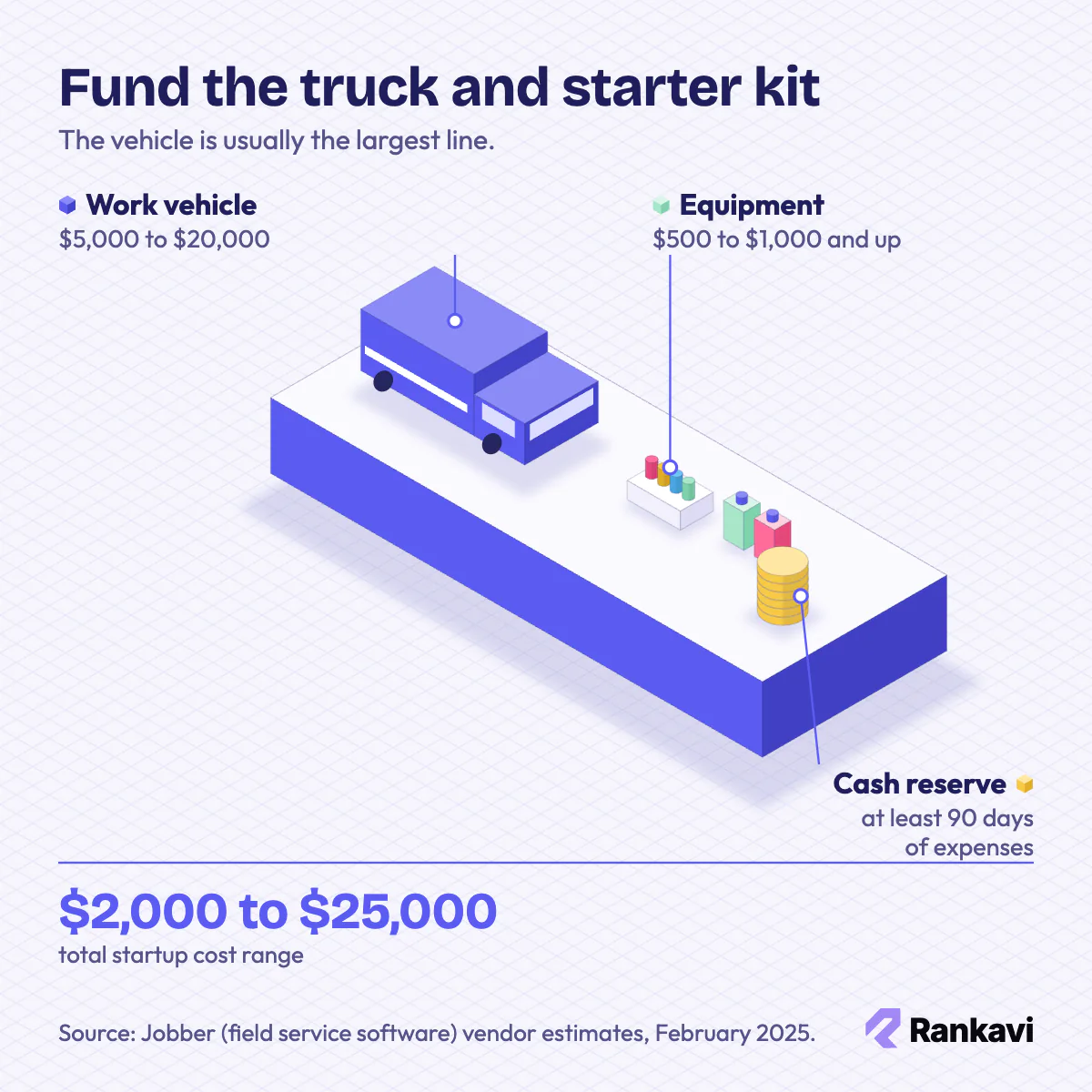
Jobber’s February 2025 estimate put a work vehicle at $5,000 to $20,000. Owners who already drive a pickup start near the low end.
Most owners start lean on personal savings. Equipment and vehicle financing fill larger gaps.
Savings carry no interest but slow the start. Financing speeds up buying but adds monthly payments before the route fills. Jobber’s guide also advises keeping a reserve that covers at least 90 days of expenses.
As of 2026, the U.S. Small Business Administration (SBA) offers microloans up to $50,000 for small startups like a first pool route. Nonprofit intermediary lenders make those loans and the credit decisions.
Buying an existing route is the other path. A purchased route brings paying customers on day one but needs far more capital up front.
5. Register the Pool Cleaning Company
Registering a pool company gives it a legal identity that signs service agreements and holds insurance. Property managers and homeowners associations often ask for it.
Most pool firms form a limited liability company (LLC). Technicians pour acid and chlorine on someone else’s property. The LLC keeps one bleached liner or stained deck from reaching the owner’s personal savings.
The name comes first. A search on the Secretary of State website confirms it is free, and the state filing creates the entity.
The Internal Revenue Service (IRS) issues the employer identification number (EIN) at no charge online. A business bank account opened with it keeps monthly route billings apart from personal funds.
A sole proprietorship costs less to set up but leaves personal assets open to claims. An LLC does not replace insurance.
Sales tax rules for chemicals and service differ by state, so the state department of revenue confirms what applies.
6. Get Pool Operator Certification and Licenses
Licensing a pool company means meeting state, county and city rules before the first paid visit. Rules differ widely, so the county clerk is the first call.
Most cities and counties require a general business license. Routine cleaning often needs nothing more, while repairs and equipment work usually need a contractor licence.
Four items are easy to confuse: a business license, a contractor license, operator certification and a health department permit. Residential cleaning usually needs the least, while homeowners association, apartment and hotel pools tend to bring certification demands.
Replacing a pump or heater, or touching plumbing or electrical work, counts as repair, not cleaning. Repair work often triggers contractor licensing, and unlicensed work can bring fines.
Florida’s Construction Industry Licensing Board is the state body that licenses swimming pool and spa servicing contractors. Florida Statutes section 489.105 exempts cleaning that leaves the pool structure and equipment untouched.
California’s Contractors State License Board (CSLB) licenses construction contractors, including swimming pool contractors. Since January 2025, its minor work exemption covers jobs under $1,000 that need no permit and no employees.
The Pool & Hot Tub Alliance (PHTA) is a nonprofit trade association for the pool and hot tub industry. It runs the Certified Pool & Spa Operator (CPO) certification, a two-day classroom course valid for five years. Florida’s licensing board and the California Department of Public Health are among the bodies that approve it.
The Training Center, a trade school that teaches the course, set 2026 tuition at $390 as PHTA required. Many health departments expect certified operators at public pools, and homeowners trust the credential too.
7. Insure Against Chemical and Property Claims
Insuring a pool company protects the owner from claims for chemical damage, injuries and stained surfaces. One spill on a deck or one guest injury can cost more than a year of profit.
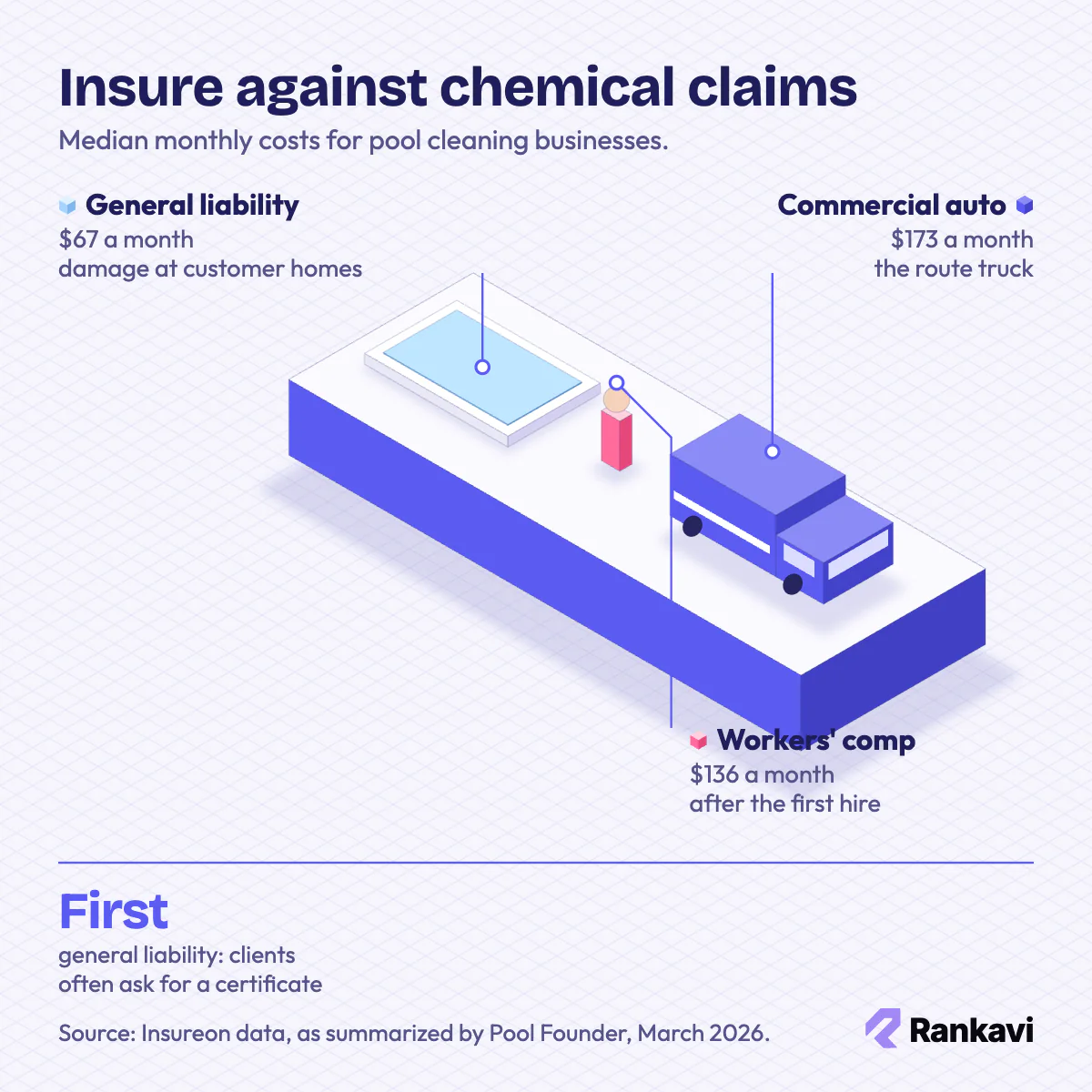
Core policies and median monthly costs:
| Policy | What it covers | Median monthly cost |
|---|---|---|
| General liability | Injuries and property damage at customer homes | $67 |
| Commercial auto | The work truck and accidents on the route | $173 |
| Workers’ compensation | Employee injuries once the first technician starts | $136 |
Source: Insureon customer data for pool and spa cleaning businesses, as summarized by Pool Founder, March 2026.
General liability comes first. Many homeowners associations and property managers ask for a certificate before a technician steps on the deck.
Commercial auto matters because a personal policy may not cover a truck loaded with chlorine. Inland marine coverage pays for a stolen pump or vacuum in transit.
A licensed insurance agent confirms whether chemical spills and pool-related damage fall inside each policy. Exclusions differ between insurers.
Workers’ compensation follows the first hire, and most states require it once a business has employees.
8. Buy a Test Kit, Pole and Chemical Stock
Buying pool equipment turns the service menu into a working truck. Two items get used at every stop: the telescopic pole and the water test kit.
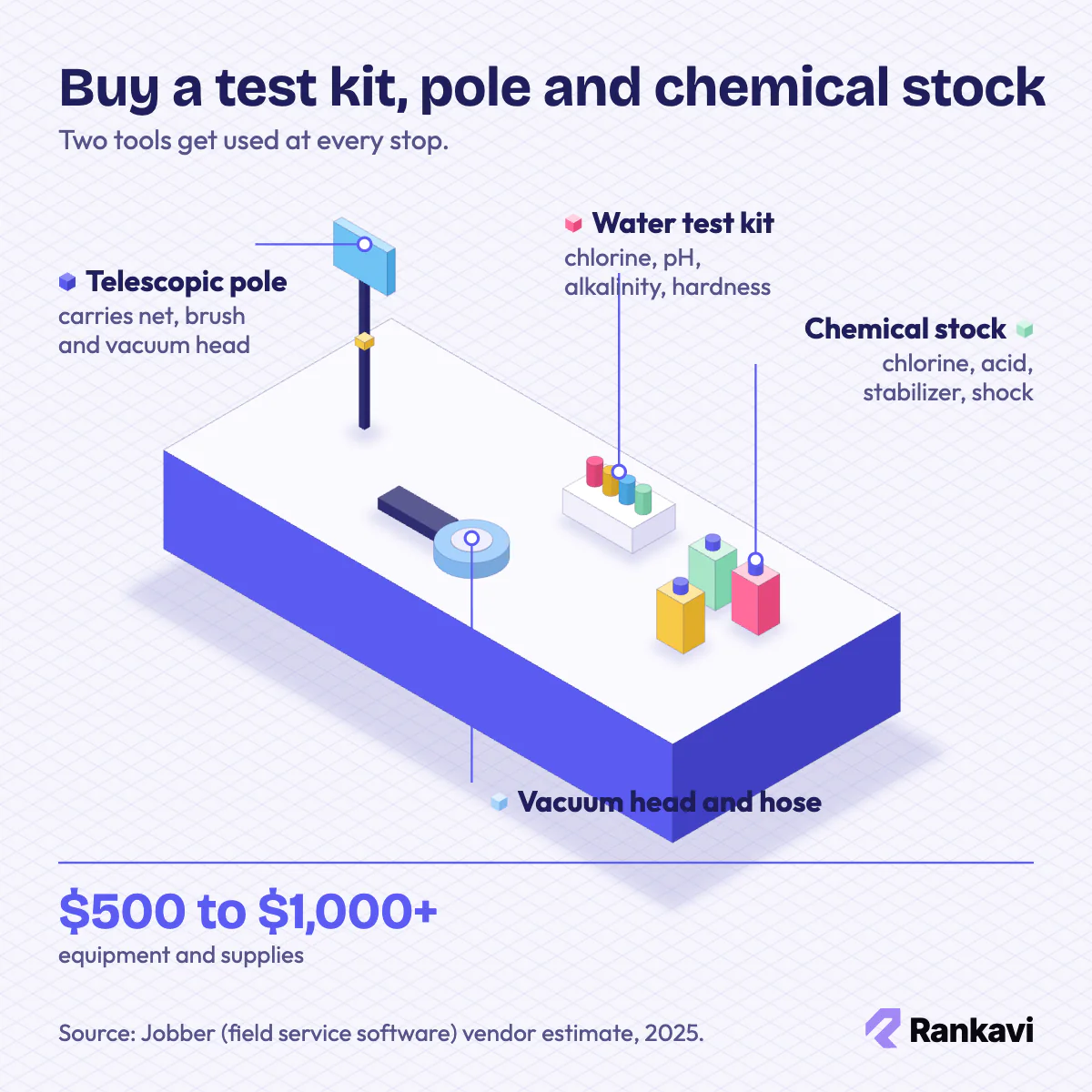
A starter kit holds five core tool groups:
- Telescopic pole: carries every attachment, so a sturdy one pays off.
- Nets and brushes: a leaf skimmer, a deep leaf rake and wall brushes.
- Vacuum head and hose: lift dirt from the pool floor.
- Water test kit: measures chlorine, pH, alkalinity and hardness.
- Safety gear: chemical-rated gloves, goggles and non-slip shoes.
Jobber’s 2025 estimate put equipment and supplies at $500 to $1,000 and up. A professional reagent test kit gives more reliable readings than strips, and accurate tests prevent callbacks for cloudy water.
Chemical stock covers chlorine, acid, stabilizer, algaecide and shock. Lockable, ventilated storage keeps acid and chlorine apart in the vehicle.
Buying chemicals in bulk from a pool supply distributor lowers the cost per pool but ties up cash. Small routes often buy for a few weeks at a time.
A used pickup with a small utility trailer suits most new routes. Spare O-rings, baskets and valves on board handle quick fixes.
9. Set Up Route Software and Service Logs
Pool service software keeps routes, chemical readings and invoices in one place. Paper notes break down once the route passes a few dozen pools.
Route optimization orders stops to cut drive time. Saved minutes turn into extra billable pools each week.
Chemical logs record every reading and dose at every stop. Those logs protect the company when a customer disputes a stain or an algae bloom.
Automated invoicing and card autopay bill customers each month without chasing. Photo service reports show customers the work was done.
Skimmer is pool service software built around routes and chemical logs. Jobber is general field service software that also handles quotes and scheduling, which suits owners who take repair jobs too.
A fixed safety routine belongs in the same system. Technicians never mix chemicals, store acid away from chlorine, and wear gloves and goggles for every dose.
10. Attract Pool Owners in Dense Neighborhoods
Marketing a pool company puts its name in front of owners on the streets the route already serves. Each new stop near existing ones raises profit per hour.
Door hangers in neighborhoods with visible pools bring the first customers fastest. A short offer and a phone number are enough.
Google Business Profile is the free Google listing that puts a pool company on Maps. Owners add services, a service area and photos, and early reviews build trust quickly.
Nextdoor is a neighborhood social network for residents and local businesses. Before-and-after photos of green pools turned blue work well there and on Facebook and Instagram.
Door hangers cost little but reach only the streets walked. Referral credits cost money only when a customer signs, so the two work well together.
Low-cost local channels:
| Channel | Why it works |
|---|---|
| Referral credits | Happy customers recruit their neighbors |
| Branded truck | Every stop advertises to the street |
| Realtors and builders | New pool owners need service right away |
| Local directories | Yelp and city listings add trust signals |
11. Grow the Route and Hire a Technician
Growing a pool company builds on add-on services, steadier seasons and a second technician. Each step raises revenue from customers already on the route.
Add-on work raises the ticket. Filter cleans, pump and heater repairs, equipment upgrades, openings and closings fit the same customers.
Off-season planning protects cash flow in colder markets. Winterizing, indoor pools and commercial contracts keep income coming after summer.
“Around here in NE Ohio it’s a SEASONAL business, so many of us have had to diversify into other areas like - artificial Christmas trees, pool tables, etc.”
— A pool business owner on the Pool and Spa Forum
Hiring starts when the owner turns work away and margins hold steady.
A technician follows the owner’s chemical safety routine and service logs. Quality then stays the same on every route. A new technician rides along first, then takes a short route and the Certified Pool & Spa Operator course.
“You won’t believe how many people do not fit the criteria and get hit with their first spring or fall and quit.”
— A former pool service manager in a YouTube comment
A full route also becomes an asset. Pool Founder’s February 2026 guide said routes sell for 6 to 12 times monthly recurring revenue, so clean records raise the price.
Annual rate increases with advance notice also lift revenue without adding pools.
12. Stand Out in AI Pool Service Answers
AI visibility for a pool company involves being named when homeowners ask chatbots for a local pool service. ChatGPT, Gemini and Google AI Overviews now answer many of those questions.
ChatGPT runs on a large language model (LLM), which repeats what trusted pages say. Review sites, local directories and “best pool service” lists shape those answers. A new company gains from appearing there before its own reviews pile up.
Rankavi is a software as a service (SaaS) platform that publishes brand mentions in articles on indexed third-party websites. Pool companies that want LLM brand mentions in ChatGPT answers can start there.