

Starting a plumbing business takes a state plumbing license, a registered company, insurance and a stocked service van. The U.S. Bureau of Labor Statistics (BLS) publishes federal job data, and it counted 510,600 plumber, pipefitter and steamfitter jobs in 2025. Only 8% of those workers were self-employed in 2025.
My name is Michal Sieroslawski, and I help plumbing companies reach homeowners through search. Homeowners increasingly ask AI apps about plumbing companies, and the ones mentioned gain an edge.
This order settles prices and money before any license fee is paid. Insurance then comes ahead of the contractor license, because state boards ask for proof of coverage. The eleven steps below take a plumbing business from plan to launch.
- Choose Service, Repair or New Construction Work
- Write a Plumbing Business Plan
- Price Plumbing Calls for Profit
- Fund the Van, Tools and Startup Months
- Register the Plumbing Company
- Insure the Crew, Van and Jobs
- Secure a Master Plumber or Contractor License
- Stock a Plumbing Service Van
- Win the First Plumbing Customers
- Hire Apprentices and Add Services
- Make the Shortlist When Homeowners Ask AI
1. Choose Service, Repair or New Construction Work
A new plumbing company picks one main market first: residential service and repair, or commercial and new construction work. Each market brings different customers, cash flow and equipment.
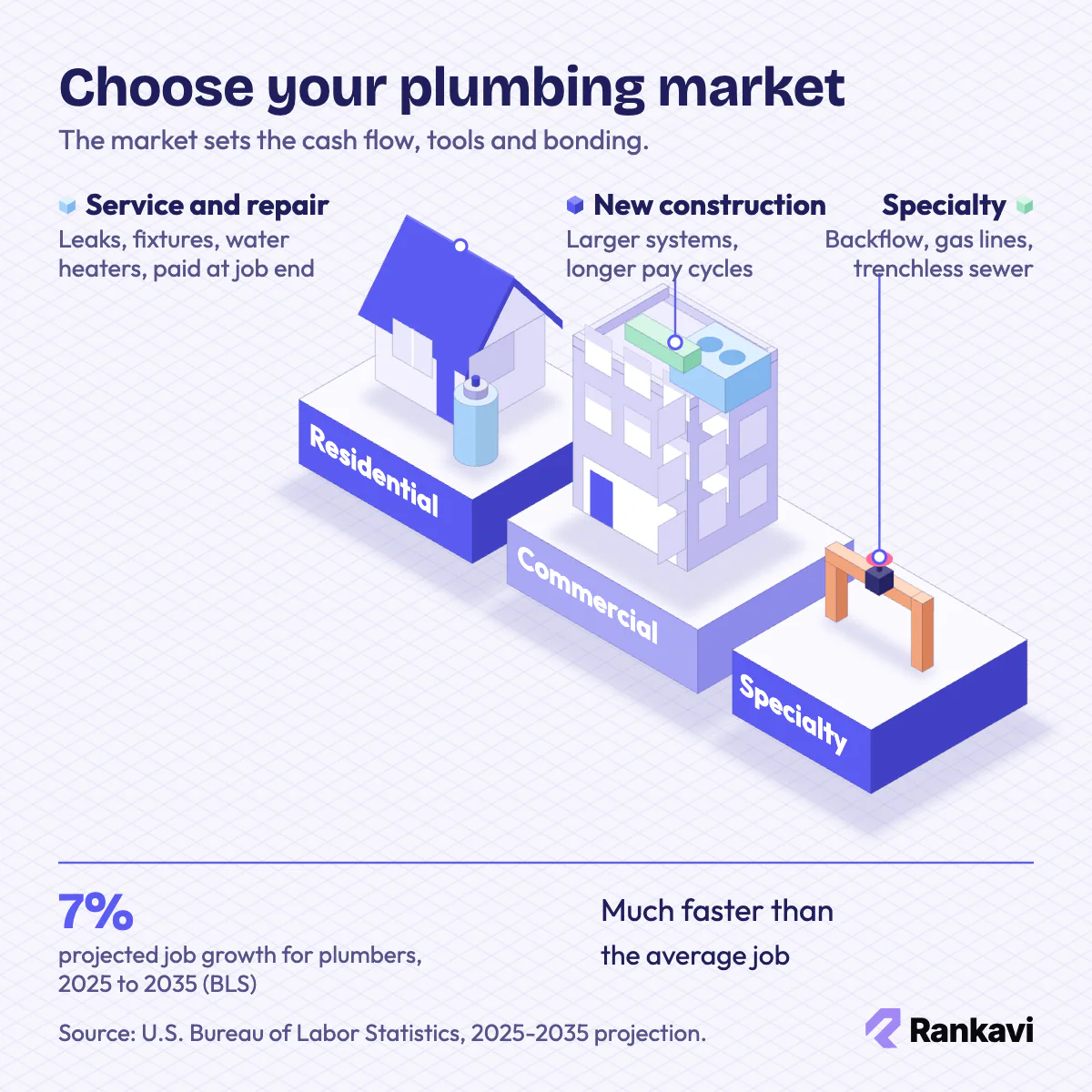
Residential service covers leak repairs, fixture installs, water heater swaps and drain cleaning. Startup costs stay lower, and homeowners usually pay when the job ends. Emergency calls at night and on weekends come with that market.
Commercial and new construction work means larger systems and coordination with general contractors. Payment cycles run longer, so the shop needs more working capital and often bonding. Fewer competitors chase this work.
The two lanes can also be combined in sequence. Service work brings quick cash and repeat customers. Commercial jobs or maintenance agreements can be added once the van stays busy. Each lane has a downside. Service work depends on fast response and good reviews, while construction work depends on schedules set by general contractors.
Demand looks steady for both paths. BLS projects 7% employment growth for plumbers, pipefitters and steamfitters from 2025 to 2035, much faster than the average job.
Specialties set a shop apart from a crowded field. Backflow testing, slab leak detection, trenchless sewer repair and gas line work often fill gaps local rivals leave. A quick scan of competitor websites and reviews shows where those gaps sit.
Each specialty may need its own training, gear or permit. The choice should match what the owner can legally offer in the first year.
A tight service area keeps a one-van shop profitable. Long drives burn fuel and billable hours, and late arrivals cost reviews. Owners start with a small radius and widen it as crews grow.
Seasons also shape the choice. Winter brings frozen pipes and failed water heaters, and summer brings outdoor and irrigation lines. Service work follows these swings, so cash reserves matter most in the slow months.
2. Write a Plumbing Business Plan
A plumbing business plan sets the job count and average ticket the shop needs to cover its costs. Banks and equipment lenders ask for it before they approve a van or tool loan.
Core plan sections:
| Section | What it covers for a plumbing shop |
|---|---|
| Executive summary | The service focus, owner license and funding request |
| Market research | Homeowner and builder demand in the service area |
| Competitive analysis | Strengths and gaps of nearby plumbing companies |
| Structure and operations | Legal entity, staffing, equipment and licenses |
| Marketing and sales | How the first customers find the business |
| Financial projections | Income, balance sheet and cash flow for three to five years |
Jobs per day is the key assumption in a plumbing plan.
Owner pay, drive time and callbacks belong in the plan too. Not every working hour can be billed, so the plan counts only the hours that earn money. One missed call a day shifts the whole projection.
A one-page lean plan works as a first draft. It lists the key assumptions in an hour or two. The full plan grows from it when a lender asks.
The plan needs an update when a van, a hire or a new service is added. That keeps the numbers close to real results.
3. Price Plumbing Calls for Profit
Plumbing prices decide whether each call pays for the truck, the license and the owner’s time. Most shops choose between flat-rate pricing and time-and-materials billing before the first customer calls.
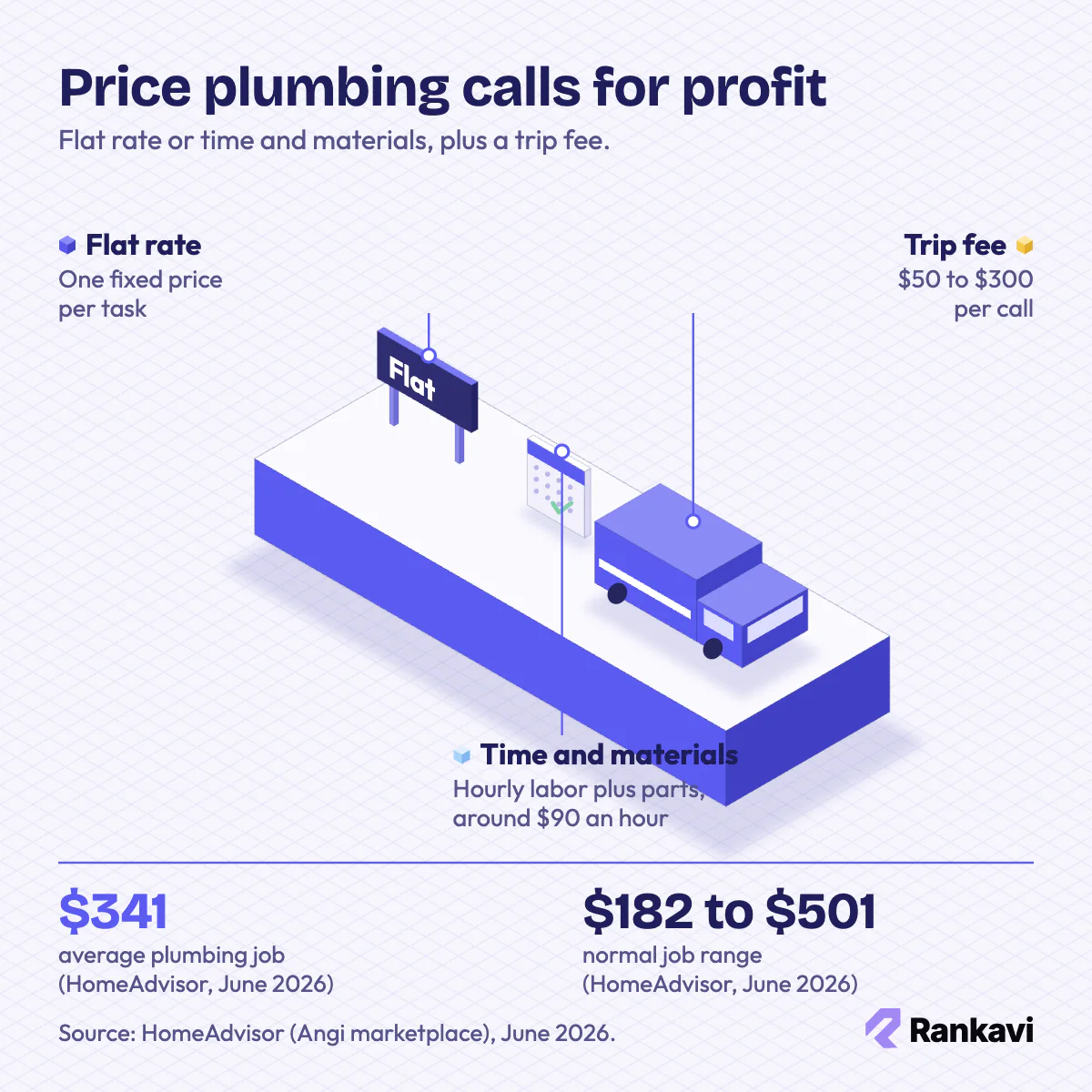
Flat-rate pricing quotes one fixed price per task, such as a toilet rebuild or a water heater swap. Homeowners like knowing the cost up front. Time-and-materials billing charges hourly labor plus parts, which suits large or uncertain jobs.
The average job is the number plumbing owners check first. HomeAdvisor is an Angi-owned marketplace that matches homeowners with plumbers and other pros. It put the average plumbing job at $341 in June 2026. Its normal range ran from $182 to $501 in June 2026. Break-even then becomes a count of jobs per month.
Average job prices also vary by city, by job type and by the hour of the call. Local quotes from nearby shops guide better than any national figure.
HomeAdvisor’s June 2026 guide put plumber labor at around $90 an hour, within a $45 to $200 range. Trip fees in that 2026 guide ran $50 to $300. After-hours calls often bill at time and a half or more.
A sound price starts from the true cost of an hour. The owner adds overhead, such as insurance, fuel, software and van payments, to the labor cost. A markup for profit sits on top, and materials get their own markup.
Markup and margin are different measures. A markup is added to cost. A margin is a share of the final price, so the same percentage gives a smaller margin than markup. Owner pay belongs in the hourly rate, not only profit.
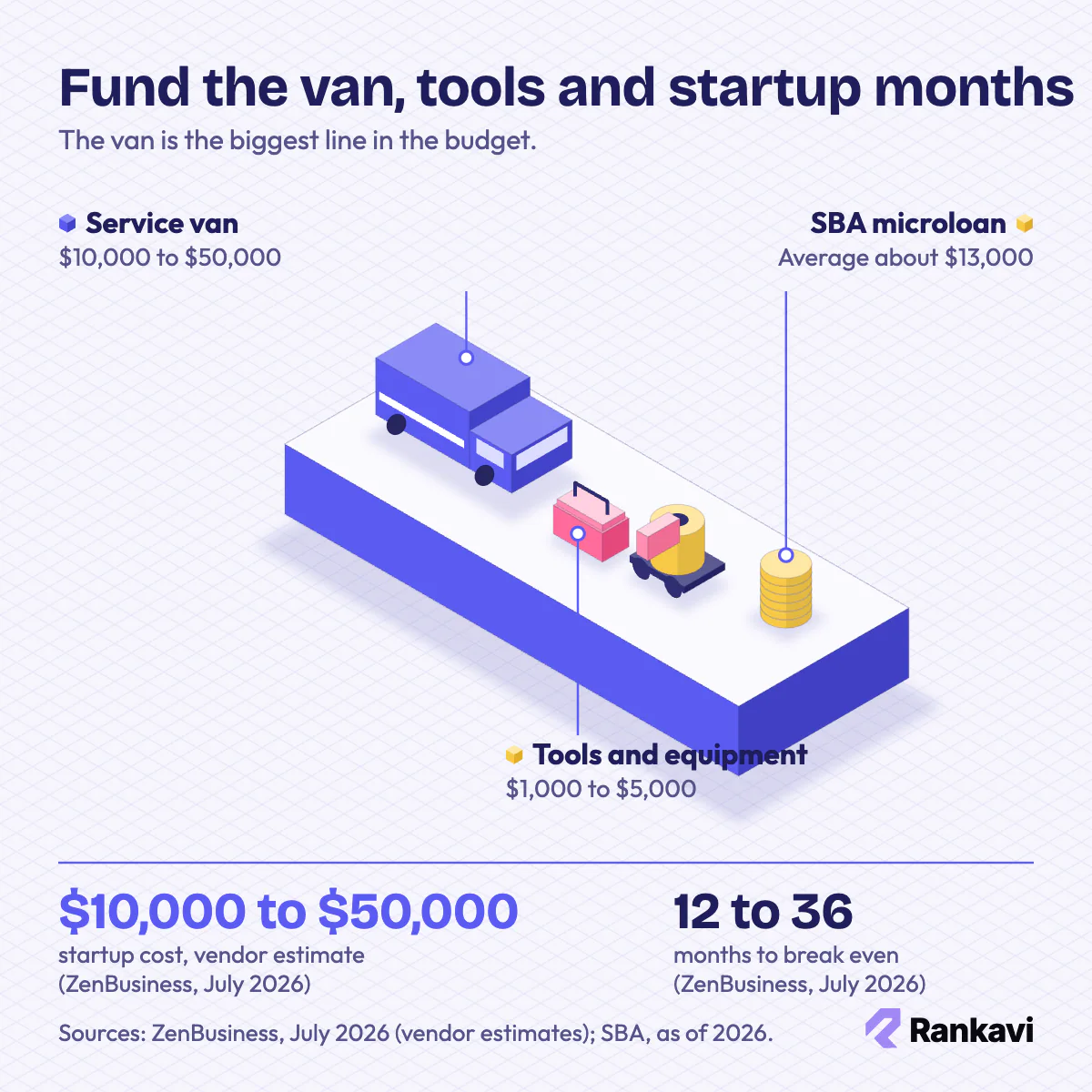
ZenBusiness is an online business formation company. It estimated plumbing startup costs at $10,000 to $50,000 in July 2026, with the van as the biggest line.
Startup money at a glance:
| Item | Typical figure |
|---|---|
| Startup cost | $10,000 to $50,000 (vendor estimate) |
| Main costs | Service van ($10,000 to $50,000), tools and equipment ($1,000 to $5,000), insurance and bonding ($500 to $2,000 a year), initial marketing ($1,000 to $9,000), licensing ($200 to $500) |
| Typical margin | 15.46% gross and 5.94% net for U.S. public engineering and construction firms, used here as a proxy for plumbing shops |
| Time to open | Set by the license timeline: a licensed master plumber can open within weeks, while an apprentice needs years first (no published average) |
| Break-even | 12 to 36 months (vendor estimate) |
Sources: ZenBusiness (a business formation company), July 2026, vendor estimates; Aswath Damodaran, NYU Stern School of Business, January 2026.
Example: An illustrative solo plumber books three jobs a day at the HomeAdvisor average and launches on a $30,000 budget.
| Input | Figure |
|---|---|
| Average job | $341 |
| Jobs per day | 3 |
| Working days per month | 21 |
| Monthly job revenue | $21,483 |
| Jobs to equal the $30,000 launch budget | About 88 |
Parts, fuel, insurance and owner pay come out of that revenue. Real payback takes far longer than 88 jobs.
Deep discounts win early calls but trap the shop in low prices. Neighbors compare quotes, so consistent prices across customers protect trust and margin.
A diagnostic fee is one way to cover drive time on calls that end without a job. It can be credited to the repair when the customer approves it.
4. Fund the Van, Tools and Startup Months
Startup funding covers the van, the tool kit, licenses, insurance and cash for the first slow months. The vehicle forms the largest share of a new plumbing budget.
Main startup cost categories:
| Cost category | What it covers |
|---|---|
| Service van | Purchase or lease, shelving and graphics |
| Tools and machines | Hand tools, drain machines and a camera |
| Parts inventory | Fittings, valves and common repair parts |
| Licenses and insurance | Exam fees, license fees, premiums and bonds |
| Software and website | Scheduling, invoicing and a basic site |
| Working capital | Fuel, payroll and bills before invoices are paid |
Lenders look at the owner’s credit, experience and plan. Banks offer term loans and lines of credit. Online lenders move faster but charge more.
Loans compare best by total repayment, not only by the monthly payment. Long terms and fees raise the final bill.
The U.S. Small Business Administration (SBA), which backs small business loans, funds microloans through nonprofit lenders. As of 2026, the SBA says the average microloan is about $13,000. Equipment financing from dealers spreads the cost of a drain machine or camera.
Used tools and vans cut the first bill. Auctions, liquidation sales and retiring plumbers sell gear below retail. Leasing a van keeps cash free, while buying it builds equity.
A lease also adds a fixed monthly payment that continues in slow months. That payment must fit the plan’s lowest expected revenue.
Working capital protects the shop while invoices clear. Commercial customers often pay weeks after the work ends. A reserve covering several months of costs keeps payroll and fuel funded.
5. Register the Plumbing Company
Registering a plumbing company creates the legal entity that holds the contractor license and signs contracts. Many owners form a limited liability company (LLC), which shields personal assets from a lawsuit over water damage.
A sole proprietorship costs less to set up but offers no such shield. A corporation suits owners who plan to add partners or investors. An accountant compares the tax effects before the filing.
The business name needs a quick search with the state and a check for a matching web domain. A short name fits on van doors, uniforms and invoices.
The Internal Revenue Service (IRS), the federal tax agency, issues a free employer identification number (EIN) online. Plumbing shops use it for payroll, supply house accounts and a business bank account. That account keeps job income apart from personal money.
A state or city business license, a sales tax account and local permit rules may also apply. The state and city offices can confirm which ones.
6. Insure the Crew, Van and Jobs
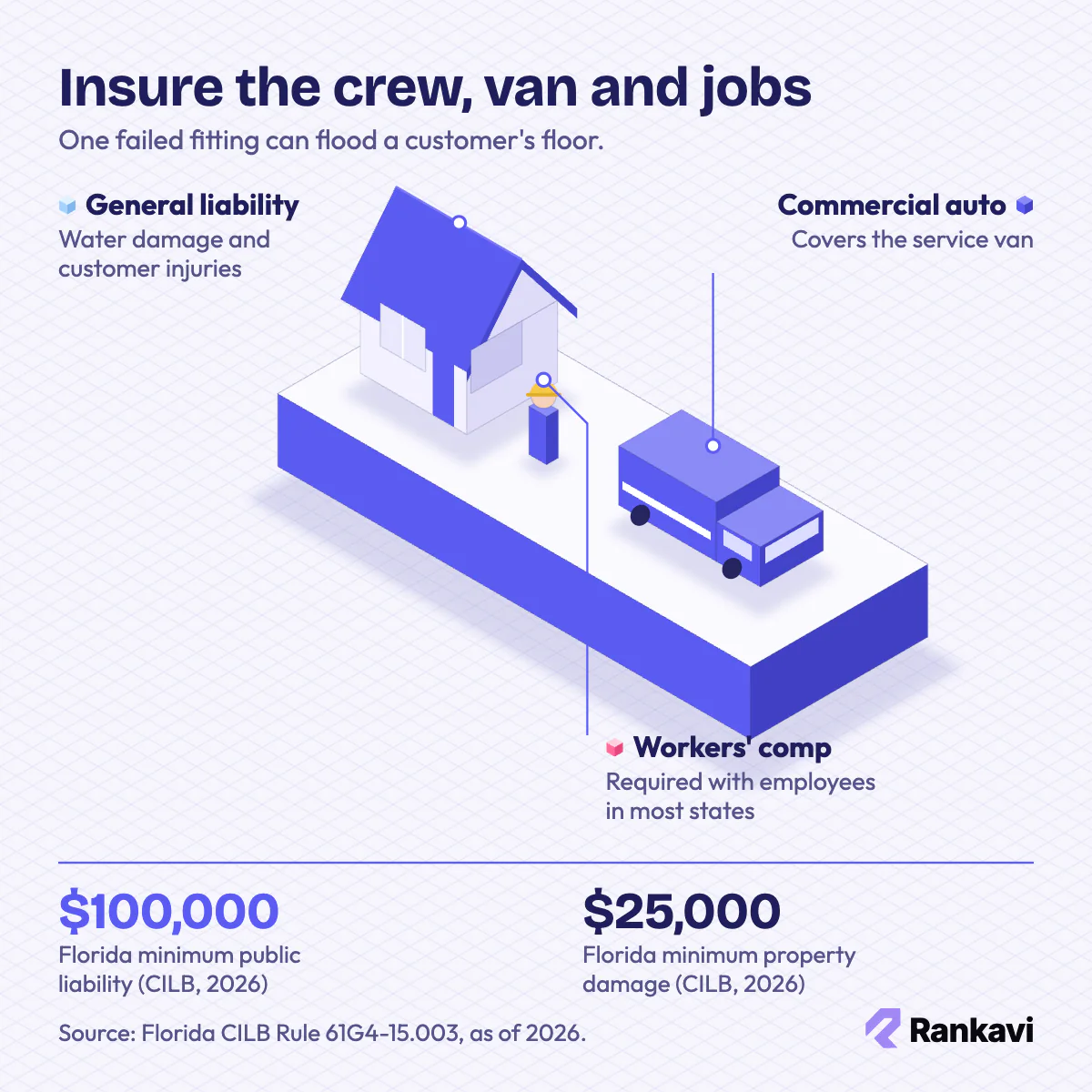
Plumbing insurance protects the business when a fitting fails and water ruins a customer’s floor. Many state boards also ask for proof of coverage before they issue a contractor license.
Main plumbing policies:
| Policy | What it covers |
|---|---|
| General liability | Property damage and injuries to customers |
| Workers’ compensation | Medical bills and lost wages for injured employees |
| Commercial auto | Accidents and damage involving the service van |
| Tools and equipment | Theft or damage to tools on jobs or in the van |
| Surety bond | A guarantee the shop follows license law or finishes a contract |
States set their own minimums. Florida’s Construction Industry Licensing Board (CILB) licenses the state’s construction contractors, plumbers included. As of 2026, CILB rules require plumbing contractors to carry $100,000 in public liability and $25,000 in property damage coverage.
Workers’ compensation becomes mandatory once the first employee joins in most states. Policies for the van and tools often come bundled with liability in one package.
Coverage limits matter as much as the policy type. A low limit can leave the shop paying the rest of a large water damage claim. The limit should match the size of jobs the shop takes.
Surety bonds work differently from insurance. Public projects and large commercial jobs often demand performance bonds before work starts. Some cities and states require a license bond as well.
Bond and insurance requirements differ by state and by project. The licensing board and each project owner set the final terms.
7. Secure a Master Plumber or Contractor License
A plumbing license gives the owner the legal right to run plumbing jobs without supervision. BLS noted in 2026 that states and localities often require 2 to 5 years of experience plus an exam.
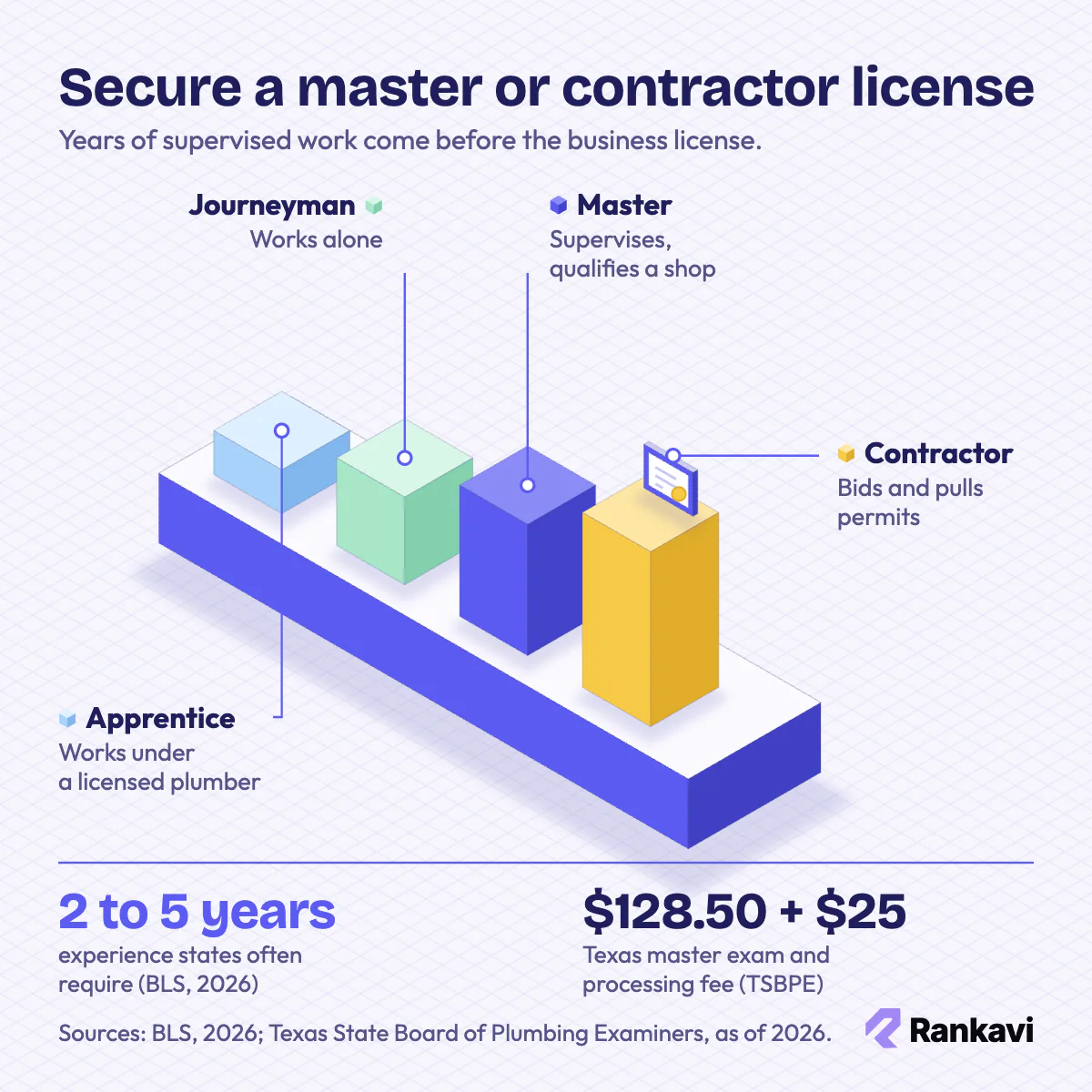
The plumbing license ladder:
| Level | What the holder may do |
|---|---|
| Apprentice | Works only under a licensed plumber while training |
| Journeyman | Works alone on plumbing systems |
| Master plumber | Supervises others and often qualifies a business |
| Plumbing contractor | Bids, contracts and pulls permits as a company |
The Texas State Board of Plumbing Examiners (TSBPE) licenses every plumber in Texas. A master plumber candidate there must have held a journeyman license for at least two years. As of 2026, the master exam costs $25 for processing plus $128.50, and the license costs $75.
In Texas, a Responsible Master Plumber supervises the work done under contracts secured on that license. As of 2026, the initial application costs $225, and the holder keeps $300,000 or more in liability coverage.
Local rules sit on top of the state license. Each job needs its own permit and inspection under the locally adopted code. The Uniform Plumbing Code is a model code that is common in western states. The International Association of Plumbing and Mechanical Officials develops it. The International Plumbing Code is a model code published by the International Code Council.
Some services need extra credentials. Backflow testing, gas line work and medical gas systems often call for separate certifications.
Which code applies depends on the jurisdiction. The local building department states which model code it follows. That choice affects materials and inspections.
8. Stock a Plumbing Service Van
The service van works as a rolling warehouse and workshop for every call. A well-stocked van finishes more jobs on the first visit.
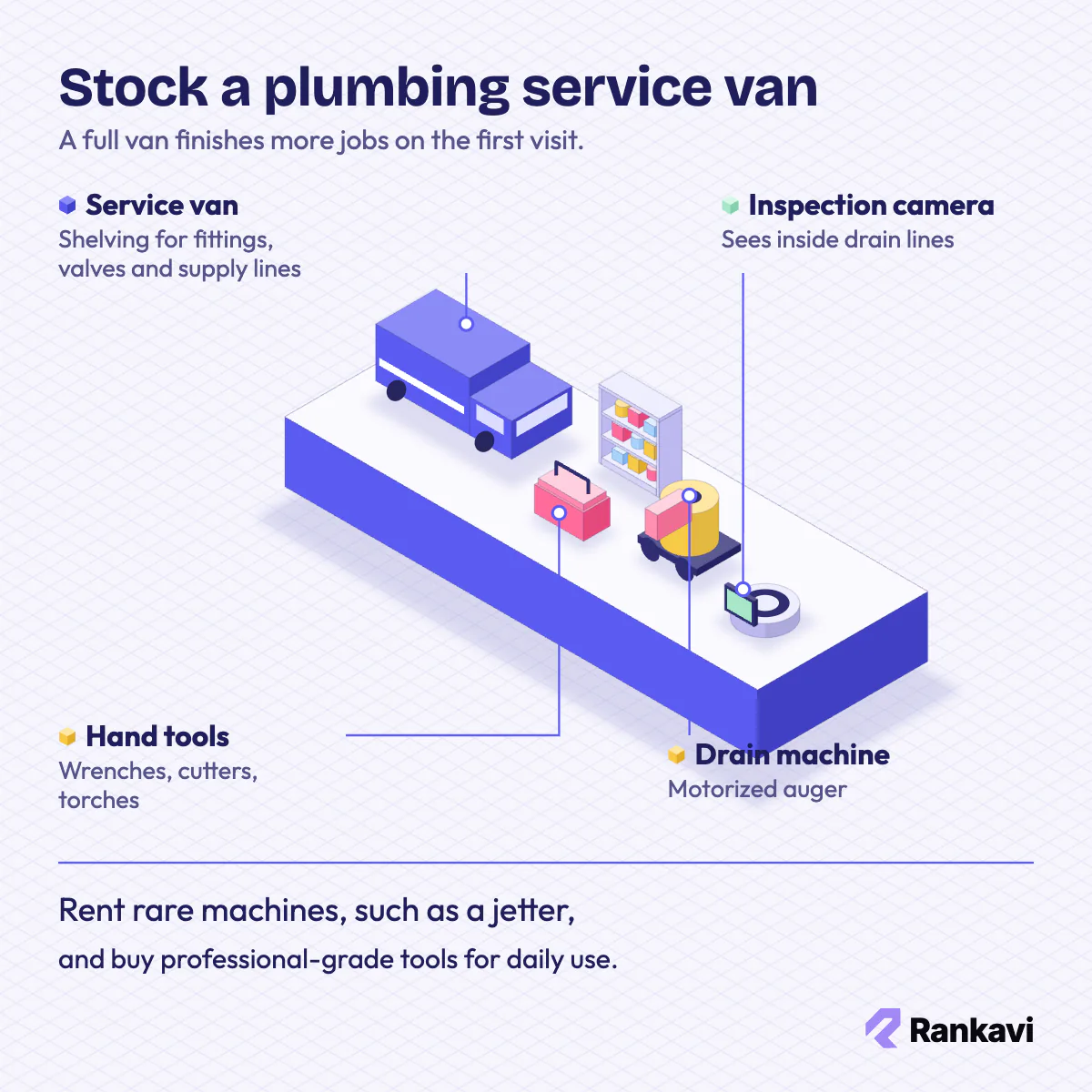
Core plumbing tools:
| Tool group | Examples |
|---|---|
| Hand tools | Pipe wrenches, pipe cutters, pliers and hacksaws |
| Drain tools | Hand snakes and motorized drain augers |
| Diagnostics | Inspection cameras and leak detectors |
| Joining tools | Torches, flame shields and pipe threaders |
| Safety gear | Gloves, goggles, boots and a fire extinguisher |
Professional-grade tools cost more but last through daily use. A broken tool mid-job wastes time and looks unprofessional. Rare machines, such as a jetter for a single job, are often cheaper to rent.
Shelving, bins and labeled drawers keep parts easy to find. A starter stock of fittings, valves, supply lines and wax rings covers common repairs. Accounts with local supply houses add trade pricing and faster pickups.
Stocking the most common parts first avoids tying up cash in rarely used fittings. Inventory can grow as the call history shows which parts run out most often.
Field service software handles scheduling, dispatch, estimates and invoices from a phone. Many apps sync with accounting software such as QuickBooks. Paper invoices soon eat weekends once calls pick up.
Software that takes card payments at the job also shortens the wait for cash, which helps in the first months.
9. Win the First Plumbing Customers
Local marketing turns a licensed plumber into the name homeowners call when a pipe bursts. Most first jobs come from search results, reviews and referrals.
A simple website lists services, license numbers, service area and a phone number. Google Business Profile is Google’s free listing for local businesses on Search and Maps. It shows the shop’s hours, photos and reviews.
Reviews decide many emergency calls. Plumbers ask happy customers for a review after each job. Fast, honest replies to negative reviews often impress readers more than praise.
A complete profile with service categories, photos and a service area also helps nearby homeowners find the shop.
Timing explains why reviews and listings matter so much. One longtime property owner described plumbing this way:
“This is known as a ‘distress purchase’ because nobody is going to call you when everything works right…”
— A longtime property owner and developer on the Plumbing Forums board
Referral partners send steady work because they manage many fixtures at once. Builders, property managers, real estate agents and former employers all need a reliable plumber.
A branded van advertises on every street it parks. Magnets and notepads left after a job keep the phone number on the fridge for the next leak.
10. Hire Apprentices and Add Services
Growing a plumbing business means adding people and recurring work without losing quality. A one-person shop keeps overhead low until the calendar stays full.
The first hire is a real cost decision. BLS put the median annual wage for plumbers, pipefitters and steamfitters at $63,800 in May 2025. Many solo owners hesitate at this step:
“It is very difficult for me to calculate the net benefit if someone else was on the payroll or the headaches I would encounter for that gain.”
— A plumbing company owner-operator on the Terry Love plumbing forum
Apprentices cost less than journeymen and learn the company’s way of working. A licensed plumber must supervise them, so each hire needs a mentor’s time. The Plumbing-Heating-Cooling Contractors Association is a trade association for plumbing and heating contractors that runs training programs.
A hire also adds payroll taxes, workers’ compensation and vehicle costs. A steady backlog of calls should come before the first employee.
Maintenance agreements smooth out the busy and slow seasons. Annual water heater flushes, drain checks and inspections bring repeat visits. Water treatment, gas lines and fixture remodels widen each customer visit.
Each new service needs the matching license and insurance coverage before the first job. The shop should check both before advertising it.
Licenses and insurance need regular renewal. TSBPE licensees, for example, complete six hours of continuing education before each renewal. Classes also track each new edition of the Uniform Plumbing Code or the International Plumbing Code.
11. Make the Shortlist When Homeowners Ask AI
A homeowner with a burst pipe may now ask ChatGPT for a nearby plumber before opening a search page. ChatGPT and similar assistants answer by repeating what local directories, review pages and news sites already say.
Those mentions take time to build, so a new plumbing shop gains from appearing on such pages early. “Best plumbers in town” lists and home improvement blogs shape which names the assistants surface.
Rankavi is a software as a service (SaaS) platform that publishes brand mentions in articles on indexed third-party websites. For plumbers aiming at ChatGPT answers, AI mention building starts on sites the assistant already reads.