

Starting a playdough business takes a reliable recipe, a clear product line, toy safety paperwork and a place to sell. Demand is growing, since Circana reported 6% growth in U.S. toy dollar sales for 2025.
My name is Michal Sieroslawski. I help playdough brands build their visibility online. Parents now ask AI chats the same questions they once typed into Google. Being one of the names those tools mention is becoming important.
This order lets the recipe set the price and the price set the budget. Safety certification then comes before the first tub reaches a child. Starting a playdough business comes down to the ten steps listed below.
- Choose Your Playdough Products
- Research Parents and Rival Dough Brands
- Develop a Soft, Long-Lasting Recipe
- Price Tubs and Kits for Profit
- Fund the First Batches and Shop Fees
- Register the Dough Company
- Certify Dough Under Children’s Toy Rules
- Buy Mixing Gear, Jars and Kit Fillers
- Market Kits to Parents and Party Planners
- Surface in AI Overviews Sensory Toy Answers
1. Choose Your Playdough Products
A playdough shop sells either plain tubs of dough, themed kits, or both. That first choice shapes the recipe work, the supply list and the buyers the brand attracts.
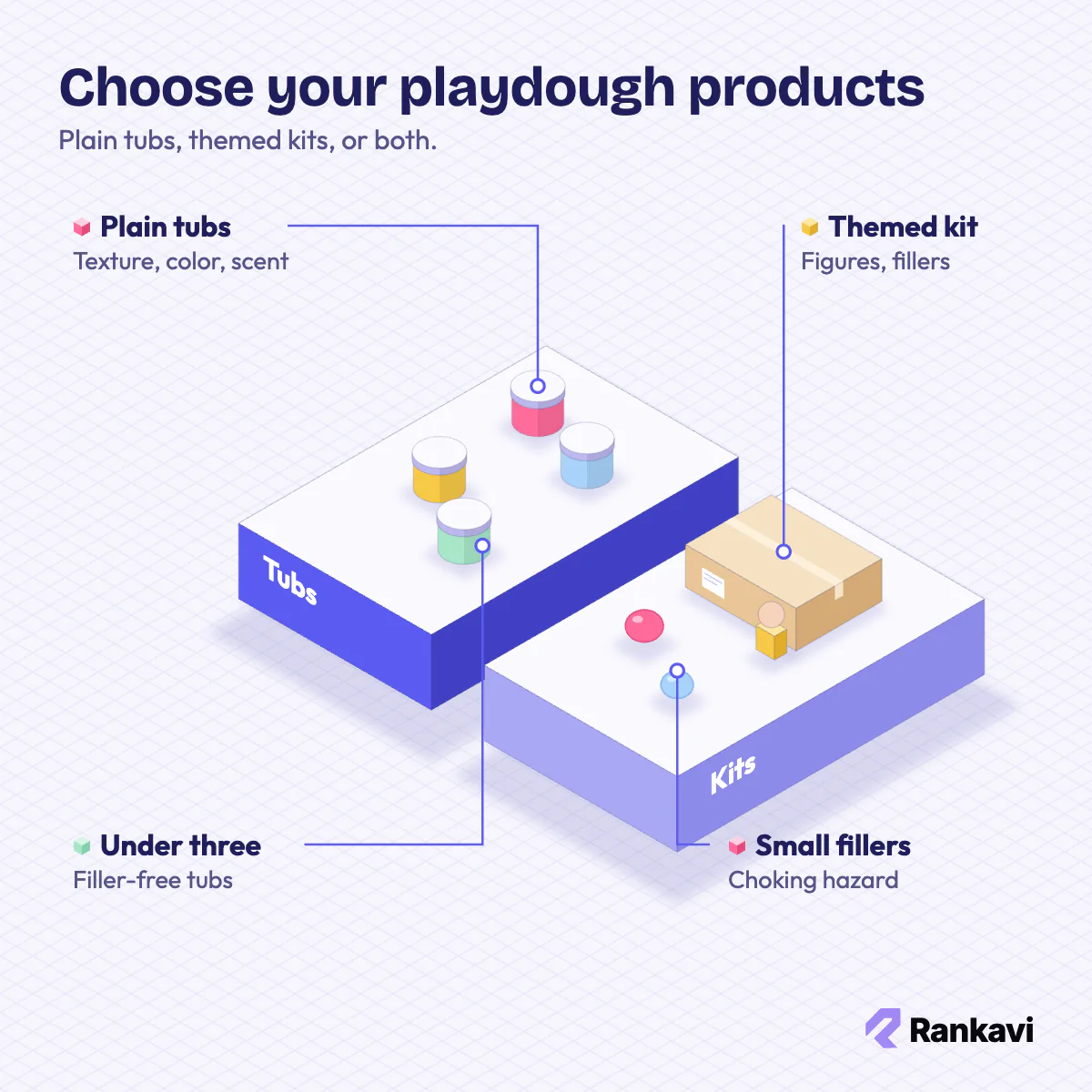
Plain tubs compete on texture, color and scent. Buyers judge them on softness and on how long the dough stays fresh. A tub line is simple to make and easy to restock.
Themed kits sell an experience instead. A kit pairs dough with figures and small fillers around one idea, such as space, construction, princesses or unicorns. One home seller calls her kits a party in a box.
Each choice carries a trade-off. Tubs cost less and restock fast. Kits earn more per sale but need more parts to source, store and pack. Licensed characters belong to their owners, so generic themes avoid that issue.
Age range shapes the whole line. Kits packed with small figures and gems carry choking hazards for toddlers. Many makers keep a separate, filler-free tub range for children under three.
Buyer type matters too. Teachers, daycares and therapists tend to want plain tubs in bulk, while party planners want kits. Wheat flour is the base of most dough, so a gluten-free tub serves families with allergies. A small first range of tubs, plus one pilot kit, shows which products sell before the line grows.
2. Research Parents and Rival Dough Brands
Market research for a playdough brand starts with the parents who buy it. Many of them want dough with simple, recognizable ingredients and no harsh chemicals.
Organic and chemical-free claims draw strong interest. Dohdough is a Bengaluru playdough brand that Deepti Bhandari founded in June 2019. It grew from her search for safer play materials, and its buyers wanted fresh dough over shelf-stable store products.
Play-Doh is the modeling compound brand every new maker competes against, and Hasbro has owned it since 1991. Mass products last long on shelves but can harden over time. A small brand wins on softer texture, fresh batches and themes that big brands skip.
Price checks complete the research. A new maker compares tub sizes, kit contents and prices on online marketplaces and in stores before setting any figure. That comparison shows where a handmade brand can charge more and where it cannot.
Early-childhood buyers form a second market. Kindergartens, preschools and therapists use dough for sensory play and hand strength. Wild Dough is an Australian playdough maker founded by Melissa Haque. It supplied the Victorian Government’s funded kindergarten kits from 2022 to 2025.
3. Develop a Soft, Long-Lasting Recipe
Developing a playdough recipe involves testing ingredients until the dough stays soft, smells good and resists drying out. The recipe is the product, so this step takes the most trial batches.
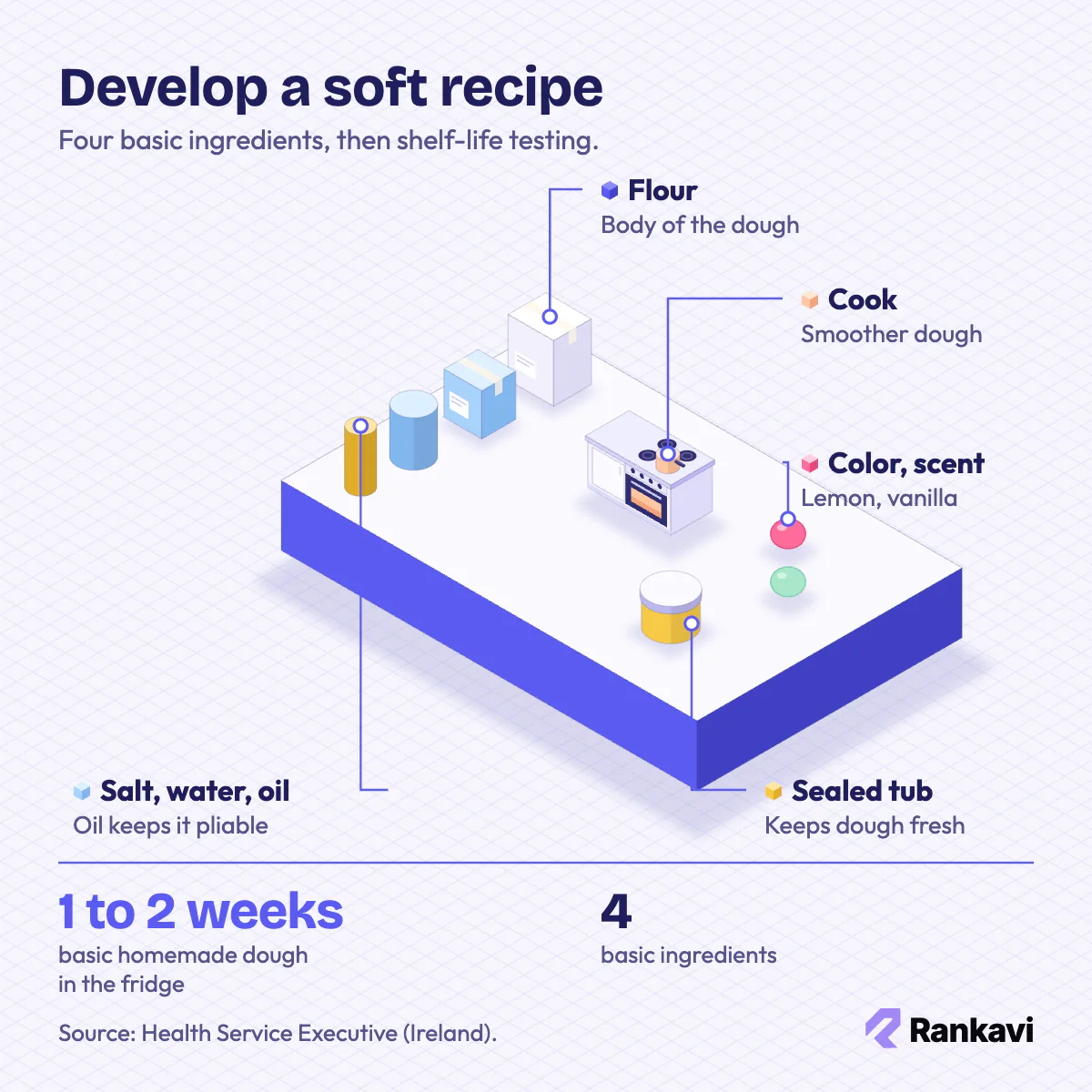
Most recipes start from four basic ingredients:
- Plain flour: the body of the dough
- Fine salt: part of the classic dough base
- Warm water: carries the food coloring
- Cooking oil: keeps the dough pliable
Food coloring goes into the water before the flour. Scents such as lemon, ginger or vanilla add a sensory twist.
Cooked dough and no-cook dough behave differently. Cooking the mix on a stove gives a smoother, longer-lasting dough. Salt-free versions also exist for families who worry about salt.
Each basic ingredient does a job. Flour gives body, salt helps keep the dough fresh, water binds the mix and oil keeps it soft. Dough that feels sticky often holds too much water. Dough that crumbles often lacks water or oil.
Shelf life decides how far the dough can travel. Ireland’s Health Service Executive says basic homemade dough lasts 1 to 2 weeks in the fridge. Play-Doh’s patent lists a preservative, while Dohdough set a strict six-month shelf life in 2021.
Children make the best testers. One kit maker uses her own kids as a focus group, and her oldest son flags pieces that don’t work.
A repeatable test method keeps results clear. The maker changes one thing per batch and writes the date on every sample. One sample stays uncovered to show how fast it dries. A second stays sealed, and weekly checks look for changes in smell, texture and mold.
4. Price Tubs and Kits for Profit
Pricing playdough sets one figure per tub or kit that covers dough, packaging, labor, fees and profit. Underpricing early makes later price rises harder.
Unit cost starts with the batch. The seller divides the cost of flour, salt, oil, color and scent across the tubs one batch fills. Jars, labels and the time spent mixing and packing come next.
Kits cost more to build than tubs. Figures, gems and tools add cost per box, and licensed themes cost the most. Generic themes like dinosaurs or farm animals keep kit costs lower.
Made-to-order pricing protects freshness. Dohdough makes small batches only after an order arrives. Fresh dough supports a higher price than mass dough sitting on a store shelf.
Margin and markup are different measures. Margin is profit as a share of the price, while markup is profit as a share of the cost. Mixing them up leads to prices that are too low.
Dough is heavy, so postage belongs in the plan. The seller either builds shipping into the price or charges it separately. Boutiques and toy stores that buy wholesale pay less than retail. The price must still leave profit after that discount.
5. Fund the First Batches and Shop Fees
Funding a playdough business covers ingredients, containers, kit fillers, safety testing and selling fees before steady sales arrive. Most makers start with personal savings.
Startup costs fall into five groups. Ingredients and packaging come first, then kit fillers. Lab testing for children’s product rules and selling costs follow.
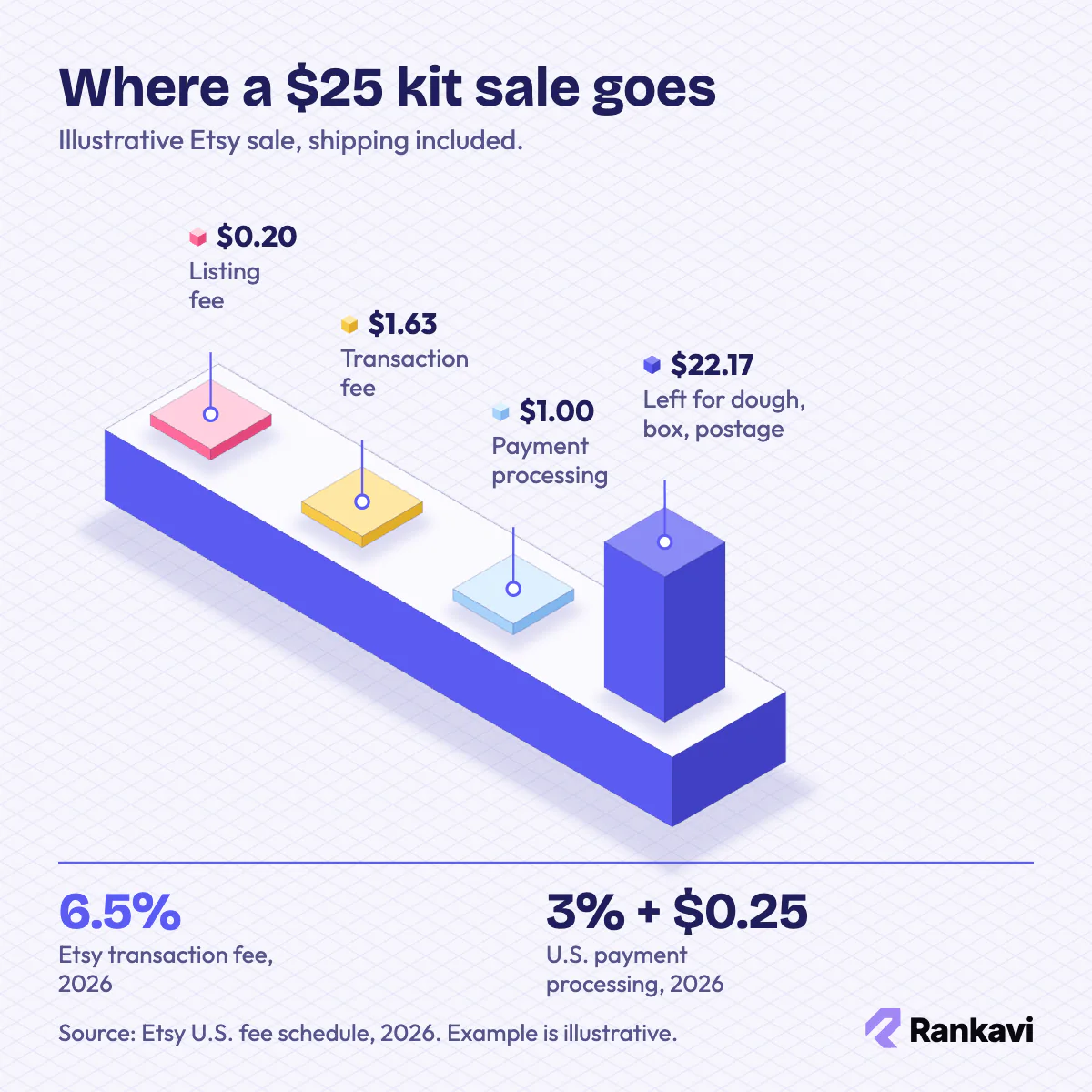
Marketplace fees are the benchmark most dough sellers check first. Etsy is an online marketplace for handmade and craft goods. As of 2026, Etsy charges U.S. sellers $0.20 per listing and a 6.5% transaction fee. Payment processing in 2026 takes another 3% plus $0.25 from each playdough order.
A website is the other main option. Shopify is an ecommerce platform whose Basic plan cost $29 a month billed yearly in 2026, per Website Builder Expert.
Small loans fill gaps that savings can’t. The U.S. Small Business Administration (SBA) runs a microloan program, which offered loans up to $50,000 as of 2026.
Savings carry no repayment, while a loan spreads out the cost of lab tests and the first bulk buys. Lab testing is a fixed cost for each product, so a narrow first range keeps that cost low.
Startup money at a glance:
| Item | Figure |
|---|---|
| Startup cost | Varies with batch size and lab testing; no published playdough range |
| Main costs | Ingredients, jars, kit fillers, safety testing, selling fees |
| Typical margin | No published playdough margin; Etsy fees take 6.5% plus 3% and $0.25 per sale |
| Time to open | Depends on recipe trials and certification |
Sources: Etsy U.S. fee schedule, 2026; U.S. Small Business Administration, 2026.
Example: An illustrative themed kit sells on Etsy for $25, shipping included.
| Line | Amount |
|---|---|
| Kit price | $25.00 |
| Listing fee | $0.20 |
| Transaction fee (6.5%) | $1.63 |
| Payment processing (3% + $0.25) | $1.00 |
| Left for dough, fillers, box and postage | $22.17 |
6. Register the Dough Company
Registering a playdough company means choosing a legal structure and filing the business name with the state. A dough maker working alone becomes a sole proprietor by default.
A limited liability company (LLC) separates business debts from personal assets. A sole proprietor carries those debts personally.
Dough makers get a free employer identification number (EIN) from the Internal Revenue Service (IRS), which issues it online. A separate bank account keeps flour receipts apart from family spending.
Most states require a sales tax permit before the shop sells direct. Cities and counties may also require a local business license.
7. Certify Dough Under Children’s Toy Rules
Children’s product rules determine which tests, certificates and labels each playdough tub needs before sale. Dough designed mainly for children 12 or younger counts as a children’s product.
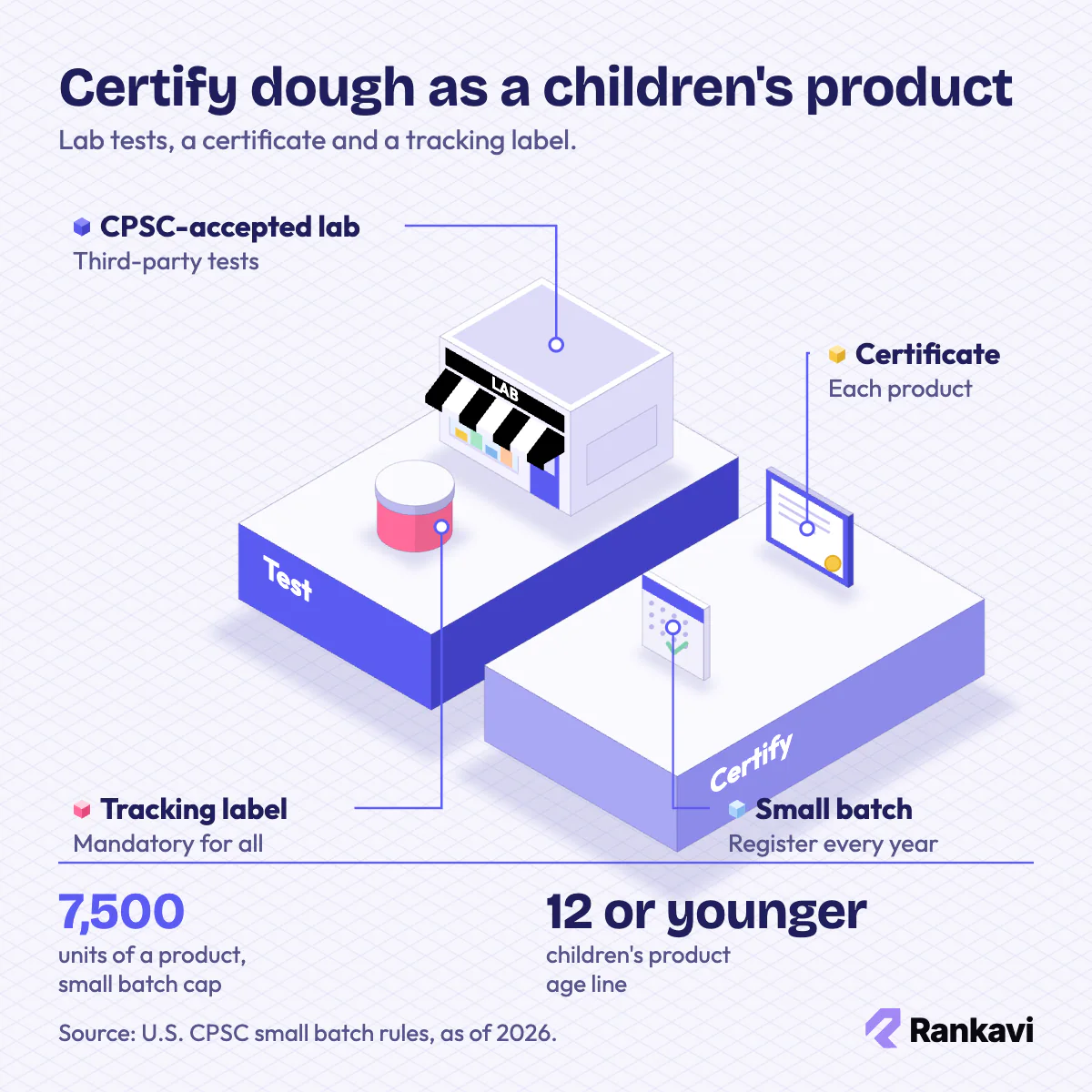
The U.S. Consumer Product Safety Commission (CPSC) sets the federal safety rules for children’s products. Each one needs a Children’s Product Certificate based on tests from a CPSC-accepted, third-party laboratory.
ASTM International is a standards organization, and it publishes the Standard Consumer Safety Specification for Toy Safety (F963). CPSC lists third-party tests under it for toy substrate materials and for clean pastes and putties. Kits with figures add the small objects test.
Small batch status eases some of that testing. As of 2026, CPSC counts makers with no more than 7,500 units of a product and $1,436,864 or less in prior-year revenue. They register every year, but small parts tests still need a third-party lab. Tracking labels stay mandatory for everyone.
A change to a tested recipe, colorant or scent may call for new tests. A maker confirms with the lab before changing a formula. CPSC lists accepted laboratories on its website, which lets a maker check a lab before paying for tests.
Art material labeling can also apply. Under the Labeling of Hazardous Art Materials Act (LHAMA), art materials carry a statement of conformance to ASTM D-4236. That rule alone doesn’t require a certificate.
8. Buy Mixing Gear, Jars and Kit Fillers
A home kitchen covers most of the early equipment. Large mixing bowls, a heavy pot for cooked dough, measuring cups and a stove handle the first batches.
Containers keep dough fresh. Airtight 16-ounce (473 ml) plastic jars suit single tubs. Kits need a box or a divided case. Dohdough chose cardboard boxes over cheaper plastic to stay eco-friendly.
Tight lids matter, since open air dries dough out. Cheap fillers fall under the same toy rules as other parts. Small pieces are checked before they go into a box.
Fillers and tools fill the kits:
| Item | Use in a kit |
|---|---|
| Small figures | Set the theme, such as farm or dinosaurs |
| Cookie cutters | Cut shapes from rolled dough |
| Mini rolling pins | Flatten dough for cutting |
| Gems and charms | Decorate dough creations |
| Silicone mats | Give children a clean play surface |
Safari Ltd is a maker of small toy figures, and its themed tubes are a common kit staple. Discount stores also sell cheap character figures.
9. Market Kits to Parents and Party Planners
Playdough sells through social media first. Short videos of squishing, cutting and unboxing show texture in a way photos can’t.
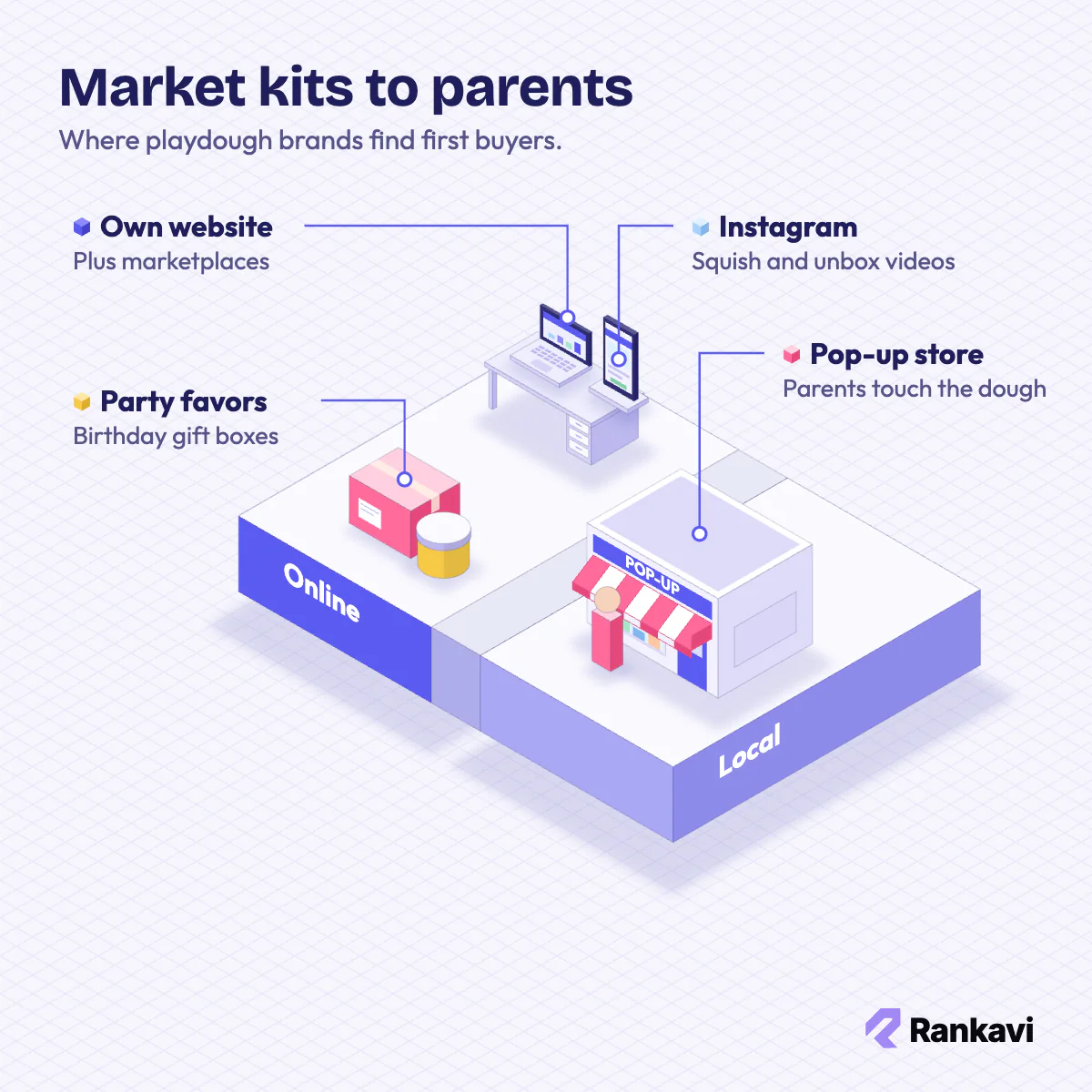
Instagram and Facebook drive many early orders. Captivating Play is a home-based kit business run by Destiny Capps. It sends buyers to Instagram for new products and stock news. Dohdough also sells through its own website and online marketplaces.
Pop-up stores let parents touch the dough. Dohdough sold at three pop-up stores in its first phase. Markets and school fairs work the same way.
Gift seasons create the biggest rush. Birthday party favors started Captivating Play, and its kits sold out until after Christmas. Party planners and teachers buy in bulk for events.
Bulk buyers need a simple order form and a clear lead time. Fresh batches take days to mix and pack, so a firm date stops rushed orders.
10. Surface in AI Overviews Sensory Toy Answers
Parents now ask Google for the best non-toxic playdough or a themed sensory kit for a birthday. Google AI Overviews answer with brand names drawn from trusted pages.
Those pages include parenting blogs, gift guides and toy roundups. A new dough brand mentioned there early has a better chance of appearing in the answer.
Rankavi is a software as a service (SaaS) platform that publishes brand mentions in articles on indexed third-party websites. Small toy makers use it to earn the brand mentions AI Overviews picks up in play searches.