

Starting a photography business means turning camera skills into a registered company that sells sessions, images and prints. Most photographers already work for themselves. The U.S. Bureau of Labor Statistics (BLS), which publishes federal job data, counted 67% as self-employed in 2025.
A bit about me: my name is Michal Sieroslawski, and I help photography businesses appear when clients search online. AI answers are quickly becoming a starting point for clients. Showing up there helps a new photography business reach people it would otherwise miss.
Each step funds or protects the next one. Budget and paperwork both come before the first paid session. The following list shows how to start a photography business in twelve steps.
- Choose Your Photography Niche
- Write a Simple Business Plan
- Budget Your Startup Costs
- Register Your Photography Business
- Insure Your Business and Gear
- Buy Cameras, Lenses and Backup Gear
- Build a Portfolio Clients Trust
- Price Your Photography Sessions
- Set Up Contracts, Booking and Delivery
- Market Your Work to First Clients
- Grow Into a Full-Time Studio
- Get Booked Through AI Answers
1. Choose Your Photography Niche
Choosing a niche means deciding which type of photography the business sells first. That choice shapes the gear list, the portfolio and the clients a new studio attracts.
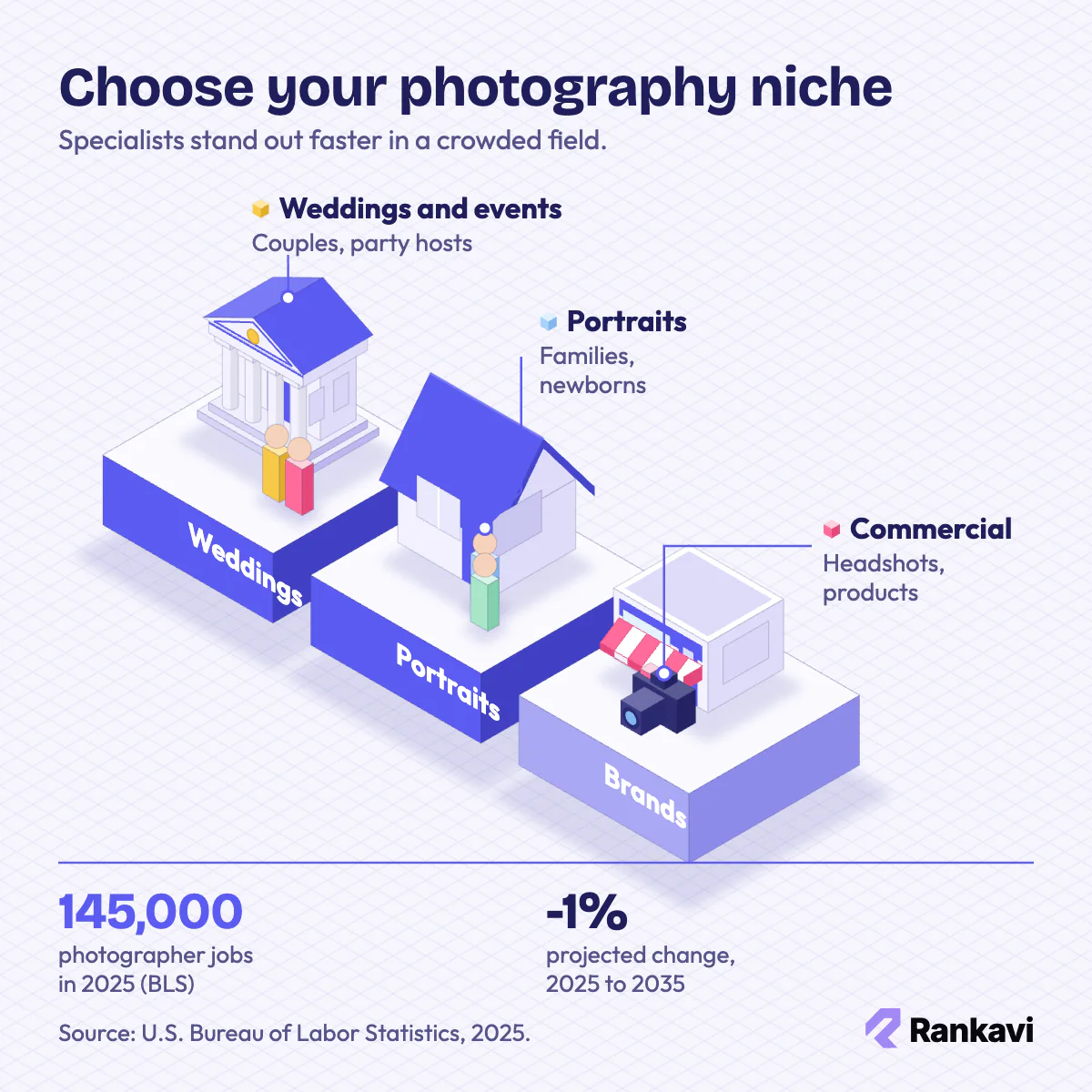
Photography is a crowded market, so a specialist stands out faster than a generalist. BLS counted about 145,000 photographer jobs in 2025. It projects a 1% decline from 2025 to 2035.
A clear specialty makes the audience easier to find in that crowded field. Marketing then speaks to one type of buyer instead of everyone.
The table below lists the common photography specialties and the clients each one serves:
| Specialty | Typical clients |
|---|---|
| Wedding and engagement | Couples planning a wedding |
| Portrait, family and newborn | Parents and families |
| Headshots and branding | Professionals, actors and small businesses |
| Event | Party hosts and companies |
| Real estate and architecture | Agents and property owners |
| Product and food | Online shops, restaurants and brands |
Smaller niches extend that list. Pet, maternity, boudoir, sports, school and aerial photography each draw their own buyers.
Aerial work adds a legal step. The Federal Aviation Administration (FAA) regulates drones in the United States. Its Part 107 rule requires a remote pilot certificate to fly a small drone. A certified pilot can also supervise directly.
Niches also differ in pace and pressure. A wedding happens once, with no retakes, and bookings follow the local wedding season. Headshot and product work happens in a controlled setting where a shot can be repeated.
Many new photographers narrow the list to two or three related specialties. Wedding photographers often add engagement and family portraits. Those sessions come from couples they already know.
Local competition matters as much as personal taste. New owners check which nearby photographers share a style or specialty. They also check which niches show steady demand. Three checks give that local picture:
- Nearby photographers: A look at other studios in town shows who already shoots the same style or specialty.
- Google Trends: This Google tool shows whether searches for a niche rise or fall in a region.
- The Knot: This wedding directory shows how many wedding photographers already serve a town.
An existing advantage can speed up early bookings. A contact at a wedding venue, a link to local businesses or a past job in sales helps. An underserved town with few photographers is another head start.
The choice still needs a real test before money goes into gear. A few low-cost sessions in the chosen niche do that. Those shoots show whether the work itself suits the photographer.
2. Write a Simple Business Plan
A business plan sets the roadmap for the photography business. The plan turns the chosen niche into goals, services and a budget the owner can track.
A single page is enough. The U.S. Small Business Administration (SBA), a federal agency, calls this short format a lean startup plan. The other choice is a traditional plan, which follows a standard structure and can run dozens of pages. Owners who want help with either version can get counseling from SBA resource partners.
Whichever format the owner picks, the numbers in it rest on one guess. The plan’s key assumption for a photographer is how many paid sessions each month the chosen niche can realistically book.
Writing the plan means answering a short set of questions about the work itself. A photography business plan answers eight questions:
- Services: The plan states which services the business offers.
- Ideal client: It names who the ideal client is.
- Place of work: It settles whether sessions happen on location, in a studio or both.
- Packages: It lists which packages the business sells.
- Finding the photographer: It explains how clients find and contact the photographer.
- Money: It sets out what income goals and monthly expenses look like.
- Difference: It says what makes the studio different from nearby competitors.
- Bookings needed: It works out how many bookings per month cover basic costs.
The answers turn into goals, and those goals fall into two groups by timing. Short-term goals cover the setup work of the first weeks. Typical items are the business name, a domain, a bank account and a contract template. Long-term goals cover branding, vendor relationships and steady marketing.
Good goals are specific, measurable, achievable, realistic and timely (SMART). “Launch a website with a portfolio, about page and pricing page this month” meets all five tests. Comparing the plan with real bookings every few months shows which assumptions held.
3. Budget Your Startup Costs
A startup budget shows how much money the photography business needs before it earns. The budget lists every cost, from gear to paperwork, so nothing surprises the owner later.
Startup money at a glance:
| Item | Typical figure |
|---|---|
| Startup cost | $2,000 to $20,000 (lean home setup at the low end) |
| Main costs | Camera gear $1,000 to $10,000; computer and editing software $1,000 plus $120 a year; insurance $200 to $500 a year; registration and licenses $50 to $500; marketing $200 to $500 |
| Typical margin | Varies with niche, travel and album costs; a home-based studio avoids rent, the largest overhead |
| Time to open | Paperwork takes weeks; break-even takes 6 months to 3 years, per ZenBusiness |
Sources: ZenBusiness, a business formation company (2026 estimate); The Knot (2026); ShootProof (2026).
Those costs only mean something next to the money coming in. Wedding photographers check one number first: bookings per month times average booking value. The Knot 2026 Real Weddings Study put the average wedding photographer cost at $3,000, based on couples married in 2025.
That fee has to cover editing too. ShootProof, a client gallery software company, surveyed photographers. In its 2026 results, about 70% spent 26% to 75% of their working time editing.
Worked example: a home-based wedding photographer spends $8,000 on two bodies, lenses, a laptop and paperwork. Two weddings a month at $3,000 bring in $6,000. Software and insurance cost about $60 a month. The kit is paid off within two busy months. This illustrative case excludes owner pay, travel, albums, taxes and the slow winter season.
Lean starts keep monthly costs low. Many photographers work from home and use free editing tools and free website plans at first. Paid subscriptions wait until bookings justify them.
Lean monthly costs still do not solve the up-front price of a kit. Camera makers offer payment plans, and an SBA microloan can cover a larger kit. In 2026, SBA microloans reach up to $50,000. Nonprofit lenders in each area make these loans and set the terms, not the SBA itself. Any loan adds a monthly payment, and heavy debt raises the pressure to book.
Taxes change how much cash the budget needs. The Internal Revenue Service (IRS), the federal tax agency, sets the self-employment tax rate at 15.3% in 2026. That rate covers Social Security and Medicare. Self-employed owners may also have to pay estimated taxes each quarter.
Two tax rules lower the real cost of starting. Section 179 lets an owner deduct qualifying gear in the year it goes into service, instead of depreciating it. A home studio may also qualify for the IRS simplified home office deduction, which in 2026 allows $5 per square foot, up to 300 square feet.
Four money habits hold the budget together from the first booking:
- Bookkeeping: Tracking income and expenses starts on day one. A spreadsheet handles the job, and so does QuickBooks, an accounting program.
- A sales tax account: Setting aside sales tax in a separate savings account avoids a painful bill later.
- A gear fund: This fund grows the kit without new debt. Many owners save a fixed share of every session’s income. Upgrades then follow real demand.
- A cash reserve: A separate reserve covers the slow months that the gear fund cannot.
4. Register Your Photography Business
Registering a photography business involves filing it with the state as a legal entity. The studio can then sign client contracts and open accounts.
Most new photographers choose between a sole proprietorship and a limited liability company (LLC). A sole proprietorship is the simplest structure. An LLC separates personal assets from business debts and claims. A local accountant helps pick the right structure.
Forming an LLC means filing articles of organization with the state, the documents that create the company. That filing usually goes through the Secretary of State’s office. The LLC also names a registered agent, who receives legal papers for the business.
Many photographers name the business after themselves, such as “First Last Photography”. A personal name stays usable if the niche changes later. The chosen name should also be free as a domain and on social platforms. A different trade name usually needs a “doing business as” (DBA) filing with the county or state.
A registered business also needs a tax number of its own. That number is the employer identification number (EIN). The IRS issues this federal tax number and charges no fee for it. Sole proprietors can apply too.
State registration and a tax number still leave local rules unmet. No single photography license exists, but cities and counties set their own requirements. Three local approvals can apply:
- General business license: A city or county may require this license to operate inside its limits.
- Sales tax permit: Many states tax photos and digital files as goods, so this permit is often required.
- Home occupation permit: A home studio that hosts clients may need this permit under local zoning rules.
Deposits and retainers belong in a dedicated business bank account, which keeps bookkeeping and tax filing simple.
5. Insure Your Business and Gear
Insurance protects a photography business from accidents, claims and damaged equipment. A policy should be active before the first paid session.
Three kinds of cover handle the main risks a new studio faces:
- General liability insurance: This covers injuries and property damage during a shoot. A guest who trips over a light stand at an event is a typical claim. Venues and corporate clients often ask for proof of coverage before booking. That proof is a certificate of insurance, a document the insurer issues on request.
- Professional liability insurance: Also called errors and omissions cover, this addresses a different risk: mistakes in the work itself. It responds to claims that the photographer missed key shots or lost a client’s files.
- Equipment insurance: This covers cameras, lenses and computers against theft and damage. Gear is often the most valuable asset a new studio owns. A policy keeps one dropped lens from stopping the business.
Insurers often write this portable gear cover as an inland marine policy, because cameras travel to each shoot. Storing gear at home raises a separate issue. A homeowners policy usually limits or excludes business equipment, so a home studio needs separate cover.
Equipment cover can also arrive through membership rather than a separate policy. Many photographers join Professional Photographers of America (PPA), which represents professional photographers from Atlanta and dates to 1868. As of October 2026, Professional Photographers of America includes up to $15,000 of PhotoCare equipment cover for Active and Life members. Members must opt in first.
These policies protect the business and its gear. Adding people to a shoot raises a separate rule. Hiring an assistant or second shooter can bring workers’ compensation rules into play. Those rules vary by state.
Taking deposits before the studio is registered and insured is risky, so paid sessions wait until both are in place.
6. Buy Cameras, Lenses and Backup Gear
Photography equipment determines which jobs a new business can accept. A portrait studio needs less gear than a wedding photographer working in dark venues. The size of the kit changes with the work, but the same basic pieces show up in both.
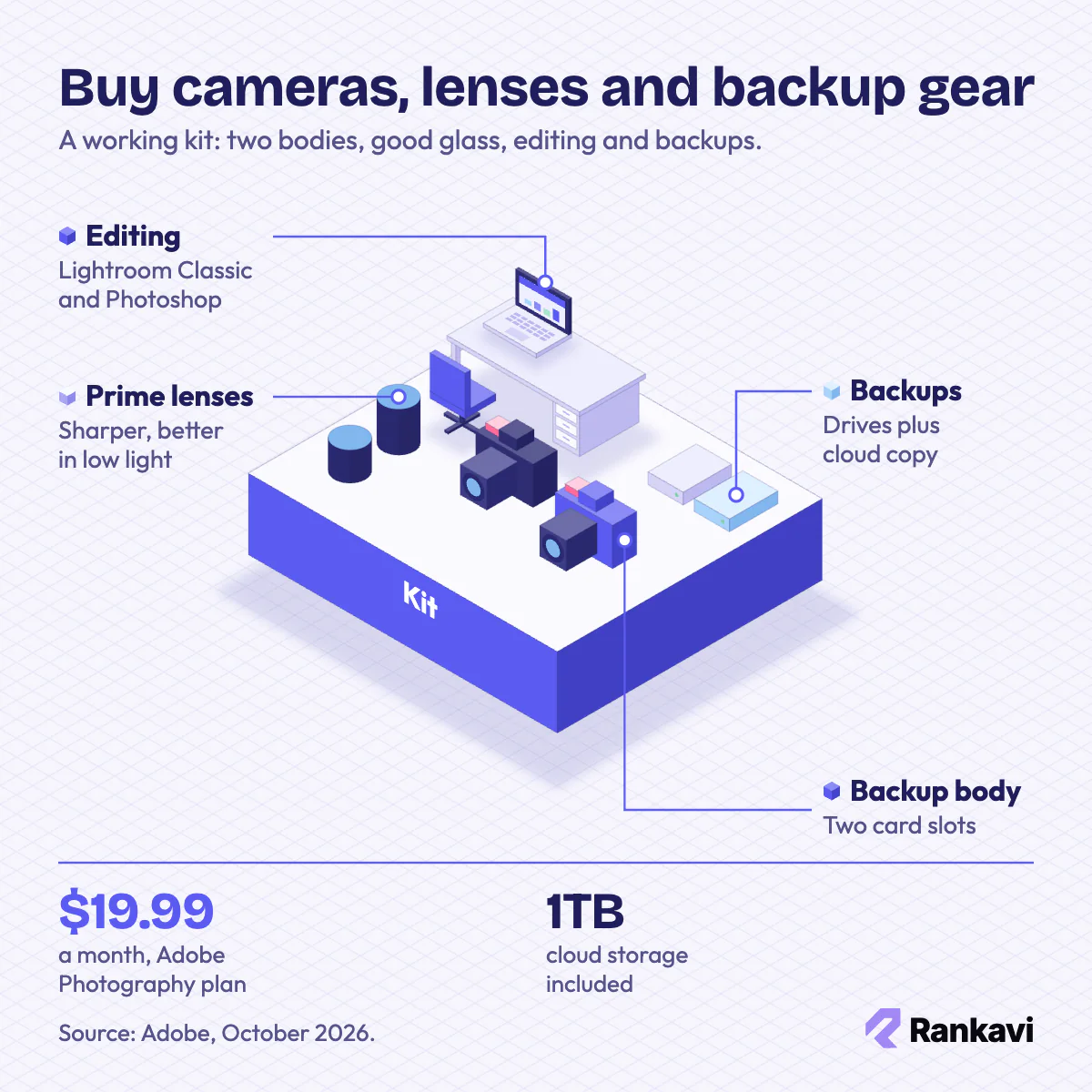
A working photography kit has six core parts:
- Camera body: The body ideally has two memory card slots. Two slots write each image twice, so one bad card does not wipe out a session.
- Lenses: One or two quality lenses start the kit.
- Memory cards and a card case: Cards hold the photos during the shoot. A case keeps them together between jobs.
- Lighting: A flash or a reflector supplies light that the room does not.
- Computer with editing software: A computer runs the software that turns each shoot into finished photos.
- External hard drives and cloud backup: Drives and a cloud service hold copies of paid client work.
The camera body choice also decides the lenses. Canon, Nikon, Sony and Fujifilm make the main mirrorless camera systems. Each brand uses its own lens mount, the fitting that joins a lens to a body. Lenses rarely move to another system without an adapter. The first body therefore commits the business to a lens system.
Image quality depends more on lenses than on camera bodies. Kit lenses do a decent job, but a fast prime lens produces sharper photos. A prime lens stays at one focal length instead of zooming. Prime lenses also handle low light better. A 50mm prime is a common first portrait lens, and a 24-70mm zoom covers many event moments.
Used and rented gear stretches a small budget. Lenses bought used hold up well when owners cared for them. Rental companies let photographers test a lens before buying. KEH Camera sells graded used gear, while Lensrentals and BorrowLenses rent lenses for a single job.
Gear that earns money has to survive the day it is booked for. A camera can fail mid-shoot, so working photographers carry a second body. Spare batteries belong in the backup kit too, because a long wedding day can drain several.
Once the shoot ends, the work moves to the computer, and editing software becomes the other core purchase.
The usual choice is Adobe Lightroom Classic, which is Adobe’s desktop editor and photo catalogue. As of October 2026, Adobe lists its Photography plan, with Photoshop, Lightroom Classic and 1TB of storage, at $19.99 per month. Capture One is a paid alternative editor that many studio photographers use for tethered shooting.
Those edited files need the same protection as the cameras that made them. Raw photos, the camera’s unprocessed images, fill a computer quickly. External drives plus a cloud backup service keep client work safe if a drive fails. Many photographers follow the 3-2-1 backup rule: three copies, on two types of storage, with one copy kept off-site.
7. Build a Portfolio Clients Trust
A portfolio gives potential clients proof of the photographer’s style. It is a curated collection of work with a unifying theme, and it sells sessions before any price talk.
Free sessions with friends and family build the first gallery. Those shoots teach posing, lighting and client communication without pressure. Friends also share the photos online.
Styled shoots and time-for-photos arrangements fill gaps. In a time-for-photos (TFP) deal, models, stylists and makeup artists trade their time for images instead of cash. Photographers who need subjects can look on Model Mayhem, a casting site for models and photographers. Product and real estate photographers can practise on items and buildings nearby.
Written permission comes before any image goes public. The following are the four documents that cover the usual cases:
- Model release: This covers the people in the frame.
- Property release: This covers private buildings that appear in the photos.
- Parent or guardian signature: Shoots with children need a parent or guardian to sign.
- TFP contract: This sets usage rights for every collaborator on a time-for-photos shoot.
Quality beats quantity in a portfolio. A small set of strong images outsells a large gallery of average ones. The best portfolios match the niche the business wants to book. Consistent editing across every image makes the set read as one style. Weaker early images come out as stronger paid work replaces them.
A curated set still needs a place where clients can find it. The finished portfolio usually lives on a website gallery built with Pixieset, Format or Squarespace.
“I am taking 8-10 months to build the business infrastructure after taking 2 very intensive years of practice (including being a second for a pro wedding photographer for 4 weddings).”
— A new photographer on The Photography Forum
8. Price Your Photography Sessions
Pricing decides whether each session covers costs and pays the photographer. Prices start from the cost of the work, not from what friends will pay.
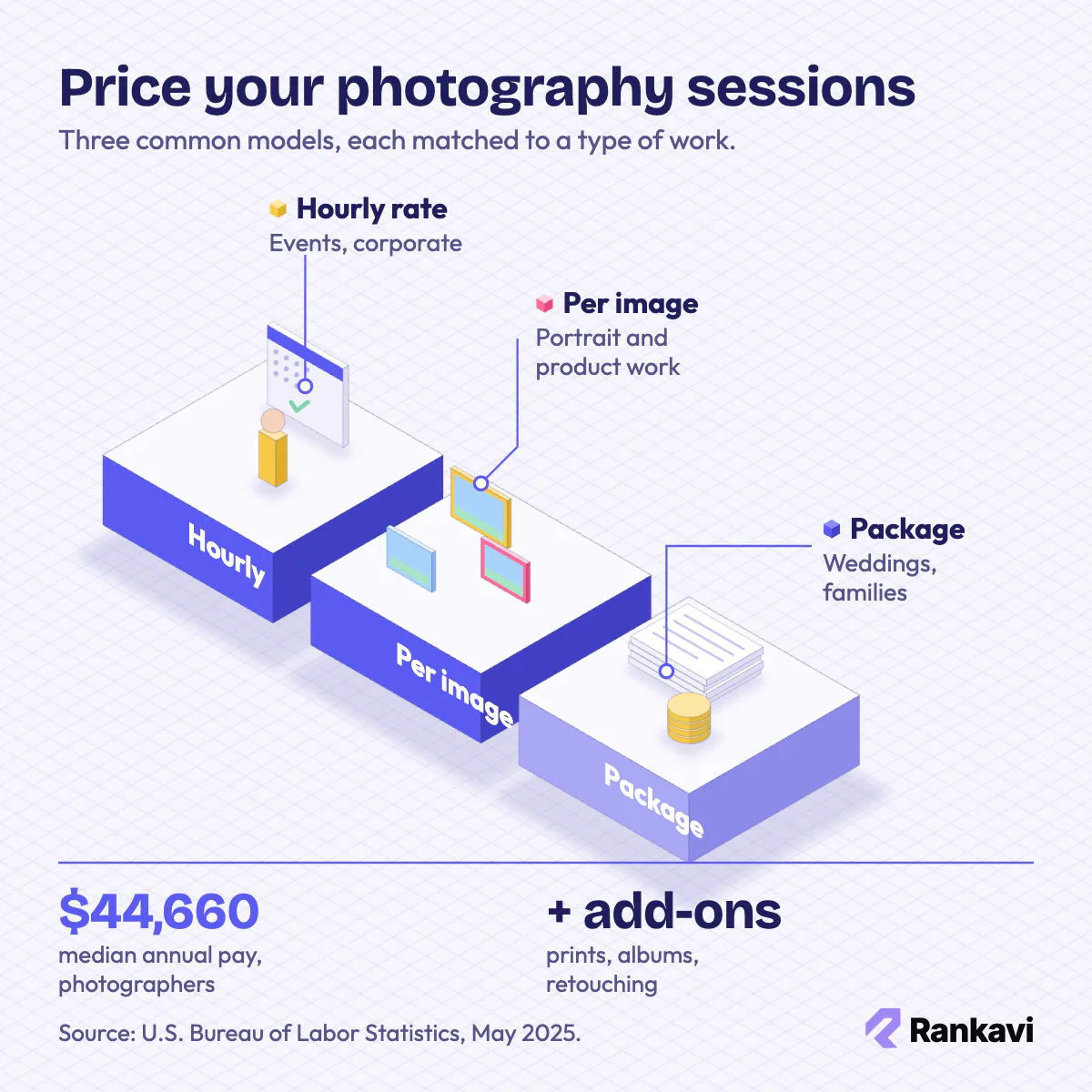
The first pricing decision is how to charge at all. Each method fits a different kind of job and a different kind of buyer.
Common photography pricing models:
| Model | Typical use |
|---|---|
| Hourly rate | Events and corporate coverage |
| Per image | Portrait and product work |
| Session or package fee | Families, headshots and weddings |
Picking a model only sets the shape of the price. The amount has to come from what the business costs to run. A cost of doing business (CODB) figure sets the price floor. It adds up a year of business costs and divides them by the sessions the owner expects to shoot. A price below that floor loses money on every booking.
With a floor in place, the owner decides how to bundle the work for buyers. Packages are sold in two main ways. Tiered collections bundle time, images and products at set prices. A la carte pricing charges a session fee and sells prints and files separately. Some portrait studios keep the session fee low and earn more from print sales afterwards.
Several factors raise or lower a quote. The number of locations, outfit changes and print packages all change the work involved. Travel time matters for on-location shoots. Travel fees often use the IRS standard mileage rate, the per mile figure the Internal Revenue Service sets each year. That rate is 72.5 cents per mile for business driving in 2026.
Editing time is part of the price. Every quote also covers overhead such as gear upkeep, software and insurance. Clients pay for skill and service, not only for time behind the camera. Commercial clients also pay usage fees based on where and how long the images will run.
Local competitors show what clients will pay. New owners compare packages from photographers in the same niche and area. The BLS reported a median annual pay of $44,660 for photographers in May 2025. Half of photographers earned more than that and half earned less, so the figure works as an income benchmark.
Undercharging is common and often leads to burnout.
“I was doing great work but wasn’t consistently booking because I didn’t have the business side set up the right way and I was low balling myself on pricing.”
— A photographer in a YouTube comment
Raising the base price is one fix, and selling more to each client is another. Add-ons raise the value of each booking. The following are four add-ons that work as upsells:
- Extra retouching: Clients pay more for added editing on chosen images.
- Prints: Printed photos sell after the shoot alongside the digital files.
- Albums: Album design is a natural add-on for wedding clients.
- Wall art: Framed pieces for the home sell as an upsell too.
Prices rise as demand grows. Regular increases keep rates in line with rising costs instead of freezing an early, low rate.
9. Set Up Contracts, Booking and Delivery
Business systems keep every client on the same path from inquiry to final gallery. Contracts, booking tools and delivery platforms replace scattered texts and emails.
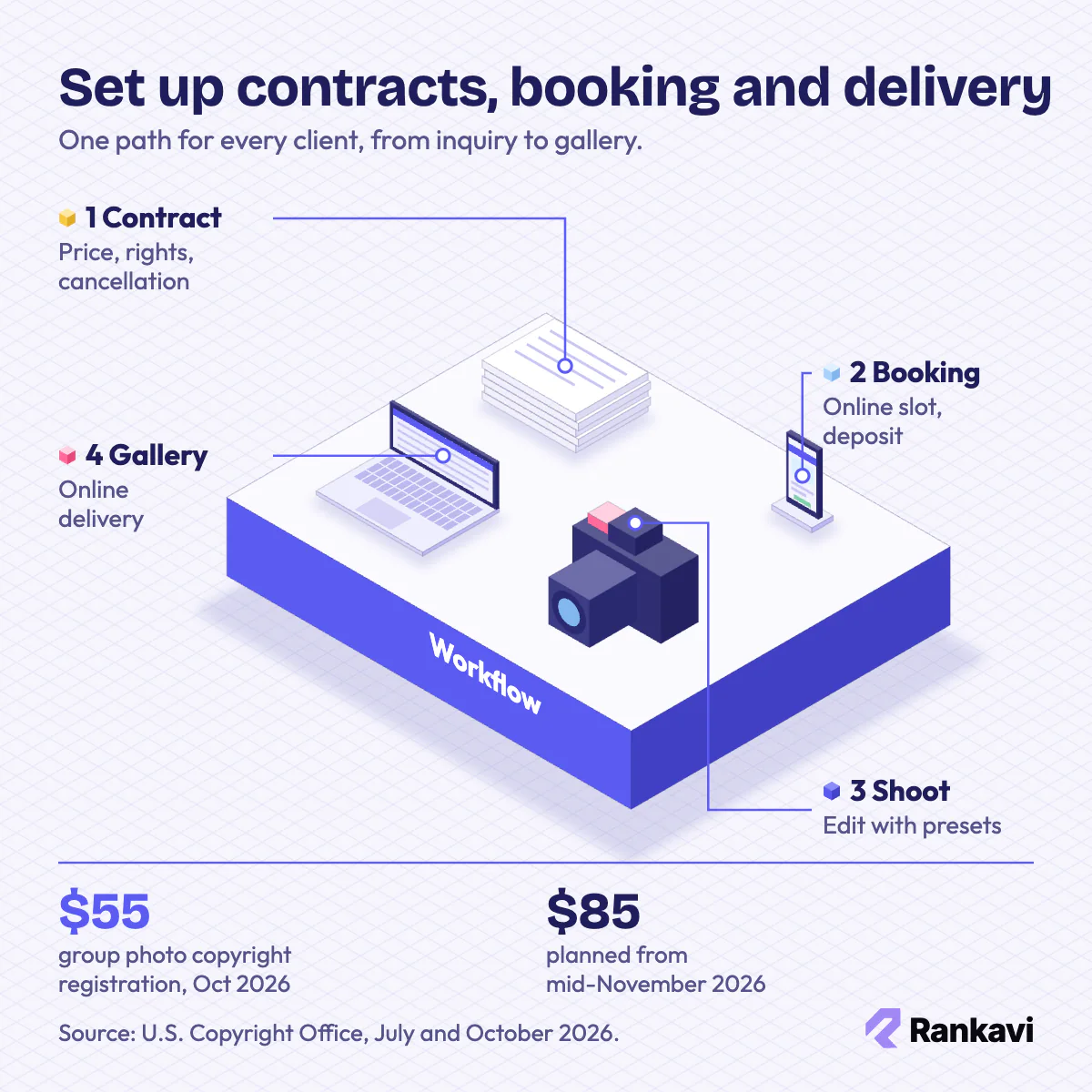
That path starts with a signed contract, which protects both sides before any shoot. The contract sets five basic terms:
- Price: The contract states the agreed price for the work.
- Shoot time: It records when the shoot takes place.
- Deliverables: It spells out what the client receives.
- Editing turnaround: It states how long the editing takes.
- Cancellation policy: It explains what happens if the shoot is called off.
The contract also states who holds copyright and how clients may use the images. A retainer, an upfront payment made at signing, holds the date and counts toward the final balance.
U.S. copyright protects a photo from the moment it is created and fixed, and registration is voluntary. Registration still matters, because an owner must register a U.S. work before suing for infringement. Federal law generally limits statutory damages and attorney’s fees to works registered early. Registration must come before infringement or within three months of publication.
Registering images with the U.S. Copyright Office, which oversees copyright registration, strengthens that position in a dispute. As of October 2026, the office charges $55 to register a group of photographs. Its proposed fee schedule, sent to Congress on July 14, 2026, raises that fee to $85. The increase takes effect in mid-November 2026 unless Congress blocks it.
Software carries the rest of this work, from the contract through the finished gallery.
Common photography business tools:
| Tool type | Examples |
|---|---|
| Client management and contracts | HoneyBook, Dubsado, ShootProof |
| Online gallery delivery | Pic-Time, Pixieset, ShootProof |
| Editing | Adobe Lightroom Classic, Adobe Photoshop |
| Booking and payments | Online schedulers and invoicing tools |
HoneyBook and Dubsado include electronic signatures, so clients sign contracts online instead of printing them. Online booking ends long email chains. Clients pick a free slot and pay a deposit when they book. Invoicing tools then collect the balance on time. Payment processors such as Stripe, Square and PayPal collect those payments, often from inside the client management tool.
Once the shoot is done, delivery platforms do more than host files. Pic-Time and ShootProof also sell prints through linked professional labs. Many photographers set an expiry date on each online gallery and ask clients to download their files before then.
Editing sits between the shoot and that gallery, and an editing workflow saves the most time. Lightroom presets and batch editing speed up every gallery. Email templates save time at the other end, answering common questions about pricing, booking and delivery.
10. Market Your Work to First Clients
Marketing turns a new photography business into one local clients know about. The first bookings usually come from people the photographer already knows.
Those first clients talk, and that talk is the fastest early channel. In ShootProof’s 2026 survey of its photographer community, 85% of photographers said they rely on referrals for new clients.
Vendor partners turn referrals into a steady source. Wedding photographers trade referrals with planners, venues and makeup artists. Property photographers work with real estate agents.
Asking each client for a Google review after delivery builds proof for the next search.
Five online channels put the work in front of those clients:
- A website: Gives the business one home for galleries, prices and booking. Clients often search for “photography studios near me” before they ask friends. Pages that name the city and the service help those searches find the site.
- A Google Business Profile: A free listing that puts the studio on Google Maps and collects client reviews.
- Instagram: Meta’s photo and video app, which suits photography because the work is visual. Regular posts, Reels and client stories show style and personality over time. Video usually reaches more people than still images.
- Pinterest: A visual search platform where couples and parents save ideas. Pins of finished galleries keep bringing visitors long after they are posted.
- Local listings: Put the studio where clients already look. Directories such as The Knot, WeddingWire and Thumbtack list photographers by service and area. Local Facebook groups and Nextdoor, a neighborhood social network, carry requests for photographer recommendations.
A limited launch rate for the first few clients fills early dates and gathers testimonials. A clear end date keeps it from becoming the expected price.
An email list gives the photographer an audience no platform controls. A monthly newsletter, sent through a tool such as Mailchimp or Flodesk, keeps past clients in touch. Paid magazine ads and boosted posts often bring weaker results than steady email marketing.
11. Grow Into a Full-Time Studio
Growth builds a steady studio from a busy side business. It starts once bookings arrive consistently and the owner tracks what works.
Every growth decision starts with numbers. Useful metrics include bookings, average profit per client and repeat business. Testing one change at a time shows which change made the difference.
Average profit per client is one of those numbers. Physical products lift each sale. Albums, print boxes and wall art earn more than digital files alone. Professional labs such as White House Custom Colour and Bay Photo print and ship orders straight to clients.
Earning more per booking still leaves the empty months. New offers smooth out slow seasons. Seasonal mini sessions bring in many short bookings at once. Some studios add video, workshops or other niches later.
Outsourcing frees the owner for shooting and selling. There are three common ways to hand that work off:
- Virtual assistant: A remote assistant handles admin.
- Outside editor: An editor outside the studio handles post-production.
- AI tools: Software such as Aftershoot and Imagen sorts and edits images in the photographer’s own style.
Each option takes a different task out of the owner’s day.
Help with admin and editing still leaves one person behind the camera. Associate photographers let the studio cover more sessions under one brand. Associates can work as contractors or employees. The IRS looks at whether the studio has the right to control how the work is done.
More sessions and more photographers raise the question of where to shoot them. A physical studio is often the largest new fixed cost at this stage. The rent stays the same each month, busy or slow. Renting studio space by the hour tests demand before the owner signs a lease.
Skills need upkeep too. Workshops, mentors and local photographer groups keep skills current. Shadowing an established photographer teaches lessons no course covers.
12. Get Booked Through AI Answers
Getting booked through AI answers means a studio’s name appears when clients ask AI tools to suggest a photographer. Engaged couples and busy parents increasingly start their shortlist this way.
Because clients start there, it helps to know where those answers come from. Google AI Overviews, the summaries at the top of search results, draw on pages that already rank. Those pages include wedding directories, review sites and “best photographers” roundups. A studio mentioned on them has a better chance of appearing in the summary.
Search is not the only place clients ask. Clients also ask ChatGPT, Gemini and Perplexity for photographer suggestions. A complete Google Business Profile with recent reviews gives these tools consistent facts. For the same reason, the studio’s name, city and services should read the same on every listing. Asking these tools the same question a client would shows where the studio stands today.
Third-party write-ups carry weight here. Rankavi is a software as a service (SaaS) platform that publishes brand mentions in articles on indexed third-party websites. Studios pay from $12 per mention. A brand mention service for AI Overviews can help Google’s AI summaries name the studio when clients compare photographers.