

Starting a pet grooming business takes grooming skill, a safe workspace, permits, insurance and repeat clients. The American Pet Products Association (APPA), which publishes pet industry data, counted 95 million U.S. pet-owning households in 2025.
My name is Michal Sieroslawski, and I’m an entrepreneur who helps pet grooming businesses become easier to find online. ChatGPT and Google’s AI Overviews now suggest pet grooming businesses by name, and that list matters.
Settling the model, prices and funding first keeps lease and permit spending tied to real numbers. Permits, insurance and equipment then follow the chosen site. The following list shows how to start a pet grooming business in twelve steps.
- Choose Your Grooming Model
- Write a Pet Grooming Business Plan
- Price Grooms by Size and Coat
- Fund the Salon, Van or Home Studio
- Register Your Grooming Business
- Find a Salon Space or Van Base
- Get Grooming Permits and Certification
- Insure Groomers, Pets and Equipment
- Buy Tables, Tubs, Dryers and Clippers
- Market to Local Dog Owners
- Grow With Staff and Added Services
- Appear in Gemini AI Answers for Pet Grooming
1. Choose Your Grooming Model
Choosing a grooming model decides where dogs get groomed, what setup costs and how many fit each day. Most founders pick a salon, a mobile van or a home studio.
A storefront salon holds several tables and tubs at once. Owners can hire groomers, rent stations to independent groomers or work alone.
Mobile groomers bring a fully equipped van to the client’s driveway. Busy professionals, older owners and anxious dogs value that door-to-door convenience.
Booth rental is the lightest start. An independent groomer rents a station inside an existing salon and builds a client list before taking on a lease.
Each model fits a different founder. A salon suits an owner who wants to build a team. A van suits an owner who wants low overhead and door-to-door clients. A home studio suits a solo groomer with suitable space.
Every model has a main drawback. A salon carries lease risk. A van can break down and cancel a full day. A home studio can face zoning or neighbor limits.
A towed grooming trailer costs less than a van. It needs a capable tow vehicle and legal parking. A franchise trades fees and rules for support. A self-serve dog wash lets owners wash their own dogs and needs no grooming skill.
Common grooming models:
| Model | Where grooming happens |
|---|---|
| Storefront salon | Leased commercial space with several stations |
| Mobile grooming van | Converted van parked at the client’s home |
| Home studio | A permitted room in the owner’s residence |
| Booth rental | A rented station inside another salon |
A local check decides the final pick. Counting nearby salons, reading their reviews and noting their wait times shows where dog owners still struggle to book.
Competitor booking pages show the next open appointment date. Long waits, and reviews that mention hard-to-book slots, point to room for a new groomer.
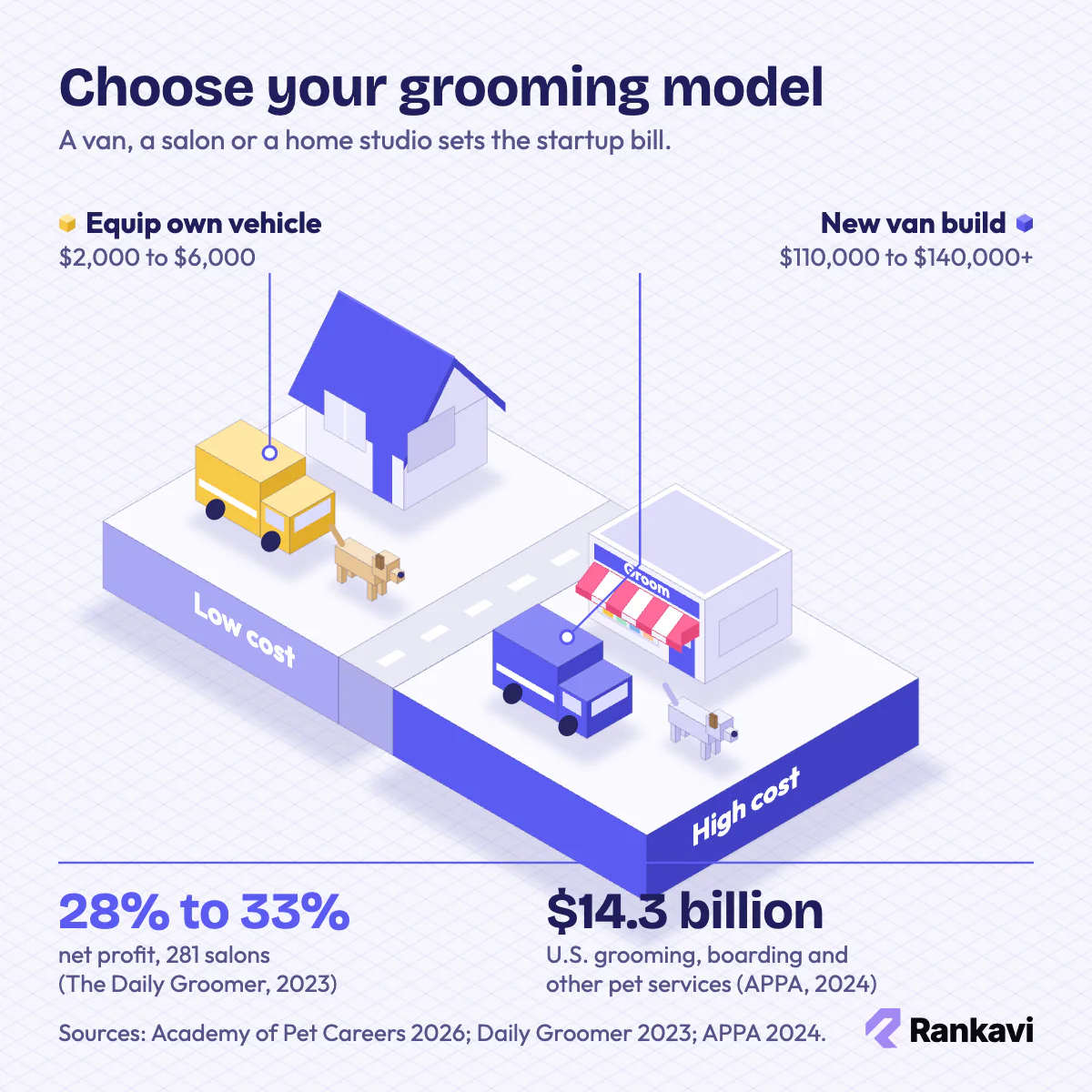
Demand is broad. APPA, the pet industry’s trade group, put 2024 U.S. spending on grooming, boarding and other services at $14.3 billion.
The Academy of Pet Careers is a dog grooming school, and it estimated in 2026 that mobile startups run from $2,000 to $140,000 or more. The Daily Groomer, which publishes a newsletter for salon owners, found 28% to 33% net margins across 281 salons in 2023.
Startup money at a glance:
| Item | Pet grooming figure |
|---|---|
| Startup cost | $2,000 to $6,000 to equip a vehicle the owner already has; $110,000 to $140,000 or more for a new professional van build |
| Main costs | Van or salon lease, build-out, tables and tubs, dryers and clippers, insurance |
| Typical margin | 28% to 33% net profit in a survey of 281 grooming salons |
| Time to open | Several weeks to a few months, set by permits, build-out and van delivery |
Sources: The Academy of Pet Careers, a grooming school, estimates (2026); The Daily Groomer, a salon owners’ newsletter, survey (2023).
2. Write a Pet Grooming Business Plan
A grooming business plan sets the model, the service menu, the daily dog count and the money needed on paper. Lenders read it, and the owner tests every assumption against it.
A lender-ready grooming plan covers eight sections:
- Executive summary: model, location, services and funding request.
- Business description: legal structure, experience and specialties.
- Market analysis: local dog owners, competitors and their prices.
- Services and pricing: the menu, packages and add-ons.
- Operations plan: workspace, hours and appointment capacity.
- Marketing plan: launch channels, referrals and rebooking.
- Financial plan: startup costs, monthly budget and break-even.
- Goals and milestones: client counts and the first price review.
Appointment capacity is the key assumption. A groomer handles only a handful of dogs a day, so revenue depends on full days, not on growth guesses.
The operations plan also names who grooms, who bathes and who answers the phone. A solo owner covers every role at first, so the plan shows which task to hand off first.
Prices and wait times from the market analysis feed the pricing and capacity sections. That keeps the numbers tied to local facts.
A short risk list helps lenders. Illness, injury, a van breakdown or a lost lease each stop income, and the plan states the backup for each.
3. Price Grooms by Size and Coat
Grooming prices determine whether a full day of dogs covers rent, products and the owner’s pay. Size, coat condition and breed style drive each price.
A small short-coated dog needs far less time than a matted doodle. Most salons therefore price by size and coat, with surcharges for matting or difficult handling.
Packages keep the menu simple. A bath and brush, a full groom and add-ons such as nail grinding, teeth brushing and de-shedding cover most requests.
Time per groom sets the price floor. A large doodle takes far longer than a small short-coated dog. One flat price loses money on the hard jobs.
Deposits and cancellation fees protect the day. An empty slot cannot be resold, so a card on file at booking covers a late cancel or a no-show.
Local competitor menus show what neighbors already pay. A premium price fits once the waitlist is long and the work is specialized.
Dogs per day is the benchmark owners check first. The Academy of Pet Careers put a realistic mobile day at three to six dogs in 2026. Fixed monthly costs divided by the profit per groom then shows the break-even dog count.
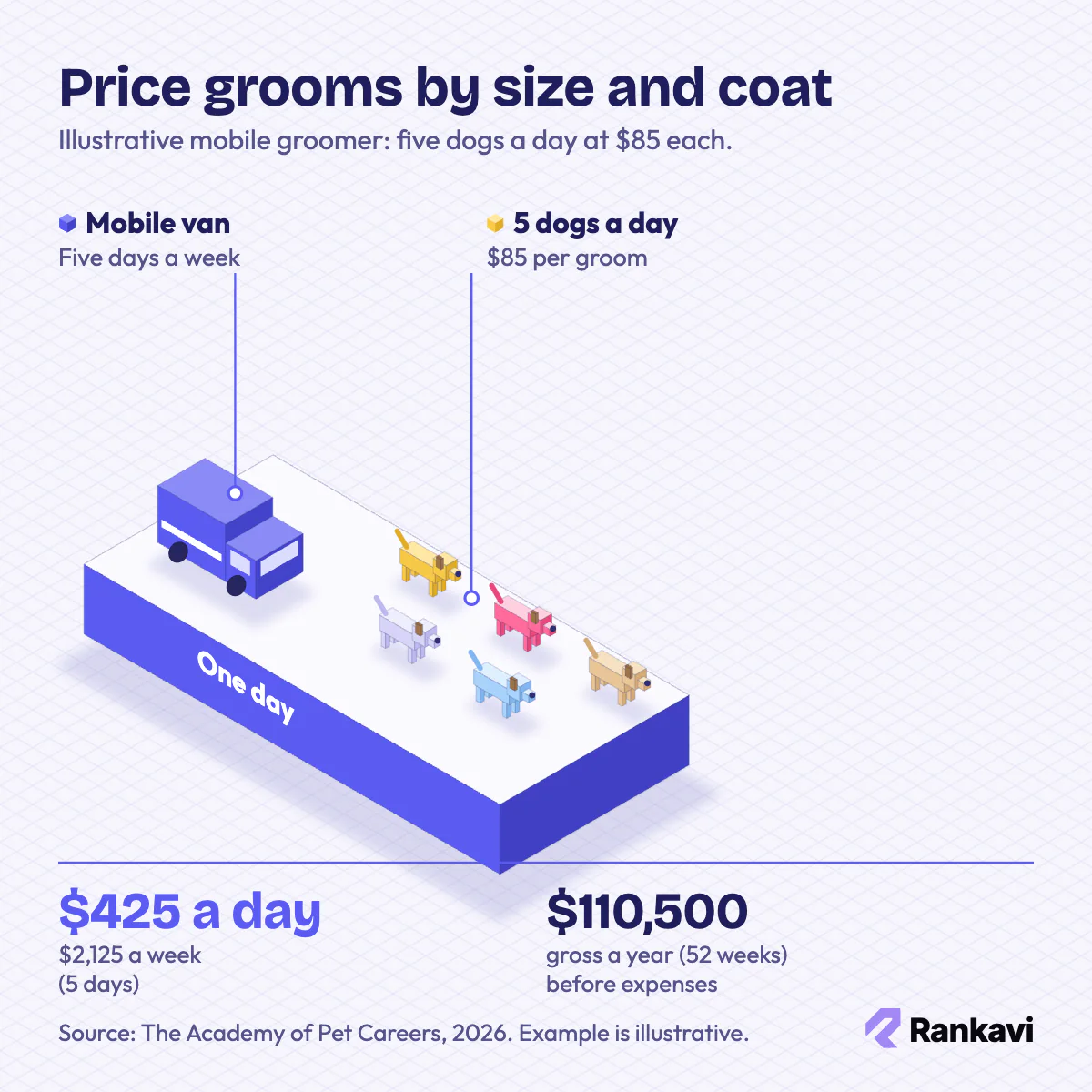
Example: An illustrative mobile groomer books five dogs a day at $85 each, five days a week.
| Input | Amount |
|---|---|
| Price per groom | $85 |
| Dogs per day | 5 |
| Revenue per day | $425 |
| Revenue per week (5 days) | $2,125 |
| Gross revenue per year (52 weeks) | $110,500 before expenses |
Raising prices beats adding more dogs. A booked-out groomer earns more with a modest increase than with longer, more tiring days.
4. Fund the Salon, Van or Home Studio
Funding a grooming business covers the space or van, the equipment and the months before the book fills. A home studio needs a modest budget, while a new van or salon needs far more.
Startup costs fall into a few groups. The van or lease deposit, build-out, grooming stations, tools, licenses, insurance and launch marketing come first.
Most owners combine savings with a loan. The U.S. Small Business Administration (SBA), which is the federal agency behind small business lending, backs microloans through nonprofit lenders. Equipment financing spreads the cost of a van.
Each model front-loads different costs. A home studio spends mostly on equipment. A van spends on the vehicle and build-out. A salon spends on deposits, build-out and rent.
Leasing a van lowers the upfront cash but adds a monthly payment. A vehicle the owner already owns, or used equipment, cuts the starting budget at the cost of more repairs later.
Lenders read the business plan, the owner’s credit history and proof of grooming experience. A new owner with no track record may need a larger down payment.
A cash reserve carries the business through a slow start. Rent, insurance and product refills arrive before the appointment book is full.
5. Register Your Grooming Business
Registering a grooming business gives it a legal identity that signs leases, holds insurance and opens accounts. Many groomers form a limited liability company (LLC) because dogs bite and accidents happen.
A sole proprietorship is simpler for a booth renter. Personal assets stay exposed, though, if a pet owner files a claim.
An employer identification number (EIN) from the Internal Revenue Service (IRS) handles payroll and tax filings. A separate business bank account keeps grooming income apart from household money.
A booth renter is usually an independent contractor, not an employee of the host salon. The IRS looks at control over hours, prices and clients when it judges that status.
A doing business as (DBA) filing covers a trade name that differs from the owner’s legal name. The name is checked against state records before it goes on signs and listings.
6. Find a Salon Space or Van Base
A grooming site means a space with water, drainage, power and zoning that allow animal services. Permits name a specific address, so the site comes before the license applications.
Zoning decides whether a salon or home studio can operate. A call to the city zoning office before signing prevents a wasted lease.
Home studios face extra checks beyond zoning. Home occupation rules, homeowners association (HOA) covenants and rental leases can each rule the model out. Written approval protects the owner.
Water and drainage decide a salon site. A space without floor drains or enough hot water adds plumbing cost. A walkthrough with the landlord before signing helps.
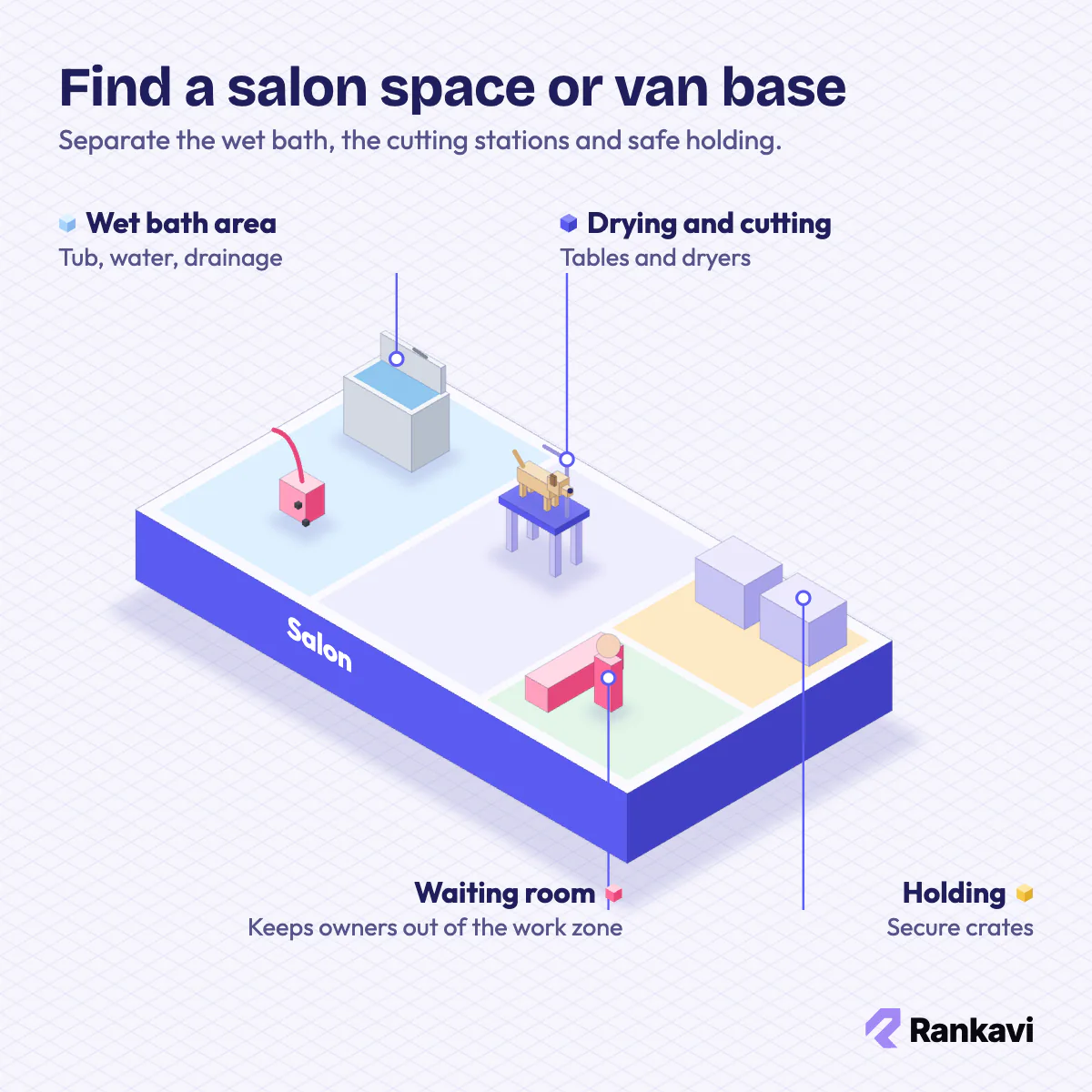
A salon layout separates the wet bath area, the drying and cutting stations and a secure holding area. A small waiting room keeps owners out of the work zone.
A mobile groomer still needs a base. The van must park legally overnight, refill fresh water and dump gray water in an approved place.
Route density matters for vans. Booking clients in the same neighborhoods on the same day cuts drive time and fits more dogs into each day.
7. Get Grooming Permits and Certification
Licensing a grooming business involves a general business license, any local animal permit and, often, a sales tax permit. Most states do not license groomers, so the city or county sets most rules.
The city or county clerk is the first call. Zoning approval, a home occupation permit and a fire or health inspection are common items, depending on the area.
A booth renter checks which permits the host salon already holds. Some rules attach to the address, and others attach to the groomer.
New York City is one exception. The NYC Department of Health and Mental Hygiene (DOHMH), the city’s health agency, issues a small animal grooming establishment permit.
Certification is optional but builds trust. Grooming schools and apprenticeships teach breed cuts, safe handling and skin care before a groomer works alone.
The National Dog Groomers Association of America (NDGAA) runs the National Certified Master Groomer exams, with written and practical tests. The association operates with the American Kennel Club (AKC), which is the U.S. purebred dog registry.
Certification is not a legal requirement in most places. It signals skill. Pet first aid training helps a groomer respond if a dog panics or is hurt on the table.
8. Insure Groomers, Pets and Equipment
Grooming insurance protects the owner against pet injuries, client claims and damaged equipment. Few laws require it, yet landlords and booth contracts often demand it.
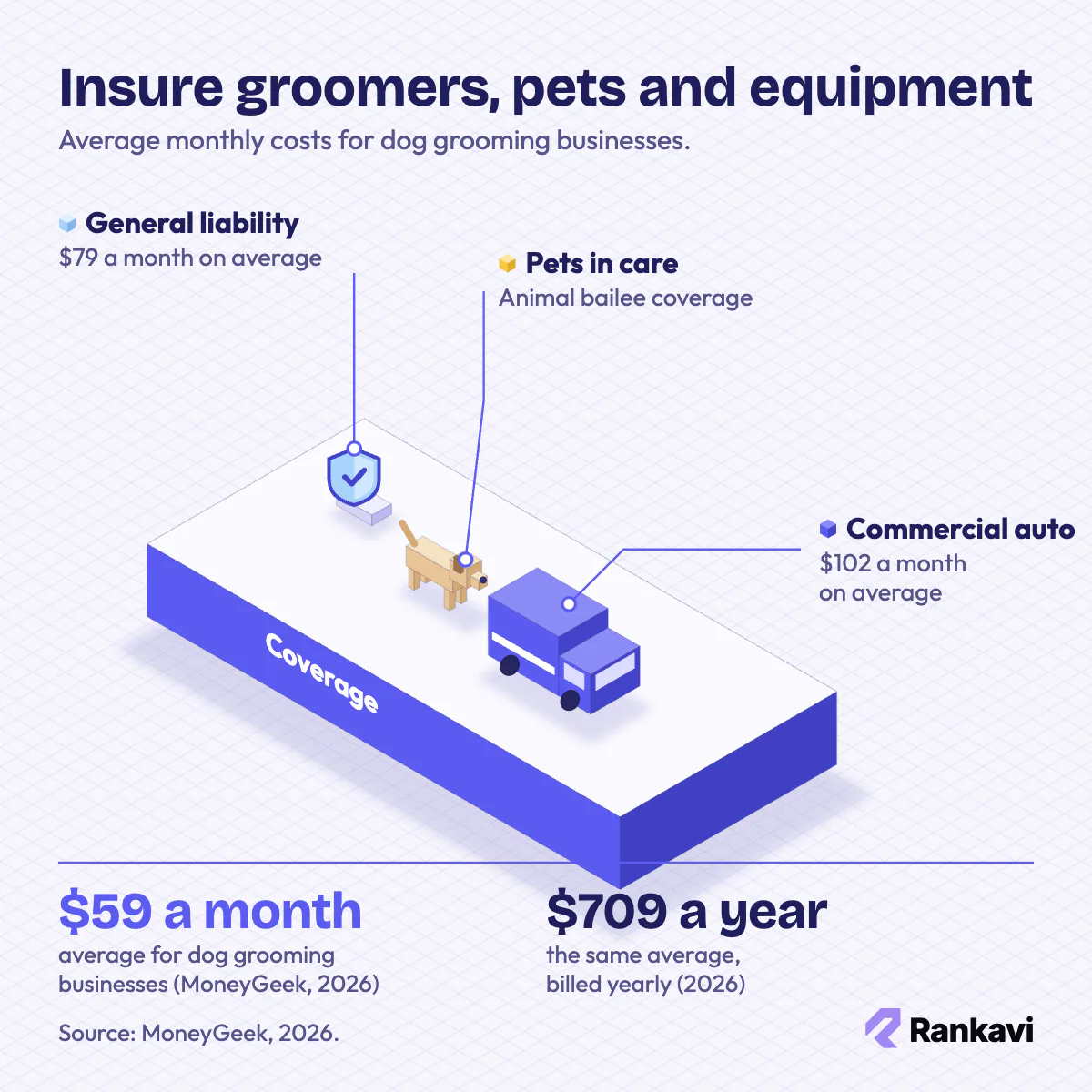
MoneyGeek, which publishes insurance cost comparisons, put the average for dog grooming businesses at $59 a month, or $709 a year, in 2026.
General liability pays for third-party injuries and property damage, at an average of $79 a month in MoneyGeek’s 2026 data. Professional liability covers claims that a groom went wrong, such as a cut or a burn.
Pets in the groomer’s care need their own coverage. Animal bailee insurance pays when a client’s dog is hurt, lost or dies while in custody.
Vans need commercial auto insurance, which MoneyGeek put at $102 a month on average in 2026. Workers’ compensation applies once the business hires its first bather or groomer.
Policy limits and exclusions matter as much as price. Some general liability policies exclude care, custody and control. A dog in the groomer’s hands may then be uncovered. That is why bailee coverage is sold separately.
Booth renters check whether the host salon’s policy covers them or whether a separate policy is needed. Quotes from several insurers, plus a question to an independent agent about pet-care policies, help match coverage to the model.
9. Buy Tables, Tubs, Dryers and Clippers
Equipment follows the model and the layout. A salon buys several stations, while a van needs compact gear built for tight space.
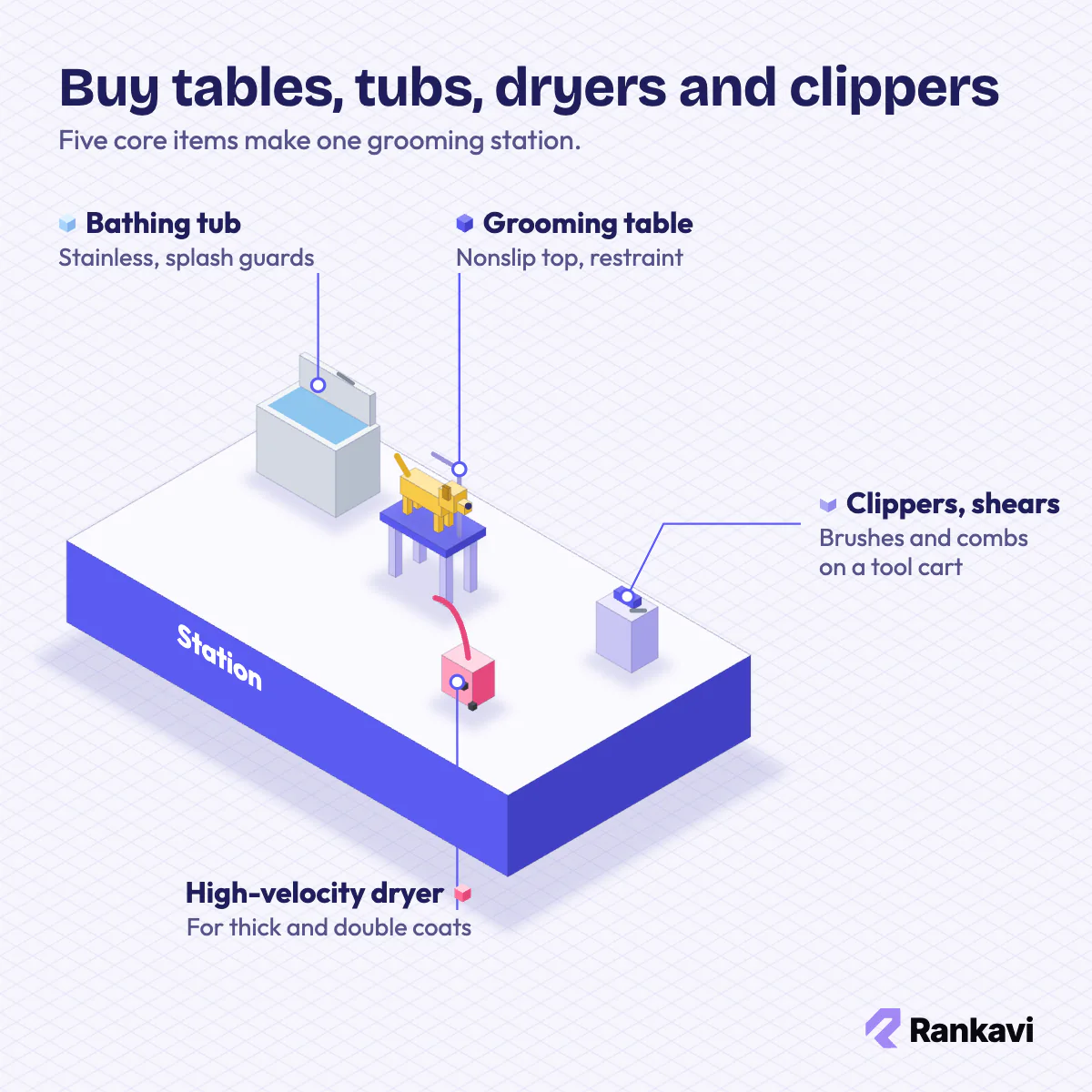
A grooming station needs five core items:
- Grooming table: hydraulic or electric, with a nonslip top and restraint.
- Bathing tub: stainless steel with splash guards and a sprayer.
- High-velocity dryer: for thick and double coats.
- Clippers and shears: with blades for different coat lengths.
- Brushes and combs: for detangling, de-shedding and finishing.
Supplies refill every week. Shampoos for sensitive skin, conditioners, ear cleaners, towels and pet-safe disinfectants keep the station running.
Secondhand gear lowers the starting budget, while new gear brings warranties. Tables and dryers see daily use, so safety features and repair support count as much as the lowest price.
Van builds add water tanks, a water heater, a generator or shore power and ventilation. The van length sets how much room remains for the table and tub.
Spare blades keep the day running while dull ones are sharpened or replaced.
Booking software saves hours of phone time. MoeGo and DaySmart Pet handle scheduling, pet profiles, reminders and payments in one place.
Software fit follows the model. A van needs route planning and map tools, while a salon with several groomers needs a calendar for each one.
10. Market to Local Dog Owners
Dog owners find groomers through search, neighbors and photos of finished dogs. Marketing starts before opening so the first weeks are booked.
A Google Business Profile is Google’s free local listing, and it puts the salon on Google Maps. Hours, services, photos and reviews answer the first questions owners ask.
Before-and-after photos sell grooming better than words. Instagram and Facebook posts of finished dogs show skill and style.
Veterinarians, trainers and pet stores send steady referrals. A small stack of cards at each counter costs little.
Reviews help new clients choose a groomer. Asking each happy owner for a Google review at pickup builds the profile steadily.
Nextdoor is a neighborhood social network where owners ask for groomer recommendations. Local Facebook groups work the same way.
A first-groom package for puppies starts the habit of regular visits. A launch waitlist turns early interest into booked days.
Rebooking at checkout fills the calendar. Most dogs need a groom every few weeks, so the next date is set before the owner leaves.
11. Grow With Staff and Added Services
Growth turns one groomer’s full book into a business that runs on more than one pair of hands. Hiring, added services and new locations each add capacity.
A bather is usually the first hire. Bathers wash and dry dogs, so the lead groomer spends more time on paid cuts.
Hiring a groomer is a bigger step than hiring a bather. The owner checks references, watches a trial groom and confirms handling skills before leaving a dog in that groomer’s care.
Employee or contractor status depends on how the work is controlled, so pay structure and legal status are set together.
The U.S. Bureau of Labor Statistics (BLS), which publishes federal wage data, reported a $35,360 median annual wage for animal caretakers, groomers included, in May 2025. BLS also projected 11% job growth for animal care workers from 2025 to 2035.
Pay structure shapes profit. Many salons pay groomers a commission on each groom, while bathers often earn an hourly wage.
Added services raise the value of each visit. Teeth brushing, nail care, de-shedding treatments and retail products need little extra space.
Waitlist length, rebooking rate and idle table time show when a second groomer pays off. Adding dogs past what one team handles well raises stress for pets and staff.
A second van or location follows a waitlist. The Daily Groomer’s 2023 survey found a median salon revenue of $346,011, mostly from shops with five or six employees.
12. Appear in Gemini AI Answers for Pet Grooming
Dog owners now ask Gemini, ChatGPT and Google AI Overviews which groomer nearby is gentle with nervous dogs. Those tools repeat what directories, review sites and local “best groomer” articles say.
A new salon or van gains from being named on those third-party pages early. Rankavi is a software as a service (SaaS) platform that publishes brand mentions in articles on indexed third-party websites. Its Gemini brand mention service places a groomer’s name in articles Gemini can read.