

Starting a painting business takes trade skill, a modest tool kit, state and local licences and liability insurance. The U.S. Bureau of Labor Statistics (BLS), which publishes federal job data, reported a $49,400 median annual wage for painters in May 2025.
My name is Michal Sieroslawski, and I help painting companies get recommended in AI search. More homeowners now ask ChatGPT to recommend a painting company, so showing up there matters.
This order prices the work before money goes into tools. Licences and insurance follow before a brush touches a client wall. The ten steps below show how to start a painting business, in order.
- Choose Residential or Commercial Painting Work
- Write a Painting Business Plan
- Price Painting Jobs to Cover Prep Time
- Fund Tools, Insurance and Working Capital
- Register the Painting Company
- Get Licensed, Bonded and Insured
- Buy Brushes, Ladders and a Sprayer
- Market With Reviews and Yard Signs
- Hire a Crew and Add Services
- Appear in Google AI Overviews Painter Picks
1. Choose Residential or Commercial Painting Work
Choosing a painting niche decides which buildings the company paints and which clients it chases. That choice shapes prices, tools, insurance and marketing in every later step.
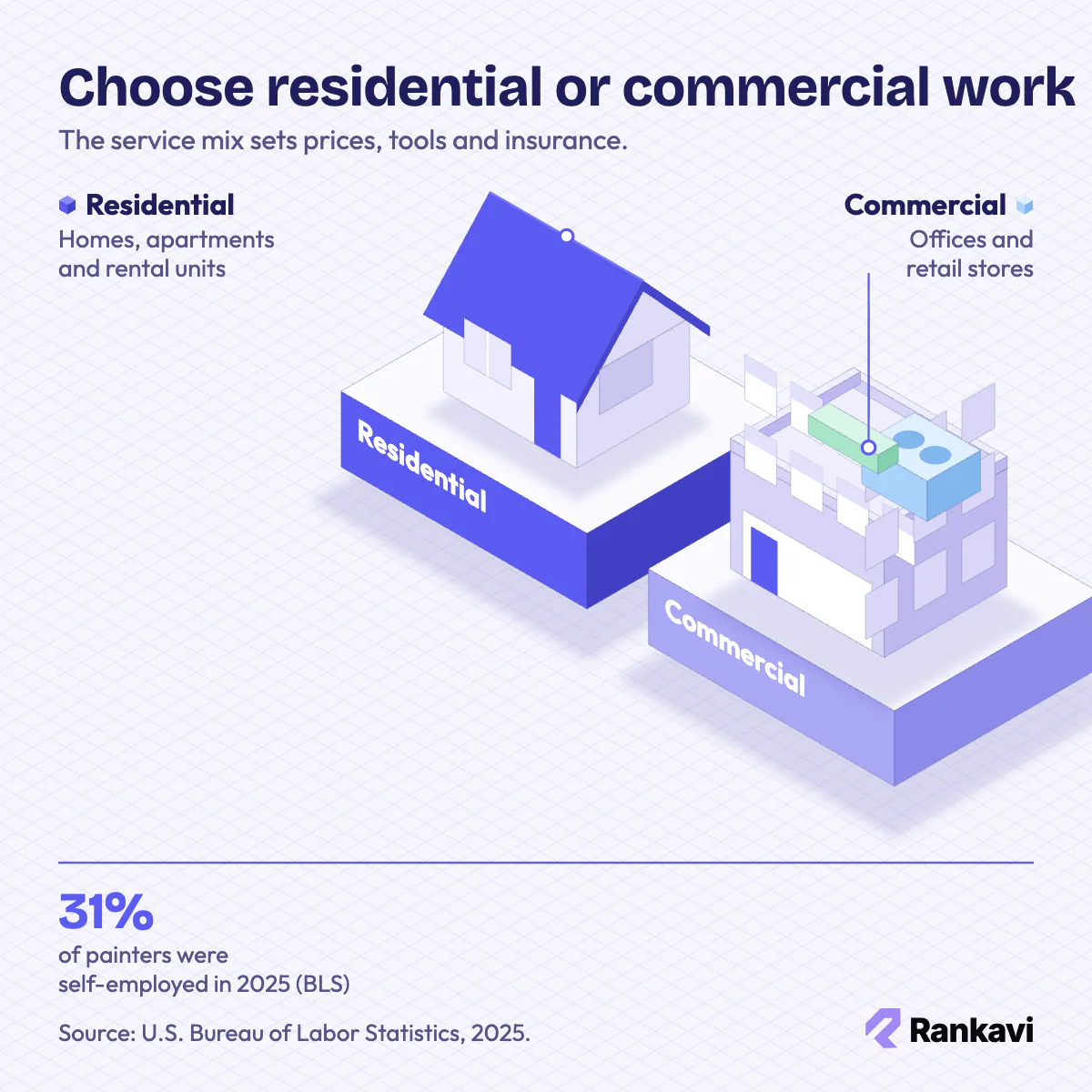
Residential painters work on homes, apartments and rental units. Commercial painters repaint offices, retail stores and other business spaces. Commercial jobs often run after hours and need larger crews.
Payment terms differ as well. Residential clients usually pay a deposit and the balance at completion. Commercial clients often pay weeks after invoicing, so a commercial start needs more working cash.
Commercial buyers also ask for proof of insurance and references before awarding a bid. Repainting apartment units between tenants is a common bridge from residential to commercial work.
A focused service list builds a reputation faster than a long one. Common services include interior painting, exterior painting, drywall repair, cabinet refinishing and deck staining. Each service needs a clear scope, such as prep work, materials and the number of coats.
Skill comes before the first invoice. The BLS also reported that 31% of painters were self-employed in 2025. Many first work for an established company to learn prep standards. Beginners then start with simple interior rooms before exteriors, tall homes or cabinets.
The Painting Contractors Association (PCA), a nonprofit trade group for painting contractors, offers education and industry standards. Painting Contractors Association courses help new owners learn the business side.
A local search on Google Maps and Yelp shows nearby rivals and their reviews. Slow replies, vague quotes and poor follow-up in those reviews point to gaps. Exterior demand also drops in cold months in most regions. Interior and commercial work can fill those months.
2. Write a Painting Business Plan
A painting business plan sets out the services, customers and goals the company works toward. One or two pages are enough for a solo painter.
A short painting plan covers five core sections:
- Services: the interior, exterior or specialty work offered.
- Target customers: the homeowners, landlords or businesses served.
- Pricing approach: how each job gets quoted.
- Marketing plan: the channels that bring the first leads.
- Financial projections: expected revenue, costs and profit.
The target customer drives most other choices. Homeowners book single rooms and full exteriors. Landlords and property managers need fast repaints between tenants and send repeat work.
Goals turn the plan into a weekly habit. Owners set a monthly revenue target and a target number of new clients. The plan then gets revised after the first few jobs show real numbers.
A plan is optional for a solo start, but lenders usually ask for one. A service area, such as a drive-time radius, keeps travel costs in check.
A list of local competitors and their prices shows where the company can stand out. Fast replies, clear quotes and tidy job sites are easy points of difference.
3. Price Painting Jobs to Cover Prep Time
Pricing a painting job involves adding paint, labor hours, overhead and profit into one quote. Most painters quote by the job rather than by the hour.
Common pricing models:
| Model | How it works |
|---|---|
| Per job | One fixed price for the whole project |
| Hourly | Estimated hours multiplied by an hourly rate |
| Per square foot | Wall or surface area multiplied by a rate |
An accurate estimate starts with a site visit. The painter measures surfaces, counts coats and checks the paint each room needs. Labor hours, materials, overhead and a profit margin then form the quote.
Homebase, a crew scheduling and payroll app vendor, priced a small bedroom at $300 to $500 in its 2026 guide. The same 2026 vendor guide added labor at $30 to $50 an hour.
Prep work is the classic estimating mistake. Patching, sanding, caulking, taping and covering can take as long as the painting itself on older homes. Thorough inspection before quoting protects the margin.
Square footage quotes work best for simple, empty rooms. Occupied rooms, high ceilings and heavy trim add hours that a flat rate misses. A quote also lists exclusions, such as moving furniture or repairs beyond minor patching.
Deposits protect cash flow on every job. Many painters collect part of the price before work starts and use it to buy paint. A written estimate lists the scope, the deposit and the final payment terms.
4. Fund Tools, Insurance and Working Capital
Funding a painting startup covers tools, licences, insurance and marketing until the first jobs pay out. A painting company starts cheaper than most trades.
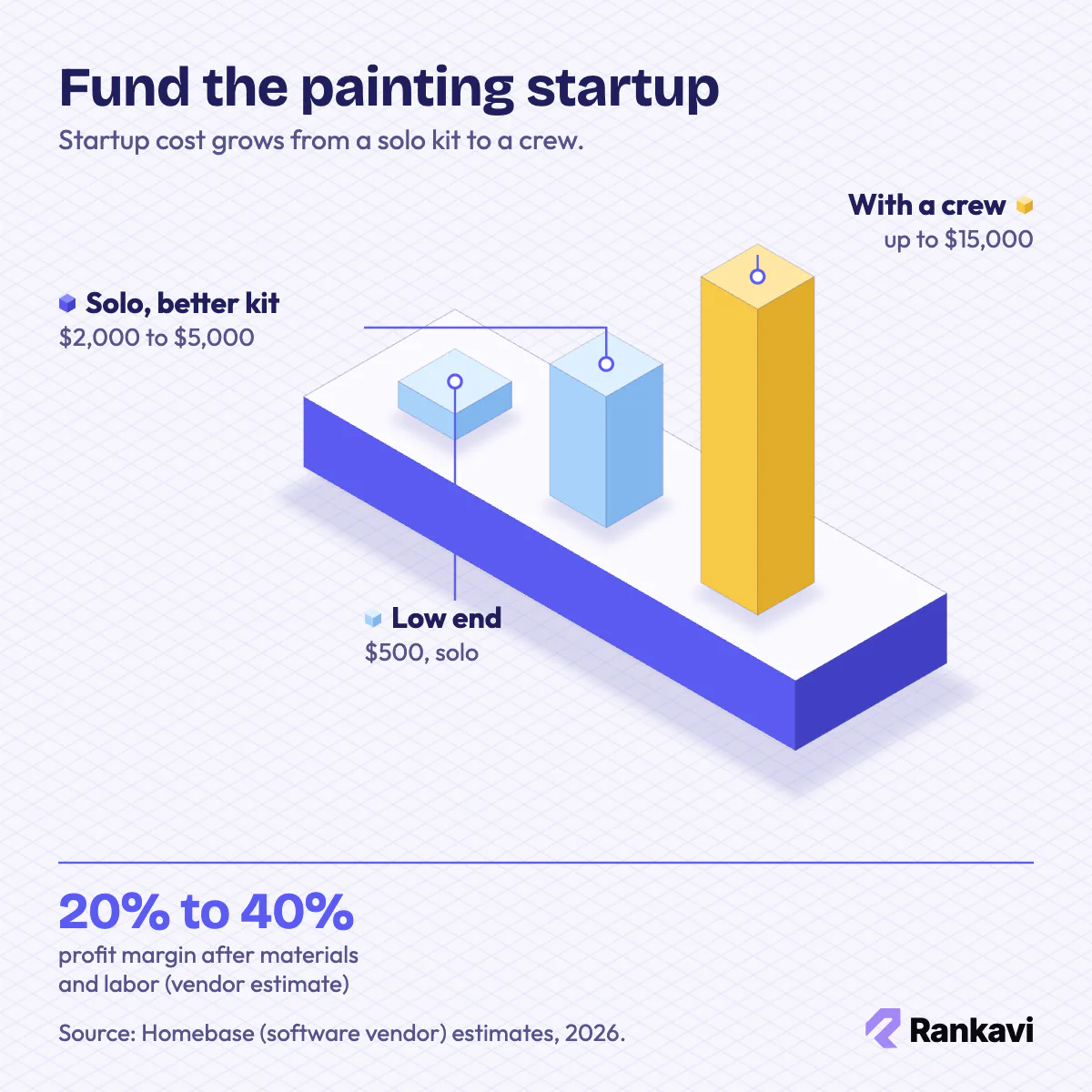
Startup costs fall into a few clear groups: equipment, licences, insurance, marketing and early operating costs. Homebase, a software vendor, estimated $500 to $15,000 in 2026, from a solo painter to a crew.
Startup money at a glance:
| Item | Figure |
|---|---|
| Startup cost | $500 to $15,000; $2,000 to $5,000 for a solo painter with better equipment |
| Main costs | Brushes, ladders and an airless sprayer; general liability ($208 a month); licence fees; marketing; a used work van |
| Typical margin | 20% to 40% profit margin after materials and labor (vendor estimate; gross or net not stated) |
| Time to open | 4 to 8 weeks for a state contractor licence where one is required; days where only a local licence applies |
Sources: Homebase, a scheduling and payroll software vendor, 2026 (vendor estimates for startup cost, margin and licence timing). MoneyGeek, an insurance comparison site, September 2026 (general liability).
Working capital bridges the gap between buying paint and getting paid. Clients often pay on completion, while paint and materials get bought before work starts. A cash buffer keeps the first jobs from draining the owner’s account. Slow commercial payment terms call for a larger buffer.
Personal savings fund most first painting kits. The U.S. Small Business Administration (SBA) offers painters microloans that nonprofit lenders hand out. Its 2026 page said microloans reach $50,000, averaging about $13,000. A business line of credit covers paint and payroll gaps as jobs grow.
Worked example: In this illustrative case, a solo painter repaints two small bedrooms a week at $400 each. Eight rooms a month bring in $3,200. General liability at $208 a month leaves $2,992 before paint, fuel and owner pay. At that pace, a $3,500 starter kit pays for itself in about five weeks.
5. Register the Painting Company
Registering a painting company gives it a legal identity that signs contracts and opens accounts. Commercial clients and property managers often ask for one first.
Many painters start as sole proprietors because the setup is simple. A limited liability company (LLC) separates personal savings from claims over a damaged floor or a fall. Owners often form the LLC before hiring or taking larger jobs.
The business name comes next. A search on the Secretary of State website confirms the name is free to use. A doing business as (DBA) filing covers a trade name that differs from the legal name.
The Internal Revenue Service (IRS) issues a free employer identification number (EIN) online. The EIN opens a business bank account, which keeps job income apart from personal money.
6. Get Licensed, Bonded and Insured
Licensing a painting business means meeting state, county and city rules before the first paid job. Rules differ widely, so the state contractor board is the first stop. Some states leave painting to county or city rules, so the local building office also needs a check.
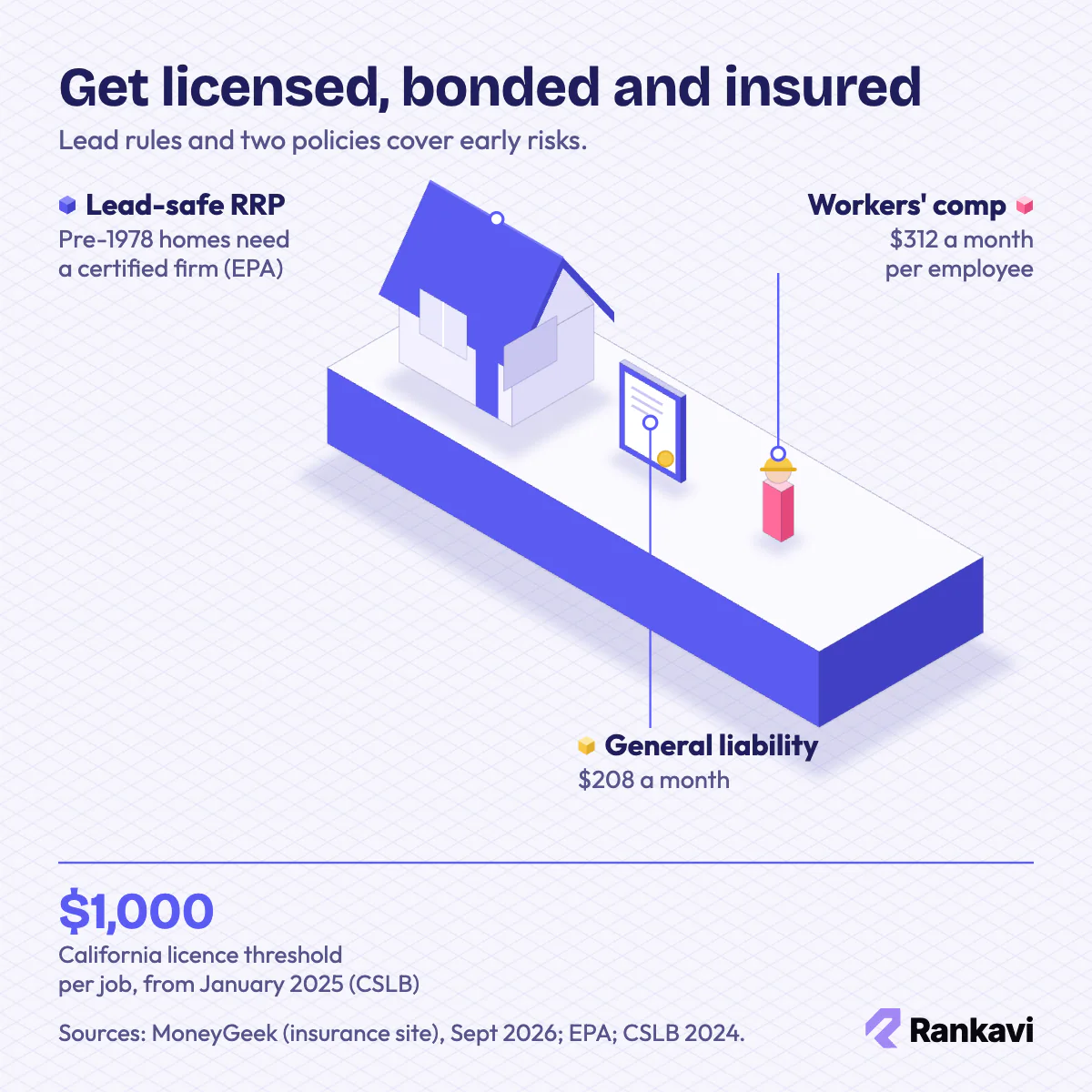
Some states require a painting contractor license with trade and business law exams. California’s Contractors State License Board (CSLB), which licenses the state’s contractors, requires four years of journey-level experience. The CSLB raised its licence threshold to jobs of $1,000 or more from January 2025, its 2024 bulletin said.
Homes built before 1978 bring lead paint rules. The U.S. Environmental Protection Agency (EPA) runs the Renovation, Repair and Painting (RRP) program. Paid work disturbing paint in those homes, childcare facilities and preschools requires a certified firm and trained workers.
A surety bond is part of licensing in some states. The bond pays clients when a contractor fails to meet licence obligations.
General liability insurance pays for damage to client property and injuries to others. MoneyGeek, an insurance comparison site, put it at $208 a month for painters in September 2026. That 2026 figure assumed $1 million per claim and $2 million a year. A certificate of insurance is the proof that clients and property managers ask for before work starts.
Workers’ compensation becomes a legal requirement in most states after the first hire. MoneyGeek’s September 2026 average was $312 a month per painting employee.
7. Buy Brushes, Ladders and a Sprayer
Equipping a painting company turns the service list into a working tool kit. Quality brushes and rollers come first, because cheap tools leave poor finishes.
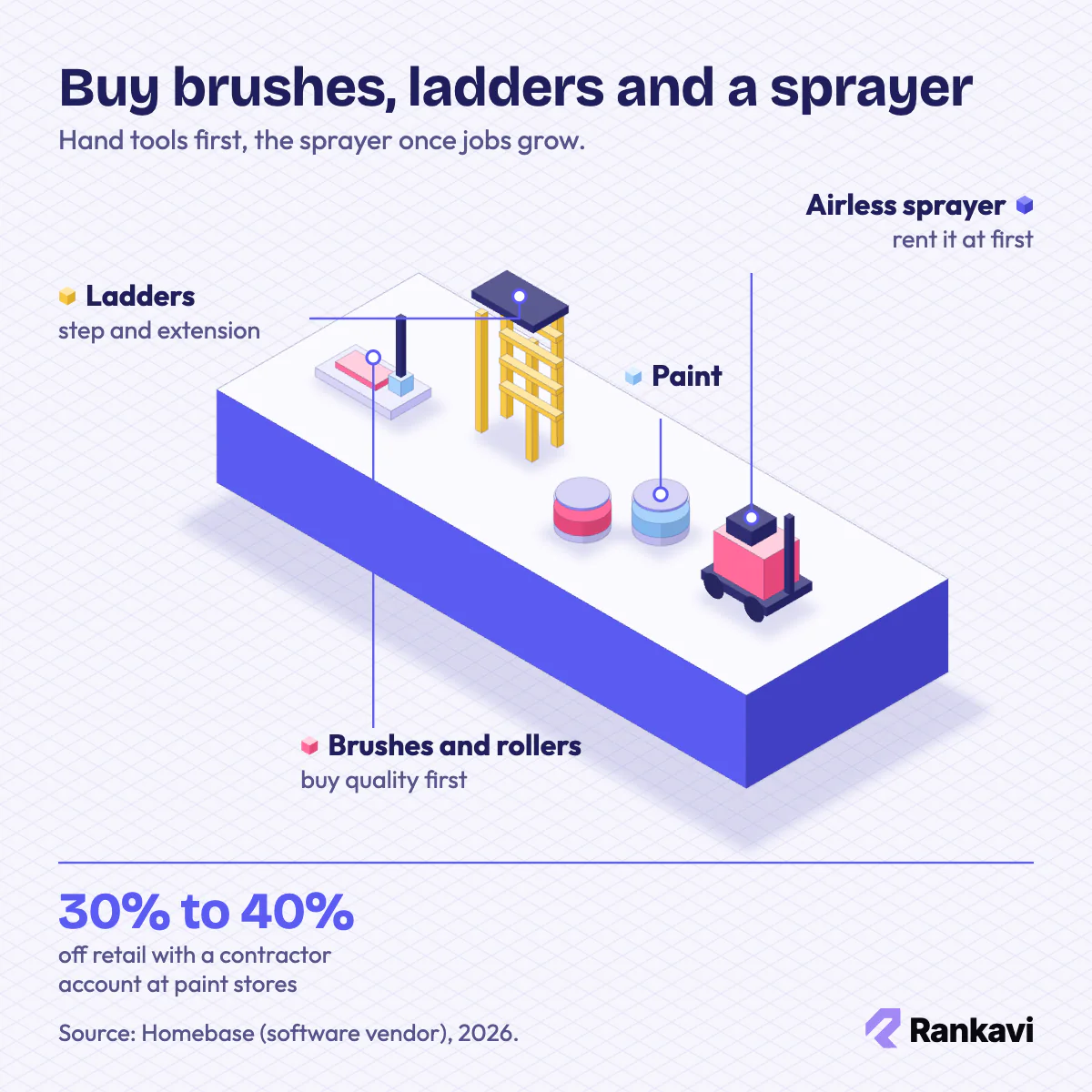
A starter painting kit holds five core items:
- Brushes and rollers: quality angled brushes, roller frames and covers.
- Ladders: a step ladder and an extension ladder.
- Drop cloths and tape: protection for floors, furniture and trim.
- Prep tools: scrapers, sandpaper, spackle and caulk.
- Airless sprayer: fast coverage for large walls and exteriors.
An airless sprayer can wait. Many painters master brush and roller work on their first jobs and rent a sprayer at first. Sprayers need skill to avoid overspray and uneven coats.
The Occupational Safety and Health Administration (OSHA) sets safety rules for painting contractors. Ladder use, respiratory protection and fall protection all fall under those rules. Respirators and eye protection belong in the kit from the first job, since sanding and spraying create dust and fumes.
Sherwin-Williams is a paint maker with its own store chain, and it offers contractor accounts. Benjamin Moore is a paint maker sold through independent dealers that also open trade accounts. Homebase put contractor pricing at 30% to 40% off retail in 2026. Store staff also recommend products for tricky surfaces. A van or a truck with a ladder rack carries the kit.
8. Market With Reviews and Yard Signs
Marketing a painting company puts its name in front of local homeowners before they collect quotes. Before-and-after photos sell this service better than words.
Google Business Profile is a free Google listing that puts painters on Maps and in local results. Owners add services, a service area and job photos. Reviews from early clients build trust while the company is new.
A simple website holds the portfolio, the service list and a quote form. Each finished job adds new photos to the site and the listing. Asking for a review right after final payment keeps the job fresh in the client’s mind.
Low-cost local channels:
| Channel | Why it works |
|---|---|
| Yard signs | Neighbors see the freshly painted house |
| Vehicle magnets | The van advertises at every job site |
| Referral partners | Realtors and contractors pass on clients |
| Door hangers | Reach the street after each job |
Referral partnerships keep the schedule full. Real estate agents, property managers and remodelers often need a reliable painter.
9. Hire a Crew and Add Services
Growing a painting company builds on steady demand, trained painters and repeat clients. Each step raises revenue without restarting the hunt for customers.
Hiring starts when the owner turns work away for weeks at a time. The BLS projected 3% employment growth for painters from 2025 to 2035. Subcontractors often fill the gap before the first employee. The IRS uses its own tests to decide whether a worker counts as an employee or a contractor. A crew lead then runs jobs while the owner estimates and sells.
Job management software handles scheduling, estimates, invoices and payments in one place. Crews see job details on their phones, and clients pay faster.
Add-on services raise the value of each client. Cabinet refinishing, deck staining and drywall repair fit the same homeowners. Commercial repaints and property manager contracts bring steadier work through slow seasons.
10. Appear in Google AI Overviews Painter Picks
AI visibility for a painting company involves being named when homeowners ask AI tools for a local painter. Google AI Overviews, ChatGPT and Gemini now answer many of those questions.
Those answers draw on review sites, local directories and “best painters near me” lists. A new painting company gains from appearing on those pages early, while its own review count is small.
Rankavi is a software as a service (SaaS) platform that publishes brand mentions in articles on indexed third-party websites. Painters who want to show up in AI Overviews answers can start with those mentions.