

Starting a mobile drug testing business means bringing specimen collection and breath alcohol testing to an employer’s site. Quest Diagnostics reported in its 2026 Drug Testing Index that 19.1% of hair tests in the general U.S. workforce came back positive in 2025.
I am Michal Sieroslawski, and I help mobile drug testing businesses get found online. Employers increasingly turn to AI assistants like ChatGPT and Perplexity for suggestions. Showing up there helps a new mobile drug testing business reach people it would otherwise miss.
The order below fixes the service menu and prices before money is spent. Training then decides the device, and the device decides the lab and review partners. Here are the eleven steps to start a mobile drug testing business, from first idea to first customers, listed below.
- Choose Your Testing Services
- Research Employer Demand Nearby
- Write a Drug Testing Business Plan
- Price Collections and Callouts
- Fund the Van and Startup Kit
- Register and Insure the Business
- Qualify as a Collector and Breath Technician
- Equip the Mobile Collection Unit
- Sign Lab and Medical Review Agreements
- Market to Employers and Administrators
- Claim a Place in Employers’ AI Overviews
1. Choose Your Testing Services
A testing service menu means the specific tests, specimen types and clients a mobile collector commits to serving. The menu decides the training, equipment and partners the business needs.
Department of Transportation (DOT) work and non-DOT work follow different rules. DOT rules cover safety-sensitive transportation workers. The Office of Drug and Alcohol Policy and Compliance is the DOT office that writes those testing procedures. Non-DOT testing follows state law and each employer’s written policy. A non-DOT rapid screen is never sold as a DOT test.
The federal rule 49 CFR Part 40 sets the procedures for every DOT test. Each DOT agency applies it to its own industry. The Federal Motor Carrier Safety Administration (FMCSA) covers truck drivers, and the Federal Aviation Administration (FAA) covers aviation. Rail, transit, pipeline and maritime agencies cover the rest.
DOT tests happen for six reasons: pre-employment, random, reasonable suspicion, post-accident, return-to-duty and follow-up. Each reason sets its own timing, so the menu states which ones the business covers. Hair testing is not accepted for DOT tests.
Business models range from simple to complex. A collection-only service gathers specimens and ships them to a laboratory. A consortium or third-party administrator (TPA) coordinates an employer’s whole program, including random pools and result reporting.
The choice between the two is a trade-off. A collection-only service needs less paperwork and capital. An administrator earns more per client but carries program duties, such as random selection and record keeping.
Common starting services:
| Service | Main requirement |
|---|---|
| DOT urine collection | Qualified collector and federal custody forms |
| DOT breath alcohol testing | Trained technician and an approved device |
| Non-DOT rapid screening | Employer policy and a lab confirmation path |
| Court-ordered testing | Kits that meet the program’s rules |
Mobile service fits clients who cannot release workers for a clinic trip. Post-accident, reasonable suspicion and large random draws suit onsite visits best. Some founders skip building a brand alone. Complete Mobile Drug Testing is a mobile drug and alcohol testing franchise that sells territories.
2. Research Employer Demand Nearby
Local demand comes from employers that must test or choose to test. Trucking firms, transit agencies, construction contractors, manufacturers, staffing agencies and healthcare employers top the list.
Demand falls into two groups. DOT-regulated employers must test, so they create steady random and post-accident work. Other employers test by choice, by contract or under the Drug-Free Workplace Act of 1988, which applies to federal contractors and grantees. Some states also reward testing programs with workers’ compensation discounts.
The FMCSA Company Snapshot lists registered trucking carriers by location, with driver counts. The U.S. Census Bureau publishes County Business Patterns, which count employers by industry and county. Together they show how many employers sit within a drive of the base.
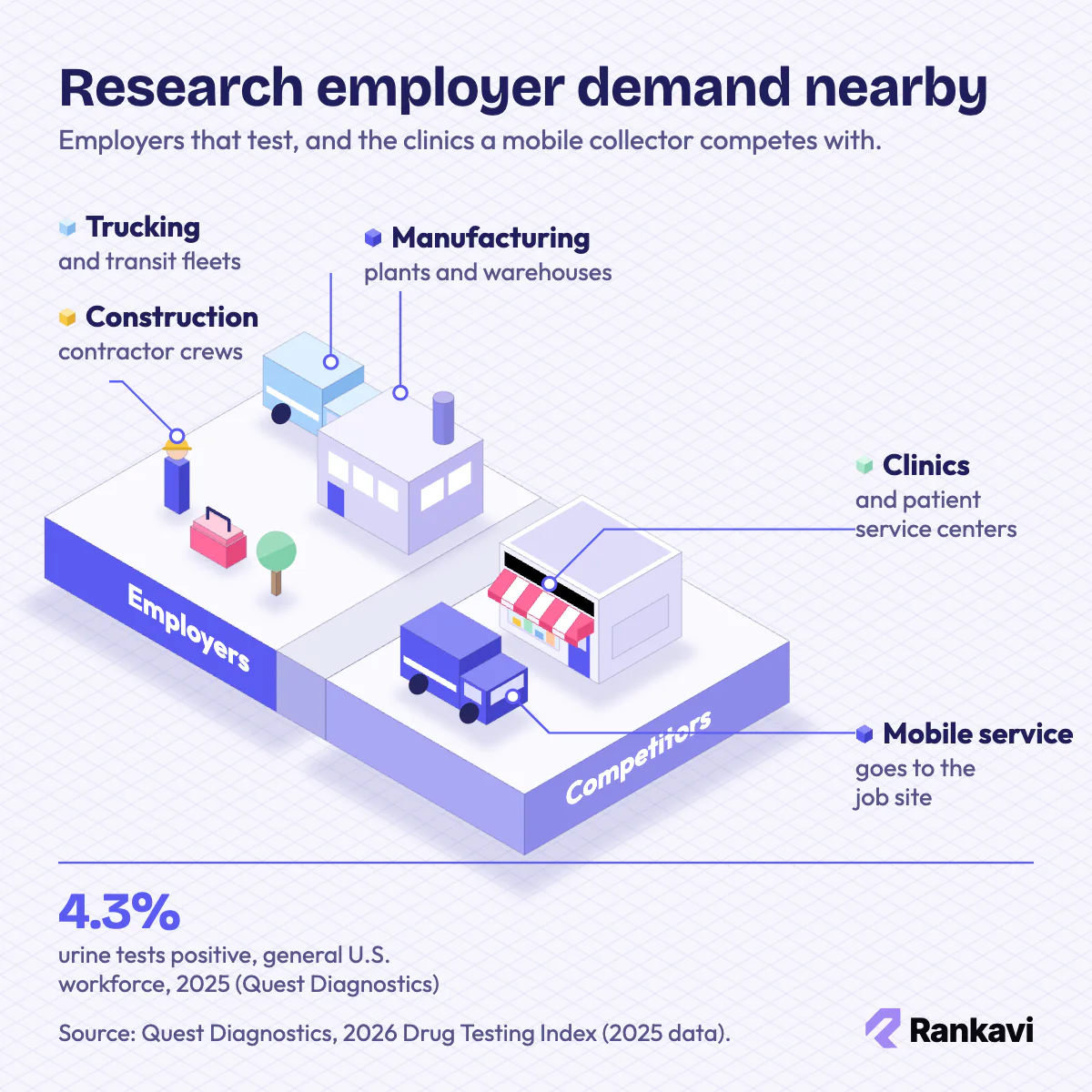
Competitors include occupational health clinics, walk-in clinics and laboratory patient service centers. Labcorp and Quest Diagnostics are large U.S. testing laboratories that run patient service centers for walk-in collections. Those sites rarely travel to a job site after hours, and that gap favours a mobile service.
Concentra is a national occupational health chain that also offers testing at its clinics. Local mobile collectors compete too, so differences such as same-day callouts, weekend hours and small-fleet focus matter.
Rural areas often have the widest gap. Workers there may drive a long way to the nearest collection site. A supervisor sometimes has to ride along for a reasonable suspicion test, so two employees leave work.
Positive results keep employers testing. Quest Diagnostics found in its 2026 Drug Testing Index that urine positivity in the general U.S. workforce was 4.3% in 2025. Employers answer with random testing programs, and random draws suit onsite collection.
3. Write a Drug Testing Business Plan
A drug testing business plan lists the target industries, service area, competitors, startup budget and monthly overhead. Lenders read it, and the founder uses it to test the idea.
A complete plan also holds an executive summary, the legal structure, the funding request and monthly financial projections. A short risk section names what could go wrong, such as a slow first year or a lost lab partner.
A mobile testing plan covers six sections:
- Service menu: DOT or non-DOT focus
- Market: target industries and service radius
- Competition: clinics and collection sites
- Budget: startup costs and monthly overhead
- Break-even: monthly test volume
- Partners: laboratory, medical review officer and courier
Break-even volume is the plan’s key assumption. The plan counts how many collections each month cover insurance, vehicle costs, software and the owner’s pay. An optimistic count leaves the business short of cash.
The plan also budgets the owner’s living costs. Employer accounts take months to win, because safety managers rarely switch providers quickly. Several months of personal savings protect the launch.
The service radius works best as drive time, not miles. Travel time limits how many collections fit into a day, and it sets the cost of every callout.
4. Price Collections and Callouts
Mobile testing pricing sets a per-test rate plus separate charges for travel, waiting and after-hours calls. A price that covers only the cup and lab fee loses money on every visit.
A cost floor shows the minimum safe price. It adds the lab fee, the medical review fee, collector labor, mileage and supplies such as cups, seals and forms. The Internal Revenue Service publishes a standard mileage rate that can serve as the base for a dispatch fee.
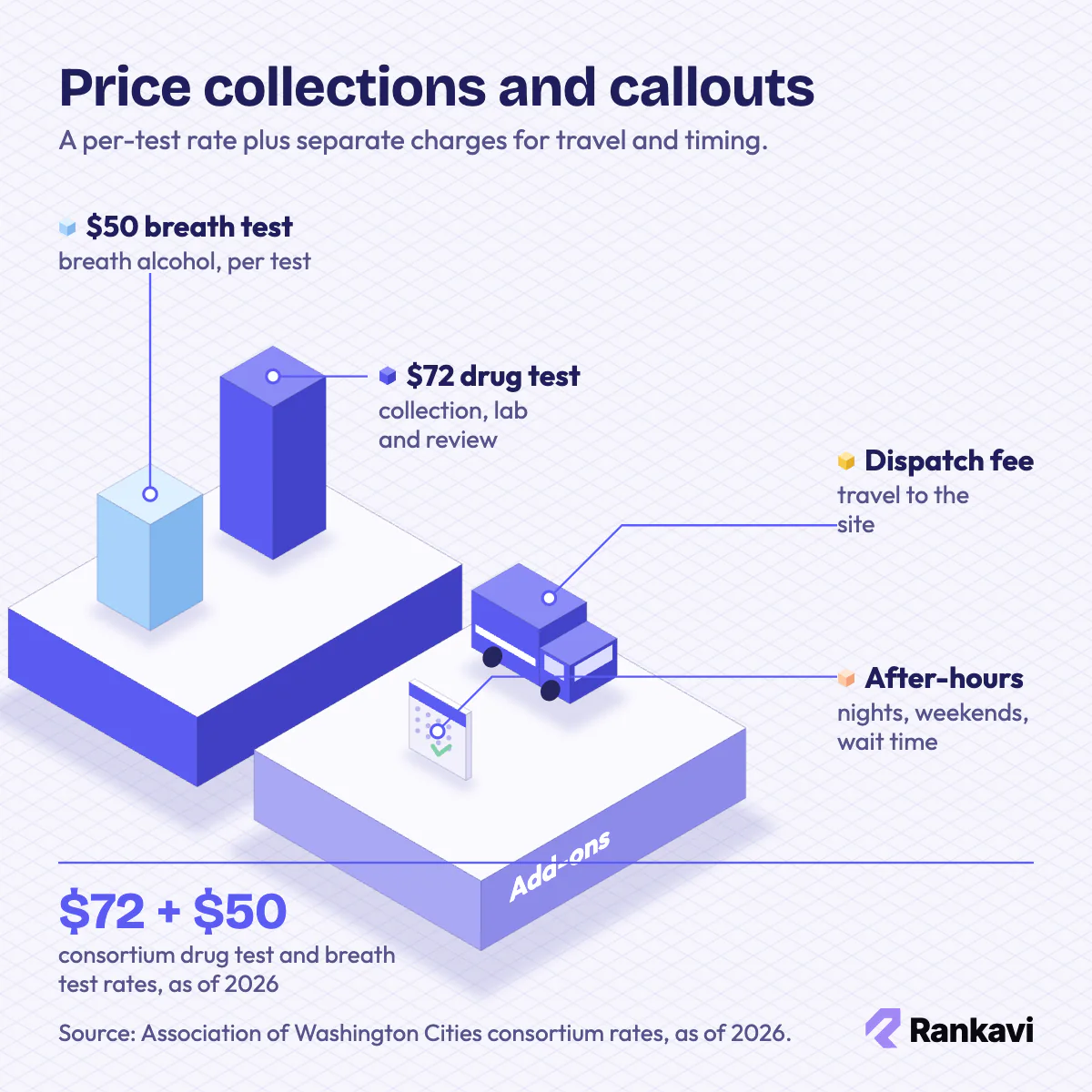
Public buyers show what bundled testing costs. As of 2026, the Association of Washington Cities consortium lists $72 for a drug test with collection, lab analysis and medical review. Its 2026 breath alcohol test rate is $50, and mobile provider fees pass through at cost.
Mobile pricing parts:
| Charge | What it covers |
|---|---|
| Per-test rate | Collection, lab and medical review |
| Dispatch fee | Travel to the employer’s site |
| Wait time | Delays once the collector arrives |
| After-hours rate | Nights, weekends and emergencies |
LegalClarity, a legal information site, estimated in August 2026 that a combined urine and breath test costs about $100 to $175. Mobile dispatch and after-hours calls add to that price.
Exceptions add their own charges. Observed collections, long waits for a donor who cannot provide a sample, no-shows and late cancellations all use collector time. A minimum charge per visit keeps a single test from losing money. Dispatch fees can be flat, set by zone or charged per mile.
Speed per donor is the benchmark that sets volume pricing. Kristine Card, a Michigan mobile testing owner, told lender Northern Initiatives in a historical 2018 profile that her team tests 100 people in three hours. One dispatch fee spread across a large random draw makes a lower per-test rate profitable.
5. Fund the Van and Startup Kit
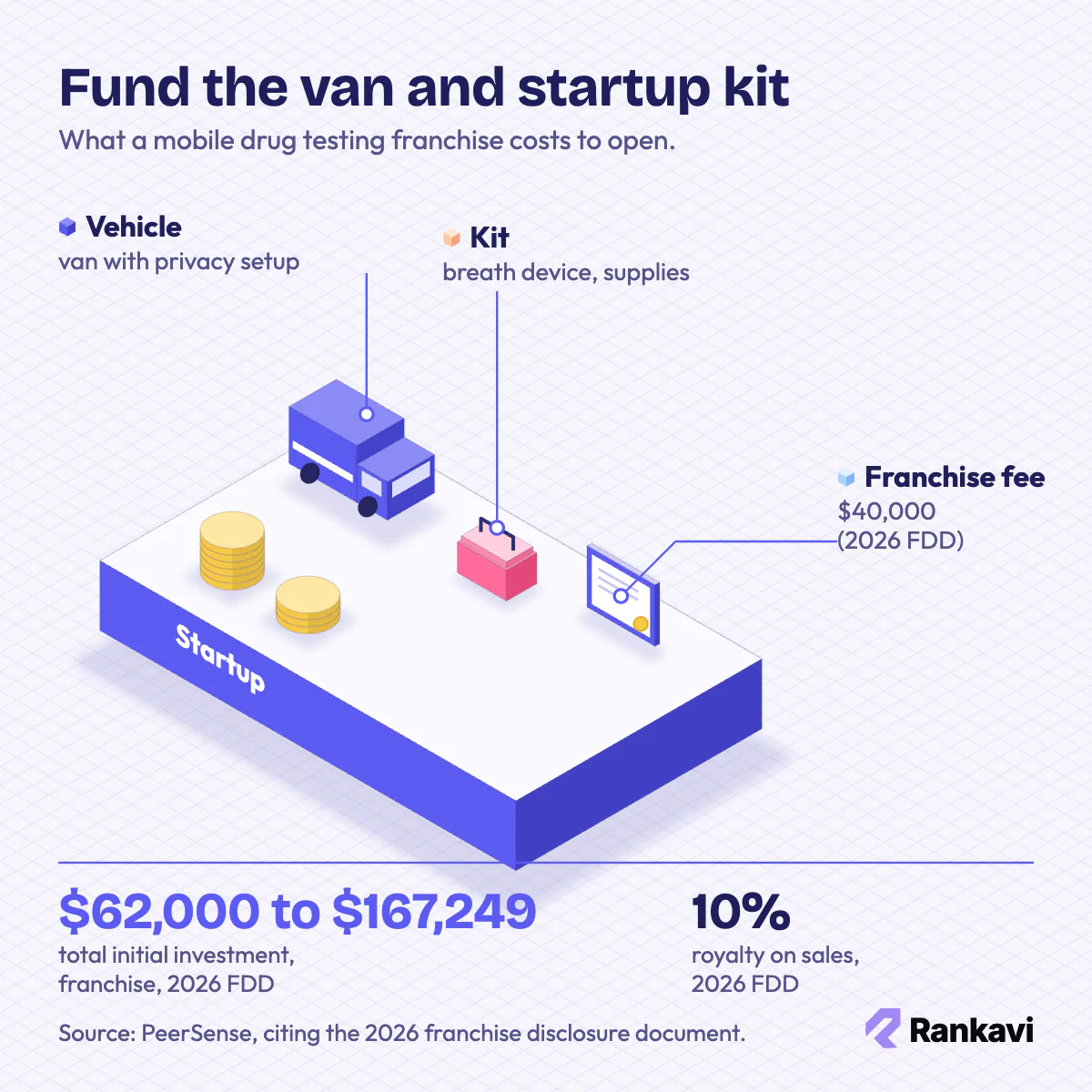
Startup funding covers the vehicle, the breath testing device, training, insurance and the months before contracts pay. A mobile model avoids a clinic lease, so the budget stays smaller than a fixed collection site.
Startup money at a glance:
| Item | Typical figure |
|---|---|
| Startup cost | $62,000 to $167,249 total initial investment for a Complete Mobile Drug Testing franchise; less for an independent collection-only start |
| Main costs | Franchise fee $40,000; vehicle; evidential breath testing device; collector course from $139; insurance |
| Typical margin | Not published; a supplier describes margins as low and volume as the profit driver |
| Time to open | Varies with training, mock collections and lab account setup; no independent figure found |
Sources: PeerSense, a franchise data site, citing the 2026 franchise disclosure document; Certified Training Solutions vendor price, 2026.
Franchise buyers pay ongoing royalties as well. PeerSense listed a royalty of 10% of sales in the 2026 franchise disclosure document. In return, owners receive training, a brand and access to national accounts.
Worked example: This illustrative franchise owner tests a random draw of 30 drivers at $72 each, billing $2,160. The 10% royalty takes $216, leaving $1,944. About 21 such visits would cover the $40,000 franchise fee before other running costs. At 100 tests in three hours, those 30 tests take under an hour on site.
Personal savings fund many first collectors. Community lenders and microloan programs fill gaps for equipment and training. The U.S. Small Business Administration (SBA) is the federal agency backing microloans and 7(a) loans for small firms.
Laboratory accounts usually cost little to open. Labs often supply DOT collection kits and custody forms to collectors with an account. That arrangement cuts the opening supply budget.
Cash runs short before it runs long. Employers and administrators may pay weeks after a visit, and the first contract can take months to close. A reserve for the gap protects the launch.
Several routes can fill the gap, and each trades cost for risk. Vehicle loans and equipment financing spread the cost but add monthly payments. A business credit card is quick but expensive to carry. Small Business Development Centers and volunteer business mentors give free help with loan packages.
6. Register and Insure the Business
Registering a testing company protects the owner and creates the entity that signs employer contracts. Most collectors form a limited liability company (LLC) to separate business debts from personal assets.
A solo owner without an LLC risks personal assets in any dispute. An LLC can later elect to be taxed as an S corporation. The LLC is filed with the state’s Secretary of State, and a registered agent receives legal papers. The owner can serve as the agent. Banks often ask for an operating agreement.
Employer contracts and lab accounts ask for a federal tax number. Collectors get a free employer identification number (EIN) from the Internal Revenue Service (IRS), which issues it online. Collection fees then flow into a dedicated business bank account, not a personal one. A local business license from the city or county finishes the filing work.
A trade name that differs from the LLC name needs a doing business as (DBA) filing. Taxes also need planning. Self-employment tax and quarterly estimated payments apply to owners, and some states tax testing services. Hiring extra collectors raises the question of employee or contractor status.
Insurance matters more in testing than in most services. General liability covers accidents at a client site. Professional liability covers collection errors that cancel a test and anger the employer. Commercial auto insurance covers the van, because a personal policy often excludes business use.
7. Qualify as a Collector and Breath Technician
Collector qualification involves federal training plus error-free mock collections before any DOT specimen is handled. Training is the real licence in this trade, because DOT holds the collector to its procedures.
No federal collector license exists. The qualification is the training plus the mock collections, and employers and DOT auditors can ask to see the proof.
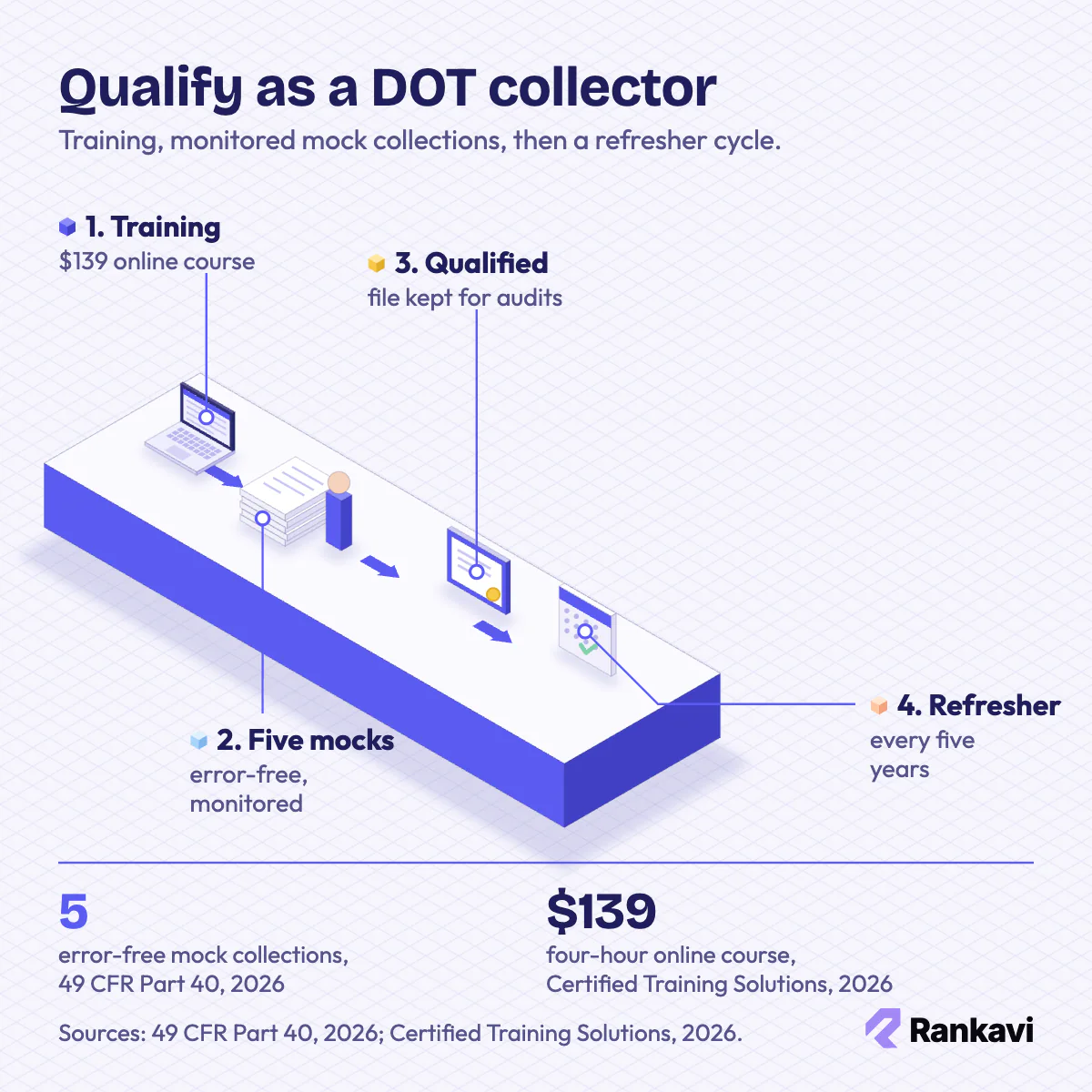
As of 2026, the DOT rule in 49 CFR Part 40 requires urine collectors to pass qualification training and five consecutive error-free mock collections. An eligible monitor observes them, and refresher training follows every five years. As of 2026, Certified Training Solutions sells a four-hour online course for $139, with mocks done separately.
Federal testing roles:
| Role | What it does |
|---|---|
| Urine specimen collector | Collects and seals DOT urine specimens |
| Breath Alcohol Technician (BAT) | Runs an evidential breath testing device |
| Screening Test Technician (STT) | Runs an alcohol screening device |
A BAT trains on the exact device used in the field and passes seven error-free mock tests under the same 2026 rule. Adding a new device later requires separate proficiency. Each technician keeps a qualification file to show clients and DOT auditors.
State law adds its own layer for non-DOT work. Some states restrict instant testing devices, so owners check the state before offering rapid screens.
8. Equip the Mobile Collection Unit
The vehicle and kit follow the service menu. A van or sport utility vehicle carries supplies, a breath testing device and a portable privacy setup.
DOT urine collections need federal custody and control forms (CCFs), collection kits, tamper-evident seals, bluing tablets and shipping materials. DOT and non-DOT forms stay clearly separated in the van.
Some laboratories offer an electronic custody and control form, which a tablet and printer can complete on site. Non-DOT work uses rapid test cups or oral fluid devices, and each needs its own supplies.
Breath alcohol testing needs an approved evidential breath testing device (EBT). The National Highway Traffic Safety Administration (NHTSA) publishes the Conforming Products List of devices valid for DOT tests. Mouthpieces, printer paper and calibration supplies come with each EBT. A failed calibration check takes the device out of service.
Mobile collections still meet site security rules. The collector secures the restroom or uses a private space at the client site. A backup arrangement covers a broken device or vehicle.
9. Sign Lab and Medical Review Agreements
Partner agreements decide who tests each specimen, who reviews results and how fast employers get answers. A mobile collector never works alone in DOT testing.
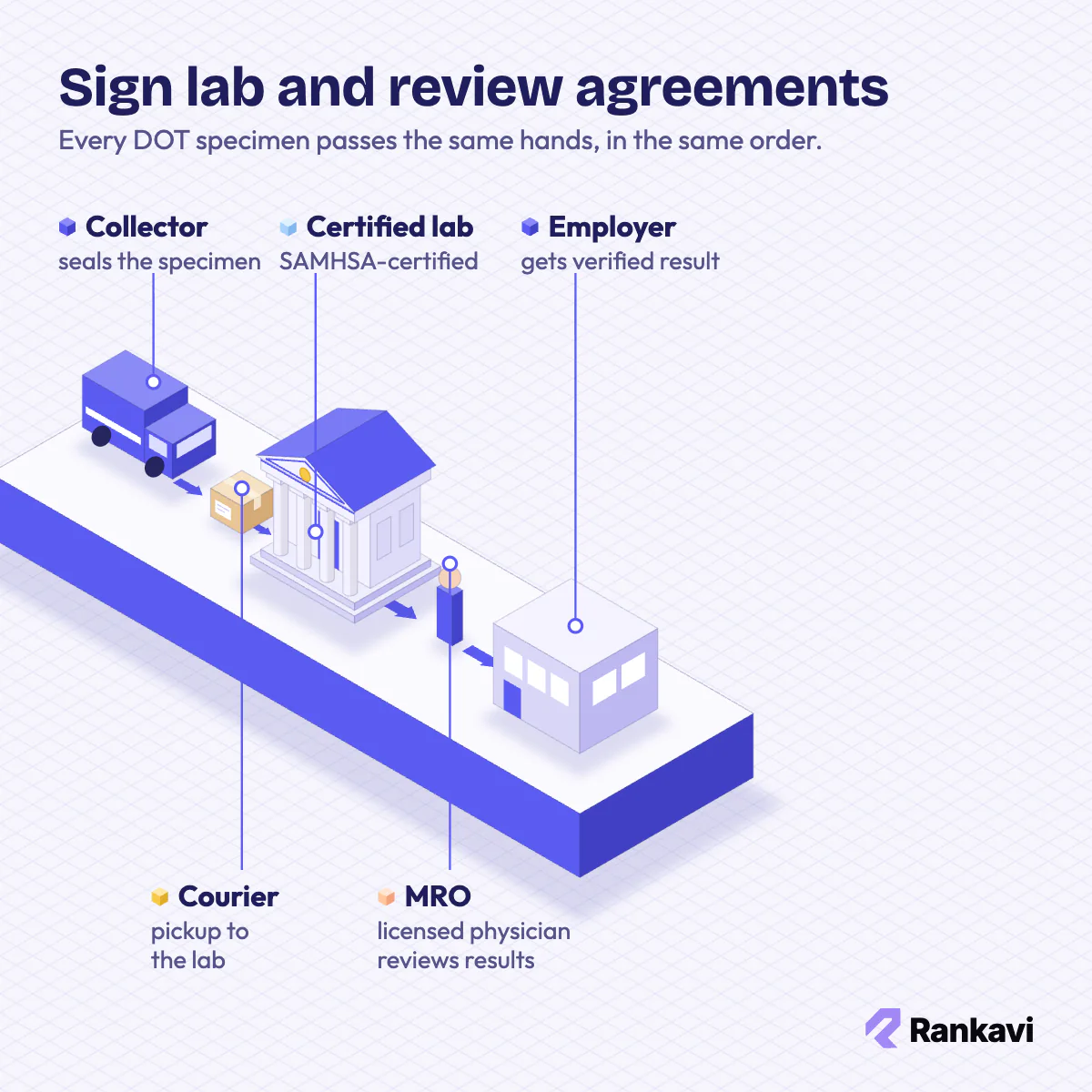
DOT specimens go to a certified laboratory. The Substance Abuse and Mental Health Services Administration (SAMHSA) certifies the federal workplace testing labs that analyse them. A medical review officer (MRO), who is a licensed physician, reviews lab results before reporting verified results to the employer. Courier pickup links the van to the laboratory.
Two more roles appear in return-to-duty cases and day-to-day contact. The designated employer representative (DER) is the client’s contact for results and referrals. A substance abuse professional (SAP) evaluates a worker who tested positive before the worker returns to safety-sensitive duty.
Some collectors work through an existing administrator that already holds lab and MRO contracts. Others sign their own. The first option is faster to start. The second keeps more control over fees and turnaround.
Written agreements name the laboratory, the MRO, courier times, result delivery and escalation steps. Clear terms prevent lost specimens and late results.
Standard operating procedures guide every visit. They cover identity checks, chain of custody, packaging and incident handling. Testing management software tracks random pools, collections and reports for each client.
10. Market to Employers and Administrators
First customers come from three groups: employers, third-party administrators and laboratories that need a local collector. Administrators often subcontract collections to mobile services in areas they cannot cover.
Google Business Profile is the free Google listing that employers see when they search for a nearby collector. Four channels win most early accounts:
- Google Business Profile: the listing that appears for “drug testing near me” searches
- Direct outreach: a list of local trucking, construction and staffing firms
- Networking: the chamber of commerce and local human resources groups
- Administrator emails: a short note on service area and after-hours availability
Staffing agencies are a useful early target. They hire in waves and need pre-employment tests quickly. Reviews on the Google Business Profile also help, because employers compare nearby providers before calling.
Industry membership builds trust with administrators. The Drug and Alcohol Testing Industry Association (DATIA) is a trade group for collection sites, labs and medical review officers. Members list the association on quotes and websites. The Society for Human Resource Management is a professional association whose local chapters gather the managers who buy testing.
Speed is the main selling point. A collector who reaches a post-accident scene fast saves the employer lost hours. A clear response promise on the website and every quote reinforces that message.
11. Claim a Place in Employers’ AI Overviews
Safety managers and human resources teams now ask Google for onsite testing providers, and AI Overviews often answer first. Those summaries draw on business directories, local news and industry roundups.
A new testing company gains from being named on those third-party pages early. Rankavi is a software as a service (SaaS) platform that publishes brand mentions in articles on indexed third-party websites. Collectors who want those mentions can work to earn AI Overviews citations for their service area.