

Starting a medical courier business takes a reliable vehicle, cold-chain gear, compliance training and commercial insurance. Contracts with labs, hospitals or pharmacies supply the work. The U.S. Bureau of Labor Statistics (BLS), which publishes federal job data, counted 8,174 private local messenger and delivery establishments in the first quarter of 2026.
I am Michal Sieroslawski, and I help medical courier services become easier to find online. Labs and clinics now turn to AI assistants for advice, and appearing there reaches new people.
The order settles prices and funding before paperwork, so every filing, policy and purchase serves a route that pays. Compliance proof and custody records then exist before the first pitch to a lab. Here are the eleven steps to start a medical courier business, from first idea to first customers, listed below.
- Choose Your Medical Courier Services
- Map Local Lab and Hospital Demand
- Price Routes, Stops and Rush Runs
- Fund the Vehicle and Cold-Chain Kit
- Register the Courier Company
- Meet HIPAA, OSHA and DOT Rules
- Insure Vehicles, Cargo and Liability
- Equip a Vehicle for Cold-Chain Delivery
- Set Up Dispatch and Chain of Custody
- Win Your First Healthcare Contracts
- Help Google AI Overviews Name Your Courier Service
1. Choose Your Medical Courier Services
Choosing medical courier services decides which healthcare cargo the company carries and how its working day runs. That choice also shapes the vehicle, the equipment and the insurance.
Medical couriers move lab specimens, prescriptions, medical equipment and confidential patient records between healthcare sites. A late or warm specimen can delay a diagnosis. For that reason, clients judge reliability before price.
Because the cargo is goods and records, medical courier work is not non-emergency medical transportation or ambulance service. Those businesses carry patients. Their licences, vehicles and insurance differ completely.
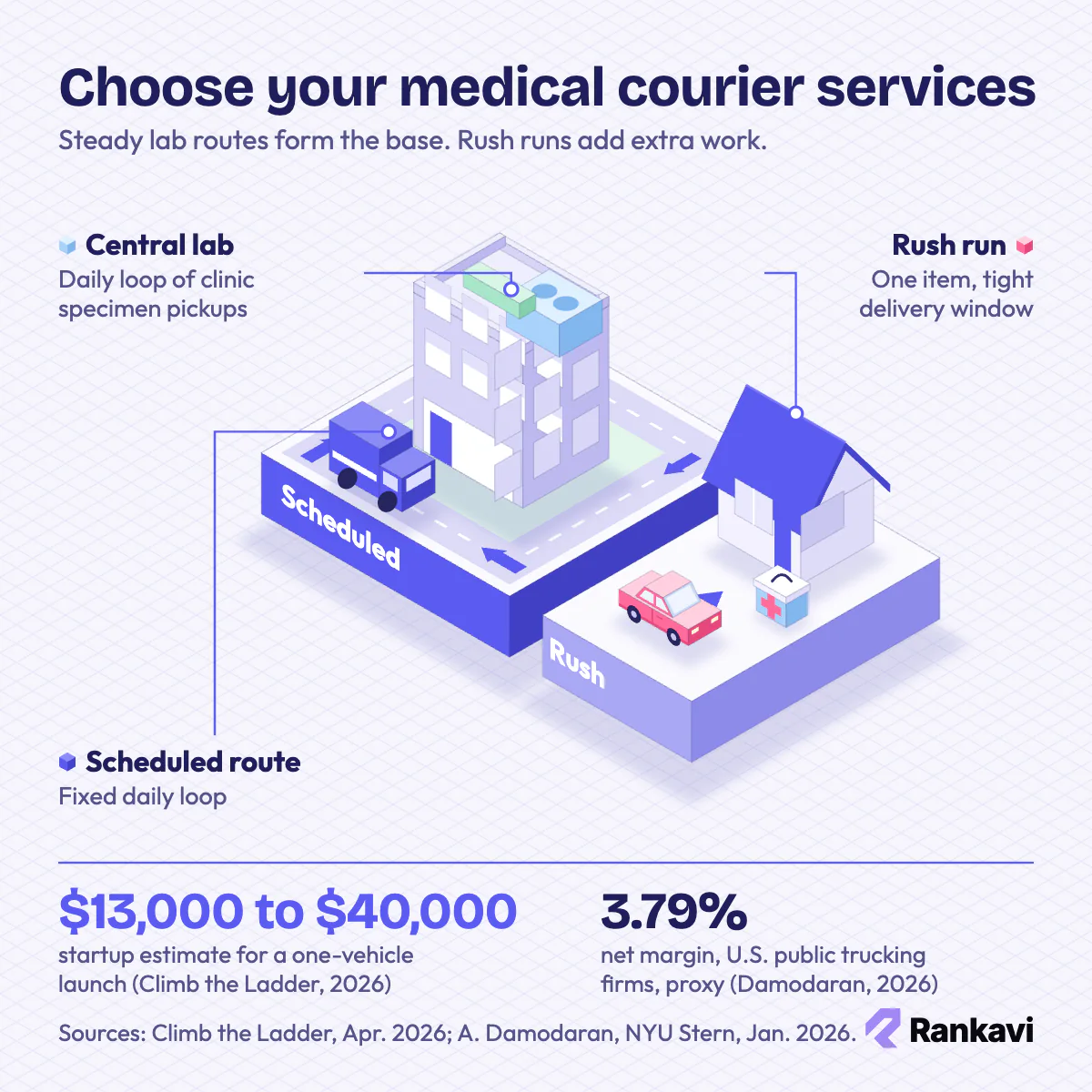
Two service models dominate the trade. Scheduled routes collect specimens from clinics on a fixed daily loop and drop them at a central lab. On-demand rush runs move one item right away within a tight window. Many owners build on steady routes and add rush jobs as higher-margin extras. Routes clustered in one corridor also cut fuel and drive time. Those are the two main variable costs.
Cargo type matters as much as service model, because it sets the gear and cover the company needs. Routine blood and urine specimens, pharmacy parcels and records suit a new company. Frozen loads, dry ice, controlled substances, blood products and organs are harder to handle. They raise equipment, training and insurance needs.
Once the cargo is set, the service level decides how fast each job must move. Service level also changes the work:
- Routine: Routine runs follow a set schedule.
- Same-day: Same-day runs are booked within hours.
- Urgent: Urgent runs go out at once.
Beyond these levels, after-hours and weekend coverage often sets a small fleet apart from larger carriers.
Scale is the next choice, because it decides who does the driving. An owner-operator drives every route alone at first. A small fleet adds drivers, often independent contractors, once contracts outgrow one vehicle.
Adding drivers raises the question of how to hire them. Drivers can be employees or independent contractors. The U.S. Department of Labor and the tax agency both publish worker classification tests. These tests show which label fits a driver. Some states apply stricter ones. Some healthcare clients also require employee drivers.
All of these choices carry costs before the first run.
Startup money at a glance:
| Item | Figure |
|---|---|
| Startup cost | $13,000 to $40,000 for a one-vehicle launch |
| Main costs | Vehicle, insurance, coolers and loggers, licences and permits ($100 to $500), privacy training ($29 to $500 per person) |
| Typical margin | 21.19% gross and 3.79% net for U.S. public trucking firms (proxy, not courier-specific) |
| Time to open | Varies with state filing times, compliance training and client vetting |
Sources: Climb the Ladder, a career advice site, startup estimates, April 2026; Aswath Damodaran, NYU Stern, margins by sector, January 2026 (trucking industry as a proxy).
Thin trucking margins explain why route density and rate discipline decide whether a courier earns money. Route density means fitting many stops into a small area. Rate discipline means charging prices that cover those costs.
2. Map Local Lab and Hospital Demand
Mapping local demand means listing the healthcare sites that ship specimens and medicines every week. That list shows whether enough recurring work exists inside one driving area.
Building the list starts with knowing which kinds of sites to look for. Five client groups buy most local medical delivery work:
- Clinical laboratories: Independent and regional labs collect specimens from many draw sites.
- Hospital systems: Hospitals move samples and supplies between campuses and outside labs.
- Pharmacies: Retail and specialty pharmacies send prescriptions to patients and care homes.
- Blood banks: Blood centers move units and samples to hospitals.
- Nursing homes: Long-term care sites need lab pickups and medication drops.
Once the client groups are clear, the next task is finding the real sites in the area. Free public lists help find these sites. The first comes from the Centers for Medicare & Medicaid Services (CMS):
- CMS lab lookup: CMS runs the Clinical Laboratory Improvement Amendments (CLIA) program. CMS publishes a lookup of certified labs by location.
- NPI Registry: The National Plan and Provider Enumeration System runs this registry. It lists physician offices, labs and pharmacies by postal code.
- State lists: State health departments and boards of pharmacy list licensed facilities.
A list of names does not show where the sites sit relative to each other. Plotting each site on a map shows which stops sit close together. Clusters along one corridor are worth more than scattered sites.
Location is only part of the picture, because each site also differs in what it ships and when. Specimen type, temperature range, pickup window and urgency decide whether the company can serve it. A late-afternoon clinic pickup and an overnight lab run need different schedules.
A site the company can serve still needs someone who will agree to hire it. That buyer is rarely the front desk. Lab logistics managers, outreach lab directors, supply chain leads and pharmacy owners usually control courier spending.
These buyers already pay someone to move their items, so the map should also show who serves them now. Competitors include national carriers, lab and hospital in-house fleets, regional couriers and app-based delivery platforms. Gaps in night, weekend, rural or same-day coverage show where a new company can win work.
Public lists and maps cannot confirm how sites actually ship today. Calling a sample of prospects tests the map. Useful questions cover who picks up today, how often, what goes wrong and when the contract renews.
The answers about current contracts help pick the first targets. Large hospital systems often hold multi-year deals with established couriers. Smaller labs and independent practices make easier first targets for a new company.
Choosing a target is not the same as winning its contract. Many contracts open through formal requests for proposals (RFPs). An RFP is a document in which a buyer invites couriers to bid on the work. These documents ask for certifications, written procedures, insurance proof and per-mile or per-stop prices.
All of this research then feeds a short business plan, which turns it into a launch case. The plan covers the service area, target clients, pricing model, compliance steps and first-year cash needs.
Some founders drive for an existing medical courier as a contractor first. That work teaches routes and client habits. However, a non-compete clause can block later competition.
3. Price Routes, Stops and Rush Runs
Pricing medical courier work sets the rate for each route, stop or mile the company drives. Each rate must cover fuel, driver time and a share of fixed costs.
Medical couriers usually quote in four ways:
- Per route: a fixed fee for a scheduled daily loop.
- Per stop: a fee for each pickup or drop on a route.
- Per mile: a rate tied to the distance driven.
- Rush premium: an extra charge for urgent, after-hours or weekend runs.
Fixed costs set the floor. Insurance, software and vehicle payments arrive every month, whether routes run or not.
Quotes also carry add-ons. Wait time, minimum charges, extra stops, return trips with an empty vehicle and fuel surcharges are billed separately. Frozen or dry-ice loads and biological specimens need handling that justifies a higher rate.
Per-route pricing suits daily lab loops, and per-stop pricing suits clinics and pharmacies. Per-mile pricing suits irregular long trips, but unpaid empty return miles can erase the profit.
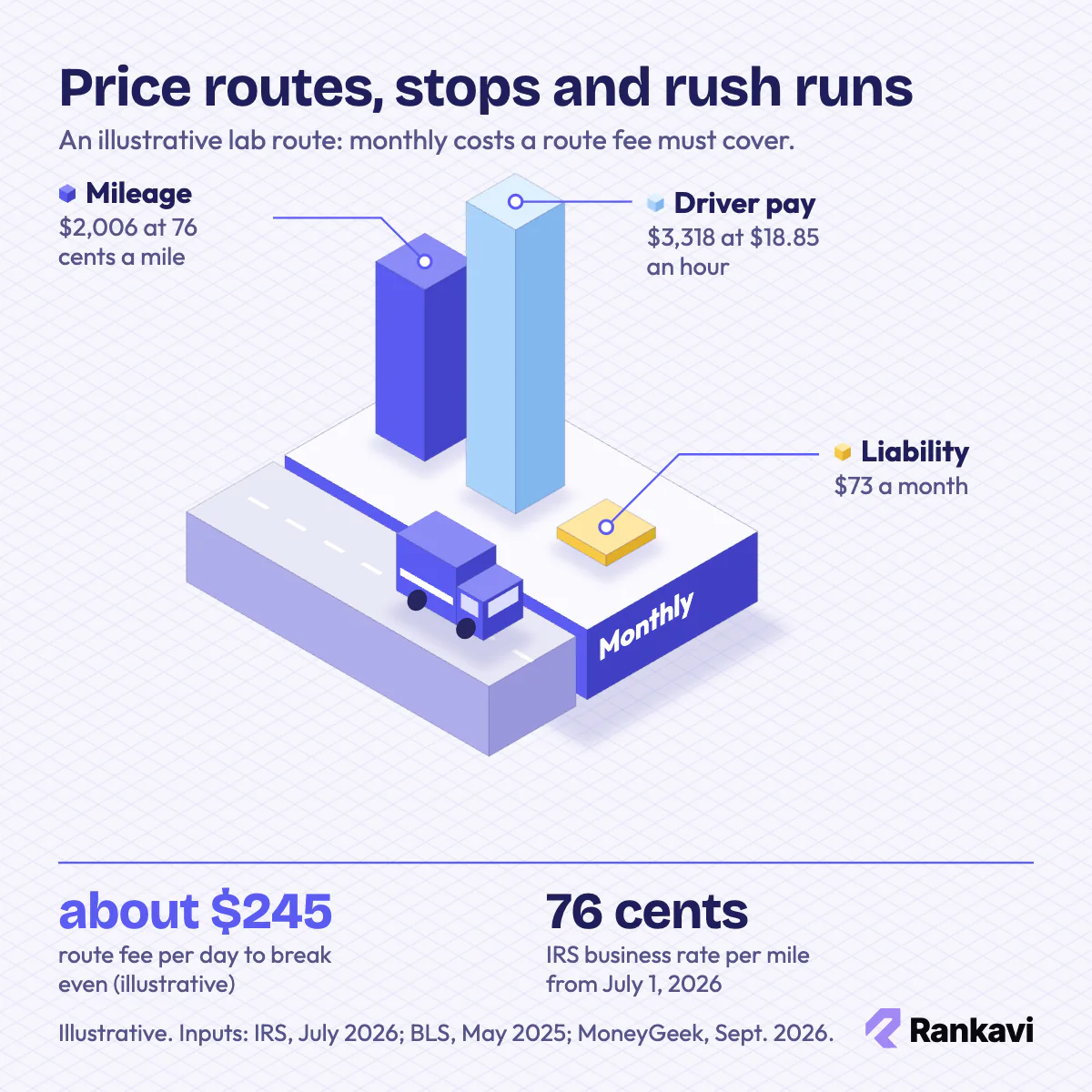
Cost per mile makes a useful first benchmark. The Internal Revenue Service (IRS), which sets the federal standard mileage rate, raised its business rate to 76 cents a mile from July 1, 2026.
“Never take any offers lower than $2/mile.”
— A delivery driver commenting on a YouTube video about medical courier startups
Worked example: Picture an illustrative lab route of 120 miles a day, run 22 days a month. Mileage at the IRS rate of 76 cents comes to about $2,006 a month. One driver paid the BLS median courier wage of $18.85 for eight hours a day adds about $3,318. General liability at $73 brings costs to about $5,397. The route fee must top about $245 a day before any profit appears.
Payroll taxes, workers’ compensation, commercial auto and cargo insurance, software and profit all come on top.
Underpricing to win a first contract is a common trap. A money-losing rate is hard to raise once a lab signs a multi-year agreement.
Temperature-controlled and out-of-hours work commands higher rates. Real mileage from the first weeks then shows which rates need adjusting.
Contract terms protect the rate. A fuel adjustment clause and a yearly rate review let prices follow costs. Payment terms of net 30 or longer delay cash that fuel and wages already used.
4. Fund the Vehicle and Cold-Chain Kit
Funding a medical courier launch covers the vehicle, cold-chain gear, insurance and early operating cash. Owners who already have a reliable car or van can start lean.
Startup spending falls into a few groups: vehicle, coolers and loggers, insurance, registration, software and marketing. An owner with a paid-off vehicle skips the cost of buying one. For that owner, insurance becomes the largest ongoing bill.
Beyond these costs, the business needs working capital. This is the cash that pays the bills before client money arrives. It matters because healthcare clients pay invoices after the work is done. The career-site guide behind the startup range above advised in 2026 budgeting two to three months of expenses first.
The vehicle affects both the upfront cost and the monthly bill, so it is the first big choice. Three vehicle options compare as follows:
- Paid-off car: Using a car the owner already owns keeps startup cost lowest.
- Used cargo van: A van such as a Ford Transit needs a larger down payment but costs less monthly.
- Leased vehicle: Leasing lowers the upfront cost. However, it adds mileage limits, which matter on route work.
Once the owner knows what the vehicle and gear will cost, the next step is finding the money. Courier founders can draw on three main funding sources:
- Personal savings or a small loan: Personal savings or a small loan fund many courier launches.
- Microloans: The U.S. Small Business Administration (SBA) offers microloans of up to $50,000 through nonprofit lenders, as of 2026. Its average microloan was about $13,000 in 2026.
- SBA 7(a) loans: For larger needs, the SBA’s 7(a) loan program allows up to $5 million, as of 2026. It covers equipment and working capital.
Any loan depends on how the lender judges the owner. Lenders usually weigh personal credit, down payment and experience. A signed letter of intent from a lab strengthens an application. This letter is a written statement that the lab plans to use the service. Small Business Development Centers give free help with loan packages.
A loan covers startup costs, but slow-paying clients can still leave the owner short of cash. This cash gap opens between doing the work and getting paid. A business line of credit can bridge it by letting the owner borrow as needed. Invoice factoring can also bridge it. In factoring, the owner sells unpaid invoices to another company for cash now. Factoring fees cut margin, though.
Buying only the minimum cold-chain kit for the first contract keeps more money in the bank. Extra coolers, loggers or a second vehicle can wait until routes are steady. Lean owners reinvest revenue from the first contracts before buying that second vehicle. That habit keeps overhead low until steady routes justify it.
5. Register the Courier Company
Registering a medical courier company creates the legal entity that signs healthcare contracts and invoices. Most owners form a limited liability company (LLC). An LLC keeps business assets separate from the owner’s personal assets.
After the state approves the entity, the IRS issues an employer identification number (EIN). This number identifies the business for tax purposes. Banks and healthcare clients both ask for it. The IRS says an EIN is free when requested directly from the agency. Third-party sites that charge for one are unnecessary.
The company name also needs care, because it appears on every contract and invoice. For that reason, it should sound professional and fit the healthcare field.
Most states also require an LLC to name a registered agent. This is the person or company that receives legal papers for the business. The agent needs a physical street address in the state. The agent must also be reachable during business hours. An owner can serve as agent, but the home address then becomes public. Commercial registered agent services handle the job instead for a yearly fee.
The same privacy concern applies to the business address. Using a business address other than home keeps the owner’s address off public filings. Money needs the same kind of separation. A separate business bank account keeps fuel, insurance and client payments apart from personal money.
Forming the company does not authorize it to operate. Local governments usually issue the general business license. States add tax and unemployment accounts once drivers are hired.
Once the company can legally operate, it can start signing healthcare clients. Hospitals and labs first approve each new supplier through a process called vendor onboarding. Healthcare buyers may ask for the following items:
- IRS Form W-9: This IRS form gives the client the company’s tax identification details. Healthcare buyers commonly ask for it.
- Certificate of good standing: This state document shows the company is registered and up to date. Healthcare buyers commonly ask for it.
- Payment details: Healthcare buyers commonly ask for these so they can pay invoices.
- D-U-N-S Number: Large health systems may ask for this business identification number.
- System for Award Management (SAM.gov) registration number: Federal facilities, including Veterans Affairs hospitals, require a SAM.gov registration number.
One healthcare number does not apply. A medical courier does not need a National Provider Identifier. The reason is that a courier does not bill insurers as a healthcare provider.
A federal ownership filing no longer applies either. The Financial Crimes Enforcement Network (FinCEN) is the U.S. Treasury bureau that collects ownership reports under the Corporate Transparency Act. FinCEN states that U.S. companies are exempt from those reports and no longer need to file.
One state filing does continue every year or two. Most states require an annual or biennial report. A biennial report is due every two years. Missing a deadline can end the company’s good standing. This matters because hospitals and labs often check good standing during vendor onboarding.
6. Meet HIPAA, OSHA and DOT Rules
Medical courier compliance involves the privacy, bloodborne pathogen and packaging rules that govern healthcare cargo. Labs and hospitals check this proof before they sign.
Before any healthcare rule applies, the business needs legal permission to operate. In most places, that starts with a general business license from the city or county. Requirements vary by state, so local rules decide the exact permits.
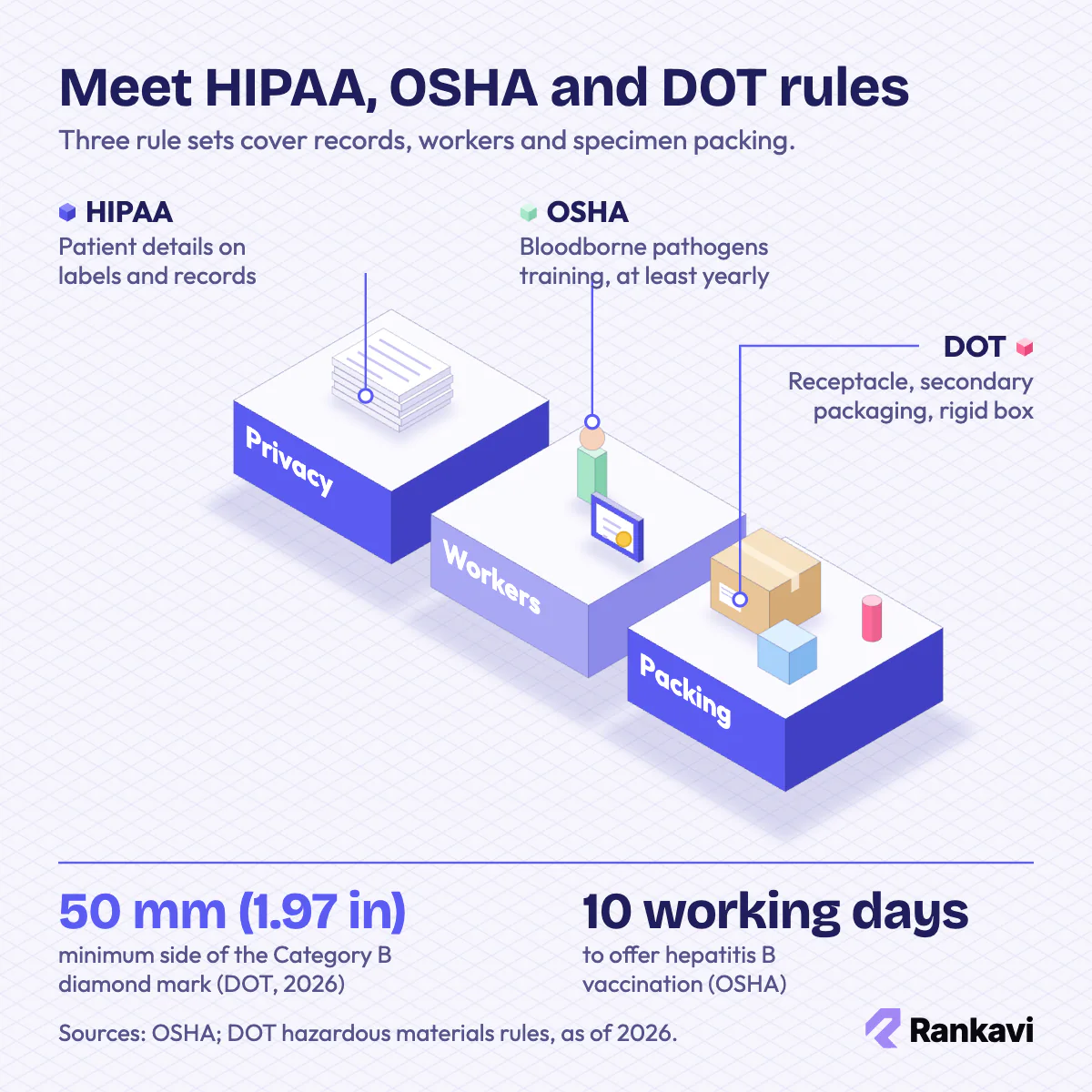
Once the business can operate, the first healthcare rule it meets covers patient privacy. The Health Insurance Portability and Accountability Act (HIPAA) sets privacy rules for patient information on labels, requisitions and delivery records. Couriers handle these papers every day. For that reason, many healthcare clients ask couriers for HIPAA training and a signed confidentiality agreement.
That training does not come with an official stamp, though. The U.S. Department of Health and Human Services (HHS) says it does not certify persons or products as HIPAA compliant. A course certificate only proves that training happened.
The client also decides how formal the privacy promise must be. A business associate is an outside company that handles patient information for a healthcare provider. Clients decide whether a courier counts as one. Many ask for a signed business associate agreement even when the courier only transports sealed packages. Labels and requisitions should show only the information the job needs.
Privacy rules protect the paperwork. The specimens themselves, however, put workers at risk of contact with blood. The Occupational Safety and Health Administration (OSHA) enforces a Bloodborne Pathogens Standard for workers exposed to blood. Employers train those workers at first assignment and at least annually, at no cost to them. They also offer hepatitis B vaccination within 10 working days.
The standard also requires written records. Employers keep a written exposure control plan, which describes how the company protects workers from exposure. They review it at least annually. Training records are kept for 3 years. Medical records are kept for the length of employment plus 30 years, as of 2026.
These duties fall on employers because the standard covers employees. A solo owner is generally outside it. Clients often ask for the training anyway.
Worker safety is one risk. A leaking package on the road is another, and a different agency handles it. The U.S. Department of Transportation (DOT) regulates specimens that may carry infection as hazardous materials. Category B shipments need three layers of packaging:
- Primary receptacle: This is the inner container that holds the specimen.
- Secondary packaging: This layer surrounds the primary receptacle.
- Rigid outer box: The outer box carries a diamond mark at least 50 mm (1.97 inches) per side, as of 2026.
A narrow exception covers patient samples carried in a vehicle used only for such materials.
Packing hazardous materials takes training, so DOT adds a second duty. Hazmat employee training is a separate DOT duty, covered by the Code of Federal Regulations (CFR). Federal rules in 49 CFR 172.704 require new hazmat employees to be trained within 90 days. Training repeats at least every three years. It covers general awareness, function-specific, safety and security awareness topics.
The coolant inside the box can be a hazard as well. Dry ice used as a coolant is a regulated hazardous material. It needs its own marking. It must not be sealed airtight, because carbon dioxide builds up in a closed van.
All of these rules apply to routine specimens. Known high-risk Category A pathogens, regulated medical waste and controlled substances fall under other rules. As a result, specimen delivery does not authorize waste hauling or drug delivery.
Core compliance rules:
| Rule | What it covers |
|---|---|
| HIPAA | Patient information on labels, requisitions and records |
| OSHA Bloodborne Pathogens Standard | Exposure training and protective equipment |
| DOT hazardous materials rules | Packaging and markings for infectious specimens |
| Local business license | Permission to operate in the city or county |
Because clients check this proof before they sign, training certificates and renewal dates belong in one file. Lab managers often request current proof during a bid. That file usually holds six records:
- HIPAA training record: This shows the courier completed privacy training.
- Signed confidentiality or business associate agreement: This records the privacy promise made to the client.
- OSHA training record: This shows the bloodborne pathogens training took place.
- Hepatitis B vaccination or declination records: These show whether each worker took or declined the vaccine.
- Hazmat training certificate: This proves the DOT hazmat training was completed.
- Written exposure control plan: This plan is reviewed at least annually.
7. Insure Vehicles, Cargo and Liability
Medical courier insurance protects the company against vehicle accidents, lost cargo and injury claims. Healthcare clients often set minimum coverage limits. They also ask for proof of coverage before they award a route.
A single delivery carries several kinds of risk, so no one policy covers it all. Four policies form the usual medical courier package:
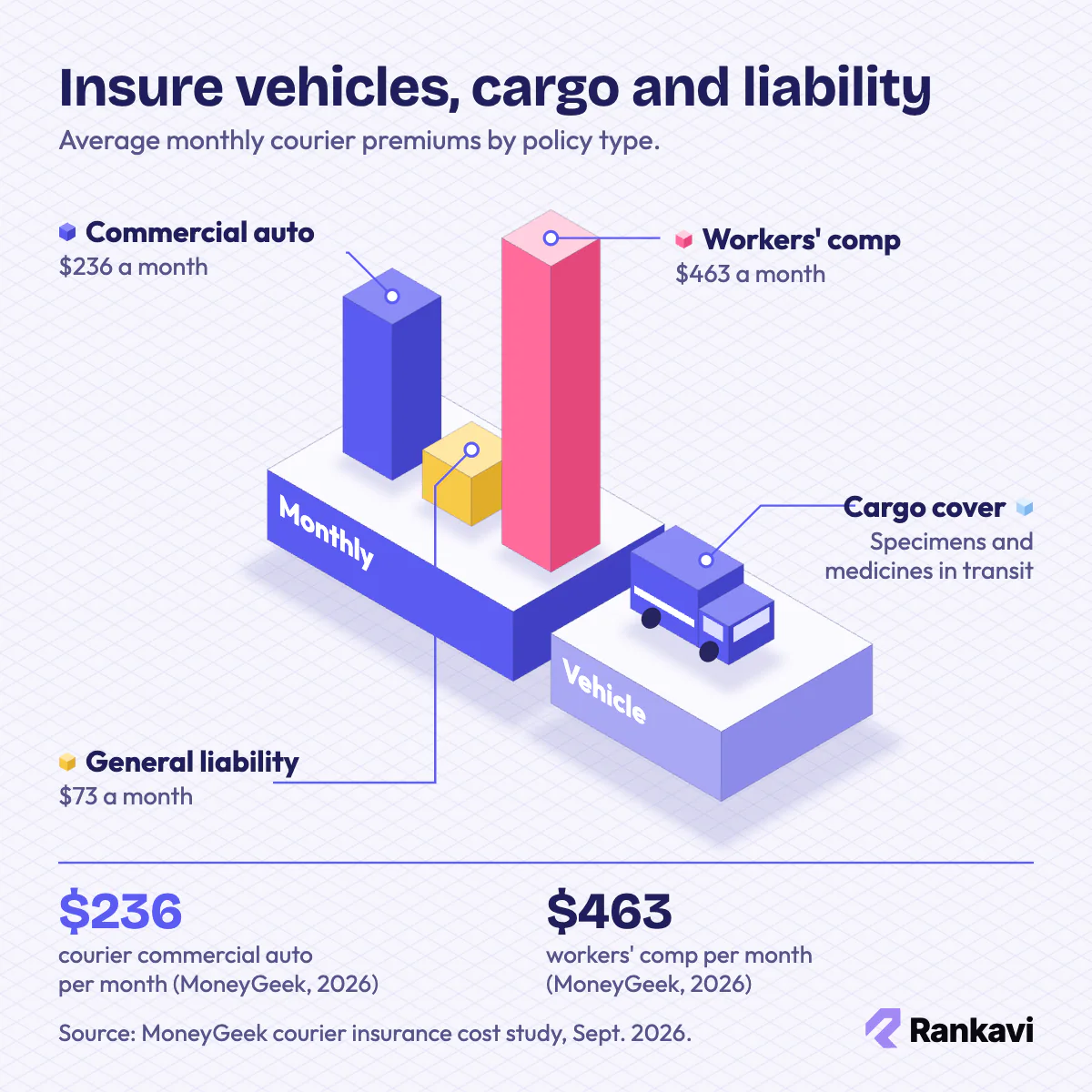
- Commercial auto: This covers vehicles used for paid deliveries. Personal auto policies often exclude that kind of driving. MoneyGeek, an insurance comparison site, put courier commercial auto at $236 a month in September 2026.
- Cargo insurance: This covers specimens, medicines and equipment while they are in transit.
- General liability: This covers injuries and property damage at client sites. MoneyGeek put general liability at $73 in September 2026.
- Workers’ compensation: This covers employees hurt on the job once the company hires staff. It averaged $463 a month in that 2026 study of quote estimates.
The two core prices give a new owner a starting cost. In September 2026, commercial auto and general liability added up to about $309 a month. That total comes before cargo coverage and workers’ compensation. A sole owner with no employees may not need workers’ compensation yet. Clients can still ask for proof of it, though.
Who pays for coverage also depends on who drives. Fleets that use independent contractors often require each driver to carry personal coverage. The contract spells out who insures the vehicle and who insures the cargo.
Drivers in their own cars, missed deliveries and stored data each create risks the base package leaves open. Four extra policies fit courier work:
- Hired and non-owned auto: This applies when drivers use their own vehicles.
- Professional liability: This covers claims of a missed pickup or a late delivery.
- Cyber liability: This covers a breach of delivery data.
- Umbrella liability: This raises coverage limits above the base policies.
Even with the right policies, the cargo policy needs a close read. Standard policies often exclude temperature-controlled goods, specimens and medicines unless a refrigeration breakdown endorsement is added. An endorsement is a written change added to a policy. Value raises a second problem. A lost biopsy has no market value. For that reason, the policy should state how such losses are paid.
Once coverage is in place, the company has to prove it to clients. A certificate of insurance is the document that shows this proof. It goes into every bid package. Hospitals, labs and pharmacies each need different coverage. So each contract gets a separate check.
Hospitals often ask for added wording on that certificate. Three requests are common:
- Additional insured endorsement: This adds the client to the policy as a covered party.
- Waiver of subrogation: The insurer gives up the right to seek repayment from the client.
- Primary and non-contributory coverage: The courier’s policy pays first, without the client’s insurer sharing the cost.
A certificate only proves coverage. It does not create it. So each endorsement must exist on the policy itself.
Coverage only pays off if claims are reported the right way. Accidents, spoiled shipments and lost specimens go to the insurer immediately. Late notice can void a claim. Photos, temperature logs and signatures help support it.
8. Equip a Vehicle for Cold-Chain Delivery
Cold-chain equipment keeps specimens and medicines inside their required temperature range from pickup to drop. Many specimens stay valid only within a narrow band.
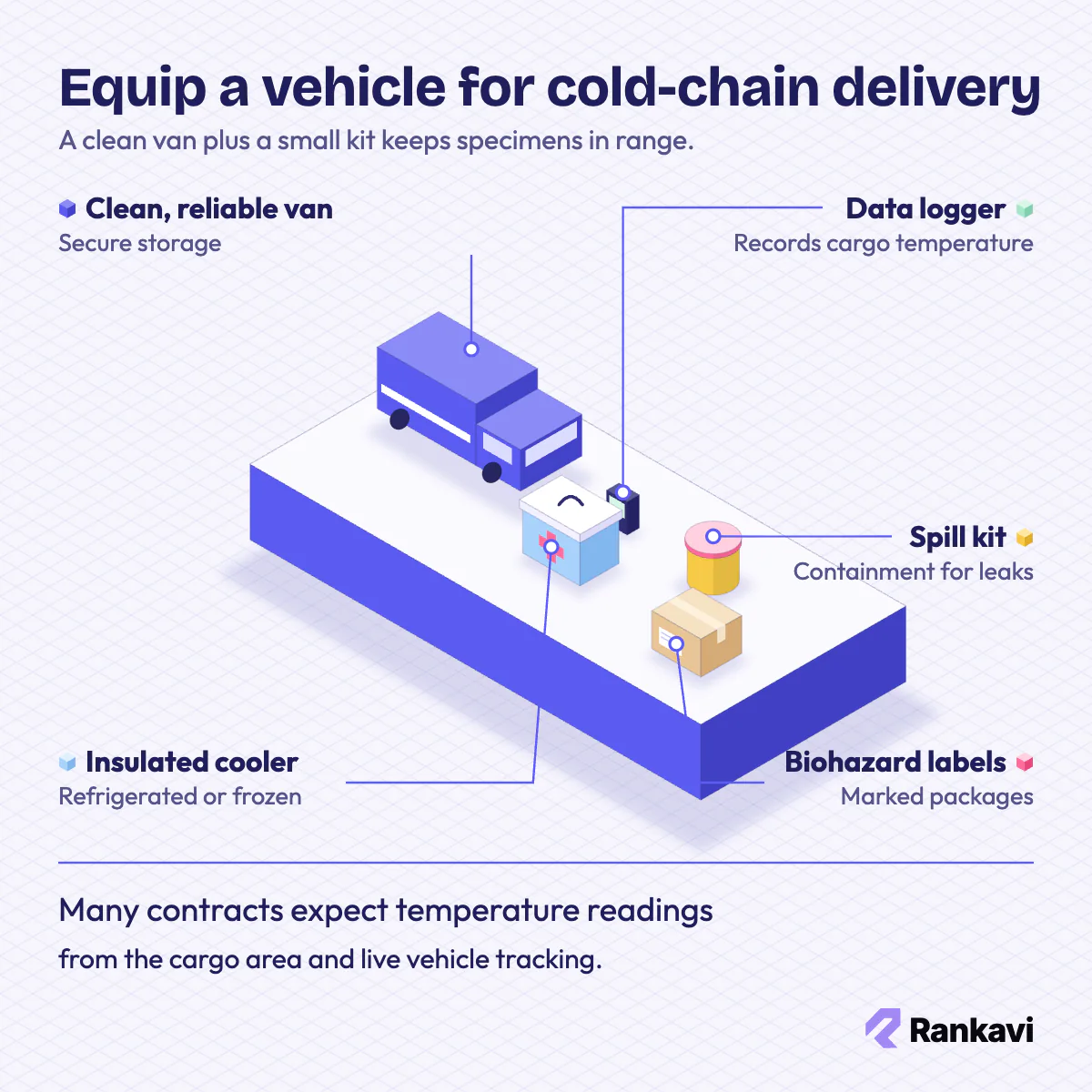
The vehicle itself needs no special build at first. A clean, reliable car or cargo van with secure storage handles most early routes.
Temperature classes decide the gear. Refrigerated loads run at 2 to 8 °C, and frozen loads need much colder coolant. Ultra-low research samples travel on dry ice. The sender’s label or requisition sets the range, and the courier should never guess it.
Passive cooling does most of the work early on. An insulated shipper with conditioned gel packs or phase-change material holds a range for hours. Powered 12V fridges and refrigerated van bodies suit long routes or high-value contracts.
Five items make up a basic medical courier kit:
- Insulated coolers: medical-grade containers for refrigerated or frozen specimens.
- Temperature data loggers: devices that record cargo temperature during transport.
- Spill kits: secondary containment and cleanup supplies for leaks.
- Biohazard labels: markings for packages that hold infectious material.
- Phone mount and scanner: hardware for navigation and specimen scans.
Manufacturers publish tested pack-outs for their coolers. Using the qualified layout matters because hold time depends on the coolant arrangement and the outside temperature. Frozen packs should never touch specimens that must stay at 2 to 8 °C.
Loggers work best with a calibration certificate, a short reading interval and alarms for readings out of range. A logged excursion means the load is set aside and the client is told, not delivered.
Many contracts now expect live vehicle tracking and temperature readings from the cargo area. Those readings prove the cold chain held during transport.
Cleaning and maintenance logs matter too. Clients often write hygiene and upkeep records straight into their courier contracts.
A log entry records the date, product used, vehicle and cooler, and who cleaned. Coolers also need checks for cracked lids and worn gaskets.
A spare cooler, extra conditioned packs and a second logger on high-value loads keep one failure from cancelling a run.
9. Set Up Dispatch and Chain of Custody
Chain of custody tracks who held each specimen and when it changed hands. Dispatch software, barcode scans and signatures build that record without slowing routes.
A custody record lists the specimen number, pickup and delivery times, temperature requirement and seal number. It also notes the specimen’s condition on receipt. Each time a specimen changes hands, the record gains a name, signature and timestamp. Labs assign accession numbers to specimens. Using these numbers keeps patient names out of the record.
Those handover entries come from proof of delivery, which the driver collects at every stop. Couriers capture it in three ways:
- Signature: The person receiving the specimen signs for it.
- Photo: The driver takes a photo at the stop.
- Badge scan: The driver scans the recipient’s badge.
Some couriers also scan location barcodes. This confirms that each driver reached the right site.
Drivers can only reach those stops on time if the routes are well planned. Delivery management software plans routes around clinic hours and urgent pickups. Live tracking then gives clients accurate arrival times.
Because this software holds the custody record, it needs features that protect the record. It should work offline, timestamp every scan and lock records after submission. A locked record cannot be changed once it is sent. Some vendors store client data. Those vendors should sign a business associate agreement, a contract in which they agree to protect that health information.
Software only works if people use it the same way every time. Written procedures cover collection, loading, handover and incident reports. Cross-trained staff can do more than one job. They keep service steady when one dispatcher or driver is out.
Even with good procedures, some runs go wrong. An exception plan covers the failures clients care about most. The plan covers five common failures:
- Late pickup: The driver arrives after the agreed pickup time.
- Leaking container: A specimen container leaks.
- Temperature excursion: The specimen leaves its required temperature range.
- Closed recipient: The receiving site is closed when the driver arrives.
- Missing count: The number of specimens does not match what was expected.
For each failure, the plan names who the driver calls and how fast the client is told.
Clients want proof that the whole system works. Each month, they receive reports on on-time rate, exception rate and temperature compliance. Labs that follow CLIA, College of American Pathologists or Joint Commission standards may ask to review the logs.
All of these records are only as good as the drivers who create them. Drivers need the following before they handle medical items:
- Motor vehicle record check: This reviews the driver’s driving history.
- Background check: This screens the driver before they are hired.
- Drug screen: This tests the driver for drug use.
- Training: This prepares the driver to handle medical items.
Hiring these drivers starts with knowing the going wage. BLS, the federal agency that tracks jobs and pay, reported a median wage of $18.85 an hour for couriers and messengers in May 2025. The median is the middle value, so half earned more and half earned less. Candidates with pharmacy or healthcare experience stand out. They bring knowledge that is hard to teach.
10. Win Your First Healthcare Contracts
Winning a first contract turns compliance paperwork into recurring routes and steady revenue. Lab managers pick couriers who look safe, insured and reliable.
A capability statement sums up services, service area, insurance and training on one page. The pitch opens with reliability and compliance, and price comes later.
Buyers include independent and hospital outreach labs, physician groups, dialysis centers, long-term care sites, home health agencies and pharmacies. Titles that sign include lab director, lab operations manager, supply chain lead and practice administrator.
Many new couriers win first work as a backup or overflow vendor. Others subcontract to larger carriers, or run a short pilot route. Margins are lower, but the work builds references and proof of performance.
Public bids appear on SAM.gov, state procurement portals and Veterans Affairs medical center postings. Hospitals may also require registration in a vendor credentialing system before a courier works on site.
The paperwork file is ready before the first call. It holds the certificate of insurance, a W-9, training records, driver background checks and written custody and temperature procedures.
Most agreements are master services agreements with service level terms. They set pricing, fuel and after-hours surcharges, liability limits, indemnification and payment terms. A healthcare or commercial attorney should review the first contract.
When a lab already has an in-house courier, a narrow offer can open the door. Peak-hour coverage, after-hours runs, missed pickups or a single route let the lab test reliability on a small slice. Credentialing and approvals can take weeks or months.
Contracts often open when an incumbent courier stumbles. A prepared company already on file gets that call, so steady follow-up pays off.
A simple website helps clinic staff check the company. A Google Business Profile is Google’s free listing for local firms. Online booking and tracking pages save time on both sides.
Renewals depend on measured service. On-time rates and delivery reports shared in contract reviews show a client that specimens arrive as planned.
Two or three anchor contracts in one corridor create a stable base. Rush work and new clients then fill the gaps.
11. Help Google AI Overviews Name Your Courier Service
AI visibility earns a medical courier a place in the answers that lab and clinic staff read. Office managers now ask ChatGPT, Gemini and Google AI Overviews which local couriers handle specimens.
Those tools lean on what trusted third-party sites say about a company. Healthcare directories, logistics roundups and local business articles shape the answers.
The basics come first. Claimed Google Business Profile, Bing Places and Apple Business Connect listings give the tools facts to verify. Identical name, address and phone details everywhere help. A website that states service area, hours, specimen types and training actually completed supports them.
Claims must be true. The tools repeat what they find, and a false compliance claim can cost a contract.
Rankavi is a software as a service (SaaS) platform that publishes brand mentions in articles on indexed third-party websites. Such mentions give a young courier a fair chance to appear in Google AI Overviews answers for lab searches.
Results build gradually, and no service can guarantee a placement. Monthly test prompts, such as “medical courier near me”, show whether each assistant names the company. They also show which sources it cites.