

Starting a meal prep business takes a focused menu, a licensed kitchen, a health permit and a cold delivery chain. Most new owners rent kitchen time by the hour and sell weekly plans.
I’m Michal Sieroslawski, and I help meal prep businesses get recommended in AI search. Busy customers increasingly turn to AI assistants like ChatGPT and Perplexity for suggestions. Showing up there helps a new meal prep business reach people it would otherwise miss.
The order fixes the menu, price per meal and budget before any kitchen lease or permit fee. The following list shows how to start a meal prep business in twelve steps.
- Choose Your Meal Prep Concept
- Write a Meal Prep Business Plan
- Price Meals and Weekly Plans
- Fund the Startup Costs
- Register and Insure the Company
- Secure a Licensed Commercial Kitchen
- Get Health Permits and Food Safety Training
- Source Ingredients, Containers and Equipment
- Set Up Ordering and Delivery
- Market to the First Subscribers
- Grow With Subscriptions and Staff
- Appear in Google AI Overviews Meal Picks
1. Choose Your Meal Prep Concept
A meal prep concept starts with what leaves the kitchen. Ready-to-eat meals arrive cooked and only need reheating, while meal kits deliver portioned raw ingredients and a recipe card.
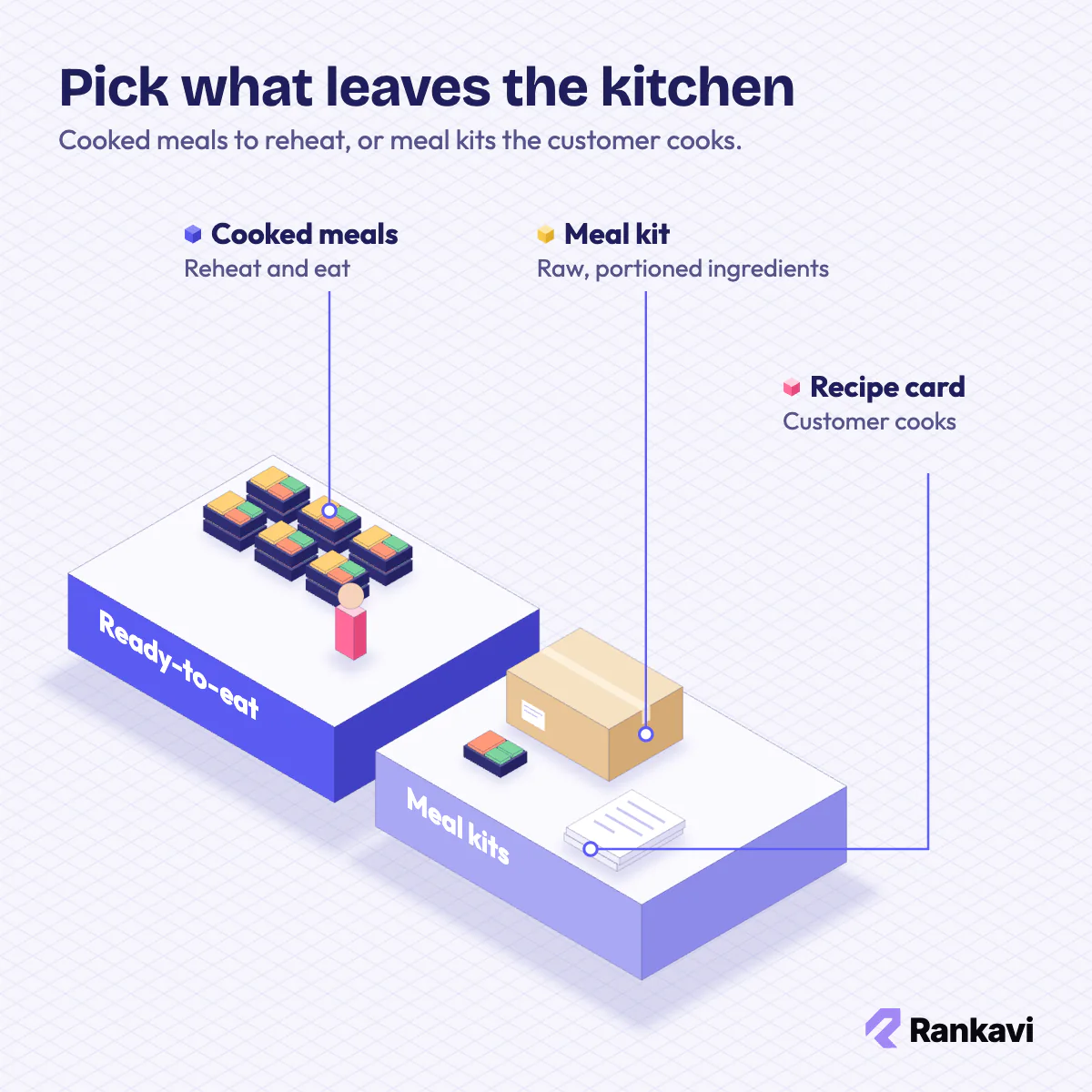
Two meal prep formats:
| Format | What the customer gets |
|---|---|
| Ready-to-eat meals | Cooked, portioned meals that only need reheating |
| Meal kits | Pre-portioned raw ingredients plus a recipe card |
A dietary niche sharpens the menu. Keto, vegan, gluten-free, high-protein and low-carb meals each attract a clear group of buyers. Customers with allergies or medical diets often pay more for food they can trust.
The target customer shapes every later choice. Busy parents want family portions, gym members want macros on the label, and older adults want soft, simple dishes.
Each format changes the workload. Ready-to-eat meals need batch cooking, fast chilling and cold storage. Meal kits need less cooking but more portioning and packing.
Local scouting reveals the gap. A founder orders from nearby meal prep companies as a customer would. Missing diets, weak portions or slow delivery point to an opening.
A concept test comes before any lease. A tasting, a waitlist or a few pre-orders shows whether buyers want the menu at the planned price.
Medical diets need extra care. A dietitian can review menus built for health conditions, and every label must list the major allergens.
2. Write a Meal Prep Business Plan
A meal prep business plan means a written forecast of meals sold, costs and launch steps. Lenders read it first, and the owner uses it to test the idea on paper.
Most plans cover eight parts:
- Executive summary: the concept and the ask in one page.
- Company description: the legal form, owners and mission.
- Concept and menu: the diet focus and sample weekly menu.
- Market and competitors: local demand and rival meal services.
- Marketing plan: how the first subscribers will hear about it.
- Operations: kitchen, packing and delivery days.
- Staffing: who cooks, packs and drives.
- Financials: startup costs, prices and break-even.
Weekly order volume is the key assumption. Kitchen hours, ingredient orders and delivery routes all follow from meals sold per week.
Supply chain planning belongs in the plan too. Wholesalers, local farms and packaging vendors each affect cost, quality and delivery days.
Risks deserve a short list with one fix each. Examples are an ingredient price jump, a lost kitchen booking and a slow first month.
Break-even ties the plan together. It states how many meals per week cover ingredients, kitchen time, delivery and fixed costs at the planned price.
3. Price Meals and Weekly Plans
Meal prep pricing decides whether each container covers its food, labor and packaging cost. The price per meal starts from those costs and adds overhead and profit.
The full cost of one container has five parts: ingredients, packaging, cooking and packing minutes, kitchen time and delivery. A target margin goes on top of that total.
Market prices frame the menu. ZenBusiness, a business formation company, put weekly subscription meals at $8 to $15 per meal in July 2026.
Food cost is the benchmark meal prep owners check first. US Foods is a foodservice distributor that supplies restaurants. Its guide, accessed in 2026, put average restaurant food cost at 28% to 32% of sales in 2026. A meal prep menu that stays near that share leaves room for packaging, labor and delivery.
A base-plus-topping menu, such as one grain, one protein and one roasted vegetable, lets one batch feed several dishes. Cheap, sturdy ingredients like chicken thighs and sweet potatoes hold up well in containers.
Competitor prices set the ceiling. A founder compares local meal services on price per meal, portion size and delivery fees before fixing a menu price.
Meal prep companies usually sell in three ways:
- Single meals: customers pick meals one by one each week.
- Weekly plans: a set number of meals at a lower price per meal.
- Multi-week subscriptions: a discount for committing to several weeks.
Delivery needs its own price. A flat delivery fee or a free pickup point keeps route costs out of the meal margin.
Card processing fees also cut into each sale, so they belong on the cost list. Prices need a recheck whenever ingredient costs rise.
Add-ons such as extra protein or snacks raise the order total without a new delivery trip.
4. Fund the Startup Costs
Funding a meal prep business covers kitchen access, equipment, containers, first ingredients, permits and an ordering website. Many founders start lean by renting kitchen time by the hour.
Startup money at a glance:
| Item | Figure |
|---|---|
| Startup cost | $9,900 to $36,500 (vendor estimate) |
| Main costs | Delivery vehicle deposit or lease, smallwares, first food stock, kitchen deposit and first month |
| Typical margin | 32.24% gross and 9.37% net for U.S. public restaurant firms (proxy; no meal prep margin is published) |
| Time to open | No public benchmark; it follows kitchen access and the health review. Break-even takes 6 to 18 months (vendor estimate) |
Sources: ZenBusiness, a business formation company, vendor estimates, July 2026; Aswath Damodaran, NYU Stern, margins by sector, January 2026.
ZenBusiness built that July 2026 range from nine cost lines. A commercial kitchen deposit and first month alone ran $1,500 to $4,000 in its 2026 estimate.
Aswath Damodaran, a New York University finance professor who publishes yearly industry margin data, put restaurant net margin at 9.37% in January 2026. Meal prep has no published margin, so that restaurant figure serves only as a proxy.
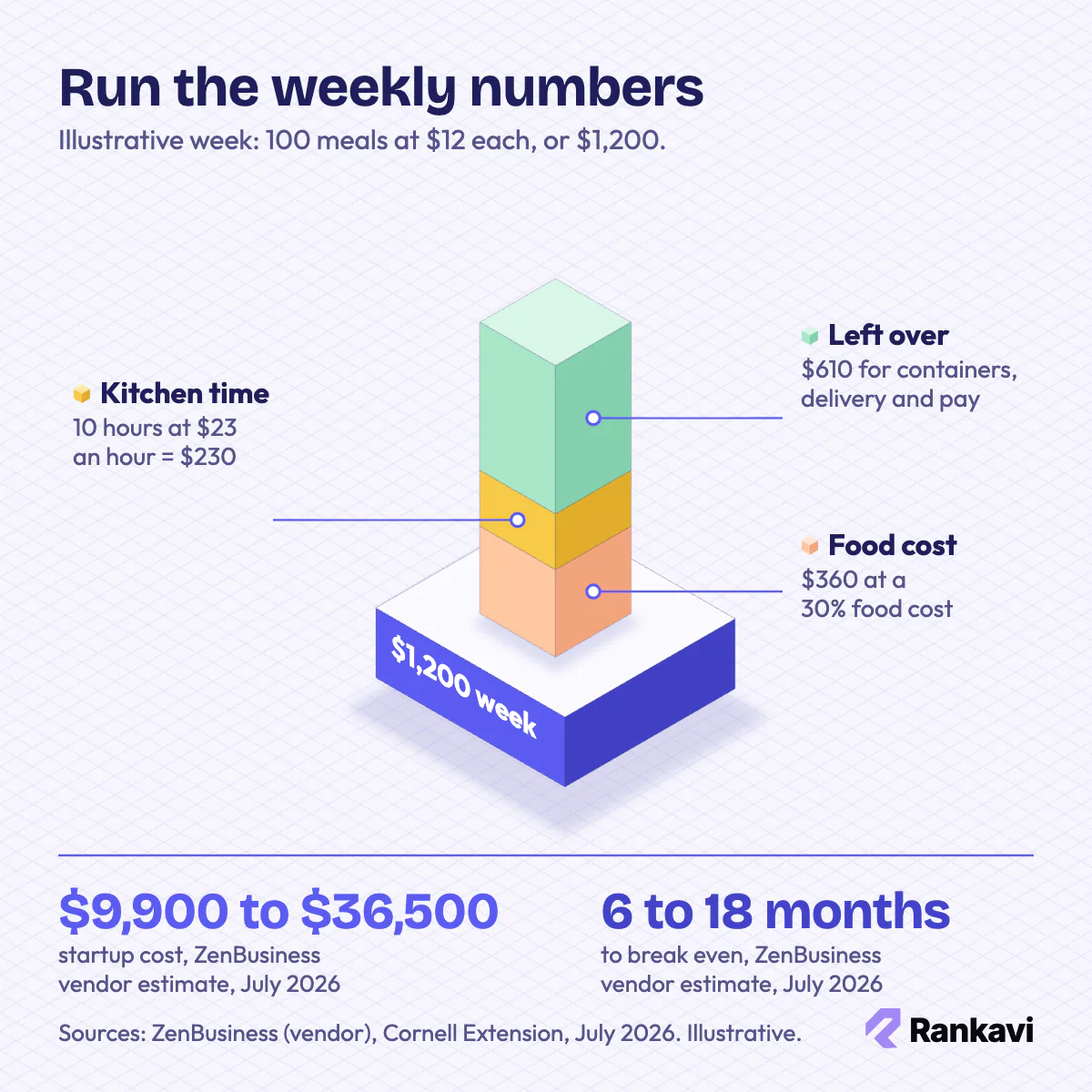
Worked example: As an illustration, a solo owner sells 100 meals a week at $12 each, or $1,200. A 30% food cost puts ingredients at $360. Ten hours of shared kitchen time at $23 an hour adds $230. That leaves $610 a week for containers, labels, delivery, insurance and the owner’s pay. The plan works only if those remaining costs, and any loan payment, stay well under $610.
Personal savings pay for most first launches. Bootstrapping keeps full ownership but puts the founder’s own money at risk.
The U.S. Small Business Administration (SBA), which backs small business loans, offers microloans of up to $50,000 as of 2026. Its average microloan was about $13,000 in 2026.
Lenders fill the rest of the gap. Business loans, business credit cards and equipment financing each suit a different purchase. Equipment loans use the equipment itself as collateral.
A cash reserve protects the first months. A subscriber base takes several months to build, so rent, insurance and ingredients need money before orders cover them.
Pre-orders from early customers can cover part of the first ingredient bill. The company must then deliver every paid meal. A separate business bank account keeps company money apart from personal money.
5. Register and Insure the Company
Registering a meal prep company protects the owner’s personal assets if a customer sues over food. Many prepared meal services form a limited liability company (LLC) with the Secretary of State. An LLC is a business form that keeps the company’s legal problems separate from the owner’s personal property.
The Internal Revenue Service (IRS) is the federal tax agency. It gives each meal prep LLC a free employer identification number (EIN). Meal prep owners use the EIN to run payroll, open the business bank account and fill out permit forms.
With the company registered, the owner can turn to insurance. Customers eat the meals days after cooking, so product liability matters here. Meal prep companies usually carry four insurance policies:
- General liability: Covers injuries and damage at pickup points or events.
- Product liability: Covers illness linked to a meal.
- Commercial auto: Covers the car or van that delivers meals.
- Workers’ compensation: Covers cooks and packers hurt on the job.
Commercial kitchens usually ask for proof of insurance before the first shift.
6. Secure a Licensed Commercial Kitchen
A licensed commercial kitchen gives a meal prep business an inspected place to cook, cool and pack perishable food. The health permit names this kitchen, so the kitchen comes first.
Home kitchens rarely qualify. Cottage food laws mostly cover shelf-stable, low-risk foods such as breads and cookies. Cooked meals that need refrigeration fall outside them in most states.
Kitchen options for meal prep:
| Option | Best fit |
|---|---|
| Shared or commissary kitchen | Booked by the hour with shared equipment and storage |
| Restaurant kitchen after hours | A partner restaurant rents its unused time |
| Incubator kitchen | Kitchen access plus mentoring for food startups |
| Own leased kitchen | Steady volume that justifies full-time rent |
Hourly rental keeps early costs low. The Food Corridor, a booking platform for shared kitchens, found in its 2023 operator survey that 42% charged $20 to $29 an hour.
Cornell Cooperative Extension of Broome County, a university extension office in Binghamton, New York, runs one such incubator kitchen. Its July 2026 guide prices 40 hours a month at $920, or $23 an hour. Members there also need a $1 million liability policy, per that 2026 guide.
Zoning comes up before any build-out at home. City and county offices decide whether a residence can host a food business. Homeowners association covenants can add their own limits.
Layout matters as much as size. A meal prep kitchen needs a cooking area, a packing station and cold storage for finished meals.
A visit during the planned cooking hours shows whether oven time, cooler space and booking slots fit the weekly volume. The agreement should state the deposit, the notice period and the storage space included.
7. Get Health Permits and Food Safety Training
A food permit involves a health department review of the kitchen, menu and food handling plan. Many counties start with a plan review and then inspect the kitchen.
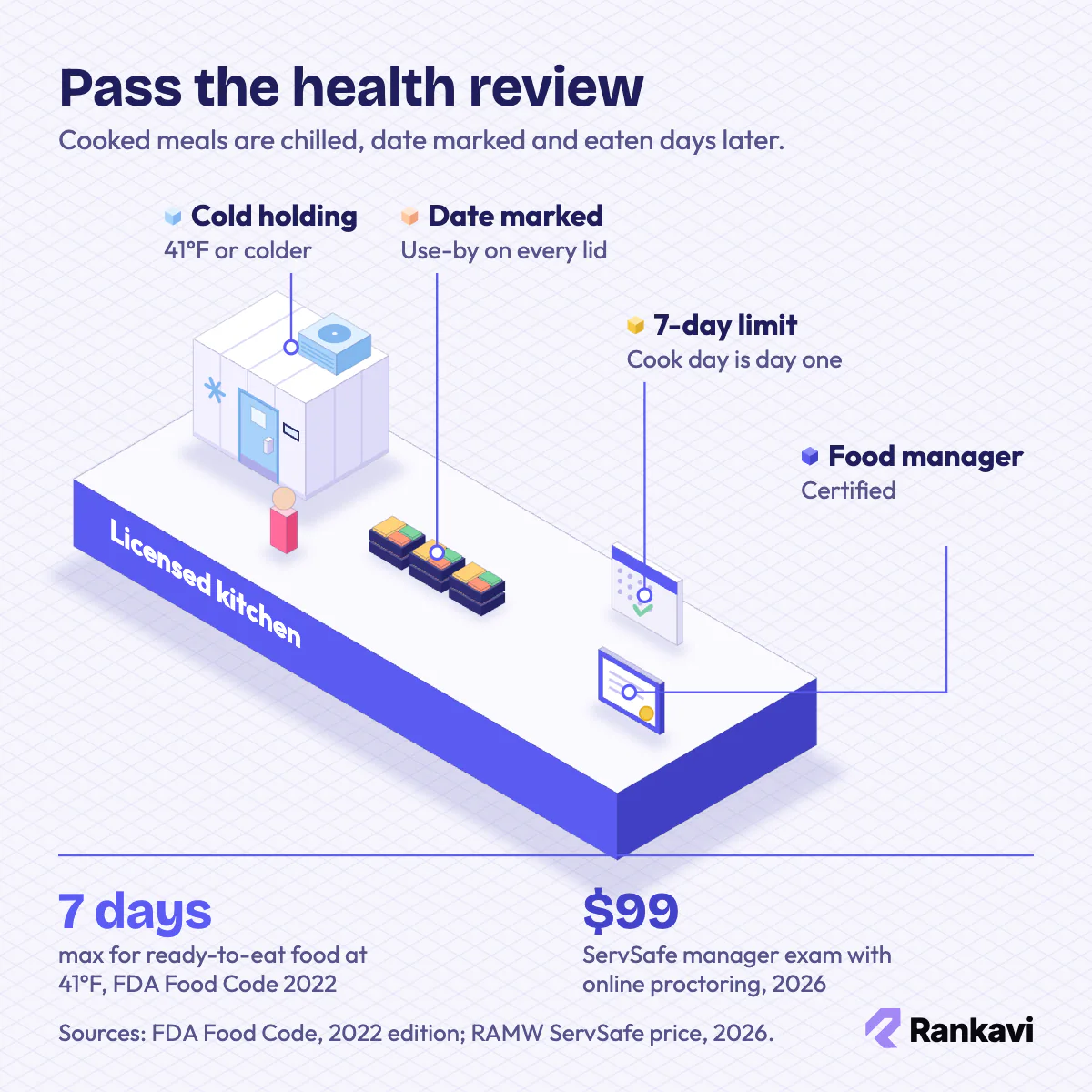
Inspectors check sinks, refrigeration, cooling steps and how food stays cold until delivery. Meal prep adds one more risk, because cooked food is chilled and eaten days later.
A temperature log shows inspectors that cooking and cooling were checked on every batch. Fees and timelines differ by county, so the local health department is the first call.
Most local codes follow the Food Code, a model rulebook the U.S. Food and Drug Administration (FDA) publishes. Its 2022 edition limits refrigerated ready-to-eat food to 7 days at 41°F (5°C) or colder. The day of cooking counts as day one, so the use-by date goes on every container.
State agencies sometimes share the work. In some states the Department of Agriculture licenses food processors, and its inspectors can review kitchen plans before construction.
Training rules vary by state. A certified food protection manager is often required, and cooks usually need a food handler card. ServSafe, a certification program the National Restaurant Association runs, offers one route. Its manager exam with online proctoring costs $99 as of 2026.
Common meal prep permits:
| Permit | Purpose |
|---|---|
| Business license | Lets the company operate in its city or county |
| Health permit | Approves the kitchen and food handling plan |
| Seller’s permit | Lets the company collect sales tax |
| Food handler card | Shows each worker passed basic food safety training |
| Zoning permit | Confirms the address allows a food business |
Labels also need care. Each container lists ingredients, major allergens and that use-by date.
8. Source Ingredients, Containers and Equipment
Sourcing for a meal prep business determines food quality, cost per meal and how meals look on arrival. Reliable suppliers matter more than the lowest price.
Ingredients come from two kinds of supplier. Broadline distributors handle bulk staples, while local farms add seasonal produce that justifies a higher price.
Suppliers differ on minimum order size and delivery days, so a new owner compares both along with price.
Containers carry the brand. Leak-proof, microwave-safe containers protect meals in transit, and compostable options appeal to eco-minded buyers. Buying one container size in bulk cuts the unit cost.
A test batch shows whether lids seal, food stays neat after a reheat and containers survive a delivery trip.
Core meal prep equipment:
| Item | Job |
|---|---|
| Sheet pans and hotel pans | Batch-cook proteins and vegetables |
| Chef’s knives and cutting boards | Prep produce and proteins fast |
| Food thermometers | Log cooking and cooling temperatures |
| Portion scale | Keep every container the same size |
| Label printer | Print ingredients, allergens and dates |
A shared kitchen usually supplies the ovens, ranges and walk-in cooler, so a new owner mostly buys smallwares.
9. Set Up Ordering and Delivery
An ordering system connects the weekly menu, the order cutoff and the delivery route. Customers pick meals online by a set day, and the kitchen cooks to those orders.
An order cutoff before cooking day lets the kitchen buy and cook only what customers ordered, which cuts waste.
Website builders such as Squarespace and Wix offer simple templates for menus and checkout. Subscription platforms add recurring billing and let customers skip a week.
Delivery eats time fast. A tight delivery radius or one pickup point keeps a solo owner in the kitchen instead of on the road.
Meals must stay cold in transit. Insulated bags, ice packs and a refrigerated holding area keep cooked food at safe temperatures until handoff.
Third-party apps such as Uber Eats widen reach but take a commission. Many meal prep owners keep their own delivery for weekly subscribers.
10. Market to the First Subscribers
The first subscribers usually come from people who have already tasted the food. Free trial meals for friends, family and coworkers create early photos, reviews and word of mouth.
Instagram and local Facebook groups suit meal prep. Weekly menu posts, packing videos and macro breakdowns show the food better than any ad.
A sample box or tasting lets buyers try the food before they commit to a plan. Tracking how each subscriber found the company shows which channel earns more effort.
Local partners send steady buyers. Gyms, yoga studios, offices and dietitians all serve people who want ready meals.
Referral offers turn subscribers into sellers. A free meal for each referred friend rewards customers who spread the word.
A Google Business Profile is Google’s free listing in Search and Maps. It puts the company in front of nearby searchers. Customer reviews there help nearby buyers decide.
11. Grow With Subscriptions and Staff
Growth in meal prep turns one-off buyers into weekly subscribers who make revenue predictable. Steady subscriptions also make ingredient orders easier to plan.
Churn is the number to manage. ZenBusiness estimated in July 2026 that meal prep subscribers churn at 15% to 25% a month. Reliable delivery and menu variety keep that loss down.
A skip-a-week option lets a customer stay subscribed through a busy or travel week.
Capacity sets the pace. Many owners cap weekly orders, fill those slots, fix the process, then raise the cap.
Staff come in as orders grow. Prep cooks, packers, delivery drivers and a customer support person usually join in that order.
The first hire usually takes over the task that eats most of the owner’s hours. The U.S. Bureau of Labor Statistics (BLS), which publishes federal wage data, reported a $37,390 median annual wage for restaurant cooks in May 2025.
Corporate accounts add volume. Offices that order team lunches or wellness meals buy in bulk on a fixed schedule.
Customer feedback guides the menu. Short surveys and reorder data show which dishes to keep and which to drop.
12. Appear in Google AI Overviews Meal Picks
Busy professionals, parents and gym members now ask Google which meal prep service to try. Google AI Overviews answers many of those searches with a short list of local names.
Those answers draw on what trusted sites already say. Local food guides, “best meal prep” roundups and review sites shape which companies appear.
Rankavi is a software as a service (SaaS) platform that publishes brand mentions in articles on indexed third-party websites. Meal prep founders use it to earn brand mentions Google AI Overviews picks up in local food articles.