

Starting a marketing business takes a proven skill, a clear client niche and prices that cover slow months. Skilled marketers often leave well-paid jobs to do it. The U.S. Bureau of Labor Statistics (BLS), which publishes federal wage data, put the median marketing manager wage at $166,790 in May 2025.
My name is Michal Sieroslawski, and I help marketing agencies reach businesses through search. When businesses ask ChatGPT for a marketing agency, the names in the reply get the first look.
The order fixes the offer and its prices before any money goes into paperwork, software or outreach. Each of the seven steps below builds on the last, from marketing idea to first paying customer.
- Choose Your Marketing Niche and Services
- Price Your Services and Budget the Launch
- Register the Agency and Sign Contracts
- Set Up Your Marketing Tool Stack
- Land the First Marketing Clients
- Grow With Contractors and Hires
- Earn Agency Citations in Google AI Overviews
1. Choose Your Marketing Niche and Services
A marketing business sells a freelancer’s hours, a specialist agency’s focused service or a full-service agency’s whole program. Each model carries different overheads and limits.
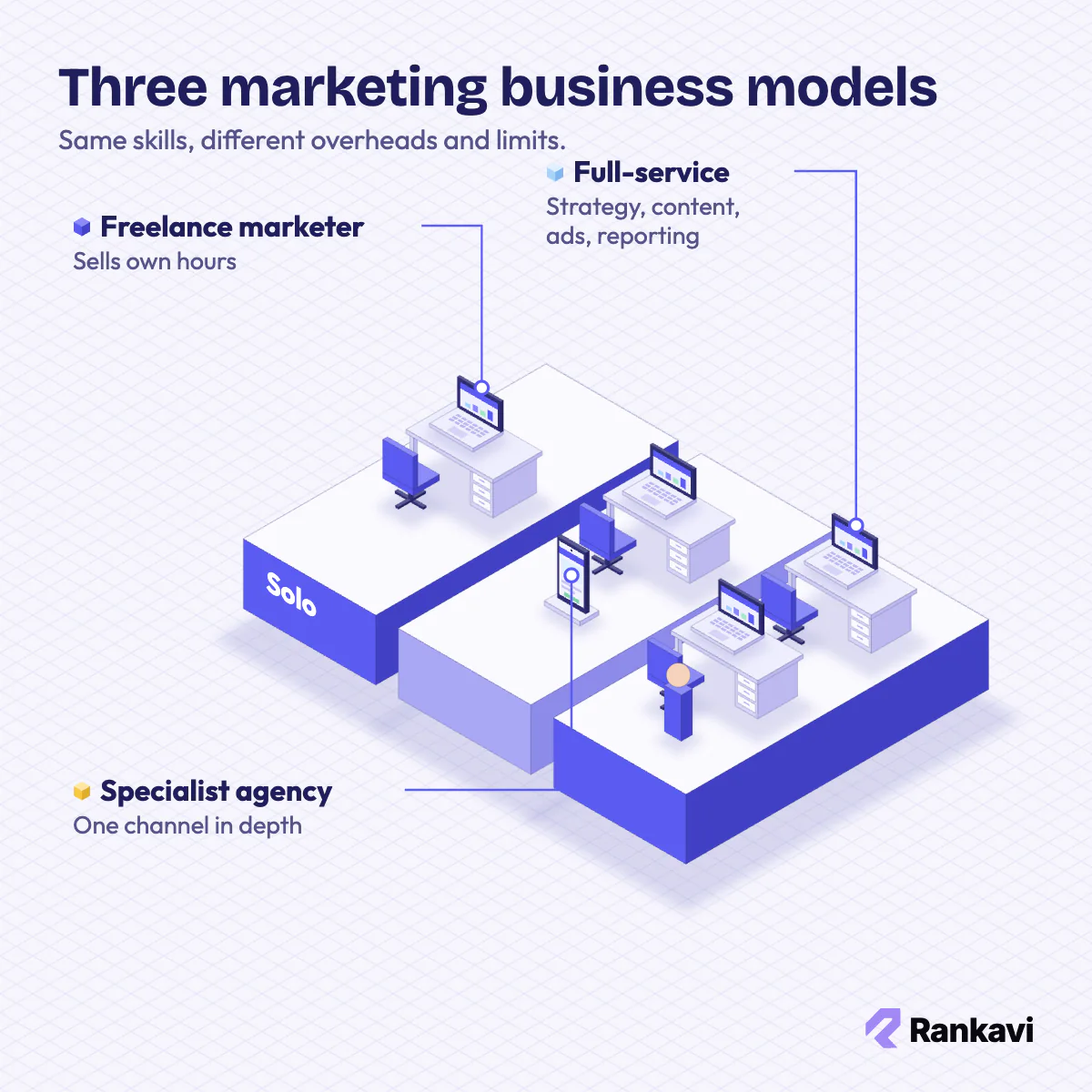
Three marketing business models:
| Model | What the client buys | Main limit |
|---|---|---|
| Freelance marketer | The founder’s own hours and skills | Hours in the week |
| Specialist agency | One channel done in depth, such as paid ads | A narrow buyer pool |
| Full-service agency | Strategy, content, ads and reporting together | Payroll and coordination |
Three other models exist. A consultant sells advice and strategy without running campaigns. A fractional chief marketing officer (CMO) leads a client’s marketing part-time. A white-label agency does work for other agencies under their brand. Consulting suits founders with senior experience, while white-label work gives steady volume but no direct client relationship.
A client niche makes the agency easier to remember and to refer. “Marketing for local bookstores” or “paid social for software startups” tells prospects exactly who the firm serves. Broad “marketing services” competes with every agency in town.
A niche can be defined in five ways:
- Industry: dental practices, law firms or ecommerce brands, where the founder already knows the buyer’s language.
- Service: one deliverable such as email marketing or paid ads, which makes the offer easy to compare and sell.
- Client size: startups, small local firms or mid-market companies, which differ in budget and in who signs the contract.
- Location: businesses within one metro area, which helps with local networking but caps the buyer pool.
- Platform: Shopify stores or Amazon sellers, where platform knowledge becomes the selling point.
A niche works when four conditions hold. The founder has relevant skills or experience. The target clients already spend money on marketing. Enough of them exist to fill a client list. Competing agencies leave room for a newcomer. A founder without a niche can start broad. The first few clients then show which work pays best.
The first offer should hold one or two core services the founder already delivers well. Search engine optimization (SEO), paid ads, social media, email and content are the usual starting points. Extra services can wait until the first ones run smoothly.
Each service targets a different result. SEO aims at organic traffic and rankings. Google Ads is Google’s pay-per-click advertising platform, where advertisers bid for placement in search results. Paid ads there and on Meta Ads and LinkedIn Ads aim at leads at a set cost per lead. Email marketing aims at repeat sales, and content marketing at inbound leads and authority. Services should match the niche. Local SEO suits dental practices and home services, while LinkedIn Ads suit business software firms.
The Google Ads certification gives a new agency some proof of skill. A portfolio of pilot projects or spec work can fill the gap when client results do not exist yet.
Competitor checks show where the gaps sit. Directory listings, Google Maps results and LinkedIn pages show which agencies already serve a niche. Agencies already serving the niche reveal their packages, their messaging and the clients they ignore. Google Trends is a free Google tool that shows how search interest in a topic rises and falls over time. It helps check that a niche has steady demand. Calls with a few target clients confirm which problems they would pay to fix. A pass mark set before the calls keeps the result honest.
A one-page business plan holds these decisions together. It names the target client, the core services, the revenue goal and the angle that sets the agency apart.
2. Price Your Services and Budget the Launch
Pricing sets how a marketing business turns its time and skill into steady revenue. Most agencies combine a few models rather than relying on one.
Common marketing pricing models:
| Model | Best fit | Main risk |
|---|---|---|
| Hourly | Advice, audits and small fixes | Income capped by hours |
| Project | Website builds and campaign launches | Underquoting the scope |
| Monthly retainer | Ongoing social, content and ad management | Scope creep |
| Performance | Lead generation with clear tracking | Results depend on the client |
Clutch is a business-to-business (B2B) ratings and reviews platform for agencies. Its September 2026 pricing guide, built from verified client reviews, put the typical advertising agency rate at $100 to $149 per hour.
SparkToro is an audience research software company that runs a yearly agency survey. Its 2025 survey of 376 mostly North American and European agencies found 85% preferred retainers, up from 81% in 2024. In the same 2025 survey, 49% reported an average monthly retainer of $1,000 to $5,000.
Four other pricing methods appear in agencies that grow beyond the basic table:
- Value-based pricing: the fee follows the outcome for the client, such as revenue gained, instead of hours spent. It earns more when results are strong but needs trusted tracking.
- Hybrid pricing: a base retainer plus a performance bonus. The base covers costs and the bonus shares the upside.
- Productized packages: a fixed set of deliverables at a fixed price, such as an SEO audit. These are easy to sell and quote but leave little room for custom work.
- Percentage of ad spend: a management fee for paid media that rises with the client’s budget. Small budgets often make this fee too low to cover the work.
A rate starts with the income needed, plus overhead and taxes, divided by the hours that can realistically be billed. Billable hours are always fewer than working hours, because sales, admin and reporting take time. A retainer then equals that rate times the monthly hours the deliverables need.
Retainers fit marketing because campaigns never really finish. Every retainer still needs a written list of monthly deliverables, or it drifts into unlimited access. A paid audit or a starter tier gives cautious buyers a smaller first step.
Several terms protect the revenue. Retainers are usually billed in advance, and projects often start with a deposit. A minimum contract length and a notice period stop clients from leaving after one month. Late fees and payment terms belong in writing. Revision limits and an hourly rate for out-of-scope work keep scope creep in check.
Ad spend is normally a pass-through cost. The client pays the ad platform, or the agency passes the bill on. That money is not agency revenue. Counting it as revenue makes margins look far smaller than they are.
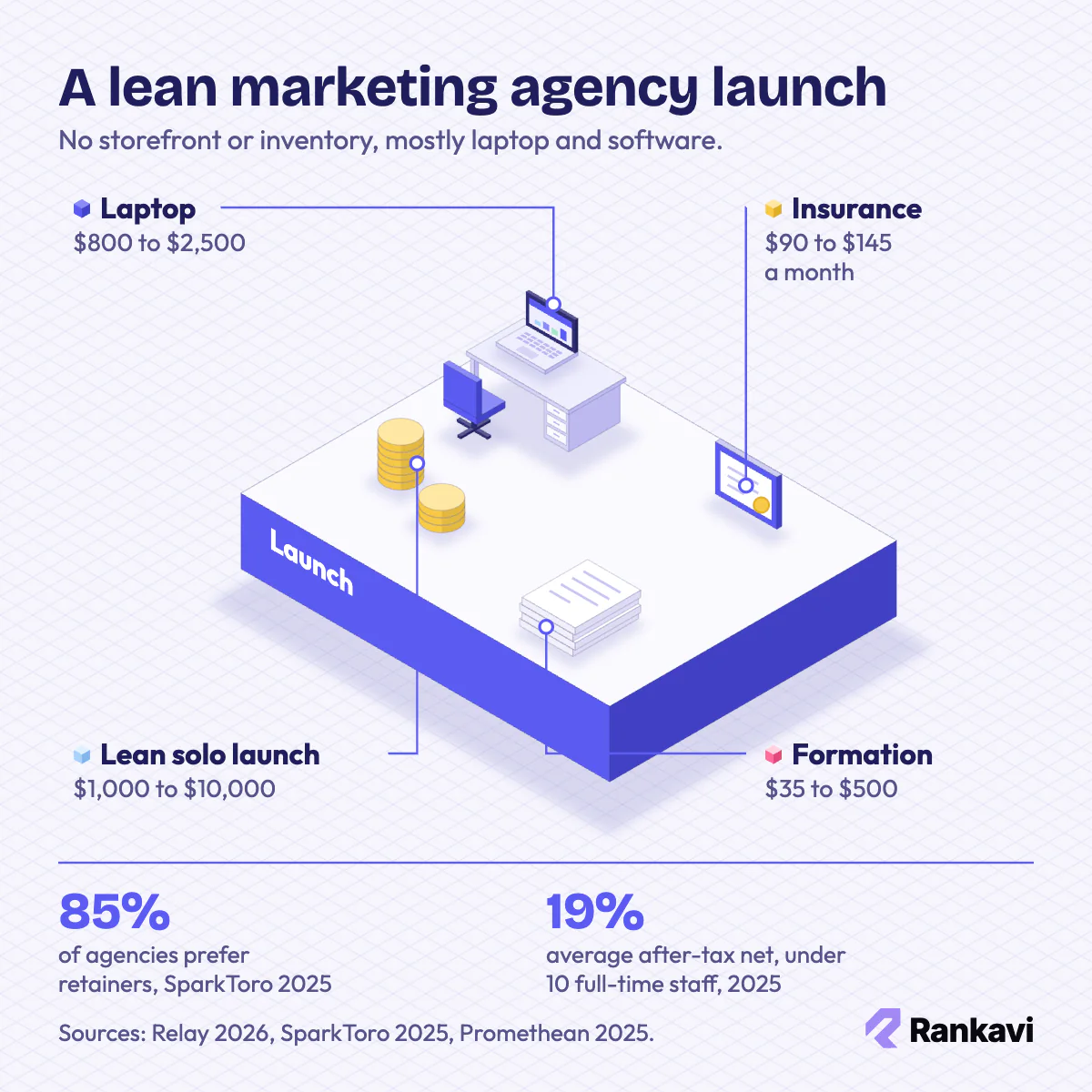
Launch costs stay low for a home-based agency, since no storefront or inventory is needed. Relay is a business banking platform for small companies. Its August 2026 vendor estimate put a lean solo agency launch at $1,000 to $10,000.
Startup money at a glance:
| Item | Marketing business figure |
|---|---|
| Startup cost | $1,000 to $10,000 for a lean solo launch |
| Main costs | Laptop ($800 to $2,500 per workstation), website, software, business formation ($35 to $500), insurance ($90 to $145 a month) |
| Typical margin | 19% average after-tax net margin for digital agencies with fewer than 10 full-time employees |
| Time to open | Varies: a freelancer can sell within weeks, while case studies and referrals take months to build |
Sources: Relay (business banking platform, vendor estimates), August 2026; Promethean Research, which publishes digital agency benchmarks, 2025 data published 2026. Time to open stays qualitative since no published figure covers agency launch timelines.
The same benchmark firm found a 13% average after-tax net margin across all agency sizes in 2025. The two figures group agencies differently, so they are not a like-for-like comparison.
Worked example: A solo marketer signs three retainers at $2,000 a month each, inside the most common band (illustrative figures). Revenue reaches $6,000 a month. A starter software stack costs about $250, and insurance adds $145. That leaves $5,605 a month before tax, or about $67,000 a year. Three mid-range retainers therefore replace a modest salary, but not a senior one.
The example leaves out income tax, payment processing fees, contractor costs and unpaid time spent on sales and admin. It also assumes no client leaves.
Working capital matters more than equipment. Clients take time to sign, so the founder needs savings or a side income for the quiet first months. Those months also need a tax set-aside. A self-employed founder pays self-employment tax and makes quarterly estimated payments.
Founders who need outside money have a few options. Savings keep full control, and a side income bridges the first months. The U.S. Small Business Administration (SBA) is the federal agency that backs small business loan programs, including microloans. A business line of credit covers gaps while client invoices wait to be paid. Each adds debt or delay, so savings remain the safest base.
3. Register the Agency and Sign Contracts
Registering a marketing agency gives it a legal form, a tax identity and contracts that protect both sides. A home-based agency rarely needs a special license.
A solo founder can start as a sole proprietorship and form a limited liability company (LLC) later. The LLC separates business debts and claims from personal savings. Other choices are a partnership for co-founders and a corporation for founders who raise investment. Most solo agencies choose an LLC for its mix of protection and low upkeep. Some founders wait for steady income first:
“why not get 3-5 clients and when you have some consistent cashflow, you can do all these formalities”
— A viewer commenting on a YouTube video about starting a digital marketing agency
A founder usually files the LLC in the home state, with the Secretary of State or the state’s equivalent office. Fees and yearly reports differ by state. Every state also requires a registered agent, who receives legal papers for the business. The founder can act as the agent or hire a service.
A business name needs a check against the state registry, and a trademark search helps avoid conflicts. A name that differs from the legal one needs a doing-business-as (DBA) filing. Cities and counties may also require a local business license, and home-based agencies should check zoning rules and lease terms.
The Internal Revenue Service (IRS) issues a free employer identification number (EIN) to new businesses. A separate business bank account keeps client payments apart from personal spending. Mixing the two can weaken the legal protection that an LLC offers. An operating agreement records ownership and decision rules, and it matters most when co-founders share the agency.
A client service agreement sets the scope, payment terms and notice period. It also states who owns the creative work, the ad accounts and the data once the contract ends.
Client email campaigns fall under the federal commercial email law. The Federal Trade Commission (FTC) enforces that law, and both the client and the sending agency can be held responsible. As of 2026, the FTC lists penalties of up to $53,088 per violating email.
Professional liability insurance covers claims that advice or a campaign error cost a client money. General liability insurance covers other third-party claims, and cyber coverage matters when the agency handles client data. A lawyer can review the service agreement template once. The same document then serves every later client.
4. Set Up Your Marketing Tool Stack
A tool stack covers the software an agency uses to research, create, publish and report. The right mix depends on the services the agency sells.
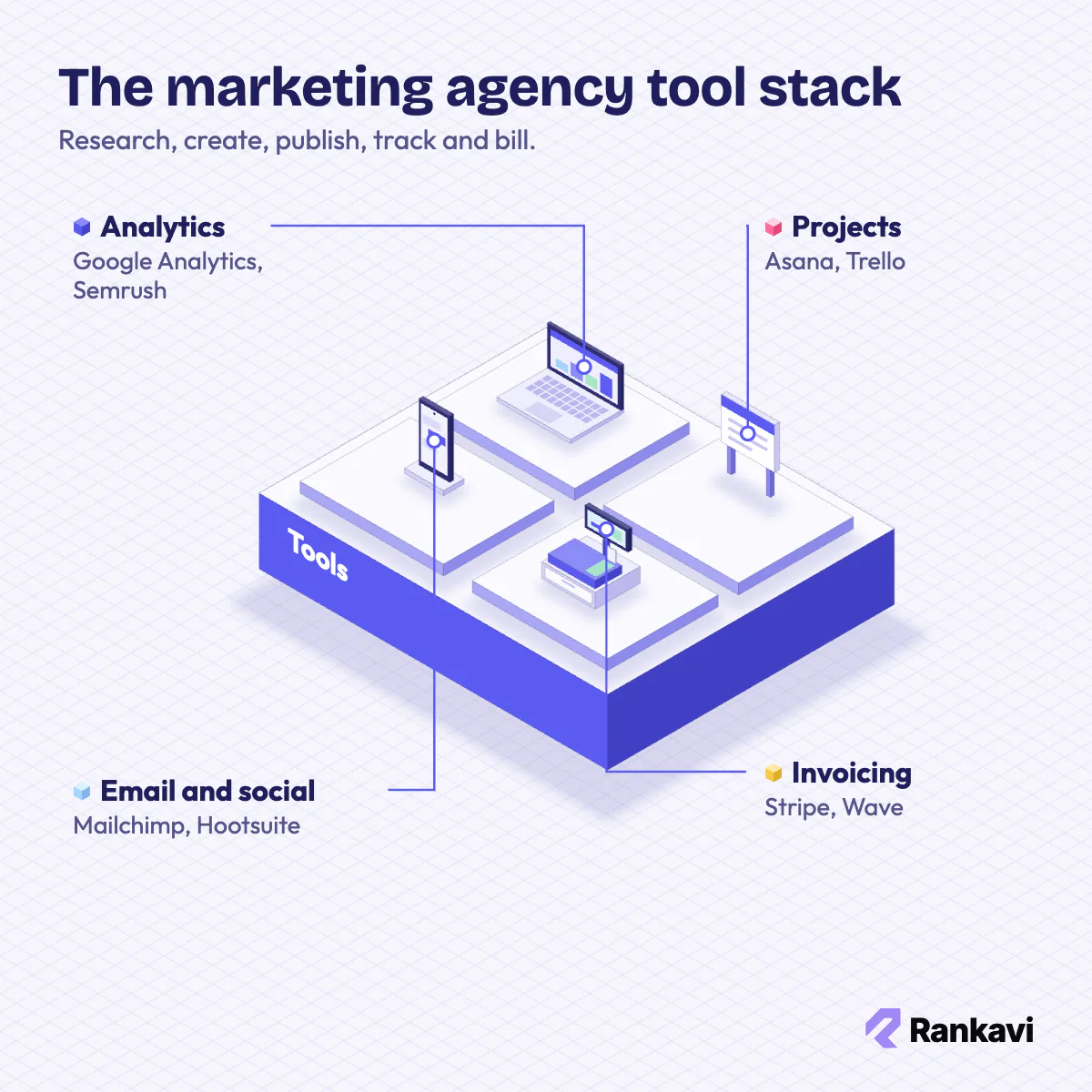
Core tools for a marketing business:
| Job | Typical tools |
|---|---|
| Analytics and research | Google Analytics, Semrush |
| Design and content | Canva, Adobe Photoshop |
| Email and social scheduling | Mailchimp, Hootsuite, Buffer |
| Project management | Asana, Trello |
| Invoicing and payments | Stripe, Wave |
Google Analytics is Google’s free web analytics service, which tracks site traffic and conversions for every client. Semrush, an online visibility platform, handles keyword and competitor research. Canva is an online graphic design platform for quick social and ad visuals.
Mailchimp, an email marketing platform owned by Intuit, sends client newsletters and tracks opens. Free tiers cover most needs at the start. A tool gets upgraded only when a paying client’s work demands it.
Four criteria help choose between tools:
- Services sold: the tool must fit the work the agency delivers.
- Monthly cost: fees add up while the client list is small.
- Data export: a tool that locks reports inside one account makes switching painful.
- Client visibility: clients should be able to see the results. Paid tools should wait for signed work.
Looker Studio is Google’s free reporting tool that turns data from Google Analytics and ad platforms into client dashboards. Asana is a project management platform that tracks tasks and deadlines across clients. Stripe is a payment processor that lets clients pay invoices by card. Its processing fee is a cost to budget for.
Documented processes matter as much as software. Checklists for onboarding, reporting and campaign launches let any team member follow the same steps. Those checklists later make hiring and training far easier.
Every client account should sit under the client’s ownership, with the agency added as a user. That setup builds trust and avoids disputes if the relationship ends.
5. Land the First Marketing Clients
First clients usually come from people who already know the founder’s work. Former employers, colleagues and local business owners are the warmest leads.
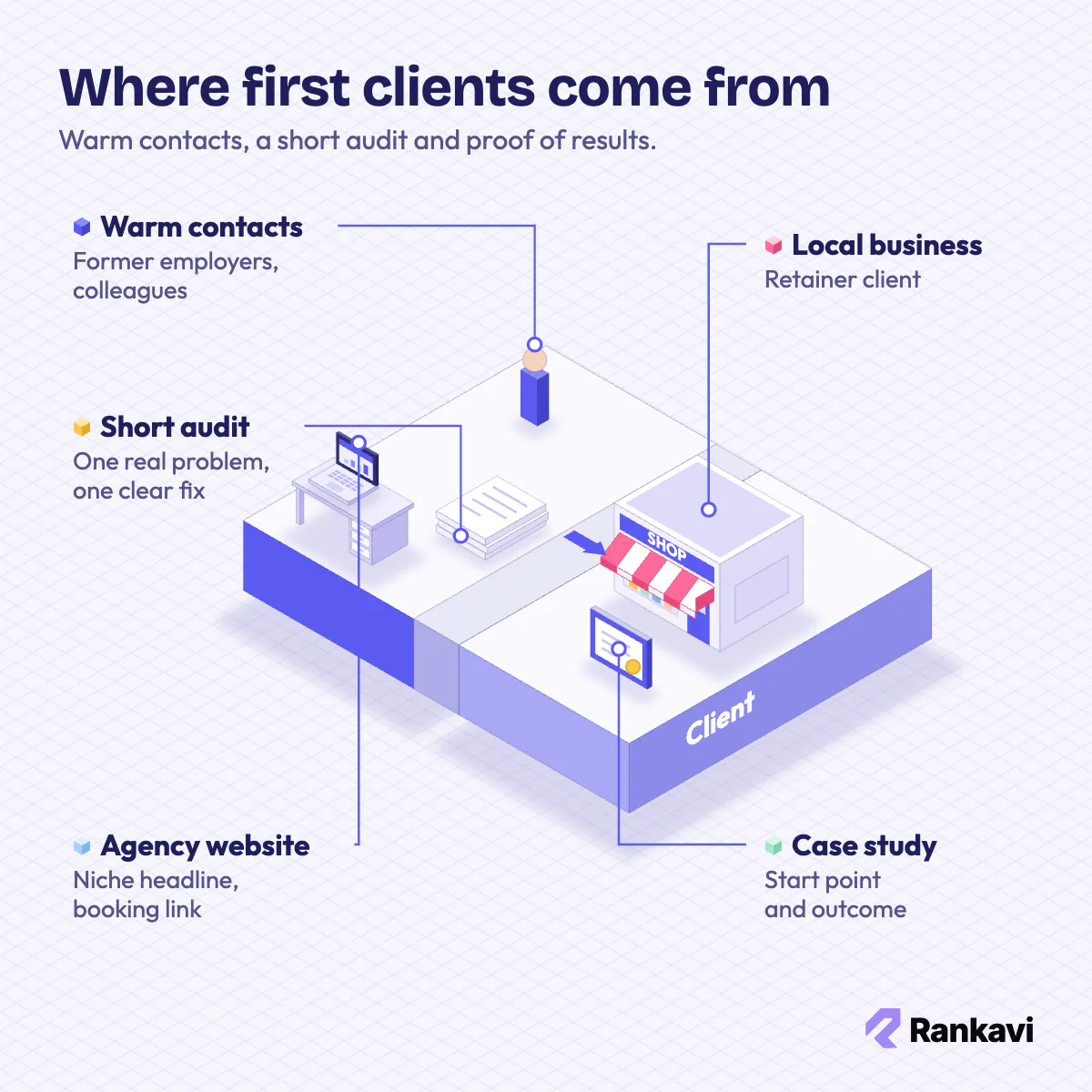
The agency’s own website acts as its storefront. A niche headline, clear packages, a portfolio and a booking link turn visitors into calls. A well-run site also proves the agency practices what it sells.
A short audit opens doors faster than a sales deck. It shows a prospect a real problem in their marketing and a clear way to fix it. Good audits lead straight into a paid project or retainer.
Case studies carry the most weight with new prospects. One documented result, with the starting point and the outcome, beats any list of promises. Early clients who agree to a written testimonial speed up every later sale.
Upwork is a freelance marketplace that connects businesses with independent professionals. New marketers use it to win paid work and early reviews. The trade-off is competition from lower-priced bidders and a fee on earnings. Partnerships with web developers and designers add a steady stream of referrals.
Outreach adds a second path when the warm network runs dry. LinkedIn messages and local networking events reach business owners in the chosen niche. A short, specific message that names one visible problem gets more replies than a generic pitch. A listing on Clutch and a complete Google Business Profile help prospects who search for agencies by name.
Each sales call should end with a written proposal that lists the scope, the price and the start date. A proposal sent the same day keeps the conversation fresh. Early discounts should be limited and time-bound, so that the first clients do not set the price for later ones.
6. Grow With Contractors and Hires
Growth turns a founder-led practice into a team that delivers without constant oversight. The shift begins once client work fills the founder’s week.
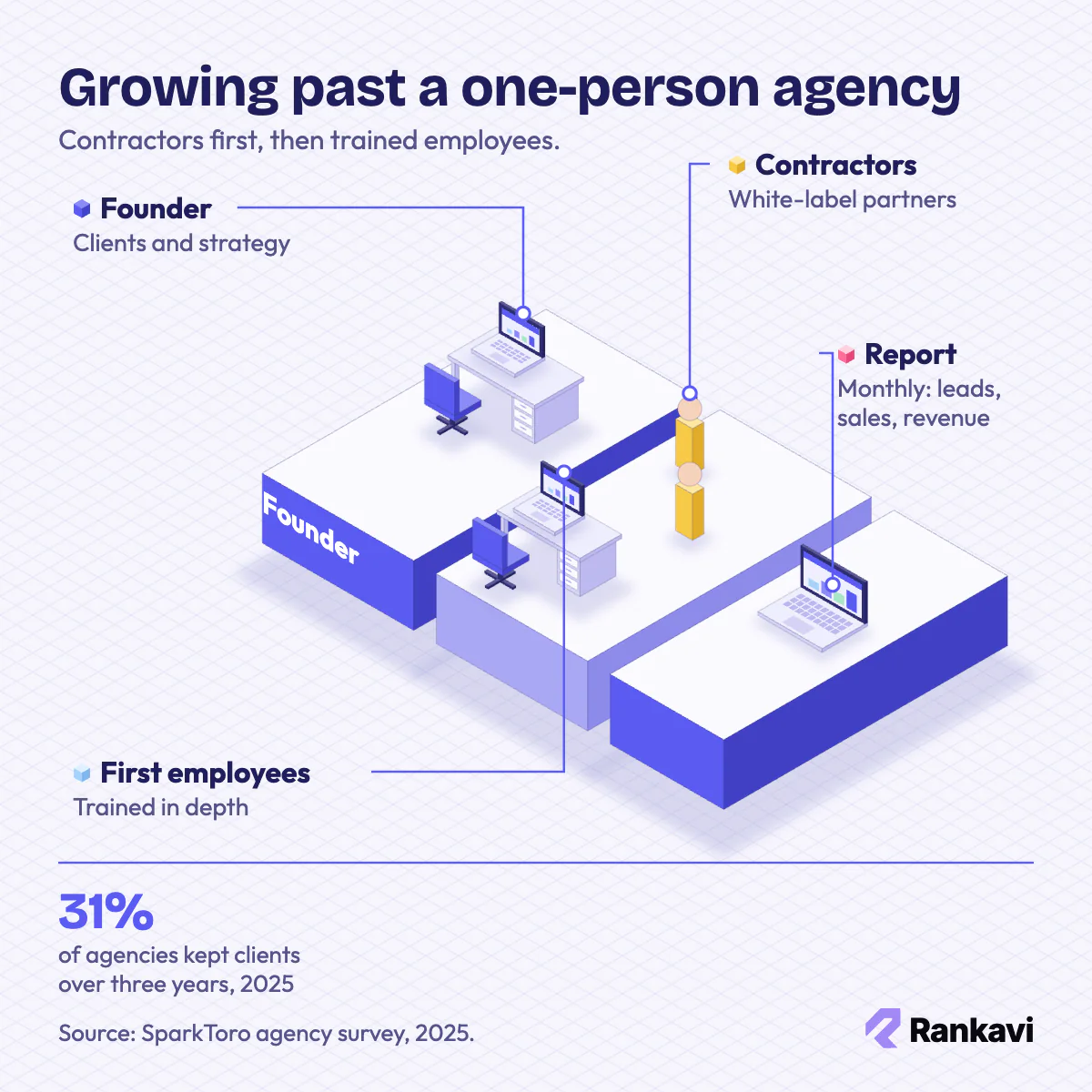
Freelancers and white-label partners add capacity before payroll does.
A white-label partner delivers work under the agency’s brand, so clients deal only with the agency. Each contractor needs a written agreement covering scope, confidentiality and ownership of work.
The IRS applies tests to decide whether a worker is a contractor or an employee. Long-term, closely supervised work may need payroll instead. Contractors keep fixed costs low but offer less control over quality and availability.
New employees should fit the agency’s culture as well as its skill gaps. Founders who train early staff in depth can later hand training to them. Senior people then spend their time on clients and strategy.
Productized packages make delivery repeatable. A fixed set of deliverables at a fixed price is easier to sell, staff and quote. Written checklists for each service let a new hire or contractor deliver the same result as the founder. Hiring usually starts with the task that takes the most founder time, such as reporting.
Retention keeps growth profitable. In SparkToro’s 2025 agency survey, 31% of agencies said they kept clients for over three years. Monthly reports that tie the work to leads, sales or revenue help clients renew and refer others.
7. Earn Agency Citations in Google AI Overviews
Business owners now ask ChatGPT, Perplexity or Google for agency suggestions in their industry. Google AI Overviews are the AI-generated summaries above some search results, and they often answer that question first.
Those answers draw on what agency directories, review sites and “best agencies” articles already say. A young agency with few outside mentions rarely appears. Early mentions on trusted sites give the summaries something to repeat. Profiles on directories such as Clutch, client reviews and the agency’s own case studies all add to that record. No tactic guarantees a citation, since the summaries change with each query.
Rankavi is a software as a service (SaaS) platform that publishes brand mentions in articles on indexed third-party websites. Agencies that want their name cited in Google’s summaries can review its AI Overviews citation packages.