

Starting a lawn care business means buying a mower, insuring the work and winning nearby homeowners who want weekly cuts. The U.S. Bureau of Labor Statistics (BLS), which publishes national job data, counted 20% of grounds maintenance workers as self-employed in 2025.
A bit about me: my name is Michal Sieroslawski, and I help lawn care businesses appear when homeowners search online. Many homeowners now start by asking ChatGPT, so its suggestions can bring new customers.
The order below prices the work and lines up money before any filing fee or equipment purchase. Licensing and insurance then come before the first paid lawn. The twelve steps below show how to start a lawn care business, in order.
- Choose Your Lawn Care Services
- Research Demand in Your Service Area
- Write a Lawn Care Business Plan
- Price Mowing by the Visit
- Fund Your Mowers and Trailer
- Register the Business With Your State
- Get a Pesticide Applicator License
- Insure Your Crew and Customers’ Property
- Buy Commercial Mowing Equipment
- Market Before the Spring Rush
- Grow Dense Routes and Add a Crew
- Surface in AI Lawn Care Recommendations
1. Choose Your Lawn Care Services
Choosing lawn care services decides which yards the company works on and what it does there. That menu shapes the equipment list, the licenses and the price sheet for every later step.
Before picking services, an owner needs to know which trade the company belongs to. Lawn care and landscaping are different trades. A lawn care company keeps existing turf healthy through mowing, edging, feeding and weed control. Landscapers design and build outdoor spaces with plants, stone and new beds. Most new owners start on the recurring maintenance side because it needs less capital.
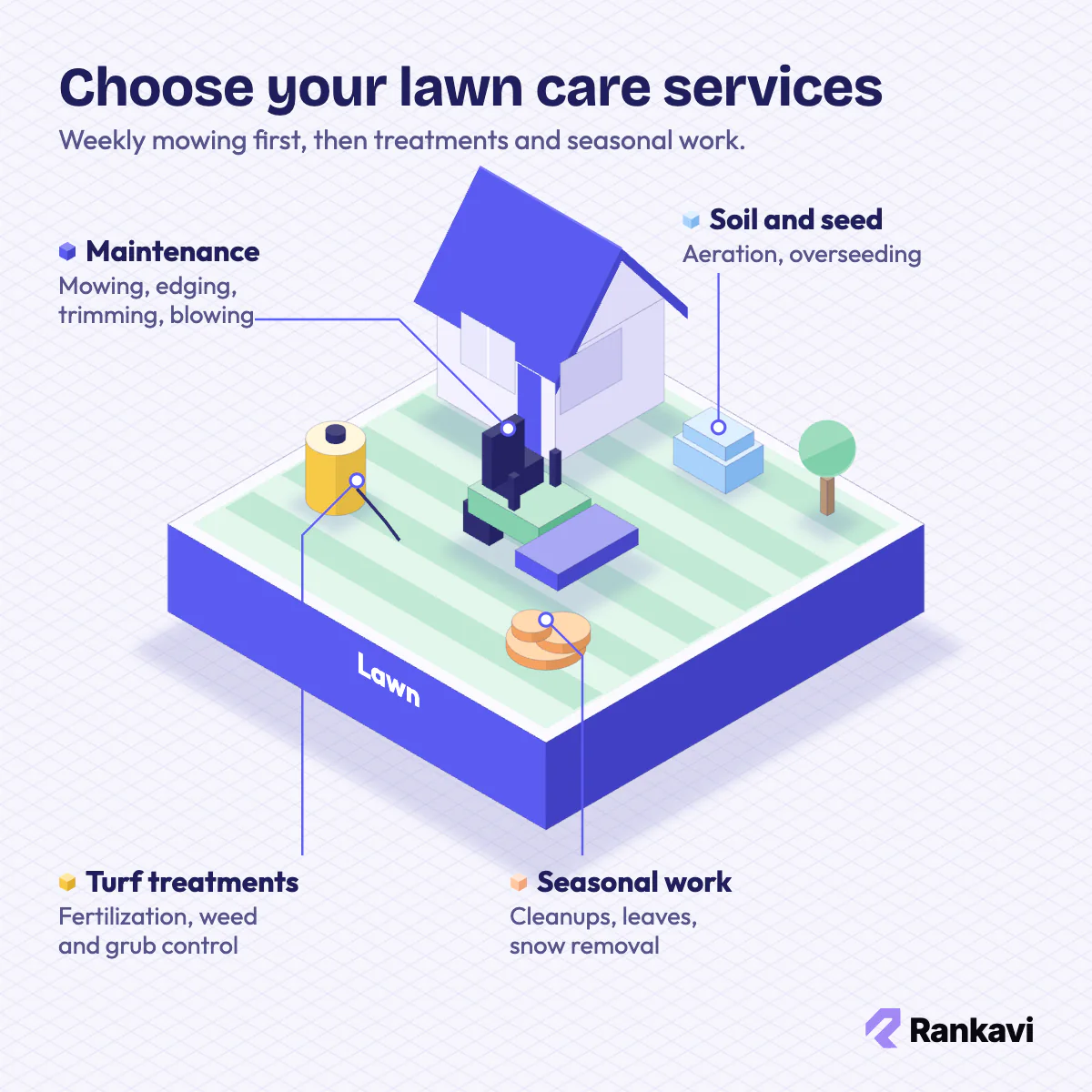
Within lawn care, weekly mowing is the core service for most new companies. Treatment work adds higher-value visits to the same lawns the crew already mows. The usual treatments are fertilization, weed control, aeration, overseeding and grub control. Aeration means pulling small plugs of soil so air and water reach the roots. Overseeding means spreading new seed over existing grass.
These services fall into four groups:
Common lawn care services:
| Service type | Examples |
|---|---|
| Recurring maintenance | Mowing, edging, trimming, blowing |
| Turf treatments | Fertilization, weed control, grub control |
| Soil and seed work | Aeration, overseeding |
| Seasonal work | Spring cleanup, leaf removal, snow removal |
Grass type decides the calendar. Cool-season grasses such as Kentucky bluegrass and tall fescue dominate northern lawns. They peak in spring and fall. Warm-season grasses such as Bermuda, zoysia and St. Augustine dominate southern lawns. They grow hardest in summer. Aeration and overseeding timing follows the grass type, so the local grass sets the work calendar.
Each service needs its own tools and rules, so a starter menu can stay small and grow in stages. Weekly mowing, edging, trimming and blowing come first. They need only a mower, a trimmer and a blower. Aeration and overseeding come next, since the equipment can be rented. Fertilizer and weed control come last because they bring license rules, covered in a later step.
Mowing fills only part of the year, so seasonal add-ons help smooth out a short season. Spring cleanups and fall leaf removal bracket the cutting season. In colder regions, snow removal keeps the truck earning through winter.
With a service menu in mind, a founder must also decide whether to buy a brand or build one. Some founders buy a franchise instead of starting from scratch. Franchisees pay fees and get training and systems in return. Lawn Pride, for example, is a weed control and fertilization franchise. It is owned by Neighborly, a home services franchisor.
Lawn Doctor, Weed Man, Spring-Green and NaturaLawn of America sell similar treatment-focused programs. A franchisor must give buyers a Franchise Disclosure Document, which lists fees, obligations and territory.
An independent mowing business takes the other path. It keeps full control over its services and prices. In exchange, it must build its own name against national operators such as TruGreen and Scotts LawnService. The choice comes down to paying fees for training and systems, or keeping full control while building a name alone.
2. Research Demand in Your Service Area
Researching demand shows whether enough nearby lawns exist to fill a weekly route. Good research prevents a new mowing company from chasing customers scattered across a whole metro area.
Across the country, demand for this work is steady. The BLS counted 1,299,200 grounds maintenance jobs in 2025. It projected 5% growth for those workers from 2025 to 2035. These national numbers show the trade is healthy. They cannot show whether one town has enough lawns, so that answer has to come from local research.
Local research starts with a choice between residential and commercial clients, because the two groups buy in different ways. Homeowners book weekly mowing and pay per visit. Commercial clients, such as offices and apartment complexes, sign larger seasonal contracts. They also expect formal bids and proof of insurance.
Each segment needs its own equipment, insurance proof and pricing. Picking one segment first keeps the early menu of services and the route simple.
Once the segment is set, a founder can study the companies already serving it. This means listing the local mowing companies along with their services, prices and reviews. Gaps show up quickly in a list like this. One suburb may have no one offering treatments. In another area, local companies may reply slowly to quotes.
A gap only matters if customers actually want the service, so the next step is testing demand. This can happen before any equipment is bought. The founder advertises the service and counts the quote requests that come in. The following four channels can bring in those requests:
- Nextdoor: Posts on Nextdoor can bring quote requests from people in the area.
- Local Facebook groups: Posts in these groups can also bring quote requests.
- Flyers: Flyers handed out or posted nearby can bring quote requests too.
- Google map listing: A free Google map listing lets local people find the business and request a quote.
The number of requests shows whether a route can fill. Free advising from the Service Corps of Retired Executives (SCORE) can help a founder review the results.
The count alone is not enough, because a route depends on where the lawns are. Neighborhood choice matters more than city size. Subdivisions with similar lot sizes and busy households produce many lawns on a few streets. A tight service area cuts fuel, drive time and wear on the trailer.
3. Write a Lawn Care Business Plan
Writing a lawn care business plan sets the services, target clients, prices and money goals before equipment is bought. If the owner seeks a loan, the lender reads that document first.
Because the plan’s reader changes, its length can change too. An owner who self-funds can write a one-page lean version. An owner who needs a lender writes a longer version. SCORE, a nonprofit that mentors small business owners, offers free templates to start from.
Whatever the length, the plan covers the same ground. A lawn care business plan has five core sections:
- Services and target clients: This section names the work the business will offer and the clients it will serve.
- Pricing strategy: This section sets what the business will charge for its services.
- Marketing plan: This section explains how the business will reach its target clients.
- Startup and operating budget: This section lists what the business will spend to open and to keep running.
- Financial projections: This section covers startup costs, a 12-month cash flow forecast, a profit and loss statement and break-even. A cash flow forecast tracks the money coming in and going out each month. A profit and loss statement shows revenue minus costs. The break-even point is where revenue covers all costs.
Every projection rests on a few key assumptions. These are revenue per visit, visits per week, labor hours per property, fuel, insurance and owner pay. These numbers are estimates. The plan therefore builds three versions: conservative, expected and best case. Comparing them shows how much room the plan has if results come in low.
In a mowing plan, seasonal cash flow is the key assumption. Revenue peaks during the growing months, when lawns need regular cutting. It drops sharply in late fall. Loan payments and insurance still come due in the slow months. A sound projection shows how the business covers them.
Climate decides how long the season lasts. Northern markets mow for fewer months, so their slow stretch is longer. Southern markets mow for most of the year.
Off-season work such as leaf cleanup or snow removal needs its own equipment and insurance. The plan models it separately. Flat monthly billing, where clients pay the same amount each month, evens out cash flow across the year.
The plan also tests the owner’s fit for the work. Lawn care means long days outdoors in heat. It means lifting equipment onto trailers and working in all kinds of weather. A realistic plan budgets the owner’s own hours before it budgets hired help.
4. Price Mowing by the Visit
Pricing lawn care services turns each visit into a fee that covers labor, overhead and profit. Prices set too low leave the owner mowing at a loss all season.
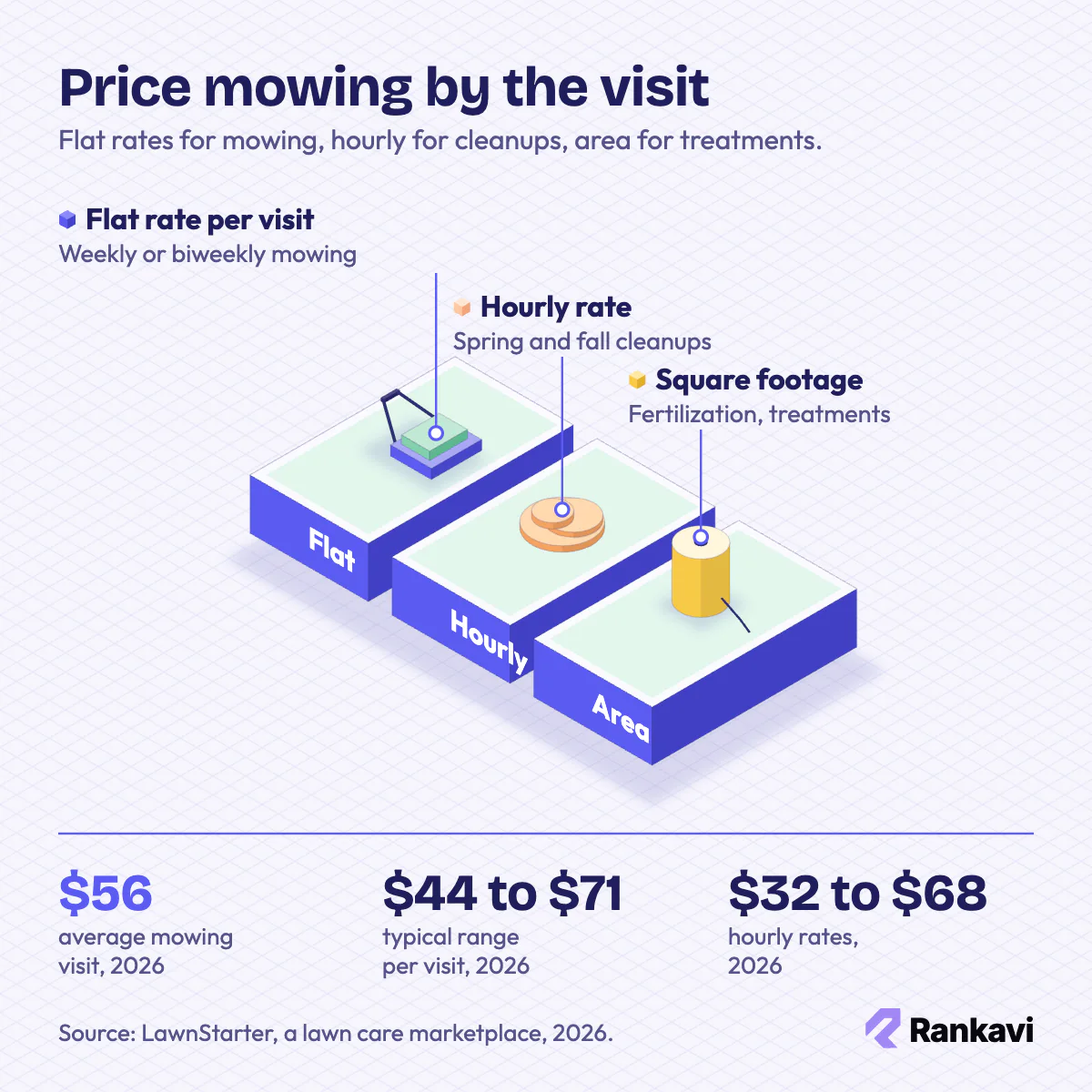
To avoid that loss, a new owner first needs to know what customers already pay. LawnStarter runs a marketplace that books lawn care pros for homeowners. It builds its cost guide on its own booking data. Its October 2026 cost guide puts the average mowing visit at $56. The 2026 guide’s typical range runs from $44 to $71 per visit. Its 2026 hourly rates run from $32 to $68.
Lawn care pricing follows three main models:
- Flat rate per visit: Recurring mowing takes about the same time on each lawn every visit. That steady time makes one set fee safe to charge.
- Hourly rate: Some jobs, such as cleanups, are hard to size up before the work starts. Charging by the hour means the fee grows with the time the job takes.
- Square footage rate: This rate charges by the lawn’s area in square feet. It suits treatments such as fertilization.
The table below matches each model to the jobs it fits best.
Lawn care pricing models:
| Model | Best fit |
|---|---|
| Flat rate per visit | Weekly or biweekly mowing |
| Hourly rate | Spring and fall cleanups |
| Square footage rate | Fertilization and other treatments |
Even within one model, no two lawns cost the same to mow. Lot size, slope, obstacles, grass height and visit frequency all move the price. Frequency matters because grass grows taller between cuts. Taller grass takes longer to cut, so biweekly service costs more per visit than weekly service.
Very small lawns raise a different problem. Their fee may be too low to be worth the stop. A minimum fee per stop keeps very small lawns from losing money.
A minimum fee raises a bigger question: what is the lowest price the business can charge? Overhead decides that floor price. Overhead means the costs of running the business beyond the mowing itself.
Fuel, insurance, equipment wear and drive time all belong in a daily overhead figure. Many lawn maintenance firms never calculate this daily overhead rate. Many also never calculate the cost of a free estimate.
Since each lawn’s features change the price, the owner needs to see the lawn before quoting. A walk-through of the property reveals slopes, gates, obstacles and the property owner’s expectations. A narrow gate, for example, forces a smaller mower and a slower visit. Quotes built on these details win better jobs.
Once the price is right, the next goal is to keep the customer all season. Weekly contracts do this better than one-off cuts. A season-long agreement fixes the visit day and locks in revenue. It also keeps the grass short enough for fast mowing.
5. Fund Your Mowers and Trailer
Funding a lawn care startup covers the gap between buying equipment and collecting the first monthly payments. Most of the early money goes into machines that earn back their cost over several seasons.
Startup money at a glance:
| Item | Figure |
|---|---|
| Startup cost | $15,000 to over $50,000 from scratch, mostly driven by equipment quality |
| Main costs | Walk-behind mower $1,000 to $5,000, ride-on mower $6,000 to $10,000, used truck from $5,000, open trailer about $1,000 |
| Typical margin | Landscape maintenance gross margin around 50% to 53% (industry composite; landscaping proxy for lawn care) |
| Time to open | Varies with state filing and insurance turnaround; no published benchmark |
Sources: LawnStarter, a lawn care marketplace, vendor estimates, 2026; Level, an accounting firm for contractors, citing a Wilson 360 / Lawn & Landscape composite, April 2026.
Startup costs fall into two groups. Initial costs cover the mower, trimmer, blower, trailer and a basic website. Ongoing costs cover labor, fuel, insurance, repairs and replacement parts.
Used or rented equipment lowers the opening bill. LawnStarter’s July 2026 estimate prices a starter bundle of mower, trimmer, blower and trailer at about $6,000. Many owners start with a reliable used commercial mower and buy new once the route is full.
Worked example: As an illustration, a solo owner with 30 weekly lawns at $56 a visit bills $1,680 a week. Level reports a median gross margin of about 50% for landscape maintenance, used here as a lawn care proxy. At that margin, about $840 remains after fuel, parts and direct labor. That gross profit repays a $6,000 starter bundle in roughly seven weeks, before overhead such as insurance.
Outside money comes from savings, dealer financing, equipment loans or small business loans. Savings carry no interest but tie up personal cash. Dealer financing speeds up a purchase but adds interest to every machine.
Leasing lowers the upfront cost but leaves no asset to resell. The U.S. Small Business Administration (SBA), which backs loans through partner lenders, also offers microloans through nonprofit intermediaries. As of 2026, the SBA lists the average microloan at about $13,000.
6. Register the Business With Your State
Registering a lawn care business gives the company a legal name and a separate identity from its owner. Clients, banks and insurers all ask for that registration.
Because the registered name becomes the company’s legal name, it should be chosen with care. A good name describes the work and leaves room to grow. A name tied only to mowing can feel narrow once the company adds treatments or snow removal.
Some owners run the business under a name that differs from their own legal name. This is called a trade name, and it usually needs a separate filing. Rules and fees depend on the state, so the Secretary of State website is the first stop.
Registering also means choosing a legal structure. That choice decides whether business debts can reach the owner’s personal assets. Most mowing companies form a limited liability company (LLC).
An LLC keeps business debts separate from personal assets. That matters if a stone thrown by a mower breaks a window. A sole proprietorship is simpler, but it gives no such separation. The LLC’s protection has a cost. It adds state filing fees and, in many states, annual reports.
Once the business is registered, it needs a tax number. The Internal Revenue Service (IRS) issues an employer identification number (EIN), which the company uses for taxes and payroll. A business bank account comes next. Many cities and counties also require a general business license before work starts.
7. Get a Pesticide Applicator License
Getting a pesticide applicator license lets a lawn care company legally apply weed killers and other treatments to client lawns. Basic mowing usually needs no special license. A company that only mows can skip this step until it adds treatments.
The U.S. Environmental Protection Agency (EPA) sets certification standards for anyone who applies restricted use pesticides. States, territories and tribes then run the actual certification programs.
States run the programs, so some of them set rules that go further than the EPA’s standards. Texas, for example, licenses anyone who applies any class of pesticide to grass or plants for hire.
Because each state sets its own rules, the license types also differ from place to place. Lawn work usually falls under a turf and ornamental category, though category names differ by state. Fertilizer rules vary in the same way. Fertilizer-only work may need no license in one state and a license in the next. Since fertilizer licensing varies by state, treatment companies check both rules.
After a company knows which category fits its work, it applies through the state program. In most states, the department of agriculture runs the commercial applicator program. Applicants pass a test on the safe use and disposal of herbicides, insecticides and fungicides. Herbicides kill weeds, insecticides kill insects, and fungicides kill fungi.
8. Insure Your Crew and Customers’ Property
Insuring a lawn care company protects it from claims for property damage, injuries and stolen equipment. Commercial clients and homeowner associations often ask for a certificate of insurance before signing. A certificate of insurance is the one-page proof that a policy is active.
Some commercial and government clients also request a bond. Insurance is not the same as a bond.
Policies for a lawn care company include:
- General liability: This is the base policy for mowing work. It covers a stone thrown through a window or a damaged sprinkler head.
- Commercial auto insurance: This policy covers the truck that tows the trailer. Personal policies often exclude business use, so a personal policy may not cover the work truck.
- Equipment coverage: This protects mowers and trimmers parked on a trailer.
- Workers’ compensation: It becomes mandatory in most states once the first employee joins the crew.
- Business owner’s policy: Some owners buy this policy because it bundles liability and property coverage together.
The cost of these policies is hard to predict. Premiums vary widely with crew size, policy limits and state. For that reason, owners compare several quotes before the season starts.
9. Buy Commercial Mowing Equipment
Buying commercial mowing equipment determines how many lawns one person can cut in a day. A wider mower finishes the same lawn faster than a narrow one when the operator walks at the same speed.
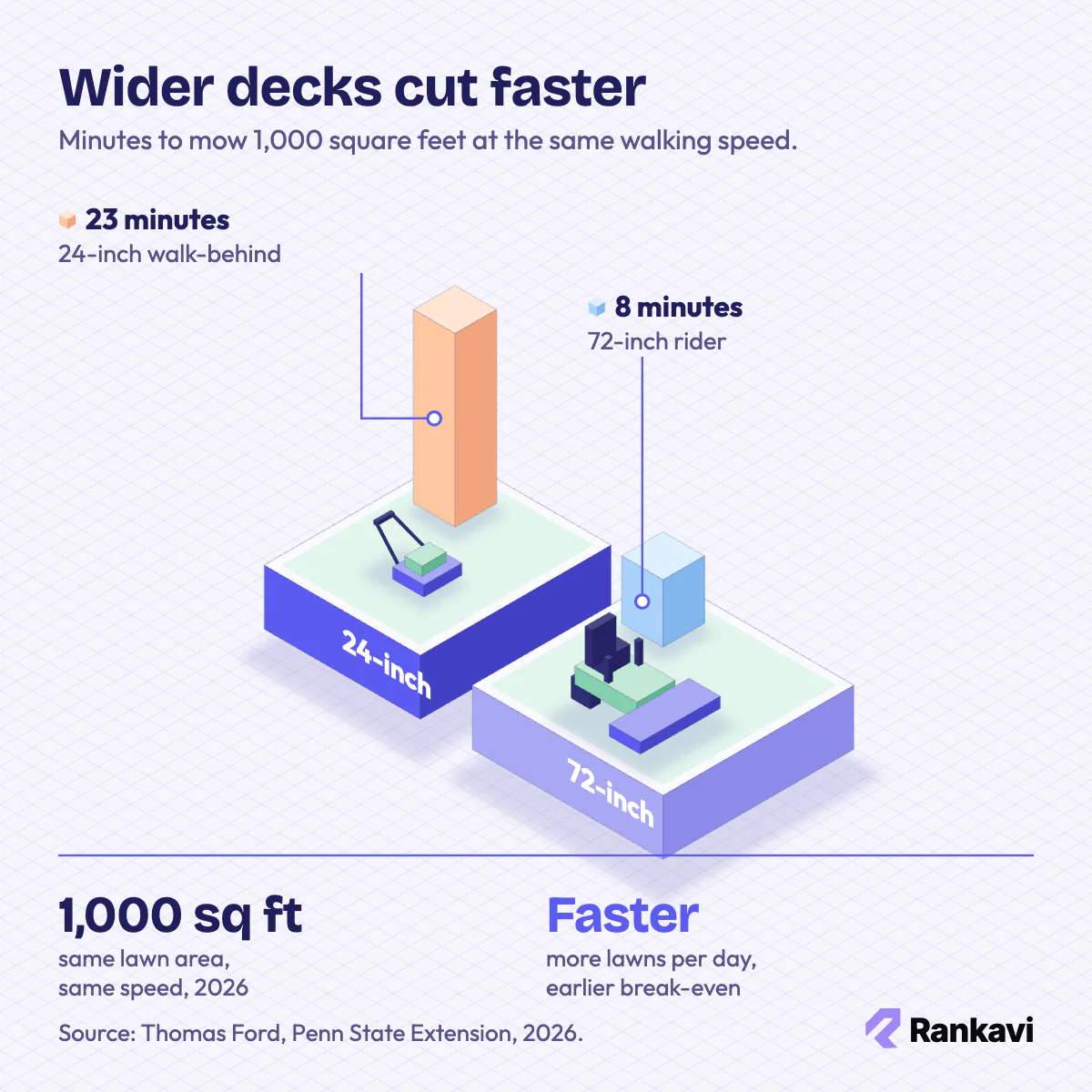
Because width sets the pace, deck width is the first number mowing owners check. The deck is the housing that covers the cutting blades. Thomas Ford, a former educator at Penn State Extension, works through the numbers in a guide updated in May 2026. Penn State Extension is Penn State University’s outreach arm for farmers and turf managers.
At 22 feet per minute, a 24-inch mower needs 23 minutes per 1,000 square feet in that 2026 guide. At the same speed, a 72-inch mower cuts that area in 8 minutes.
Those saved minutes add up across a full route. Faster cutting lets one person fit more lawns into each day. More lawns bring in more money, so the machine reaches break-even sooner. Break-even is the point where the mower’s earnings cover what it cost. One operator described this payoff directly:
“I would not drop a client just to be able to get rid of a larger mower. The machine can pay for itself.”
— A lawn care operator in a YouTube comment
A big mower still cannot reach every yard. Narrow gates and tight backyards still need a smaller walk-behind mower. Basic lawn care equipment includes the following seven items:
- Commercial mower
- String trimmer and edger
- Backpack or handheld blower
- Sprayer for treatments
- Aerator and dethatcher
- Hand tools such as rakes and shovels
- Safety gear such as gloves, glasses and hearing protection
The mower itself comes in several types, and each one trades cost against speed. The following are the four mower types a new business can choose from:
- Walk-behind mowers: These cost less and fit through tight gates.
- Zero-turn riders: The operator rides these mowers, and they cover big lawns faster.
- Stand-on mowers: These sit between walk-behinds and zero-turn riders.
- Battery-powered options: These run quieter and need less fuel handling. Their runtime and charging limit a long day.
The lawns on the route decide which type fits best. Renting first shows which type fits the route before money goes into a purchase.
Once the mowers and tools are chosen, they need a way to get from yard to yard. A pickup truck and an open trailer carry the equipment between jobs. Ramps, locks and racks keep the load secure and make it quick to unload.
Where the equipment is bought matters too, because the seller handles service after the sale. A good local dealer pays off for years. One trusted dealer handles warranty claims, fast repairs and advice on the next machine. This support matters because downtime in peak season costs more than a slightly higher purchase price.
10. Market Before the Spring Rush
Marketing a new mowing company fills the route before the first cut of the season. Homeowners pick a lawn service in early spring and rarely switch mid-season.
Marketing in that window does not have to cost much. These are the five low-cost channels that work for a new mowing company:
- Door hangers and flyers: Door hangers work well in this trade. Hangers placed on streets around existing clients add lawns to the same route.
- Yard signs on client lawns: Yard signs also work well in this trade. Signs on finished lawns show neighbors the result right where they live.
- A free Google map listing: Google Business Profile is Google’s free listing that puts a company on Maps. Reviews from the first clients build trust with neighbors.
- Referral discounts: Referrals from friends, family and current clients cost the least of any channel.
- Branded truck and uniforms: Branded shirts and truck decals turn every visit into an advertisement for the street.
GreenPal, which runs a marketplace that connects homeowners with local lawn pros, can send a new company its early jobs. Marketplaces trade money for speed. They bring jobs fast, but they take a fee from each job. That fee lowers margin.
Wherever a lead comes from, the way the company handles it helps win the next lawn. Same-day quotes help win the next lawn. Review requests to happy clients add reviews to the profile. Those reviews build trust with neighbors.
11. Grow Dense Routes and Add a Crew
Growing a lawn care company means packing more lawns into fewer streets before adding people. Density raises income per hour without raising prices.
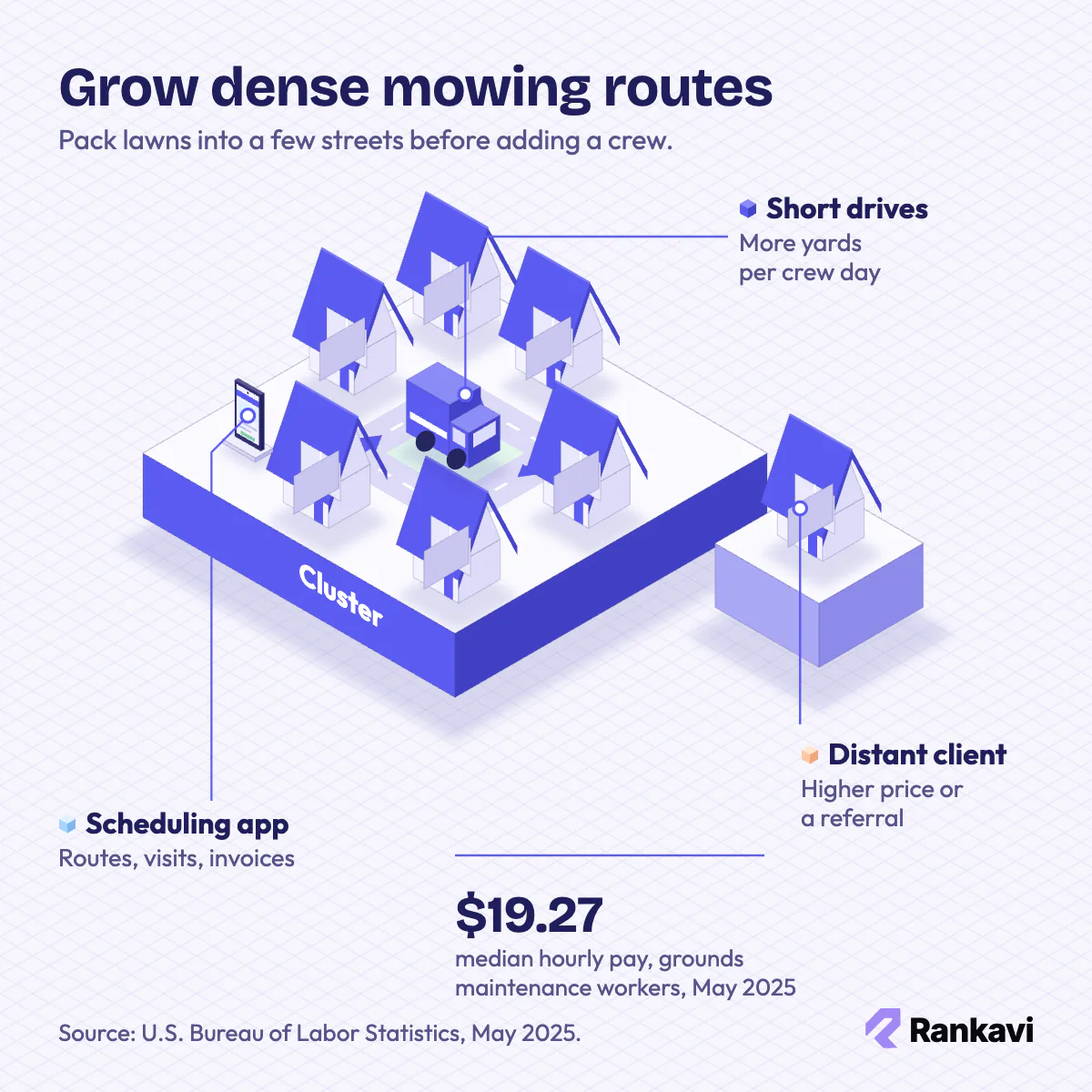
Density comes from neighborhood clusters, not scattered clients. When lawns sit close together, the crew spends less time driving between them. Less drive time lets one crew finish more yards per day. A new client far from the route would add that drive time back. For that reason, a distant client gets a higher price or a polite referral elsewhere.
Scheduling software keeps a growing route organized. Jobber is one example of such an app. Lawn care apps handle routing, recurring visits, invoices and customer messages from a phone.
The first hire usually comes when the owner turns down work or spends evenings quoting. A helper on the trimmer and blower lets the owner run the mower full time.
Before hiring, the owner needs a sense of what a helper costs. The BLS, the federal agency that tracks pay and jobs, reported median pay of $19.27 per hour for grounds maintenance workers in May 2025.
The owner also has to decide how to bring the helper on. Helpers can be employees or independent contractors. The IRS decides worker status by how much control the owner has over the work. The label alone does not settle it.
12. Surface in AI Lawn Care Recommendations
Earning AI recommendations places a mowing company in ChatGPT, Gemini or Perplexity answers about local lawn service. Homeowners now type “who mows lawns near me” into these tools. The answers draw on local directories, review platforms and “best lawn care in” lists.
A new mowing company gains ground by appearing on those pages early, while its review count is still small.
Rankavi is a software as a service (SaaS) platform that publishes brand mentions in articles on indexed third-party websites. Mentions start at $12 each, and most go live in under 24 hours. Lawn care owners who want ChatGPT to name them can start with chatbot brand mentions.