

Starting a laundry business means washing, drying and folding other people’s clothes for a fee. Most new owners begin with wash-and-fold or pickup and delivery, not a full laundromat. The Laundry Association, which represents laundromat owners, puts the U.S. total near 29,500 coin laundries (overview read in 2026).
Before the steps, a quick note: I’m Michal Sieroslawski, and I help laundry services appear when busy customers search online. More busy customers now ask ChatGPT to recommend a laundry service, so showing up there matters.
The order protects cash. Prices and funding come before any lease, the address comes before permits, and marketing starts once orders can flow. To start a laundry business, follow the eleven steps below.
- Choose Your Laundry Service Model
- Research Local Laundry Demand
- Price Laundry by the Pound
- Fund the Startup Costs
- Register and Insure the Business
- Set Up a Processing Space
- Clear Zoning and Local Permits
- Buy Machines, Supplies and a Vehicle
- Run Orders Through Laundry Software
- Market to Apartments and Busy Households
- Appear in AI Answers for Laundry Pickup
1. Choose Your Laundry Service Model
A laundry service model decides where the washing happens and how clothes reach the business. The choice sets the budget, the hours and the ceiling on growth.
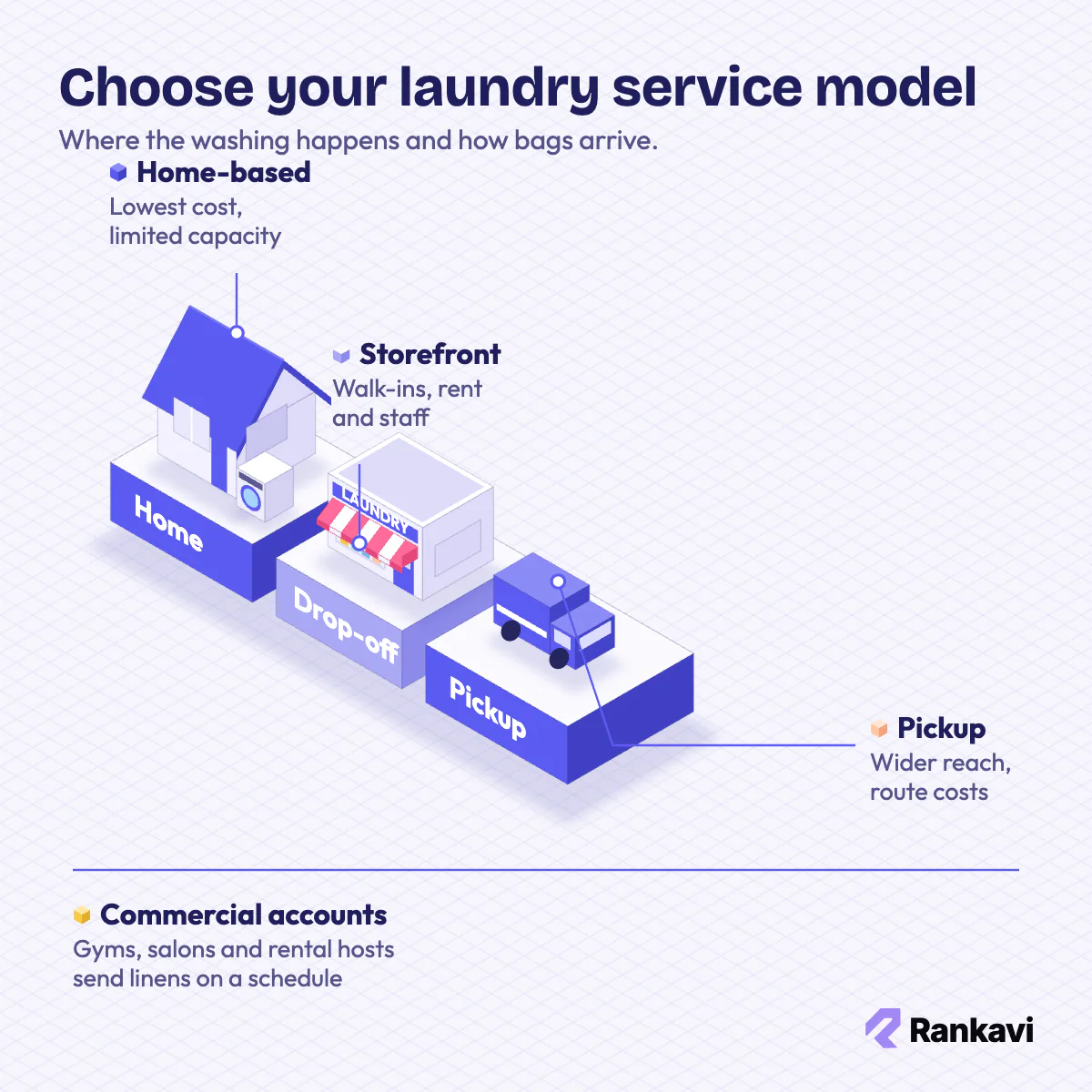
Wash-and-fold is the core offer. Customers hand over dirty laundry, and the business washes, dries, folds and returns it packed.
A home-based start keeps overhead lowest. Household machines limit volume, though, so it suits testing demand before buying commercial gear.
Pickup and delivery widens the market. Drivers collect bags from homes and offices, which adds labor, fuel and scheduling work.
Common laundry service models:
| Model | How orders arrive | Main trade-off |
|---|---|---|
| Home-based wash-and-fold | Customers drop off at the owner’s home | Lowest cost, limited machine capacity |
| Drop-off storefront | Walk-in customers at a counter | Steady traffic, rent and staff |
| Pickup and delivery | Drivers collect and return bags | Wider reach, vehicle and route costs |
| Locker drop-off | Smart lockers in apartments or gyms | No counter staff, locker hardware |
Commercial accounts add steady volume. Gyms, salons, short-term rental hosts and restaurants need towels and linens washed on a schedule.
A self-service laundromat is a different business. Customers run coin or card machines themselves, so income comes from machine use, not labor. Staffing stays light, but rent and utilities are heavy.
An outsourced model is the lowest-capital test. The owner takes orders and handles delivery while a partner laundromat does the washing. Margin is thinner, because the partner keeps a share.
Dry cleaning is a separate model, not an add-on. It needs different equipment, solvent handling and training, so most wash-and-fold startups leave it out or subcontract it.
The right model depends on budget and time. A low budget or a day job points to home-based or outsourced work. Steady foot traffic and capital point to a storefront. A dense apartment area points to pickup and delivery or lockers.
Each model carries its own risk. Home-based work hits a capacity limit. Delivery depends on drivers and missed windows. Storefronts lock the owner into a lease. Lockers need host agreements with buildings. Commercial accounts can lean on a few large clients who pay late.
Most owners start small and graduate. A common path runs from home or outsourced work to a storefront, then pickup and delivery, then commercial accounts.
2. Research Local Laundry Demand
Demand research reveals who will pay to skip laundry day and what local rivals already offer. That evidence keeps the business from buying machines for customers who are not there.
Apartment renters without in-unit machines form the largest group. Busy dual-income families, college students and small businesses with linens follow close behind.
A competitor audit lists every laundromat and delivery service nearby. Owners record prices, turnaround, hours, pickup options and complaints in online reviews.
Gaps in that list become the pitch. Next-day turnaround, fragrance-free detergent or evening drop-off can set a newcomer apart.
Delivery services also fix a starting radius. A tight zone keeps drive time short until order density justifies a wider map.
Demand differs by customer type. Residential customers order by the bag and pay at pickup or by card. Commercial accounts bring steadier volume, but they often pay on invoice terms, which slows cash flow.
Online reviews of local rivals show what customers value. Repeated complaints about late returns, lost items or missed pickup windows mark the problems a newcomer can solve first.
A simple test confirms demand before any spending. Offering a handful of neighbors a first order shows whether people will pay the planned price.
3. Price Laundry by the Pound
Laundry pricing sets what each order earns after labor, detergent and utilities. Per-pound pricing is the standard for wash-and-fold work.
Laundry Lockers, which offers smart laundry lockers, put most markets at $1.50 to $3.00 per pound in its 2026 startup guide. Turnaround speed and add-ons decide where a service lands in that range.
Weighing every bag keeps the charge fair and simple. A certified scale at intake records the weight before washing starts.
Per-bag or per-load pricing suits very small operations. Customers know the price upfront, though heavy bags can squeeze the margin.
Subscriptions bring weekly pickups for a flat monthly fee. Recurring plans make revenue easier to forecast and keep customers longer.
A minimum order protects margin on small bags. Without one, a short pickup can cost more in drive time than it earns.
Commercial accounts price differently from households. Gyms and rental hosts usually get a lower rate per pound in return for steady weekly volume.
Pickup and delivery fees can be billed separately or built into the rate. A separate fee keeps the per-pound price clear, while a built-in fee is simpler for customers.
Price checks against local rivals keep the rate realistic. A price far below the market signals low quality. A price far above needs a clear reason, such as faster turnaround.
Four add-ons lift the value of an order:
- Stain treatment: extra handling for marked garments
- Hypoallergenic detergent: fragrance-free washing for sensitive skin
- Express turnaround: same-day or next-day return
- Hang-drying: delicate items kept out of the dryer
4. Fund the Startup Costs
Funding a laundry business covers the machines, supplies, paperwork and first months of bills before income catches up. A home-based start needs far less than a storefront.
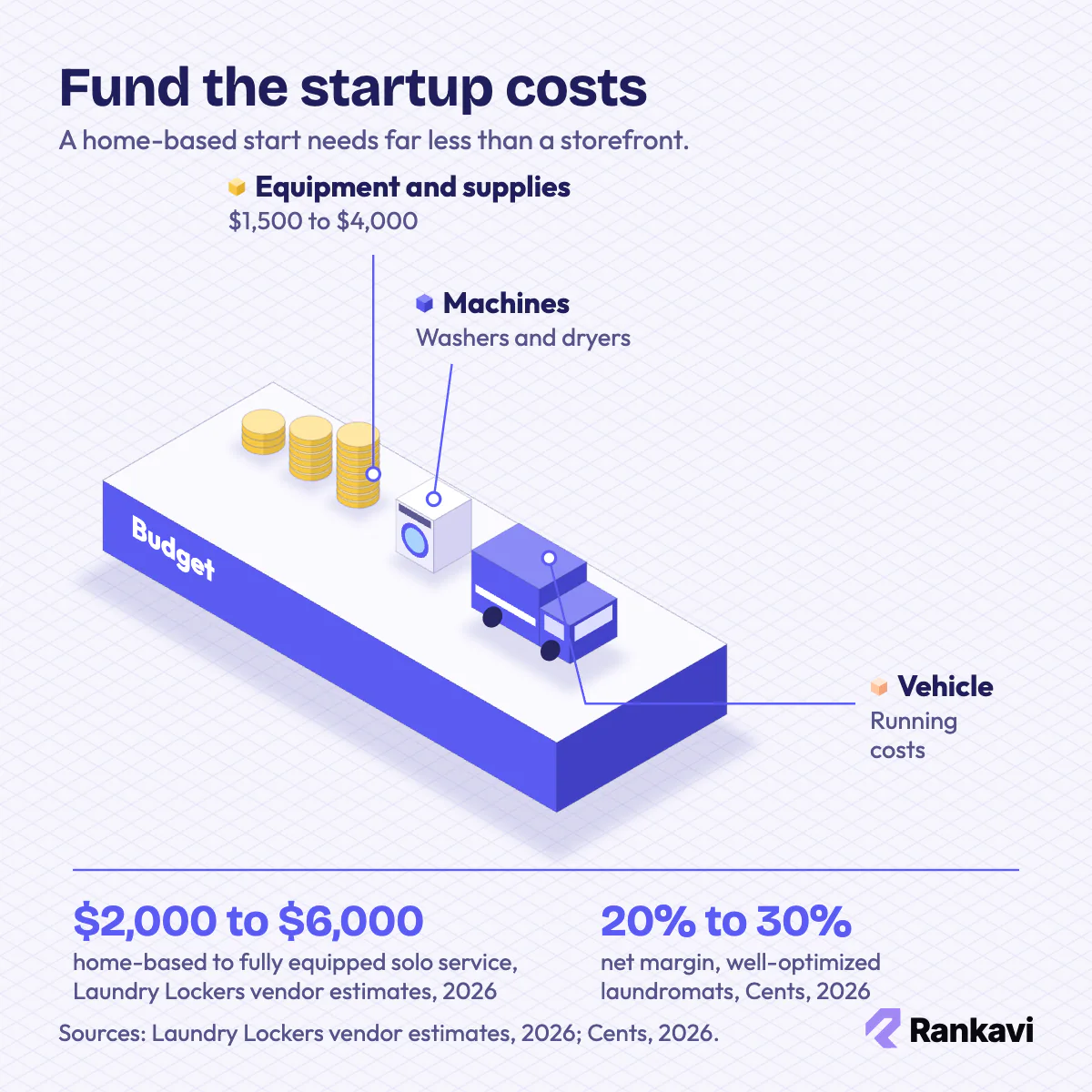
Startup spending falls into a few groups. Equipment and supplies, licenses, insurance, marketing and a delivery vehicle make up most of it.
Working capital matters as much as equipment. Water, gas and electricity bills arrive before regular customers do.
Cents, which offers laundry business software, put net margins for well-optimized laundromats at 20% to 30% in 2026.
Startup money at a glance:
| Item | Figure |
|---|---|
| Startup cost | As little as $2,000 home-based with existing machines; $5,000 to $6,000 for a fully equipped solo service |
| Main costs | Equipment and supplies ($1,500 to $4,000), licenses, permits and insurance ($200 to $800), marketing launch ($300 to $600), vehicle running costs |
| Typical margin | 20% to 30% net profit for well-optimized laundromats (a proxy; no wash-and-fold-only benchmark found) |
| Time to open | Weeks for a home-based start, longer for a storefront build-out (no published benchmark) |
Sources: Laundry Lockers (smart-locker vendor estimates), 2026; Cents (laundry software vendor), 2026.
Worked example: Picture an illustrative solo service charging $2 per pound. A typical 15-pound bag, an assumed weight, brings $30. At 50 orders a week, revenue reaches $1,500. A 20% net margin leaves about $300 a week. A $6,000 setup pays back in roughly 20 weeks.
Savings fund most home-based starts. Larger builds often use equipment financing from machine distributors, which spreads the cost over several years.
Each funding source has a trade-off. Savings carry no interest, yet the owner’s own money is on the line. Financing keeps cash free for working capital, but the payments start before the business is steady.
Used machines cut the upfront cost. They can also break down more often. They may use more water and energy, so a repair fund belongs in the plan.
Lenders usually ask for a short business plan and a realistic list of costs. A clear price per pound and a weekly order target make that plan easier to judge.
The U.S. Small Business Administration (SBA), which oversees federal small business lending, backs microloans and 7(a) loans through approved lenders. As of 2026, SBA microloans averaged about $13,000 and can fund machinery and working capital.
5. Register and Insure the Business
Registering a laundry service creates the legal entity that signs leases, account contracts and insurance policies. Many owners pick a limited liability company (LLC), which limits personal liability.
Formation runs through the state’s Secretary of State office. The Internal Revenue Service (IRS), the federal tax agency, then issues a free employer identification number (EIN) online.
A separate business bank account keeps laundry income apart from household money. Clean records simplify taxes and loan applications later.
Insurance protects against claims that clothes were lost or ruined. General liability, coverage for customer property in the business’s care and commercial auto for delivery vans form the core.
A personal auto policy may not cover a vehicle used for deliveries. Insurers treat business driving as a different risk, so the policy should name the delivery use.
A limited liability company only protects personal assets when the business stays separate. Mixing household and business money weakens that protection.
Policies differ on what counts as customer property. Checking the limit per item and the exclusions before signing avoids a surprise after a claim.
6. Set Up a Processing Space
The processing space shapes how fast orders move from dirty bags to folded stacks. Options include a home laundry room, a garage, a rented unit or spare time at a partner laundromat.
A good layout follows one direction. Intake and sorting lead to washing and drying, then folding, then staging for pickup.
Each zone needs room to work without mixing orders. Waist-high folding tables reduce back strain, and labeled shelves hold finished bags.
Heat and moisture build up fast. A ventilation fan or dehumidifier protects clean clothes and keeps the room comfortable for staff.
Utility hookups decide which machines fit. Commercial washers need larger water lines and drains, and dryers need gas or heavy electrical service.
Each space type has a trade-off. A home laundry room is cheap but small. A garage adds room but may need ventilation and a drain. A rented unit adds capacity and rent. A partner laundromat needs no machines, but the owner depends on its hours.
Dryer exhaust must vent outdoors. Lint builds up quickly in a busy dryer. Regular cleaning of the vent and lint trap lowers the risk of fire.
A clear rule separates dirty from clean. Dirty bags stay on one side of the room and finished orders on the other, which prevents mix-ups between customers.
7. Clear Zoning and Local Permits
Permitting a laundry business means getting local approval to run it at a specific address. Rules differ by city and county, so the space comes first.
Home-based services often need a home occupation permit. Some residential zones limit customer visits, signage or delivery vehicles.
Most laundry services check four permits:
- Business license: the city or county permit to trade
- Home occupation permit: approval to run the service from a residence
- Wastewater approval: sewer rules for commercial washing volumes
- Sales tax registration: required in states that tax laundry services
Wastewater rules matter more as volume grows. Some cities require lint filters or interceptors before commercial washers connect to the sewer.
Zoning decides whether laundry work is allowed at an address. Commercial and light industrial zones usually permit it. Residential zones may allow only a small home operation.
A lease should be checked before it is signed. The landlord must allow laundry use, and the building must support the needed water, drain and gas or electrical load.
The city or county planning office can confirm zoning and list the permits for one address. A call before signing a lease or buying machines avoids a costly mistake.
8. Buy Machines, Supplies and a Vehicle
Laundry equipment turns a room into a production line that can handle steady weekly volume. Household machines work at first, then commercial units take over.
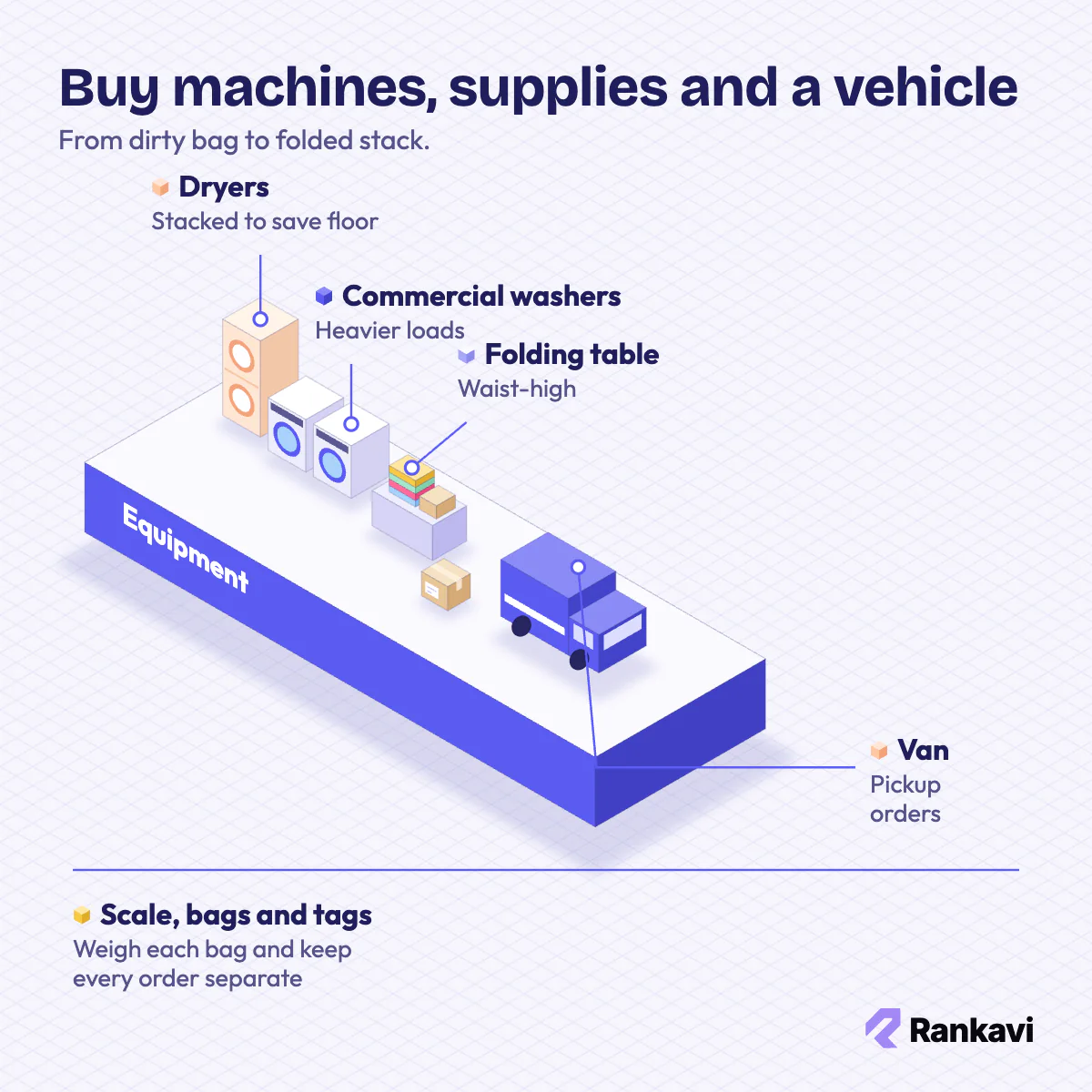
Commercial washers and dryers run longer cycles and heavier loads. High-efficiency models cut water and energy use per pound.
Core laundry equipment:
| Item | Purpose |
|---|---|
| Commercial washers and dryers | Handle volume beyond household machines |
| Digital scale | Weighs bags for per-pound billing |
| Folding tables and rolling carts | Move and finish orders |
| Branded bags, tags and labels | Keep each customer’s clothes separate |
| Detergents and additives | Standard, fragrance-free and stain products |
| Delivery van | Collects and returns pickup orders |
A delivery vehicle can start as the owner’s own car. A van with shelving becomes worth it once routes fill up.
Buying new or used is a trade-off. New machines come with warranties and better efficiency. Used machines cost less upfront, but repairs are harder to predict.
Machine capacity should match the order volume. Machines that are too small slow every order, and machines that are too large waste water, energy and money.
Spare parts and a service contact matter as much as the machines. A broken washer stops the whole line, so a local repair technician is worth finding before the first order.
9. Run Orders Through Laundry Software
Laundry software tracks each order from pickup to return. It records weights, preferences, payments and status updates in one place.
Tagging at intake prevents mix-ups. Every bag gets a label or barcode that follows it through washing, drying and folding.
Route planning saves fuel and time. Grouping pickups by neighborhood shortens each driver’s loop.
Customer notifications cut missed pickups. Text or email alerts confirm the pickup window, and a second alert says when clean laundry is on the way.
Software also takes payments and stores preferences. Saved notes on detergent, folding style and special items let any employee handle an order the way the customer asked.
A spreadsheet can run a very small service. Software becomes worth its fee once order tracking, routes and payments take more time than the laundry itself.
Hiring starts with part-time help at a clear volume trigger. Laundry Lockers suggested waiting until a service consistently passes 50 orders per week, in its 2026 guide. Attendants handle washing and folding, while drivers handle routes. The U.S. Bureau of Labor Statistics (BLS), which publishes federal wage data, reported a $34,890 median wage for laundry and dry-cleaning workers in May 2025.
10. Market to Apartments and Busy Households
Marketing a laundry service starts with being easy to find and easy to book. Neighbors search online first, then ask friends.
Google Business Profile is Google’s free listing that puts the service on Search and Maps. Photos, hours, service areas and prices help it show up in “laundry service near me” results.
Property managers open doors to whole buildings. Apartment complexes, gyms and student housing can host flyers, lockers or resident discounts.
Door hangers and laundry-room flyers reach renters directly. A referral reward turns early customers into the next wave of orders.
Reviews build trust after each order. Owners ask happy customers to post one and reply to every review.
Each channel suits a different customer. Flyers and property managers reach renters in one building. Online listings reach people who search when they need laundry done. Referrals work best with households.
A first-order discount lowers the risk of trying a new service. A limited offer for a building keeps the discount from becoming the regular price.
Consistency drives repeat orders. Clean, on-time returns matter more than any single promotion, because most revenue comes from customers who return each week.
11. Appear in AI Answers for Laundry Pickup
AI visibility for a laundry service means being the name an assistant gives for nearby laundry pickup. Busy renters now type that question into ChatGPT, Gemini and Perplexity.
Those assistants repeat what trusted third-party pages say. Local directories, review sites and “best laundry service” roundups shape which names appear.
Rankavi is a software as a service (SaaS) platform that publishes brand mentions in articles on indexed third-party websites. New laundry services use it to build early ChatGPT mentions for businesses in their delivery area.