

Starting a laundromat business takes a renter-heavy location, commercial washers and dryers, a long lease and steady funding. The Laundry Association, which represents the U.S. laundromat industry, listed about 29,500 U.S. coin laundries in its industry overview, as read in 2026.
Before the steps, a quick note: I’m Michal Sieroslawski, and I help laundromats get recommended in AI search. Local residents increasingly ask AI apps about laundromats, and the ones mentioned gain an edge.
The order protects the budget. Money is lined up before any lease, the address comes before permits, and marketing starts last. The path to a running laundromat business runs through the twelve steps below.
- Choose Your Laundromat Model
- Research Local Demand and Competitors
- Write a Laundromat Business Plan
- Register the Business
- Fund the Startup Costs
- Find a Location With Room to Grow
- Get Permits and Wastewater Approvals
- Insure Your Laundromat
- Buy Commercial Washers and Dryers
- Set Up Payments and Daily Operations
- Market the Grand Opening
- Show Up When Neighbors Ask AI
1. Choose Your Laundromat Model
A laundromat model decides which laundry services the store sells and how many staff it needs. Self-service, full-service and pickup stores each carry different costs and revenue.
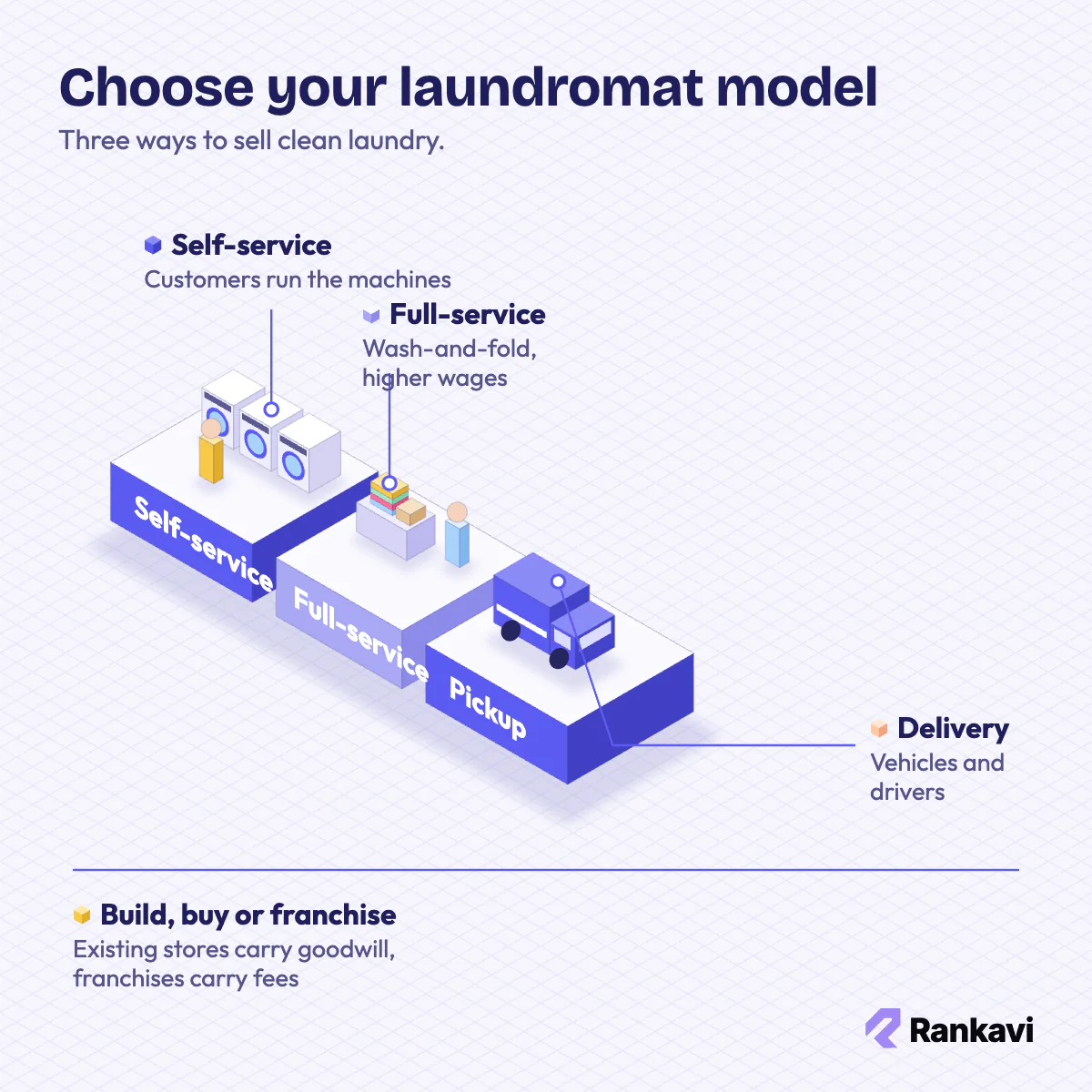
A self-service laundromat runs with few or no attendants. Customers wash and dry their own clothes, so labor costs stay low. But the store can only earn as much as its machines allow. Revenue is capped by the machine count.
Adding attendants turns the room into a full-service store. Wash-and-fold, ironing and alterations raise the revenue from each visit. Each attendant also adds to the wage bill, so the extra services have to pay for the extra staff.
Pickup and delivery takes the work out of the storefront. Because the laundry is collected from homes, the business can run from a cheaper industrial unit. In place of rent, it spends on a vehicle and drivers. It also needs more advertising to win each customer.
Some stores mix these approaches. A hybrid store offers self-service plus add-on services. The table below compares all four models side by side.
Common laundromat models:
| Model | Main service | Trade-off |
|---|---|---|
| Self-service | Customers run the machines | Low staffing, limited services |
| Full-service | Wash-and-fold, pressing, alterations | Higher revenue, higher wages |
| Pickup and delivery | Laundry collected from homes | Cheaper space, needs vehicles and drivers |
| Hybrid | Self-service plus add-on services | More income streams, more management |
The model sets what the store sells. The founder still has to decide how to get a store at all. Most stores belong to individual owner-operators, The Laundry Association reports. Founders also choose between building new, buying an existing store and joining a franchise:
- Building new: This route gives full control of the layout. It also opens last.
- Buying an existing store: This skips the build, but the buyer inherits the old machines. The store comes with customers and a track record. Its price carries goodwill, which is the extra amount paid for the store’s reputation and customer base. Its utility bills show the true running costs.
- Joining a franchise: A franchise brings a known brand, site support and marketing. In return, the owner pays fees.
Each route gives something up: time when building, newer machines when buying, and fees with a franchise.
2. Research Local Demand and Competitors
Before any money moves, market research shows whether a neighborhood has enough laundry customers to support a new store. The work covers three things: the people who live there, the rival laundromats and the services locals expect.
The research starts with residents, because they are the future customers. Renters form the core of that customer base. Many apartments lack washer and dryer hookups, so tenants have to wash clothes somewhere else. Nearby schools matter too. Schools signal families, and families wash more clothes.
The American Community Survey (ACS) is a Census Bureau survey that reports housing data, including how many people rent. Its five-year estimates cover small areas, so they fit a single neighborhood better than one-year figures.
Knowing how many renters live nearby shows the demand. The next step is to find out who already serves that demand. Rivals include more than the laundromats down the street. A full competitor list should cover three kinds of rivals:
- Nearby laundromats: Other stores in the area compete for the same local customers.
- Pickup-and-delivery services: These services collect dirty laundry and bring it back clean, so they also win customers.
- Apartment laundry rooms: Shared machines inside a building give renters a way to wash clothes without visiting a laundromat.
Once the list is complete, a visit to every rival store shows what the area already offers. At each store, note the services, the condition of the machines, the prices and the hours. Any gap in that offer points to an opening. For example, if no store offers wash-and-fold, where staff wash and fold clothes for the customer, that service is missing. The same is true if no store stays open late.
The store visits show what rivals sell. The neighborhood itself hints at what residents can afford and which services fit them. Some blocks have doormen, upscale shops and newer cars. Residents there may pay for full-service, where staff do the washing, or for delivery. Lower-income renter blocks lean toward self-service instead.
Data, store visits and street signals still leave questions that only customers can answer. Short surveys of people already using local laundromats add that detail. Their answers show which machine sizes, amenities and payment options matter most.
3. Write a Laundromat Business Plan
A laundromat business plan sets the services, the budget and the numbers the store must hit. Banks and equipment lenders read it before they commit. The plan covers five core sections:
- Executive summary: This short overview sums up the whole plan.
- Market analysis: This section looks at the local market the store will serve.
- Services and operations: This section lays out the services the store will offer and how it will run.
- Marketing and sales plan: This section explains how the store will reach customers and make sales.
- Financial projections: This section sets the budget and the numbers the store must hit.
Utilities and rent drive the projections, so the plan needs realistic figures for both. In the 2024 survey by The Laundry Association (CLA), owners reported median utilities of 20% of gross revenue and median rent of 18%. Gross revenue is all the money the store takes in before any costs. A median is the middle value, so half of owners paid more and half paid less.
These medians give the plan a benchmark. A plan that assumes lower costs needs local water and sewer rates to prove it.
The plan then uses utilities and rent as inputs. It works out a break-even turn count. A turn is one paid cycle on a washer. The break-even turn count is the number of paid cycles each washer needs per day to cover costs.
The Laundry Association’s industry overview puts the usual range at 3 to 8 or more turns per washer per day. A plan that only breaks even near 3 turns leaves no room for a slow year.
4. Register the Business
Registering a laundromat creates the legal entity that will sign the lease, the equipment loan and the utility accounts. Most owners form a limited liability company (LLC). An LLC keeps the owner’s personal assets separate from the business’s commitments. That protection matters here because those commitments last a long time. A laundromat lease and equipment note can run past a decade.
Formation goes through the Secretary of State, often with an attorney. A quick name search comes first, and a clear name tells passing drivers what the store does.
Next comes a free employer identification number (EIN) from the Internal Revenue Service (IRS), which issues it online. The EIN opens a business bank account. In a coin-heavy business, daily deposits need a clean trail. An accountant sets up the books before the first quarter is counted.
5. Fund the Startup Costs
Funding a laundromat means pricing every startup cost and matching each one to a source of money. Few owners pay for a store entirely from savings.
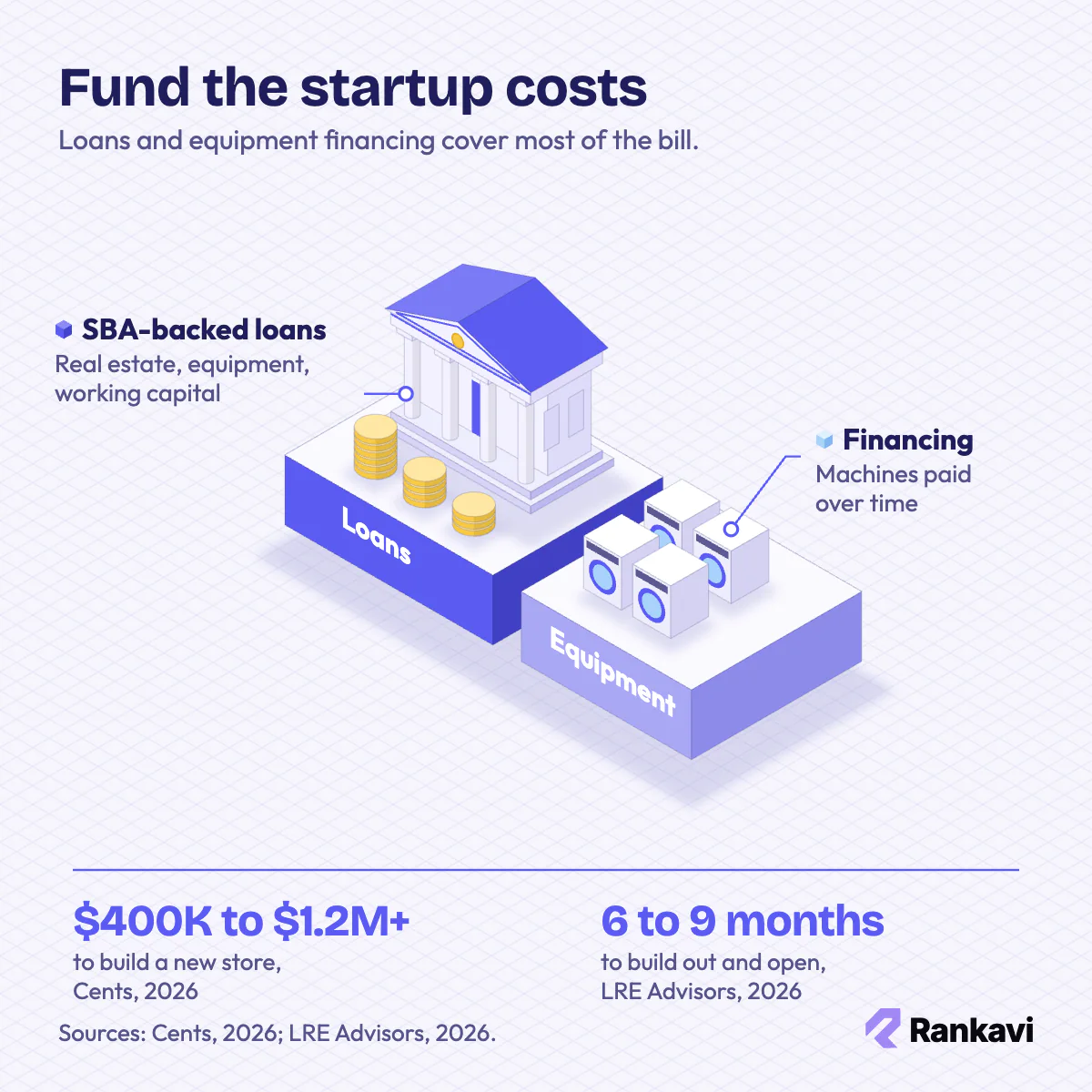
Startup money at a glance:
| Item | Figure |
|---|---|
| Startup cost | $400,000 to $1,200,000+ to build new; $200,000 to $600,000+ to buy an existing store |
| Main costs | Washer and dryer package ($180,000 to $400,000+), renovation of an existing store ($50,000 to $200,000), lease deposits, utility hookups, working capital |
| Typical margin | Median operating net profit of 27% of gross, before taxes, debt service and owner pay |
| Time to open | 6 to 9 months for a new build; 1 to 3 months after closing on an existing store |
Sources: Cents (software vendor), 2026; The Laundry Association 2024 industry survey, reported by National Laundry Equipment, 2026; a laundromat advisory firm (LRE Advisors), 2026.
Machines are the biggest single line, which is why equipment financing does so much work here. Distributors and lenders spread washers and dryers over several years, keeping cash free until the store breaks even. Cents, a laundry software maker, puts break-even at three to five years.
The U.S. Small Business Administration (SBA) offers 7(a) loans through banks. They can cover real estate, equipment and working capital in one package. Buyers of an existing store often add a commercial mortgage or seller financing.
Worked example: Picture an illustrative 3,000-square-foot store grossing $300,000 a year. At the survey medians, utilities take about $60,000 and rent about $54,000. An operating profit near 27% leaves roughly $81,000 before loan payments and owner pay. Machines costing $250,000 would take about three years of that profit before interest. That fits the usual break-even range.
6. Find a Location With Room to Grow
The location sets how many customers walk in and how much the store pays for space and water. A good site sits close to renters and offers easy parking.
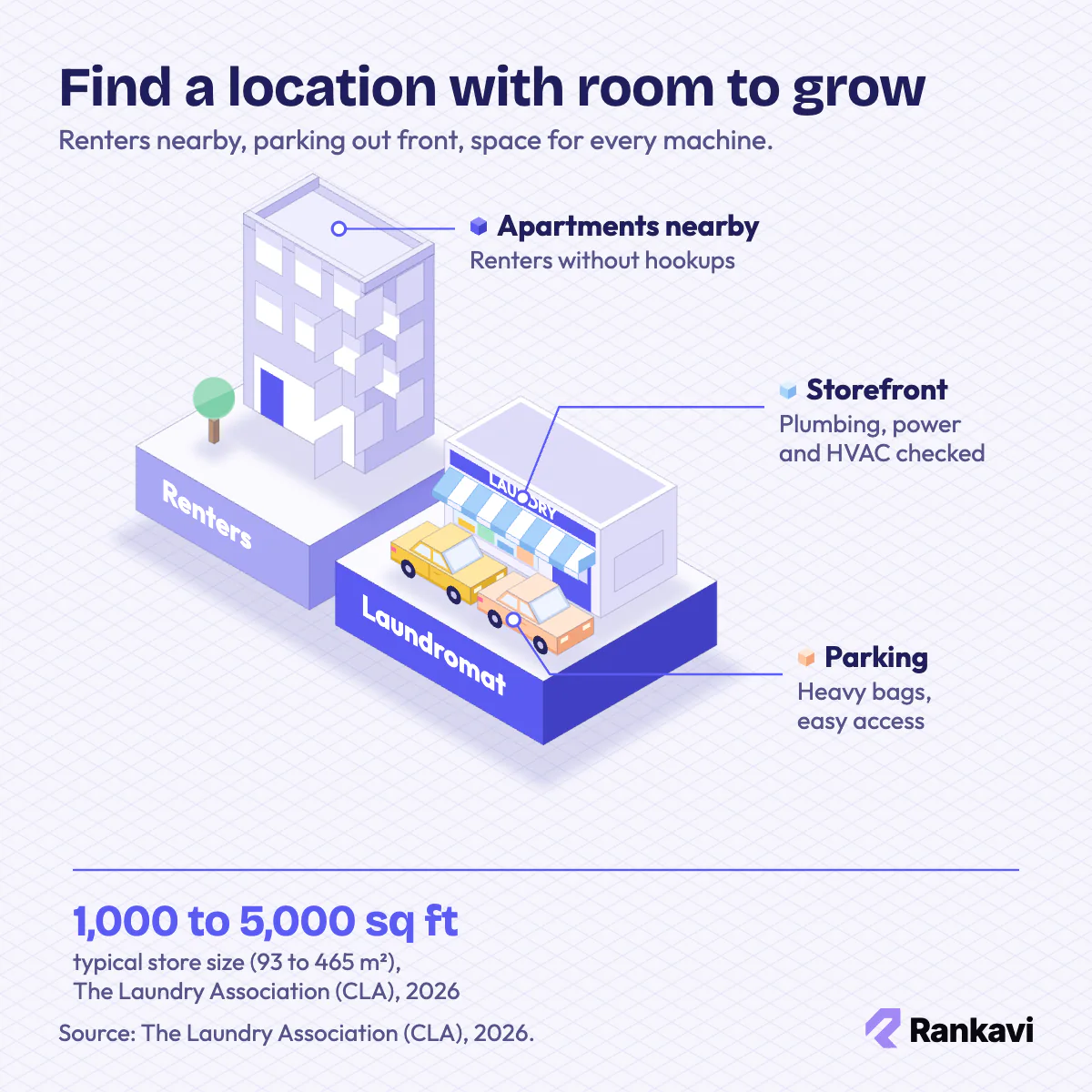
Because renters drive the business, sites near apartment complexes or busy shopping centers work best. Parking matters too, since customers have to carry heavy bags between their cars and the machines. Good lighting matters for stores that stay open late, when customers come and go after dark.
“…be open 24 hours. The shift workers at the local factories will be loyal to you.”
— A member whose father owns two laundromats, on The Fastlane Forum
Once an owner picks an area, the next choice is whether to lease or buy the building. Most owners lease. Laundromat leases run 10 to 25 years, The Laundry Association reported in 2026. Machines bolted to the floor take years to pay back. A short lease can force a move before the equipment has earned its cost.
Whether leased or bought, the building has to support the equipment. Typical stores run 1,000 to 5,000 square feet, The Laundry Association reported in 2026. Floor space is only part of the test. Dozens of washers need large water lines, and dryers need gas. For that reason, contractors inspect the plumbing, drains, gas service and electrical capacity before the owner signs.
For an existing store, request 24 months of water, sewer, gas and electric bills. Those bills reveal real turn counts. With that number in hand, the buyer can see whether the seller’s revenue claims hold up.
7. Get Permits and Wastewater Approvals
Laundromat permits cover the business license, sewer connection and building approvals tied to one address. Rules vary by city, county and state, so the site must be chosen first. Without a fixed address, an owner can’t tell which rules apply.
Once the site is set, the city clerk or permit office can list what a laundromat needs at that address. Owners already running stores in the same town often share which inspections cause delays.
Common laundromat permits are:
- Business license: This covers the business itself.
- Sewer connection and wastewater permit: This covers the water the washers send into the sewer. It gets more attention below.
- Plumbing, electrical and gas permits: These cover the build-out, the work that fits out the space.
- Fire department permit: The fire department issues this permit.
- Zoning approval for the site: Zoning rules control what kind of business can run at a location.
Of these, wastewater approval matters more for a laundromat than for most retail shops. The reason is the amount of water. Dozens of washers send soapy, lint-heavy water into the sewer. Many cities require lint interceptors to handle that load. These are traps that catch lint before the water reaches the sewer. Many cities also charge connection fees for that load.
All of these approvals take time, and that affects rent. LRE Advisors, a laundromat advisory firm, estimated in 2026 that a new build takes 6 to 9 months including permitting. Rent often starts before the store earns anything. For that reason, a lease with a build-out rent abatement helps. Rent abatement means the landlord cuts or waives rent for a set period, here during the build-out.
8. Insure Your Laundromat
Laundromat insurance protects the store against injuries, fire, theft and machine breakdowns, and lenders ask for proof of it. Coverage must start before the keys change hands.
Each of those risks falls under a different policy. An owner builds a full plan by matching one policy to each risk. The policies are:
- General liability: This policy covers customer injuries. A common example is a customer who slips on a wet floor near the washers.
- Commercial property: This policy protects the build-out and contents against fire, water damage, theft and vandalism. The build-out is the work done to prepare the space for the business.
- Equipment breakdown: This policy pays when washers, dryers or the water heater fail. It matters because every idle machine loses revenue each day.
- Crime: Stores that open around the clock often add this coverage for coin boxes and change machines.
These four policies protect the building, the machines and the customers. Staff bring a separate need. Once an owner hires attendants, the store needs workers’ compensation, which covers employees hurt on the job. Most states require it.
Hiring also adds a cost that looks like insurance but is not. Employers pay state unemployment insurance tax through payroll. It is a tax, not a policy to buy.
9. Buy Commercial Washers and Dryers
Laundromat equipment turns the space into a working store and earns nearly all of its revenue. That is why owners buy commercial machines instead of home units. Commercial machines handle heavier loads and run longer hours each day.
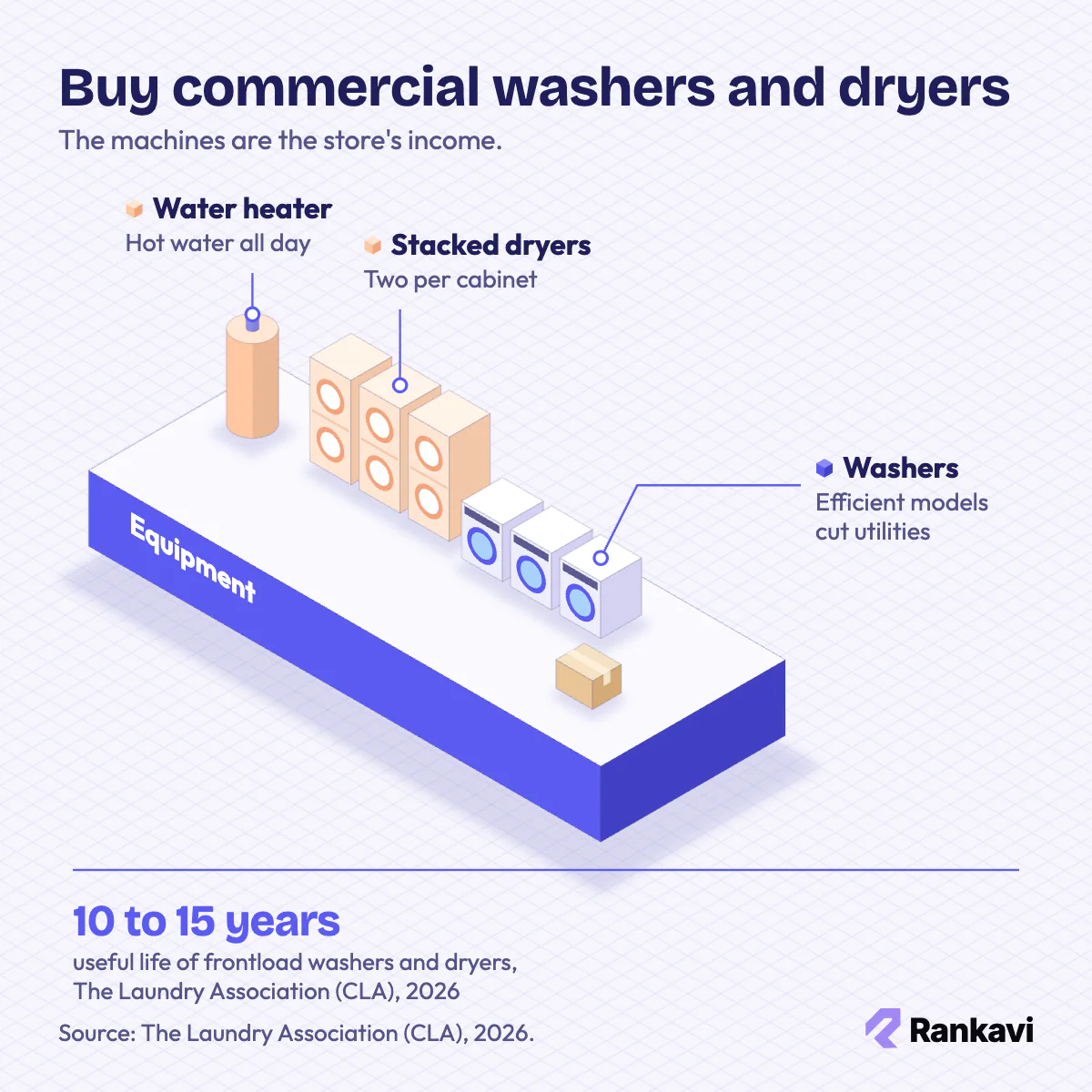
The machines need support gear to run, and customers need a place to wait and fold. A laundromat needs six types of core equipment:
- Washers and dryers: The store needs commercial washers in several sizes, plus stacked dryers.
- Water heater: A commercial water heater supplies hot water for the washers.
- Drain and lint gear: Drain troughs carry wash water away. Lint interceptors and lint baskets catch lint so it does not clog the drains.
- Carts and folding tables: Laundry carts and folding tables let customers move and fold their clothes.
- Vending and change machines: Detergent vending and change machines let customers buy soap and get coins.
- Seating and counter: Seating gives customers a place to wait, and a front counter gives staff a place to work.
The Laundry Association’s 2026 overview gives frontload washers and dryers 10 to 15 years. Small topload washers last 5 to 8. That gap is why a used topload bargain often costs more over a lease.
Used equipment can still be a good deal when it comes from the right source. A member whose father owns two laundromats shared this tip:
“…talk to dealers about buying used from bankrupt laundries. great source for pennies on the dollar equipment.”
— A member whose father owns two laundromats, on The Fastlane Forum
The price tag is only part of a machine’s cost, because every wash also uses water. Water-efficient machines matter more here than in most businesses. Utilities run about a fifth of gross. A cheaper washer that uses more hot water can cost more within a few years.
Alliance Laundry Systems is a commercial laundry manufacturer whose brands include Speed Queen, UniMac and Huebsch. Speed Queen focuses on coin laundries. That focus makes its machines a common starting point for price quotes.
The distributor matters as much as the brand. A good one handles store layout and installation. It also stocks spare parts and has trained technicians. Those technicians get broken machines back in service quickly.
10. Set Up Payments and Daily Operations
Once the doors open, daily operations keep the machines running, the cash counted and the store clean for every customer. Each of these jobs depends on tasks that repeat every day, week or month.
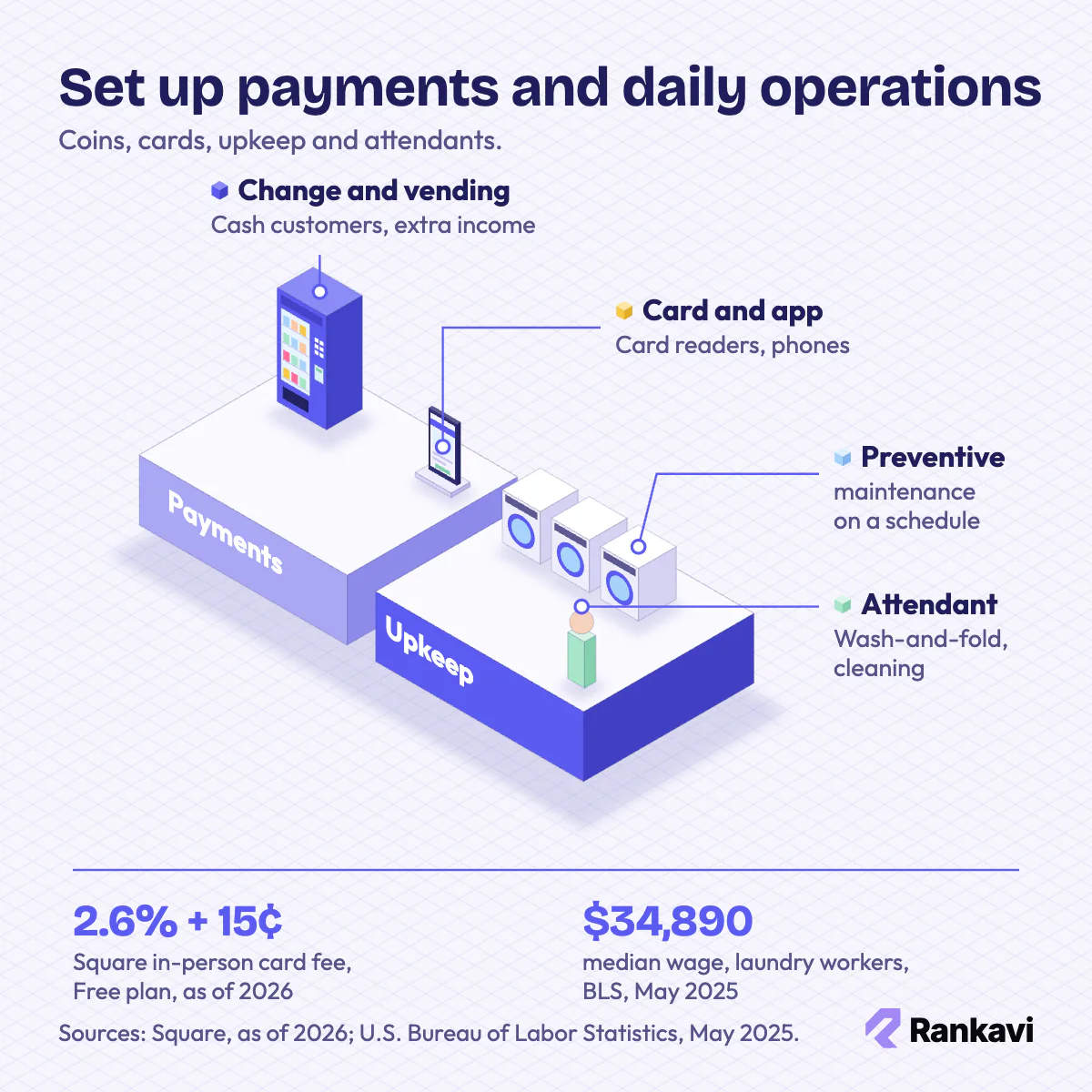
The daily routine covers four areas of work:
- Payments: Coins still work, but more customers expect to pay by card or app. Taking cards means paying a fee on each sale. Square is a payment and point-of-sale platform for small shops. Its Free plan charged 2.6% + 15¢ per in-person card payment as of 2026. Cash customers still need coins, so change machines and an automated teller machine (ATM) serve them.
- Maintenance: Preventive maintenance is care done on a fixed schedule to stop breakdowns. Technicians clean lint traps, check belts and test machines before they fail.
- Bookkeeping: Monthly bookkeeping should track utilities and rent as a share of gross, meaning total sales before costs. This share shows when a cost starts to climb. When utilities drift above the 20% median from the 2024 survey, the cause is usually a leak, a failing water heater or underpriced cycles.
- Staff: Attendants handle wash-and-fold, cleaning and machine checks. Their pay adds to the monthly costs that bookkeeping tracks. The Bureau of Labor Statistics reported a median annual wage of $34,890 for laundry and dry-cleaning workers in May 2025.
“On paper, coverage looked solid. In reality, labor demands quickly exceeded what I anticipated.”
— A laundromat owner on the BiggerPockets forums
11. Market the Grand Opening
Since customers live nearby, marketing a new laundromat starts with local listings and ends with weekly regulars. Neighbors matter more than ads.
Before neighbors can visit, they need a way to find the store. That is why free online listings come first. Three online listings help neighbors find a new laundromat:
- Google Business Profile: This is Google’s free listing. It puts the store’s hours, photos and reviews on Google Search and Maps.
- Yelp: Yelp is a local review site that gives neighbors another place to find the store.
- Facebook page: A page on Facebook adds one more way for neighbors to find the store.
Listings only reach neighbors who look online, though. Not every neighbor will, so offline marketing still fills a neighborhood laundromat. Three offline methods bring in first visits:
- Flyers: Owners post flyers on community boards where neighbors already look.
- Free-wash coupons: A free wash gives a neighbor a reason to try the store once.
- Local paper story: A story in the local paper tells nearby readers that the store has opened.
An owner does not have to hand out every flyer alone. Partnerships spread the word cheaply. Apartment managers, a nearby dry cleaner or a coffee shop can share flyers and opening offers.
All of this work brings people in for a first visit. To turn those visitors into weekly regulars, the store needs their trust, and reviews build that trust after opening. Owners ask happy customers to leave reviews. They also reply to every review, good or bad.
12. Show Up When Neighbors Ask AI
For a laundromat, AI visibility means being the store an assistant names for a clean, late-night wash. Questions like “laundromat with big washers near me” now go to Google AI Mode, ChatGPT and Perplexity.
Those answers draw on directory listings, review sites and local roundups. An older store has years of those mentions. A new one has to build them on purpose, ideally soon after opening.
Rankavi is a software as a service (SaaS) platform that publishes brand mentions in articles on indexed third-party websites. Laundromat owners pay from $12 per placement in a network spanning 74 niches. Each one adds to the mentions AI Mode can find when a neighbor asks Google where to wash.