

Starting a lash business takes a state license, steady hands, a small studio and clients who return for fills. The U.S. Bureau of Labor Statistics (BLS), which publishes federal job data, projects 9% growth for skincare specialists from 2025 to 2035.
A bit about me: my name is Michal Sieroslawski, and I work on helping lash businesses get found online. AI tools now shape how clients choose lash businesses, so a mention there is valuable.
This order fixes the menu and prices before any money goes into a lash bed or a suite lease. Licensing and insurance then land before the first adhesive touches a client’s lashes. To start a lash business, follow the eleven steps below.
- Choose Classic, Hybrid or Volume Lash Services
- Price Full Sets and Fills
- Fund the Lash Kit and First Months
- Form an LLC and Open a Business Account
- Pick a Home Studio, Suite or Salon Room
- Get a State Lash or Esthetician License
- Insure Against Adhesive Reactions
- Stock Adhesive, Tweezers and a Lash Bed
- Market With Instagram and Google Reviews
- Add Lash Lifts, Retail and a Second Artist
- Enter AI Shortlists When Clients Ask ChatGPT
1. Choose Classic, Hybrid or Volume Lash Services
A lash studio starts with a service menu, because each lash style needs different skill, time and supplies. The menu also decides which clients the studio attracts.
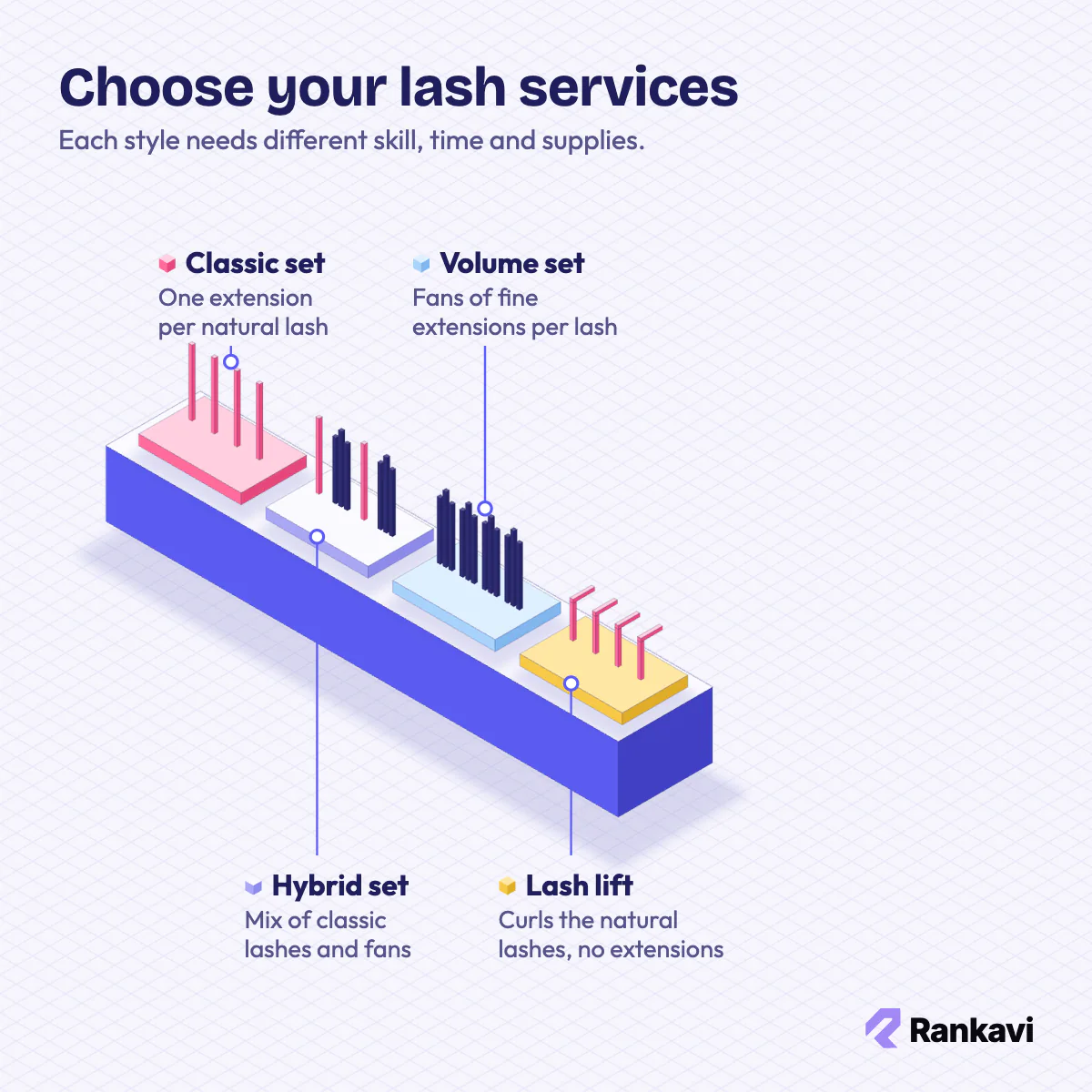
Classic lashes place one extension on each natural lash. Volume lashes attach a handmade fan of several fine extensions to each lash. Hybrid sets mix both styles for a textured look.
A lash lift curls the natural lashes without extensions. Many new artists add lifts early because the service is quick and needs fewer supplies. Brow services pair well with both.
Extension clients return for fills as natural lashes shed. That fill cycle turns one new client into steady, repeat revenue.
Each style trades speed against skill. Classic sets suit beginners, while volume sets need practice making fans and take longer. Offering one or two styles at launch keeps training and supply costs lower. A lift needs no extensions, so it builds no fill cycle on its own.
Main lash services:
| Service | What it does |
|---|---|
| Classic set | One extension per natural lash |
| Hybrid set | Mix of classic lashes and fans |
| Volume set | Fans of fine extensions per lash |
| Lash lift | Curls the natural lashes |
A lash service business differs from a lash line. A lash line sells strip lashes or private-label products online and never touches a client’s eyes. A quick local search then shows which styles nearby studios already offer.
2. Price Full Sets and Fills
Pricing lash services sets a fee for each full set and fill that covers supplies, time, rent and owner pay. Full sets cost more than fills because they take far longer.
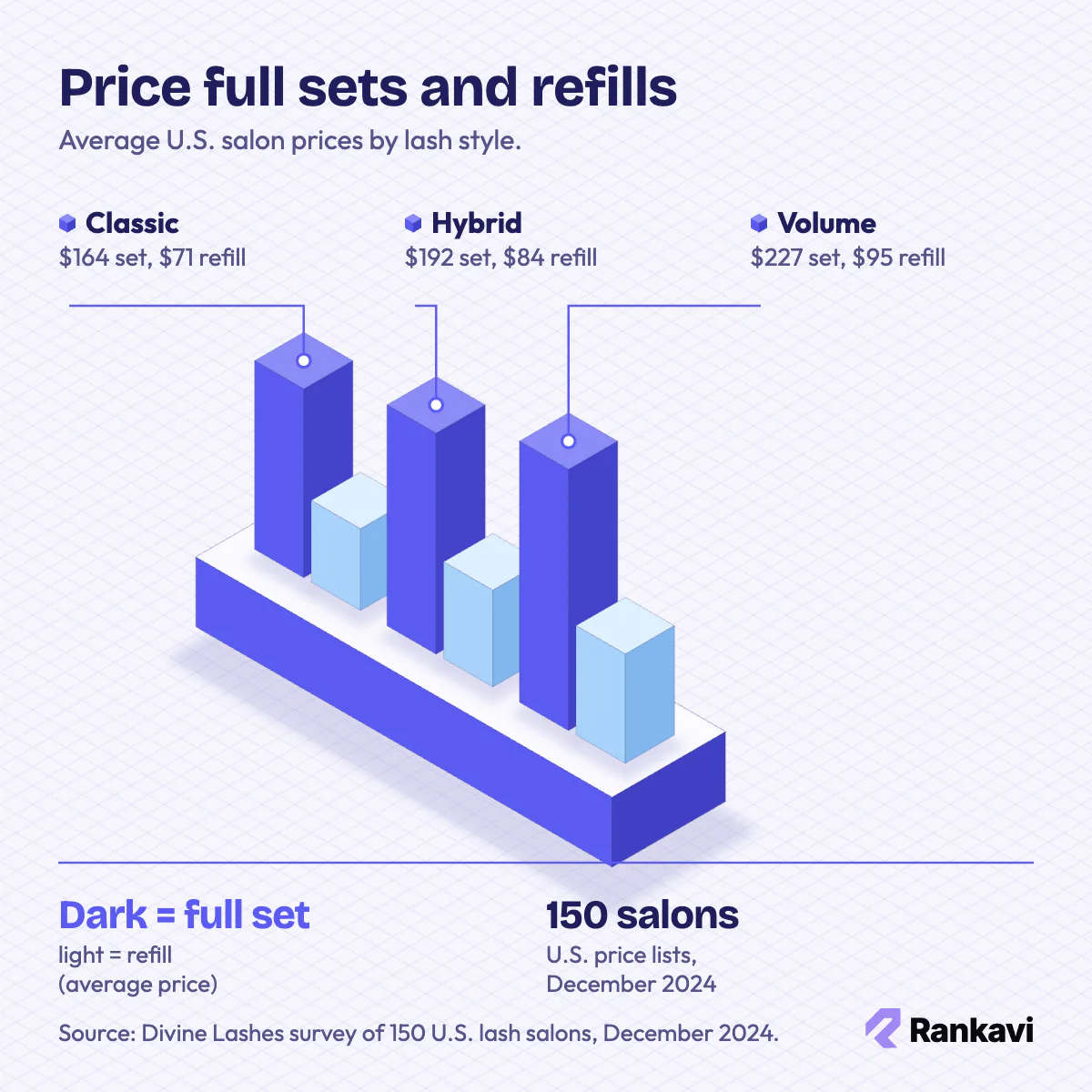
Divine Lashes, a Canadian lash studio chain, surveyed 150 U.S. salon price lists in December 2024. Classic full sets averaged $164 and refills $71 in that 2024 study.
| Style | Full set | Refill |
|---|---|---|
| Classic | $164 | $71 |
| Hybrid | $192 | $84 |
| Volume | $227 | $95 |
Source: Divine Lashes, survey of 150 U.S. lash salons, December 2024.
Many artists price from an hourly target. They add yearly expenses, taxes and desired pay, then divide by planned working hours. The hourly rate times the appointment length gives the set price.
The target also needs room for card fees, booking software and the time spent on consultations and cleanup. Not every working hour gets booked, so the target is divided over realistic booked hours. A new artist may price lower while building a portfolio. Prices rise as skill and demand grow, with advance notice to clients.
Extras can be listed apart from set prices. Removal, bottom lashes and late-cancellation fees fit here. A deposit protects long full-set slots.
Appointment length depends on the style. Divine Lashes put a classic full set at 90 to 120 minutes and a volume set at 120 to 180 minutes in 2024.
Supplies make up a small share of each set. Fresha, a salon booking software company, estimated supplies at $8 to $15 per full set in July 2026. Labor time is the main cost.
Fill cadence is the number owners check first. Light Heart Lash, a lash supply brand, wrote in April 2026 that loyal clients prebook every two to three weeks. Those repeat fills carry break-even, not new full sets.
Startup money at a glance:
| Item | Figure |
|---|---|
| Startup cost | $500 to $2,000 for a starter kit and lash bed; a franchise salon runs $269,063 to $790,080 |
| Main costs | Training hours, salon suite rent ($400 to $900 a month), liability insurance (from $10 a month), supplies ($8 to $15 per full set) |
| Typical margin | No published gross or net margin; supplies cost under a tenth of a $164 classic set |
| Time to open | Training first (320 hours in Texas); The Lash Lounge, which runs a lash salon franchise, aims to sign leases within 100 days |
Sources: Light Heart Lash, a lash supply brand, vendor estimates, April 2026. Fresha, salon software, vendor estimate, July 2026. Insurance Canopy, which offers lash insurance, vendor price, 2026. Divine Lashes, a lash studio chain, December 2024. The Lash Lounge franchise site and the Texas Department of Licensing and Regulation, which licenses lash artists, accessed October 2026.
Worked example: In this illustrative case, a solo artist rents a $650 suite. Weekly the artist does 20 classic refills at $71 and three full sets at $164. That earns $1,912 a week, or $7,648 in four weeks. Supplies at $15 for 92 visits cost $1,380, a cautious figure since refills use less. After rent and $10 insurance, $5,608 remains before taxes and pay. A $2,000 kit pays back in month one.
3. Fund the Lash Kit and First Months
Funding a lash studio covers training, the starter kit, rent and marketing until fills pay the bills. Most solo artists start with personal savings and a modest budget.
Each funding route has a trade-off. Savings keep full control but slow the start. A microloan adds working capital but brings repayments before fills build up. A franchise adds brand support at the cost of royalties and fixed rules.
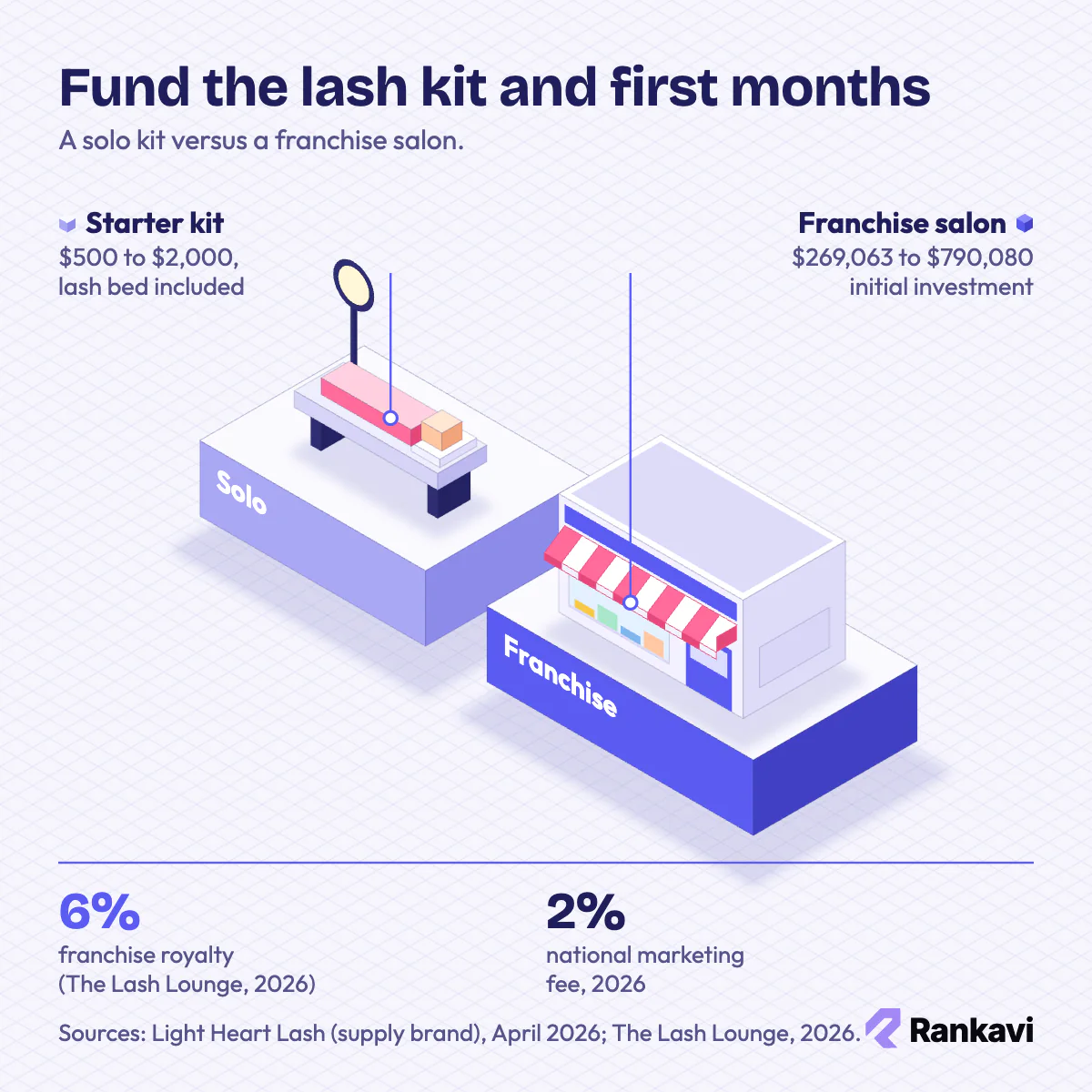
Light Heart Lash, which also runs a training academy, put a starter kit at $500 to $2,000 in April 2026. The high end includes a proper lash bed.
A simple budget sorts spending into supplies, studio rent, marketing, insurance, taxes and owner pay. An emergency fund then covers slow months or a broken lash bed.
“I started last year and spent more than it made but I’m going to keep going!”
— A new lash business owner commenting on YouTube
A franchise is the high-cost route. The Lash Lounge, a lash salon franchise, lists a $269,063 to $790,080 initial investment as of 2026. Its 2026 franchise page adds a 6% royalty and a 2% national marketing fee.
The U.S. Small Business Administration (SBA) offers microloans through nonprofit lenders. Small loans like these suit equipment and early working capital.
4. Form an LLC and Open a Business Account
Forming a lash company gives the studio a legal identity that signs leases, opens accounts and holds insurance. Many solo artists start as sole proprietors and switch later. Forming one adds filing fees and paperwork, and insurance is still needed because it does not replace it.
A limited liability company (LLC) keeps personal savings apart from business claims. An allergic reaction claim then targets the company, not the artist’s home.
The business name comes first, checked on the Secretary of State website. An employer identification number (EIN) comes from the Internal Revenue Service (IRS), which issues it free online.
A separate business bank account and card keep lash income apart from personal spending. Clean records make tax season simpler, and an accountant handles deductions for supplies and rent.
5. Pick a Home Studio, Suite or Salon Room
Choosing a workspace decides rent, privacy and which licences the studio needs. Lash artists work from four common setups, each with its own trade-off between cost, privacy and control:
- Home studio: a separate room, if zoning and state rules allow it.
- Salon suite: a private, lockable room inside a suite building.
- Salon room rental: a room inside an existing hair or nail salon.
- Mobile service: the artist travels to each client.
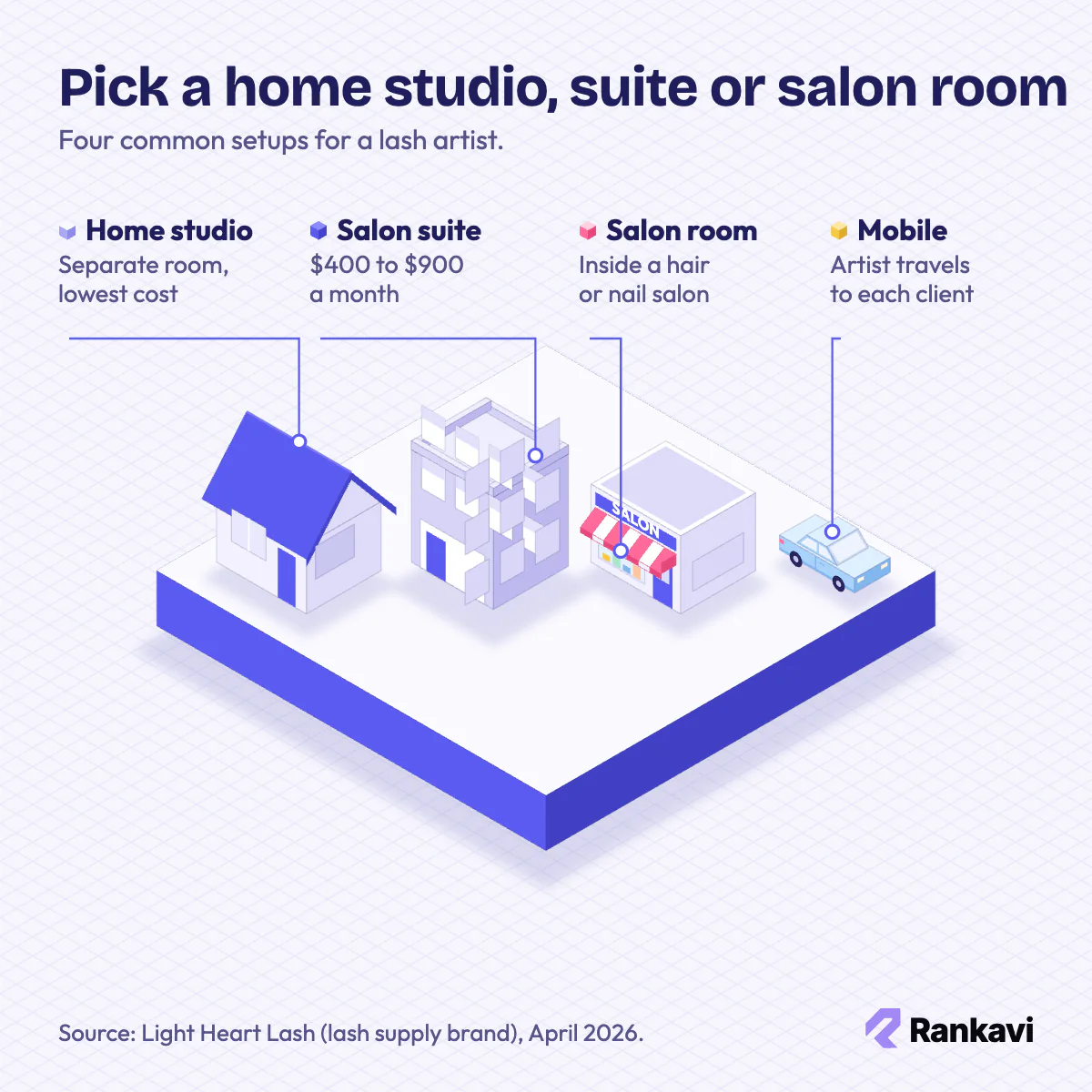
A home studio keeps costs lowest. Many states require a separate entrance or room, and local zoning may limit client traffic.
A salon suite gives a private space with shared reception and utilities. Light Heart Lash put suite rent at $400 to $900 a month in its April 2026 guide. Renting a room inside a busy salon also brings walk-in clients.
The room needs bright, even lighting, a sink for handwashing and space around the lash bed. Quiet matters too, since clients often sleep during a long set.
Mobile service avoids rent but limits lighting, handwashing access and client privacy. A lease or sublease deserves a careful read before signing, especially its rules on insurance and shared areas.
6. Get a State Lash or Esthetician License
Licensing a lash business means meeting the state board rules for the artist and for the studio itself. Requirements vary widely between states, so the state board website is the first stop. A license also shows clients and landlords that the artist met the state standard.
Most states treat lash extensions as cosmetology or esthetics. Artists complete a state-approved program and pass a state exam before working on clients.
Texas offers a separate eyelash extension specialty license. As of 2026, the Texas Department of Licensing and Regulation (TDLR), which licenses beauty professionals, approves the 320-hour training courses it requires.
California allows only licensed cosmetologists and estheticians to apply eyelash extensions. The California Board of Barbering and Cosmetology, which licenses the state’s estheticians, restated that rule in a July 2022 bulletin.
The studio itself often needs a salon or establishment license at its address. A local business license and a sales tax permit for retail products complete the paperwork.
7. Insure Against Adhesive Reactions
Insuring a lash studio protects the artist from claims for allergic reactions, eye irritation and client falls. Adhesive works close to the eye, so mistakes carry real risk.
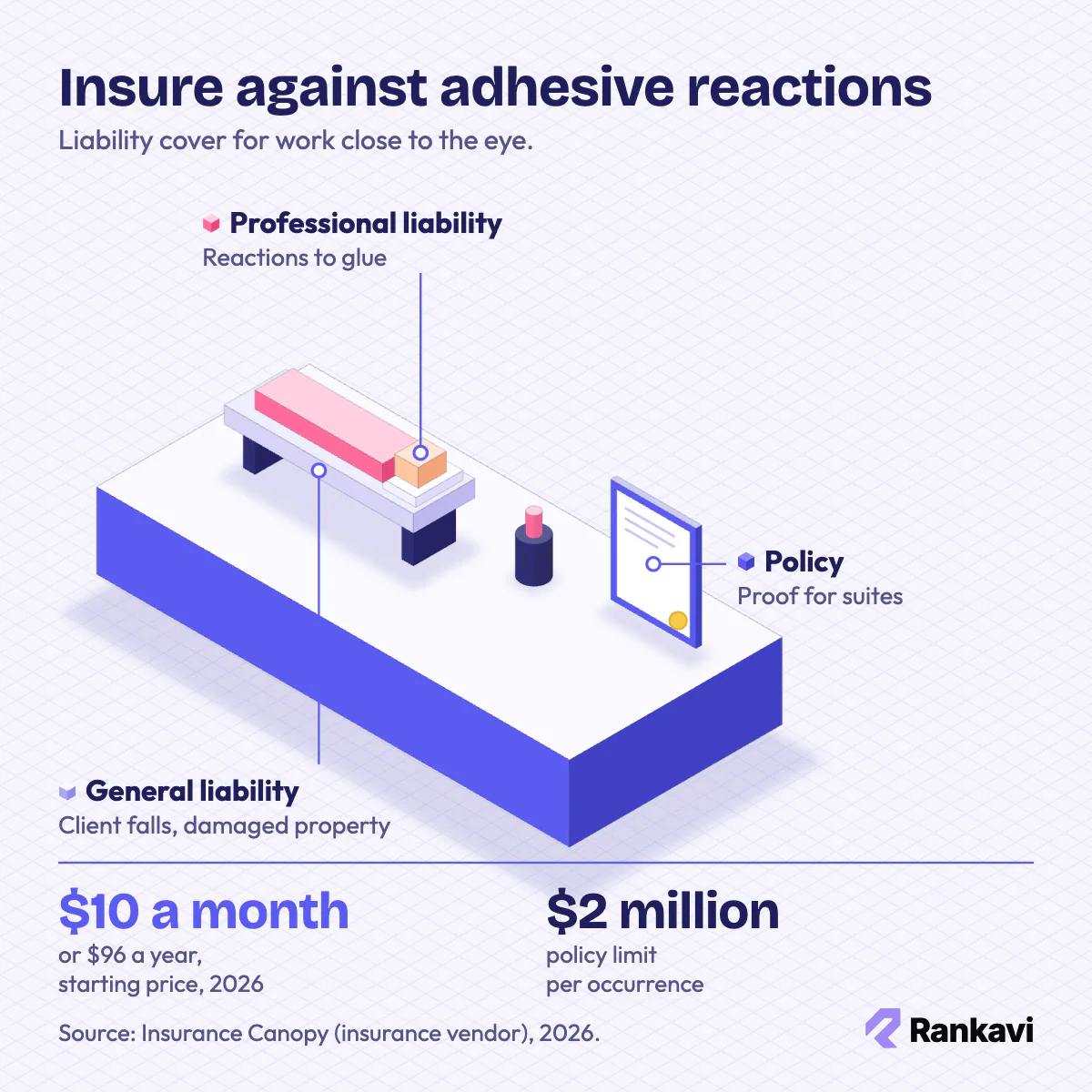
General liability pays when a client trips over a lamp cord or a handbag gets damaged. Professional liability covers claims that the service itself caused harm, such as a reaction to glue.
Insurance Canopy, an insurance vendor for beauty professionals, sells lash policies from $10 a month or $96 a year as of 2026. Its 2026 policy limit is $2 million per occurrence.
Policies differ in what they exclude, so the exclusions deserve a read before buying. Patch test records and signed consent forms help support a claim if a reaction occurs. Salon suites and host salons usually ask for proof of insurance before move-in. Property coverage protects the lash bed, lights and stock, and workers’ compensation follows the first employee.
8. Stock Adhesive, Tweezers and a Lash Bed
Stocking a lash studio turns the service menu into a working station. Quality supplies affect retention more than any other purchase.
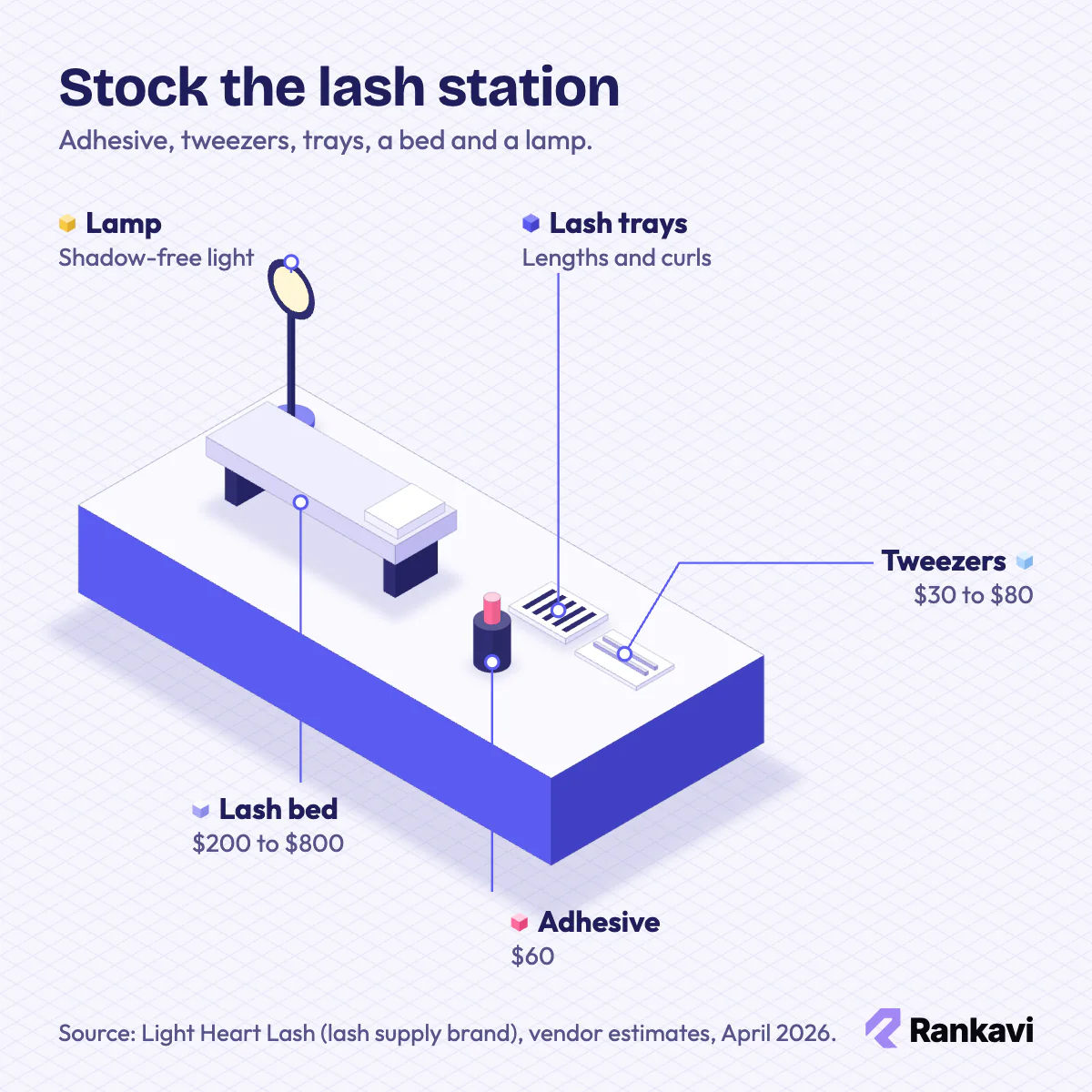
Starter lash kit:
| Item | Purpose | Vendor estimate |
|---|---|---|
| Lash trays | Extensions in several lengths and curls | Varies by brand |
| Adhesive | Bonds each extension to a natural lash | $60 |
| Tweezers | Isolation and fan pickup | $30 to $80 |
| Primer and lash shampoo | Clean, oil-free lashes before application | Varies by brand |
| Lash bed | Keeps the client still and comfortable | $200 to $800 |
| Lamp | Shadow-free light on the lash line | Varies by model |
Source: Light Heart Lash, a lash supply brand, vendor estimates, April 2026.
The U.S. Food and Drug Administration (FDA), which regulates cosmetics, treats false eyelashes and their adhesives as cosmetics. Eye-area reactions are a known risk, so artists run a patch test on new clients.
Lash trays and adhesive run out first, so early reordering avoids cancelled appointments. Cheap marketplace glue and lashes can hurt retention and reputation. Established lash suppliers list ingredients, batch dates and storage rules.
Booking software handles appointments, deposits, reminders and client notes. Deposits reduce no-shows on long full-set slots.
9. Market With Instagram and Google Reviews
A lash studio wins its first clients with photos, because results sell lashes better than words. Every set becomes marketing material.
Instagram is the main showcase for lash artists. A clear profile, local hashtags and consistent before-and-after posts show style and quality.
Pinterest works as a visual search engine. Lash style boards link back to the booking page and keep bringing visitors for months.
Google Business Profile is the free Google listing that shows a lash studio on Maps and in local search. Reviews from early clients build trust fast. Instagram needs steady posting. Google reviews need a simple way to leave one, such as a card with a link.
Word of mouth fills the rest of the book. A referral reward for clients who bring a friend costs little and rewards loyalty.
10. Add Lash Lifts, Retail and a Second Artist
Growth comes from more revenue per client before more clients. Each added service uses the same chair and the same customer base.
Aftercare retail is the simplest add-on. Lash cleanser and brushes help clients keep extensions longer, and the studio earns a product margin.
Add-on services raise the ticket. Lash lifts, brow shaping and tinting fit the same appointment slots.
Hiring a second artist starts when the owner turns clients away. The BLS reported a $45,330 median annual wage for skincare specialists in May 2025. That group includes eyelash services, so it serves as a pay proxy.
A second artist adds capacity but also needs space, training standards and a license of their own.
The American Lash Association is a membership group for lash artists and studio owners. It publishes a trade magazine and a standards code. As of 2026, American Lash Association membership for artists costs $145 a year.
11. Enter AI Shortlists When Clients Ask ChatGPT
AI visibility for a lash studio involves being named when clients ask chat tools for a lash artist nearby. ChatGPT, Gemini and Google AI Overviews now answer many beauty searches.
Those answers lean on review sites, local directories and “best lash studio” lists. A new studio gains from appearing on those pages before its own review count grows.
Rankavi is a software as a service (SaaS) platform that publishes brand mentions in articles on indexed third-party websites. Lash studios that want stronger brand visibility in AI answers from ChatGPT can begin with it.