

Starting a landscaping business means choosing installation services, licensing them, insuring the crew and pricing every project for profit. The U.S. Bureau of Labor Statistics (BLS) put grounds maintenance employment at 1,299,200 jobs in 2025.
Hello, my name is Michal Sieroslawski, and I help landscaping companies get noticed by homeowners online. Chat-based search is changing how homeowners find landscaping companies. For a new landscaping company, being part of those recommendations is a real advantage.
The order puts pricing and money ahead of paperwork, so licenses and insurance are bought for services that already pay. Equipment comes after the license, because the license decides which installs are legal. The path to a running landscaping business runs through the twelve steps below.
- Choose Your Landscaping Services
- Write a Landscaping Business Plan
- Price Installation and Design Work
- Fund Your Startup Costs
- Register Your Company
- Get a Contractor License and Permits
- Insure and Bond the Business
- Buy Trucks, Trailers and Install Equipment
- Set Up Estimating and Scheduling Software
- Market to Homeowners and Builders
- Hire Crews and Add Services
- Appear When Homeowners Ask AI
1. Choose Your Landscaping Services
Choosing landscaping services decides which projects the company bids on and which clients it serves. The service mix shapes the license, the equipment list and the pricing model that follow.
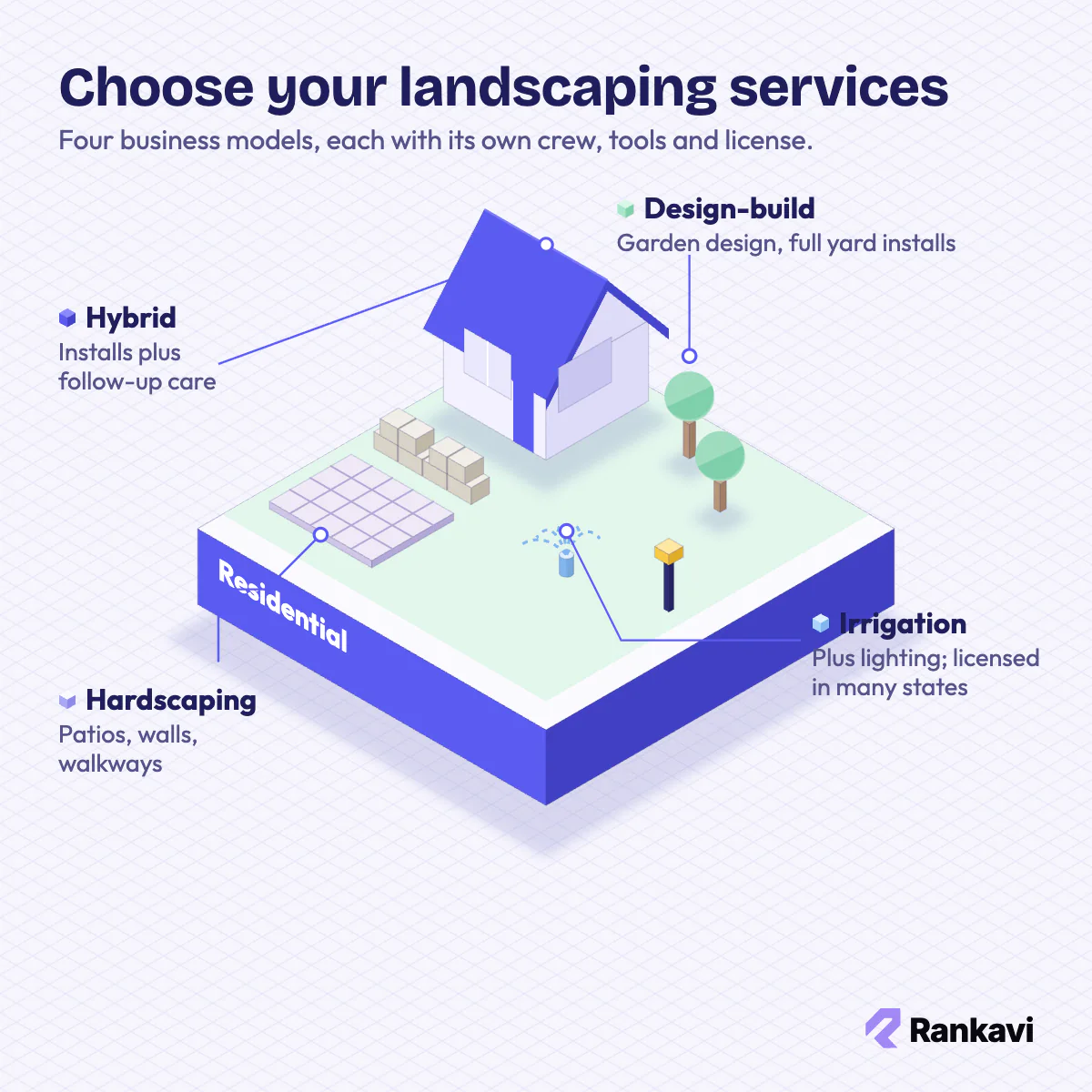
Landscaping companies follow one of five broad models, and the image above shows the four install-focused ones. Maintenance firms sell recurring upkeep. Design-build firms plan and install new outdoor spaces. Hardscaping and irrigation firms focus on one trade, and hybrid firms combine several.
Common landscaping business models:
| Model | Typical work | Trade-off |
|---|---|---|
| Maintenance | Mowing, edging, mulching, seasonal cleanups | Lower tickets, steady recurring income, route density matters |
| Design-build | Garden design, planting plans, full yard installs | Higher tickets, longer sales cycles |
| Hardscaping | Patios, walkways, retaining walls, fire pits | Skilled crews and heavy equipment |
| Irrigation and lighting | Sprinkler systems, drip lines, outdoor lighting | Licenses or certifications in many states |
| Hybrid | Installs plus follow-up care | More logistics to manage |
Design-build and hardscape projects pay well but arrive unevenly. Each job needs a site visit, a design, a bid and a signed contract. A new installer therefore plans for gaps between projects.
Field experience comes before the first bid. Many founders work for an established installer first, digging, hauling stone and setting pavers. That job teaches estimating, crew pace and the mistakes that cost money on a site.
A look at local rivals reveals where the openings are. Competitor reviews expose common complaints, such as missed start dates or poor drainage work. A town crowded with mowing crews may still lack a reliable irrigation installer or paver contractor.
Client type also shapes the choice. Homeowners buy design-build, patios and lighting, and decide on appearance and trust. Homeowners associations and property managers buy maintenance and irrigation repair, and decide on price and reliability. Builders hire installers for new construction. Homeowners usually have the shortest sales process, so new companies often start there.
Four questions narrow the choice:
- Skills: the trades the founder has actually worked on.
- Capital: maintenance needs mowers and a trailer, while hardscaping needs machines and material storage.
- Climate: cold regions often pair installs with snow removal, and dry regions lean on irrigation.
- Local demand: the services nearby competitors lack.
Launching with one or two services keeps equipment and training simple. A maintenance contract paired with one install specialty also covers the gaps between projects. Pesticide application, irrigation and retaining walls carry extra licensing rules, covered in step six.
2. Write a Landscaping Business Plan
Writing a landscaping business plan sets the services, target clients and financial targets on paper before money is spent. Lenders read the plan, and the owner uses it to judge each season.
A standard plan follows a familiar order. Each section answers a question a lender or partner will ask.
A plan includes seven sections:
- Executive summary
- Company overview and owner background
- Services and price ranges
- Market analysis of local competitors
- Marketing plan
- Operations, equipment and scheduling
- Financial projections
The U.S. Small Business Administration (SBA) describes two plan types. A traditional plan is detailed and can run dozens of pages. A lean startup plan is typically one page. A self-funded solo owner can use the short form, while a bank usually expects the long one. Clients belong in the plan by segment, with the planned split between recurring maintenance contracts and one-time installs.
Seasonality drives the financial section. Installation work peaks in spring and early summer, then slows in late fall. The plan shows how the company covers winter overhead, through snow work, holiday lighting or saved cash.
The service area belongs in the plan as well. Neighborhoods with larger lots and higher home values support patio and full-yard projects. A tight radius also cuts drive time between job sites.
3. Price Installation and Design Work
Pricing landscaping projects determines whether each install pays for materials, labor, equipment and profit. Underbidding is the most expensive early mistake in design-build work, because one losing project can erase a month’s margin.
Full-cost pricing is the standard method. The estimate adds materials, crew hours, equipment time, disposal, permits and a share of overhead. A markup on materials and a profit margin then sit on top.
Owners most often underestimate labor. The U.S. Bureau of Labor Statistics (BLS) reported median pay of $18.82 an hour for landscaping and groundskeeping workers in May 2025. Payroll taxes and insurance add to that base wage. The Internal Revenue Service (IRS) set employer Social Security tax at 6.2% and Medicare tax at 1.45% of wages for 2026.
Markup and margin are different numbers. Margin is profit as a share of the price, so a markup always yields a smaller margin. The price for a target margin equals cost divided by one minus that margin.
Common landscaping pricing models:
| Model | Best fit |
|---|---|
| Fixed project bid | Patios, walls, planting installs with a clear scope |
| Time and materials | Drainage repairs and jobs with hidden conditions |
| Design fee | Plans and drawings, often credited toward the install |
| Per-unit rate | Mulch, sod or pavers priced by area or volume |
Deposits protect the company’s cash. Many installers collect a deposit at signing to buy materials, then bill progress payments as phases finish. Written change orders cover extra work the client adds mid-project.
“I now insist on a simple signed contract for all work (other than very small jobs) with a payment on day 1 to at least cover materials. Anyone who doesn’t want to sign is clearly going to be a problem & it’s best to walk away at that stage.”
— A landscaper on the Landscape Juice Network, a UK forum
Contract law differs in the US, so the deposit habit transfers, not the legal detail.
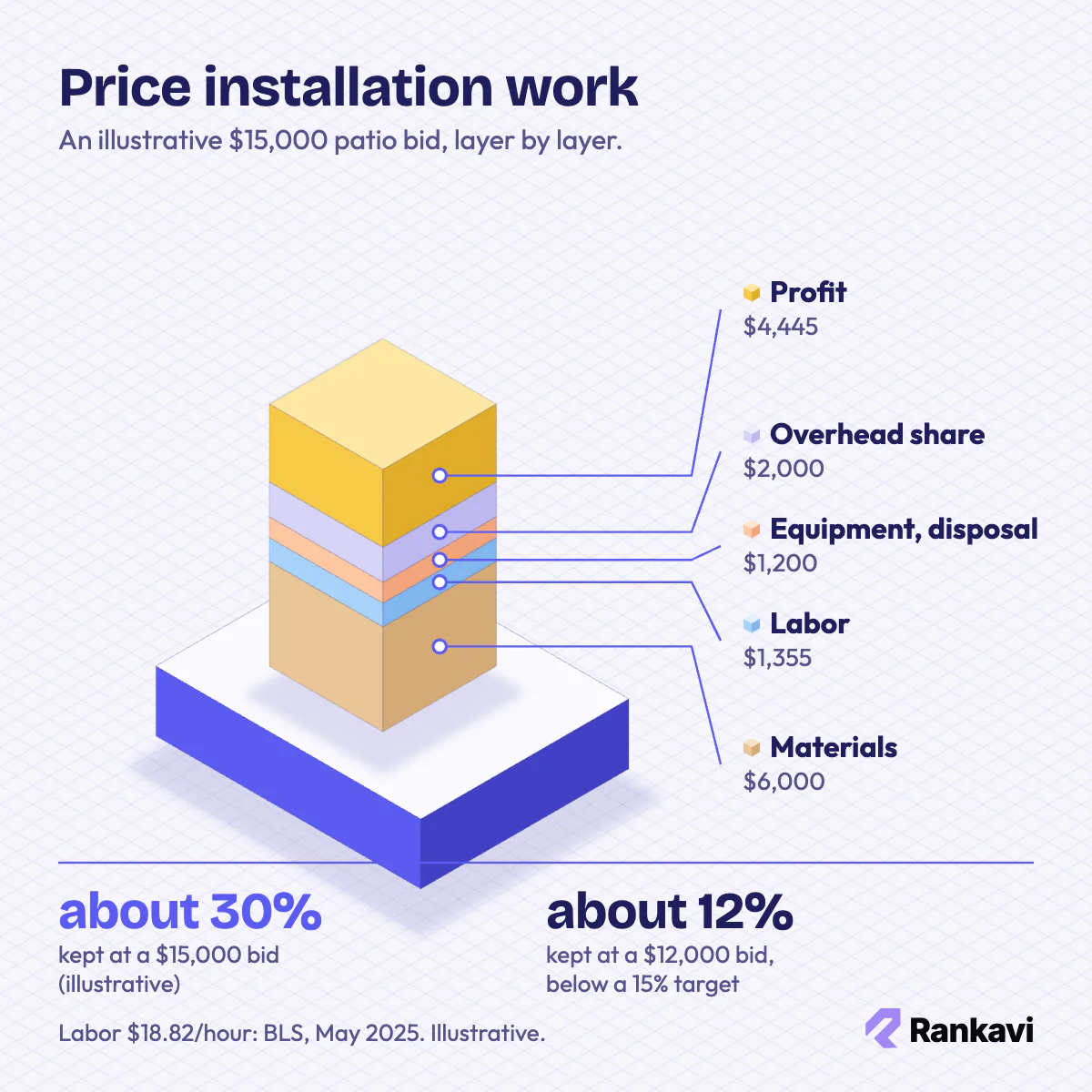
Worked example: Take an illustrative patio bid of $15,000. Materials cost $6,000. A three-person crew logs 72 labor hours in total at $18.82, about $1,355 before payroll taxes. Equipment rental adds $900, disposal $300 and the overhead share $2,000. Total cost is $10,555, so the job keeps $4,445, about 30%. At a $12,000 bid the same patio keeps only $1,445, about 12%, below a 15% target.
Competitor prices serve as a benchmark, not a template. A newer installer with strong photos and clean contracts doesn’t need to be the cheapest bid in town.
4. Fund Your Startup Costs
Funding a landscaping startup covers the vehicles, equipment, licenses and cash reserve the company needs before projects pay. The total depends mostly on whether the owner already has a truck and a trailer.
Startup money at a glance:
| Item | Typical figure |
|---|---|
| Startup cost | $107,650 to $252,850 for a Grounds Guys franchise (franchisor’s estimate, including a $43,750 fee); an independent installer who already owns a truck typically starts lower |
| Main costs | Truck and trailer, compact machines, insurance (about $610 a year average for general liability, broker figure), license fees and bond |
| Typical margin | About 15% average profit margin for new landscaping businesses (vendor estimate; gross or net not stated) |
| Time to open | Several weeks to a few months; license exams, bond filing and insurance set the pace |
Sources: Neighborly’s Grounds Guys franchise page (2026 disclosure document figure); Insureon, an insurance broker (customer data), 2026; Aspire, a landscaping software vendor, vendor estimate, 2025.
The Grounds Guys is a landscaping franchise owned by Neighborly that sells mowing, irrigation, lighting, planting and snow removal. Neighborly listed an estimated initial investment of $107,650 to $252,850 in 2026. That franchise figure includes the brand fee and leans toward lawn and grounds care.
An independent design-build installer skips the franchise fee and often starts lower, especially with a truck already paid off. A franchise buys a known brand and training, while an independent keeps full control.
Aspire, a landscaping software vendor, reported in 2025 that new landscaping businesses average about a 15% profit margin, without saying whether that is gross or net. That benchmark sets the break-even test for every bid and every loan payment.
Working capital carries the company through slow months. Material suppliers often want payment before the client’s final invoice clears. Winter also brings fixed costs with little install revenue.
Owners without enough savings borrow. The U.S. Small Business Administration (SBA) is the federal agency that backs bank loans and microloans for small firms. Banks and credit unions also offer equipment loans and lines of credit.
Equipment financing spreads the cost of a skid steer or truck over several years. Renting occasional-use machines keeps early debt low. Used equipment saves money but needs careful inspection before purchase.
5. Register Your Company
Registering a landscaping company means filing the business with the state under a chosen name and structure. The filing creates the entity that signs installation contracts and holds the contractor license.
Many landscape design and installation founders pick a limited liability company (LLC). The LLC shields the owner’s house and savings from company debts, which matters when crews work on clients’ property. A sole proprietorship is simpler but leaves the owner personally exposed.
The business name comes first. Owners check availability with the Secretary of State and search existing trademarks. A sole owner using another name files a doing business as (DBA) registration.
Once the state approves, the owner gets a free employer identification number (EIN) from the Internal Revenue Service (IRS). A dedicated business bank account then keeps deposits, material purchases and payroll apart from personal money.
6. Get a Contractor License and Permits
Licensing gives a landscaping company the legal right to build hardscapes, install irrigation and apply chemicals for pay. Rules differ by state, so the license list depends on the services chosen in step one.
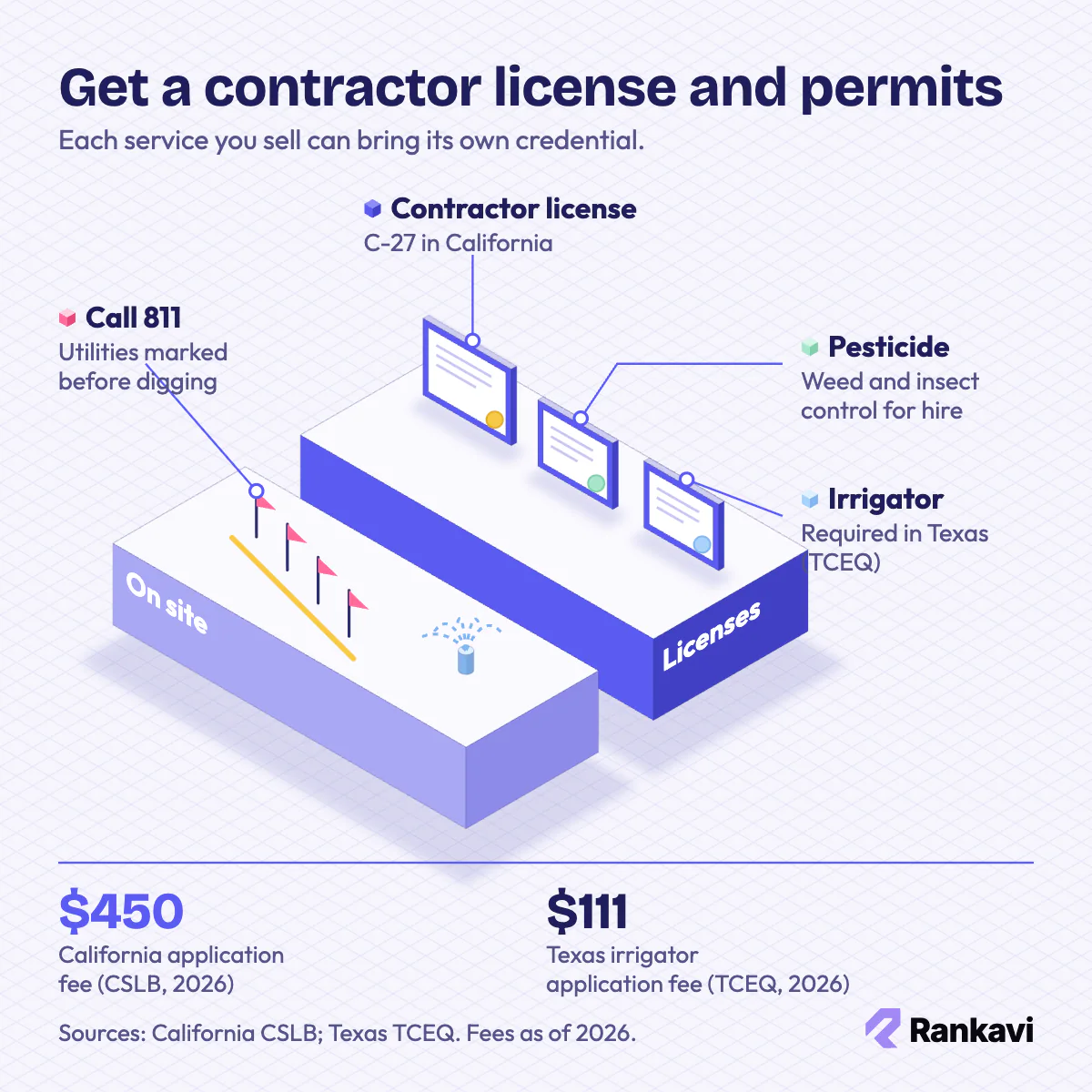
Many states license landscaping contractors that build structures, pour paving or install drainage. California’s Contractors State License Board (CSLB), which licenses the state’s construction contractors, issues the C-27 Landscaping Contractor classification. As of 2026, the CSLB charged a $450 application fee and a $200 initial license fee for sole owners.
Chemical work needs its own credential. The Environmental Protection Agency (EPA), the federal environmental regulator, sets pesticide applicator standards. State agencies run most licensing programs. Many states license any company that applies weed control or insecticides for hire.
Irrigation is licensed separately in some states. The Texas Commission on Environmental Quality (TCEQ) is the state agency that licenses irrigators. Nobody may design or install a sprinkler system there without that license. As of 2026, the TCEQ application fee was $111.
Common landscaping credentials:
| Credential | Needed for |
|---|---|
| State contractor license | Hardscapes, walls, drainage, larger installs |
| Pesticide applicator license | Weed control and insect control for hire |
| Irrigator license | Designing and installing sprinkler systems |
| Local business license | Operating in the city or county |
Local permits apply to many projects. Retaining walls, grading and drainage changes may need a city building permit. Crews also contact 811 a few business days before digging. The Common Ground Alliance runs 811, a free national service that marks buried utilities.
7. Insure and Bond the Business
Insuring a landscaping company protects the owner, crew and client from the cost of job site accidents. Heavy stone, power equipment and excavation make injuries and property damage real risks.
General liability insurance covers damage to a client’s home and injuries to visitors. Insureon, an insurance broker, reports that its landscaping customers paid an average of $51 a month, or $610 a year, for general liability in 2026. That is the broker’s own customer figure, not an industry-wide rate.
Commercial auto insurance covers the work truck and trailer. A personal auto policy usually excludes vehicles used for business hauling. Inland marine coverage protects tools and equipment on trailers and job sites.
Workers’ compensation becomes necessary with the first employee in most states. Texas is the main exception. The Texas Department of Insurance is the state regulator, and it lets most private employers skip coverage.
Licensed contractors often need a bond too. In California, the CSLB required a $25,000 contractor bond on file as of 2026. The bond assures clients that the contractor follows licensing law.
8. Buy Trucks, Trailers and Install Equipment
Buying equipment turns a licensed installer into a working landscaping crew. The equipment list follows the service mix, so a hardscape company buys very differently from a planting company.
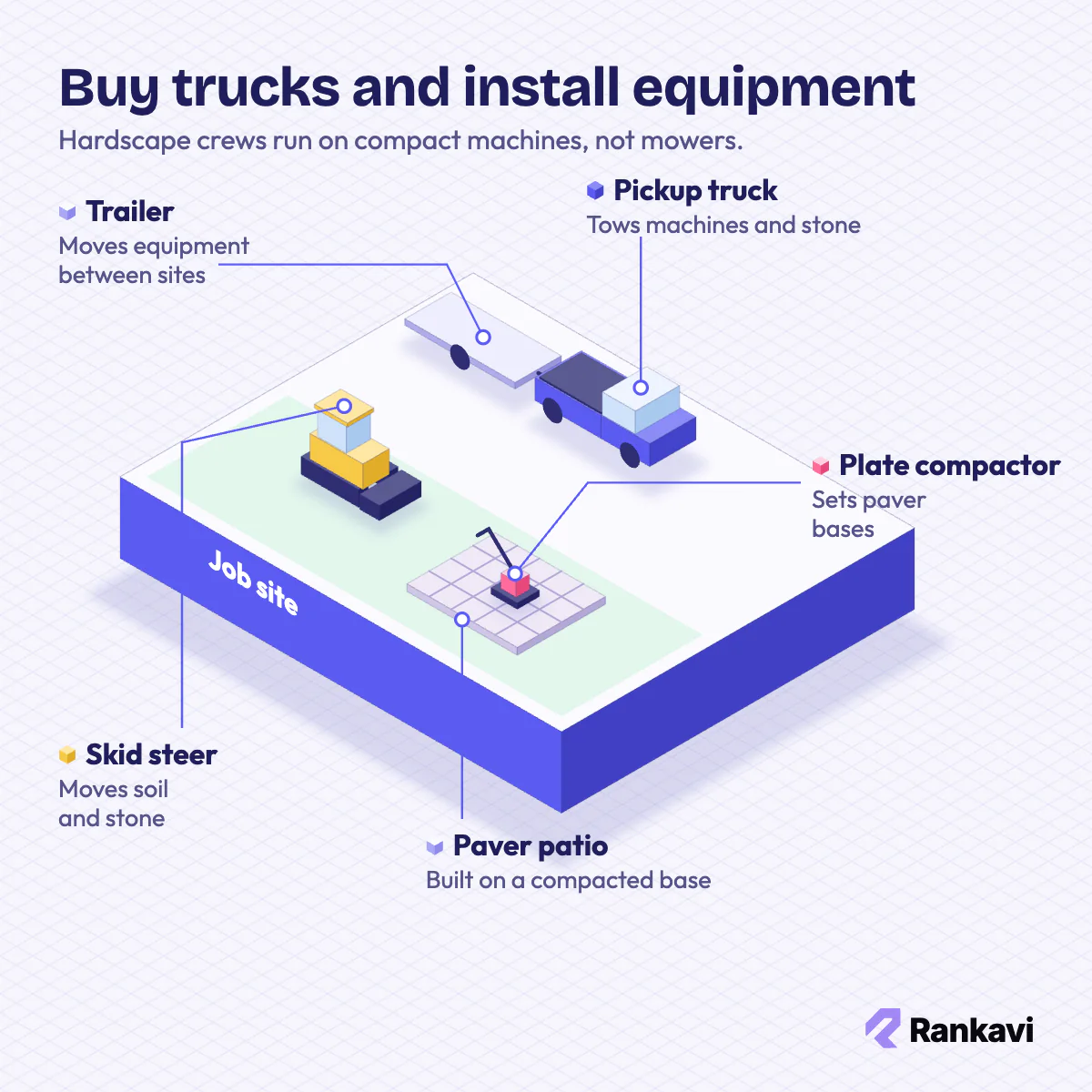
A heavy-duty pickup and a trailer form the core. The truck tows materials and machines, and a dump trailer hauls soil, stone and debris. A trailer with ramps moves compact equipment between sites.
Installation work needs compact machinery. A skid steer or compact track loader moves soil and stone. A mini excavator digs footings and trenches. A plate compactor sets paver bases, and a masonry saw cuts stone.
Typical installation equipment:
| Group | Items |
|---|---|
| Vehicles | Pickup truck, dump trailer, equipment trailer |
| Machines | Skid steer or compact track loader, mini excavator |
| Hardscape tools | Plate compactor, masonry saw, levels, screed rails |
| Hand tools | Shovels, rakes, wheelbarrows, pruning shears |
| Safety gear | Gloves, safety glasses, hearing protection, steel-toe boots |
Renting beats buying for machines used only a few times a season. Equipment dealers and rental yards rent excavators and trenchers by the day. Frequent-use machines are worth owning once the project calendar fills.
Equipment needs a secure home. Many owners rent a small yard or garage for machines and bulk materials. Some cities restrict parking trailers and storing stone at a home address.
9. Set Up Estimating and Scheduling Software
Setting up business software keeps estimates, schedules, crews and invoices in one system. A small landscaping company runs on accurate bids, so estimating tools matter more here than in mowing businesses.
Estimating software turns site measurements into material lists and labor hours. Takeoff tools measure areas from aerial images or plans. Consistent estimates protect the margin on every bid.
Design software produces drawings that help clients approve projects. A clear plan view or 3D rendering shows plant placement, patio size and lighting before work starts.
Field service software handles scheduling, crew dispatch, client messages and invoices. Accounting software tracks job costs, so the owner sees which project types actually earn money.
10. Market to Homeowners and Builders
Marketing a landscaping company puts finished projects in front of the people who will pay for the next one. Design-build clients buy on trust, so photos and reviews do most of the selling.
A portfolio website shows before and after photos for each service. The site lists the service area, the license number and a simple request form for estimates.
Google Business Profile is the free Google listing that shapes how an installer shows up on Search and Maps. Owners add project photos, services and the service area. Reviews from early clients drive both local visibility and trust.
Offline channels still win installation work. Yard signs at active job sites reach neighbors who see the progress. A wrapped truck acts as a moving billboard. Home and garden shows put the company in front of homeowners who plan projects.
Referral partners send steady leads. Home builders, pool companies, realtors and property managers all need reliable installers. A small referral reward keeps those partners sending work.
11. Hire Crews and Add Services
Growing a landscaping company involves adding crews, skills and new service lines once demand outgrows the owner’s schedule. Installation work is labor-heavy, so growth depends on finding and keeping good people.
Hiring starts with a crew lead who can run a site alone. The BLS projected about 162,500 openings a year for grounds maintenance workers from 2025 to 2035. Competition for experienced crew members stays strong in spring.
Some installers fill seasonal gaps through the H-2B program, which the U.S. Department of Labor runs for temporary nonagricultural work. Employers use it for seasonal or peakload labor needs.
Training keeps quality consistent across crews. The National Association of Landscape Professionals (NALP) is the main U.S. trade group for landscape companies. The National Association of Landscape Professionals runs the Landscape Industry Certified Technician exam. Its specialties include hardscape installation, softscape installation and irrigation.
The Concrete Masonry & Hardscapes Association (CMHA) is a paver and masonry trade group. It absorbed the Interlocking Concrete Pavement Institute. The Concrete Masonry & Hardscapes Association runs education and certification programs for hardscape crews.
Installs feed recurring work. A client with a new patio, irrigation system or lighting often signs a care agreement for upkeep and seasonal checks. Recurring contracts also make the company worth more if the owner ever sells.
“The problem with a business that mainly does “one off” jobs is that it has no value compared to a business that has every customer on a recurring weekly or fortnightly contract.”
— A landscaper on the Landscape Juice Network, a UK forum
Rates rise as demand grows. A full schedule and a strong portfolio justify higher bids. Owners track close rate, average project size and gross margin by project type.
12. Appear When Homeowners Ask AI
Appearing in AI answers means having a landscaping company named on the websites those assistants rely on. More homeowners now ask ChatGPT, Gemini or Perplexity for a patio builder or irrigation installer nearby.
Those assistants seldom invent their picks. They repeat what review platforms, local directories and “best landscapers in town” roundups publish. A new installer listed on those pages early has a better chance of being suggested.
Rankavi is a software as a service (SaaS) platform that publishes brand mentions in articles on indexed third-party websites. Installers can order unlinked mentions from $12 each. For homeowners asking ChatGPT about outdoor projects, its brand mentions for ChatGPT page covers the sources that assistant reads.