

Starting a junk removal business takes a truck or trailer, insurance, a disposal plan and steady local cleanout jobs. The Environmental Research & Education Foundation, which publishes waste research, reported a 10% rise in U.S. landfill tipping fees in 2024.
Quick introduction: I’m Michal Sieroslawski. I help junk removal companies get found by homeowners on Google and in AI chats. Tools like ChatGPT and Google’s AI Overviews now suggest junk removal companies by name. So being recommended in those chats matters more every year.
The order below tests demand and prices loads before any money goes into a truck. Licences and insurance then land before the first paid haul. Below are the ten steps, in the order most junk removal founders take them.
- Choose a Junk Removal Business Model
- Research Demand and Draft a Plan
- Price Jobs by Truckload Volume
- Register and Insure the Company
- Get Hauling Licenses and Permits
- Buy a Truck, Trailer and Hand Tools
- Set Up Disposal and Recycling Routes
- Market to Homeowners and Property Managers
- Grow With a Crew and Second Truck
- Land in Google AI Mode Answers
1. Choose a Junk Removal Business Model
Choosing a junk removal model decides the opening budget, the owner’s control and who finds the customers. Every later step, from pricing to insurance, follows from that choice.
A junk removal company clears the bulky items that curbside trash service leaves behind. Typical jobs include garage and attic cleanouts, estate clearouts, storage units, old furniture and renovation debris. Customers pay for the labor, the truck space and the disposal.
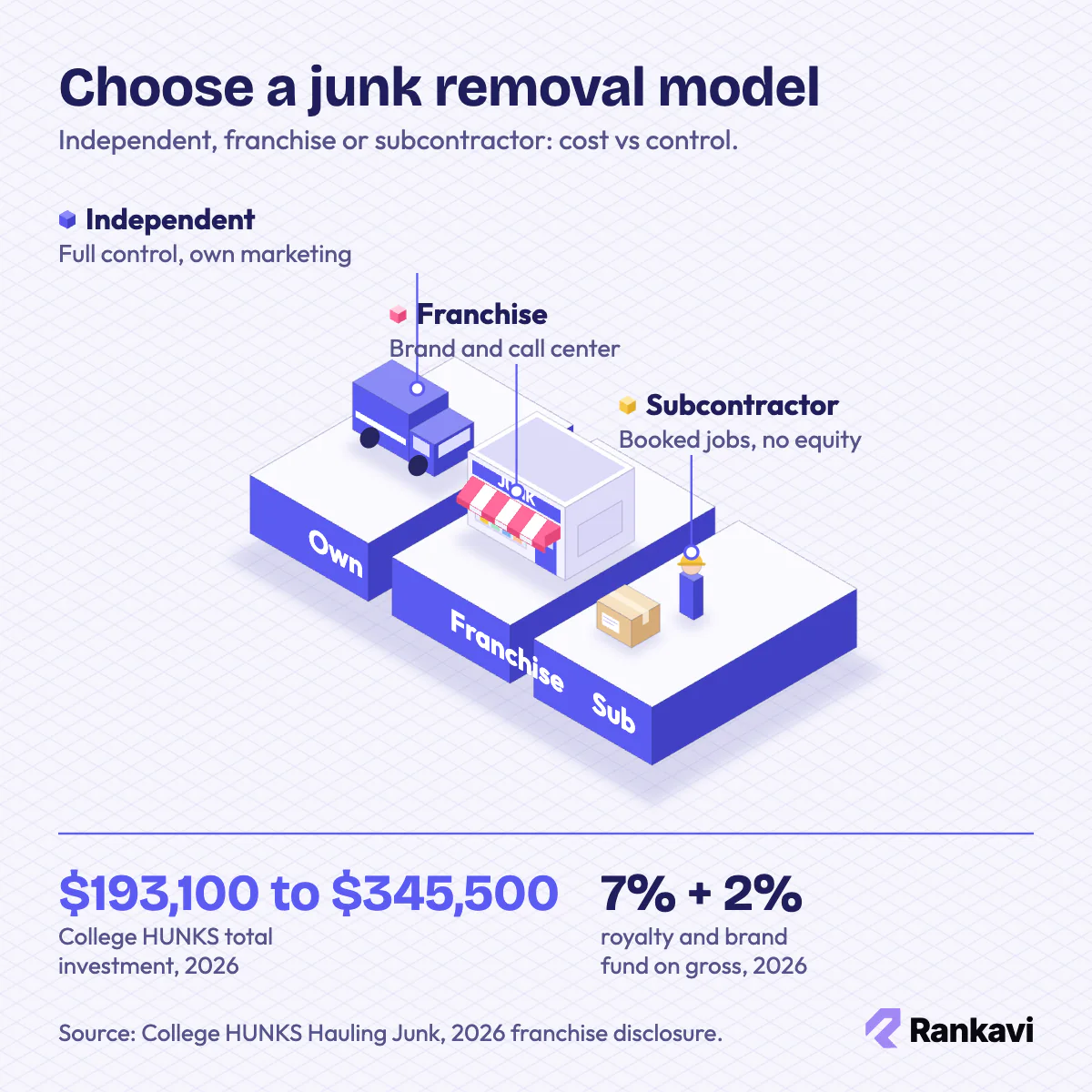
Three entry paths dominate the trade. An independent company builds its own brand, prices and customer base. A franchise buyer gets a known name and a booking system but pays a share of every job. A subcontractor hauls jobs booked by another company and owns no customer list.
Junk removal entry paths:
| Path | What the owner gets | What the owner gives up |
|---|---|---|
| Independent company | Full control of brand, prices and profit | Marketing and pricing built from scratch |
| Franchise | Brand, training, pricing model, call center | A share of every job, territory rules |
| Subcontractor | Booked jobs without marketing | Control over prices, no equity |
Other paths blend these models. A hybrid operator pairs hauling with moving, dumpster rental or resale. That adds revenue per job but also adds equipment and handling work. BizBuySell is a marketplace for businesses for sale. A buyer can purchase an existing junk removal company there.
Several brands sell junk removal franchises. JDog Junk Removal & Hauling is a franchise brand. Junk King is a franchise brand. The Junkluggers is a franchise brand. Each sets its own fees, so a buyer compares brands.
College HUNKS Hauling Junk is a junk removal and moving franchise. Its 2026 franchise disclosure lists a total investment of $193,100 to $345,500. The franchisor’s 2026 site also lists a 7% royalty and a 2% brand fund on gross sales.
The Federal Trade Commission (FTC) is the federal consumer protection agency. Its 2026 guidance says a franchisor must give a Franchise Disclosure Document (FDD) at least 14 days before a buyer signs or pays. Item 7 of the FDD lists the estimated initial investment. Item 19 holds earnings claims, which a franchisor may choose to include.
Cash, risk tolerance and the wish for control decide the path. A founder with a capable truck and a small budget leans toward the independent or subcontractor path. A founder with large capital and no marketing experience may prefer a franchise. Subcontracting builds no customer list, so it rarely leaves a business to sell.
Customer focus matters as much as the model. Residential work serves homeowners, renters and landlords clearing furniture, appliances and clutter. Commercial work serves offices, retail spaces and builders with larger, repeat loads.
Andrew Thompson, founder of JEDI Junk Removal and later of the software company Autopilot, wrote in 2026 that he started with about $4,000. Autopilot is field service software built for junk removal companies. Thompson put solo margins near 70% in 2026, falling to about 25% net with crews and ads.
Startup spending depends mostly on the vehicle. Stripe is a payments company that publishes startup guides. Its 2026 guide estimated that a used box truck with a liftgate usually costs $20,000 or more. An owner who already has a capable pickup skips that bill.
MoneyGeek is a personal finance and insurance comparison site that models premiums for haulers. The Environmental Research & Education Foundation (EREF) is a nonprofit that publishes solid waste research, including landfill fees.
Startup money at a glance:
| Item | Figure |
|---|---|
| Startup cost | About $4,000 for a founder who rents a pickup per job day; $20,000 or more once a used box truck is bought |
| Main costs | Vehicle, insurance (general liability $142 and commercial auto $198 a month), licence and hauling permit $30 to $500, dump fees averaging $62.28 per ton |
| Typical margin | About 70% for a solo operator, about 25% net at scale with employees (one owner’s own books) |
| Time to open | About one week for registration, bank account, insurance and listings |
Sources: Andrew Thompson (Autopilot), owner figures, 2026; Stripe vendor estimates, 2026; MoneyGeek, October 2026; EREF, 2024 data.
2. Research Demand and Draft a Plan
Local demand comes from moving, downsizing, renovation and estate work. Areas with many renters and frequent moves create steady furniture pickups. Suburbs with large garages and older homeowners create bigger cleanouts.
The U.S. Census Bureau’s American Community Survey (ACS) is an annual survey of housing, rent and age data. It reports by county, place and census tract. A high renter share points to frequent furniture pickups. Older homeowners and older housing point to bigger cleanouts. Google Trends is a free tool that charts how often people search a term. It shows whether junk removal searches rise in certain months.
Referral partners also send work. Real estate agents, property managers, estate sale companies and contractors all need cleanouts on deadlines, so a founder lists the ones in the service area.
A competitor review shows where a new hauler fits. A founder lists nearby junk haulers, their services, their prices and their reviews. Competitors fall into three groups: national franchise brands, independent local haulers and dumpster rental companies. Dumpster rental serves similar large cleanouts, but the customer does the loading. For each competitor, a founder records the service area, services, prices, minimum charge, same-day availability, review count and rating on Google Maps. The one-star and two-star reviews matter most. Repeated complaints about no-shows, surprise fees or slow replies mark gaps a new hauler can fill.
Core plan sections:
| Section | What it answers |
|---|---|
| Services and customers | Residential, commercial or both |
| Pricing | Load sizes, minimums and surcharges |
| Budget | Truck, fuel, disposal, permits and marketing |
| Disposal costs | Tipping fee at each nearby site and which loads can be donated |
| Break-even | Jobs per month needed to cover fixed costs |
| Growth | When to hire and add a second truck |
Disposal cost is the key assumption in a hauling plan. Dump fees vary by town and by load weight, so the plan prices them before setting rates. A plan that ignores tipping fees overstates profit on every job. Break-even follows from three numbers: average revenue per job, average cost per job and monthly fixed costs. Fixed costs divided by profit per job give the jobs per month needed to break even. A founder gets tipping fees from the county solid waste authority and plans with the highest realistic fee.
Test jobs prove demand before a truck purchase. Some founders book two or three same-day jobs and rent a pickup for the day. Paid jobs on a rented truck show whether the area produces enough work to justify buying one. The pass mark is set before the test starts. It covers booked jobs, profit per job after disposal and fuel, and whether any customer asks for a repeat visit.
3. Price Jobs by Truckload Volume
Pricing junk removal jobs sets a fee for each load that covers labor, fuel, disposal and profit. Most haulers charge by the share of the truck bed a customer’s items fill.
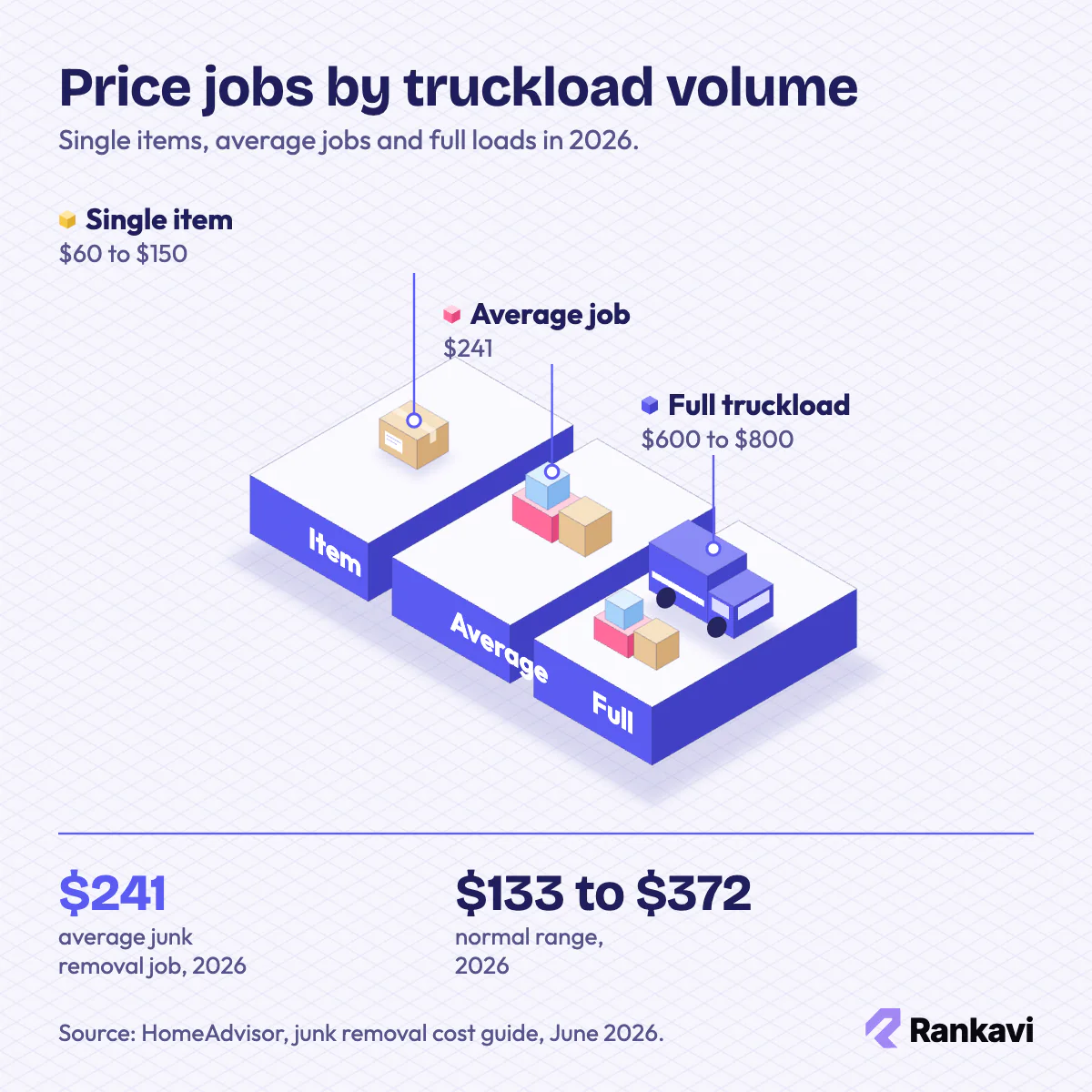
HomeAdvisor is a home services marketplace owned by Angi. Its cost guide, updated in June 2026, puts the average junk removal job at $241. The same 2026 guide gives a normal range of $133 to $372.
Truck space is measured in cubic yards. Fraction pricing works only when the hauler knows the truck’s size in cubic yards. Volume pricing splits the truck into fractions, such as a quarter, half, three-quarter or full load. HomeAdvisor listed a full truckload at $600 and $800 in June 2026. Single items ran between $60 and $150 in that 2026 guide.
Junk removal pricing models:
| Model | Best fit |
|---|---|
| Volume by truckload fraction | Mixed household cleanouts |
| Flat rate per item | A single mattress, couch or appliance |
| Hourly labor rate | Estate cleanouts and heavy disassembly |
| Weight or bed-load rate | Concrete, dirt, gravel and roofing |
A price floor adds disposal, fuel, labor and overhead for one job. That sum is divided by one minus the target margin. The U.S. Bureau of Labor Statistics (BLS) is the federal labor statistics agency. BLS reported median pay of $18.38 an hour for hand laborers and material movers in May 2025, a proxy for helper wages. A minimum charge keeps one small item from losing money on the trip.
Surcharges protect the margin on hard jobs. Stairs, long carries and high-rise buildings add labor time. Haulers price heavy material by weight rather than volume, because dump scales charge by the ton. Mattresses, tires, electronics and appliances with refrigerant can carry a separate fee when their disposal costs extra.
Worked example: As an illustration, a solo hauler books three average jobs a day at $241 each. That brings in $723 a day. General liability and commercial auto at $142 and $198 a month total $340, about half of one good day. A franchise owner pays 9% of that same $241 job, or $21.69, in royalty and brand fund fees. The independent hauler keeps that $21.69 but must find every customer alone.
On-site estimates prevent losses. Phone quotes based on a description often miss the true size of the pile. Photo or video estimates sent by text give a price range before arrival. Many owners explain the load prices by phone, then confirm the price in the driveway before loading.
4. Register and Insure the Company
Registering a hauling company gives it a legal identity that signs contracts, opens accounts and carries insurance. Property managers and commercial clients ask for both before they book.
Registration follows a set order. A name check with the Secretary of State comes first, then the Articles of Organization and an operating agreement. A tax number, a business bank account and insurance quotes follow. A hauler that trades under another name files an assumed name (“doing business as”) with the state or county.
Most junk removal owners form a limited liability company (LLC). The Articles of Organization is the filing that creates it.
An LLC keeps personal assets apart from claims for a scratched floor or a cracked doorframe. A separate business bank account helps keep that separation clear. Once profit grows, a certified public accountant (CPA) can advise on an S corporation election with IRS Form 2553. A sole proprietorship costs less to set up but offers no such separation.
The Internal Revenue Service (IRS), the federal tax agency, issues an employer identification number (EIN) at no charge. A business bank account and card processing follow, so crews can take payment in the driveway.
Core junk removal insurance:
| Policy | What it covers | Average monthly premium |
|---|---|---|
| General liability | Damage to a customer’s home and injuries to third parties | $142 |
| Commercial auto | The truck and trailer while hauling | $198 |
| Workers’ compensation | Crew injuries once the first employee joins | $322 |
Source: MoneyGeek, modeled premiums for junk removal firms with one to four employees, October 2026.
Before the first hire, general liability and commercial auto total $340 a month in the same October 2026 MoneyGeek figures.
A certificate of insurance (COI) is the document an insurer issues to prove coverage. Clients may also ask to be named an additional insured. Optional policies include inland marine for tools and umbrella coverage for large claims. Standard policies can exclude hazardous materials, so the agent confirms in writing how a leaking paint can is handled.
MoneyGeek’s October 2026 figures assume $1 million per occurrence limits, so quotes shift with truck count and crew size. Personal auto policies often exclude business hauling.
5. Get Hauling Licenses and Permits
Getting junk hauling licenses lets the company legally collect, transport and dump other people’s waste. Rules differ by state, county and city, so each owner checks every level.
A general business license from the city or county is the usual baseline. Washington, for example, asks haulers for a state license plus a city license. The Washington State Department of Revenue issues that state business license.
The usual order starts with a business license, then a hauler permit. A U.S. Department of Transportation (USDOT) number and a seller’s permit follow. The county solid waste office, the city clerk and state agencies each answer part of the question. The landfill can also name the hauler registration it requires.
Some jurisdictions add a waste hauler or transporter permit. Those permits can apply even to ordinary household debris. Stripe estimated in 2026 that a business licence and hauling permit cost $30 to $500 combined.
Vehicle weight triggers federal rules. The Federal Motor Carrier Safety Administration (FMCSA) regulates commercial trucks nationwide. As of 2026, FMCSA requires a U.S. Department of Transportation (USDOT) number for interstate vehicles rated at 10,001 pounds (4,536 kg) or more.
FMCSA guidance in 2026 requires a commercial driver’s license (CDL) at a vehicle rating of 26,001 pounds or more.
In 2026, a combination under 26,001 pounds needed no CDL, even with a trailer over 10,000 pounds, unless it carried hazardous materials. Each state sets its own rules for trucks that stay in state.
Sales tax registration applies where the state taxes junk removal as a service.
Certain items also need special handling. Refrigerators that hold refrigerant, tires and hazardous waste follow separate disposal rules. A hauler that declines hazardous waste, asbestos or medical waste says so before quoting. Hauling without a required permit can bring fines, and illegal dumping can bring liability for the hauler.
6. Buy a Truck, Trailer and Hand Tools
Buying hauling equipment determines how many loads the company can carry each day and how much each trip costs. Many owners start small and upgrade only after bookings prove steady.
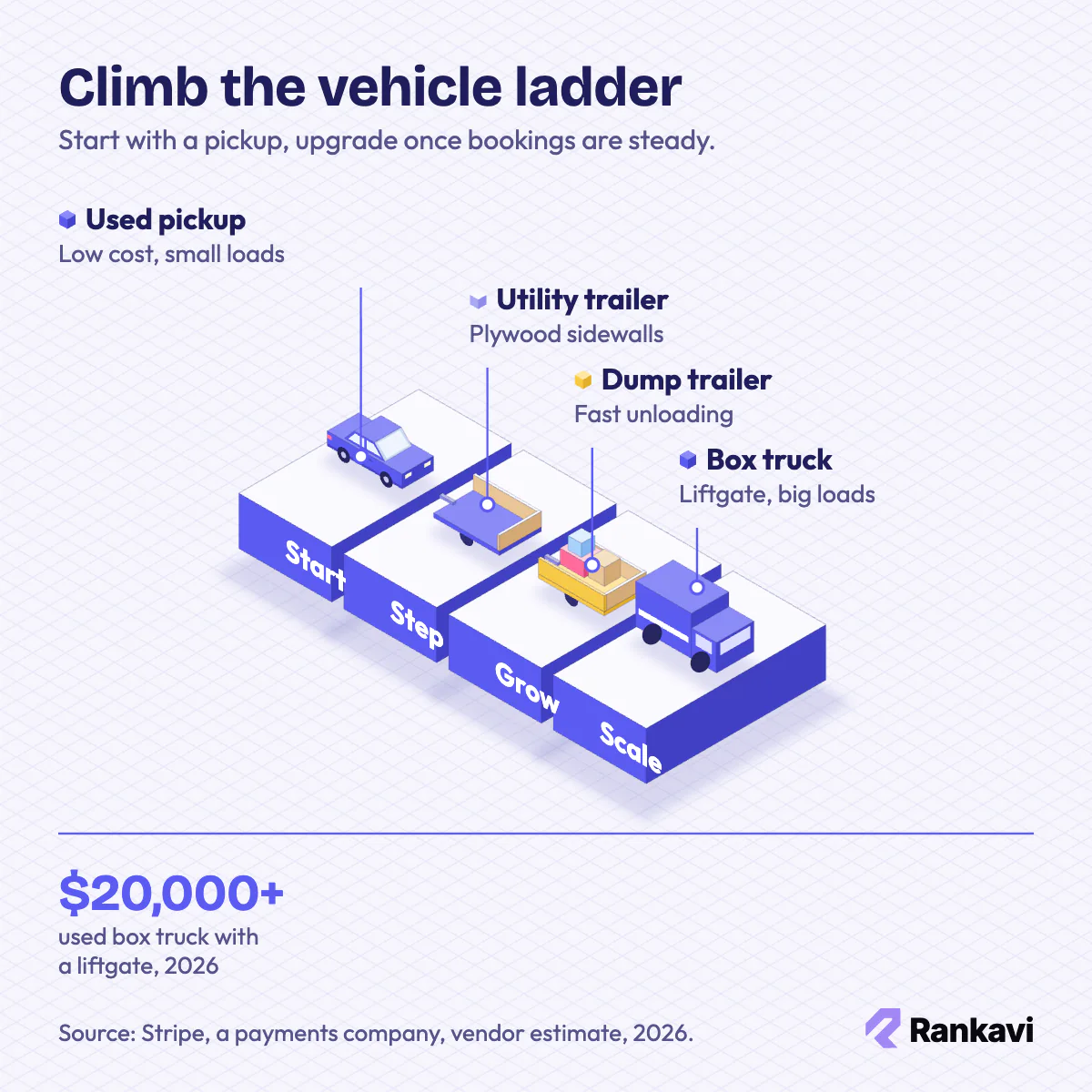
Junk removal vehicle ladder:
| Stage | Setup | Main trade-off |
|---|---|---|
| Start | Used pickup truck | Low cost, small loads |
| Step up | Pickup with a utility trailer and plywood sidewalls | More volume, still cheap to insure |
| Grow | Pickup with a dump trailer | Faster unloading at the dump |
| Scale | Box truck with a liftgate or a dump truck | Large loads, higher insurance and repairs |
Payload is the weight a vehicle can legally carry. Mixed furniture fills a truck by volume, while concrete, dirt and shingles reach the weight limit first. A truck rated under the CDL weight line avoids that license.
A box truck with a liftgate cuts manual lifting on big jobs. A dump trailer, by comparison, tips the load at the transfer station in minutes. Large trucks force commercial insurance early, and one breakdown can wipe out a slow month.
“If you have questions about equipment and what might work or not work. Go sit at a staging point outside of the dump. You can learn a lot just by watching what’s coming through.”
— A junk hauler in a YouTube comment
Used trucks need a closer look. A buyer checks the title, frame rust, the transmission and tires. Dump hoists get a leak check, and a mechanic inspects the truck. A vehicle history report completes the review. An upgrade is due when loads no longer fit or one job needs two dump runs.
The U.S. Small Business Administration (SBA) is the federal agency that runs a microloan program for small businesses. In 2026, SBA microloans went up to $50,000 and averaged about $13,000. They can fund working capital, supplies and equipment.
Hand tools come before any truck upgrade. The basic kit includes a hand truck, a flat dolly, ratchet straps, tarps, contractor bags and a sledgehammer. Gloves, steel-toe boots and eye protection cover the crew. A reciprocating saw cuts hot tubs and sofas into carryable pieces.
Truck upgrades raise capacity cheaply. Sidewalls or cages add height to a pickup bed or trailer. Branded decals turn the truck into a moving advertisement.
7. Set Up Disposal and Recycling Routes
Disposal planning separates profitable haulers from busy ones. Each load gets sorted before anyone pays a dump fee.
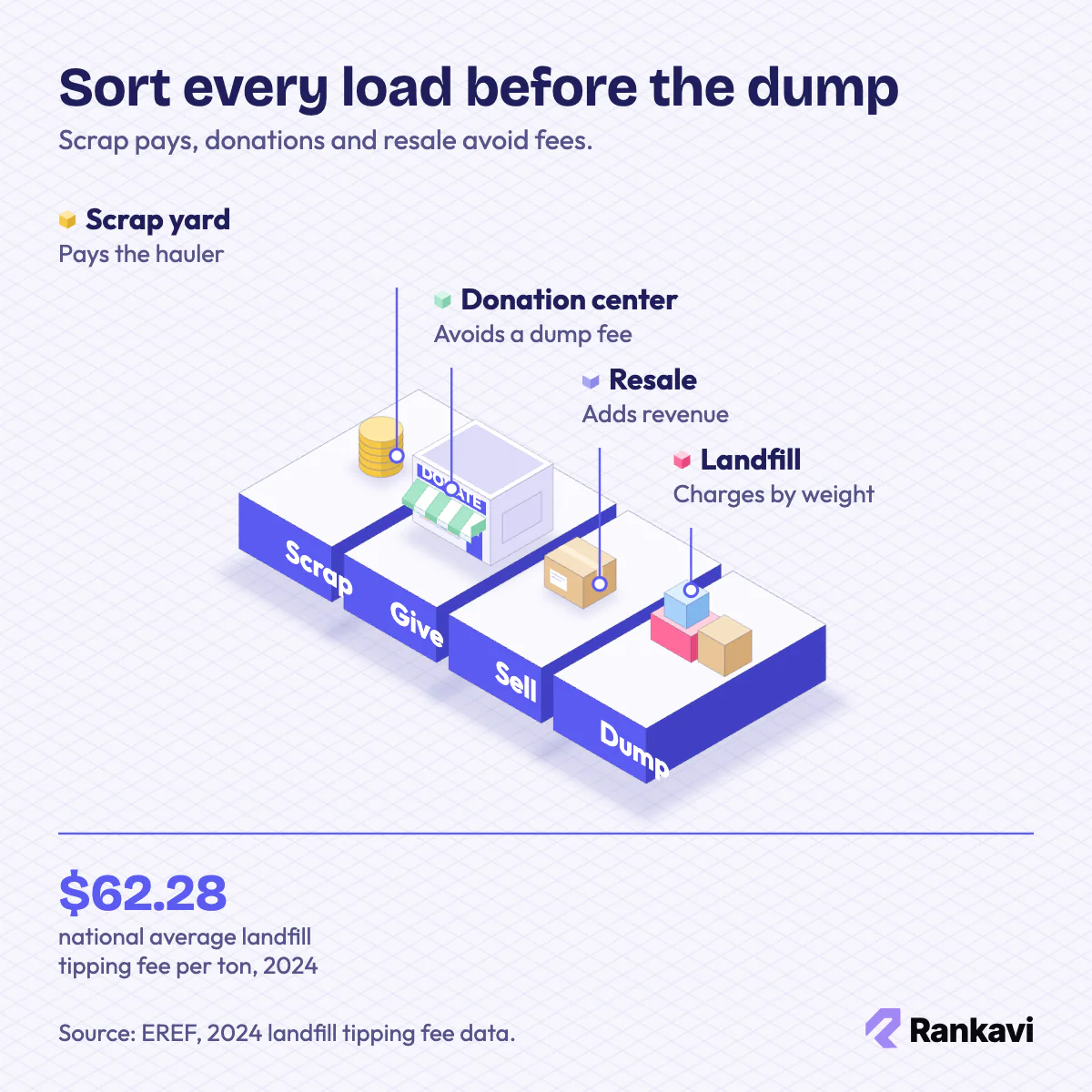
Where junk goes:
| Destination | Typical items | Effect on cost |
|---|---|---|
| Scrap yard | Metal, appliances without refrigerant | Pays the hauler |
| Donation center | Usable furniture and household goods | Avoids a dump fee |
| Resale | Good furniture and tools | Adds revenue |
| Recycler | Electronics, cardboard, refrigerant appliances | Small fee or free |
| Household hazardous waste collection | Paint, cleaners, oils, batteries and pesticides | Kept out of the regular trash; the local program sets the terms |
| Transfer station or landfill | True trash and mixed debris | Charges by weight or volume |
Household refrigerators, freezers and window air conditioners need their refrigerant recovered before final disposal. The Environmental Protection Agency (EPA) enforces this under the Clean Air Act. The scrap recycler or landfill owner must confirm the recovery. Recyclers may ask for a signed statement with the date and the name of the person who removed the refrigerant. A hauler asks the recycler what proof it wants.
The EPA lists paints, cleaners, oils, batteries and pesticides as household hazardous waste. Earth911 is a recycling directory. Its database lists collection sites for this waste by postal code. Asbestos and medical waste stay off the truck.
The 2024 EREF survey put the national average landfill tipping fee at $62.28 per ton. Private landfills charged more than public ones in that 2024 data.
Transfer stations set their own rates and rules. King County in Washington, for example, closed its landfill to the public and runs transfer stations instead. A new owner maps every site within a short drive, with prices and hours.
Facilities bill per ton, per load or with a minimum charge. The scale prints a weigh ticket, the record of the load’s weight. Weigh tickets, recycler receipts and donation receipts show where each load went, and property managers may ask for that proof.
Goodwill is a nonprofit that sells donated goods in thrift stores. Habitat for Humanity ReStore is a donation outlet for furniture, appliances and building materials. Each charity sets its own acceptance rules, so a hauler calls first.
Donation and resale cut the bill further. Usable sofas, tables and tools go to charity stores or online marketplaces. Each diverted item lightens the load that reaches the scale.
Software keeps the routes organized once calls pile up. Scheduling apps book jobs, send reminders and plan the day’s route. Card readers and digital invoices let crews collect payment right after the last item leaves the house.
8. Market to Homeowners and Property Managers
Google Business Profile is the free Google listing that puts a hauler on Maps and in local search results. It is the first marketing asset for a hauler. Homeowners search there for pickups near them. Reviews from the first customers build trust quickly.
A junk hauler is a service-area business. The profile can hide the street address and list up to 20 cities or postal codes. Google’s guidelines say the area should stay within about two hours of driving from the base. The FTC’s Consumer Reviews and Testimonials Rule, effective October 21, 2024, bans fake reviews. It also bans buying reviews that must express a set sentiment.
Free local channels fill the early calendar. Nextdoor is a neighborhood social network where residents ask for local services. Owners also post on Facebook Marketplace, local Facebook groups and Craigslist.
Referral partners for junk haulers:
| Partner | Why they refer |
|---|---|
| Property managers | Tenant move-outs and abandoned furniture |
| Real estate agents | Listing cleanouts before photos |
| Professional organizers | Clients ready to let go of clutter |
| Storage facilities | Unpaid units that need clearing |
| Estate sale companies and senior move managers | Leftover contents after a sale or downsizing |
| Probate and estate attorneys | Estate cleanouts with deadlines |
| Remodelers | Debris and unwanted furniture before and during projects |
| Water and fire restoration companies | Damaged contents that must be hauled out |
Property managers hire on speed and paperwork. A certificate of insurance and an IRS Form W-9 help a hauler pass vendor screening. The W-9 gives a payer the business’s tax number. Many managers keep approved vendor lists, so a hauler asks who maintains the list.
Asking each caller how they found the business shows which channel books work. A log of calls, quotes and booked jobs per channel completes the picture.
Visible branding works on every street. Yard signs left with a small customer discount show neighbors who did the work. A sign beside the truck during a job draws walk-up quotes.
Paid ads come later. Search ads need a budget, call handling and tracking. Free channels and referrals fund that step once revenue arrives.
9. Grow With a Crew and Second Truck
Growth starts when the owner turns down jobs or spends evenings quoting. A helper doubles lifting capacity and speeds every load. Stripe’s 2026 guide says one truck with a two-person crew handles three to five residential jobs a day.
Jobs per truck per day is the benchmark owners check first. Below three jobs, fixed costs such as insurance eat most of the day’s margin. Near five jobs, the truck is full and a second one starts to make sense.
Helper pay is the first cost to model. The U.S. Department of Labor is the federal agency that enforces wage and hour law. It states that the Fair Labor Standards Act (FLSA) requires time and one-half pay after 40 hours in a workweek. That covers nonexempt employees. The IRS separates employees from contractors using three groups of evidence: behavior, finances and the type of relationship.
A second truck adds a payment, insurance, fuel and maintenance. Break-even jobs per day come first: monthly truck cost plus crew pay, divided by profit per job. A larger second truck can cross the weight lines covered in steps 5 and 6.
Hiring good movers takes a plan. Clear training on lifting, estimates and customer manners keeps quality steady. Written checklists let a new crew run a job without the owner on site.
Two numbers guide every growth decision. Average job revenue shows what each booking earns. Customer acquisition cost shows what marketing spends to win that booking.
Other numbers help too. They include revenue per truck, gross margin per job and labor cost as a share of revenue. Field service software such as Autopilot tracks bookings and routes for those figures.
Add-on services raise revenue per customer. Dumpster rentals, light demolition and estate cleanouts use the same truck and crew. Donation pickups also appeal to eco-minded homeowners. Each add-on brings its own needs. Dumpster rental needs dumpsters and a truck to place them, and light demolition adds tools and debris handling.
10. Land in Google AI Mode Answers
Homeowners now ask AI tools for help with a cluttered garage or a dead sofa. Google AI Mode, ChatGPT and Perplexity answer with named junk haulers. Those answers lean on directories, review sites and local “best junk removal” lists.
Free steps come first. A complete Google Business Profile helps, and so do matching business details on every listing. Reviews that name the job and the city also feed those sources. Each month, a search for the best junk removal in the target city shows who gets named. The answers also show which sites are cited. No tool guarantees placement.
A new hauling company gains from appearing on those pages while its review count is still small.
Rankavi is a software as a service (SaaS) platform that publishes brand mentions in articles on indexed third-party websites. Haulers pay from $12 per article, and most articles go live in under 24 hours. Junk removal owners who want to be mentioned in AI Mode can begin with a few articles.