

Starting a jewelry business takes a focused product line, honest metal descriptions and prices that cover every cost. The U.S. Bureau of Labor Statistics (BLS) reported a median annual wage of $52,540 for jewelers and precious stone and metal workers in May 2025.
I’m Michal Sieroslawski, and I help jewelry brands become easier to find online. Asking an AI assistant is becoming a normal way for shoppers to compare jewelry brands. Showing up there helps a new jewelry brand reach people it would otherwise miss.
This order settles the product and its price before money is spent. Legal marks and insurance come before the first public sale. Starting a jewelry business comes down to the twelve steps listed below.
- Choose Your Jewelry Niche
- Research Buyers and Competing Brands
- Write a Jewelry Business Plan
- Design and Source the First Collection
- Set Up a Safe Jewelry Workspace
- Price Each Piece for Profit
- Fund the First Collection
- Register the Business and Its Name
- Follow Metal Marking and Safety Rules
- Insure Inventory and Shipments
- Launch Sales Channels and Marketing
- Appear in AI Gift Suggestions
1. Choose Your Jewelry Niche
Choosing a jewelry niche decides which buyers the brand serves and which materials it works with. A clear niche keeps the first collection small and easy to explain.
Jewelry splits into three broad tiers. Fine jewelry uses solid gold, platinum and genuine stones such as diamonds or sapphires. Demi-fine pieces use sterling silver, gold vermeil, gold-filled metal or moissanite. Fashion jewelry relies on brass, stainless steel, plated metals, glass and resin.
A niche is more than a tier. It combines four choices. Product types include rings, necklaces, earrings and bracelets. Styles include minimalist, boho and vintage. Buyers include brides, gift shoppers and men. Values include recycled metals and lab-grown stones.
A founder also picks a production route. Four are common. Pieces can be made by hand, assembled from ready-made parts or made to order. Finished stock can also come from a wholesaler such as Faire.
Faire is a wholesale marketplace that connects independent brands with retail shops. Handmade work sells on craft and story, while sourced jewelry sells on curation and price. Sourced designs are also easier for competitors to copy. Solo work is common in this trade: BLS counted 32% of the 32,800 jewelers’ jobs as self-employed in 2025.
Five checks compare candidate niches: search demand, competition, skill fit, entry cost and repeat purchases. Gold and gemstone work ties up the most cash. Beaded and wire-wrapped work needs the least. Google Trends is a free tool that shows whether searches for a style rise, fall or peak by season. Marketplace search suggestions show what buyers type.
A narrow start keeps risk low. Demi-fine or fashion pieces carry less capital risk than fine gold. Trend-only niches can fade within a season, so a gifting or milestone buyer gives a niche steadier demand.
Many new sellers start with one category. A bracelet business, for example, can launch with beaded, chain and charm styles before adding rings or earrings.
2. Research Buyers and Competing Brands
Market research shows which pieces buyers already want and what they pay for them. That evidence keeps the first metal order away from guesswork. Without it, a new jeweler risks paying for stock that buyers do not want.
Marketplace search results reveal demand for a style. Etsy is an online marketplace for handmade and vintage goods. Its search results show how much demand a style has. A jeweler who searches for “dainty name necklace” sees how many shops compete. The same results show where their prices cluster.
A search shows demand today. It cannot show whether that demand is growing, holding or tied to a season. That question is about timing, and trend tools answer it. These tools help:
- Google Trends: This free tool charts search interest in a style over time.
- Pinterest Trends: This tool shows whether interest in a style is rising, steady or tied to a holiday.
- eRank: This Etsy keyword tool estimates search volume for specific phrases.
Once a style looks promising, the jeweler needs harder numbers from competitor listings. For each style, the jeweler records price, review count, Bestseller badge, metal and photo style. Ten or more listings per style give a useful record. These records show what kind of market the style has. Many shops with steady reviews signal proven demand. Many shops with few sales signal a crowded niche.
Listings show what sells. Reviews show what buyers dislike after they buy. In jewelry, the same complaints come up again and again: tarnish, broken clasps, skin reactions and slow shipping. Each repeated complaint points to a gap a new brand can fill. Amazon reviews, Trustpilot and Reddit threads show the same patterns beyond Etsy.
All of these sources are online, so they miss shoppers who buy in person. Craft fairs and boutiques add that offline evidence. A single visit to a fair shows which booths draw crowds. It also shows which price tags make shoppers walk away. Boutique owners can say which pieces sell and which sit.
Research so far measures interest, but interest does not prove that people will pay. For that reason, a cheap demand test comes before any metal order. An Instagram poll, a short survey or a pre-order page shows whether buyers commit.
The evidence from every step feeds into a final choice. Research ends with three decisions:
- Target buyer: The jeweler picks the buyer the brand will serve.
- Price band: The jeweler sets the price range, using where competitor prices cluster.
- Open gap: The jeweler picks one gap competitors leave open, such as a complaint that keeps repeating in reviews.
Throughout this work, the jeweler studies competitor designs to measure demand, not to copy them.
3. Write a Jewelry Business Plan
A jewelry business plan turns the niche and research into written targets for products, sales and cash. Lenders and wholesale partners often ask to see one.
Because different readers need different things, plan length depends on who will read it. A solo maker who self-funds can use a short lean plan. A loan application or a pitch to retail stores calls for a fuller plan. The U.S. Small Business Administration, a federal agency, publishes a free guide to writing one.
Whether short or full, a jewelry business plan holds these eight core sections:
- Executive summary: A short overview of the whole plan.
- Target buyer and market evidence: Who the buyer is and the research that shows demand.
- Collection and materials: The pieces for sale and what they are made from.
- Sales channels: Where the pieces will be sold.
- Pricing approach: How the maker sets prices.
- Marketing plan: How the business will reach buyers.
- Operations: How the work gets done, including monthly production capacity. This is the number of pieces the maker can produce each month.
- Financial projections: The expected sales, costs and cash.
Of these sections, the sales channel mix is the key assumption. The mix is the share of sales each channel is expected to bring. Each channel carries different fees, so the mix sets the profit per piece.
A jewelry maker can sell through four main channels:
- Marketplaces: Etsy charges listing, transaction and payment fees.
- Own website: A website platform charges a monthly plan plus payment fees. It brings no built-in shoppers.
- Wholesale: Selling through Faire, an online wholesale marketplace, or through direct store orders brings a lower price per piece.
- Shows: Selling at shows adds booth, travel and display costs.
The plan works out profit per piece for each channel. It then weights each result by that channel’s expected share of sales.
Sales also rise and fall through the year, so a release calendar belongs in the plan too. Jewelry demand peaks around Valentine’s Day, Mother’s Day, the November and December holidays and wedding season. Launch dates are set by working backward from those peaks. Made-to-order bridal pieces need the longest lead times. Lead time is the gap between taking an order and delivering the piece.
The financial section tracks four numbers:
- Gross margin per piece: The money left from each sale after the cost of making the piece.
- Average order value: The average amount a buyer spends in one order.
- Conversion rate: The share of shoppers who go on to buy.
- Customer acquisition cost: What the business spends to win one new buyer.
Future sales are uncertain, so best, base and worst cases for sales help. A metal price assumption belongs here too. A rise in gold or silver prices can erase the margin on existing designs.
These numbers are only guesses until real results come in. For that reason, a quarterly review compares real sales and cash against the plan.
4. Design and Source the First Collection
Product development involves designing each piece and securing reliable sources for metal, stones and findings. A tight first collection limits wasted material.
Keeping the collection tight starts with one theme. A few hero designs, meaning the standout pieces, carry the line. Variations in length, finish or stone color then fill it out without adding new designs. Launching with too many styles is a common beginner mistake, because it works against a tight collection.
Once the designs are set, the business needs a way to get materials or finished pieces. The right route depends on whether the owner makes, resells or casts the jewelry. The following are the three main sourcing routes:
- Bench suppliers: Makers buy sheet, wire, chain and findings from bench suppliers such as Stuller and Fire Mountain Gems. Findings are the small working parts of a piece, such as clasps and ear wires.
- Wholesale and private-label sources: Resellers buy finished pieces from wholesalers such as Faire, private-label manufacturers or marketplaces such as Alibaba. A private-label manufacturer makes pieces that the reseller sells under its own brand.
- Casting services: Makers who cast pieces send a computer-aided design (CAD) file or wax model to a casting service. The service turns that model into metal pieces.
Each route trades control for speed and minimum order size. Minimum order size is the smallest amount a supplier will sell at one time.
Whichever route the business picks, it should check each supplier before placing a bulk order. A sample shows the real quality of the work. The following show a supplier’s reliability:
- Written metal content: The supplier states in writing what metal each piece contains.
- Clear return policy: The supplier explains how returns work before any money changes hands.
- Matching reorder: A small reorder arrives with the same finish as the sample.
Overseas suppliers carry more risk, so protected payment methods help lower it.
The metal content a supplier confirms matters because metal choice shapes price and durability. Jewelry sellers mainly choose among five metal options:
- Sterling silver: Sterling silver tarnishes, but it costs far less than gold.
- Gold-filled: Gold-filled metal sits between plated and solid gold.
- Gold vermeil: Gold vermeil is gold over sterling silver.
- Plated brass: Plated brass looks bright at first. Yet the plating can wear through on rings.
- Stainless steel, titanium and niobium: These metals suit buyers with sensitive skin.
Recycled metals give buyers a sourcing story that can be checked. Step 9 covers the legal terms for each label.
Stones need the same care as metal, because a stone’s hardness decides where it belongs. Sapphire and moissanite hold up in daily-wear rings. Soft stones such as opal and pearl chip more easily, so they suit earrings and pendants. The type of stone also affects cost. Lab-grown and simulated stones lower cost, while certified natural stones come with a grading report.
Metal and stone choices only prove themselves in use, so every design gets a wear test before launch. The maker wears a sample for several weeks. During that time, the maker checks clasps, plating and stone settings. Pulling on clasps, tugging at stones and exposing samples to water and sweat add more checks. These tests bring weak points to the surface before customers find them.
5. Set Up a Safe Jewelry Workspace
A jewelry workspace gives the business a safe, organized bench for making, photographing and packing pieces. Most founders start in a spare room or a garage corner.
Rio Grande is an Albuquerque jewelry supply company owned by Berkshire Hathaway. It sells most of these tools, plus findings and packaging.
Basic bench tools cover six jobs:
- Pliers and wire cutters: shape wire and findings
- Saw frame and files: cut and clean edges
- Torch and soldering block: join metal pieces
- Pickle pot: removes oxidation after soldering
- Polishing tools: finish surfaces, from a flex shaft to a tumbler
- Ring mandrel and sizing tools: set ring sizes
A workspace needs a sturdy bench at elbow height and a bench pin to saw and file against. Bright daylight-style lighting helps. A tray catches metal filings, which can be sold to a refiner.
Soldering needs ventilation and fire safety. Torch work stays on a heat-proof surface, away from fabric and paper, with an extinguisher nearby. Open windows, a fan or a fume extractor clear flux fumes. Safety glasses protect the eyes, and a respirator protects the lungs during polishing. Pickle stays in a lidded pot.
Makers who assemble beaded or wire-wrapped pieces can skip the torch and pickle pot. Pliers, cutters, a work mat and good light are enough.
Photos sell jewelry online, so a small photo corner matters. A light box, a steady phone tripod and a clip-on macro lens show metal color and stone sparkle clearly.
Packaging completes the setup. Boxes, pouches, tissue and padded mailers protect pieces and shape the unboxing moment.
“Packages and wraps are expensive. Another area where I try to keep things simple. Uline has a number of industrial products that are affordable and look pretty good.”
— A jeweler on the Ganoksin Orchid jewelry forum
6. Price Each Piece for Profit
Jewelry pricing sets a retail price that covers materials, labor and overhead and still leaves profit. Prices built from full cost survive discounts and wholesale orders.
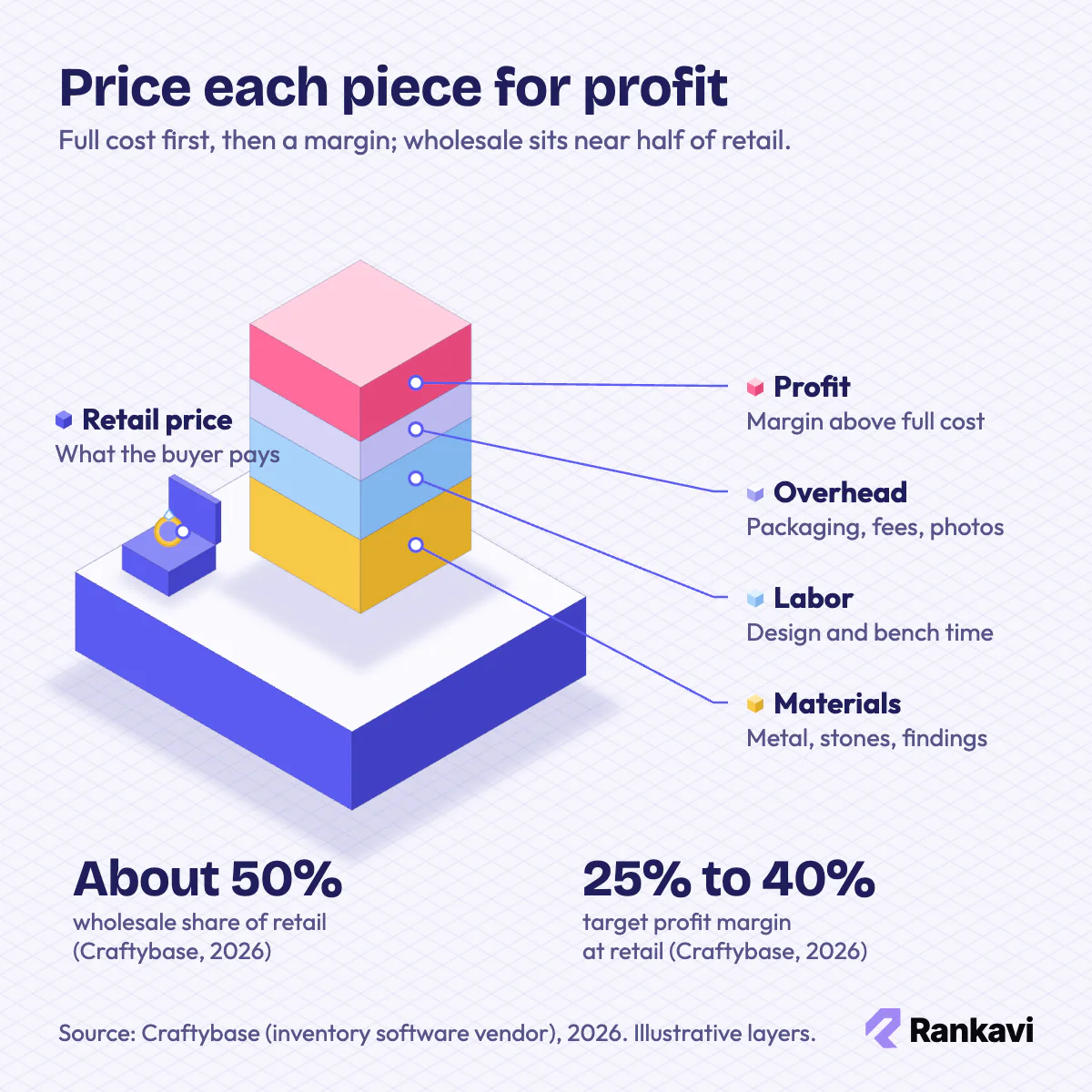
Every price starts with full cost. Full cost joins three parts: materials, labor time and overhead. Overhead covers tools, packaging, photos and platform fees. Profit sits on top of that full cost.
Inputs in a jewelry price:
| Input | Examples |
|---|---|
| Materials | Metal, stones, chain, findings |
| Labor | Design and bench time |
| Overhead | Packaging, fees, tools, photos |
| Profit | Margin above full cost |
Each part needs careful measuring, because any cost left out comes straight out of profit. Materials must include waste. Scrap, filings and polishing loss all add to metal cost. Labor needs an hourly rate, and a timer on each piece shows the true bench time. Overhead gets spread across pieces. The maker divides monthly costs by the number of pieces expected to sell.
Once full cost is known, a profit margin turns it into a retail price. Craftybase, an inventory software vendor, divides full cost by one minus the target margin. Its 2026 pricing guide suggests a 25% to 40% profit margin at retail.
This formula uses margin, and margin is easy to confuse with markup. Markup is a percentage of cost. Margin is a percentage of the selling price. Mixing them up is a common pricing error.
The retail price also has to leave room for wholesale. This wholesale gap is the benchmark most jewelers check first. The same 2026 Craftybase guide puts wholesale at about 50% of retail. A wholesale price must still clear full cost. So retail needs to be at least double the cost of making a piece.
The same retail price should apply on every channel. Otherwise, a brand’s own website undercuts the boutiques that buy wholesale. A minimum sale price, set from full cost and the lowest acceptable margin, keeps discounts from erasing profit.
Full cost does not stay fixed, because metal prices move often. Gold and silver pieces need a regular price review. That way, a rise in metal cost doesn’t erase the margin. Custom work and repairs don’t fit this per-piece method. They are priced separately, by hourly rate plus materials.
7. Fund the First Collection
Funding a jewelry business covers materials, tools, a sales platform and launch marketing before revenue arrives. A small first collection keeps that need modest.
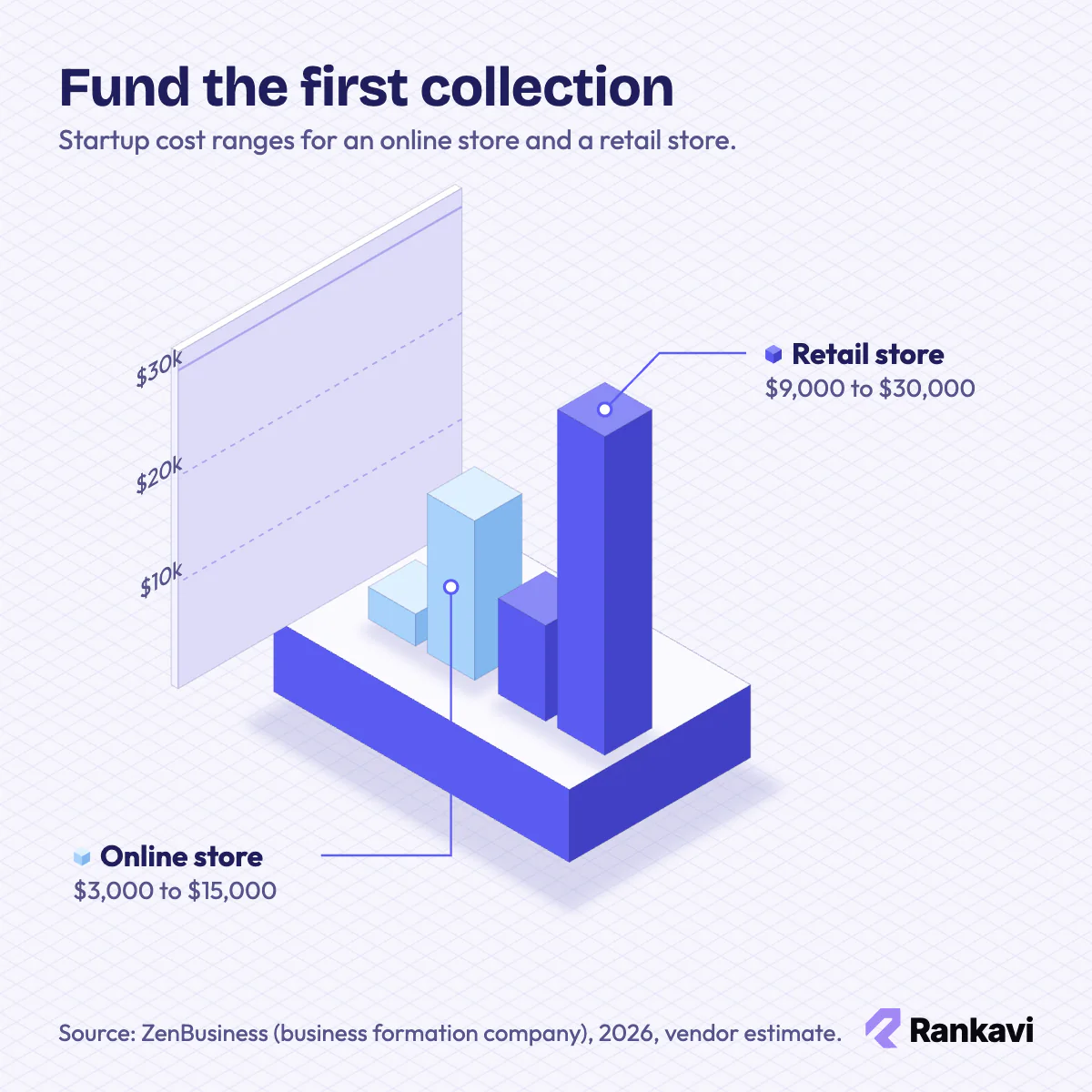
Startup money at a glance:
| Item | Figure |
|---|---|
| Startup cost | $3,000 to $15,000 for an online jewelry store; $9,000 to $30,000 for a retail store |
| Main costs | Materials and first stock, tools, website, branding, packaging and launch marketing |
| Typical margin | 25% to 40% target profit margin at retail (vendor guidance); 39.5% gross margin at Signet Jewelers, a large chain (proxy) |
| Time to open | Varies; an online shop can open within weeks, while a store waits on a lease and fit-out (no sourced figure) |
Sources: ZenBusiness, a business formation company, 2026 (vendor estimate). Craftybase, an inventory software vendor, 2026 (vendor guidance). Signet Jewelers fiscal 2026 results and Form 10-K (big-chain proxy).
Worked example: An illustrative $60 sterling necklace ships free on Etsy. Etsy keeps $0.20 + $3.90 + $2.05, or $6.15. Materials ($12), packaging ($2), postage ($5) and an hour of labor ($25) leave $9.85, about 16%. Repaying $3,000 takes about 305 sales. Raised to $74, the same piece keeps about $22.50, a 30% margin, and repays $3,000 in about 134 sales.
A starter budget has six lines: first stock, tools, an online store plan, photography, packaging and launch marketing. Metal from bench suppliers is the largest swing, since gold and silver prices move. A contingency line covers price swings and reprints.
Funding sources trade cost against risk:
- Savings: no repayment, but personal money is at risk.
- Pre-orders and custom commissions: bring in cash before materials are bought.
- Crowdfunding: Kickstarter and Kiva raise money from backers or lenders, but need an audience.
- Supplier terms: a net-30 account at a supplier delays payment until after sales.
- Business credit cards and platform financing: fast, but costlier, so they suit proven inventory only.
A separate business bank account keeps a clean sales record for any lender. Home equity and retirement funds are risky sources for a first collection.
”…I fully expect to lose money for at least the first three. Because every cent in profit I take in right now has to be plowed right back into the business…”
— A metalsmith on the Ganoksin Orchid jewelry forum
The U.S. Small Business Administration (SBA) is the federal agency for small firms. As of 2026, its microloan program offers loans of up to $50,000, with an average of about $13,000. Nonprofit intermediary lenders make the credit decisions. Funds can cover working capital, stock, supplies and equipment, but not existing debt or real estate. A loan works best once the plan shows steady sales.
8. Register the Business and Its Name
Registering a jewelry business creates the legal entity that sells pieces, collects sales tax and owns the brand name. Most founders file once funding is lined up and before the first public sale.
Many solo jewelers start as a sole proprietorship, which needs no state filing but leaves personal assets exposed. A limited liability company (LLC) separates personal assets from business claims, which matters for products worn against the skin.
Filing with the state forms an LLC, and it does not replace insurance. Selling under another name usually calls for a doing business as (DBA) filing.
An employer identification number (EIN) from the Internal Revenue Service (IRS) opens a business bank account. A seller’s permit lets the brand collect state sales tax on retail orders.
A seller’s permit also lets the brand buy stones, metal and findings tax-free with a resale certificate. Marketplaces such as Etsy often collect sales tax themselves. Website and craft fair sales stay the seller’s duty. A city or county business license or a home-occupation permit may apply to home studios.
A trademark search protects the brand name. The search covers state name records, the U.S. Patent and Trademark Office, domains, social handles and Etsy shop names. Jewelry falls under trademark class 14. Jewelers who stamp metal also pick a maker’s mark. Federal law requires a name or trademark beside a gold or silver quality stamp.
9. Follow Metal Marking and Safety Rules
Marking rules determine how a jeweler may describe and stamp gold, silver and platinum. Honest marks protect buyers and keep the brand out of trouble.
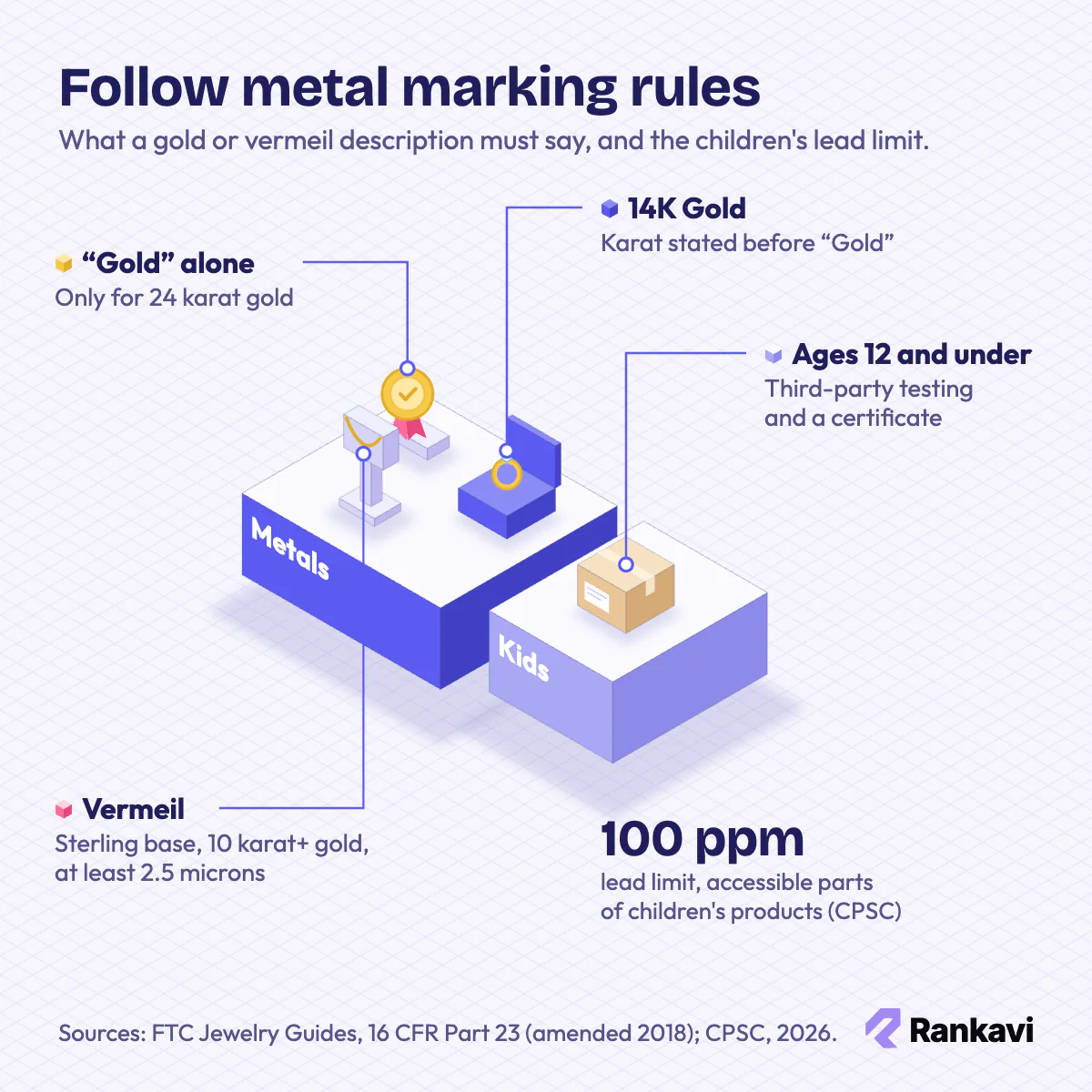
The Federal Trade Commission (FTC) sets these rules in its Jewelry Guides at 16 CFR Part 23. The guides were last amended in August 2018. Their main idea is that a metal’s name must match what the piece contains.
That is why the word “Gold” alone fits only 24 karat gold. An alloy mixes gold with other metals, so it must state its karat first, as in “14K Gold.” A plated piece has a gold surface layer over another metal. It needs a qualifier such as “Gold plated.”
The same idea sets minimum standards for silver, platinum and layered gold. The table below shows what each common term requires.
Marking terms in the FTC Jewelry Guides:
| Term | Requirement |
|---|---|
| Gold, unqualified | 24 karat throughout |
| 14K Gold and similar | Karat stated before “Gold” |
| Gold plated | Karat stated and a durable surface layer |
| Sterling silver | At least 925/1,000ths pure silver |
| Platinum | At least 950 parts per thousand pure platinum |
| Gold filled | Gold layer at least 1/20 of the item’s metal weight, 10 karat or higher |
| Vermeil | Sterling silver base, gold of 10 karat or more, at least 2.5 microns |
Source: Federal Trade Commission, 16 CFR Part 23 (eCFR), as amended 2018, sections 23.3, 23.5 and 23.6.
These terms apply wherever a metal is described, not only on the stamp. Listings and social posts follow the same wording as the stamp. Other claims about a piece must also be honest. Lab-grown stones need a clear disclosure. Claims such as “hypoallergenic” need proof behind them.
A quality mark on gold or silver brings a second duty under the National Gold and Silver Stamping Act. A quality mark is a purity stamp such as “14K” or “Sterling.” Before mailing or shipping across state lines, the maker or dealer adds its name or trademark. The trademark must be registered or applied for in the United States. It sits next to the quality mark, in lettering at least as large.
Children’s jewelry faces stricter rules. The U.S. Consumer Product Safety Commission (CPSC) regulates products made mainly for children 12 or younger. Accessible parts, meaning parts a child can reach, must stay at or below 100 parts per million (ppm) of lead. The jewelry also needs third-party testing and a Children’s Product Certificate.
Adult jewelry does not need a Children’s Product Certificate. For adult pieces, the task is checking that purity claims are true. Suppliers can document alloy content. An independent lab can test any purity claim that seems doubtful.
Some marking questions are hard to answer alone. The Jewelers Vigilance Committee is a jewelry industry compliance group founded in 1917. Members of the Jewelers Vigilance Committee get guidance on marking questions.
10. Insure Inventory and Shipments
Jewelry insurance protects small, valuable stock against theft, loss and claims. Gold and stones pack high value into a tiny space.
Standard homeowner’s policies rarely cover business stock. Their limits for jewelry theft are also low. Some insurers do offer cover for jewelry businesses. Jewelers Mutual is one insurer that offers it. A group of Wisconsin jewelers founded it in 1913, and it insures both jewelry and jewelry businesses.
Business cover for jewelry comes in four main types:
- Jewelers block policy: This policy covers inventory at home, in transit and at shows. Customer pieces left for repair need bailee coverage, which protects goods the business holds for someone else. The policy states whether stock is valued at cost or at selling price. Exclusions are cases the policy will not pay for, such as unattended vehicles and unlocked display cases. They deserve a close read.
- Product liability insurance: This cover answers claims that a piece caused a skin reaction or broke. Craft shows and wholesale buyers often ask vendors for a certificate of insurance. This certificate is a document that proves the cover is in place.
- Business owner’s policy: This policy bundles property and liability cover into one plan. For jewelry, it may not be enough on its own, so a jewelers block may need to be added.
- Shipping insurance: This cover protects parcels between the bench and the buyer. Carriers cap declared value on jewelry. As a result, high-value parcels may need cover from a third-party shipping insurer. Signature confirmation adds proof of delivery for high-value orders.
Photos, stock codes, weights, receipts and appraisals support any claim. These records show the insurer what was lost and what it was worth.
11. Launch Sales Channels and Marketing
Jewelry marketing puts the pieces in front of buyers through the right channels and photos. Most new brands mix one marketplace with one own store. A marketplace brings shoppers to the brand, while an own store gives the brand control.
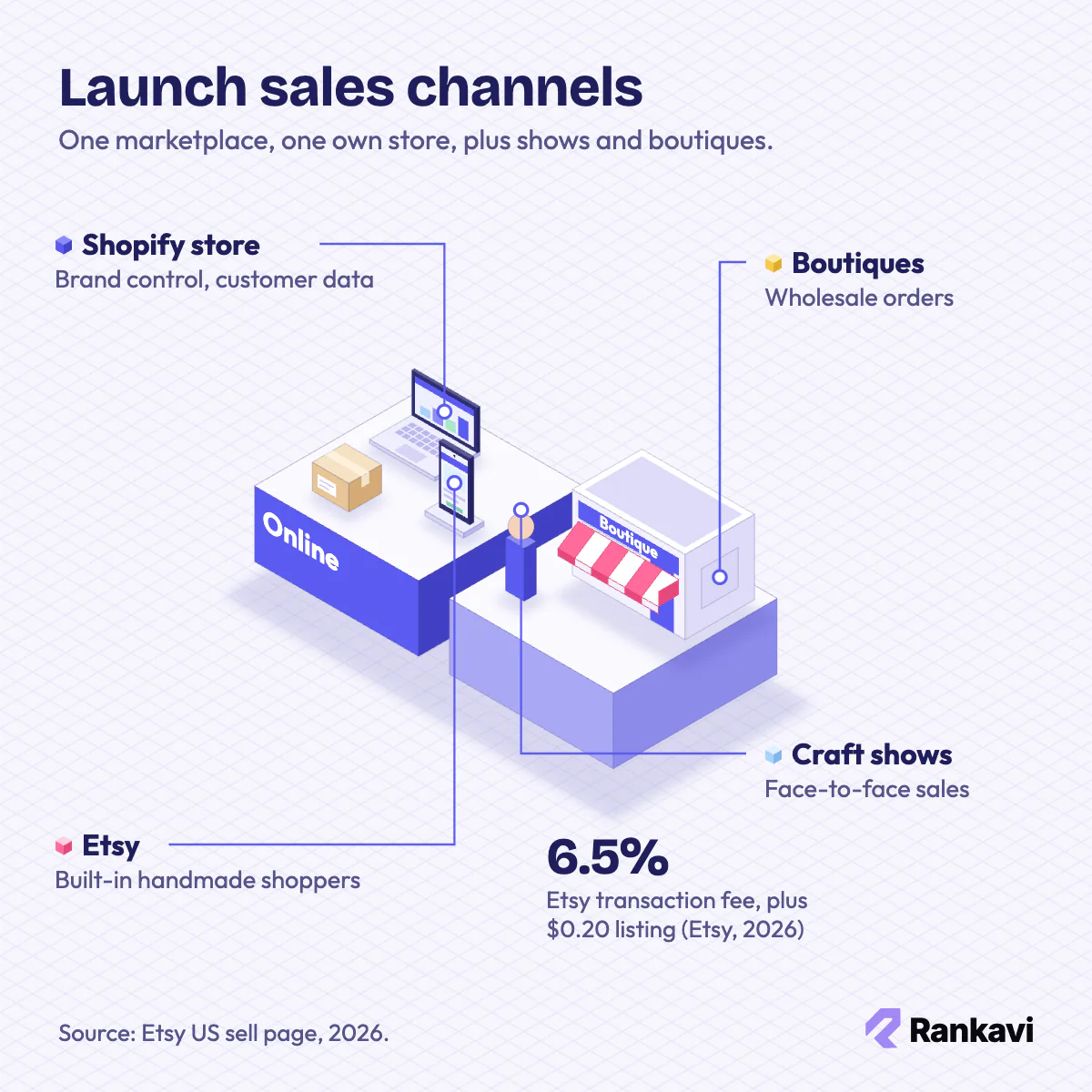
Etsy is a marketplace that brings built-in shoppers to new jewelry shops. Those shoppers come with a cost on each listing and sale. As of 2026, Etsy’s US sell page lists a $0.20 listing fee, a 6.5% transaction fee and 3% + $0.25 payment processing.
An own store meets a different need. Shopify, an ecommerce platform, runs a branded store. The brand keeps full control over its customer data.
The table below compares the four main places new jewelry brands sell.
Where new jewelry brands sell:
| Channel | Main strength |
|---|---|
| Etsy | Built-in handmade shoppers |
| Shopify store | Brand control and customer data |
| Craft shows | Face-to-face sales and feedback |
| Boutiques | Wholesale orders |
Other platforms fill these same two roles for different needs. Amazon Handmade is a marketplace that suits gift buyers who search by product type. For an own store, Squarespace, Wix, WooCommerce and Big Cartel are alternatives to Shopify. A common order is a marketplace first and an own store second.
On any online channel, buyers cannot touch a piece. That is why photos carry the sale. The following are the four shots in a strong photo set:
- White-background main image: This is the lead photo for the listing.
- Close-up: This shows the detail of the piece.
- Scale shot: This shows how big the piece is.
- Lifestyle shot: This shows the piece being worn or used.
A packaging shot adds one more view that helps gift buyers. Natural window light and a recent phone are enough to take all of these.
Good photos only help once buyers find the listing. Listings get found when the title names the item type, material and style. After a buyer opens the listing, clear details answer questions before they are asked. Dimensions, weight, closure, care steps and processing time cut questions and returns. Processing time is how long an order takes before it ships.
Buyers judge jewelry by sight, so visual social media suits it well. Instagram, Pinterest and TikTok all fit for this reason. Short videos show how a necklace moves and catches light. Micro-influencers are social media creators with small followings. Gifting them pieces with a tracked discount code tests reach cheaply. The code shows which sales came from each creator.
Selling in person builds a local following. At craft shows, shoppers try pieces on and ask questions. Shoppers often return to buy online later. Craft shows need a card reader, a mirror and an email sign-up sheet.
Boutiques bring wholesale orders. They need a line sheet. This is a document with photos, materials, wholesale prices and minimum order sizes.
Every channel brings in first buyers, and an email list keeps them coming back. The sign-up sheet from craft shows is one way to grow it. Launch notes, restock alerts and gift reminders before holidays turn first buyers into repeat customers.
12. Appear in AI Gift Suggestions
AI visibility decides whether a jewelry brand gets named when shoppers ask AI assistants for gift ideas. Shoppers now ask ChatGPT, Gemini, Perplexity, Claude, Microsoft Copilot and Google AI Overviews for dainty necklaces or meaningful bracelets. Typical prompts include a gift for mom, a birthstone necklace for a daughter or bridesmaid jewelry.
These assistants lean on gift guides, jewelry blogs and review roundups. Reddit threads and review sites also shape answers. A small brand featured on those pages early has a better chance to appear in the answers. No tactic guarantees a mention, so the aim is evidence across several sources.
The store comes first. Product pages that state metal, stone, size, price, occasion and recipient are easier for assistants to read. An About page, a shipping and returns FAQ and a consistent brand name across Etsy, Instagram and the website help. Genuine customer reviews add proof.
Gift guides are planned months ahead, so pitching editors for Mother’s Day, Valentine’s Day or holiday lists starts early.
A monthly check shows progress. Running the same ten gift prompts in several assistants and logging which brands appear shows whether mentions work. Pages must be indexed first, so results take weeks.
Rankavi is a software as a service (SaaS) platform that publishes brand mentions in articles on indexed third-party websites. Each article is published as written, at $12 per mention in the 50-credit pack. Brands that want to be mentioned in ChatGPT for gift searches can start there.