

Starting a hotshot business takes a heavy-duty pickup, a flatbed trailer, federal operating authority and commercial insurance. Brokers and shippers then supply urgent, smaller loads. The U.S. Bureau of Labor Statistics (BLS), which publishes federal job data, counted 2,221,200 heavy and tractor-trailer truck driver jobs in 2025.
Quick introduction: I’m Michal Sieroslawski, and I help hotshot trucking businesses appear when shippers search online. AI tools now shape how shippers choose hotshot trucking businesses, so a mention there is valuable.
The order settles freight, rates and money before any filing, so every permit serves a truck that can earn. Insurance and authority then land before the first broker call. Starting a hotshot business comes down to the thirteen steps listed below.
- Choose Your Hotshot Freight Niche
- Research Lanes, Shippers and Brokers
- Write a Hotshot Business Plan
- Price Loads by the Mile
- Fund the Truck, Trailer and Cash Reserve
- Register an LLC and Business Bank Account
- Get USDOT Authority and a CDL
- Insure the Truck, Cargo and Liability
- Buy a Pickup, Trailer and Securement Gear
- Set Up Logs, Fuel Tax and Factoring
- Book First Loads Through Boards and Brokers
- Grow Into a Small Hotshot Fleet
- Claim a Place in Shippers’ Google AI Overviews
1. Choose Your Hotshot Freight Niche
Choosing a hotshot freight niche decides which loads the truck hauls and which customers call. Hotshot trucking moves smaller, time-sensitive loads with a heavy pickup and a flatbed trailer instead of a semi.
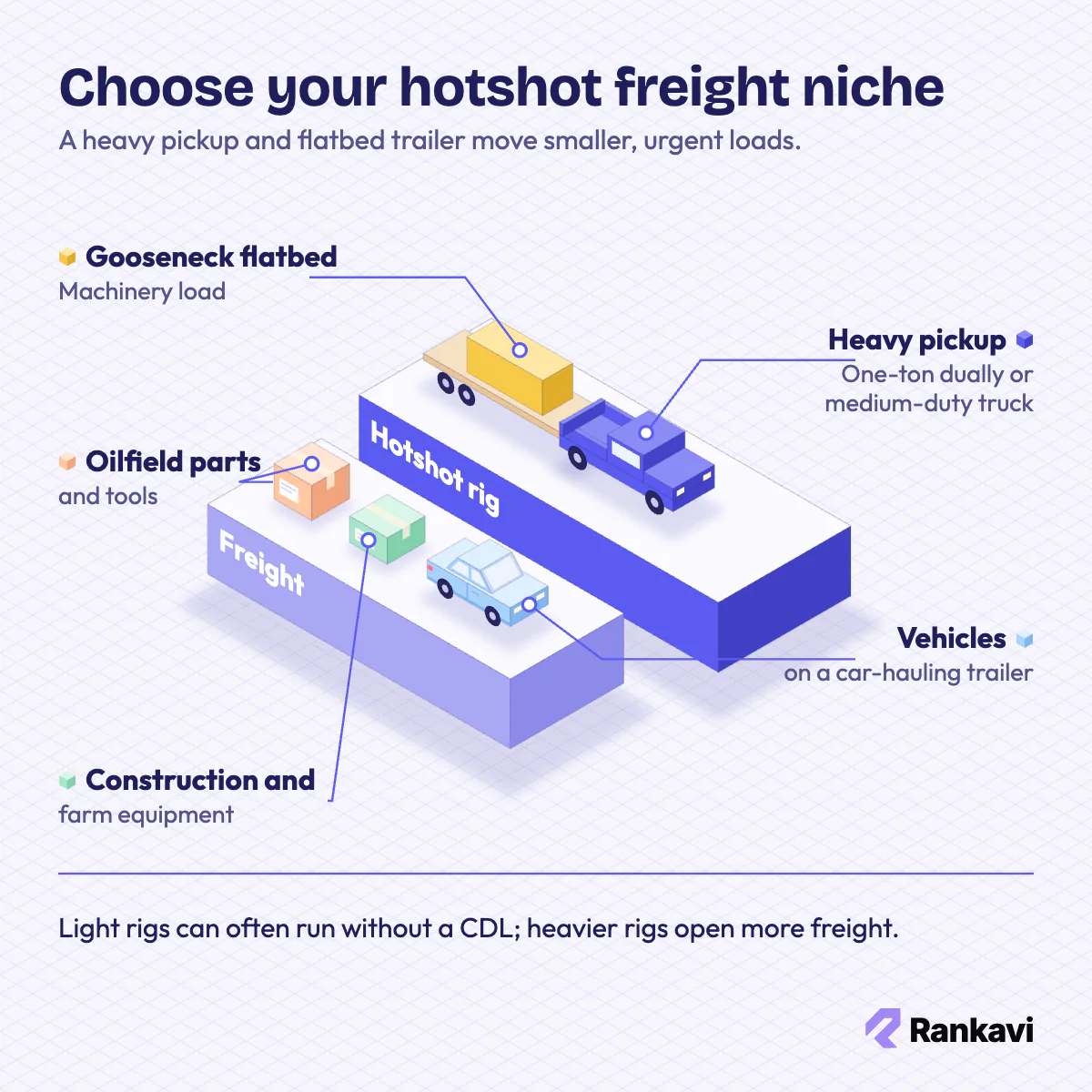
The trade grew out of oilfield work, where crews needed parts and tools delivered fast. Today hotshot carriers also haul construction materials, machinery, farm equipment and vehicles.
Each niche follows its own demand cycle. Oilfield freight follows drilling activity. Construction freight slows in winter. Farm freight peaks around planting and harvest. A niche with a strong seasonal swing needs savings or a second freight type.
The niche also sets the trailer. Machinery and vehicles usually ride on a dovetail or car-hauler trailer, while pipe and building materials suit a flatbed. Choosing the niche first avoids buying a trailer that fits no paying freight.
Weight is the next choice. A light combination can run without a commercial driver’s license (CDL) in many cases. A heavier setup needs a CDL but opens more freight.
Ownership is the last choice. Some owner-operators run under their own authority from day one. Others lease onto an established carrier first and learn rates, brokers and paperwork under its name.
Leasing on trades revenue for convenience. The carrier takes a share of every load but supplies freight and coverage. Own authority keeps the full rate but adds paperwork and the risk of late payment. Many beginners pick one primary niche with a close backup that uses the same trailer.
2. Research Lanes, Shippers and Brokers
Researching hotshot lanes means mapping where freight starts, where it ends and who ships it. Local industry decides most of that demand.
Oilfield activity, construction sites, equipment dealers and farms create steady hotshot freight. A region with one dominant industry swings with that industry, so a second freight type adds stability.
Brokers and direct shippers behave differently. Brokers post spot loads at changing rates and pay after delivery. Direct shippers such as dealers, supply yards and contractors offer repeat work, but they hire carriers that proved reliable first.
Competition matters as much as demand. Low entry costs pull many new drivers into hotshot work, and established carriers already hold the best regular customers.
Return trips decide profit. Deadhead, the trucking term for driving empty, burns fuel without pay. Lanes with freight in both directions beat lanes that pay well only one way.
Home time belongs in the lane choice too. Regional lanes let the driver sleep at home more often. Long hauls pay more per trip but add fuel cost and time away. A lane is worth running only when the pay covers the empty miles back.
3. Write a Hotshot Business Plan
A hotshot business plan sets the goals, freight lanes, rates and cash needs on paper. Lenders and equipment dealers often ask to see one before they finance a truck.
A hotshot plan usually covers five sections:
- Goals: target freight, lanes and customers.
- Market: local demand and competing carriers.
- Pricing: the rate model and cost per mile.
- Operations: daily routine, dispatch and equipment.
- Finances: projections, cash needs and risks.
The operations part describes a normal day: how loads get found, who dispatches, and where the truck parks. That detail exposes gaps before money is spent.
The finances part should show the break-even point, the loaded miles per month at which income covers all costs. A plan that never reaches break-even on paper will not reach it on the road. Pricing and funding figures from the next steps feed straight into this section.
The risk part covers slow freight months, breakdowns and fixed bills. A part-time hotshot business still pays full-time insurance and truck payments.
4. Price Loads by the Mile
Pricing hotshot loads determines the rate per loaded mile that covers costs and pays the owner. Brokers quote most hotshot freight per mile or as a flat rate for the run.
Cost per mile is the benchmark every carrier checks first. The American Transportation Research Institute (ATRI), which runs research for the American Trucking Associations, measured an average $2.336 per mile in 2025. That study covers mostly semi fleets, so it serves only as a proxy for hotshot work.
Fixed costs include truck and trailer payments, insurance and permits. Variable costs cover fuel, tires, maintenance, tolls and load board fees. ATRI put repair and maintenance alone at 40.4 cents a mile in its 2025 data.
“Run your numbers including $1k/week net pay…minimum. If you’re rates aren’t good enough to support that, you might reconsider your plan.”
— A hotshot driver on the TruckersReport forum
Partial loads create rate pressure. Some brokers call a full hotshot trailer a partial and offer a semi’s partial rate. A carrier that knows its cost per mile can refuse those loads quickly.
Deadhead miles must be priced in. A load that pays well but ends far from the next freight must also pay for the empty drive home. Extra stops, tolls and dock waiting time raise the real cost of a load. Each deserves its own line in a quote.
A flat rate suits short, urgent runs, and a per-mile rate suits long hauls. Either way, the quote should leave room for a margin above the cost per mile, not just a break-even price.
5. Fund the Truck, Trailer and Cash Reserve
Funding a hotshot launch covers the truck, trailer, insurance down payment, filing fees and first weeks of fuel. The truck and trailer take the largest share.
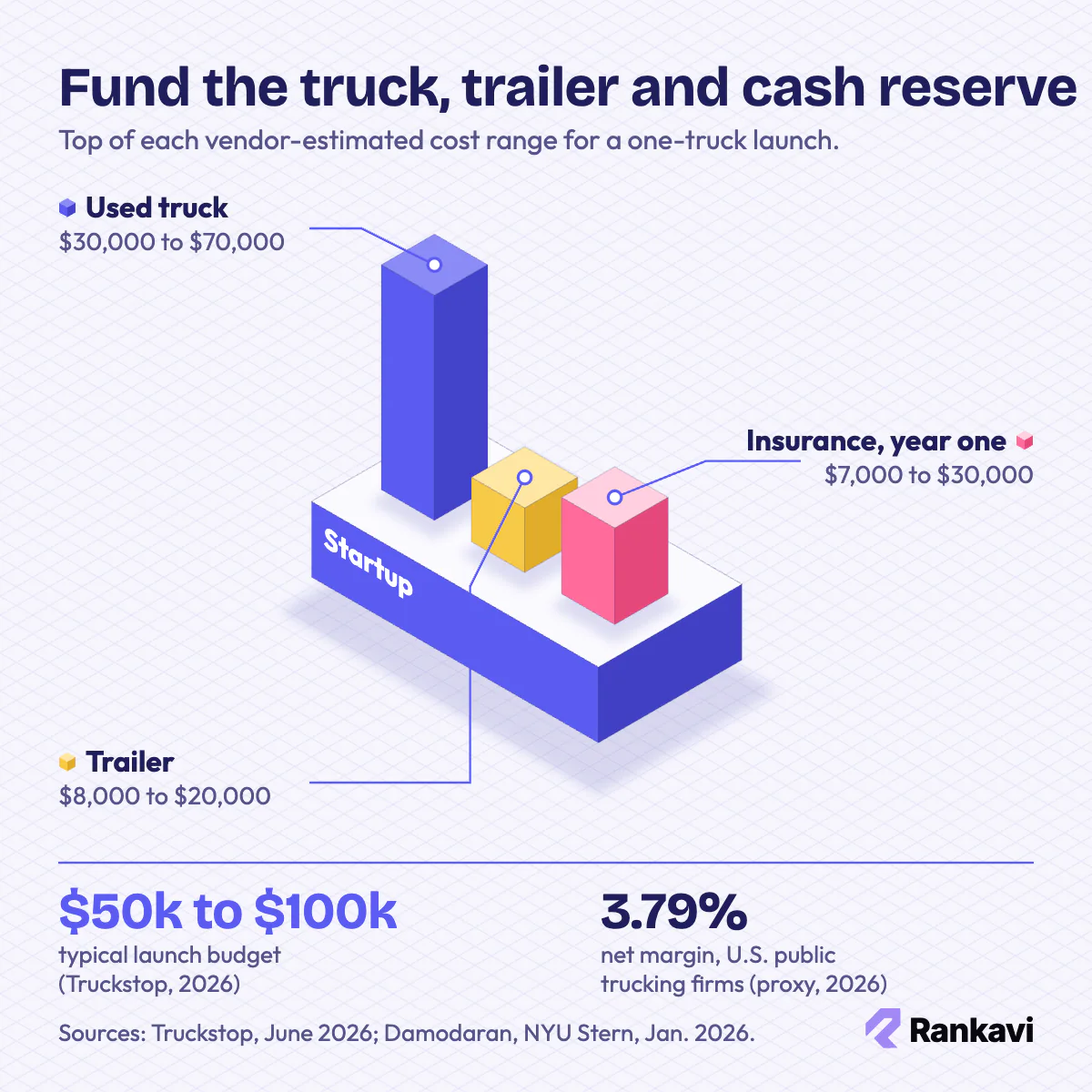
Startup money at a glance:
| Item | Figure |
|---|---|
| Startup cost | $50,000 to $100,000 for one used truck and trailer |
| Main costs | Used one-ton dually ($30,000 to $70,000), trailer ($8,000 to $20,000), first-year insurance ($7,000 to $30,000), authority filing ($300 per form) |
| Typical margin | 21.19% gross and 3.79% net for U.S. public trucking firms (proxy, not hotshot-specific) |
| Time to open | Several weeks, because federal authority has a waiting period before it goes active |
Sources: Truckstop, which runs a load board, vendor estimates, June 2026; Aswath Damodaran, NYU Stern, margins by sector, January 2026 (trucking industry as a proxy).
Cash reserves matter because brokers pay weeks after delivery. Authority approval can also leave a truck insured but idle while the waiting period runs.
A used truck lowers the purchase price but raises the odds of repair bills. A new truck costs more up front but brings a warranty and fewer surprises. The trade-off is monthly payment against repair risk, and the cash reserve should be sized to match.
Many owners finance the truck and pay cash for the trailer. The U.S. Small Business Administration (SBA) offers microloans of up to $50,000 through nonprofit lenders, as of 2026, with an average near $13,000.
Other routes exist, though each has costs. Equipment loans keep the truck as collateral, which makes the truck the lender’s claim if payments stop. Personal savings avoid interest but drain the cash reserve that a new carrier needs most.
Worked example: Picture an illustrative first-year carrier paying $1,800 a month for insurance and running 6,000 loaded miles a month. Insurance alone costs 30 cents a mile. Repair and maintenance of 40.4 cents per mile adds about $2,424 a month. Those two lines take about 70 cents of every loaded mile before fuel, truck payment or owner pay.
6. Register an LLC and Business Bank Account
Registering a hotshot company creates the legal entity that signs broker contracts and receives payments. Most owner-operators form a limited liability company (LLC) to keep personal assets apart from crash claims.
The state filing names the company and its registered agent. A written operating agreement matters most when partners or friends own the business together.
A hotshot LLC gets a free employer identification number (EIN) from the Internal Revenue Service (IRS), which issues tax numbers. Federal filings, banks and factoring companies all ask for that number.
A separate business bank account keeps fuel, insurance and broker payments apart from personal money. Clean records protect the LLC and simplify fuel tax filings.
An LLC protects personal assets only when it is kept separate from them. Paying personal bills from the business account can weaken that protection. State fees and annual report rules differ. The secretary of state’s site in the home state confirms them.
7. Get USDOT Authority and a CDL
Getting federal operating authority gives a hotshot carrier the right to haul freight for pay across state lines. The Federal Motor Carrier Safety Administration (FMCSA), which regulates interstate truck carriers, issues it.
A U.S. Department of Transportation (USDOT) number is the federal number that ties a carrier to its safety records. Operating authority, known as a motor carrier (MC) number, lets the company haul regulated freight for hire.
The application also needs a process agent filing and proof of insurance. Truckstop, a load board company, listed the FMCSA filing fee at $300 per form in June 2026.
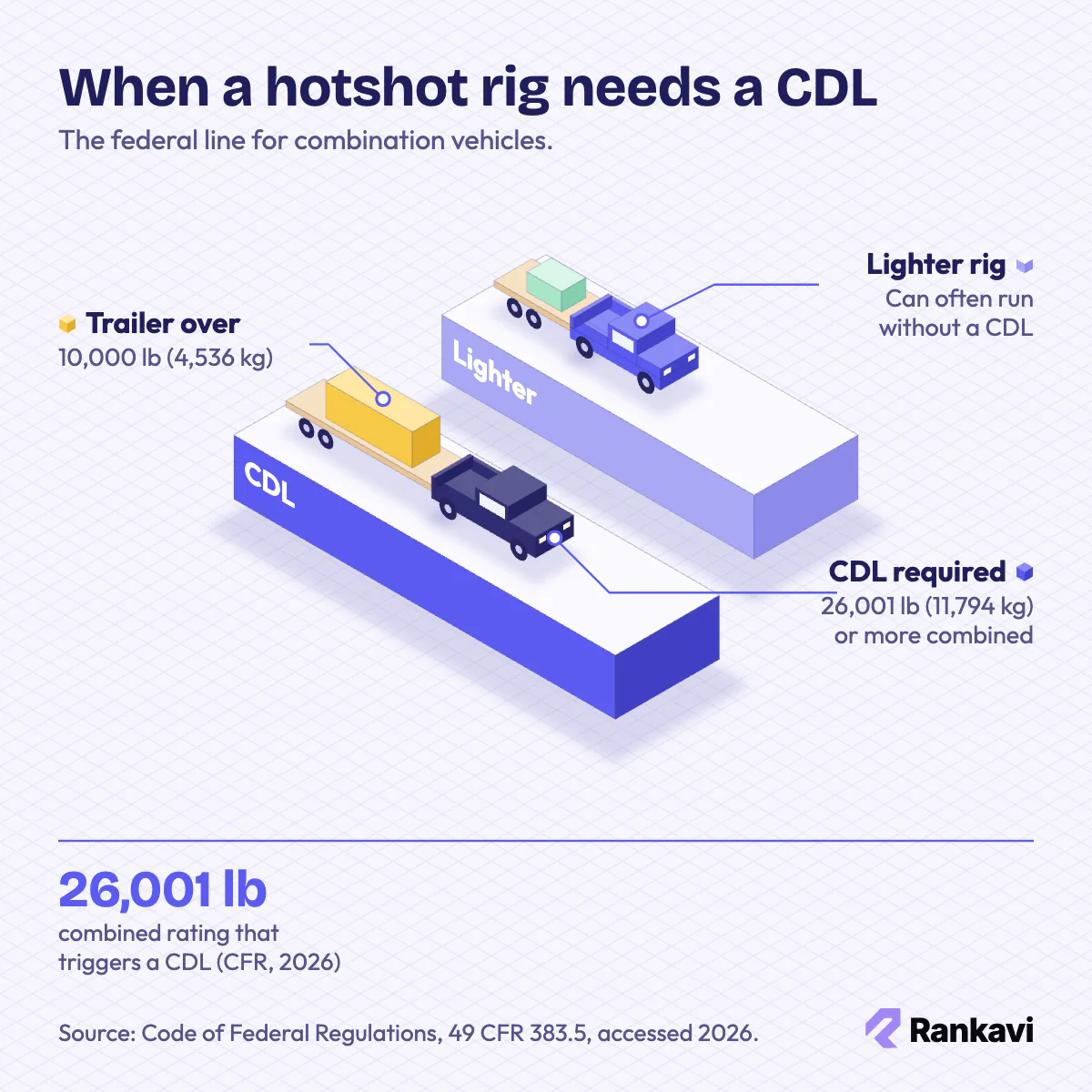
The Code of Federal Regulations (CFR), accessed in 2026, requires a CDL once truck and trailer are rated at 26,001 pounds (11,794 kg) or more combined. That 2026 rule applies when the trailer itself exceeds 10,000 pounds (4,536 kg). CDL holders also join a drug and alcohol testing program.
The application is the start of a process, not the end. After filing, authority stays inactive until insurance proof reaches the FMCSA and the waiting period ends. Starting the insurance quotes before filing keeps the truck from sitting idle.
A CDL changes more than the license. A driver with a CDL faces stricter medical, testing and recordkeeping rules than a driver without one. A rig kept just under the weight line avoids those extras but also limits the freight it can haul.
Core federal filings:
| Filing | Purpose |
|---|---|
| USDOT number | Safety identity for the carrier |
| MC operating authority | Permission to haul for hire |
| Process agent filing | Legal contact in each state |
| Medical certificate | Proof the driver is fit to drive |
8. Insure the Truck, Cargo and Liability
Hotshot insurance protects the carrier against crash claims, damaged freight and truck repairs. Authority does not go active without proof of liability coverage.
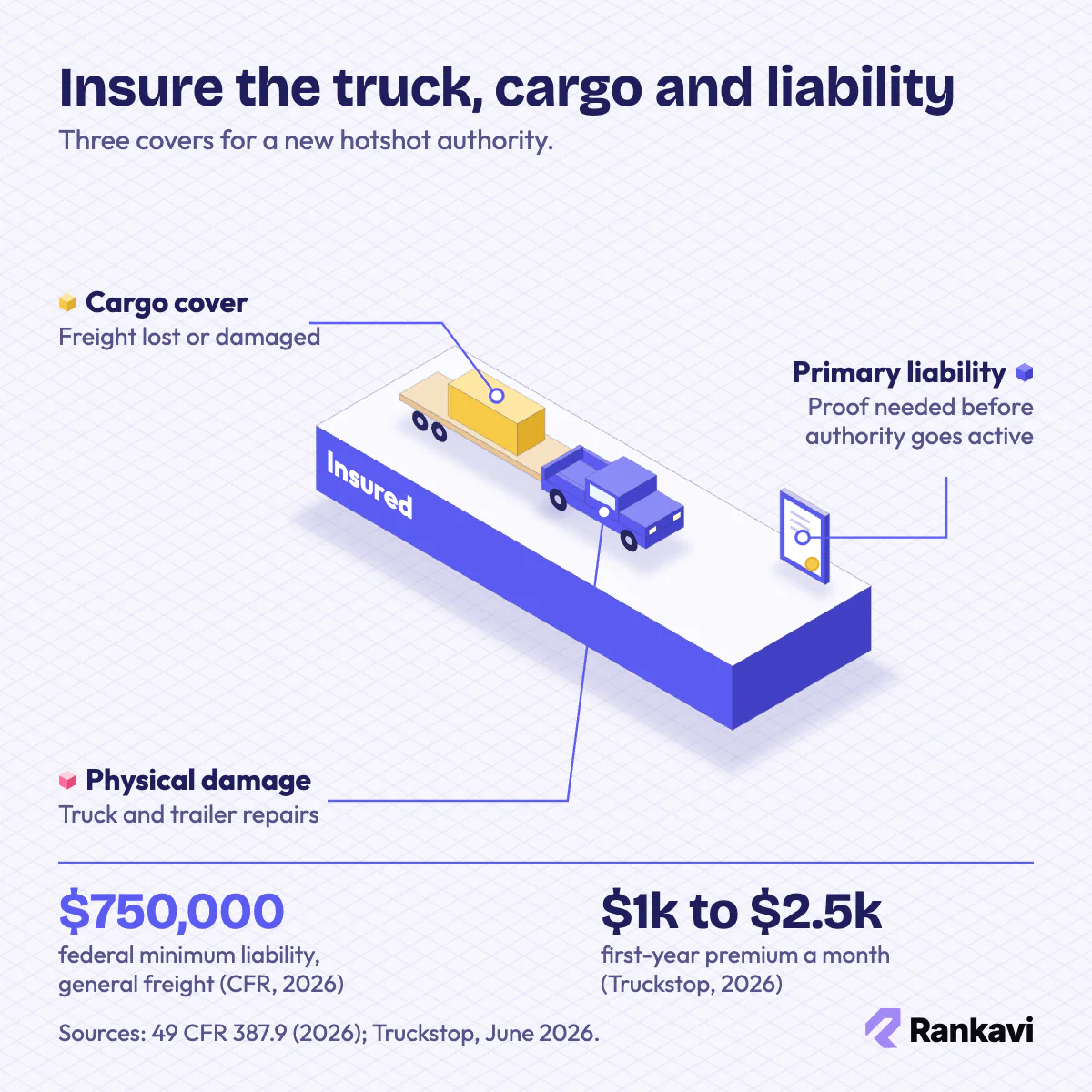
Under 49 CFR 387.9, accessed in 2026, a carrier of general freight in a vehicle of 10,001 pounds or more needs $750,000 of liability coverage. Brokers and shippers often require higher limits before they book a load.
Coverage should match the freight. Machinery and vehicles are worth more than pallets of supplies. Cargo limits that suit one niche can fall short in another. Brokers often check the policy before the first load, so the certificate of insurance should be ready to send.
Cargo insurance pays for freight lost or damaged in transit. Physical damage coverage repairs the truck and trailer after a crash.
Premiums run high for new authorities and young drivers. Truckstop, a load board company, estimated first-year hotshot premiums at $1,000 to $2,500 a month in June 2026.
A clean driving record, a longer history under authority and a higher deductible all lower the price over time. A higher deductible means the owner pays more after a claim. The cash reserve must cover it.
9. Buy a Pickup, Trailer and Securement Gear
Buying hotshot equipment puts a truck, trailer and tie-down kit under the freight the niche demands. The niche decides the trailer, and the trailer decides the truck.
One-ton dually pickups suit lighter, shorter runs. Medium-duty trucks carry heavier loads and wear more slowly, but they cost more to buy.
A heavier truck also tows with more margin. Pulling a trailer near the truck’s rated limit strains brakes and tires, and it raises crash risk. Matching the truck’s rating to the heaviest regular load protects both the equipment and the insurance record.
Three trailer types dominate hotshot work:
- Flatbed: a general freight trailer.
- Gooseneck: a hitch-in-bed trailer for heavier loads and stability.
- Dovetail: a trailer with a sloped tail for wheeled equipment and vehicles.
Securement gear keeps loads in place. Chains and binders hold heavy machinery, while straps, ratchets and tarps handle lighter freight. Corner protectors and safety lights complete the kit.
Securement is a legal duty, not only a good habit. A load that shifts can damage freight, trigger a roadside violation or cause a crash claim. Buying quality gear once costs less than replacing damaged freight or paying a deductible.
10. Set Up Logs, Fuel Tax and Factoring
Hotshot back-office setup keeps driving logs, fuel tax filings and cash flow in order. These systems run from the first load.
Hours-of-service rules in 49 CFR 395.3, accessed in 2026, allow 11 hours of driving within a 14-hour window. Most interstate carriers record that time on an electronic logging device (ELD).
The International Registration Plan (IRP) is a registration agreement that splits truck fees among states by miles driven. The International Fuel Tax Agreement (IFTA) is a pact that simplifies fuel tax reporting for carriers crossing states and provinces.
Invoice factoring sells unpaid broker invoices for quick cash, minus a fee. Factoring smooths cash flow, but the fee reduces every load’s margin.
Factoring suits a new carrier that waits weeks for broker payments. A carrier with enough cash reserve can skip it and keep the full invoice. Recourse terms decide who absorbs a broker’s failure to pay, so the contract deserves a careful read.
Bookkeeping belongs in this step as well. Fuel receipts, mileage by state and load invoices feed the fuel tax and income tax filings. Tracking them from the first load avoids a scramble at filing time.
“Choose a factor that will take your paper with no recourse. That means that if they can’t collect, they won’t come back to you for the money.”
— A new flatbed hotshot owner on the TruckersReport forum
11. Book First Loads Through Boards and Brokers
Booking first loads turns a registered, insured truck into a paying hotshot business. Most new carriers start with load boards and freight brokers.
Load boards list available freight from brokers and shippers. Good hotshot loads disappear fast, so dispatching one truck can take hours of watching the board.
A new carrier has no track record, so brokers may offer lower rates at first. Completing early loads on time and keeping paperwork clean builds the reputation that later brings better rates and repeat calls.
Freight brokers connect carriers with shippers. Each broker sets up a carrier with insurance proof and authority papers before the first load.
“Eventually you’ll have some brokers who call you with loads before those loads get on the boards.”
— A hotshot owner-operator on the TruckersReport forum
Direct shippers pay better but need trust first. Equipment dealers, oilfield suppliers and contractors often hire carriers they know. A Google Business Profile is Google’s free listing for local firms, and it helps them check a new carrier.
Broker payment terms vary, so each load should be checked before pickup. A broker with slow or disputed payments can turn a good rate into a cash problem. Reading reviews and payment history before accepting a load reduces that risk.
12. Grow Into a Small Hotshot Fleet
Growing a hotshot company means adding trucks and drivers only after one rig earns steady profit. Each new truck brings its own payment and insurance bill.
A second truck doubles the exposure as well as the income. A slow freight month now hits two payments and two policies. Growth makes sense once cash reserves and regular freight can cover both trucks through a slow season.
Prebooked freight makes growth easier. Regular shippers let a carrier plan a week of loads before the truck leaves home.
Drivers are the hardest part. BLS reported a $58,640 median wage for heavy truck drivers in May 2025. A small fleet competes against that pay.
A hired driver also adds payroll tax, required testing and more insurance cost. Some owners instead lease a second truck to an owner-operator, which shifts some of those costs but also gives up control over the freight.
Some owners add a car-hauling trailer for steadier work. Others add specialised freight that needs extra training and permits but pays more.
13. Claim a Place in Shippers’ Google AI Overviews
AI visibility involves being named when shippers ask AI tools which hotshot carriers to call. Dispatchers and equipment dealers now ask ChatGPT, Gemini and Google AI Overviews for fast carriers.
Those tools repeat what trusted third-party sites say. Carrier directories, trucking roundups and local business articles shape which names appear.
A carrier that appears only on its own website is easy for these tools to skip. Mentions on independent sites that describe the service, niche and region give the tools more evidence to repeat.
Rankavi is a software as a service (SaaS) platform that publishes brand mentions in articles on indexed third-party websites. A new carrier can use its brand mention service for Google AI Overviews to appear in those articles.