

Starting a home care business means choosing non-medical or skilled home health care, then getting a state license. Rules vary by state. In 2024, the American Association of Retired Persons (AARP) found three in four adults 50 and older want to remain in their current homes.
My name is Michal Sieroslawski. I help home care agencies get found by families on Google and in AI chats. As AI search grows, families ask ChatGPT for suggestions, and being recommended there counts.
The order matters. The care model decides the license. Money, insurance and often an office must exist before the state approves it. Each of the twelve steps below builds on the last, from home care idea to first paying customer.
- Choose Your Home Care Model
- Research the Local Senior Care Market
- Write a Home Care Business Plan
- Register Your Agency
- Fund the Startup Period
- Insure Your Business
- Secure an Office and State License
- Set Up Care Plans and Scheduling
- Hire and Train Caregivers
- Market to Families and Referral Partners
- Grow Your Services and Payer Mix
- Get Named When Families Ask AI
1. Choose Your Home Care Model
Choosing a home care model decides whether the agency provides non-medical support or skilled medical care at home. That decision sets the license type, the staff mix and the startup budget.
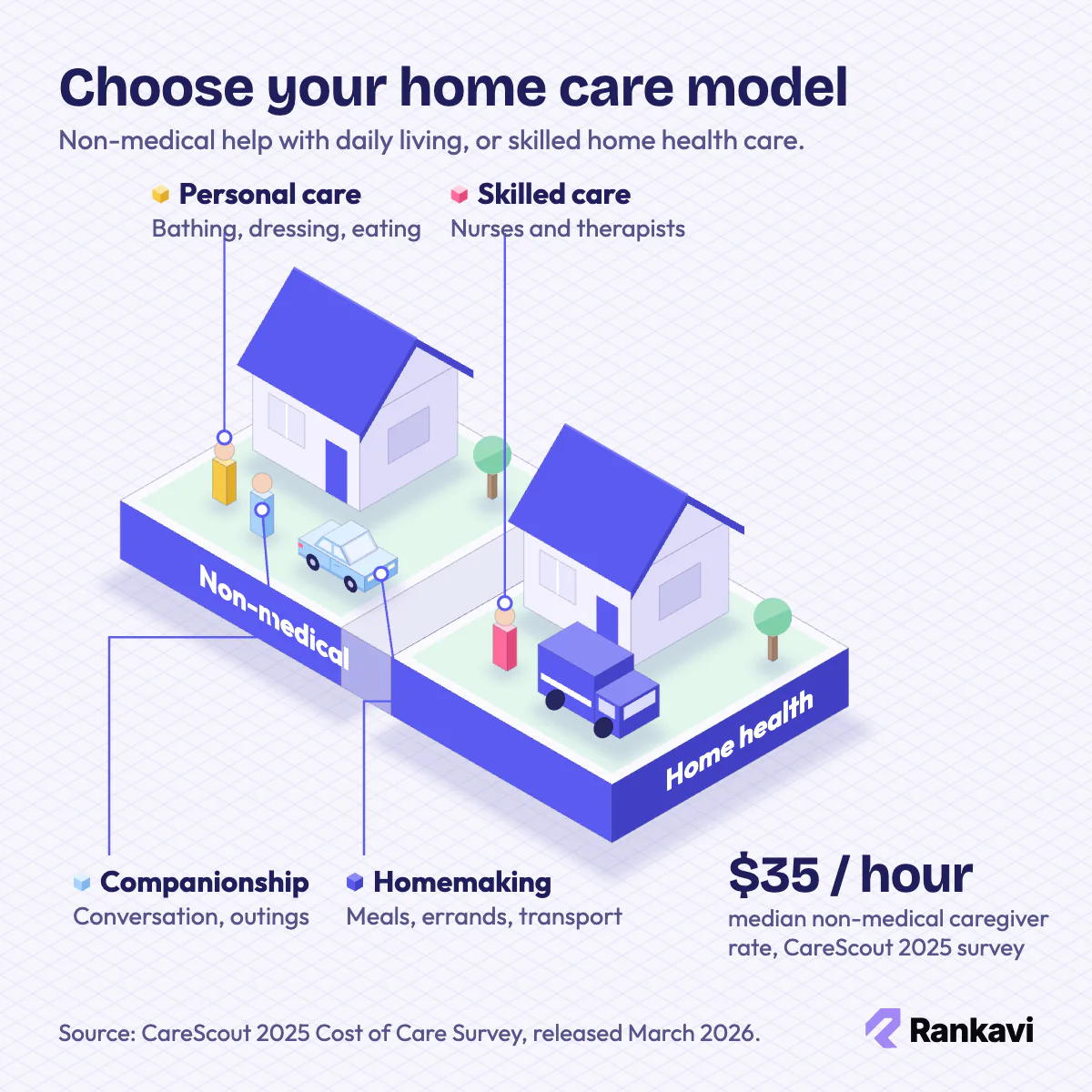
Non-medical home care helps clients with daily living. Skilled home health care sends nurses and therapists under a physician’s orders. Non-medical agencies open faster and on less money, so most first-time owners start there.
Common non-medical services:
| Service type | Typical tasks |
|---|---|
| Personal care | Bathing, dressing, eating, toileting |
| Homemaking | Cleaning, meal preparation, errands, transportation |
| Companionship | Conversation, outings, emotional support |
| Respite care | Short relief for family caregivers |
Specialty services set a new agency apart. Dementia care, overnight shifts and fall prevention programs each attract a defined group of families.
Private rates set the revenue ceiling. CareScout’s 2025 Cost of Care Survey, released in March 2026, put the national median rate for non-medical caregiver services at $35 per hour.
Typical clients include older adults living alone, people recovering after a hospital stay and adults with disabilities.
Medicare.gov says Medicare does not pay for custodial or personal care when it is the only care needed. Non-medical clients therefore pay privately or through long-term care insurance, veterans’ benefits or state Medicaid programs. Medicare covers home health only when a doctor orders it, the patient is homebound and needs part-time skilled care.
The two models can be combined. Many owners open with non-medical care. They add skilled services later, with the extra license and certification those services require.
Franchises are the other choice. A franchise such as Home Instead sells training, a brand and support for an upfront fee. An independent agency skips the fee and keeps full control.
2. Research the Local Senior Care Market
Market research shows how many older adults need help nearby and who already serves them. It confirms demand before the owner pays any license fee.
Demand starts with the older population in the service area. Household income matters too, since families pay privately for most non-medical care.
The U.S. Census Bureau’s American Community Survey reports how many residents are 65 and older, how many live alone and what households earn, by county. Area Agencies on Aging know local service gaps. Competitors appear in the state license directory and on Google Maps. Their reviews show missed shifts and slow callbacks.
Calling five to ten competitors as a customer shows their hourly rates, minimum shift lengths and start times. Talking to hospital discharge planners shows where families struggle to find help. The step ends with a one-page summary of the service area, local prices, competitors and gaps.
Workforce supply matters as much as client demand. The U.S. Bureau of Labor Statistics (BLS) publishes federal job projections. It expects 18% job growth for home care aides from 2025 to 2035. Every agency nearby recruits from that same pool.
National franchises, local independents and private caregiver registries compete directly. Adult day centers compete indirectly for the same families.
Gaps point to an opening: weekend coverage, overnight care, rides to appointments and same-week start times. Rural counties often lack providers, while metro areas have more clients and more agencies.
3. Write a Home Care Business Plan
A home care business plan turns the care model into hours, staff and cash on paper. Its key assumption is how many billable hours the agency can staff each week.
Business plan sections:
- Executive summary
- Company description and services
- Industry and customer analysis
- Competitive analysis
- Marketing plan
- Operations plan
- Management team
- Financial plan
Payers shape the cash plan. Families can be billed weekly, but Medicaid and insurers pay after the care is delivered. The plan needs a monthly cash forecast and a downside case with fewer billable hours than expected.
In the management section, name the administrator the state will ask for at licensing. Lenders read the financial plan for the bill rate, the caregiver wage and the hours needed to cover overhead.
4. Register Your Agency
Registering the agency creates the legal company that signs client contracts and holds the state license. Most states expect the entity to exist before a license application arrives.
Most owners form a limited liability company (LLC) with the Secretary of State. An LLC shields personal assets from claims tied to in-home care, which a sole proprietorship does not. The agency should be formed in the state where it will be licensed. Forming in another state adds foreign-qualification paperwork.
The filing is called Articles of Organization in most states. Every LLC also needs a registered agent. This is a person or service with a physical state address that receives legal papers. An operating agreement is rarely filed, but banks and licensing agencies often ask for it.
Next comes an employer identification number (EIN) from the Internal Revenue Service (IRS), the federal tax agency. The IRS says an EIN never costs a fee, so paid websites are not needed. Home care agencies need one early because caregivers are usually W-2 employees, not contractors.
The licensing application must match the exact legal name. Some health departments also ask for a certificate of good standing from the Secretary of State. A business bank account and state unemployment insurance account follow. Keeping personal and agency money apart protects the liability shield.
5. Fund the Startup Period
Funding a home care agency covers licensing, insurance, an office and payroll until client hours become steady. Most of the money is working capital, not equipment.
State license fees belong in this budget. The California Department of Social Services, which licenses Home Care Organizations, charges $5,603 for a two-year license as of 2026. The Texas Health and Human Services Commission (HHSC) licenses agencies there and has charged a $2,625 initial fee since 2021.
Startup money at a glance:
| Item | Typical figure |
|---|---|
| Startup cost | $91,040 to $269,750 for a Home Instead franchise, including a $54,000 fee; independents skip the fee |
| Main costs | Working capital for payroll, state license fee ($2,625 to $5,603), insurance, office, recruiting |
| Typical margin | Gross wage spread of about half the bill rate ($35 billed vs $17.21 median aide wage), a derived estimate before payroll taxes and overhead |
| Time to open | Several months; state license review and on-site survey set the pace |
Sources: Home Instead 2025 Franchise Disclosure Document (Item 7, via 1851 Franchise summary); California Department of Social Services; Texas HHSC; CareScout 2025; BLS May 2025.
Payroll comes before revenue. Home Instead’s 2025 disclosure budgets $28,840 to $134,120 for the first three months alone. Caregivers are paid every pay period, while families pay after care is delivered.
The key decision benchmark is the gap between the bill rate and the caregiver wage. Multiplied by weekly billable hours, that spread decides break-even.
Worked example: An illustrative independent agency bills $35 an hour and pays caregivers $17.21, leaving about $17.79 per staffed hour. Overhead runs $12,000 a month. Break-even then takes about 675 billable hours a month, or 156 a week. That is roughly eight clients at 20 hours each, before payroll taxes, owner pay, interest and income taxes.
Savings usually anchor the funding. In 2026, the Small Business Administration (SBA) lists 7(a) loans of up to $5 million through partner lenders. Its 2026 microloans go up to $50,000 and come from nonprofit intermediary lenders.
Slow payers add to the cash need. At the May 2025 median wage of $17.21, 156 weekly hours cost about $2,685 a week in wages. In that case, a 30-day payment delay ties up roughly $11,500 in 2025 wages before overhead. A line of credit sized to payroll covers that gap.
Medicare-certified home health agencies face a larger requirement. The Centers for Medicare & Medicaid Services (CMS) runs Medicare. Its rule in the Code of Federal Regulations (CFR) at 42 CFR 489.28 requires initial reserve operating funds. At least half must be non-borrowed.
6. Insure Your Business
Insurance protects a home care agency from claims tied to care delivered inside private homes. Many states ask for proof of coverage with the license application, so policies are bound before applying.
General liability covers a fall in the client’s kitchen or a broken heirloom. Professional liability covers negligence claims, such as a missed medication reminder or a care plan error.
Several more policies are worth pricing. Abuse and molestation coverage may be excluded from a standard liability policy, so the policy wording needs a check. A fidelity bond covers theft by caregivers, and some clients and referral sources ask for one. Employment practices liability covers claims from caregivers, such as wrongful termination. Cyber liability covers a breach of client records.
Professional liability is often written on a claims-made basis. If the agency changes carriers or closes, tail coverage keeps older incidents covered.
Workers’ compensation matters more here than in most service businesses, because lifting and transfers make back injuries common. Hired and non-owned auto coverage protects the agency when caregivers drive their own cars on client errands. Owning a vehicle for client rides calls for commercial auto. A broker with home care experience can compare quotes on limits, exclusions and price.
7. Secure an Office and State License
Getting a state home care license gives the agency legal permission to send caregivers into clients’ homes. Rules vary by state, so the state health or social services agency sets the exact steps.
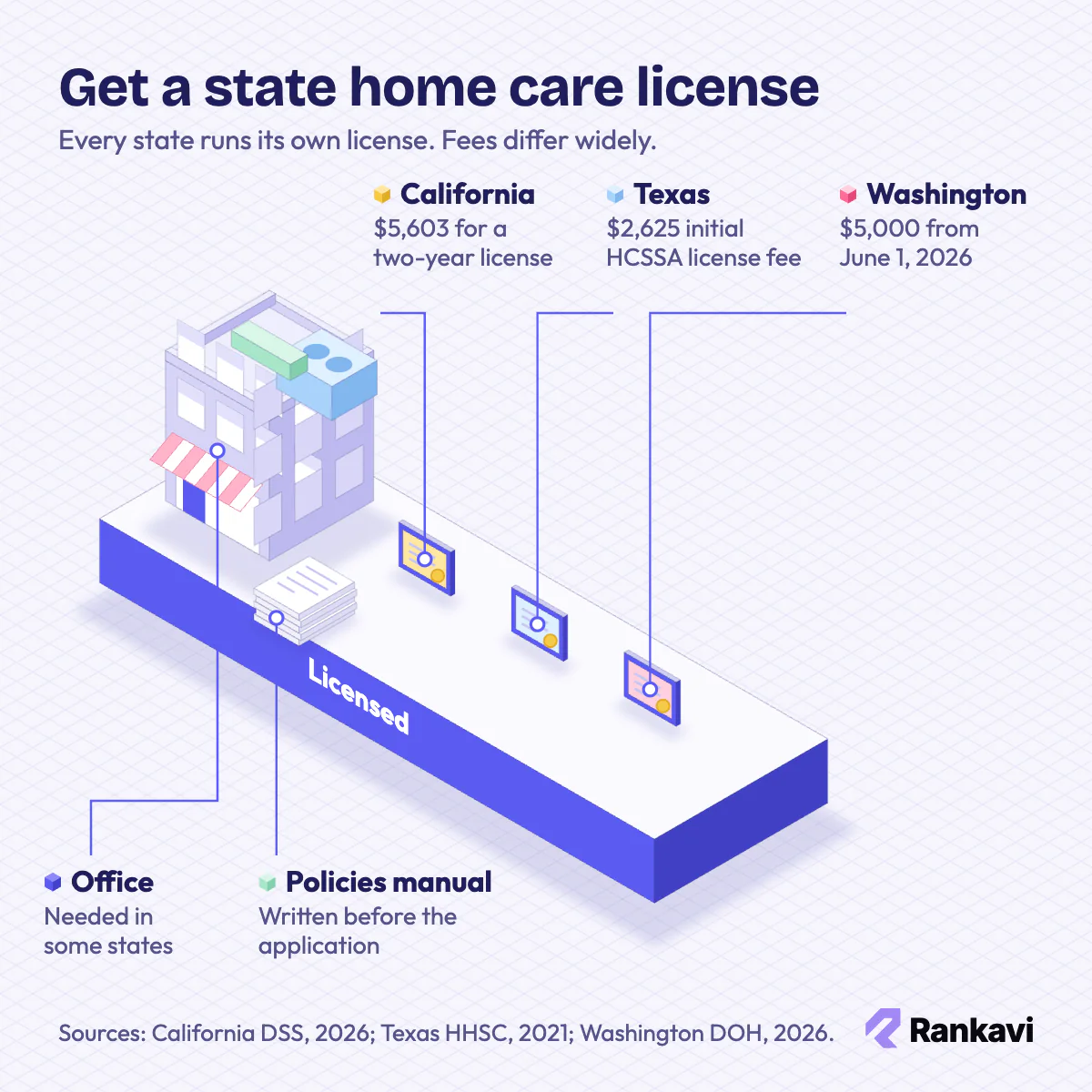
An office address often comes first. Some states require a physical office where surveyors review client records and personnel files. In those states, the lease is signed before the application goes in.
Each state names the license differently. The Georgia Department of Community Health licenses Private Home Care Providers. The Washington State Department of Health licenses in-home services agencies, and on June 1, 2026 it raised the initial home care fee from $3,283 to $5,000.
Examples of state home care licenses:
| State | License | State agency |
|---|---|---|
| California | Home Care Organization license | California Department of Social Services |
| Texas | Home and Community Support Services Agency (HCSSA) license | Texas Health and Human Services Commission |
| Georgia | Private Home Care Provider license | Georgia Department of Community Health |
| Washington | In-home services agency license (home care) | Washington State Department of Health |
A written policies and procedures manual comes before the application. It covers client rights, emergency plans, infection control, care planning, personnel rules and complaints.
Many states then inspect the agency with an on-site survey. Some issue a provisional license first and a full license once the agency serves clients.
Skilled home health agencies face more steps. They must meet the Medicare Conditions of Participation in 42 CFR Part 484. The Centers for Medicare & Medicaid Services (CMS) runs Medicare, and Medicare certification follows the state license.
Accreditation can replace the state survey for Medicare. The Accreditation Commission for Health Care is an approved accrediting organization. So is the Community Health Accreditation Partner. The Joint Commission is another. Some states also require a certificate of need first.
8. Set Up Care Plans and Scheduling
Care operations turn each new client into a written care plan and a staffed schedule. Good systems keep visits on time and paperwork ready for surveyors.
The care plan comes from an intake assessment that every client receives. The assessment covers two kinds of activities. Activities of daily living (ADLs) are basic self-care tasks such as bathing, dressing and toileting. Instrumental activities of daily living (IADLs) are household tasks such as meals and housekeeping.
State rules decide who may perform the assessment. Many agencies use a registered nurse or a trained care manager.
The assessment results then become the care plan. The plan lists the client’s tasks, visit times and family contacts. The client or a representative signs it.
Once the plan sets visit times, the agency has to staff those visits and keep records of them. Home care software handles scheduling, billing, payroll and visit notes. Keeping all of this in one system cuts double entry for a small office.
Medicaid clients bring an extra rule. The 21st Century Cures Act set deadlines for states to require electronic visit verification (EVV) for Medicaid personal care. EVV is an electronic record of each visit. States faced a January 2020 deadline for personal care. The deadline for home health services was January 2023. States that showed a good faith effort got until January 2024.
States that miss the mandate risk reduced federal Medicaid funding.
EVV must record six items:
- Type of service: The kind of care the caregiver delivered.
- Person receiving the service: The client who got the care.
- Date: The day the visit took place.
- Location: The place where the service happened.
- Person providing the service: The caregiver who delivered the care.
- Start and end times: When the visit began and when it ended.
Scheduling software should support the state’s EVV system.
Health records fall under the Health Insurance Portability and Accountability Act (HIPAA), the federal privacy law for patient information.
9. Hire and Train Caregivers
Hiring caregivers determines how many client hours the agency can actually deliver. Unstaffed hours cannot be billed.
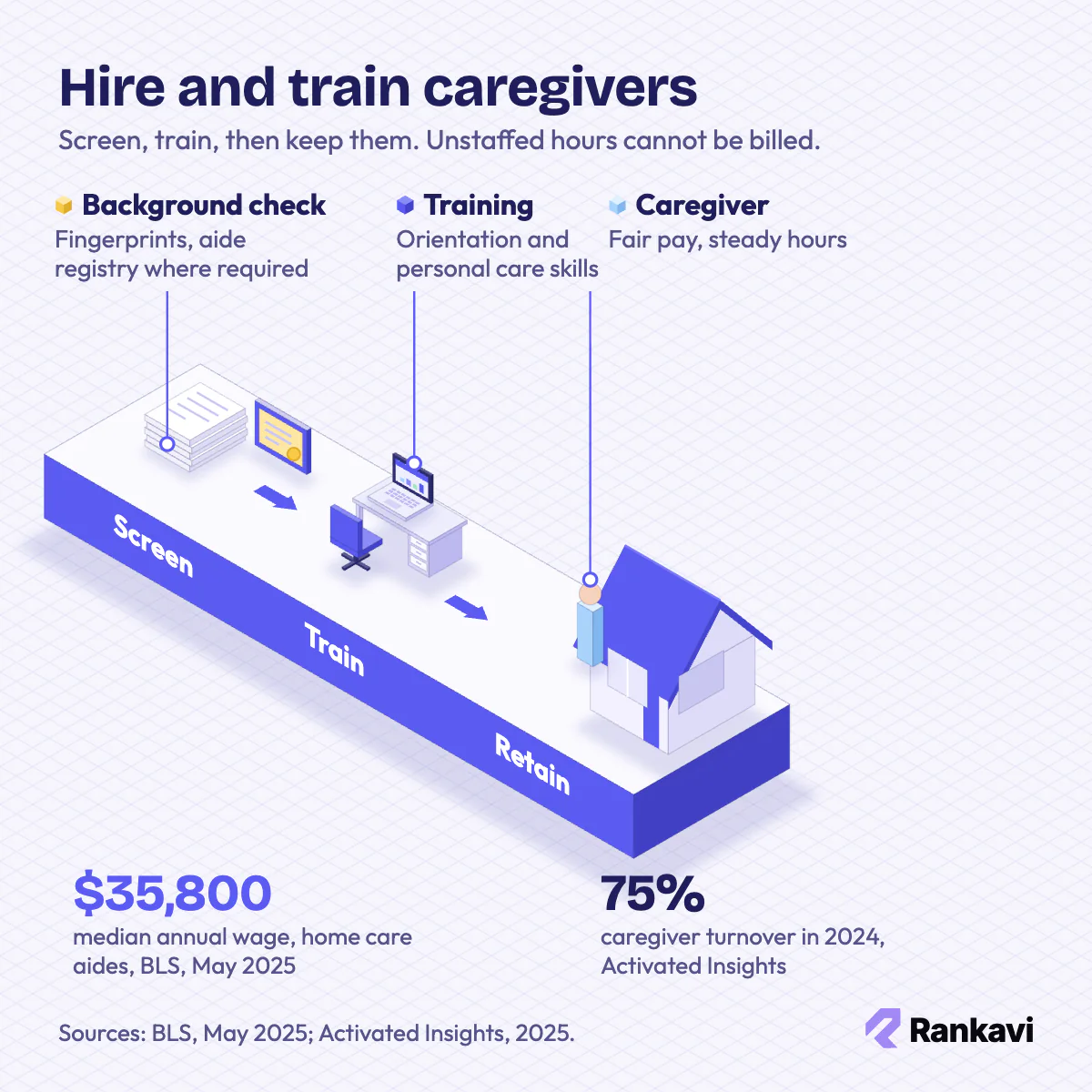
Every new hire has to be cleared before working with clients. Background checks come before any client visit. Many states require fingerprinting. Some states keep a public registry of screened home care aides.
Screening is only the start of getting a caregiver ready to work. A full caregiver hiring checklist covers these six steps:
- Criminal background check: Each hire needs a criminal background check and fingerprinting.
- State aide registry: The caregiver needs an entry in the state aide registry where the state requires one.
- Health screening: Caregivers go through a health screening, such as tuberculosis testing.
- Orientation: Orientation explains the agency’s policies.
- Personal care training: Hands-on practice prepares caregivers for transfers and personal care tasks.
- Ongoing annual training: Training continues every year after hiring.
Required training depends on the type of agency. Medicare-certified home health agencies must follow federal training rules.
Under these rules, home health aides need at least 75 hours of classroom and supervised practical training. They also need 12 hours of in-service training every year (42 CFR 484.80). In-service training is ongoing training done while on the job. Non-medical agencies follow their state’s rules instead.
Turnover is the cost most new owners underestimate. Activated Insights, a home care benchmarking firm, reported caregiver turnover of 75% in 2024. In 2024 that was down from 79%, the lowest rate in three years.
One owner described the result:
“Because of staffing I lost most of my clients and now I find myself having a hard time rebuilding.”
— A home care company owner in a YouTube comment
Pay drives both hiring and retention, so wages decide whether an agency can find and keep caregivers. BLS put the median wage for home health and personal care aides at $17.21 an hour in May 2025.
Overtime rules shape payroll too, and the federal rule is in flux. The U.S. Department of Labor (DOL) is the federal agency that enforces wage laws. It issued its Home Care Rule in 2013, and the rule took effect in 2015. It barred agencies from claiming the companionship exemption.
In July 2025, DOL proposed rescinding the Home Care Rule. It also paused enforcement with Field Assistance Bulletin 2025-4. The pause lasts until any final rule takes effect, so agencies should check the current status.
10. Market to Families and Referral Partners
Marketing a home care agency means earning the trust of families and the professionals who refer them. Activated Insights put the cost to acquire a client at $845 in 2024.
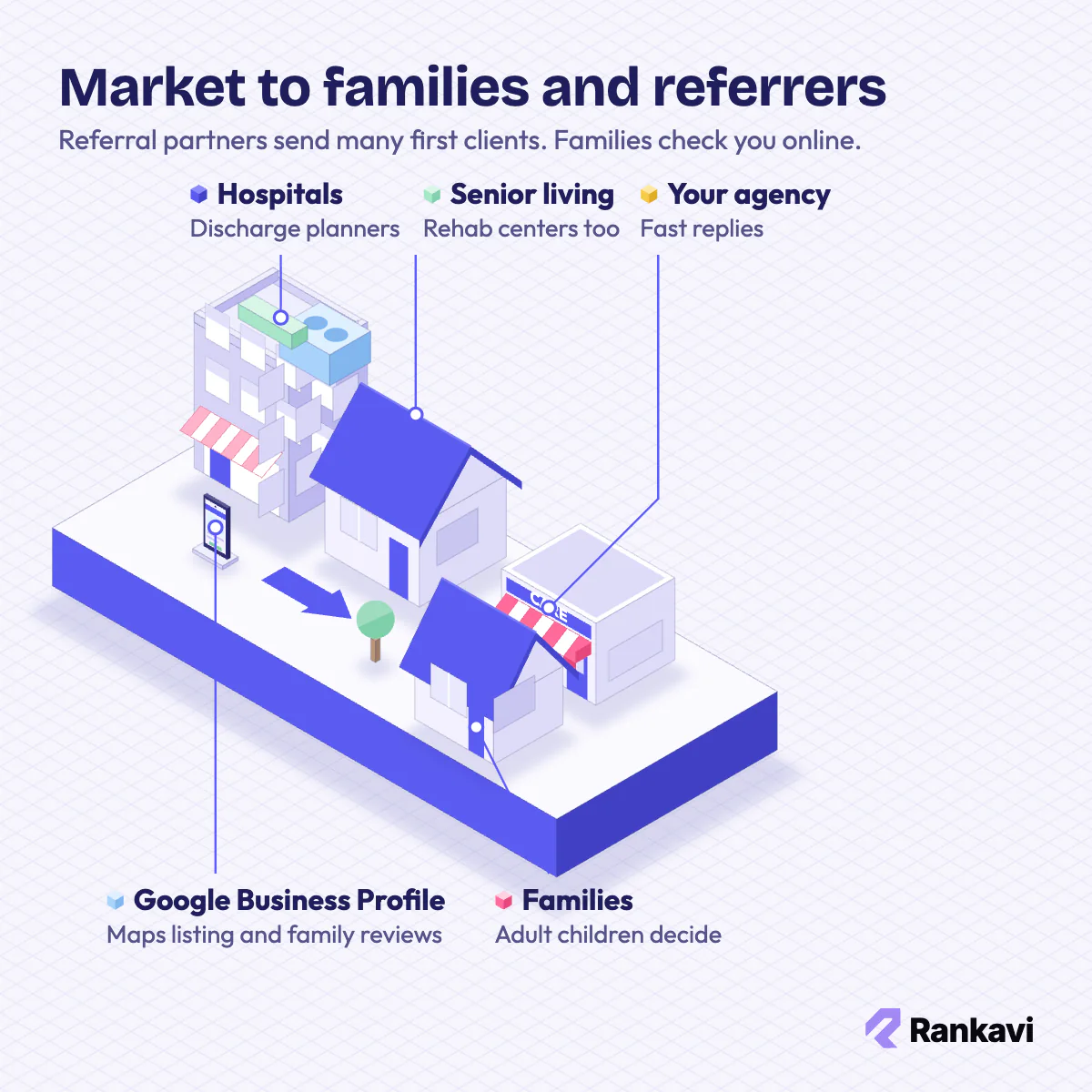
Many first clients come from professionals who refer them. Hospitals, discharge planners, physicians, rehabilitation centers and senior living communities send many of them. Discharge planners are hospital staff who arrange care for patients going home. Regular visits and same-day responses build those relationships.
Referrals come from other places too.
Skilled nursing and rehabilitation facilities refer clients. So do Area Agencies on Aging, which are local offices that connect older adults with services. Elder law attorneys and geriatric care managers, who help families plan care for aging relatives, refer clients too. With so many possible partners, a tracking sheet of referrals shows which ones actually send clients.
Not every family arrives through a professional. Adult children often make the hiring decision, so the agency also needs to reach them directly. Families find and judge an agency through three main channels:
- Website: A clear website shows services, service areas, caregiver screening and a direct phone number.
- Google Business Profile: A Google Business Profile puts the agency on local maps. Reviews from families reassure the next family searching nearby.
- Community talks: Talks at senior centers, places of worship and caregiver support groups reach families offline.
11. Grow Your Services and Payer Mix
Growing a home care agency involves adding payers, services and territory once the core schedule runs smoothly.
Once that base holds, one place to grow is the list of who pays for care. Payers other than families widen the client base. More people can afford care when someone else covers the bill.
The following are three payers other than families:
- Long-term care insurance: These policies pay for some non-medical care. Non-medical care means help with daily tasks rather than medical treatment.
- Veterans’ benefits: These benefits also pay for some non-medical care.
- Medicaid: Medicaid provider enrollment is the process of signing up to bill Medicaid. It opens a larger client base than the other two payers. Each state runs its own home and community-based services program. Each program has separate enrollment rules and rates.
The following are the three services that extend the agency’s reach:
- Dementia programs: These programs serve clients living with memory loss.
- Overnight care: This service covers clients who need help through the night.
- Licensed home health branch: Home health means medical care given at home. Agencies add this licensed branch later.
Territory is the third kind of growth. Agencies can expand into neighboring counties or open branch offices. Both moves often require license updates.
An owner does not have to build each of these pieces alone. Some owners instead join a home care franchise for its training, brand and support.
12. Get Named When Families Ask AI
AI visibility means an agency’s name comes up when a worried daughter asks ChatGPT for a trustworthy local agency. Those answers draw on senior care directories, review platforms and local “best home care” lists.
Brand-new agencies seldom appear on those pages, so ChatGPT has little to cite. Earned mentions on established local and senior care sites change that. Rankavi is a software as a service (SaaS) platform that publishes brand mentions in articles on indexed third-party websites. It suits owners who want to get recommended by ChatGPT.