

Starting a hair business means turning styling skill into a licensed salon or studio with steady repeat clients. The U.S. Bureau of Labor Statistics (BLS), which publishes federal job data, counted 670,800 barbers, hairstylists and cosmetologists in 2025.
I am Michal Sieroslawski, and I help hair salons get noticed by clients online. Tools like ChatGPT and Google’s AI Overviews now suggest hair salons by name. Showing up there helps a new hair salon reach people it would otherwise miss.
This order settles the menu and prices before any money goes into chairs or a lease. The space then comes before licences, because the state inspects a real address. To start a hair business, follow the eleven steps below.
- Choose Salon Services or a Hair Extension Line
- Research Local Clients and Competing Salons
- Price Cuts, Color and Extension Installs
- Fund the Chairs, Lease and Opening Stock
- Form an LLC for the Hair Business
- Lease a Suite, Booth or Storefront
- Get Cosmetology and Salon Licenses
- Insure Chemical Services and Client Hair
- Stock Styling Stations and Backbar Products
- Book First Clients With Instagram and Google
- Win Salon Mentions in Google AI Overviews
1. Choose Salon Services or a Hair Extension Line
A hair business means either a salon that serves clients or a brand that sells hair products. The first model sells time and skill. The second sells inventory.
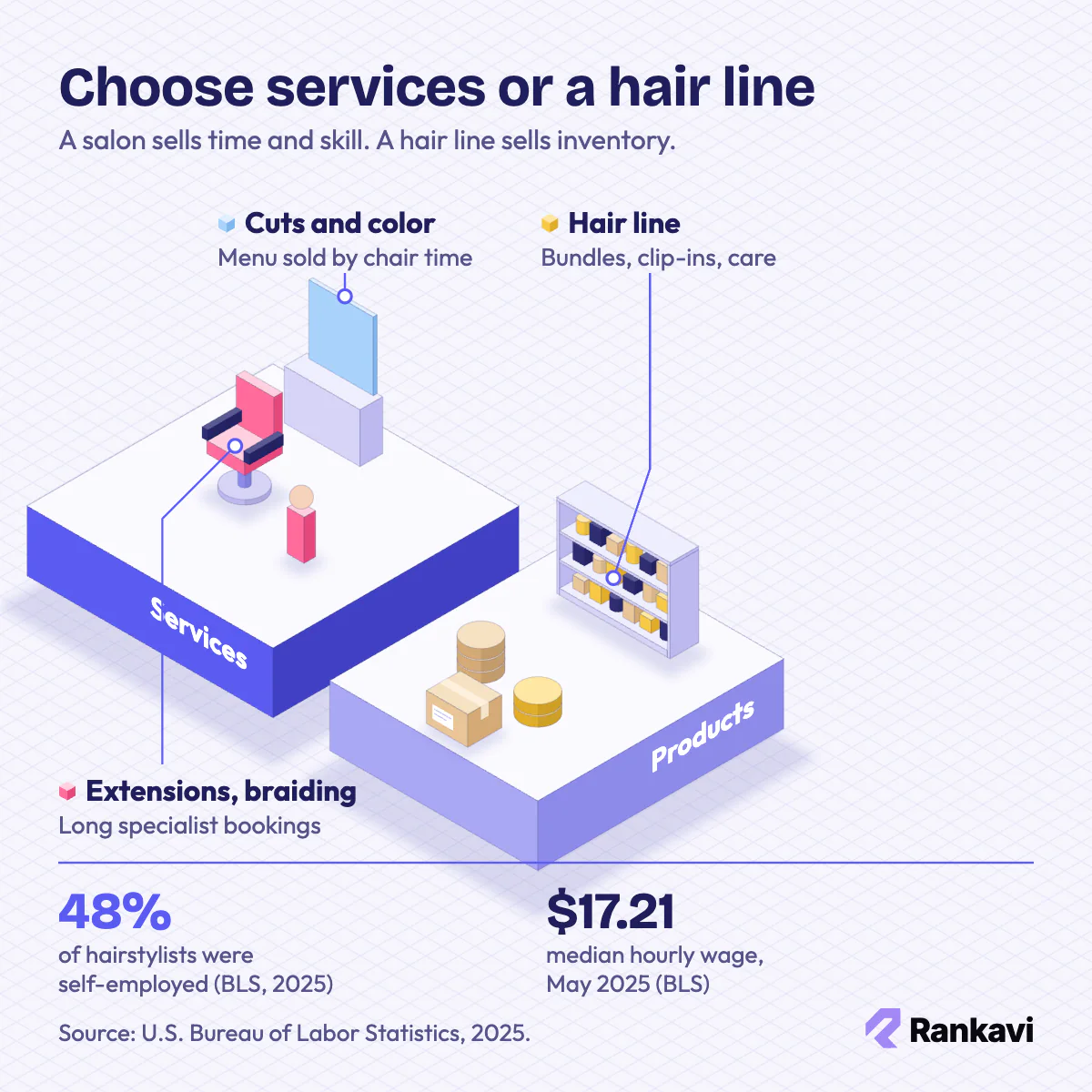
A service salon builds its menu around cuts, color and styling. Chemical treatments such as keratin smoothing add higher tickets. Extensions and braiding attract clients who book long, specialist appointments.
An extension studio blends both models. The stylist installs the hair, and the studio also stocks bundles and clip-ins for sale. Expensive inventory then sits on the shelf before any client pays.
A service salon takes several formats. A stylist can rent a suite or booth, or work on commission inside another salon. Others travel as mobile stylists or work from a licensed home studio. Each format changes overhead and how much of the price the stylist keeps.
Licensing also separates the two models. Cutting, coloring and chemical services need a state cosmetology license. Selling packaged hair products generally does not, though business registration and sales tax still apply. Step 7 covers licensing.
A hair line chooses a product and a source. Private label means a supplier makes the hair and the brand sells it under its own name. Dropshipping means the supplier ships each order, so the brand holds no stock. Each route trades margin against cash tied up in inventory.
Many stylists already work for themselves. The BLS reported in 2025 that 48% of hairstylists, hairdressers and cosmetologists were self-employed. Their median hourly wage was $17.21 in May 2025.
A narrow specialty helps a new salon stand out. Curly hair, blonding, bridal styling and natural hair care each draw a defined group of loyal clients.
Starting with one model is safer than starting with both. Many stylists begin with services to build cash and a client base, then add a branded line for those clients. The main risk differs: services risk an empty chair, while a line risks unsold stock.
Services suit a stylist who holds or plans to earn a license and enjoys client work. A line suits a founder who is stronger at marketing and sourcing than at styling.
2. Research Local Clients and Competing Salons
Market research for a salon involves mapping who books hair services nearby and what competing salons already offer. The findings shape the menu, prices and location.
Demand looks steady. The BLS projects 7% job growth for barbers, hairstylists and cosmetologists from 2025 to 2035, with 80,300 openings a year.
The trade area is the set of neighborhoods within an easy drive or walk of the salon. The U.S. Census Bureau publishes age, income and household counts by Zone Improvement Plan (ZIP) code. Its American Community Survey is free on data.census.gov.
The target client profile covers age, income, neighborhood and hair type. A salon for busy professionals needs evening hours, while a bridal studio needs weekend slots.
Competitors fall into four types:
- Value chains: Great Clips and Supercuts sell fast, low-cost cuts.
- Blow-dry bars: Drybar is a chain built around blowouts.
- Suite salons: Sola Salon Studios and Phenix Salon Suites rent private suites to independent stylists.
- Independents: solo stylists, barbershops and extension specialists.
Suite stylists often compete for the same clients without a storefront, so they belong on the list.
A simple grid records each competitor’s services, prices, review themes and booking platform. Vagaro is a salon booking platform whose public booking pages show open appointments. Competitor calendars can be checked without contacting the salon.
Repeated review complaints about wait times, color damage or parking point to openings. Gaps show up quickly, such as no curly specialist in town or no late appointments.
Google Trends shows how often locals search for terms such as “balayage near me.” A short survey or a poll in a neighborhood Facebook group shows whether people would book. A local Small Business Development Center (SBDC) offers free or low-cost advising for this stage.
A short business plan then records goals, the main services, the budget and opening milestones. Lenders and landlords often ask to see that plan.
3. Price Cuts, Color and Extension Installs
Salon pricing sets a fee for each service from its chair time, product cost and the local going rate. Long or damaged hair takes more time and product, so it costs more.
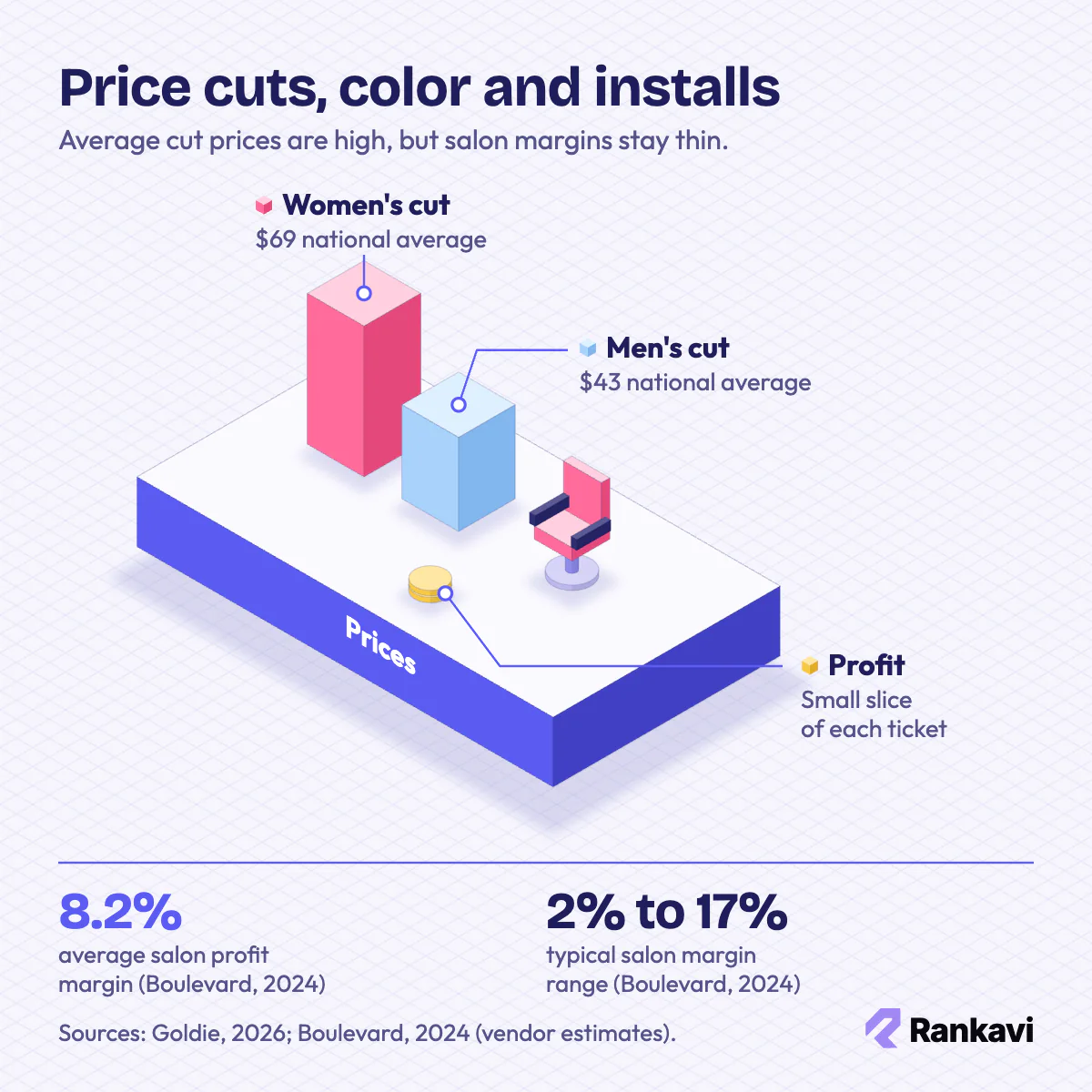
Goldie, which runs a scheduling app for beauty professionals, put the national average women’s haircut at $69 and the men’s cut at $43 in March 2026. Those vendor averages hide wide gaps between states.
Many stylists price from a target hourly rate. They add rent, supplies, insurance and owner pay, then divide by bookable hours. Each service price follows from its length. Competitor prices from Step 2 show whether the result fits the local going rate.
Prices can rise as the book fills. A new stylist can start below senior stylists nearby, then move up as repeat clients and referrals build. Extension installs price by method and amount of hair. The hair itself is often billed apart from labor.
Margins stay thin, so prices must cover every cost. Boulevard, which offers salon software, put the average salon profit margin at 8.2% in August 2024, within a 2% to 17% range.
Deposits protect long appointments. Color corrections and extension installs tie up a chair for hours, so a no-show costs real money.
Startup money at a glance:
| Item | Figure |
|---|---|
| Startup cost | $5,000 to $25,000 for a salon suite or booth; $50,000 to $100,000 for a small storefront with two to five chairs |
| Main costs | Build-out, chairs and shampoo bowls, opening color stock, working capital, liability insurance |
| Typical margin | 8.2% average salon profit margin (net or gross not stated), range 2% to 17% |
| Time to open | 6 to 12 months from planning to opening day for a salon |
Sources: Vagaro, which offers salon software, vendor estimates, March 2026. Boulevard, which offers salon software, vendor estimate, August 2024.
Worked example: In this illustrative case, a stylist spends $15,000 to open a salon suite. She books 25 women’s cuts a week at $69, which brings in $1,725 a week. Over a year of 50 working weeks, sales reach $86,250. At an 8.2% margin after rent, supplies and her own pay, profit is about $7,073 a year. The $15,000 setup then takes a little over two years to earn back.
4. Fund the Chairs, Lease and Opening Stock
Funding a hair salon covers the lease deposit, build-out, stations, opening inventory and several months of working capital. Booth renters need far less than storefront owners.
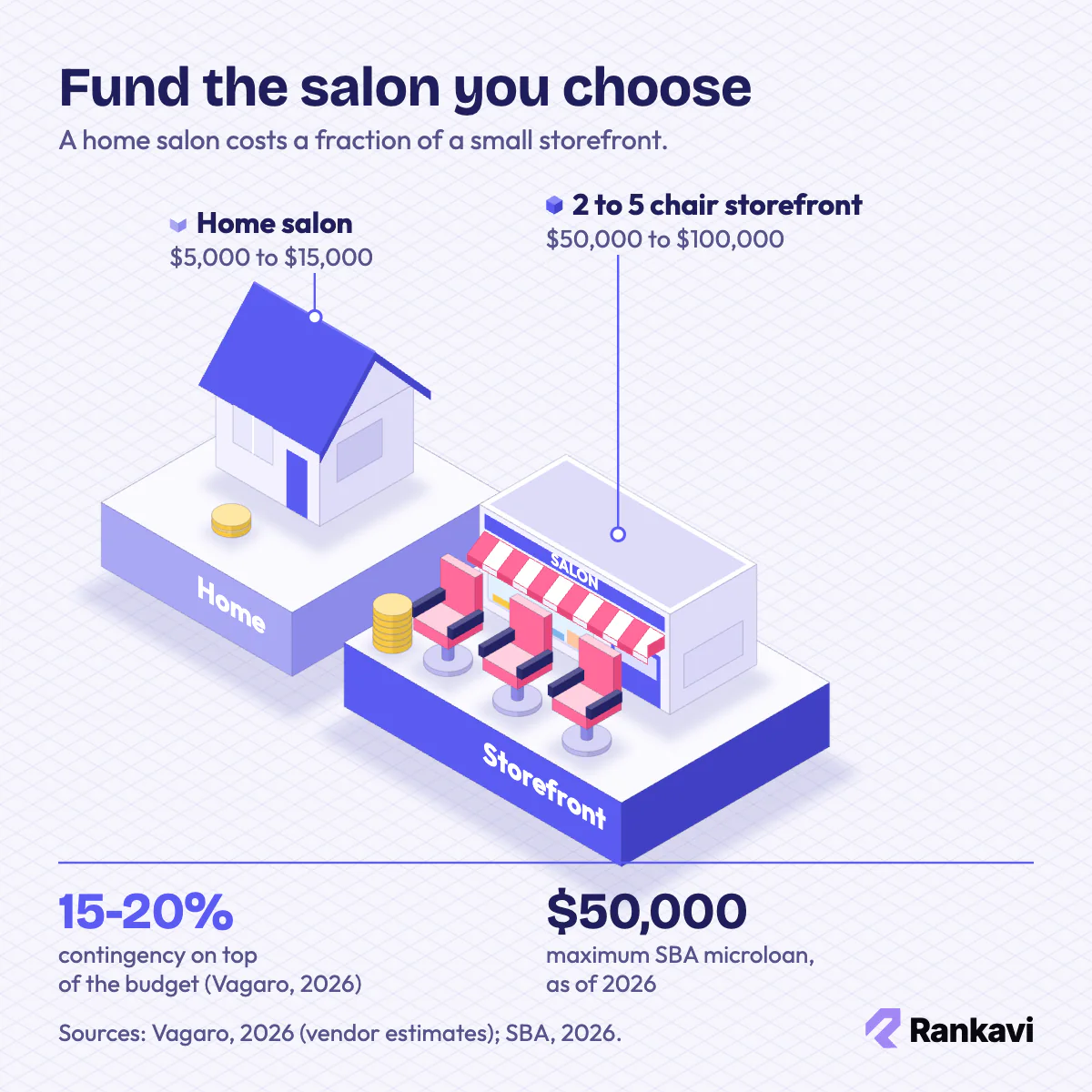
Vagaro, a salon booking software company, estimated in March 2026 that a home salon costs $5,000 to $15,000 to open. Its 2026 estimate for a small two-to-five chair storefront is $50,000 to $100,000.
Startup spending falls into six groups:
- Space: rent, deposits and the first months of the lease.
- Build-out: plumbing, electrical work, flooring and lighting.
- Equipment: chairs, stations and shampoo bowls.
- Inventory: color, backbar and retail stock.
- Paperwork: licences and insurance.
- Marketing: logo, website and signage.
Build-out swings the budget most. Vagaro’s March 2026 guide put mid-range salon build-out at $15,000 to $75,000 and three to six months of working capital at $15,000 to $45,000.
Funding routes differ by setup. A booth renter can often open from savings. A storefront usually needs a loan, an investor or both, which adds monthly repayments to the fixed costs.
Overruns are common in salons that add new plumbing. Vagaro advised in 2026 adding a 15-20% contingency fund on top of the total budget.
The U.S. Small Business Administration (SBA), which backs small business loans, offered microloans up to $50,000 as of 2026. Its average microloan was about $13,000 in 2026.
5. Form an LLC for the Hair Business
Forming a limited liability company (LLC) gives the salon a legal identity that signs the lease and holds its accounts. Many solo stylists start as sole proprietors.
An LLC keeps personal savings apart from business claims. A client claim over scalp damage then targets the company, not the stylist’s home.
The business name gets checked in the Secretary of State database first. The Internal Revenue Service (IRS), which runs federal taxes, gives the salon a free employer identification number (EIN) online.
Wholesale hair suppliers often require a registered business before opening an account. A separate bank account keeps product purchases and service income clean for tax time.
6. Lease a Suite, Booth or Storefront
Choosing the workspace decides rent, privacy and how much build-out the salon needs. Stylists usually work from four setups:
- Home salon: a separate room, where zoning and state rules allow it.
- Booth rental: one chair inside an existing salon, paid weekly.
- Salon suite: a private, lockable room in a suite building.
- Storefront: a full salon with several chairs and a reception area.
Each setup trades control against commitment. Booth rental carries the lowest cost but shares the host salon’s space and rules. A suite adds privacy and set hours at a higher rent. A storefront gives the most control but adds the longest lease and the largest build-out. The local research from Step 2 shows which setup fits the clients nearby.
A home salon keeps costs lowest, but chemical fumes need fresh air. Families and pets share that air, so ventilation matters.
A storefront needs plumbing for shampoo bowls, strong electrical circuits for dryers and good ventilation. Retail landlords often prefer a registered company as the tenant.
A lease deserves a careful read before signing. Key points are its length, who pays for build-out and what happens if the salon closes early.
7. Get Cosmetology and Salon Licenses
Licensing a hair salon means meeting state board rules for the stylist and for the shop itself. Requirements vary between states.
Stylists complete a state-approved cosmetology program and pass written and practical exams. The National-Interstate Council of State Boards of Cosmetology writes and runs the standardized exams many state boards use.
Texas shows the scale of training. The Texas Department of Licensing and Regulation (TDLR), which licenses Texas cosmetologists, requires a 1,000-hour Cosmetology Operator course as of 2026. Its application fee was $50 in 2026.
The location usually needs its own salon or establishment license. Inspectors check sanitation for tools, stations and client seating.
Some states license barbering separately from cosmetology, and some license hair braiding on its own. A stylist who plans to offer these services checks the state board first.
Local paperwork completes the set: a general business license, zoning approval and a certificate of occupancy for a storefront. A seller’s permit covers retail sales tax.
8. Insure Chemical Services and Client Hair
Insuring a hair salon protects the owner from claims over chemical burns, hair loss and client falls. Color, bleach and heat tools carry real risk.
General liability covers a client who slips on wet hair. Professional liability covers claims that a service caused harm, such as breakage after bleaching.
Insurance Canopy, an insurance vendor for beauty professionals, listed hairstylist policies from $10 a month or $96 a year in 2026. Its 2026 limit was $2,000,000 per occurrence.
Smoothing treatments add a fume hazard. The Occupational Safety and Health Administration (OSHA), which enforces workplace safety rules, warns that some hair smoothing products release formaldehyde. Salons using them need ventilation and safety data sheets.
Setup changes who needs which policy. A booth renter often carries a personal policy, because the host salon’s policy may not cover independent renters. A storefront owner also covers staff and the building contents.
Suite buildings and host salons usually ask for proof of insurance before move-in. Property coverage protects stations, dryers and stock.
9. Stock Styling Stations and Backbar Products
Stocking a salon turns the service menu into working stations. Each station needs a chair, mirror, storage and power.
Core salon equipment:
| Item | Purpose |
|---|---|
| Styling chair and station | Cutting and styling space |
| Shampoo bowl and chair | Washing and rinsing |
| Dryers and hot tools | Blowouts and setting |
| Backbar products | Color, developer and treatments |
| Consumables | Brushes, bowls, clips, towels and capes |
Vagaro estimated in March 2026 that chairs, stations and bowls for a mid-range salon cost $10,000 to $40,000. Used equipment cuts that bill.
Backbar products are used on clients during a service, such as color and developer. Retail products are sold to clients for home use. Retail stock is optional and ties up cash.
Professional-only distributors often ask for a license number before selling color and treatments. Hair suppliers need careful checks. Samples, steady quality and clear terms matter more than the lowest price.
Booking software handles appointments, reminders, deposits and client color notes. Online booking also takes appointments after hours.
10. Book First Clients With Instagram and Google
Marketing a new salon builds a client list by showing finished work where local clients already look. Photos sell hair services better than words.
Instagram and TikTok serve as the portfolio. Before-and-after posts with the location tagged show style and skill.
Google Business Profile is Google’s free business listing that puts a salon on Maps. Early reviews build trust fast. A booking link in the Instagram bio and on the Google listing lets interested clients book at once.
Online booking also helps clients come back. Boulevard reported in August 2024 that 78% of clients who booked a first visit online returned, against 39% of walk-ins.
Local partnerships bring steady referrals. Wedding planners, gyms and photographers send clients, and a small referral gift rewards loyal regulars. A stylist leaving another salon checks any client or non-compete agreement before inviting past clients.
11. Win Salon Mentions in Google AI Overviews
AI visibility for a salon places it in the answers clients get when asking chat tools for a stylist. Google AI Overviews, ChatGPT and Gemini now answer many salon searches.
Those answers draw on review sites, city guides and “best salon” lists. A new salon gains when those pages name it early.
Rankavi is a software as a service (SaaS) platform that publishes brand mentions in articles on indexed third-party websites. Salons that want to get brand mentions in AI Overviews can start there.